Friendship is unnecessary, like philosophy, like art… It has no survival value; rather it is one of those things that give value to survival.

C.S. Lewis (via katelyns-otherleft) (via scumblr)

For both PC and mobile video, over 70 percent of respondents prefer advertising-supported models as opposed to consumer-paid models…

But whatever else you do, don’t get too much in the way of their content… respondents from all six countries polled protested traditional television models such as interruption advertisements during the video or the use of product placements within programs.

Close to 60 percent of total respondents were willing to provide information about themselves – such as age, gender, lifestyle, or communications preferences – in exchange for something of value.

Todd Watson: IBM’s ‘Beyond Advertising’ Study: Going Digital (via somethingchanged)

// ah, spreadsheets and coffee. what could make the morning more exciting?

What the audience hears:

“Blah, blah, blah… interesting tidbit… blah, blah, blah… exciting insight… blah, blah, blah, etc.”

Seth Godin

Link

But I love being lied to by an impersonal internet babe

From Seth Godin:

This isn’t a honest note from a real person. It’s the carefully crafted non-statement of a committee. What an opportunity to get personal and connected and build bridges…

Link

Oh, the wonderful things you can learn/ignore from the internet.

(Yes, it’s Monday, I’m behind schedule, and I still can’t decide: red pill or blue pill.)

// what’s more important: the life you lead or the legacy you leave?

// ‘painting is just another way of keeping a diary.’

// translating poems i composed in my moleskine journal to my laptop

// found some old sketch books in the barn. makes me want to draw this afternoon.

When Reading Submissions . . .

Surrealist, and therefore comic, but with a specific gravity in his imagining that manages to avoid the surrealist penalty of weightlessness.

Seamus Heaney, Lannan Podcasts

Susan Sontag

“To the academic reader, these are provocative, even flashy performances. To the common reader, they’re like shots of intellectual espresso.” read more »

Magazine of the Year reorganizes company

From Ad Age:

“Some of the layoffs are a result of the integration process,” the spokesman [for the Economist] said….

The majority came not from the magazine but from The Economist Intelligence Unit, the group’s business-to-business publishing arm, he said.

The Economist Group has roughly 225 employees remaining.

The magazine has seen ad page sales slow, however…. The Economist’s North American edition increased ad pages by 3.4% through the Nov. 1 issue….

Its paid circulation averaged 747,254 over the first half of this year, 7.6% higher than the first half a year earlier, according to reports with the Audit Bureau of Circulations.

Link

Do three things well, and one thing better than anyone else.”

What Are You Really Good At?

// the inbox still has 80-something unanswered emails. if you emailed me in the last week, please be patient. i will reply.

// web ad done. working on weekly planner book and a full page ad.

// heard this on NYT Book Review podcast… of the 15,000 fiction and poetry published this year only 320 are translation

The old network media complex is dead

From Ad Age:

The winners were the ones that fed the public’s desire for news where and when they wanted it: 24-hour cable TV news; participatory blogs that aggregate news of a political bent; websites that allow users to access media on their own terms (YouTube) and those that allow users to communicate and organize with each other (Facebook).

Link

I’m not sure whether to rejoice or weep.

Nietzsche wrote that “the mediocre are combining to make themselves masters…” and the unintended consequences of this power shift is “tyranny of the least and dumbest.”

For context, Renate Wood writes (regarding Nietzsche’s idea) that the intellectual community’s “contempt for the newly literate masses and the shallowness and vulgarity of the literature…” is well documented.

T.S. Eliot referred to the readers of the growing mass media culture as “complacent, prejudiced and unthinking.”

In light of the recent American election cycle I perplexed.

Google make you stupider

From the LA Times:

the Atlantic featured another essay, by Nicholas Carr, called “Is Google Making Us Stupid?” The answer was an emphatic, if not altogether wistful, “Yes.”

I didn’t read the article, but I googled it. Here’s the link (now I really feel stupider). Further:

In theory, a tool like Google should free us to be more creative. In reality, there are pitfalls…. the open-endedness of an Internet where “you can imagine knowledge and then find it.” But there is a downside, which, according to Frel, is rather dire: “Pretty good has become the new perfection.”

When Alexander Solzhenitsyn memorized passages of “One Day in the Life of Ivan Denisovich,” he had no choice but to enact the modernist version of oral traditions. This was not an expression of collective culture so much as an extreme example of what T.S. Eliot called “the individual talent.”

Today’s blogs are a mutation of Solzhenitsyn’s modernist mythmaking — where the merely personal becomes a matter of permanent record. Increasingly, mainstream writers cite blogs. Political journalists use them as sources. According to CommonSenseMedia.org, 74% of journalists recently surveyed regularly read blogs, and 84% “say they would or already have used blogs as a primary or secondary source for articles.”

Link

(No, I didn’t read the rest of the LA Times article. Blame it on adult ADHD or the fact that I have six windows open in my browser and I’m getting really hungry and the caffeine from this morning’s latte finally wore off…)
it may be that blogs will become the new (acceptable) “personal” genre for Poets who Think

Joseph Harrington

Oxford compiles list of top ten irritating phrases

fluffynotes:

1 – At the end of the day

2 – Fairly unique

3 – I personally

4 – At this moment in time

5 – With all due respect

6 – Absolutely

7 – It’s a nightmare

8 – Shouldn’t of

9 – 24/7

10 – It’s not rocket science

Telegraph

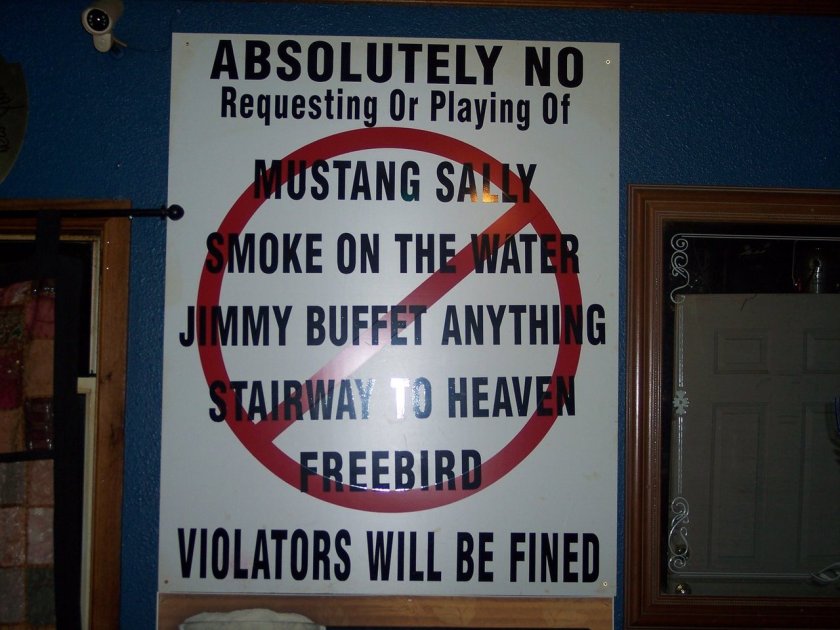
This sign should be posted at every open-mic in Amerika.

(via stereofidelics) link

I was engaging in a dubious art form that has no audience.

I read a poem at a coffeehouse last night and watched the audience’s eyes glaze. So, when I read this I smiled. » read essay @ globel life

In essence, [blogging/blog platforms are] a straightforward content-management system that posts updates in reverse-chronological order and allows comments and other social interactions.

Viewed as such, blogging may “die” in much the same way that personal-digital assistants (PDAs) have died. A decade ago, PDAs were the preserve of digerati who liked using electronic address books and calendars. Now they are gone, but they are also ubiquitous, as features of almost every mobile phone.

Blogging grows up: The Economist (via somethingchanged)