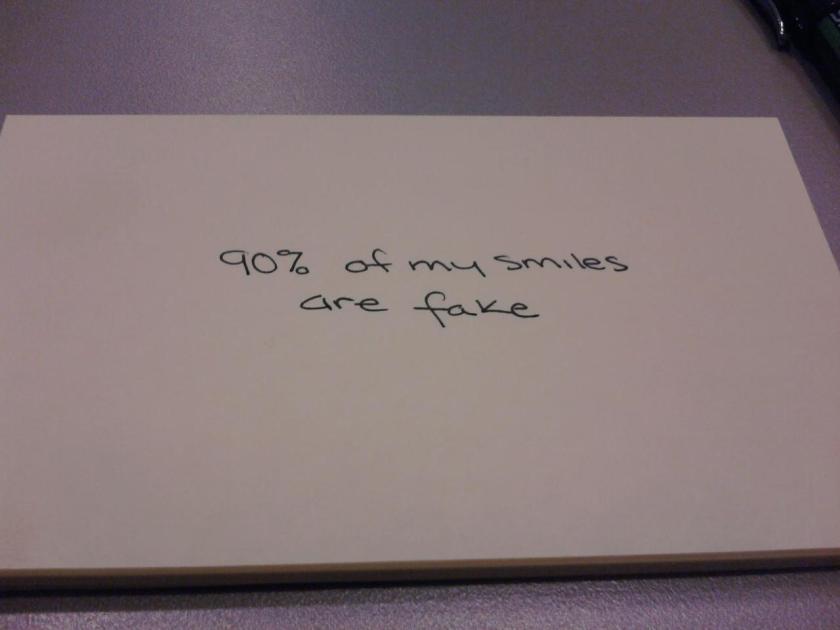
malty: My post-it note confession
malty: My post-it note confession
fluffynotes: Magazines are emotional products. They are objects of aspiration, passion, and desire. No one needs to read magazines, but millions of readers still subscribe to their favorite titles because they harbor deep connections to the glossy pages. As one veteran editor once explained to me, the best magazines make you feel like tearing open the plastic wrap the second that they arrive in your mailbox and curling up on the couch with them, ignoring whatever plans you had for the evening. Which is why the current downturn can be good for publishers. Magazines still offer an unsurpassed ability to marry literary ambitions with deep reporting, photography, and visual design. In this new media age, people talk about the importance of transforming readers into “communities.” Magazines have never had a community problem. Great magazines have built enduring relationships with their readers that Facebook and Tumblr still aspire to. But in a race to grow their businesses, publishers put advertising first and editorial excellence second. http://www.thebigmoney.com/articles/impressions/2009/03/17/magazine-isnt-dying?page=0,0
American physicist Alex Wissner Gross has recently done research in the filed of web searching. He has estimated that each google search lets out 7 gram of CO2. A kettle of boiling water required for a cup of tea leaves 15 gram. That means two google searches are equal to a cup of tea. Now that doesn’t sound to bad, but thinking about the amount of google searches done every single day brings the total to a different level.
Now the funniest part of the research is that google lets out more CO2 than other search engines. At first I thought that had to be complete nonsense, but since google is a very fast search engine and uses several servers to provide us with top notch results, it may be some truth to it.
Google itself claims that they let out a lot less than Gross stated, saying each search only result in only 0,2 gram.
Wonder what the footprint of this post will be…
Often, I’ve wondered about the carbon footprint made by maintaining an online magazine versus a print magazine. A print magazine can always be recycled (inks, papers, etc.). But an online magazine requires energy to keep an online magazine available 24-hours a day.
Is there any research to answer this question?
From Ad Age:
“Some of the layoffs are a result of the integration process,” the spokesman [for the Economist] said….
The majority came not from the magazine but from The Economist Intelligence Unit, the group’s business-to-business publishing arm, he said.
The Economist Group has roughly 225 employees remaining.
The magazine has seen ad page sales slow, however…. The Economist’s North American edition increased ad pages by 3.4% through the Nov. 1 issue….
Its paid circulation averaged 747,254 over the first half of this year, 7.6% higher than the first half a year earlier, according to reports with the Audit Bureau of Circulations.
From Ad Age:
The winners were the ones that fed the public’s desire for news where and when they wanted it: 24-hour cable TV news; participatory blogs that aggregate news of a political bent; websites that allow users to access media on their own terms (YouTube) and those that allow users to communicate and organize with each other (Facebook).
I’m not sure whether to rejoice or weep.
Nietzsche wrote that “the mediocre are combining to make themselves masters…” and the unintended consequences of this power shift is “tyranny of the least and dumbest.”
For context, Renate Wood writes (regarding Nietzsche’s idea) that the intellectual community’s “contempt for the newly literate masses and the shallowness and vulgarity of the literature…” is well documented.
T.S. Eliot referred to the readers of the growing mass media culture as “complacent, prejudiced and unthinking.”
In light of the recent American election cycle I perplexed.
With the market plunging, here’s two encouraging items to consider as a poet:
1) “The state’s jobless rate began the year at 4.9 percent and has steadily increased since then. It stood at 6.6 percent in July.” Link The unemployment rate in N.C. is presently 7 percent.
DO NOT try to make a living writing poetry. Keep your day job (and your night job, too).
2) In the Asheville area, almost $400,000 was donated to political campaigns.
NONE of that money was spent on your livelihood as a poet, buying your poetry books, or purchasing coffee and other goodies at your public poetry readings.
From How magazine’s blog (link):
“If you’re a designer, one of the things you can do right now is taking steps to improve (and prove) your value to your clients and employer…”
Obviously written by someone who is trying to keep their job at How magazine.
Poetry reading at Malaprop’s Bookstore this Sunday, Oct. 19, 3 PM. The advance poetry class that I am attending will present their work with a public, free reading.
This marks my return to Malaprop’s. It has been over two years since I read my work in that place (http://1000blacklines.blogspot.com/2006/06/blind-date-with-poetry.html). A lot has happened in three years. I trust that will show when I read my new work.
From Ad Age (link): “The New Yorker… ad pages sank 22.3%; Blender… drop[s] 24.6%… SmartMoney, which fell 25.7%; Country Weekly, itself 26.8% lower… Coastal Living, down 27.9%; and U.S. News & World Report, down 28.2%. “Gainers included Men’s Journal, up 10.8%; In Touch, up 12.7%; House Beautiful, up 13.2%, Fast Company, up 31.1%; and OK, up 34.4%.”
According to Rafe Needleman in an Ad Age (http://adage.com/digitalnext/article?article_id=131655) article.
For me (who became a Twitter user less than a month ago), Needleman may be correct. Regarding Twitter, it is merely an info aggragater; at least that’s the way I use it. Inversely, I rarely visit Twitter except to follow the news of a few people (which is pointless because most of the people I follow supply the same info using other services like Facebook).
Edgy Mama recently mused about it on Twitter (http://twitter.com/edgymama/statuses/959014214): “Wondering why folks want to follow me here when I hardly ever Twitter?” There are other, more efficient services to keep up to date with people in your social networks, but Twitter isn’t one of them.
From NPR (http://www.npr.org/templates/story/story.php?storyId=95256794): “Switching from task to task, you think you’re actually paying attention to everything around you at the same time. But you’re actually not,” [neuroscientist Earl] Miller said.
Another classmate came up to me and asked if I had studied poetry. That make a total of three classmates who have asked how it is I know so much about poetry and poetic techniques. The answer is simple: No, I didn’t go to school and study poetry. I just read books.
I made a personal goal of trying to write a poem per day for the month September; or at least a sketch a day. Reality is a harsh master. A presentation project I am working on has kept my brain occupied with details regarding photo selection and event branding. I’ve only been able to compose a poem every other day. Normally, this would bring on a fit of frustration and depression, but not this time. Even a small sketch, the second one I composed, reminds me that patience and perseverance is essential and pursuing master of this craft. Here’s the second poem I wrote this month:
Half a pint down
eight minutes to go
half a porter to go
eight minutes ’til I leave
It’s a spare sketch; something in the vein of a hybrid haiku or tanka.
This excercise is to prepare me for an advance poetry class that I am taking. It begins this week.
Google has begun scanning microfilm from some newspapers’ historic archives to make them searchable online, first through Google News and eventually on the papers’ own Web sites…
From Print is Dead:
Google will then serve up scans of newspapers either via Google, or on the site of the originating newspapers, which provides income for Google (in the first example) and/or traffic and visitors (and potentially income from advertising) for the original newspapers (in the second example).
From Poetry Hut Blog:
One of the editors of Cider Press — Robert Wynne — has responded to (what appears to be) unethical behavior regarding their Cider Press Review Book Award. And Stacey Lynn Brown’s rebuttal. (I’ve read that Pavement Saw Press’ contest has been problematic. And did you know that there was no winner chosen this year for the Cave Canem Poetry Prize?)
From 43 Folders:
Jilly Dybka released her self-pub book recently and has this to share about the books early impact (link):
Book release announced May 16, 2008
Stats provided May 25, 2008
400 daily readers of Poetry Hut
83 downloads of Trouble and Honey
5 individuals donated via PayPal
13 copies ordered via Lulu.com
Jilly provides her own interpretation of these numbers, but the numbers seem a bit off.
To make an accurate assesment of the data she would need to track daily page views, daily individual items sold (and/or downloaded), and daily revenue. Or at least track it weekly. From the collection of data she could discover and project sales trends, adjust marketing and promotional compaigns, and (in general) provide herself a statiscal analysis of the publishing effort of Trouble and Honey.
IMHO, I think it is too early to determine anything regarding this chapbook release.
Micheal Smith (head of the International Digital Publishing Forum) says”
E-books are a growing niche for now… but I certainly don’t see a time when everybody will be reading them. People just love what the traditional book represents to them. Link
Yet…
Public sightings of e-books remain rare compared to iPods or iPhones… Link
And…
Publishing house Penguin said today that it…. is… working on turning its 5,000 title Penguin backlist into ebooks for publication this year and next. Link
Yet…
The publisher is digitising its entire worldwide backlist so that it can make the most of the emerging ebook trend. It also hopes the print-on-demand opportunities – whereby customers can have one-off copies of out-of-print titles printed, bound and shipped to them – will give older books a new lease of life. Link
Does that last part make sense to you? Penguin plans to publish ebooks and POD out-of-print titles? Why? Why, I ask, if the ebook is available would you want a POD of that title?
Here’s an idea; why not offer limited edition printings of out-of-print titles to collectors and bibliophiles. Due to limited supply, Penguin could charge more for these special lifestyle objects. Ebooks are geared for a completely different audience—an audience who just wants the content and not the packaging. Don’t waste time on POD. POD books are for university creative writing students and vagrant poets.
More doom and gloom about the declining influence of books and readership.
MSM outlets report these desperate stories, yet the printer who manufactures the books I help publish report that book sales increased from 2007 by 7.4% . Maybe people aren’t reading the books they buy. Juvenile hardcover increased 46% while adult hardcover is up almost 8%. Further, audio books is up almost 20% and e-books are up 23%.
Can Kindle increase the number of people reading?