Every product starts out as inspiration, moves to the drafting board, the production line, and then goes into someone’s hands before ending up, finally, on the scrap heap.
Jeff Gomez, Print is Dead Link
Every product starts out as inspiration, moves to the drafting board, the production line, and then goes into someone’s hands before ending up, finally, on the scrap heap.
Jeff Gomez, Print is Dead Link
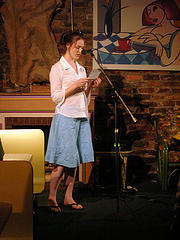
[Originally uploaded by coffeehouse junkie]
Most Thursday nights a few years ago you would find me haunting the Beanstreets open mic. Then Beanstreets closed and there was an open mic vacuum.
The Dripolator used to offer an open mic event every Thursday, but that has changed to the first Thursday of the month. And it’s a different atmosphere from the Beanstreets days.
Courtyard Gallery has an open mic every Thursday. But last night it was canceled due to lack of host and attendees.
I sat on a bench beneath the Vance monument drinking coffee from a paper cup and wondered where to soak up some poetry vibes. Plenty of singer/songwriter open mics. But where’s a poet to go to squander a few verses on a polite crowd?
Seriously, being in the male minority at a Friday lunch with coworkers, it is equally humorous and awkward when female coworkers discuss why men think they need 4-hour sexual performance pills.
I don’t pretend to know how to respond to the question, “Why do men think they need a 4-hour pill? They’re just going to fall asleep afterwards.”
I thought about snoring loudly. But I can’t enjoy a jerked chicken sandwich while snoring.

Holy Shoot! Is this for real? From the Asheville Citizen-Times:
Two new high-rises planned for downtown
“…plans to renovate the Haywood Park Hotel and adjacent properties between Page and Haywood avenues downtown call for adding a 25-story tower…. The new hotel… would stand alongside a more modern residential high-rise of 21 floors overlooking Haywood Avenue…. Fraga plans to add an additional 500 parking spaces underground, as well as convert the existing Haywood Park hotel space to office and retail space.”
and
Fraga unveils plans for 25-floor hotel tower
“Tony Fraga…. said…. ‘I believe that cities have to grow vertically. Instead of developing subdivisions and increasing our dependency on foreign oil, we have to go up in downtown, not up into the mountains. And in this area, we have a tower that was already planned….’”
For out-of-towners, the downtown Asheville area is so congested it is almost insane to consider high rises and the relative human element to fill those residential and commercial outlets. Asheville might as well rename the city—New York South.
For local Ashevegas residents, might as well get ready to change your colloquial expression of “Hi, ya’ll” to “Hey, yous.”
Regarding generational synergy:
“there are opportunities to see where Gen Y is going by… looking at their relationship to… their Boomer parents, and other times in their shared code with Gen X. Codes of caution and status (Boomer) and codes of instigator and notoriety (Gen X). The reality is that generations are shaped by the ways they choose to assimilate or differentiate from the other generations in their world”
(via Brand Noise) Link
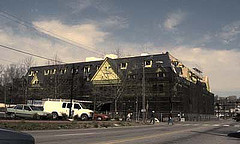
Biltmore Village – The Bohemian Hotel: The new Bohemian Hotel creates a concrete canyon in the Biltmore Village and dwarfs almost everything around it.
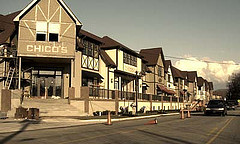
Biltmore Village new construction: Chico’s and Talbot’s extends their reach into the Biltmore Village area—physically imposing their presence in this new commercial development.
Argh, I read these posts and want to scream! Why don’t you just tattoo the letters AMATEUR across your forehead.*
I know what you’re thinking… “But I can finally publish my lousy, self-absorbed poems and people will love me and want to buy my book and maybe sleep with me.”
No, that’s not what poetry is about. And don’t dare visit Lulu! Only idiots use Lulu for their own creative validation.
And then you upload your crappy ass covers that scream CorelDRAW and MS Word and you want publishing cred?!?
If you’re going to DIY and publish poetry in a unique and deserving manner, at least exhibit an intimate love for the physical package of a book… like this or this.
*Forgive me, after seven years of publishing independently I cringe when people make the same mistakes I made during the early years. And, not to brag, but I have been able to sell and ship over 14,000 copies of various titles at my current post. Rule #1: Selling books makes you a publisher. Rule #2: Printing a book makes you a printer (duh, not a publisher). Rule #3: Just because you publish it doesn’t mean people will give a flying flip and actually buy it. Rule # 4: Covers sell books. Rule #5: I don’t care what’s beyond the book cover, the cover sells the book. Rule #6: See Rule #4 and #5, again. Rule #7: Have a business plan including production, distribution and customer service details. Rule #8: If you don’t know the difference between RIO, P&L and ISBN, don’t get involved in publishing just step away from your laptop and go back to Kinkos where you belong and photocopy your precious little chapbook and pass it out to friends and family and vagrants. Rule #10: If you read this far you realize Rule #9 are missing. It contains secret ingredients that I can not post, but may be able to e-mail you.
From a spokesperson for the Geraldine R. Dodge Foundation regarding Poetree.coop being shut down (via Seth Godin):
“We applaud the work of the FBI in shutting down this travesty of copyright. If we want great poetry, America, we’re going to have to pay for it.”
Seth Godin observes:
“Many of the world’s top poets reported dramatic decreases in royalties and sales as a result of the site. ‘When poetry is free, no one is willing to pay for it,’ one poet is quoted by Wired. Even though some poets had reportedly been earning three or four million dollars a year in royalties and advances, it apparently wasn’t enough.”
I’d like to know what poets earn that kind of money in royalty. It sure isn’t anyone I know.
There’s coffee and then there’s coffee. Ditto what David Burn says:
“I have enough compromise in my life, I don’t need it in my coffee.”

Asehville’s Lexington Avenue street threads. (photo by Coffeehouse Junkie)
For the last four or five weeks I’ve been tormented. Should I, or shouldn’t I continue contributing to Write Stuff. See, I’ve been extremely busy in my professional life (of publishing other people’s books) that I felt that my contributions were lacking the quality I wanted to deliver. So I emailed the site’s leader this weekend and politely resigned and promised to deliver one final contribution: Rainless among marram.
This morning I read today’s Write Stuff post about defining genres and left a comment that was DELETED! WTF! I mean, is it necessary to delete the comment?
My comment mentioned that genres are mainly decided by publishing companies to help bookstores sell books. In the same manner, the recording industry uses the same strategy to sell albums by differentiating their target audience by marketing a project as ‘country’ or ‘alt country’ or ‘punk americana country.’ I referenced Peter Rubie’s book Telling the Story: How to Write and Sell Narrative Nonfiction
So, crassly speaking, genres help sell books. Or not so crassly, genres help publishers deliver titles to the correct audiences.
Why would that get DELETED? I don’t get it. Whatever. I go back to work now.
UPDATE: Not only was my post deleted, but someone else’s (username Square1) was also deleted. Thanks to Google Reader (I RSS the Write Stuff comments), I was able to learn this detail. I wonder if there is a glitch in their comments software, because Square1 left a comment on my final Write Stuff post, Rainless among marram that was not deleted.

[Click on image to download image]
A recently completed poster design for A Third World Asheville Gathering.

The Traveling Bonfires prepare for their first appearance in Durham. Read the press release below:
Blotter Blurbs & Words: June 16: FAME: Summer LUAU
FAME is having it’s first “open reading” night! We look forward to this as we celebrate popular local magazine, the BLOTTER. Special guests poets Pasckie Pascua and Matthew Mulder from Asheville and his friends female songwriters Sally Spring (www.sallyspring.com) and Ophir Drive (http://myspace.com/ophirdrive). We look forward to hearing what they have to say!
Join us at RINGSIDE: 308 West Main Street, Durham.
Doors open at 10pm: 18+

Three months ago I pushed words and metaphors into the ground and despite the drought the ground broke with lovely green things and white flowers.
I think I should name them poems, but my children call them basil and tomato and peas and peppers.
A call from an acquaintance in NYC prompted me to ask the question: Is Asheville the wrong place to try to make it as a poet? The Check out the D.C. scene and the Baltimore scene.
A couple, who appear to be on intimate terms, converse at the bus stop.
The man (wearing a Cradle of Filth t-shirt) tells the woman: “Suicide Girls is art–not pornography.”
The woman (smokes her second cigarette in ten minutes): “No. The guy who takes photos of a thousand nude people in Mexico is an artist. Suicide Girls is pornography.”
The man: “Some pornography is art. Suicide Girls is art because they perform to music.”
Bus arrives.
Rest my head in
hand near the table
where a small black
radio plays an
instrumental I
have never heard but
know it… know its
emotional
audio content.
Notes plucked
from guitar strings
weave and release
a story that
resonates deep
within my soul
and makes me want
to cry and hope.
The announcer
says his name is
Ottmar Liebert
but does not share
the name… the name
of the song that
makes me want to cry.
The latest volume of The American Poetry Review arrived in my mailbox Friday afternoon. So I tucked under my arm and drove off into the rain to the Fellowship Hall feeling very smart and silly at the same time. I don’t consider myself academic. So the act of trying to look smart in a room full of academics is a foolish charade on my part. Nevertheless, I did read the first few selections while waiting for the reading to begin. I’m still not sure what I think of Mary Kinzie’s poem.
Anyway, Jennifer Grotz, a poet, began the evening by reading two translations by a French poet. She reads slowly, deliberately pronouncing each word as if reading role call for a high school home room or like the Economics Teacher in the movie Ferris Bueller: “Bueller?… Bueller?… Bueller?” She bridged each poem with a bubbly, conversational introduction which the audience seemed to appreciate. Maybe her poems are better read on paper. Her work just didn’t resonate with me at all.
Danzy Senna, a novelist, read from her novel Autobody and read with drama; shifting narrator voice to character voices. She has a subtle lisp when pronouncing “innocence” and “success” and “stare.” Her narrative is captivating and populated with warm approachable characters and full of tense lines like: “the conversation went from ironic to earnest.” I really enjoyed her reading.
Brooks Haxton, poet, began with a humoristic, absurd, controversial (you had to be there to enjoy it) poem about the planning of a large mall in Syracuse. That poem pleased the audience greatly and they responded to all the right lines with loud laughter. Haxton presents his work as recitations, more or less, with the expert use of eye contact; makes one feel like each poem is a conversation or gift to listeners. I like this approach. He delivers the poems to the listener, not the pages on the lecturn.
Kevin McIlvoy read a delightful short fiction monologue from the point of view of a kid playing little league baseball. His animated presentation, complete with humming, singing, raising his left hand to catch a ball, revealed his master storytelling ability.

A quick review of last night’s Warren Wilson College public reading at the Fellowship Hall behind the Chapel. I arrived early and chatted with a local poet who is enrolled in the MFA program. He let me read some of his poems as we discussed future Flood Fine Art Center poetry readings–more on that later.
I don’t remember the first reader. She is a novelist and, with all due respect, I couldn’t really get into her prose. It didn’t interest me in the least. I’m sure she is a good writer, but her story just didn’t engage me at all.
The highlight of the evening for me was Mark Jarman’s reading. He read from a forth coming book titled “Epistles” that evoked such lines as: “to some, bliss is when the body becomes words…” and “God has committed you to memory…” Jarman read each line as if delivering a homily; consistent, calculating the gravity of each word, line, poem. This is my first exposure to Mark Jarman so I don’t know if he always reads in that manner or not. But he reminded me of the way a clergyman reads a creed or prayer or scriptures. He doesn’t look up from his text until he is done. And in that case it is a quick glance to where his chair is located. I’m drawn to his new material and look forward to reading his book when it is made available.
I anticipated hearing Stephen Dobyns but there was a change in schedule. I notice Mr. Dobyns isn’t reading at all. I hope he is still doing his lecture on “The Nature of Metaphor.”
Anyway, it was a pleasure to listen to Percival Everett read from a new manuscript–a non sequential novel. Mr. Everett displays a keen wit with ideas and words and reads through his work rather quickly–almost in a manner that suggests he is reading it more for himself that the audience–that sometimes I felt like I missed essential parts of his story. So it was profound when he stumbled over a word, paused for an long silence, and announced “sorry, I just found a typo and I don’t have a pencil to correct it.” He laughed and continued reading at the same pace as before the discovery of a typo. I’ve only recently been introduced to his work and am interested in reading more of it.
Updated schedule
As stated, the schedule is subject to change. However, Amy Grimm, of Warren Wilson College, just e-mailed me an updated schedule for the next two weeks.I’ll post something about last night’s reading later today.
The public is welcome to attend the morning lectures and evening readings in fiction and poetry offered during the Warren Wilson College Master of Fine Arts Program for Writers’ winter residency. Events last approximately one hour. Admission is free. For more information, call the MFA Office:
(828) 771-3715.
Readings will begin at 8:15 pm in the Fellowship Hall behind the Chapel unless indicated otherwise.
The schedule is subject to change.
READINGS – 8:15pm
by MFA faculty and graduating students
Friday, January 5
Jennifer Grotz, Kevin McIlvoy, Brooks Haxton, Danzy Senna
Saturday, January 6
Victor LaValle, Betty Adcock, Megan Staffel, Steve Orlen
Sunday, January 7—in Gladfelter, Canon Lounge
Rick Barot, Adria Bernardi, Marianne Boruch, Robert Boswell
Monday, January 8, 5:30-7:00pm
Reception and faculty reading at Malaprop’s Bookstore/Café, 55 Haywood Street, Asheville
Tuesday, January 9
Charles D’Ambrosio, Tony Hoagland, David Haynes, Ellen Bryant Voigt
Wednesday, January 10
Maurice Manning, Debra Spark, Martha Rhodes, Peter Turchi
Thursday, January 11
Graduating student readings: Leslie Blanco, Thad Logan, Anna Clark, Kathy Alma Peterson,
Jason Githens
Friday, January 12 (4:30pm, followed by Graduation Ceremony)
Graduating student readings: Jeneva Stone, Catherine Brown, Catherine Williamson, Bora Reed
Friday, January 5, 10:30am
DEBRA SPARK: Size Matters
Feel like you’re writing little stories—domestic dramas or workingman’s woes—when you should be attempting something…ahem…bigger? Something more in keeping with your political outrage and general horror when you read the daily newspaper? After all, isn’t the great fiction of our day about the great crises of our day? Or shouldn’t it be? Well, holy Mrs. Dalloway, maybe the problem isn’t your lack of ambition, but how you’re thinking about size. This will be a lecture on magnitude in fiction, on three, maybe four, novels in which the principal characters intersect with something significantly larger than their selves, and not in the way that all fiction does this—the individual as a representative of the whole, the world globbing itself in a drop of dew—but through a true intersection. How do the novels incorporate the big world and its big concerns, while avoiding the obvious pitfalls of a historical or overtly political novel?
Saturday, January 6, 10:30 am
ELEANOR WILNER: “Like a piece of ice on a hot stove,
a poem must ride on its own melting….” (Frost)
A talk about the crucible of the imagination, its transforming powers, how a poem finds its own way as it goes, and the different ways that poets may conceive of that “melting.”
Sunday, January 7, 10:30am
KEVIN McILVOY: Making, Masking, and
Gladfelter Hall, Canon Lounge Unmasking “God” in Fiction
In this lecture we’ll take up the uniquely challenging methods of portraying “God” as a figure in fiction. Leo Tolstoy’s “Master and Man” will be our primary focus, but we will also refer to “The Death of Ivan Ilyich.”
Tuesday, January 9, 10:30am
RICK BAROT: The First Herbert
At the January 2006 residency, Jen Grotz presented a wonderful primer on Zbigniew Herbert and his poetry of “stratagems” and “crimes.” In this lecture, I’ll discuss the work of George Herbert—the ingenious formal stratagems which are signatory of his poems, and the passionate crimes of doubt that is the subject of those poems. Herbert lived from 1593 to 1633, deep in the metaphysical current of English Poetry. He has often been thought of as the minor poet among the metaphysicals. He is not minor. The poems are feats of engineering, as inventively modern as microchips. And they seem modern, too, in their unruly interiorities. The believer in the full flush of his belief feels a “strong regard and awe,” Herbert says. We’ll look at how that “strong regard” led to Herbert’s rigorous, beautiful poems.
Wednesday, January 10, 10:30am
BROOKS HAXTON: Else Lasker-Schüler
This lecture will locate the German Jewish poet, Else Lasker-Schüler in her time and place, present details of her biography, in its cultural and political context, discuss her vision, and offer new translations of a number of her poems.
Thursday, January 11, 10:30am
STEPHEN DOBYNS: The Nature of Metaphor
Friday, January 12, 9:30am
JENNIFER GROTZ: Flung Speech
Emily Dickinson wrote: Prayer is the little implement
Through which men reach
Where presence is denied them.
They fling their speech
By means of it in God’s ear;
If then He hear,
This sums the apparatus
Comprised in prayer.
“If then He doesn’t hear,” one could add, “This sums the apparatus /Comprised in poetry.”
My lecture will consider some similarities in the construction of poetry and prayer. There is no advanced reading required; a handout will be provided.
Friday, January 12, 10:45am
ADRIA BERNARDI: The China Night-Light and the Bottle-Tree: Visual Image and Noise in Eudora Welty
“. . . I know equally well that the bottle-tree appearing in the story is a projection from my imagination; it isn’t the real one except in that it is corrected by reality. The fictional eye sees in, through and around what is really there.”
“Finding a Voice,” in One Writer’s Beginnings
The movement between the inner and the outer, and the primacy of the visual image, are central to the poetics of Eudora Welty. The title of her collection of essays, The Eye of the Story, places the visual image and the act of seeing centrally to her creative process.
I’ve been considering Welty stories in terms of this progression from a Rilke poem, “And I would like to listen in and listen out into you, into the world, into the woods.” The progression, from “To Say Before Going to Sleep,” involves movement from the internal to the external on the behalf of the other. In the case of Welty’s stories, the progression involves a narrator looking into a character, looking out through that character, into the world, or into the metaphorical woods of that character. Rapidly, sometimes in the course a single paragraph, the reader will listen into the depths, only to then shift into or perceive an active world: maybe little gestures of kindness or bravery, more likely pettiness, half-truths, lies, mockery, cowardliness, cruelty—variations of behavior by, as Katherine Anne Porter called them, “Miss Welty’s ‘little human monsters.’” With another quick shift, the story may then enter that same character’s metaphorical woods. Welty’s narrators see and listen into in all of these four places on behalf of a wide spectrum of others.
I’ll be considering the visual images at the transition points where the point of view or level of consciousness shifts. I’m exploring whether the Rilke progression may be useful in considering one’s own work, and how it is that the visual image offers the opportunity to move into another way of seeing, thus finding another place within the story. I’ll be talking about the sensory images of sound in the Welty stories, specifically, those that relate to noise. As in the Rilke poem, visual and aural images sometimes occur together in the stories at key points. Primarily, I’ll be talking about “Death of a Traveling Salesman.” I’ll also refer to “No Place for You, My Love,” “A Memory,” “June Recital,” “Where is the Voice Coming From?” and her essay, “Place in Fiction.”
The MFA Program for Writers at Warren Wilson College
Public Schedule – Winter 2007
The public is welcome to attend the morning lectures and evening readings in fiction and poetry offered during the Warren Wilson College Master of Fine Arts Program for Writers’ winter residency. Events last approximately one hour. Admission is free. For more information, call the MFA Office: (828) 771-3715.
Readings will begin at 8:15 pm in the Fellowship Hall behind the Chapel unless indicated otherwise.
The schedule is subject to change.
READINGS – 8:15pm
by MFA faculty and graduating students
Wednesday, January 3
Maud Casey, Debra Allbery, Alexander Parsons, Eleanor WilnerThursday, January 4
Stacey D’Erasmo, Mark Jarman, Danzy Senna, Stephen DobynsFriday, January 5
Jennifer Grotz, Percival Everett, Brooks Haxton, Kevin McIlvoySaturday, January 6
Victor LaValle, Betty Adcock, Megan Staffel, Steve OrlenSunday, January 7—in Gladfelter, Canon Lounge
Rick Barot, Adria Bernardi, Marianne Boruch, Robert BoswellMonday, January 8, 5:30-7:00pm
Reception and faculty reading at Malaprop’s Bookstore/Café, 55 Haywood
Street, AshevilleTuesday, January 9
Charles D’Ambrosio, Tony Hoagland, David Haynes, Ellen Bryant VoigtWednesday, January 10
Maurice Manning, Debra Spark, Martha Rhodes, Peter TurchiThursday, January 11
Graduating student readings: Leslie Blanco, Thad Logan, Anna Clark, Kathy
Alma Peterson,
Jason GithensFriday, January 12 (4:30pm, followed by Graduation Ceremony)
Graduating student readings: Jeneva Stone, Catherine Brown, Catherine
Williamson, Bora Reed
Faculty Lectures
by Warren Wilson MFA faculty follows:
The MFA Program for Writers at Warren Wilson College
In the Fellowship Hall behind the College Chapel unless indicated otherwise.
Thursday, January 4, 11:15am
MARIANNE BORUCH: Is and WasFriday, January 5, 10:30am
DEBRA SPARK: Size MattersSaturday, January 6, 10:30 am
ELEANOR WILNER: “Like a piece of ice on a hot stove, a poem must ride on its own melting….” (Frost)Sunday, January 7, 10:30am
KEVIN McILVOY: Unmasking “God” in FictionTuesday, January 9, 10:30am
RICK BAROT: The First HerbertWednesday, January 10, 10:30am
BROOKS HAXTON: Else Lasker-SchülerThursday, January 11, 10:30am
STEPHEN DOBYNS: The Nature of MetaphorFriday, January 12, 9:30am
JENNIFER GROTZ: Flung SpeechFriday, January 12, 10:45am
ADRIA BERNARDI: The China Night-Light and the Bottle-Tree: Visual Image and Noise in Eudora Welty
 Coffeehouse Junkie