How greenhouse gas does the IT industry generate?

“the global IT industry generated as much greenhouse gas as the world’s airlines – about 2% of global CO2 emissions” (via the times)1

NOTES:
1) The Sunday Times, accessed April 28, 2009, http://technology.timesonline.co.uk/tol/news/tech_and_web/article5489134.ece (page no longer available)

How Big Is Magazine’s Carbon Footprint?

“Each month’s issue of DISCOVER in this process, transportation included, releases the equivalent of 170 tons of CO2 , whereas recycled magazines—only a small portion of the total—produce about 6 tons. Beyond reducing greenhouse gases, recycling saves about 1,000 pounds of solid waste, some 10,000 gallons of water, and 17 million Btu of energy per ton of paper. Furthermore, two tons of trees per ton of paper remain standing due to recycling”1

NOTES:
1) Jennifer Barone, Amber Fields, Karen Rowan, and Jessica Marshall, “How Big Is DISCOVER’s Carbon Footprint?” April 21, 2008, Discover Magazine, accessed April 28, 2009, https://www.discovermagazine.com/how-big-is-discovers-carbon-footprint-16252

Is print media dead?

“Newspapers must become digital enterprises, even if they choose to continue to print on some days or on every day of the week” (via Martin Langeveld) 1 2

NOTES:
1) Michael Josefowicz, “The Fallacy of the ‘Print Is Dead’ Meme,” April 27, 2009, Mediashift, accessed April 28, 2009, https://mediashift.org/2009/04/the-fallacy-of-the-print-is-dead-meme117/
2) Martin Langeveld, “Newspapers must grow their online news market share. Can they?,” April 16, 2009, Nieman Lab, accessed April 6, 2026, https://www.niemanlab.org/2009/04/newspapers-must-grow-their-online-news-market-share-can-they/

Calculate your blog or website’s carbon footprint

What’s Your Blog’s Carbon Footprint?1

NOTES:
1) Kristen Nicole, “What’s Your Blog’s Carbon Footprint?,”November 8, 2007, Mashable, accessed April 28, 2009, https://mashable.com/archive/co2stats-project-widget (widget does not seem to be active)

How much CO2 is released in a Google search?

“Each google search lets out 7 gram of CO2. A kettle of boiling water required for a cup of tea leaves 15 gram. That means two google searches are equal to a cup of tea.” (via Alex Wissner Gross)1

NOTES:
1) “The Google Footprint,” A Brief History of Life, accessed April 28, 2009, https://abriefhistoryoflife.tumblr.com/post/70656966/the-google-footprint

You are not your device

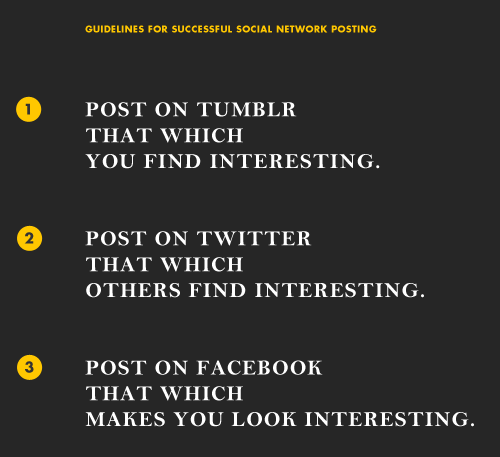
somethingchanged: peterwknox: notthatkindagay:(via skimmingthesurface)

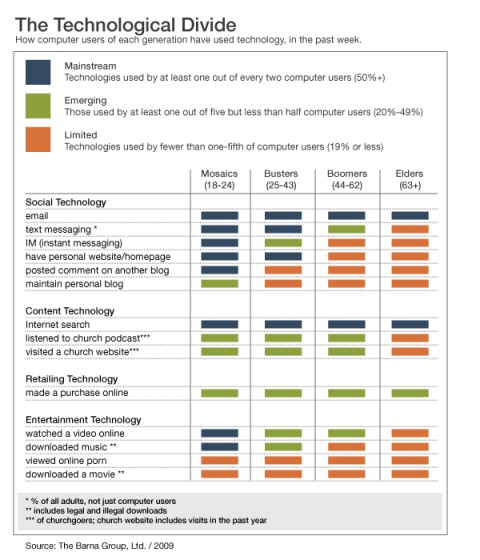
Technological divide between generations

somethingchanged:

soupsoup: jhnbrssndn: azspot: The Generational Tech Divide

Mosaics, busters, boomers, and elders.

macbook pro battery exploded

my macbook pro battery exploded after 20 months of use. luckily, i was able to remove it before it ruined the laptop.

Google make you stupider

From the The Atlantic:

the Atlantic featured another essay, by Nicholas Carr, called “Is Google Making Us Stupid?” The answer was an emphatic, if not altogether wistful, “Yes.”

Nicholas Carr1

From the LA Times:

In theory, a tool like Google should free us to be more creative. In reality, there are pitfalls…. the open-endedness of an Internet where “you can imagine knowledge and then find it.” But there is a downside, which, according to Frel, is rather dire: “Pretty good has become the new perfection.”

When Alexander Solzhenitsyn memorized passages of “One Day in the Life of Ivan Denisovich,” he had no choice but to enact the modernist version of oral traditions. This was not an expression of collective culture so much as an extreme example of what T.S. Eliot called “the individual talent.”

Today’s blogs are a mutation of Solzhenitsyn’s modernist mythmaking — where the merely personal becomes a matter of permanent record. Increasingly, mainstream writers cite blogs. Political journalists use them as sources. According to CommonSenseMedia.org, 74% of journalists recently surveyed regularly read blogs, and 84% “say they would or already have used blogs as a primary or secondary source for articles.”

Beau Friedlander2

NOTES:
1) Nicholas Carr, “Is Google Making Us Stupid,”July/August 2008, The Atlantic, accessed November 10, 2008, https://www.theatlantic.com/magazine/archive/2008/07/is-google-making-us-stupid/306868/
2) Beau Friedlander, “The Net effect,” Nov. 9, 2008, Los Angeles Times, accessed November 10, 2008, https://www.latimes.com/archives/la-xpm-2008-nov-09-ca-gutenberg9-story.html

The Cloud

You hear a lot of talk about “The Cloud” nowadays…. But nobody seems to be talking about Power Laws.

Hugh MacLeod1

NOTES:
1) Hugh MacLeod, “the cloud’s best-kept secret,” August 1, 2008, Gaping Void, accessed August 2, 2008, http://www.gapingvoid.com/Moveable_Type/archives/004638.html (page not available)

Technology changes, people don’t

(via Gaping Void)1

NOTES:
1) Hugh MacLeod, August 1, 2008, Gaping Void, accessed August 2, 2008, http://www.gapingvoid.com/ (page not available)

Of course, if you’re reading this on tumblr, you are probably already perverting the language.

How texting is wrecking our language

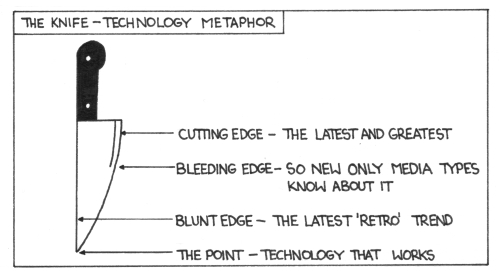
The Knife metaphor

aja:

The Flowfield Unity

The ubiquitous Wikipedia

…the Wikipedia site was listed among the top three Google hits 100 percent of the time.

Michael Petrilli. Link.

Weekend review

Another reason not to visit Disney: Fingertip biometrics at Disney turnstiles

Open society: largest data breaches

If it looks like a moleskine: “stylish little pocket notebook”

And finally, from Seth Godin:

“So, there’s plenty of bad economic news floating around. From the price of oil to Wall Street to bailouts to the death of traditional advertising.

Which is great news for anyone hoping to grow or to make an impact.”

New info opiate

research shows that a brain rewards itself with a squirt of natural opiates when it comes across new information that requires interpretation

Mark Frauenfelder (via Boing Boing) Link

Pornographers don’t sell pornography

AdPulp provides this:

“42.7% of consumer time online is spent with content sites, 28.6% is with communication sites, 16.1% with commerce sites and 5% on search sites.” Link

(For more detailed analysis visit OPA Link)

While a lot of content provider sites (i.e. news and entertainment sites) feel pressure to offer their content for free (and some have already removed their firewalls—i.e. TNYT and WSJ) the question remains—how does an organization provide “free” content without going bankrupt?

Jake McKee’s post—You’re selling the wrong thing—sited the McGuire HuffingtonPost Porn Knows What It’s For—Do You? as an answer to that question. To excerpt some notable quote from McGuire’s article:

“Pornographers… don’t seem to care much about how they do it—they’ll just find ways to give people the orgasms however people want them given… magazines… online photos, online videos… why are newspapers… having such a hard time?… they have a fundamental misunderstanding of what they do.

“The value of a newspaper is not that it gives me information; the value of a newspaper is how it selects information…”

And here’s a necessary mainstream-media-sucks, blogs-rule rant from McGuire:

“Blogs are excellent selectors of information, while newspapers are pretty clunky at it—because for the past 300 years they existed in an ecosystem where information was scarce. Now information (and access to it) is abundant.”

McGuire misses the point in the steam of his own blog-rant.

Blogs survive as scavengers of info. Blogs select and repackage recycled information. Blogs—with the exception of maybe 50 techno-intelligentsia sites—rarely provide original content. The mainstream media behemoths still provide the bulk of online content. Here’s were McGuire is correct: pornographers don’t care about how or by what vehicle they deliver the content—online or offline. Pornographers bank on three basic actions: consumption, evangelism, purchase (and repeat).

Or to put it another way: “delivering anticipated, personal and relevant [content] to people who actually want” it. (Source). Do people still consume news? Yes. Do the majority of people want to pay for it? No. How does a news/entertainment organization earn revenue online? IMHO, online advertising + products = revenue. Translation: offer ad rates (dictated by web traffic) plus and an online store with shopping cart for souvenirs related to the content the consumers want.
Before audio books…

“Of all the repetitive, mind-numbing jobs in the late 19th century, cigar-rolling was special. “Unlike sewing clothes, mining coal or forging steel, it was blessedly quiet. And thus cigar workers, whether in Chicago or Havana, were the first ones in their time who managed to introduce that vital commodity — distraction — onto the work floor.“Using their own wages, and backed by a powerful union, they paid for a “reader” who sat in an elevated chair and began the morning with the news and political commentary. By the afternoon, he would usually have switched to a popular novel. The 100 or so rollers on the floor were his captive audience, listening as they worked.”

(via NYT — thanks AdPulp) Link

Before audio books there were…