Why The Economist is thriving while Time and Newsweek fade http://www.theatlantic.com/doc/200907/news-magazines
Tag: media
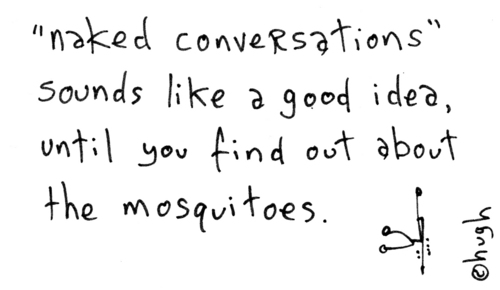
Naked conversations
The big story is not about blogging. It’s not about Twitter, YouTube, Facebook, Friendfeed or whatever.
It is about..
Cheap. Easy. Global. Media.
CheapEasyGlobal is the big story.
(via Gaping Void)1
NOTES:
1) Hugh MacLeod, “cheapeasyglobal,” July 13, 2008, Gaping Void, accessed July 31, 2008, http://www.gapingvoid.com/Moveable_Type/archives/004603.html (page not available)
Pornographers don’t sell pornography
AdPulp provides this:
“42.7% of consumer time online is spent with content sites, 28.6% is with communication sites, 16.1% with commerce sites and 5% on search sites.” Link
(For more detailed analysis visit OPA Link)
While a lot of content provider sites (i.e. news and entertainment sites) feel pressure to offer their content for free (and some have already removed their firewalls—i.e. TNYT and WSJ) the question remains—how does an organization provide “free” content without going bankrupt?
Jake McKee’s post—You’re selling the wrong thing—sited the McGuire HuffingtonPost Porn Knows What It’s For—Do You? as an answer to that question. To excerpt some notable quote from McGuire’s article:
“Pornographers… don’t seem to care much about how they do it—they’ll just find ways to give people the orgasms however people want them given… magazines… online photos, online videos… why are newspapers… having such a hard time?… they have a fundamental misunderstanding of what they do.
“The value of a newspaper is not that it gives me information; the value of a newspaper is how it selects information…”
And here’s a necessary mainstream-media-sucks, blogs-rule rant from McGuire:
“Blogs are excellent selectors of information, while newspapers are pretty clunky at it—because for the past 300 years they existed in an ecosystem where information was scarce. Now information (and access to it) is abundant.”
McGuire misses the point in the steam of his own blog-rant.
Blogs survive as scavengers of info. Blogs select and repackage recycled information. Blogs—with the exception of maybe 50 techno-intelligentsia sites—rarely provide original content. The mainstream media behemoths still provide the bulk of online content. Here’s were McGuire is correct: pornographers don’t care about how or by what vehicle they deliver the content—online or offline. Pornographers bank on three basic actions: consumption, evangelism, purchase (and repeat).
Or to put it another way: “delivering anticipated, personal and relevant [content] to people who actually want” it. (Source). Do people still consume news? Yes. Do the majority of people want to pay for it? No. How does a news/entertainment organization earn revenue online? IMHO, online advertising + products = revenue. Translation: offer ad rates (dictated by web traffic) plus and an online store with shopping cart for souvenirs related to the content the consumers want.

