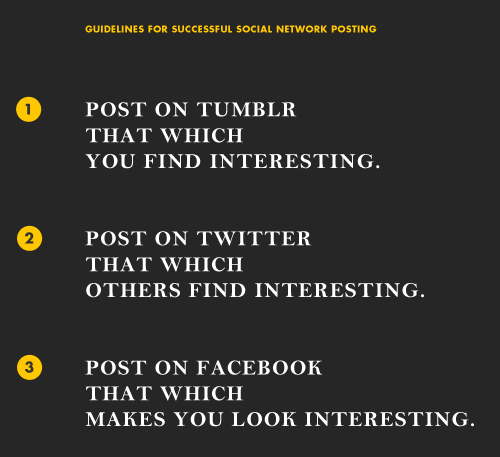
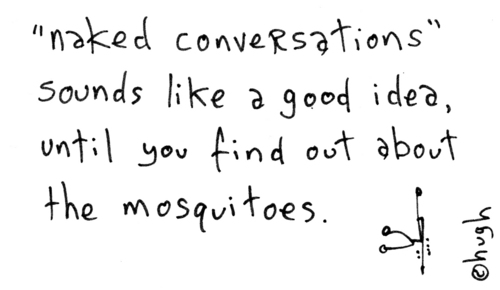
“Why share our work in social networks?” was a question recently asked on a professional forum. My reply: two reasons:
1) promotion and
2) personal brand.
It was a Malcolm-Gladwell-Blink response and I clicked the “add comment” button without much thought. My thoughts still linger on that question, “Why…?”
A few months ago I came across a few articles asking the question “Does social media promote or enable narcissism?”[1] [2] The article that impacted me most is by author Dodai Stewart. Her comments are stinging and self-revelatory.
Just look around: Between Twitter, Facebook, Tumblr, Instagram and Pinterest, the whole ME ME ME thing has swept the nation. Here are MY thoughts, MY pictures, MY shopping wish lists! We call it sharing, but it’s just egoistic self-indulgence, usually. LET ME TELL YOU WHAT I WANT. But wait: Enough about me… what do you think about me? [3]
Hm, narcissism and self-absorption. Herein rests the lingering thoughts of a week or so ago.
As a professional, promoting my goods, services and whatnot help to grease the gears of capitalism, right? Conventional wisdom purports that if consumers are not aware of your product/service, customers will not purchase from ME. So, I am advised by business owners and other professionals to promote MY skills, services, products, etc. And not only that, I need to establish MY personal brand (so that consumers can be more emotionally and psychologically invested in the products/services I provide).
Maybe social networks are not promoting narcissism and self-absorption as much as one might think. There may be a greater systemic issue that only social networks magnify.
NOTE: [1] Tara Parker-Pope, “Does Facebook Turn People Into Narcissists?,” New York Times, May 17, 2012 accessed January 2, 2013 http://well.blogs.nytimes.com/2012/05/17/does-facebook-turn-people-into-narcissists/ [2] Steve Tobak, “Social networks and the narcissism epidemic,” CBSNEWS Money Watch, August 29, 2012, accessed January 2, 2013 http://www.cbsnews.com/8301-505125_162-57502035/social-networks-and-the-narcissism-epidemic/ [3] Dodai Stewart, “Self-Absorbed Is the New Normal,” Jezebel, June 26, 2012, accessed January 2, 2013 http://jezebel.com/5921468/self+absorbed-is-the-new-normal.