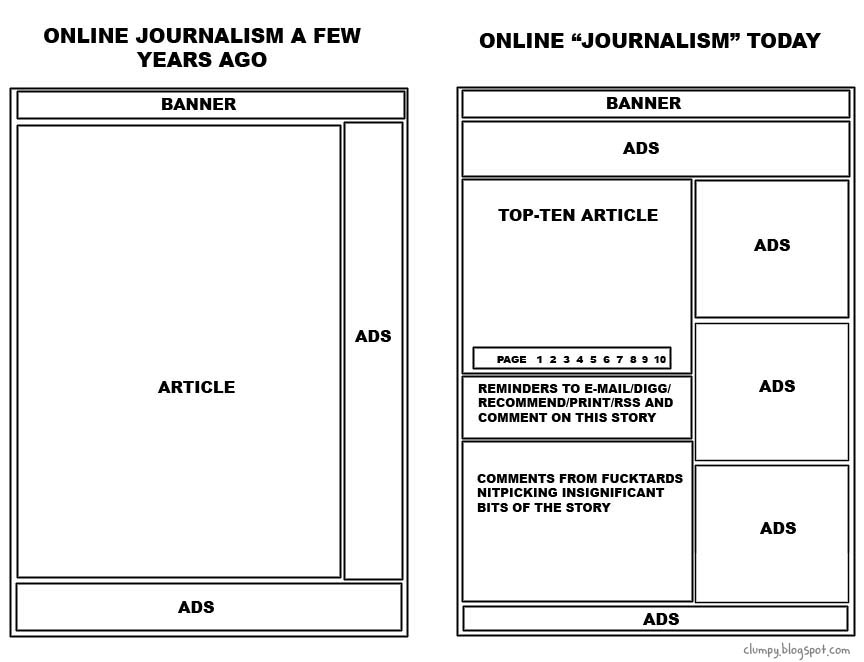
Ever come across an article or blog post where the hyperlink leads to a deceased web page? That is what I discovered when scanning through old web log posts.
Exhibit 1
How to keep your job in journalism
POSTED ON MARCH 8, 2008
- Create killer content
- Pimp your work
- Brand yourself
This from Jason Sandford, founder of Ashvegas and veteran reporter. I shared my summary [1] and linked to his blog post. However, the hyperlink at the end of the post leads to a web page that reads: “Sorry. The Squarespace account ashvegas is not available.”
After a bit of research, it appears that Mr. Sandford migrated the blog content from Squarespace to an impressive hyperlocal news web page.[2] After scrolling for a decade, I found the original post [3] and reconnected the broken link. Problem solved.
Reading his original post, I learned that he quoted from a Robert Niles article [4] published two days before he shared excerpts with his readers.
Exhibit 2
The Knife Metaphor
POSTED ON JUNE 13, 2008
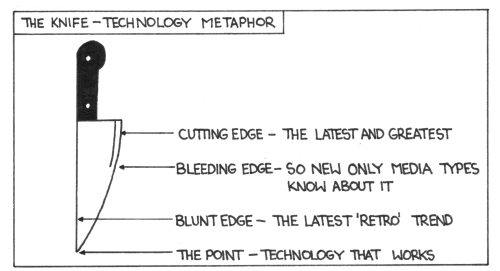
I do not know who created the image,[5] but I did provide a couple source links.
The hyperlink to The Flowfield Unity reads: “Nothing Found. Sorry, but we can’t seem to find what you’re looking for.” Follow Aja’s link I read a similar note: “Well this is somewhat embarrassing, isn’t it? It seems we can’t find what you’re looking for.”
I used to follow Aja on Tumblr. That is, before I quit Tumblr. The proliferation of adult content by users and providers prompted me to delete my account.
Sometimes I re-posted an image with source attribution. Link love was the proto-social media expression and polite thing to do.
Exhibit 3
A 90-second GTD primer
POSTED ON AUGUST 25, 2008
Surprisingly, the 43 Folders hyperlink from my blog post [6] is still active. Merlin Mann shared this — abridged here — jewel during Google’s infamous [7] August 11, 2008 outage:
- Project. Any desirable outcome that requires more than one physical action in order to be considered complete.
- Next Action. The next physical activity I could perform that moves a Project nearer to the outcome I want.
- Context. Any limitation, opportunity, tool, or resource that lets me do one of the physical actions in my Project.
- The Four Criteria Model. The notion that Priority is only one of four criteria in deciding what to do at a given moment.
The full, original post is worth reading. Especially for young readers who may find it interesting that even Google has service outages.
Exhibit 4
Poetry, the highest form of art
POSTED ON OCTOBER 8, 2008
Posted this Guardian lead paragraph [8] on my blog.[9]
“Imagine living in a society where poetry was considered to be the most important art form. Where a poet could easily fill a football stadium. Where a poet’s death was the top news story for days.”
Not surprisingly, the hyperlink is still active. Even if the article is more than a decade old.
Closing thoughts
I expected to find a lot more dead web pages and broken hyperlinks than I did. The sampling from 2008 of blog posts offers insight into journalism and social media.
Social media is reactionary. At its best, social media sneezes an ideavirus [10] that is contagious. At its worst, social media spreads toxic influenc-za.
Journalism reports news and events. To provide a permanent record for this age and the generations to follow. Journalism informs and educates readers. When done well, journalism inspires.
It is an easy tirade to attack social media as harmful rather than helpful. Equally, it is simple to launch a screed against poor quality journalism. Especially when broadcast news makes it effortless. (Side note: I do make a distinction between broadcast news and print/legacy news. But that is a topic for a different day.) It is fair to say that both journalism and social media may effectively be broken. Like an old, broken hyperlink they need time and patience to reconnect to a valid source.
NOTES:
[1] How to keep your job in journalism, accessed January 4, 2020.
https://coffeehousejunkie.net/2008/03/08/how-to-keep-your-job-in-journalism/
[2] Ashvegas.com.
https://ashvegas.com/
[3] “How to keep your job in journalism,” by Jason Sandford. First published March 8, 2008, accessed January 4, 2020.
https://coffeehousejunkie.net/2008/06/13/aja-the-flowfield-unity/
[4] “Keeping your job in journalism,” by Robert Niles. First published March 6, 2008, accessed January 4, 2020.
http://www.ojr.org/080305niles/
[5] Accessed January 4, 2020.
https://coffeehousejunkie.net/2008/06/13/aja-the-flowfield-unity/
[6] A 90-second GTD primer, accessed January 4, 2020.
https://coffeehousejunkie.net/2008/08/25/a-90-second-gtd-primer/
[7] “We feel your pain, and we’re sorry,” by Todd Jackson. August 11, 2008, accessed January 4, 2020.
https://gmail.googleblog.com/2008/08/we-feel-your-pain-and-were-sorry.html
[8] “Importing a passion for poetry,” by Sarah Maguire. First published October 6, 2008, accessed January 4, 2020.
https://www.theguardian.com/books/booksblog/2008/oct/06/poetry.in.translation
[9] Poetry, the highest form of art, accessed January 4, 2020.
https://coffeehousejunkie.net/2008/10/08/poetry-the-highest-form-of-art-2/
[10] Unleashing the Ideavirus, by Seth Godin, accessed January 4, 2020.
https://www.hachettebooks.com/titles/seth-godin/unleashing-the-ideavirus/9780786887170/