(via motherearthfathersky)

I want to give myself utterly as this maple that burned and burned for three days without stinting and then in two more dropped off every leaf; as this lake that, no matter what comes to its green-blue depths, both takes and returns it. In the still heart, that refuses nothing, the… 

Poetry 365: Lake and Maple, Jane Hirshfield (for 7/21)

nevadamoonrise: kissingreflections

(via nevadamoonrise)

* * *

[scene one]

Asheville may be the only place I know that can turn a hula hoops event into something slightly tamer than pole dancing. Walking to the Transit Center earlier this week, I observed quite a large crowd of people with hula hoops at Pritchard Park. A deejay whipped up some trance vibes and the crowd responded with hips and hoops. For the most part, the event seemed quite family friendly with the exception of a few women whose performance with hula hoops approached the idea of *ahem* public art.

[scene two]

The next evening I walked along Patton Avenue — again heading toward the Transit Center. A guy leaning on the rail outside the Asheville Yacht Club with a Pabst Blue Ribbon can in his right hand stared across the street as if watching a tired rerun of That 70s Show. I didn’t think much of it. Maybe he had a lousy day and was trying to unwind. Maybe he was waiting for someone to join him and was just killing time. When the signal lamp changed I crossed the street and realized that the guy outside the Asheville Yacht Club was watching two young women making out at one of the tables on the street outside Thirsty Monk’s Pub. Who needs a television? or an iPhone? Just grab a seat at the rail outside the Asheville Yacht Club, order a PBR, and watch the wildlife at Thirsty Monk’s Pub. The whole scene made me feel oddly lugubrious.

[scene three]

Thursday morning the sunrise bruised the sky with purple and red clouds. The air echoed its coolness and as I walked from the bus stop to Starbucks. After purchasing a pumpkin muffin and a tall bold coffee, I walked across the parking lot toward the office. I noticed a car with all its windows open about an inch or so. It seemed trashed. Piles of plastic bags with clothes, stuffed toys, fast food restaurant bags, and shoes cluttered the interior of the car and seemed to reach the window. As I bit off a morsel of muffin I realized, at second glance, that a woman, man and child were sleeping in the car. What appeared to be plastic bags were black sleeping bags that were unzipped and pulled up to their necks like quilts. The woman was in the driver’s seat with the seat reclined back as fast is it will go. The man was sleeping on his right side facing the woman. His seat was also reclined, but not as much as the woman’s. The child slept in an a car seat with a dark blanket pulled up to the neck. I paused, but thought a third glance would be wrong and might wake them.

The sun still hid behind the mountains to the east as I finished eating the muffin while standing in the parking lot. They’re story must be interesting, I thought to myself as I stuffed the paper muffin wrapping in my pocket. It was still early. No one was in the office yet. I hesitated for a few seconds, looked back at the car in the parking lot with a sleeping family, took a sip of coffee and walked up the steps to the office.

brocatus:

noonebelongsheremorethanyou:

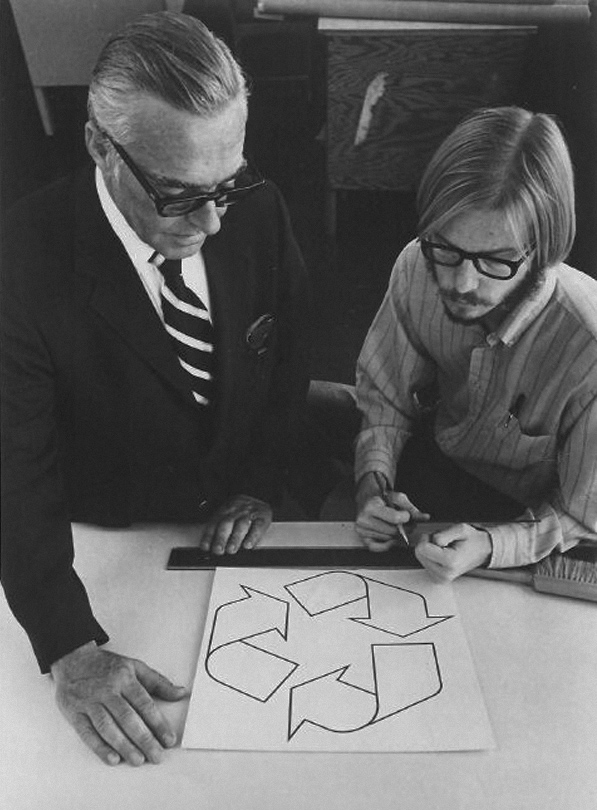
Gary Anderson (right), creator of the recycling symbol, 1970.

(via waxandmilk) Anderson was a 23-year-old USC Architecture graduate when he entered the Container Corporation of America’s design contest to create what would become the universal symbol for recycling. From Wikipedia: The 500 entries to the competition were judged by designers recognized as world leaders in graphics and industrial art, including Saul Bass, Herbert Bayer, James Miho, Herbert Pinzke and Eliot Noyes. According to Anderson: “Angela Davis had just shot up the courthouse and the Manson murders had just happened. I wanted to move away from that, from the Haight-Ashbury poster art with its amorphous organic shapes to create something simpler and cleaner.”

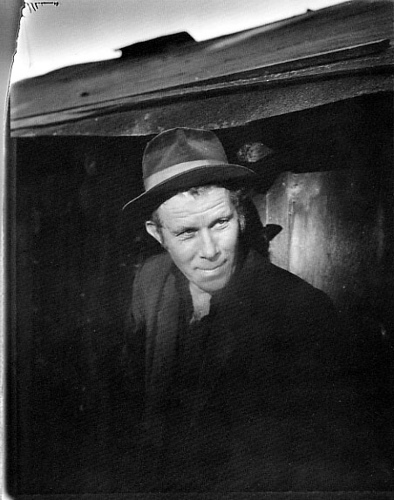
everybodyknowsthisisnowhere: shedarkedthesun: Tom Waits by Marina Chavez

* * *

Dear twitchy-guy riding the bus and wearing an Iron Maiden hoodie,

Please don’t hit on the young lady in the Slipknot T-shirt. It’s the musical equivalence of incest. Besides, she doesn’t like you and the bus driver is ready to throw you off the bus.

Further, having consumed moderate amounts of Iron Maiden during the Seventh Son of a Seventh Son and No Prayer for the Dying era, your ear-bud induced convulsions are a poor imitation of Nicko McBrain’s thunderous drum work.

Sincerely,
Annoyed-undercaffeinated bus rider

everybodyknowsthisisnowhere: madame0: (via sotona)

Krista Tippett, host The crescent-topped dome of Masjid An-Nasr peeks through trees of a residential neighborhood in Oklahoma City. (photo: Andrew Shockley/Flickr) My grandfather was the Reverend Calvin Titus Perkins, known by all as C.T. He was a Southern Baptist evangelist — a… 

SOF Observed: My Grandfather’s Faith: Contradictions and Mysteries

nevver: Words & Eggs

Comic strip artist Michael Jantze and Julie Negron in #AVL this weekend

SECNCS ShopTalk Flier
Cartoonist/Illustrator ShopTalk on September 11, 2010

National Cartoonists Society members Michael Jantze, artist of the comic strip The NORM, and Julie Negron, artist of the comic strip Jenny the Military Spouse, to be featured at the Southeast Chapter of the National Cartoonists Society present a “Shop Talk” this Saturday, September 11, 2010.

The Cartoonist and Illustrator Shop Talk schedule is as follows:

10am – 11am Shane “Shane Hai” Harris and James E. Lyle (comic book artists) present an inking demonstration combined with a brief history of American comic books.

11am – 12 noon Michael Jantze (syndicated cartoonist and instructor at SCAD) speaking on his career as a cartoonist.

Noon – 1pm Portfolio review for the attendees.

1pm – 2:00 pm Julie Negron speaks about “Jenny and 9/11”.

2:00 pm – 3:00 pm Matt Mulder (New Media) moderates a round-table discussion on web-media, featuring the scheduled speakers.

3:00pm – 4:00 pm Kaysha Siemens (Illustrator) demonstrates digital painting techniques.

Hope to see you all at the Skyland/South Buncombe Library this weekend!

bobowoodlake: miss-mary-quite-contrary:

Southeast Chapter of the National Cartoonists Society presents Michael Jantze and Julie Negron

SECNCS ShopTalk Flier
Cartoonist/Illustrator ShopTalk on September 11, 2010

Yes, you did read Monday’s Citizen-times correctly. I am scheduled to moderate a round table on new media as it relates to cartoonists, comic book artists and illustrators. Some of the topics I hope to cover during the round table include: Is it a good business model to create cartoons/comic books for iPads (and other digital devices)? Does online cartoons/comic devalue the art form? Is it possible to protect your cartoons/comics from online piracy? What is the future of collecting traditional print comics vs. downloading digital comics?

This Saturday, September 11th, the Southeast Chapter of the National Cartoonists Society presents a “Shop Talk” at the Skyland/South Buncombe Library (260 Overlook Road, Asheville, NC).  The program will run from 10 am until 4 pm.

Also, if you’re interested, the Southeast Chapter of the National Cartoonists Society meets monthly at Frank’s Roman Pizza. The meet up is open to all interested parties and all ages. Regulars include teens, twenty-somethings, thirty-sometings and older-somethings. If you’re interested in hang out with local artists feel free to contact me.

Saturday’s event features two members of the National Cartoonists Society: Michael Jantze (artist of the comic strip The NORM, and instructor at Savannah College of Art and Design), and Julie Negron (artist of the comic strip Jenny the Military Spouse for Stars and Stripes magazine).

More ShopTalk details and schedule to be presented soon.

Link: The Western North Carolina cartoonists group presents ‘Shop Talk II’

Quote

Be slow to fall into friendship, but when thou art in continue firm and constant.

– Socrates

cosmic-dust: cosmicgypsyhustler wishyoself ottomanempire oldfaithfulshop

Have you ever had one of those mornings where you wish you could hit reset and start over?

Red Green says, “Men need to replace the phrase ‘Hey, watch this’, with ‘Where are my glasses?’ and ‘Where are my other glasses?’…”

Somehow I managed to make it all the way to the office before I realized I left my glasses at home. Usually I’m more organized than this. My book bag is packed the night before. Bus pass, office keys, glasses, etc. are placed next to the book bag. Shoes are placed at the front door. So, the futility of waking up early this morning to get to the office before anyone else only to have to return home, retrieve my glasses and go back to the office was rewarded by a barista who says, “You want a bold coffee, right?”

I’m sure David Allen would have something appropriate to say about the inefficiency of this mornings events. Maybe there was an open loop somewhere I didn’t close. Maybe it has something to do with time or energy availability. Or maybe it has to do with stumbling around the house in the dark while trying not to wake anyone.

All this to say, I can do stupid things just as fast without coffee as I can with coffee.

Are you more interested in coffee or books?

Last night I enjoyed a conversation around the kitchen table with friends from out-of-town. At one point in the conversation a parent told a story about a neighborhood child joining their family for an evening meal. As mastication commenced the mother noticed all her children had a book they were reading while the neighborhood child looked about awkwardly. The mother told her eldest not to ignore their friend, maybe offer the friend a book. Her eldest puts the book down and asked the friend, “Do you like reading?” The friend replied, “Not much.”

This story reminded me of something I read recently regarding “aliteracy” — being able to read and write, but choosing not to — and the decline of reading whole books — in other words, reading a book cover to cover versus reading world literature condensed to 140 characters or less (see Twitterature for an example). In a recent article published in The Chronicle, Carlin Romano writes:

Destructive cultural trends lurk behind the decline of readerly ambition and student stamina. One is the expanding cultural bias in all writerly media toward clipped, hit-friendly brevity—no longer the soul of wit, but metric-driven pith in lieu of wit.

Link: Will the Book Survive Generation Text?

This isn’t a new trend. I recall Socrates faced similar “cultural trends” in his age. When a culture has the immense wealth of knowledge and wisdom but choses to vapid soundbites and emotionalism, the “destructive… trends” are established like a rut society finds difficult to escape. Almost twenty years ago, The New York Times published an educational article with the following lead paragraph:

Illiteracy is primarily a problem of the third world. But it is the United States that appears to be leading the way in aliteracy — the rejection of books by children and young adults who know how to read but choose not to.

Link: The Lost Book Generation

This past weekend I attended a local poetry reading. An Irish poet lamented that a second-hand bookstore closed and now he has to go to Barnes & Noble to purchase books. He commented that Barnes & Noble is a place where people seem more interested in coffee drinks than books.

Best I can tell, The New York Times story may be the first mainstream publication to cover aliteracy (if you find others, please share them in the comments section or email me). George Orwell published an essay in the 1940s on a similar theme (Books v. Cigarettes) and in the 1930s Aldous Huxley presented a society without books in Brave New World. Toward the end of Brave New World, World Controller Mustapha Mond tells John the Savage:

Our world is not the same as Othello’s world… The world’s stable now. People are happy; they get what they want, and they never want what they can’t get… But that’s the price we have to pay for stability. You’ve got to choose between happiness and what people used to call high art.

I can’t help but wonder what we as a culture trade for happiness?

(via fluffynotes, whatconsumesme)

Early bird gets coffee

It’s a cool September morning. For the first time in over a week, the bus from my ‘hood made it to the Transit Center in time for me to transfer to the next bus that takes me to work.On the way to the office I stop by my coffee dealer who sets me up with a pumpkin scone and a bold Italian blend coffee. To the east, the sun barely breaks the ridge of the mountain at 7:45 AM. The office is quiet as a nibble away at breakfast and sip steaming hot coffee.

thingslikethat: Colourful language

Book Review: Tear Down the Mountain

This is a book review I do not want to write. In fact, I have put it off for more than six months. Why the delay, you ask. Procrastination? Too busy? Lack of motivation? All of these. And yet none of these. It has nothing to do with the book or its author. For a first novel, the book offers a startling look into the contemporary scene of rural Appalachia. It is clear that Roger Alan Skipper reaches for a story that is close to him like a favorite coffee mug or faded denim jacket or even a place—an old diner where coffee is still served for fifty cents including free refills. The novel is not too complicated, nor too simple, nor too trite to write a review. In a manner of speaking—it is too true to be fiction.

I feel I might be he, Sid, who loves and hates the mountains where he once lived and left—as if the mountains themselves embrace and reject him. I feel that if I write about this book I may be committing myself to its plot. And I am not sure I like how the author left Sid Lore on page 208. The plot is simple and complex like the characters that pass through the pages between the book’s covers. And if I write this review it will be like a rune that once it is carved into stone cannot be withdrawn—the future committed before it arrives—before it is lived. Is that possible?

During the alter call, the girl went forward. A swarm of growed-ups buried her in a mess of sweat and noise. “Give her your Spirit, Lord,” one cherry-faced old bag bellered, and Sid shivered…. She couldn’t get the tongues any better than he could, she said, and in the company of someone just like him, … he’d decided to talk in tongues whether they was the Lord’s or his own, …

The author writes in an authentic voice; placing the reader in a small rural Appalachian mountain town, placing the reader in a small charismatic congregation, placing the reader on a road to tear down the mountain. Sid struggles with his identity, his sense of place and purpose. He sees Janet seeking acceptance in the church and identifies with her desperation, longing, isolation. Sid and his brother try to fit into this community, but Sid feels equally a part of it as he does a stranger to it.

Like the novel’s title, some days I want to “tear down the mountain” in search of a place that has a better job market to match the housing costs. Sid and Janet “tear down the mountain”—a colloquial expression meaning to leave the mountains, not remove them—in a beat up pickup truck with no tags and “FARM USE scrawled on the doors with green spray paint. How were they to know that wasn’t legal outside of West Virginia?”

Once left behind, the mountains change. After fourteen years divorced from the home where Sid and Janet met, they return separately to find the quiet little secluded place in the Appalachians transformed to a tourist getaway.

A sense of the ridiculous swelled as she drove slowly… . Familiar signs that she never expected to see—Perkins and Comfort Inn… made it all a mixed-up dream.

Several themes complicate and populate this novel: personal identity, community, the authentic and superficial attributes of religious life, gender roles in a traditional marriage, and the emotional strain of unemployment in an economically challenged and changing Appalachian town. All these themes resonate with the Asheville, North Carolina experience.

A couple years ago I shared a conversation with an older graphic designer. I asked him how Asheville had changed since he had moved here (because it is rare to find someone in Asheville who actually grew up here). He told me that Asheville resembles Aspen during the 1980s. The older graphic designer had moved from a comercialized Aspen tourist spot to the quiet enclaves of Asheville. This city had the mountain charm and vibe that Aspen had lost. But now Asheville is losing its mountain roots and values—replacing it with tourism. And tourists visit Asheville to see a city on exhibition and do not share the commitment and struggle to maintain a daily mountain lifestyle.

I’ve witnessed families relocate to Asheville, but within 12 to 16 months move to Raleigh or other cities because skilled-labor opportunities (especially for professionals in creative services and high-tech businesses) are rare in this region. Just last week on the bus, Route 13 to be precise, I overheard two women talking about their plans to move to Charlotte because the jobs that pay well don’t exist in Asheville. One of the women said she found a six-bedroom house in Charlotte and a job that can afford the mortgage (i.e. Asheville’s housing is too expensive and the wages too low.) In Tear Down the Mountain, Sid Lore faced the same dilemma.

“May back’s no better. Unless we move where there’s jobs I can do, its up to you. Or we can set here and starve.” [Sid’s] eyelids hung red and water shot like an old hound’s. “You could go to college, learn that stuff.”

Sacrifices must be made if one wants to live in the mountains of Asheville. Sid and Janet decide to move to a city in the valley where there are jobs.

Where Route 50 topped Allegheny Front Sid pulled to the side of the road and killed the engine. “What’s wrong?” Janet said. “You want to give the mountains one last look before we fall off?”
“No man, having put his hand to the plow, and looking back, is fit for the Kingdom of God. The Bible says that.”
Sid laughed … “I didn’t figure it come from the TV Guide …”

At this point in the novel I begin to dislike the story. They left the mountains. I knew before I left page 176 that they could never return to the same mountains they once knew. No one ever does. Once you leave you lose your ground—your roots. You change. The place changes. That is why I do not want to leave Asheville. That is why I sacrifice a lot to stay in this area. That is why a lot of citizens in Asheville accept low wages and high costs of living. They do not want to tear down the mountain. They accept the hardships and ironies of a mountain lifestyle. That is how I would have ended the novel, but that is not the life the author planned for Sid Lore and Janet Holler. Tear Down the Mountain is a tragic Appalachian love story. And Roger Alan Skipper’s debut novel from Soft Skull Press could have no other ending. But it is not my ending.

(c) Matthew Mulder. All rights reserved.

Originally published in The Indie, Volume 5, Number 51

Essay: When the lights go out

Many aspects about web ‘zines and journals I enjoy. However, publications that still do things the old way (i.e. print only, no web version) really resonate with me and maybe you as well….

[read more]

UPDATE: This blog post is available as part of an audio podcast.

Listen now:

Or listen on:
PodOmatic: coffeehousejunkie.podomatic.com
SoundCloud: soundcloud.com/coffeehousejunkie

E-book: This blog post will be featured in a forthcoming e-book. More details coming soon.

Interview/Review: Deborah Crooks’ Prayer for the World

It was a cold November night when I entered The Grey Eagle as Deborah Crooks performed her songs for The Traveling Bonfires benefit concert. After taking some photos of her for The Indie, I found a corner spot opposite the bar where I could see half the stage.

I opened my notebook and listened to Deborah finish one of her original songs. She introduced her last song by celebrating that she is a lapsed Catholic, Hindu, Buddhist. Her confession received modest applause from a growing crowd. Deborah closed her set with a prayer for the world.

One of the lines from her last song caught my attention: “Walked alone with all my doubt…” I thought of how heavy doubt can be. The weight of not knowing or not wanting to know or questioning what you already know.

Deborah Crooks finished her prayer for the world and the next act began setting up their musical equipment. More people joined a small gathering in the music hall as others bought drinks at the bar. Over the house speakers a bluegrass number played the lyrics: “bare me away on your snow white wings to my immortal home.”

I noticed Deborah at the bar. She wore a dark brown coat which matched her dark wavy hair and deep brown eyes. She waited for a bit before the bar staff warmed her mug with hot coffee. Slowly she walked back to the “green room” off stage right, retrieved her guitar and again slowly, maybe even meditatively, walked to the back of the music hall and found a seat.

I invited Deborah back to my table and asked her to tell me about the last song she sang. It has quite a history, she told me. It includes the death of her father, a World War II vet, and witnessing the World Trade Centers collapse.

In exploring her roots, Deborah discovered a parallel path between her father’s liberation efforts during W.W.II and her own personal liberation through ashtanga yoga. “Writing and singing is where I find my direction” she told me as she discussed finding faith through the conflicting messages of being in New York City for a yoga event and witnessing the tragedy of 9-11.

Like many fathers and daughters, there were struggles between her and her father which she sought to reconcile before his death. Without out going into personal details she summarized, “The same things that get between people get between countries.”

The next musical act had assembled on stage and begun to belt out their first song. We realized that our discussion about liberation would have to be continued later. She quickly concluded, “We’re all looking for the same thing—a haven, a home.”

(c) Matthew Mulder. All rights reserved.

Originally published in The Indie, December 2005