Taking requests

For those who are familiar with my work, is there a poem I wrote that you would like me to read at Friday’s poetry reading at Malaprop’s? Email me at coffeehousejunkie@gmail.com to make a request and I’ll dedicate the poem(s) to you during the reading: http://www.malaprops.com/NASApp/store/IndexJsp?s=storeevents&eventId=433391

Coffeehouse Junkie Podcast – Episode 014

This episode features an essay titled “The Hunger.” Listen to episode 14 here.

I AM NOT YOUR PRINCESS

Sandpaper between two cultures which tear one another apart

I’m not a means by which you can reach spiritual understanding

Or even learn to do beadwork
I’m only willing to tell you how to make fry bread
1 cup flour, spoon of salt, spoon of baking powder
Stir, add milk or water or beer until it holds together
Slap each piece into rounds -let rest
Fry in hot grease until golden
This is Indian food
Only if you know that Indian is a government word
Which has nothing to do with our names for ourselves
I won’t chant for you
I admit no spirituality to you
I will not sweat with you or ease your guilt with fine turtle tales
I will not wear dancing clothes to read poetry Or explain hardly anything at all
I don’t think your attempts to understand us are going to work so
I’d rather you left us in whatever peace we can still
Scramble up- after all you continue to do
If you send me one more damn flyer about how to heal myself
For $300 with special feminist counseling
I’ll probably set fire to something
If you tell me one more time that I’m wise

I’ll throw up on you
Look at me
See my confusion, loneliness, fear, worrying about all our
Struggles to keep what little is left for us
Look at my heart

Not your fantasies

Please don’t ever again tell me about your Cherokee great-great grandmother
don’t assume I know every other Native Activist
In the world personally

That I even know names of all the tribes
or can pronounce names I’ve never heard
or that I’m expert at the peyote stitch
If you ever again tell me
How strong I am
I’ll lay down on the ground & moan so you’ll see
at last my human weakness

Like your own
I’m not strong, I’m scraped
I’m blessed with life while so many I’ve known are dead
I have work to do dishes, to wash a house to clean
There is no magic
See my simple cracked hands which

Have washed the same things you wash

See my eyes dark with fear in a house by myself late at night

See that to pity me or to adore me are the same
1 cup flour, spoon of salt, spoon of baking powder, liquid to hold
Remember this is only my recipe

There are many others
Let me rest
Here
At least

– Chrystos, Menominee

(via deltafoxtrot)1

NOTES:
1) Delta Foxtrot, “I am not your princess,” January 8, 2010, Deltafoxtrot, accessed January 8, 2010, https://deltafoxtrot.tumblr.com/post/323784465/i-am-not-your-princess


Coffeehouse Junkie Podcast – Episode 013

This episode was recorded the week after the River Arts District studio stroll weekend. It features an essay about writing titled “The Field.” Also, I read two poems, “Dead Italians” by Jennifer L. Knox and “asunder” by Craig Arnold. Listen to episode 13 here: http://www.coffeehousejunkie.com/podcast.html

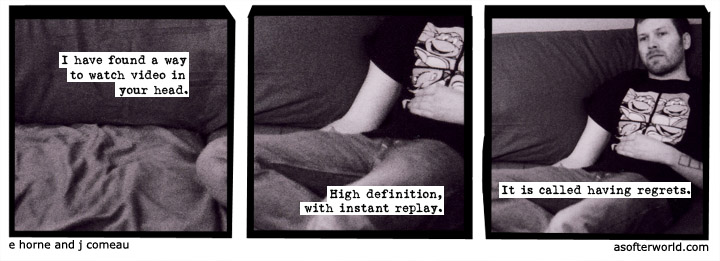
High def regrets

high def regrets…

(via frontiercity)

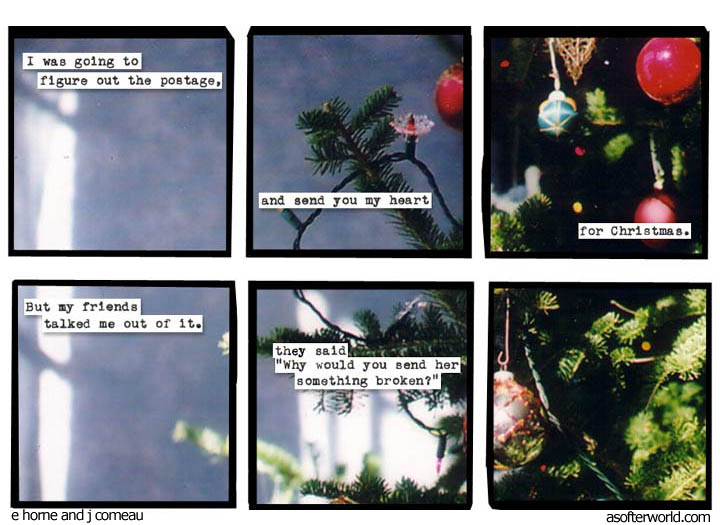
Send you my heart

(via giannasunshine)

Flood Reading Series @ Posana Cafe

tonight at 7:30, Flood Reading Series @ Posana Cafe featuring Ned Condini and Laura Hope-Gill

the definition of haiku

the definition of haiku is more than 3-line poems with no more than 17 syllables… the key is the revelatory moment…

Haiku… are short, unrhymed, poems… that juxtapose two images to capture a moment of insight about the world or about oneself. (via poetry foundation)

What is poetry?

how many pull quotes can you possible use to answer whether poetry is poetry, or prose?

Samuel Taylor Coleridge:

The definition of good prose is – proper words in their proper places; of good verse – the most proper words in their proper places. The words in prose ought to express their intended meaning, and no more… But in verse, you must do more; there the words [are] the media

Housman:

Poetry is not the thing said but the way of saying it.

Frost:

poetry is what’s lost in translation.

Auden:

A poem must be a closed system.

(via)

An argument for self-publishing your poetry manuscript

if you had $2000 to spend on publishing your poetry manuscript, why give that money to 76 publishers?

from the book of kells:

So in total, 76 presses had the opportunity to consider it over 5 years (plus 9 that ALMOST got to consider it…) Don’t do the math on how much it cost me in postage, paper, and contest fees (I’m estimating about $30 a shot) or you’ll end up with about $400 a year on submissions (I’d guess about $2000 total). This makes me a little ill as that’s a lot of money. Thankfully, it was over 5 years, so my family still ate well and was fully clothed while I tried my best to be published. (via)

this is a really good argument for self-publishing your own poetry manuscript… imho… i’m just saying, if i had $2000 to spend on my own book, i’d hire a professional editor, art director, & spend the rest on printing, ad/marketing & distribution.

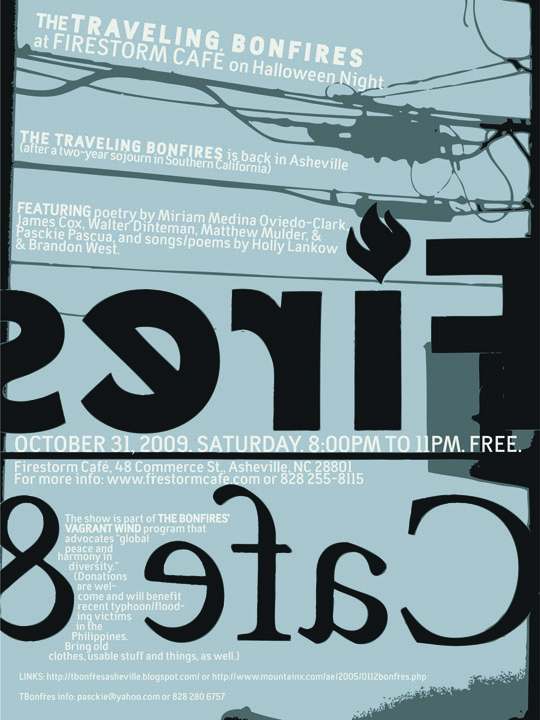
The Traveling Bonfires

a two-year absence from asheville, THE TRAVELING BONFIRES is back in asheville!

i’ll be reading some poems with other vagrant poets and musicians at firestorm cafe october 31. it’s free. it starts at 8:00 pm.

Coffee at Albiani’s: A Poetry Workshop

Every morning at 6 a.m. the young Donald Hall would walk to an all night cafeteria, called Albiani’s, order coffee and work on his poems until 8 a.m. Following the Poet Laureate’s example, we’ll meet for two hours a week and work on poetry (coffee is optional). Open to students of all writing levels. This is a generative workshop and focuses on various writing exercises. Additionally, class members will be encouraged to submit two to three poems for inclusion in a class chapbook which will be published at the conclusion of the course. Each student will receive a copy of this chapbook.

Classes meet Tuesday evenings (Oct. 13, 20, 27, Nov. 3, 10) 6 – 8pm in the library at the Phil Mechanic Building

Chapbook: Tomorrow We Sweat Poetry

A Flood Gallery Fine Arts Center poetry chapbook

This weekend copies of the chapbook Tomorrow We Sweat Poetry arrived. The publication of the chapbook is born from the Flood Gallery Fine Arts Center writing workshop program — specifically, the workshop I directed called “Write and do not waste time.”

The chapbook features poems by Susan Ryonen Keene and an introductory essay by myself which summarizes the poetry writing workshop.

Chapbook details: 20 pages, paperback, 5″x8″

Copies available for purchase: $8 + shipping.

tomorrow we sweat poetry

the poetry workshop chapbook, tomorrow we sweat poetry, arrived this weekend. review an excerpt here. cover price $8. contact me for your copy.

poetry workshop chapbook

cover art for the poetry workshop chapbook. cover photo & design © 2009 matthew mulder. cover price $8. contact me to reserve your copy.

I rarely hand write.

vela: So when I started writing a note, I paused after a word I typically misspell. For a second I found myself waiting for the red squiggle to appear. FML

at a poetry reading yestarday afternoon, a poet confessed to loosing seven years of poetry when her computer crashed.

my notebooks contain sketches and drafts. composing poems in analog form first is how i begin the process. entering the content into my mac is considered part of the revision process.not that i’m gloating. notebooks can be easily lost, misplaced or stolen.

still, i suspect yesterday’s prizing-winning poet uses a pc.

found poetry (headlines edition)

if your familiar with found poetry, here’s my find for today (using headlines):

poll finds tell-all,

created a rorschach cheat sheet,

his supporters, say goodbye.

if you’re not familiar with found poetry , it’s sort of like mad libs… but not really…

[link]

Coffeehouse Junkie Podcast: An excerpt from Gregory Orr’s essay “Four Temperaments and the Forms of Poetry” will be read on today’s podcast plus an short poem.

“Go to the pine to learn of the pine,” Basho

“A haiku is far more than a concrete image of something ‘out there.’ It is very much about the cognitive awareness ‘in here.’” (via Roadrunner Journal)1

NOTES:
1) William M. Ramsey, “How One Writes in the Haiku Moment: Mythos vs. Logos,” May, 2009, Roadrunner Haiku Journal, Issue IX:2, accessed May 23, 2009, https://thehaikufoundation.org/omeka/items/show/1301

// i woke up from a dream in which coleman barks & i read sufi poetry in translation together…

// & now, a hafiz moment… ‘ever since happiness heard your name, it has been running through the streets trying to find you.’

[link]

the sixth Coffeehouse Junkie Podcast… a poem from the book Calenture and a poem from patricia smith will be read on this podcast episode…

// love the pejorative tone many bourgeois have toward the idea of poetry readings…

“[Khalil] Gibran’s ‘masterpiece’… turns not so much upon poetry as upon the genre of wisdom literature and its subgenre, the aphorism, which holds a particularly valued place in Arab culture. Like all good aphorists, he uses language that is both plain and metaphorical; it invites understanding yet in a way that brushes against the mysteries of being alive. There’s no doubt that the style occasionally ascends into comical elevations, and that its high tone seems lost in the ironies and specificities of American life. But that sort of spiritual homelessness pretty much describes a large swath of immigrant life.” (via poetry & popular culture)