I didn’t go to religion to make me happy. I always knew a bottle of Port would do that. If you want a religion to make you feel really comfortable, I certainly don’t recommend Christianity.
C.S.Lewis
I didn’t go to religion to make me happy. I always knew a bottle of Port would do that. If you want a religion to make you feel really comfortable, I certainly don’t recommend Christianity.
C.S.Lewis
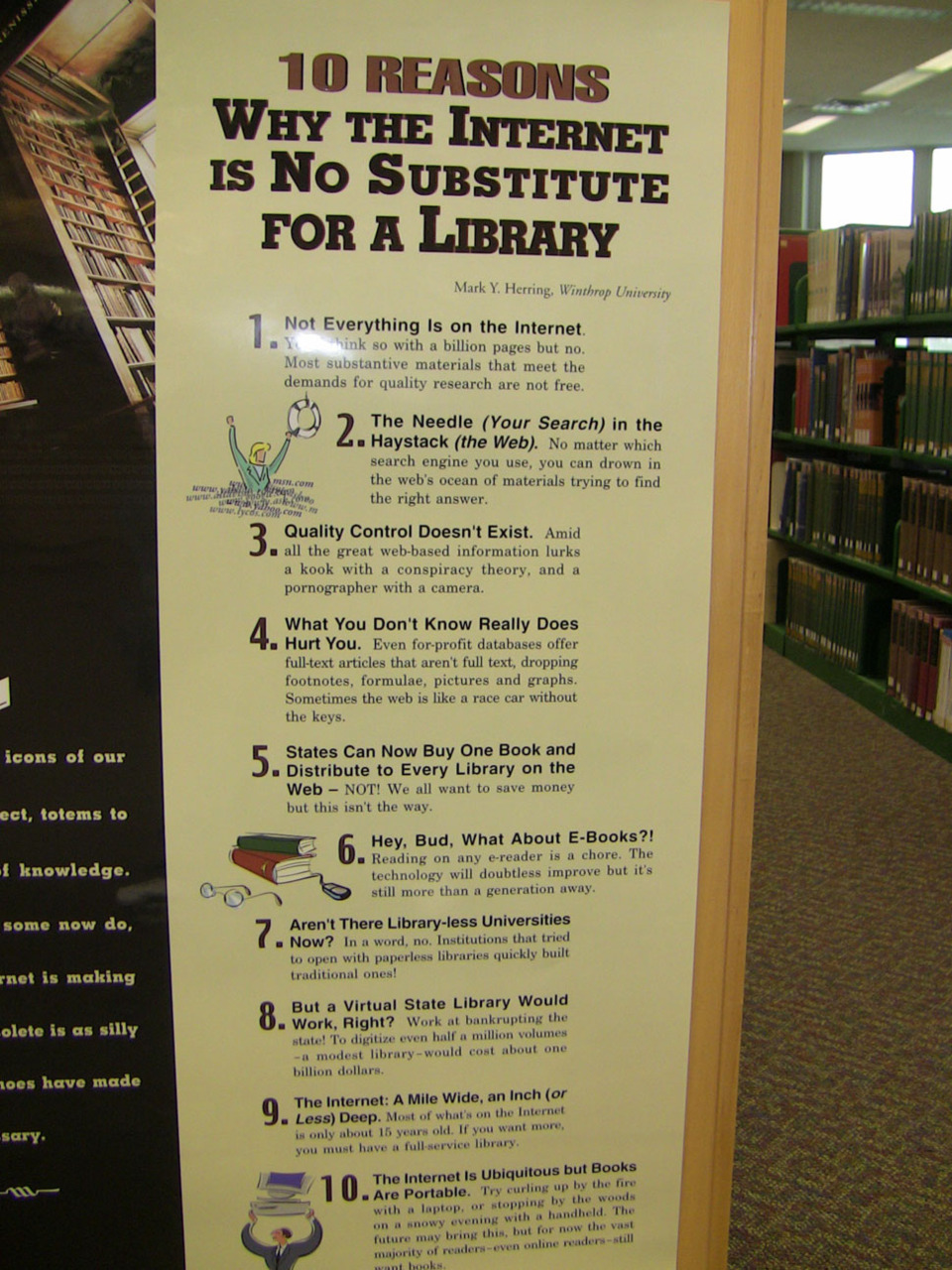
Ten Reasons Why the Internet Is No Substitute for the Library:
1. Not Everything is on the Internet.
2. The Needle (Your Search) in the Haystack (the Web)
3. Quality Control Doesn’t Exist.
4. What You Don’t Know Really Does Hurt You.
5. States Can Now Buy One Book and Distribute to Every Library on the Web… Not.
6. Hey, Bud, What About E-Books?! (Reading on any e-reader is a chore.)
7. Aren’t There Library-less Universities Now? (No.)
8. But a Virtual State Library Would Work, Right? (Only if you like bankruptcy.)
9. The Internet: A Mile Wide, an Inch (or Less) Deep.
10. The Internet is Ubiquitous, but Books are Portable.
(via sleepinginyourflowerbed)
PREACH! (via chartophylax)
Social is not a feature. Social is not an application. Social is a deep human motivation that drives our behaviour almost every second that we’re awake. It doesn’t matter if we’re online or offline, on a browser or using an app. Humans are social creatures.
For me to remember friendship is to recall those conversations that it seemed a sin to break off: the ones that made the sacrifice of the following day a trivial one.
Christopher Hitchens, 1949-2011
“Keepers of private notebooks are a different breed altogether, lonely and resistant rearrangers of things, anxious malcontents, children afflicted apparently at birth with some presentiment of loss.”
Joan Didion, “On Keeping a Notebook” (via missmollymary)
it’s like whispering to your companion during a dinner party: you might not get heard loud and clear, but only a fool wouldn’t take note of the possibility of leakage.
Susan Orlean on sending private messages via social media (via newyorker)
In the late eighteenth century, advances in steam-powered presses and machine-made paper and ink made books affordable for the masses. Before that, a family might have a Bible, but only the clergy and aristocrats owned books. According to technology historian Cathy Davidson, the sudden flood of cheap, popular books alarmed preachers, teachers, parents, and our Founding Fathers. They feared that wild tales of anarchy and romance would corrupt girls and workmen; that “novels” would ruin democracy, cause youth to lose their ability to concentrate on serious subjects, and would forever corrupt American morals. Presidents Thomas Jefferson and John Adams both wrote impassioned denunciations of the horrors of reading fiction.
I loathe blogs when I look at them. Blogs look to me illiterate, they look hasty, like someone babbling. To me writing is a considered act. It’s something which is a great labor of thought and consideration. A blog doesn’t seem to have any literary merit at all. It’s a chatty account of things that have happened to that particular person.
Paul Theroux discusses blogging, travel writing, “Three Cups of Tea,” and his new book “The Tao of Travel.” Read the whole interview at The Atlantic. (via theatlantic)
The poet should speak to all men, for a moment, of that other life of theirs that they have smothered and forgotten.
Edith Sitwell (via nathanielstuart1)
NOTES:
1) nathanielstuart, June 7, 2011, (page no longer available, web site is still active, accessed April 27, 2024, https://www.tumblr.com/nathanielstuart)
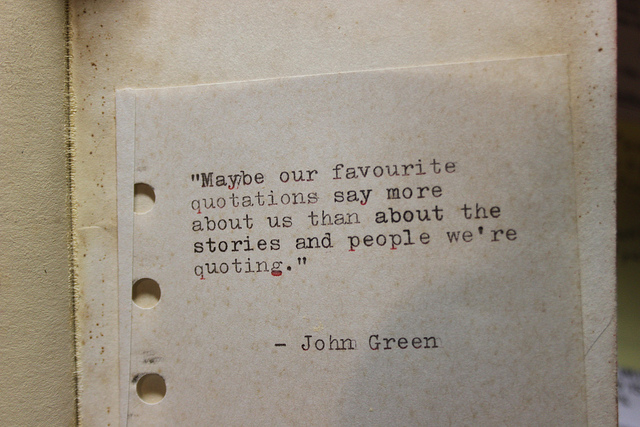
Maybe our favourite quotations say more…
You can change a reader’s life, and you can change—you should change, I think—your own life.
David Grossman (via theparisreview)

bookoasis: A book and a cup of coffee are two of life’s greatest pleasures. (Photo by meadbh metrustry)
I don’t write because there’s an audience. I write because there is literature.
Susan Sontag (via theparisreview)
Can do better, will do better.
Andre Dubus III, Six-Word Memoir from the Memoirville interview at Smith Magazine (via wwnorton)
Take note on these lessons from Wieden+Kennedy’s Executive Creative Director, John C Jay:
via SwissMiss
Be authentic. The most powerful asset you have is your individuality, what makes you unique. It’s time to stop listening to others on what you should do.
Work harder than anyone else and…
Photojojo!: 10 Lessons for Young Designers (and Photographers!)
Cheaply made.
Not as cool as you thought.
Looks better in the picture.
The underestimation of the human intelligence is the worst sin of our time…
Mortimer J. Adler
Ein Haus ohne Bücher ist arm, auch wenn schöne Teppiche seinen Boden und kostbare Tapeten und Bilder die Wände bedecken.
(A house without books is poor, even if beautiful carpets cover its floor and expensive wallpapers cover the walls.)
Hermann Hesse (via germanheit)
“Statistics are like a bikini. What they reveal is interesting. But what they hide is vital.”
–Aaron Levenstein, former Baruch College business professor
Link: Brand Autopsy http://ping.fm/Lh6cr
If instead I see my value as separating the important from the unimportant and making good decisions on the important, then I can go home at a reasonable hour, spend time with my family, ignore my email and phone messages all weekend long…
–Peter Norvig
Link: Knowing important from unimportant tasks
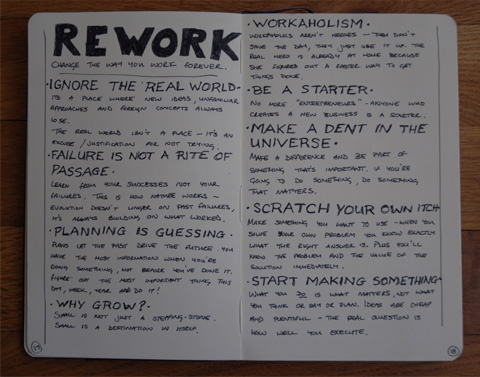
Rework is a really smart business book written by the crew from 37signals. If you haven’t checked it out, you must. In the meantime, Gnat Gnat has done a nice job of summarizing the highlights in this downloadable cheat sheet (pdf).
A good book is like a good conversation with a good friend.
Knowledge is erotic.
Jane Hirshfield, from her book Nine Gates
About 10% of Cambridge University Press’s sales of academic and professional titles are generated by books printed on demand…. Before POD, if sales of one of the publisher’s books dropped below 50 copies a year, it was taken out of print. Now a publisher can keep titles available forever.
The Economist (link)

