Why do you write? Why did you start?
// Bus broke down. Only got home 5 minutes late. How’s that for efficient public transit?
// Is trying to catch the 4 o’clock bus.
// someone’s cellphone is ringing in the other office… answer it, please.
You’re kidding, right? Magazine ad sales increase?
Ad pages in the monthly magazines’ January through September issues had fallen 7.4% from 2007, according to Media Industry Newsletter. The first nine months of 2007, by comparison, slipped only 1% from 2006. Before that, we’d seen a few years of gains.
Okay, so maybe it is not all bad.
The Economist… presented a crisp example of excellence in editorial, ad sales, circulation and marketing. Women’s Health continued its ascent…. Every Day With Rachael Ray even reversed the newsstand decline of first-half 2007.
// redux… why was the guy on the bus trying to sell a stolen credit card TO passengers? (I’m sure I ordered a double lattee. Where’s my brain this morning?)
// back at the office… why was the guy on the bus trying to sell passengers a stolen credit card? Idiot.
// listening to Morphine play over The Drip’s house stereo system
// making final revisions to a childrens book that is supposed to go to press today
U.S. Media Revenue Rises 4.6%
From AdAge:
The nation’s top 100 media companies saw a 4.6% revenue boost in 2007, their slowest growth since the recession year of 2001.
Media’s tempered growth mirrors that of the economy: GDP last year recorded its most tepid growth (2%) since 2002 amid signs the economy was heading into recession.
Media’s biggest winner is no surprise: digital, with revenue up 10.8%. Cable-network growth was close behind, at 10.6%. The biggest loser: newspapers, down 6.8%.
The right way to slack off at work
1. E-mail can wait.
2. Saying ‘no’ won’t get you fired.
3. Don’t multitask.
4. Give yourself a break.
5. Don’t eat lunch at your desk.
6. Schedule some “me” time.
Oh, really.
The idea is not the story
Does one really create ideas? I suspect I know what this writer is attempting to say. However, writing prose is about the story not the idea. Ideas embedded in the story make it great, but the idea itself won’t sell the story. The etymology of the word “idea” is “figure, image, symbol” and “to see.” A great idea is nothing unless it has a narrative substance. Besides, does one create an idea or does one have an idea?
Overheard on the bus
Bus rider: Yeah, last night there was another fight at the gas station. This time is was two women.
Overheard @ The Dripolator
Barrista: So you like spending money on higher education? What, you like got your degree lit… and… now it’s like sweet, I can’t get a job anywhere.
From Print is Dead blog:
…even though I wrote a book called Print is Dead, even I don’t think that publishing is over. Rather, it just needs to change and be willing to embrace new ideas and business models.
Link
Can intelligent literature survive in the digital age?
A transatlantic debate is currently raging about whether a decade of staring at computer screens, sending emails and text messages, and having our research needs serviced instantly by Google and Wikipedia, has taken a terrible toll on our attention, until our brains have been reconfigurated and can no longer adjust the tempo of our mental word-processing to let us read a book all the way through.
NOTES:
1) Andrew Cowan, “Books special: Can intelligent literature survive in the digital age?,” The Independent, accessed September 18, 2008, https://www.the-independent.com/arts-entertainment/books/features/books-special-can-intelligent-literature-survive-in-the-digital-age-926545.html
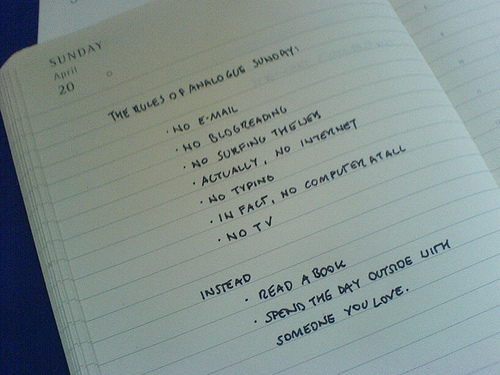
sunili:(via theoisjonesing: tightgrip: thenausner)
Awesome! Analogue Sunday can’t come quick enough.
Poets Teaching Poets, part 2
The advanced poetry class in which I am enrolled, began last night. Two of the four predictions I made regarding the class are right (the other two will be determined later):
1. 25 percent of the students are male
2. 16 percent of the students are under the age of 40
The first night of class was an amiable experience and it seems as if several of my classmates know each other from other writing classes. I’m bracing myself for an onslaught of confessional lyric poems about grandchildren or childhood or something along that line. A good gardening poem would be preferable, in my humble opinion.
One of the poetry books I am reviewing collects poems about the decline of the working class in America. It is a fantastic subject and book. Can’t wait to see what the editor thinks of my review. It’s that type of material I want to tackle in poetry; some subject that changes peoples life or at least causes a physical reaction. The editor of Main Street Rag once said that the poems he likes the most are ones that make him react physically; meaning he laughs or cusses or throws the book across the room. A few years ago, I witnessed someone shed a few tears after I read one of my poems. That’s the stuff I want to write (and hopefully publish); the stuff that creates a place for the reader to inhabit. The teacher told the class last night that the word “stanza” is Italian for “room.” If that is the only thing I learn from this class, it will be enough; the composition of inhabitable poems. Maybe that’s why I like today’s featured poem at Writer’s Almanac; I can get into its space.
“Literature in the 21st Century” by Ronald Wallace
Sometimes I wish I drank coffee
or smoked Marlboros, or maybe cigars—
yes, a hand-rolled Havana cigar
//read more
How Fat is The Long Tail?
Didn’t just write about this?
From Publishers Weekly:
“Some products belong in the tail not the head,” Elberse [Anita Elberse, associate professor at Harvard Business School] said.
Link
book publisher crowds the short head
This is amazing. From Publishers Weekly:
After scrambling to meet the overwhelming demand for its Sarah Palin biography… indie Epicenter Press has signed an exclusive distribution deal with Tyndale House. Tyndale has gone to press for 250,000 copies of the paperback about the newly minted Republican vice-presidential candidate and will begin shipping the books on September 10. Link
The little indie publisher I work with would love to secure a deal like that with our published authors. Oh, wait… it get’s better. Again from Publishers Weekly (just a few days later):
Tyndale House has ordered a second printing of 100,000 copies for Sarah: How A Hockey Mom Turned the Political Establishment Upside Down… Link
Here’s a dirty little publishing reality; how many of those books that ship to retailers will be returned to the publisher? Somewhere between 28 to 40 percent of books published return to the publisher (98,000 to 140,000 copies to return and recycle.). Unless, of course, you have a Dan Brown or Sarah Palin on your frontlist. But even then, consider the crowded head of publishing a best-seller versus a long tail best-seller like The Hobbit (selling, on average, over 1 million copies annually for more than 70 years). Working for an indie publisher, the hope is that I discover a long tail book that increases in value and enriches the world with beautiful literature and not waste the company’s efforts on immediate sales gratification.
*Further reading on the long tail here, here and here (notice that none of the links are to Wikipedia).
Poets Teaching Poets
This weekend I picked up a copy of Poets Teaching Poets at Malaprop’s. It is the only required book for the advanced poetry in which I am enrolled. I read the introduction and first few pages of the opening chapter on the bus ride back home. I hope the class is as engaging as this book.
The first class is Tuesday and I have a few predictions about the class:
- male students will be a minority
- students (regardless of gender) under 40 years of age will be a minority
- half (if not the majority) of the students will have had taught in an educational capacity at some time during their adult life (and now that they have retired want to write and publish poetry)
- the majority of the students will write in confessional lyric verse
This sounds a bit cynical, but I’ve taken a few classes like this in recent years and that tends to be the trend. I’ll share the results of these predictions later in the week.
An email from the class teacher arrived this afternoon as instructed all students to bring the following to class this week:
- one of your own poems
- and one of your favorite poems
writing a poem a day
I made a personal goal of trying to write a poem per day for the month September; or at least a sketch a day. Reality is a harsh master. A presentation project I am working on has kept my brain occupied with details regarding photo selection and event branding. I’ve only been able to compose a poem every other day. Normally, this would bring on a fit of frustration and depression, but not this time. Even a small sketch, the second one I composed, reminds me that patience and perseverance is essential and pursuing master of this craft. Here’s the second poem I wrote this month:
Half a pint down
eight minutes to go
half a porter to go
eight minutes ’til I leave
It’s a spare sketch; something in the vein of a hybrid haiku or tanka.
This excercise is to prepare me for an advance poetry class that I am taking. It begins this week.
The New York Times reports on Google’s newspaper scanning efforts
Google has begun scanning microfilm from some newspapers’ historic archives to make them searchable online, first through Google News and eventually on the papers’ own Web sites…
From Print is Dead:
Google will then serve up scans of newspapers either via Google, or on the site of the originating newspapers, which provides income for Google (in the first example) and/or traffic and visitors (and potentially income from advertising) for the original newspapers (in the second example).
 Coffeehouse Junkie