Poetry reading list for National Poetry Month, part two

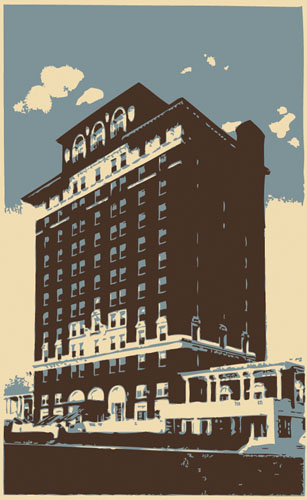
Historic Battery Park Apartments, Asheville, North Carolina

As stated last week, I will continue the reading list for National Poetry Month even though it is May 1st. April was a brutal month. Though the plan was to compose thirty days of posts in April, the work/life balance — or chaos — of my life prohibited meeting that goal. But why restrict poetry to one month, right?

Some of you know this, others may not, but there is a lot of labor involved if you put your hand to the practice and turn of poetry. There was a lot of hard work and late nights at cafés, open mics and taverns and copious amounts of coffee and hours of mic time that provided me the opportunity to read poems at an art gallery — the Flood Gallery Fine Art Center.
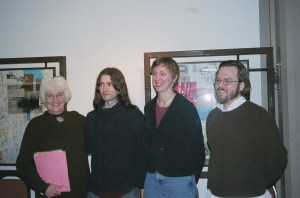
Flood Gallery Fine Art Center, February 2007

The Flood Gallery Fine Art Center[1] organized a poetry reading series that featured local poets. That evening marked a milestone — in my mind. Before that night at the Flood Gallery, the poets — Britt Kaufmann, Brian Sneeden, Barbara Gravelle and myself — were barely familiar with each other. But something alchemical happened during the reading.

Britt Kaufmann’s Belonging was published sometime after that reading.[2] I remember Britt emailing me drafts of the poems prior to publication as well as discussing the nuances of navigating publishing challenges. Barbara Gravelle has published several books of poetry.[3] Her collection of Greek island poems came together before my eyes. One afternoon we looked at illustrations and poems side by side to consider the flow of art and poetry. Brian Sneeden has several forthcoming books of translations and poetry.[4] The first time I heard him read his work was at Malaprop’s Bookstore/Cafe for a Traveling Bonfires event.

Barbara, Brian and myself went on to form a poetic collective called the Rooftop Poets. We collaborated on an invitation-only event of music and poetry at the private ballroom of the Historic Battery Park Apartments. Attendees were given a commemorative, limited edition anthology of our poems. There were a few more public gatherings of the Rooftop Poets, but for me the treasure was sharing our compositions privately. Discussing everything from modern Greek poetry to religion to archeology to feminism to poetry to local gossip as well other aspects of life. I greatly miss that face-to-face time with these friends.

Shortly before my departure from Asheville,[5] I sat in a side room of a wine bar on a Sunday afternoon. The room was filled with aspiring and novice poets. We went around the room reading poems. At the conclusion of the readings I overheard a few people commenting about the Rooftop Poets. They discussed — even mythologized — who the Rooftop Poets were, what they did, how many people attended a private reading, what happened at that reading and so on and so forth. The eavesdropping made me smiled. I did not correct factual errors. I walked to the main bar. Someone bought me a beer. We talked about employment and jazz and all things Asheville. And I left.

These poets and friends made in impact in my life — as well as the local and regional community.

NOTES:

[1Flood Gallery Fine Art Center poetry reading. http://www.floodgallery.org/poetryinthepresence.html
[2Read more about Britt Kaufmann and her work as a poet and playwright. http://www.brittkaufmann.com/poetry
[3Some of Barbara’s books are out of print, but worth the read if you can find them. Here’s a link to one of her published poems: http://www.salomemagazine.com/search.php?search=1
[5The reason for leaving my adopted hometown of Asheville, North Carolina is captured in this article, “Why I Left Asheville,” published in The Asheville Blade: http://ashevilleblade.com/?p=306


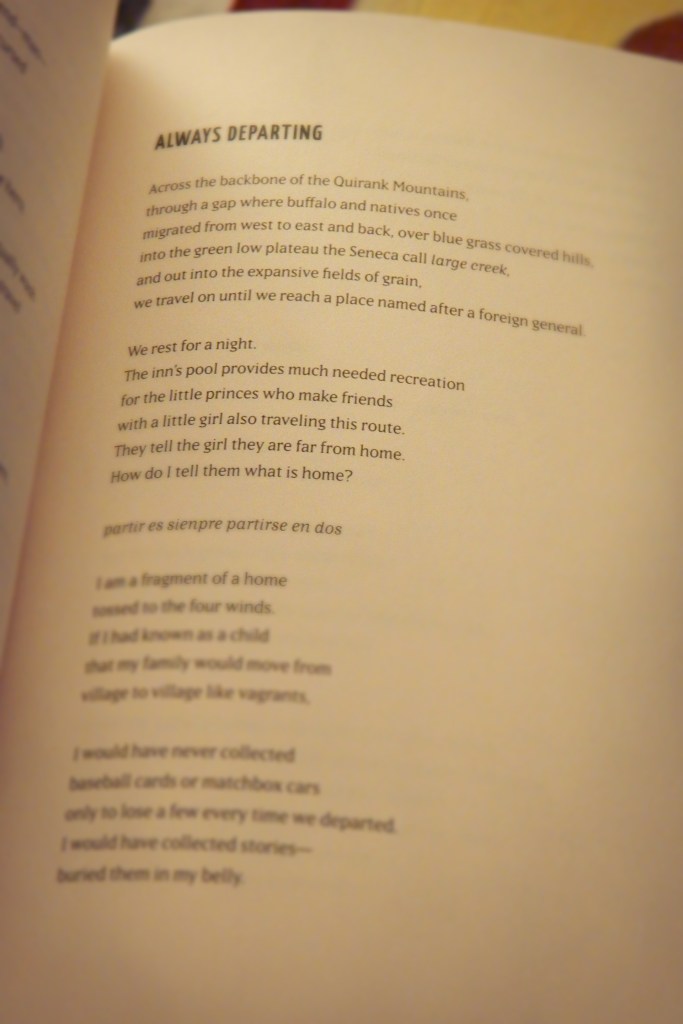
Poem 7: Always Departing

An excerpt of
An excerpt of “Always Departing” by Matthew Mulder from the anthology Rooftop Poets.

Poem 6: Saturday Night, Coffeehouse

DSCN5416[sqr-basic-lomo-dusk-tilt]

NOTES: Originally published in Rapid River Arts & Culture Magazine, April 2004. Unable to locate the printed artifact nor find a digital version on the publisher’s website, I photographed this draft of “Saturday Night, Coffeehouse.”

Poetry reading list for National Poetry Month, part one

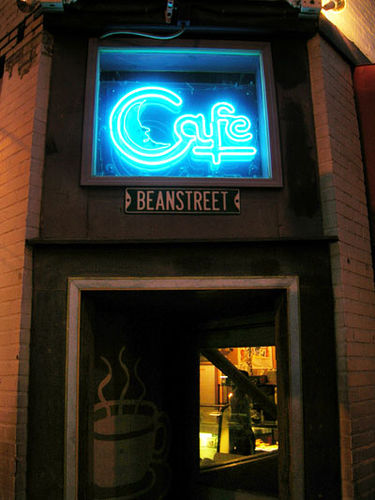
Asheville’s Beanstreet coffeehouse, circa 2005.

As stated earlier this week, my poetry reading list for National Poetry Month is designed to encourage you to seek out the influence of living poets — where they live and and where they read. Allow me to introduce you to a few of the living poets I met at the open mics and coffee dens of Asheville, North Carolina.

One of those souls is an editor, poet, journalist and friend, Pasckie Pascua.[1] He has published several chapbooks and collections of poetry and prose. We first met at a coffeeshop in West Asheville and later haunted Beanstreets and other places from North Carolina to New York City. He left the back door to the poetry scene open for me and allowed me to grow and mature as a poet and writer. He also published many of my early writings. Lines from his poems still echo in my mind, like this one:

“The color of my poem

is also the color of my brother’s soul,

the color of my friend’s heart.”[2]

Another poet I wrote with and read alongside is Jessica Newton.[3] She facilitated a writers group when I first moved to Asheville. We gathered at the UNCA library or other spots around Asheville to write and read our compositions. Sometimes she brought writing prompts or other sources of inspiration. We shared prompts and poems. One night Mara Leigh Koslen[4] brought examples of haibun.[5] She introduced the poetic form and then we wrote. It was that night that I composed the first draft of a poem that would later be published.[6] Several other poets and writers visited the writers group.

My poetry reading list is really an introduction to friends and poets who I have met face-to-face. We read and wrote poetry together. We drank coffee at sidewalk cafés until dark-thirty. We shared wine after a moonlit poetry reading. Met in cafés and coffeehouse, taverns and art galleries, bookstores and basements and rooftop ballrooms. We did life together.

When I introduce you to poetry, I introduce you to friends.

I’ll continue the reading list, introductions throughout this month and maybe beyond. Why should poetry only be celebrated in April?

NOTES:

[1]Learn more about Pasckie Pascua from this Rapid River Magazine article. http://www.rapidrivermagazine.com/2015/red-is-the-color-of-my-night/
[2]Read the full poem, “Red is the color of my night” and other poems. http://pasckiepascuawords.blogspot.com/p/poetry-red-is-color-of-my-night.html
[3]Jessica Newton is published in several literary journals. The last time we read together was at the Asheville 100 Thousand Poets For Change event. https://coffeehousejunkie.net/2013/10/03/100tpc-quote-jessica-newton/ Jessica was also a finalist in the Mountain Xpress poetry prize: https://coffeehousejunkie.net/2011/04/07/who-will-be-the-winner-of-the-2011-mountain-xpress-poetry-prize/
[4]Mara Leigh Koslen bio: https://palimpsestgarden.com/about/bio/


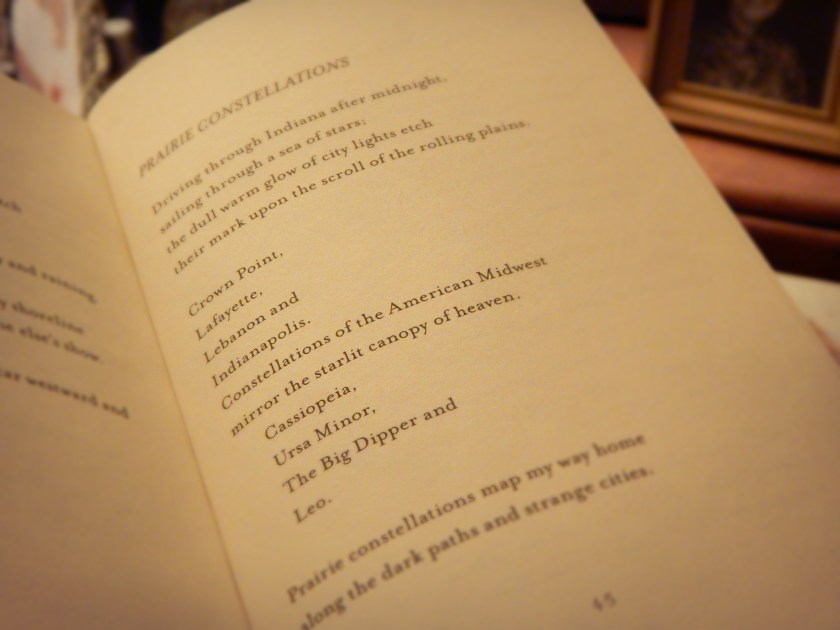
Poem 5: Prairie Constellations

“Prairie Constellations” by Matthew Mulder from the book Late Night Writing.

Poetry reading list for National Poetry Month, intro

The best way to share poetry with people — who do not know that they may like poetry — is to start by reading the works of living poets. That is the basic idea of my poetry reading list for National Poetry Month.

Most books lists of are just lists. Promotional bullet points. Usually there is an image of the book or photo of the poet, a brief description or summary, sometimes even a list of credentials and awards, and a hyperlink to the poetic work or an online retail store. That is an approach I will try to avoid.

I read recently that the ancient Greeks and Romans enjoyed literature in a very different way than our modern culture — where we silently read books. The ancient poets read and/or recited their work out loud to a public audience.

So, my poetry reading list for National Poetry Month is designed to encourage you to seek out the influence of living poets — where they live and and where they read.

Poem 4: Last night at the New French Bar

DSCN5432[sqr-bsc-lomo-dusk-tilt]

The fourth poem, Last night at the New French Bar, was published in Crab Creek Review. It is part of seven published poems I am sharing during National Poetry Month.

Somewhere I read that a poet should never explain a poem, but rather let the poem speak to the reader. This is an example of allowing the poem to communicate to the reader. No need for introduction nor backstory.

Poem 3: Loneliness visits

DSCN5435[basic-lomo-sangria]

For National Poetry Month I will share seven photos of published poems. The third poem, Loneliness visits, was published in ISM Quarterly.

Poem 2: Reading “My American Body”

DSCN5421[bsc-lomo-dusk]

Reading “My American Body” by W. K. Buckley
by Matthew Mulder

Fireflies sparkle
outside. I see them through the
living room window.
It’s the time between
times as I
examine a new hole in
my jeans and consider
“Picking up their shreds
to the tangled light.”
Condensation rolls down
St. Pauli Girl who
makes me sparkle
inside.

NOTES:
(c) Matthew Mulder. All rights reserved.
Originally published in Rapid River Arts & Culture Magazine, October 2005

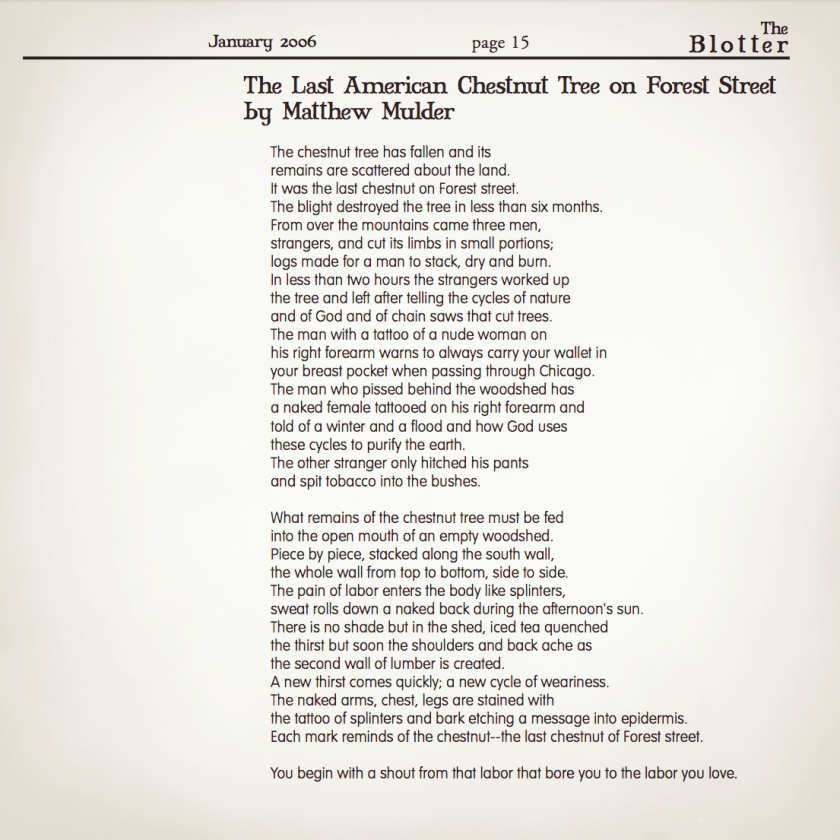
Poem 1: The Last American Chestnut Tree on Forest Street

The Last American Chestnut Tree on Forest Street

For National Poetry Month I plan to share seven photos of published poems. The first poem, The Last American Chestnut Tree on Forest Street, was published in The Blotter.

National Poetry Month

DSCN5411[sqr-basic-lomo-lofi]
It is April. The fourth month of the year. It is also National Poetry Month.

One question I receive from time to time is this: “Are you published?”

The answer is yes. See the bio page for a summary of publishing credits.

I will post photos of my published work throughout the month of April.

Another question I get from people who do not know that I might enjoy poetry is this: “What poetry books should I read?”

That question is more difficult. But I will attempt to compile a book list you may, or may not, appreciate.

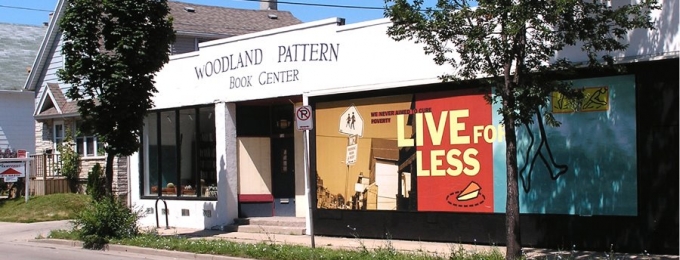
The Woodland Pattern Poetry Marathon is this weekend

This is my third year contributing.

Here is a Twitter pic from last year, 2016.

Heather captured some great photos from the 2015 poetry marathon. Those photos are lost somewhere on Facebook. It was the first time I read at Woodland Pattern. And the first time I read along side the best poets in Racine. It was a magical night.

The Annual Poetry Marathon & Benefit at Woodland Pattern, Milwaukee, begins at 10:00AM. $10 donation taken at the door. I will be reading between 4-5PM. I would love to see you there and say “hi” and “thank you.”

Sponsor me by donating $5 or whatever using Woodland Pattern’s PayPal donation button (click here). Any amount helps. Make sure you enter “Matt Mulder” in the space provided for “Reader’s Name.” And thank you for your support!

Woodland Pattern’s 23rd Annual Poetry Marathon & Benefit

%e2%88%9awoodland-pattern-events_269_landscape_image Woodland Pattern celebrates the 23rd Annual Poetry Marathon & Benefit this weekend, January 28, 2017!

Join me and 150 poets as we raise funds for Woodland Pattern’s programming in literature and the arts. Money raised at the poetry marathon funds opportunities such as the Urban Youth Literary Arts Program.

The Annual Poetry Marathon & Benefit at Woodland Pattern, Milwaukee, begins at 10:00AM. $10 donation taken at the door. If you cannot attend, no worries. Sponsor me by donating $5, $10, $20 or more using Woodland Pattern’s PayPal donation button (click here). Any amount helps. Make sure you enter “Matt Mulder” in the space provided for “Reader’s Name.” And thank you for your support!

If you are planning to attend Woodland Pattern’s Annual Poetry Marathon, you may still sponsor me (here). I will be reading between 4-5PM. I would love to see you there and say “hi” and “thank you.”

Should be a great lit-filled weekend event. Hope to see you at Woodland Pattern!

Poetry podcast for the Fourth Sunday of Advent

The Winter Is Cold, Is Cold

by Madeleine L’Engle


The winter is cold, is cold.
All’s spent in keeping warm.
Has joy been frozen, too?
I blow upon my hands
Stiff from the biting wind.
My heart beats slow, beats slow.
What has become of joy?

If joy’s gone from my heart
Then it is closed to You
Who made it, gave it life.
If I protect myself
I’m hiding, Lord, from you.
How we defend ourselves
In ancient suits of mail!

Protected from the sword,
Shrinking from the wound,
We look for happiness,
Small, safety-seeking, dulled,
Selfish, exclusive, in-turned.
Elusive, evasive, peace comes
Only when it’s not sought.

Help me forget the cold
That grips the grasping world.
Let me stretch out my hands
To purifying fire,
Clutching fingers uncurled.
Look! Here is the melting joy.
My heart beats once again.[1]


This audio podcast features the poem “The Winter Is Cold, Is Cold” by Madeleine L’Engle and concludes with a selection from the Book of Common Prayer that is often read on Christmas Day.

NOTES:
[1] Source: The Winter Is Cold, Is Cold by Madeleine L’Engle
[2] Advent Poems (or the 12 days of Christmas poetry)

Baby, it’s cold outside

dscn6640sqr-basic-lomo-sunkissedlores
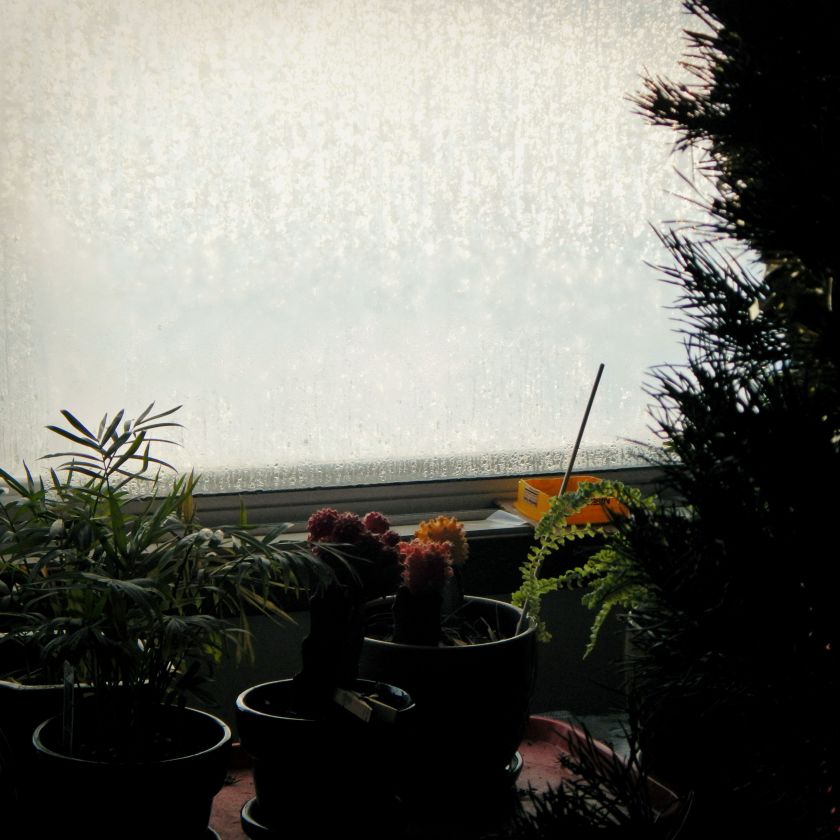
The outside air temperature this morning, when I woke up, was -6°F. Won’t event mention the windchill factor. The window completely frosted over. It is December. Wonderfully cold and beautiful.

Almost wanted to spend the day in bed composing a new list of twelve Advent poems to accompany the ever popular post Advent Poems (or the 12 days of Christmas poetry). Here’s one Advent poem I am considering for a new list.


The birth of wonder[1]
by Madeleine L’Engle

When I am able to pray with the mind in the heart, I am joyfully
able to affirm the irrationality of Christmas.

As I grow older
I get surer
Man’s heart is colder,
His life no purer.
As I grow steadily
More austere
I come less readily
To Christmas each year.
I can’t keep taking
Without a thought
Forced merrymaking
And presents bought
In crowds and jostling.
Alas, there’s naught
In empty wassailing
Where oblivion’s sought.
Oh, I’d be waiting
With quiet fasting
Anticipating
A joy more lasting.
And so rhyme
With no apology
During this time
Of eschatology:
Judgement and warning
Come like thunder.
But now is the hour
When I remember
An infant’s power
On a cold December.
Midnight is dawning
And the birth of wonder.

NOTES:
[1] “The birth of wonder” by Madeleine L’Engle. Published in the book WinderSong by Madeleine L’Engle and Luci Shaw.

The story behind Henry Wadsworth Longfellow’s poem “I Heard the Bells on Christmas Day”

Since the tradition curating advent poems[1] was started a few years ago, I found this story[2] particularly interesting.

NOTES:
[1] Advent Poems (or 12 days of poetry), December 13, 2012, https://coffeehousejunkie.net/2012/12/13/2013-advent-poems-or-the-12-days-of-christmas-poetry/.
[2] Justin Taylor, “THE TRUE STORY OF PAIN AND HOPE BEHIND “I HEARD THE BELLS ON CHRISTMAS DAY”,” http://www.thegospelcoalition.org, December 21, 2014, accessed December 11, 2016 https://blogs.thegospelcoalition.org/justintaylor/2014/12/21/the-story-of-pain-and-hope-behind-i-heard-the-bells-on-christmas-day/.

Repost: It’s that time of year

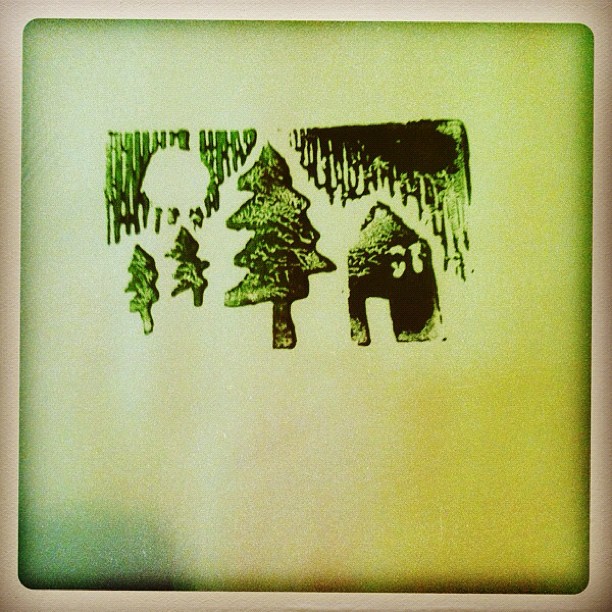
Block print Christmas card

Last weekend, the fields around the village where I live started to turn from green to harvest gold. Like the changing of the season, I noticed the first uptick in traffic to this web log. Or rather to one post in particular — Advent Poems (or the 12 days of Christmas poetry).

Best intentions

DSCN4098[sqr]

The intent was to watch the sun set and watch full, strawberry moon rise on the summer solstice.[1] But I fell asleep and awoke after 1 a.m. — cloudy, nighttime pondering of lessons in risk management.[2] A few hours later, I watch the light brighten the room[3] as I prepare for a morning walk.

NOTES:
[1] Bob Berman, “Summer Solstice Full Moon in June!,” The Old Farmer’s Almanac, accessed June 20, 2016 http://www.almanac.com/blog/astronomy/astronomy/summer-solstice-full-moon-june
[2] Gregory Orr, “Farther’s Song,” Academy of American Poets, accessed June 20, 2016 https://www.poets.org/poetsorg/poem/fathers-song.
[3] Charles Simic, “Secret History,” The Writer’s Almanac, June 19, 2016, accessed June 20, 2016 http://writersalmanac.org/episodes/20160619/.

Bonus Poem: Late Night Writing

Title poem by Matthew Mulder from the book Late Night Writing.

Poem 12: Prairie Constellations

"Prairie Constellations" by Matthew Mulder from the book Late Night Writing.
“Prairie Constellations” by Matthew Mulder from the book Late Night Writing.

Poem 11: Sunrises I and III

DSCN5427[bsc-lomo-dusk]

Poem 10: Always Departing

An excerpt of "Always Departing" by Matthew Mulder from the anthology Rooftop Poets.
An excerpt of “Always Departing” by Matthew Mulder from the anthology Rooftop Poets.

Poem 09: Narrative kernel

DSCN5426[sqr-bsc-lomo-dusk]

Poem 08: Reading “The American Zen Master” by Dick Allen

Reading The American Zen Master