Here’s a video of Pasckie Pascua from last week’s Traveling Bonfires poetry reading at Malaprop’s Bookstore/Café.
Month: May 2010
Publishers, present a reason to buy your artifact
“Consumers need powerful emotional & psychological reasons to buy your books rather than just grab the nearest free e-book,” says Audry Taylor, creative director of Go! Comi. Earlier this month, Robot 6 announced that Go! Comi closed shop “due to a combination of economic downturn and digital theft.” In a recent article she offers five suggestions for publishers who want to avoid going out of business due to digital piracy:
- Make a story available world-wide simultaneously in all major languages.
- In a digital format.
- With perks for pre-orders.
- And goodies that digital pirates can’t reproduce. (And yes, that’s possible. Goodies they can’t compete with, like author chats.)
- Rip off business model 4 pirate sites & one-up them. They offer a Wii raffle for a subscription to a d/l site, u offer author-signed Wii
Though this is written primarily for a manga/comic publishing audience, I think this is good advice for any book publisher.
I’ve said this before, but books need to be designed in way that compels consumers to buy a souvenir, dead-tree product (maybe in a decade a book will be called an artifact). In light of Audry Taylor’s comments, I plan to amend that note to encompass a broader reach than well-designed, dead-tree products. She continues by saying, “My dream pub company is multimedia + print + Etsy + Cafepress + Goodreads + Facebook + fan community.” I agree. The more you compel readers/content users to make emotional and psychological investments in your content, the better the relationship your brand will have with your loyal followers (dare I say, your brand’s evangelists?).
Garden project: how to eliminate unwanted slugs
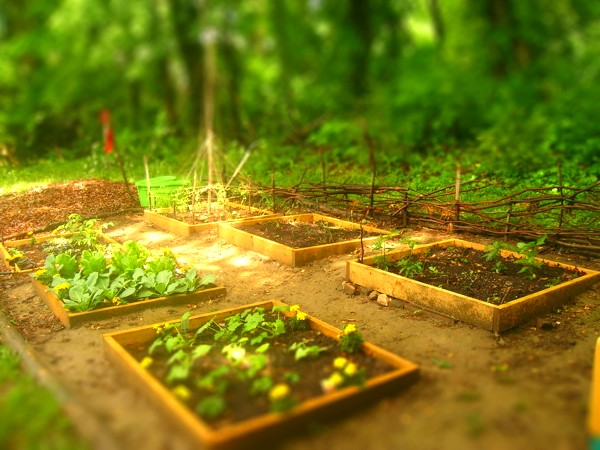
All six garden beds are in and mostly full. A couple more tomato and pepper plants would be a nice addition. Plus I’m waiting for the kale and chard to mature enough to put them in the ground.
The lettuce leaves are big enough to pull a couple for a sandwich a couple of nights ago.
Only thing that’s a bit annoying is how the slugs seem to attempting to take over the southeastern corner of the garden. Two techniques to organically get rid of unwanted snails include beer and salt. First I’ll try the beer bait first. If the slugs persist, I’ll use salt.
The beer technique works like this:
- Fill a small container (like a baby food jar) about a third full of beer and place them in the infested areas of the garden.
- Place the slug bait in the garden in the morning or evening. I usually place the beer containers in the garden at dusk and check it the next morning.
- Empty the beer containers of the dead slugs and repeat the process.
If this doesn’t curb the invasion, the next phase of attack is salt.
Always be prepared to read your poems
When I mentioned earlier today that you should join the Traveling Bonfires tonight at Malaprop’s, you really were invited to join the reading. Two of the three poets were unable to show up for tonight’s reading. The emcee of the poetry reading and founder of the Traveling Bonfires invited anyone in the audience to read poems. He asked me to read my poems as well.
I wasn’t prepared to read; only to listen. But no one else came prepared to read. So, I frantically dug into my old messenger bag and found two poetry chapbook manuscripts by other poets. For a brief moment I thought I would read from their manuscripts, but I didn’t want to read poems that weren’t ready for the public. Sandwiched between loose papers and a copy of Selected Cantos of Ezra Pound and Narrow Road to the Interior was my red notebook containing poem sketches and revisions. I had half of a thought to read selections from Pound and Basho, but in my notebook I found six poem sketches and revisions to test in front of an audience.
The moral of the story is this: always be prepared to read your poems and if you’re a poet in the Asheville area (or if you’re a poet traveling near the Asheville area) contact me or the Traveling Bonfires (travelingbonfires@yahoo.com) and we’ll find a space and a mic and a crowd of listeners.
Poetry reading: Traveling Bonfires at Malaprop’s
Join the Traveling Bonfires tonight — Monday, May 17th — at Malaprop’s from 7 to 8pm for a poetry reading featuring poets Pam Israel, Dave Rowe and special guest. Emcee: Pasckie Pascua.
Poem: Appalachian omens
“Appalachian omens” by Matthew Mulder
Anticipation
of rain and Sunday dinner,
we see a groundhog
resting on a rock near the
restaurant entrance.
And on the way home,
above the road we see a
hawk gripping a snake
while evading two large crows.
If I were the priest
Kalchas, I might proclaim that
I see the war-like
sons of Atreus, or some
other such omens.
Google says, my bad
Google’s history of scanning books without author/publisher permission to populate their online book catalog makes me suspect there’s something askew with this story. From the WSJ:
Google had previously said it was collecting the location of Wi-Fi hot spots from its StreetView vehicles, but not the information being transmitted over those networks by users.
“It’s now clear that we have been mistakenly collecting samples of payload data from open (i.e. non-password-protected) Wi-Fi networks, even though we never used that data in any Google products,” wrote Mr. Eustace. “We are profoundly sorry for this error and are determined to learn all the lessons we can from our mistake.”
Read more: link
350,000 downloads in 17 months
As of this morning, total downloads for this year are set to eclipse total downloads of last year.
Also, the last two months of podcasts feature paid sponsors — thanks to a great sales team.
I’ll write more about what gear I use to produce a podcast in an upcoming post.
Remember when you didn’t use your real name on the Internet?
Facebook is ubiquitous. In many ways it has replaced blogging. As an individual who has been blogging, well, since before the advent of Facebook, there were certain silent codes to blogging. Local bloggers like Edgy Mama, Ashvegas and Modern Peasant (who I recall may have been blogging before the advent of the internet), maintained a third–tier level of intimacy with blog readers. In other words, there were third-tier personal details that were disclosed on blogs, but other more intimate personal details that may or may not be disclosed in real life at local blogger meet ups. It appears that Facebook disregards a third-tier relationship between content provider and content consumer. Here’s a couple of articles I’ve read recently about Facebook.
Some excerpts from Gizmodo: Top Ten Reasons You Should Quit Facebook
10. Facebook’s Terms Of Service are completely one-sided: Facebook’s Terms Of Service state that not only do they own your data (section 2.1), but if you don’t keep it up to date and accurate (section 4.6), they can terminate your account (section 14)….
9. Facebook’s CEO has a documented history of unethical behavior: According to BusinessInsider.com, [Zuckerberg] used Facebook user data to guess email passwords and read personal email in order to discredit his rivals. These allegations, albeit unproven and somewhat dated, nonetheless raise troubling questions about the ethics of the CEO of the world’s largest social network…
8. Facebook has flat out declared war on privacy: Founder and CEO of Facebook, in defense of Facebook’s privacy changes last January: “People have really gotten comfortable not only sharing more information and different kinds, but more openly and with more people. That social norm is just something that has evolved over time.” … Essentially, this means Facebook not only wants to know everything about you, and own that data, but to make it available to everybody.
3. Facebook makes it incredibly difficult to truly delete your account
And here’s an excerpt from Wired: Facebook’s Gone Rogue; It’s Time for an Open Alternative
So in December, with the help of newly hired Beltway privacy experts, it reneged on its privacy promises and made much of your profile information public by default. That includes the city that you live in, your name, your photo, the names of your friends and the causes you’ve signed onto.
This spring Facebook took that even further. All the items you list as things you like must become public and linked to public profile pages. If you don’t want them linked and made public, then you don’t get them — though Facebook nicely hangs onto them in its database in order to let advertisers target you.
This includes your music preferences, employment information, reading preferences, schools, etc. All the things that make up your profile. They all must be public — and linked to public pages for each of those bits of info — or you don’t get them at all.
[Read More: http://www.wired.com/epicenter/2010/05/facebook-rogue/#ixzz0nY6uIYRD]
And Business Insider offers 10 Reasons You’ll Never Quit Facebook, including:
- How will you remember anybody’s birthday?
- How will you hear about parties?
- You don’t care about privacy anymore. Remember when you wouldn’t use your real name on the Internet?
And my personal issue to hate Facebook for:
- 80 million of you are addicted to Zygna’s Facebook game, FarmVille.
The Internet has allowed access to volumes of data. Yet, some personal details should be maintained behind firewalls or offline. I’m not sure if it’s entirely Facebook’s fault. Facebook users willingly surrender intimate details to the Internet gods. A good, old school blogger rule is this: the Internet is immediate and permanent; only post stuff you want to remain permanent and searchable.
the garden project: late april
New feet within my garden go,
New fingers stir the sod;
A troubadour upon the elm
Betrays the solitude.
—Emily Dickinson, “The Garden”
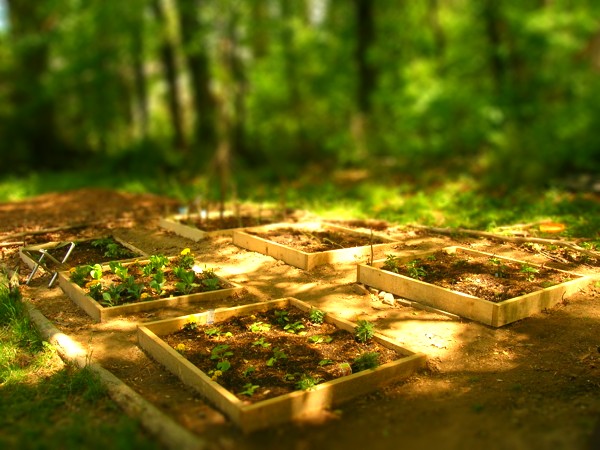
Unlike the poem, the troubadour is a male cardinal and the tree is an red oak. And no, I didn’t color coordinate the bird and tree. Actual bird and tree reside on or near the location of the garden. A cardinal couple made their home east of the garden project and routinely perch on a lower limb of the red oak tree and comment on my gardening progress.
At this point, all six garden boxes are built, soil turned, topsoil added and plants planted. Plants yet to plant include chard and kale and a couple blueberry bushes. The blueberry bushes will go in the northwest corner.
The garden receives at least six to eight hours of direct sunlight each day, but not until after noon. On an early morning in late April the sunlight provides dappled shadows on the garden. By May, the surrounding trees are in full green dress and the garden remains in full shade until noon.
The garden project: diy terrace gardening
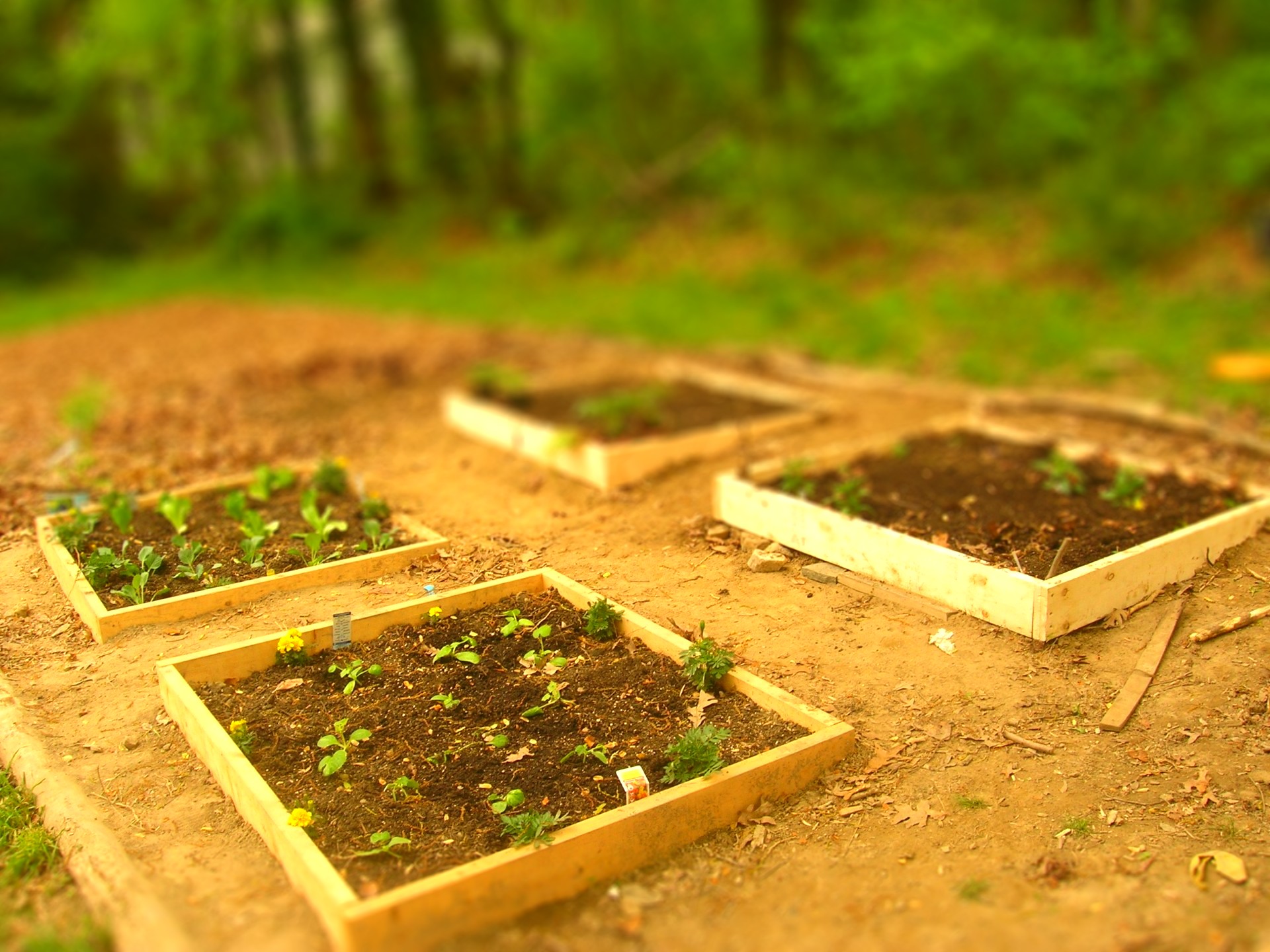 The garden project revealed something very obvious the other weekend; I really underestimated is the slope of the land. Two more boxes were built on the east side of the garden; otherwise known as the top of the garden. Each box is level, but east boxes are almost six inches higher than the west boxes. At this point, the only thing that’s in the ground are cucumbers, cabbage, lettuce and some assorted plants that lost their labels (I’ll know what I planted later this year from the fruit they yield).
Initially, the idea in my head was terrace gardening, but a challenge presented itself. Mainly this, more lumber is required for proper terracing of a slope. I suppose I could use stone for terracing a slope, but the transportation costs of delivering stones exceeds my budget. So, with limited resources, I maintain the raised bed/container gardens strategy, but have to build the boxes into the slope in such a way that each box varies in elevation from two inches to six inches. From the southeast corner to the northwest corner is a difference of almost a foot. And remember, the goal is six garden boxes.
The garden project: marigolds
I came here last, bringing
marigolds from the round garden
outside the kitchen.
—Donald Hall, “Maple Syrup”
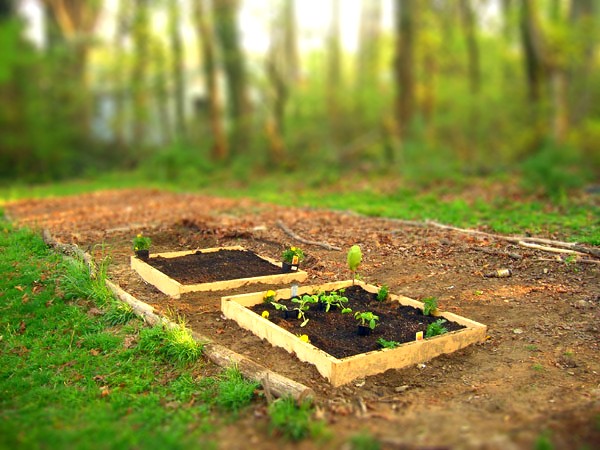
The last few weeks have been chaotic and I’ve had a challenge focusing on the garden project. The goal is to build six wood container boxes. But my weekly lumber allowance disappeared rather quickly; cost more over $17 to build two 4’x4′ boxes. The other challenge is the composting I did in the fall of ’09 only filled one box. So know I have to spend a few extra dollars purchasing topsoil.
Since I don’t own a motorized tiller, I resorted to a very old method of preparing the soil for planting. The New Self-sufficient Gardener by John Seymour offers an old English tradition for raised beds preparation. Basically, get a spade and dig down 6 to 10 inches and flip, or turn, the soil. After turning the soil in each box, I used a garden weasel tool to break up the soil even more. Finally, I added about two to three inches of topsoil before I began planting marigolds around the perimeter of the box. One source I read stated that marigolds provide an organic pest repellent. This is the first year I’ve used marigolds in the garden.
The garden project begins
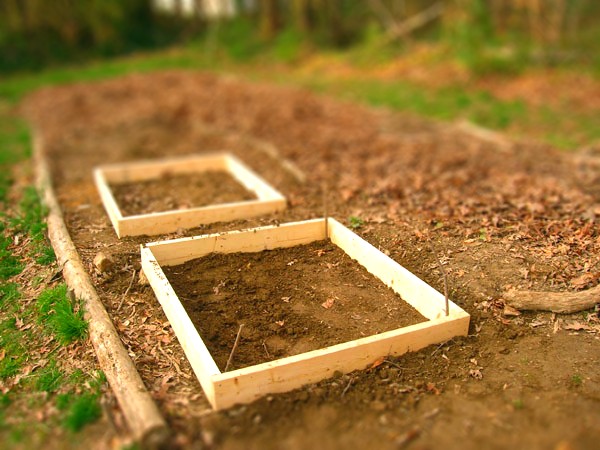
The last couple of years the garden project goals have been simple: spend less than $100 on garden supplies (seeds, plants, etc.), use native or found materials (like creek stones or fallen, dead wood from local trees to make garden borders) and avoid using pesticides or herbicides (with the exception of natural, organic pesticides like cayenne pepper, ground cinnamon & the like).
This year I took the liberty to construct garden boxes with the goal of making raised bed/container gardens. The garden boxes are made from 2″x6″ pine boards and measure four feet square.
I began the garden project in April.
I’m using a variety of sources to put together this year’s garden project. But the primary gardening strategy handbooks I use include Trowel & Error by Sharon Lovejoy and The New Self-sufficient Gardener by John Seymour.
No more Free Lunch
This weekend I received a letter in the post informing me that Free Lunch is closing shop. The news really disappointed me for two reasons. One, I was hoping to have some poems published. Two, I reviewed an issue of Free Lunch for Small Press Review and really enjoyed the publication. Some literary/poetry publications are dense with inaccessible poetry and my work doesn’t seem to fit. But Free Lunch felt like a good fit. Here’s an abridged version of the review I submitted to Small Press Review:
Free Lunch presents an engaging 20th Anniversary issue. Unlike many poetry magazines that contain a smattering of good poems and a couple great poems, the Spring 2009 issue of Free Lunch collects stellar work by Billy Collins, Stephen Dunn and many others. It is my habit as a reader to dog-ear pages in books or magazines that elicit some sort of physical response; like smacking a book on my knee and saying “yeah” to the amusement of fellow bus riders. Lyn Lifshin writes, “I love the sense/ of her contentment/ feel it moving/ inside me the/ way when a/ poem works…” in her poem “Writing a poem is like why and when a cat purs.” In “Advice from a Pro,” X. J. Kennedy writes, “I vowed to make my work intensley sober.” There are many great poems by poets Roger Aplon, Denise Duhamel, and others. And, in short, my copy of the 20th Anniversary of Free Lunch has almost every page dog-eared with praise.
Poem: Saturday Night, Coffee House
“Saturday Night, Coffee House” by Matthew Mulder
The awkwardness is complete—
strangers sitting side by side
with nothing to offer but body heat
on this cold winter night;
and the only thing that
connects us is my brother’s wife
and the wooden bench we sit upon.
Conversation is embarrassingly
fumbled with references to
the chai we sip;
and at long silences we sip
more chai and look
around the coffee house
for more material to
discuss,
or some distraction
to fascinate our senses.
(Originally published in Rapid River Magazine, April 2004.)
 Coffeehouse Junkie