Confession: I am an advocate of self-publishing. I have been for years. But my views are changing on the matter due to the glut of poorly written self-published books being released each year. Serendipitously, I found this article in the London Evening Standard that offers two reasons why not to self-publish: 1) publishers and 2) editors.
Authors need publishers more than ever when there are so many voices out there competing for our attention. As Horowitz rightly says, the main raison d’être of a publisher is to provide the author with a skilful editor who can turn a sow’s ear into a silk purse.
Editors are the midwives of great literature. T S Eliot’s The Wasteland wouldn’t have been the masterpiece it is if it hadn’t been edited by Ezra Pound and his wife, Vivien.
The death of publishing is greatly exaggerated. We will still need publishers as long as we read books, just as we still need critics to review those books. It is part of the great filtering process of literature and culture. (link: Self-publishing makes us think we can write)
The monthly poetry reading series Poetrio continues Sunday, March 4, 2012, 3:00 p.m. at Malaprop’s Bookstore/Café. The March Poetrio features Megan Volpert with SONICS IN WARHOLIA, Rupert Fike with LOTUS BUFFET, and Jethro Clayton Waters with SOUTH OF ORDINARY.
Please note that UNC-A has a champion basketball event downtown this weekend and the public parking garages will charge a special daily “event fee.” Park away from the center of downtown Asheville and enjoy a lovely Sunday afternoon stroll to Malaprop’s. They have a wonderful café with refreshments and poetry for after a nice walk through the city.
Later this week, a literary reading featuring Catherine Reid and Valerie Neiman. February 18, 2012, at Posana Cafe, at 7:30 p.m.
Catherine Reid is the author of COYOTE: SEEKING THE HUNTER IN OUR MIDST, as well as essays in such journals as GEORGIA REVIEW, MASSACHUSETTS REVIEW, FOURTH GENRE, and BELLEVUE LITERARY REVIEW. Currently, she directs the undergraduate creative writing program at Warren Wilson College, where she also teaches creative nonfiction and environmental writing.
Jane Alison calls Valerie Nieman‘s third novel, Blood Clay “both a tense, plot-driven story about complicated issues of race and guilt, and a meditation on solitude, history, and ways of living.”
A former newspaper reporter, Nieman is also the author of a collection of short stories, Fidelities, and a poetry collection,Wake Wake Wake. She teaches at the John C. Campbell Folk School and serves as poetry editor of Prime Number magazine.
From an email from Mark Prudowsky and Katherine Soniat
How many book lovers among the young has the Internet produced? Far fewer, I suspect, than the millions libraries have turned out over the last hundred years.
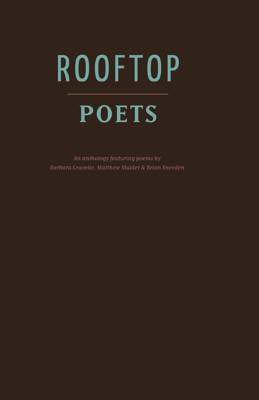
In September 2010 an idea was born to hold a poetry reading under a full moon at the Roof Garden of the historic Battery Park Hotel. Three weeks after that September afternoon, sixty people attended an invite-only poetry reading, book-signing and jazz show on Friday, October 22, 2010. The event was publicized almost exclusively through Twitter, Facebook and word-of-mouth and featured Asheville, North Carolina poets Barbara Gravelle, myself (Matthew Mulder) and Brian Sneeden with special musical performance by Vendetta Creme and Aaron Price. And thus, Rooftop Poets was born in Asheville under a full moon.
Since the Roof Garden reading, the Rooftop Poets have been invited to read at various venues and interviewed for newspaper and television. Brian’s poem “The Temple” (included in Rooftop Poets poetry book) went on to be the Mountain Xpress’s first place winner in their 2011 poetry contest.
If you missed the memorable evening last October, there are still a few copies of the limited-edition, 64-page book. You may purchase copies at Malaprop’s.
Rooftop Poets is a limited-edition, 64-page book of poems featuring the work of three Asheville, North Carolina poets.
Barbara Gravelle, author of several poetry books including, Keepsake, Dancing the Naked Dance of Love, and her latest collection of poems, Poet on the Roof of the World.
Matthew Mulder, one of the original members of the Traveling Bonfires, his poetry and prose have appeared or are forthcoming in Crab Creek Review, Small Press Review, The Indie, H_NGM_N, and other publications.
Brian Sneeden has produced, designed or written for more than a hundred theatrical performances. He is the current director and MC of Asheville Vaudeville.
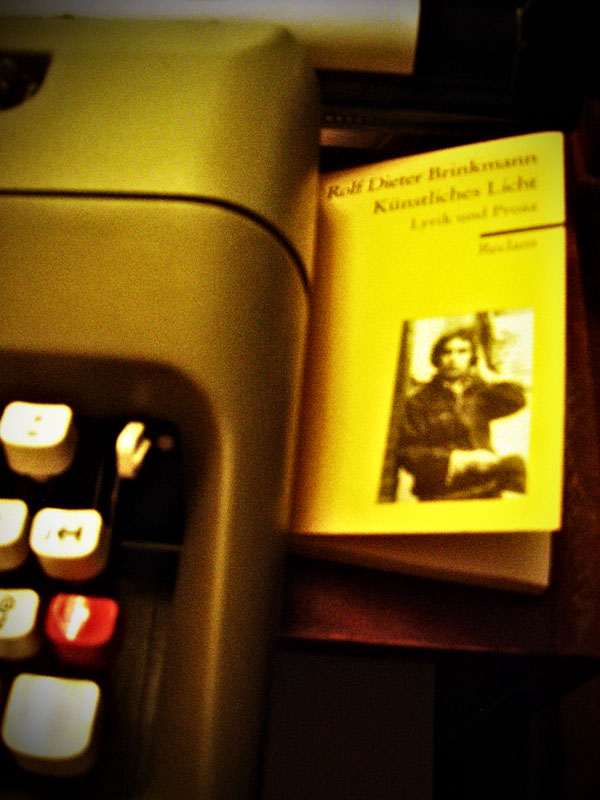
Brinkmann’s book Künstliches Licht begins with a poem titled after the French architectural style of roughly-finished concrete. Nothing more interesting than translating a German poem with French words and deeper contextual elements.
Look what arrived from across the pond. Forgive me for being rather spare with my online presence these last few weeks. I’ve got two good reasons and a surprise.
A vintage manual typewriter arrived and I’ve been spending more time using that machine than I’ve been online.
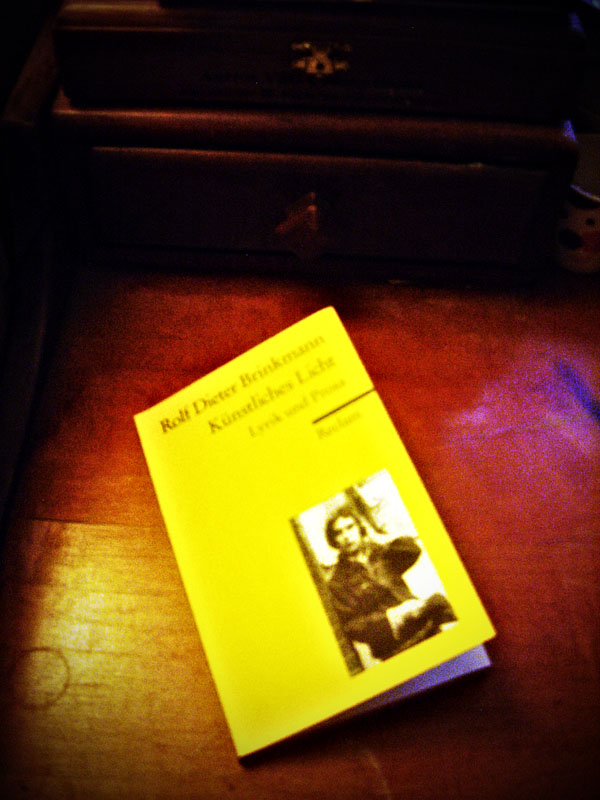
A copy of Rolf Dieter Brinkmann’s Künstliches Licht arrived in time for the rainy season and I’ve been reading in German and translating to English. Hopefully I’ll have some of the translations done in time for the upcoming Poetry at the Pulp event on April 8th.
Okay so the big surprise is still in the works. Sorry for the tease. I’ve been working on something new and plan to launch it here in the near future. That’s all I can say at this point. By the end of the week I should have more details that I will share.
Tomorrow We Sweat Poetry (paperback, 20 pgs, 8″x5″ $8 + s/h) is officially out of print.
Tomorrow We Sweat Poetry is the result of the workshop I directed called “Write and do not waste time” and features poems by Susan Ryonen Keene. A digital sample is available here. Each poetry writing workshop I direct invites students to contribute their best poems for publication in a poetry book. If you’re interested in an upcoming poetry writing workshop, please leave a comment or email me at coffeehousejunkie [at] gmail [dot] com.
Maybe ‘review’ is a bit of an erudite word to use in this blog title regarding Sunday’s poetry reading at Malaprop’s Bookstore/Café. But Sunday’s poetry reading may be one of the best Poetrio readings I’ve attended in a long time. After the snow flurries ceased the poetry began. Several local literary luminaries were in attendance including Pat Riviere-Seel, Gary Hawkins, Sebastian Matthews, Keith Flynn among others.
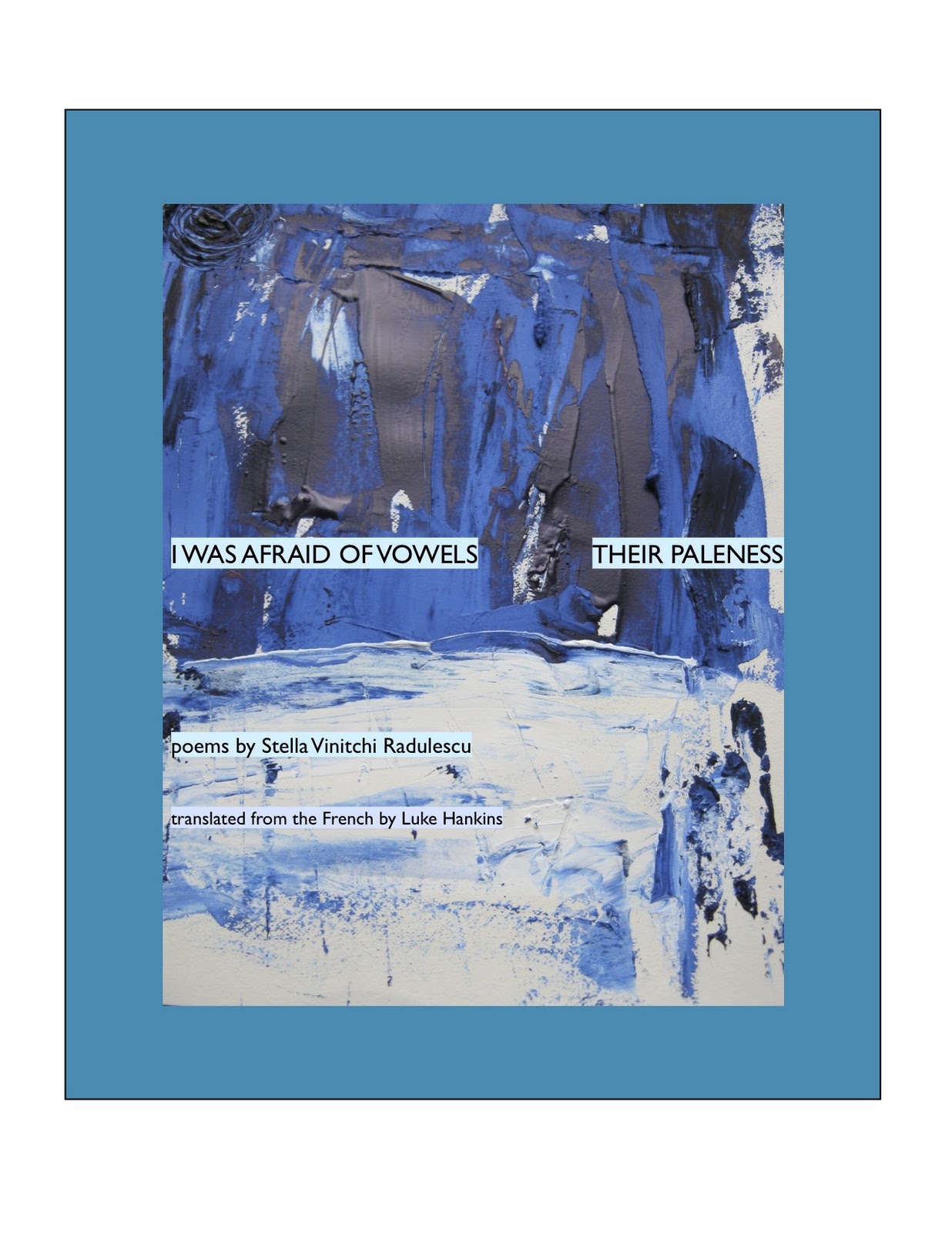
I Was Afraid of Vowels, Their Paleness by Luke Hankins
The first poet who read was Luke Hankins, Associate Editor of Asheville Poetry Review. I first learned about Luke from an article he wrote for the The Writer’s Chronicle and then I had the privelege to met him at one of the Poetry at The Pulp events last year.
He read from his recently published bilingual chapbook of translations, I WAS AFRAID OF VOWELS / THEIR PALENESS, of French poems by Stella Vinitchi Radulescu. Poems read include: ‘landscape in three movements,’ ‘children of the fog,’ ‘a cry in the snow,’ and the poem where the title of the chapbook originates — ‘adagio.’ Radulescu’s poems tend to be spare and short and afforded Luke opportunity to read some of his own poems. The difference between Luke and Stella’s styles offered a stimulating contrast to his portion of the Poetrio reading. Luke read another translation he had made of a different French poet. I didn’t catch the name of the poem or poet, but the poems essence was atmospheric (and reminded me of the poet Jean Orizet) and provided a beautiful centerpiece to his portion of Sunday’s reading.
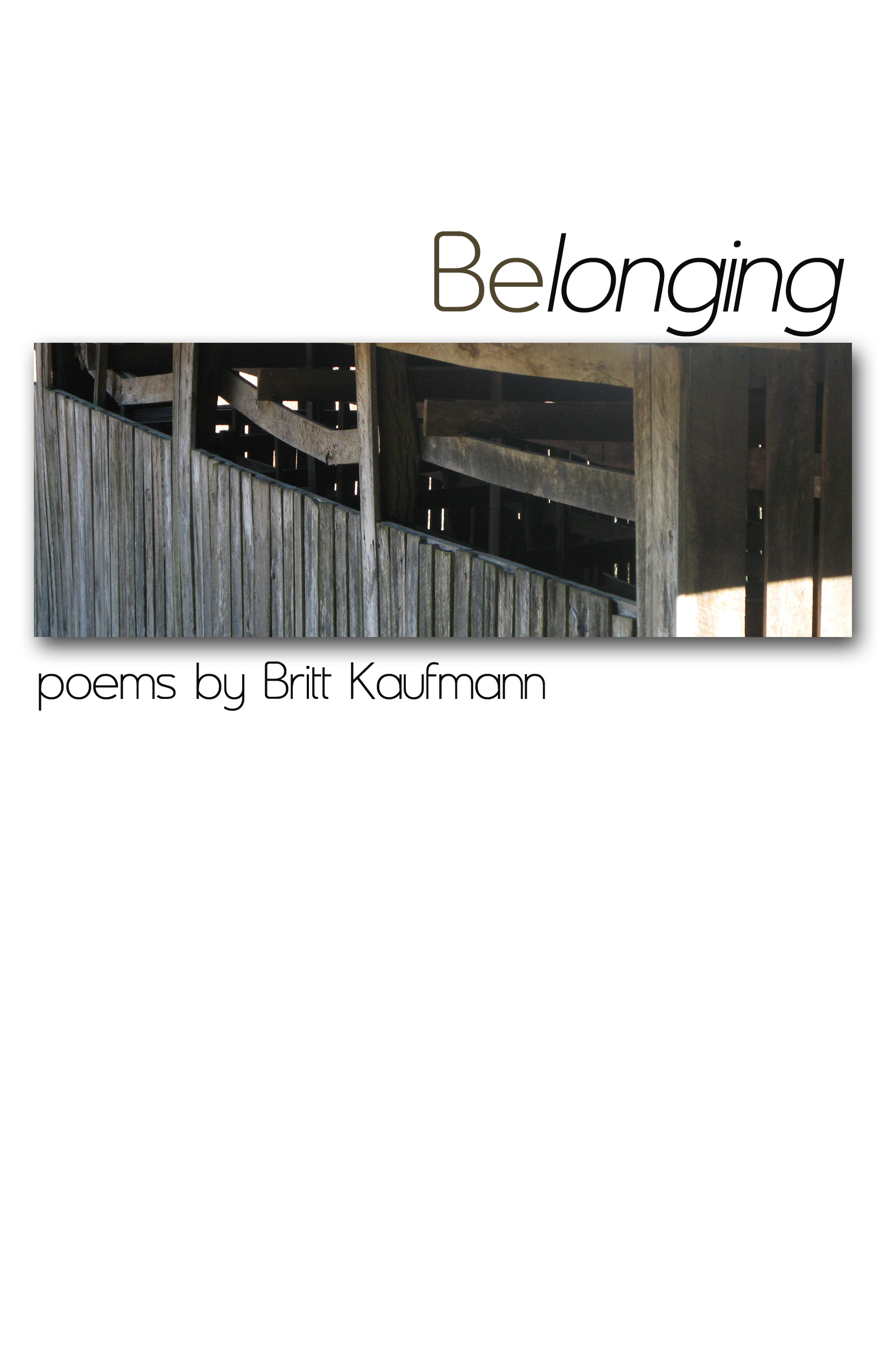
Belonging by Britt Kaufmann
Britt Kaufmann read next from her recently published chapbook BELONGING. Her chapbook was named a semi-finalist in the most recent competition for the New Women’s Voices Series at Finishing Line Press.
My introduction to Britt and her work was at a Flood Reading Series in February 2007. Poems read include: ‘Oak Leaf,’ Hand-Me-Down Gift,’ ‘Under Grandma’s Quilt, ‘Tobacco Barns,’ and others. Interestingly, the title poem to the chapbook is not included in the collection of poems. But Britt read it as her last poem of her portion of the event.
Britt’s poetry evokes a celebration of everyday moments too often overlooked. A lyrical ache subtly emerges from each poem the way daffodils quietly appear in late February here in the mountains. There’s a longing for meaning in each poem and a sense of contentment to just be.
If you missed Poetrio, Britt is scheduled to read on Friday May 6, 2011 at 4 p.m. at Wordfest at Grateful Steps Publishing House and Bookshop.
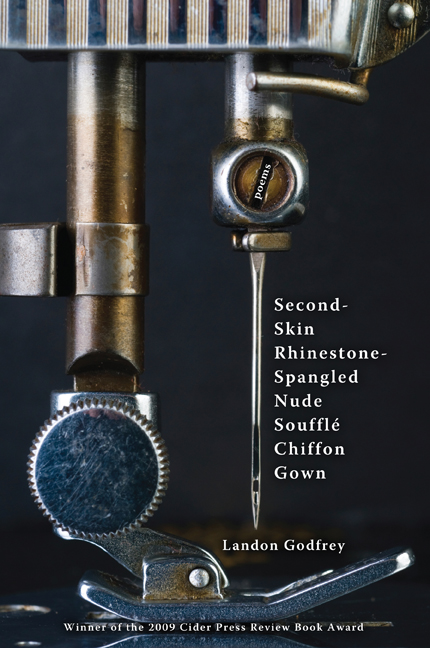
Second-Skin Rhinestone Spangled Nude Souffle Chiffon Gown by Landon Godfrey
The final poet to read at Sunday’s Poetrio event was Landon Godfrey. She read from her recently published book, SECOND-SKIN RHINESTONE-SPANGLED NUDE SOUFFLE CHIFFON GOWN. David St. John chose her manuscript as the winner of the 2009 Cider Press Review Book Award.
A book title like this is hard to forget, and equally difficult to remember. I first heard Landon read the title poem at a Flood Reading Series in March 2009 [listen to the audio] and later at May 2009 Poetrio event. Other poems read at those 2009 readings included ‘Chanel No. 5,’ ‘Labor in Vain,’ ‘There Are Thousands of Stones in the Sky,’ and ‘On Black Cloth with White Chalk I Drew the Stars.’ Landon read some of those poems at Sunday’s Poetrio reading as well as others: ‘Landscape with Dialectical Materialism and Milk,’ ‘Hotel Beds,’ and ‘Compositions in Grey and Grey.’
Landon’s poems provide a rich, lush tapestry of memorable moments that haunt you long after you’ve heard or read them. There’s tense, delicious balance between smooth sensuous lines and jarring acrimony in her poems.
Again if you missed Sunday’s Poetrio, Landon is scheduled for a reading and book signing at Warren Wilson College’s Sage Cafe with March 24, 2011 at 7 p.m. She is also scheduled for a reading and book signing at Wordfest, on May 7, 2011 at 7 p.m.




 Coffeehouse Junkie