This week the Juniper Bends reading series continues this Friday, February 10th, at 7:00 p.m. at Downtown Books and News. The event features readings by: Kate Zambreno, Katherine Soniat, Jesse Rice-Evans and Adam Jernigan. Visit the Facebook event page for more details. (link)
Category: literature
Three things I learned from Christopher Hitchens
This morning, after reading the news of the passing of celebrity intellectual Christopher Hitchens, I reblogged a few items and quotes on my Tumblr page. [1] [2] It was not his rhetoric [3] that attracted me to his public persona. Nor is it his writings that attracted me to him. I have not read all his books. Though I do confess that I subscribe to The Atlantic for the sheer pleasure of reading his articles.
What enamors me to Hitchens is his justo to engage in the Great Debate. [4] That inspires me. Where most of our culture retreats from serious discussion of issues of faith, philosophy and religion–preferring reductionist thought and banal entertainment–Hitchens stoked the fires of conversation and debate with wit, passion and intrigue. In reflecting what I might learn from the life of Christopher Hitchens, I feel quite inadequate. There is so much to learn from him, yet, here are three short thoughts:
- If you are a mediocre or even good writer, your words will survive you.
- Friends will shape you and your thinking.
- Avoid being defined by your critics and fans.
Writers and public intellectuals will compose grand obituaries with wise thoughts, expressions and reflections. Their words will be published today and throughout the weekend in the world’s largest newspapers and magazines. And then there are a lot of us beyond the periphery of the spotlight and public square who in some small way are affected by his legacy. To conclude, as one writer concluded his obituary, [5] Christopher Eric Hitchens (1949-2011). R.I.P.
NOTES: [1] “I became a journalist…” and “to remember friendship is to recall those conversations…” and Postscript: Christopher Hitchens, 1949-2011. [2] To some who know me beyond the façade of blogs and social media, this may or may not appear an odd display. [3] He often offered false assumptions and careless conclusions in his arguments. In this, I refer to rhetoric as it relates to classical education (rhetoric builds on grammar and logic) not polemics. [4] The Great Debate is more than a book or video (featuring Hitchens), it is an age-old debate of the existence of God. [5] “Christopher Hitchens Has Died”
Nightstand reading
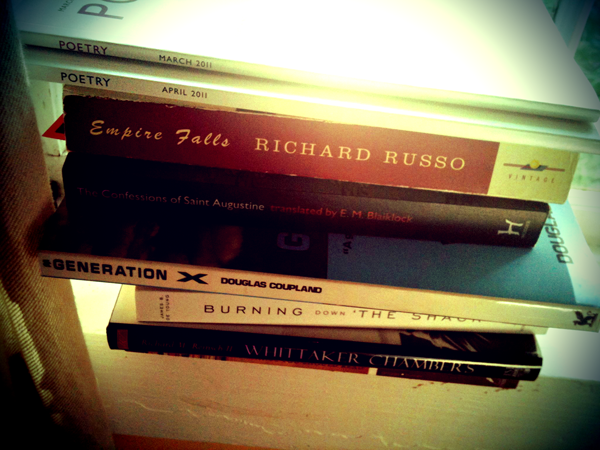
I’ve been told my taste in books is eclectic.
Who will be the winner of the 2011 Mountain Xpress Poetry Prize?
And the finalists are:
- Randal Pride, “Coal Palace”
- Jessie Shires, “Corpus unum”
- Jesse S. Rice-Evans, “Taking A Bath In Frida Kahlo’s Tub”
- James Cox, “By the Lake in Northern Michigan”
- James Davis, “Sourwood”
- Jessica Claire Newton, “Two Weeks Deep Into the Dirty Laundry”
- Tamsen Turner, “Sestina”
- Brian Sneeden, “The Temple”
- John Eells, “Sleep And Dreams”
- Andrew Procyk, “Life and Death”
Some good poets represented on this list. Should be great evening of poetry and music.
I am honored and humbled to be on the list of featured poets for event. There’s a nice write-up in the Mountain Xpress (Rhyme and reason) that mentions my involvement with the Rooftop Poets. Last time I was mentioned in the Xpress was when I was contributing to The Traveling Bonfires.
If you can make it to the big show tomorrow night, here’s some more details from the Mountain Xpress’s Facebook event page:
Featured poets include:
• Laura Hope-Gill, Director of Asheville Wordfest and Blue Ridge Parkway poet laureate.
• Matt Owens and Mesha Maren of the Juniper Bends reading series.
• Matthew Mulder and Brian Sneeden of the Rooftop Poets series.
• The top 10 finalists of the 2011 Mountain Xpress poetry prize will read their poems, and the overall winner of the contest will be announced. (The 10 finalists will also read their winning poems at the Saturday night YMI party during Wordfest in May.)The evening concludes with a live performance by Keith Flynn & the Holy Men in celebration of the release of their album, “LIVE at the Diana Wortham Theatre.”
The even begins at 7 p.m. with a reception. Poetry readings begin at 8 p.m., and music begins at 9 p.m.
Tickets are $5 and can be purchased in advance at http://www.mountainx.com/mxcore/poem/tickets or at the door.
Hope to see you there!
The Mountain Xpress Poetry Show Ashevill – coming up in 1 day
Friday, April 8th, 7PM, The Mountain Xpress Poetry Show featuring Laura Hope-Gill, Director of Asheville Wordfest, Matt Owens, Mesha Maren, Matthew Mulder, Brian Sneeden and the top 10 finalists of the 2011 Mountain Xpress poetry prize. Plus a performance by Keith Flynn & the Holy Men.
Poetry Prize finalists announced
Mountain Xpress announced their poetry prize finalists today. Among the finalists are a couple of friends. Hope all my friends win first place! The winning poet will be announced next Friday, April 8th, at the Mountain Xpress Poetry Show.
As part of the Mountain Xpress Poetry Show, I have been invited as a guest poet to read alongside some of Asheville’s talented and notable poets. I’ll be the poet wearing the t-shirt that reads: “Haikus are easy/but sometimes they don’t make sense/refrigerator.”
Hope to see you next Friday night!
Translating Concrete
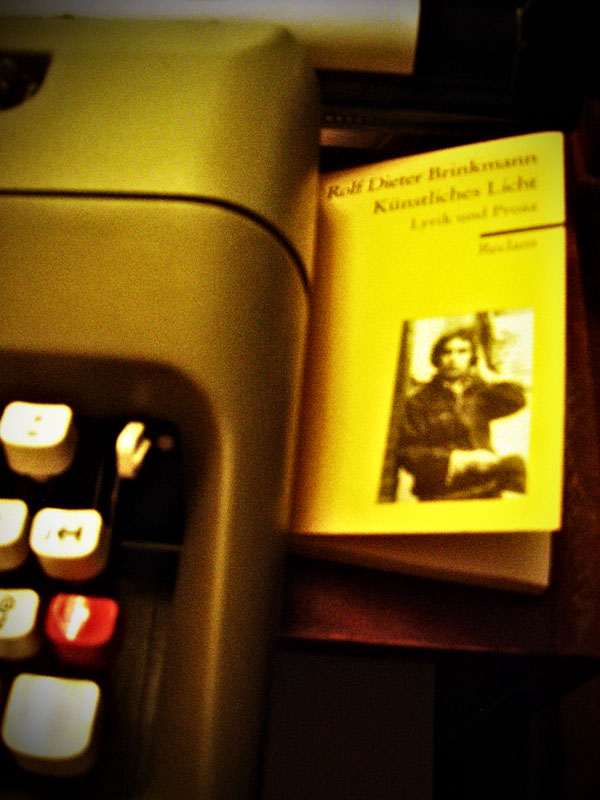
Brinkmann’s book Künstliches Licht begins with a poem titled after the French architectural style of roughly-finished concrete. Nothing more interesting than translating a German poem with French words and deeper contextual elements.
Lost in translation
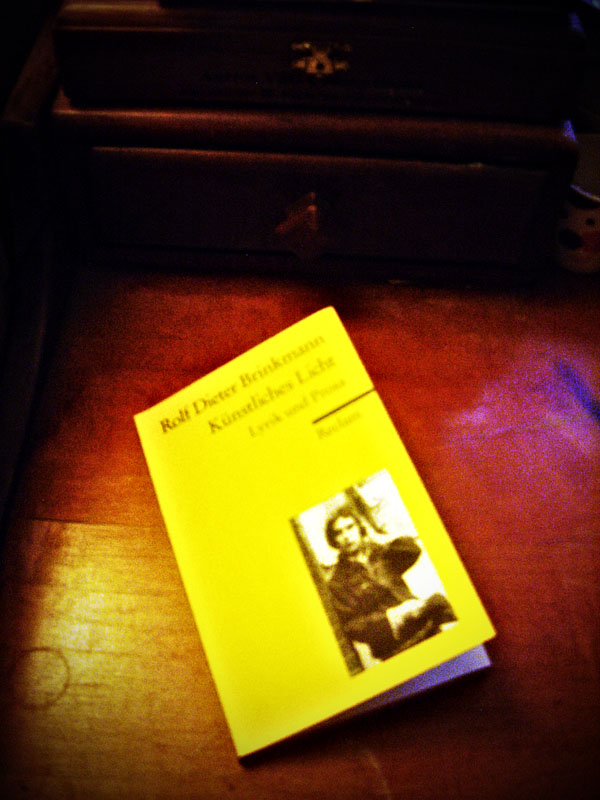
Look what arrived from across the pond. Forgive me for being rather spare with my online presence these last few weeks. I’ve got two good reasons and a surprise.
- A vintage manual typewriter arrived and I’ve been spending more time using that machine than I’ve been online.
- A copy of Rolf Dieter Brinkmann’s Künstliches Licht arrived in time for the rainy season and I’ve been reading in German and translating to English. Hopefully I’ll have some of the translations done in time for the upcoming Poetry at the Pulp event on April 8th.
Okay so the big surprise is still in the works. Sorry for the tease. I’ve been working on something new and plan to launch it here in the near future. That’s all I can say at this point. By the end of the week I should have more details that I will share.
Poetrio reading, Sunday, March 6, 2011, 3:00 p.m. at Malaprop’s Bookstore/Café: Landon Godfrey, Luke Hankins, Britt Kaufmann
From Malaprop’s e-newsletter:
On Sunday afternoon, March 6 at 3:00 p.m., Malaprop’s Bookstore/Café will welcome poets Landon Godfrey (SECOND-SKIN RHINESTONE-SPANGLED NUDE SOUFFLE CHIFFON GOWN), Luke Hankins (I WAS AFRAID OF VOWELS / THEIR PALENESS), and Britt Kaufmann (BELONGING). The reading and booksigning event is free and open to the public, and we hope that you will join us at this monthly poetry event.
Poet, artist, and actress Landon Godfrey read her poetry at the Malaprop’s Poetrio event in May 2009, and some of you may remember that this versatile practitioner of many arts has had work published in the Black Mountain College Museum + Arts Center chapbook, Voicing BMC: The Women; in Best New Poets 2008, selected by Mark Strand; and in Orbis, The Missouri Review, The Southwest Review, Beloit Poetry Journal, and many other literary journals. You may also have seen her on the stage of the BeBe Theatre in Asheville, and she’ll be appearing in Labyrinth at the Magnetic Theatre in April. For the manuscript of her just-published poetry book, SECOND-SKIN RHINESTONE-SPANGLED NUDE SOUFFLE CHIFFON GOWN, she won the 2009 Cider Press Review Book Award. Writes poet David St. John, who judged the 2009 award competition, “Never has the sumptuous materiality of language felt more seductive than in Landon Godfrey’s remarkable debut collection, SECOND-SKIN RHINESTONE-SPANGLED NUDE SOUFFLE CHIFFON GOWN. These exquisite poems are both sensually compelling and intellectually rigorous — a rare feat indeed. The iridescence of this marvelous volume continues to glow long after one has turned out the lights. . . .”
Luke Hankins has served as an Associate Editor of Asheville Poetry Review since 2006. His poetry, prose, and translation have appeared in numerous publications, including The Cortland Review, New England Review, Poetry East, Southern Poetry Review, and The Writer’s Chronicle, as well as on the blog of the NPR program “Being.” He graduated from the Indiana University M.F.A. program in 2009, where he held the Yusef Komunyakaa Fellowship in Poetry, the program’s highest poetry fellowship. At Malaprop’s, Luke Hankins will be reading from I WAS AFRAID OF VOWELS / THEIR PALENESS, his recent bilingual chapbook of translations from the French poems of Stella Vinitchi Radulescu. Radulescu was born in Romania but left in 1983, first seeking political asylum in Rome and then immigrating to the United States. A scholar and teacher as well as a poet, she has written and published books of poetry in Romanian, French, and English but does not translate her own work. In his Translator’s Note, however, Luke Hankins acknowledges “her partnership in finalizing the translations” for I WAS AFRAID OF VOWELS / THEIR PALENESS — selected poems from Radulescu’s book UN CRI DANS LA NEIGE (A CRY IN THE SNOW). Writer and translator Hoyt Rogers admires both the original poetry and Luke Hankins’ translations: “Like seashells with light shining through, these poems by Stella Vinitchi Radulescu express the tough fragility of being; in his lucid translation, Luke Hankins mirrors perfectly their deftness and their strength.”
Britt Kaufmann’s poetry has been published in The Mennonite, Western North Carolina Woman, Now & Then: The Appalachian Magazine, Main Street Rag, LiteraryMama.com, and elsewhere. Her chapbook BELONGING was named a semi-finalist in the most recent competition for the New Women’s Voices Series at Finishing Line Press. The poetry in her new collection loosely chronicles Britt Kaufmann’s upbringing in Mennonite Goshen and her move to the mountains of Western North Carolina. Her hometown of Burnsville, North Carolina, hosts the Carolina Mountains Literary Festival, for which she serves on the planning committee. Among others, Fred Chappell and Kathryn Stripling Byer, former Poets Laureate of North Carolina, admire Britt Kaufmann’s new collection of poetry. Fred Chappell has written, “‘Belonging,’ that word is the best possible title for Britt Kaufmann’s earnest, engaging, affectionate, and wonderfully enjoyable collection of poems. ‘Be,’ says the land and the nature that enfolds it. ‘Longing’ is what we feel when we gaze upon the land and try to search its meaning.” Kathryn Stripling Byer adds, “[Britt Kaufmann’s] words call up the things of everyday life and make them last. This poet belongs unapologetically to that moment when joy pushes its way to the surface, like a crocus through snow, never hesitating to praise it and its many gifts, opening her arms wide to welcome its arrival.”
Hope to see you at Malaprop’s on Sunday!
UPDATE: Due to the scheduled the Asheville Mardi Gras parade for 3:00 p.m. Sunday, March 6, Malaprop’s staff recommends arriving early (the parade line-up begins at 2:00 p.m.). The city of Asheville has several parking solutions. Here’s a link to parking garages in near Malaprop’s Bookstore: Link.
This week: Poets on the Roof: A Literary Salon
You are invited to a literary salon at the Roof Garden of the historic Battery Park Hotel. Whether you dabble in poetry or prose or you’re a published poet or writer or maybe you just love art and books; join the Rooftop Poets for a stimulating evening of literature, music and conversation.
Come prepared to participate in engaging dialogue about art, books, literature and life. Discussions will be lead by Barbara Gravelle, Matt Mulder and Brian Sneeden. Please bring work by someone you admire or something you’ve written to share at the salon.
Snacks and hors d’oeuvres will be provided, along with music by Mattick Frick and the Bloodroot Orkaestarr.
$10.00 admission includes all food and beverages.
Join us Friday, February 18, 8:00pm – 11:00pm at the historic Battery Park Hotel, 1 Battle Square, Asheville, NC (located north of the Grove Arcade building).
Tonight, 8:15PM, free public reading at Warren Wilson College
This morning Kevin McIlvoy and Alan Shapiro presented lectures as part of the MFA Program for Writers at Warren Wilson College. [1] Tonight, Dean Bakopoulos, Martha Rhodes, Alix Ohlin, and Ellen Bryant Voigt read their work at 8:15 PM at the Fellowship Hall behind the Chapel. [2]
[1] The complete Public Lecture Schedule for The MFA for Writers at Warren Wilson College – Winter 2011 [2] The Public Reading Schedule – Winter 2011
Free public readings at Warren Wilson College
The last few years I’ve taken advantage of the free public readings by guest poets and writers at the MFA Program for Writers at Warren Wilson College. It’s free and open to the general public.
A few years ago I heard Marianne Boruch present a lecture discussing ars poetica in contemporary and American poetry. It opened my eyes to the poetic process. Another year I heard a poet deliver a lecture for the MFA Program for Writers at Warren Wilson College and then, months later, discovered an essay based on that lecture printed in a notable literary journal. I thought to myself, I heard it first before it made print!
One evening [1] I heard Mark Jarman, Stephen Dobyns and Percival Everett read new and or forthcoming work. And yet another time, I heard a lecture by Maurice Manning [2] that continues to haunt me. I think back to some of the other notable readings, [3] notable to me at least, and chart the influence [4] of some poets in my work.
One poet who was a regular guest of the MFA Program for Writers at Warren Wilson College was Steve Orlen. He passed away recently [5] [6] [7] and I’ll miss hearing him read “I Love You. Who Are You?”? [8]
What I find amusing is that the public readings don’t attract larger crowds. Maybe this is one of Asheville’s best kept secrets.
[1] The MFA Program for Writers at Warren Wilson College public readings — Winter 2007 [2] The MFA Program for Writers at Warren Wilson College public readings — Winter 2008 [3] The MFA Program for Writers at Warren Wilson College public readings — Winter 2008 [4] The MFA Program for Writers at Warren Wilson College public readings — Summer 2010 [5] Arizona Daily Star [6] Best American Poetry Blog [7] Laura Hope-Gill’s Tweet [8] Anthologized in Best American Poetry 2005
The MFA Program for Writers at Warren Wilson College Public Reading Schedule – Winter 2011
Twice a year, the MFA Program for Writers at Warren Wilson College offers public readings by guest lecturers and graduating students. Here’s the schedule for this year (as posted on their web site):
Monday, January 3, 8:00pm – in Gladfelter, Canon Lounge
Antonya Nelson, Dana Levin, Patrick Somerville, Maurice ManningTuesday, January 4, 8:15pm – Fellowship Hall behind the Chapel
Rick Barot, Michael Parker, Eleanor Wilner, Megan StaffelWednesday, January 5, 8:15pm – Fellowship Hall behind the Chapel
Dean Bakopoulos, Martha Rhodes, Alix Ohlin, Ellen Bryant VoigtThursday, January 6, 8:15pm – Fellowship Hall behind the Chapel
Brooks Haxton, Karen Brennan, Alan Shapiro, Stacey D’ErasmoFriday, January 7, 8:15pm – Fellowship Hall behind the Chapel
Debra Allbery, Liam Callanan, Jennifer Grotz, C.J. HribalSaturday, January 8, 6:00pm – “Fastest Readings in the World” with MFA Faculty at Malaprop’s Bookstore/Cafe, 55 Haywood Street, Asheville.
Sunday, January 9, 8:15pm – in Gladfelter, Canon Lounge
Marianne Boruch, David Haynes, C. Dale Young, Kevin McIlvoyMonday, January 10, 8:15pm – Fellowship Hall behind the Chapel
Graduating fiction student readings: Zoe Lasden-Lyman, Scott Nadelson, Brian TaiTuesday, January 11, 8:15pm – Fellowship Hall behind the Chapel
Graduating poetry student readings: Leslie Contreras Schwartz, RJ Gibson, Jenny Johnson, Glenis RedmondWednesday, January 12 – 4:30pm, followed by Graduation Ceremony
Graduating student readings: Diana Lueptow, Nathan Poole, Andy Young
Public Lecture Schedule for The MFA for Writers at Warren Wilson College – Winter 2011
In the past, I’ve enjoyed lectures from notable poets like Marianne Boruch and Maurice Manning. This year the MFA Program for Writers at Warren Wilson College offers public readings by the following guest lecturers:
All lectures will be held in the Fellowship Hall behind the Chapel unless indicated otherwise.
Tuesday, January 4
MARIANNE BORUCH: The End Inside It
11:15amWednesday, January 5
KEVIN McILVOY: Sentencing & Summoning: Reflections on the Sentence and the Poetic Line
9:30amWednesday, January 5
ALAN SHAPIRO: Technique of Empathy: Free Indirect Style in Poetry
10:45amFriday, January 7
MICHAEL PARKER: Transvestite Hermaphrobite: All Hail the Semi-Colon
9:30amTuesday, January 11
STACEY D’ERASMO: On the Unsayable
9:30amTuesday, January 11
RICK BAROT: The Sea and the Zebra: Visual Effects in Poems
10:45amWednesday, January 12
DEAN BAKOPOULOS: Hot Dog Station! Show Show Show!: Expressionism, Exclamations, and the Lyricism of Upheaval
10:00amWednesday, January 12
MAURICE MANNING: Place and the Composition of Poetic Self
11:15am
So yeah, I think the TV interview went well
That is, until the interviewer realized I wasn’t Viggo [1] Mortensen [2]. The irony is that I don’t have a television and haven’t for years. And cable. Well, I think maybe I had cable service about a decade ago to watch the Olympics. So I was a bit embarrassed when the interviewer asked me if I had seen her show.
What the interviewer found fascinating is that the event I helped organize with two other people was promoted exclusively through social media and word of mouth. Most people who manage events work up a press release and send it to local print, radio, and television outlets. And in turn, local newspapers, radio and television stations pick up local entertainment news and add it to the calendar of events to fill in programming space. But that’s not how three people on a September afternoon began to plan an event.
Three weeks after that September afternoon, sixty people attended an invite-only poetry reading, book-signing and jazz show on a Friday night with almost no coverage [3] by the Mountain Xpress or Asheville Citizen-Times. The event was so far under the radar that it didn’t garner a mention on Ashvegas’s Asheville Hot Sheet [4]. To be honest, at the time I didn’t know if an event publicized exclusively through Twitter and Facebook and word-of-mouth would work. But it did. And I guess that’s why I was invited to a television interview regarding that event.
One comment made during the taping of the interview hasn’t left me. I don’t recall who said it, but someone observed that if poets watched a lot of television there would be less poetry in the world. Television has been around for at least 85 years. Most people reading this have grown up with access to television. This means most of you — specifically Gen-X and younger — grew up in a mass media culture. Interestingly, less than 60 years ago, the poet T.S. Eliot packed an university gymnasium with 15,000 people [5] to hear him lecture about literary criticism. Not exactly what you might call primetime broadcast material. At the time Eliot delivered his lecture, the average American earned a salary of $5300. A car cost $2100. A color television set cost between $500 to $1000 and a gallon of gasoline cost $0.30. [6] Cable television was on the horizon [7], but like network television it was only just becoming accessible to most Americans.
Now, an average gallon of gasoline costs $2.81. The average annual salary is $42,000. [8] And it seems ironic that now a cable television program may be making poetry more accessible to Americans. [9]
[1] Poet, painter and, oh, yeah, an actor. [2] He founded Perceval Press to publish his own books and CDs as well as other artist, poets, musicians and photographers. [3] Full disclosure, Mountain Xpress Blogwire did mention the event twice, but it’s not quite the same as opening a copy of Mountain Xpress on a Wednesday afternoon and reading a nice piece by Alli Marshall or one of the other writers covering Asheville’s vibrant entertainment scene. [4] There is always a lot of entertainment going on in Asheville. So I don’t fault Ashvegas for neglecting to mention an event that was not publicized in the traditional manner on the Asheville Hot Sheet. Maybe the event might get a mention if Dehlia Low or the Avett Brothers were part of it. [5] Is there a poet alive today that could lecture about literary criticism and pack out a gymnasium?. [6] When I look through the television history archives, I can help thinking that a lot of those old television screens were not much larger than an iPhone screen. [7] Now that there is Netflix, will that be the end of cable television? [8] I wonder if the average American salary includes under-employed and unemployed Americans? [9] Estimated viewership of local cable television ranges between 150,000 to 180,000.
Writing tips from C. S. Lewis
Here’s a few writing tips from the author of Til We Have Faces:
1. Read good books and avoid most magazines.
2. Write with the ear, not the eye. Make every sentence sound good.
3. Write only about things that interest you. If you have no interests, you won’t ever be a writer.
4. Know the meaning of every word you use.
An honest sinner
It’s either a clever turn if a phrase, or not. “I grew up in the Bible Belt…” the anonymous contribution to The Sun’s Readers Write section begins and concludes that “…it was better to be an honest sinner than a dishonest churchgoer.”
The phrase that arrested my attention is “honest sinner.” Juxtaposing words in that fashion are delicious.
So, I looked up the etymology of the words to see if the anonymous author is clever or something else.
“Honest” comes from the Latin meaning “honorable.”
“Sinner,” or its root word “sin,” as far as I can find comes from the Latin meaning “guilty,” thus sinner means “guilty one.” Further, “sin” means to “miss the mark,” specifically, “to miss the mark of righteousness.”
So the anonymous author constructs a phrase meaning “honorably guilty” or “honorably missing the mark.” Either conclusion (“honorably guilty” or “dishonorably attending church”) seems disappointing. To open up the phrase a bit more — the author proposes that it is better to honorably miss the mark than to charade dishonorably in church. At this point I realize that the anonymous author reveals a logic similar to that of wet noodles. I’m too disappointed to continue to write about the author’s logical fallacies and philosophical short cuts.
A grasshopper as philosopher (or how to unfold a poem)
GermanHeit is an excellent resource for those interested in learning to read German (or learn in better) or those desiring to know more about life in contemporary Germany. Recently, GermanHeit published a post about the German author Herta Müller — winner of the Nobel Prize for literature — regarding her novel “Atemschaukel” (link: GermanHeit). I inquired if there is a reliable bilingual or an English edition and GermanHeit replied with a link to an excerpt (link: “Everything I Own I Carry With Me” – an excerpt). A link to zeitgenössische Dichter (link: Die Deutsche Gedichte-Bibliothek) was also provided after I mentioned I enjoyed reading Durs Grunbein’s poetry. In one of his collections, Grunbein portrays a grasshopper as a Stoic philosopher in the poem “In der Provinz 3.” One of the qualities of Grunbein’s poetry I enjoy is the way he unfolds a poem and an image or thought is revealed in an arresting manner that catches the reader slightly off balance.
Free author readings and lectures
The Warren Wilson College MFA program for writers provides free readings and lectures to the public. The first reading begins tomorrow night. The reading schedule is posted on their web site (link). I plan on attending as many as I am able. However, a passage from one of Günter Grass’s novels makes me wonder about the validity of creative writing programs.
Here unpolished literary attempts were read aloud and critiqued…. based on the American notion of teaching creative writing. (Crabwalk, Chapter 2)
Last night I stood in a bookstore transfixed
Last night I picked up some art supplies downtown. The staff at True Blue is not only helpful, but offered me a cup of water after I coughed a couple of times. For some reason the pollen this year is especially irritating to my throat. It’s not often that staff voluntarily offer a cup of water to store customers, and that kind of service is why I plan to return often.
Being downtown, I couldn’t resist dropping by Malaprop’s for a visit to one of my favorite booksellers. Wandering through the book aisles I came across two book titles that caught my attention. The first book is by Thomas Merton, New Seeds of Contemplation. I haven’t read much of Merton’s writings. But as I was flipping through pages of New Seeds my eyes fell upon the following passage:
If I am supposed to hoe a garden or make a table, then I will be obeying God if I am true to the task I am performing. To do the work carefully and well, with love and respect for the nature of my task and with due attention to its purpose, is to unite myself to God’s will in my work. In this way I become His instrument.
The work ethics idea in this passage seems so foreign in today’s culture that it caused me to stand, shifting my weight from one foot to the other, and ponder the question: am I true to the task I am performing? However menial the task, do I accomplish tasks with due attention to its purpose?
The other book that caught my attention while I walked through the book aisles at Malaprop’s is The Poetics of Space by Gaston Bachelard. Here’s a passage that arrested my attention:
And whereas philosophical reflection applied to scientific thinking elaborated over a long period of time requires any new idea to become integrated in a body of tested ideas, even though this body of ideas be subjected to profound change by the new idea (as is the case in all revolutions of contemporary science), the philosophy of poetry must acknowledge that the poetic act has no past, at least no recent past, in which its preparation an appearance could be followed.
This took me a couple of readings to unpack the idea in this passage, and I’m not sure if I agree with it or disagree with it. My initial thought is not to agree with it simply on the basis that there is nothing new under the sun. However, counterpoint to my initial thought is a recollection of Jane Hirshfield’s thoughts on creativity and originality in poetry.
I wish I could have purchased these books last night, but I spent my money at True Blue and will have to wait until new funds arrive to purchase these titles.
“[Khalil] Gibran’s ‘masterpiece’… turns not so much upon poetry as upon the genre of wisdom literature and its subgenre, the aphorism, which holds a particularly valued place in Arab culture. Like all good aphorists, he uses language that is both plain and metaphorical; it invites understanding yet in a way that brushes against the mysteries of being alive. There’s no doubt that the style occasionally ascends into comical elevations, and that its high tone seems lost in the ironies and specificities of American life. But that sort of spiritual homelessness pretty much describes a large swath of immigrant life.” (via poetry & popular culture)
// i’d rather be reading hafiz; ‘we should make all spiritual talk simple today’ (http://www.powells.com/biblio/1-9780143037811-0)
It is a good rule after reading a new book, never to allow yourself another new one till you have read an old one in between.
C.S. Lewis
// conversation during supper included junior high awkwardness and gothic linguistics (old germanic languages not art/pop subculture).
 Coffeehouse Junkie