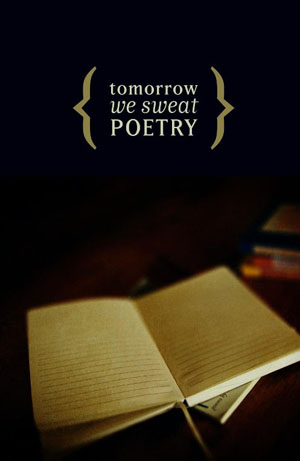
Tomorrow We Sweat Poetry (paperback, 20 pgs, 8″x5″ $8 + s/h) is officially out of print.
Tomorrow We Sweat Poetry is the result of the workshop I directed called “Write and do not waste time” and features poems by Susan Ryonen Keene. A digital sample is available here. Each poetry writing workshop I direct invites students to contribute their best poems for publication in a poetry book. If you’re interested in an upcoming poetry writing workshop, please leave a comment or email me at coffeehousejunkie [at] gmail [dot] com.
Maybe ‘review’ is a bit of an erudite word to use in this blog title regarding Sunday’s poetry reading at Malaprop’s Bookstore/Café. But Sunday’s poetry reading may be one of the best Poetrio readings I’ve attended in a long time. After the snow flurries ceased the poetry began. Several local literary luminaries were in attendance including Pat Riviere-Seel, Gary Hawkins, Sebastian Matthews, Keith Flynn among others.
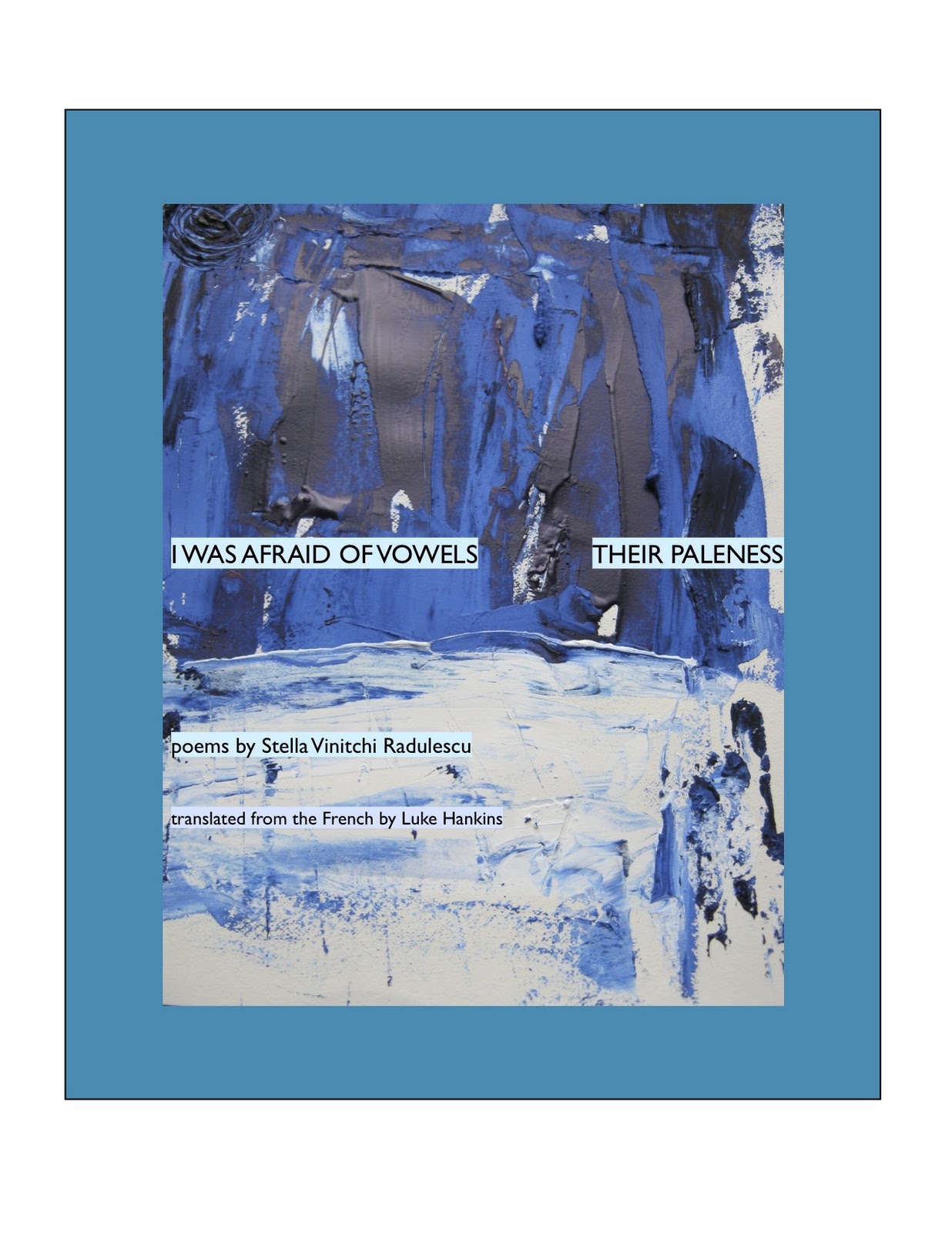
I Was Afraid of Vowels, Their Paleness by Luke Hankins
The first poet who read was Luke Hankins, Associate Editor of Asheville Poetry Review. I first learned about Luke from an article he wrote for the The Writer’s Chronicle and then I had the privelege to met him at one of the Poetry at The Pulp events last year.
He read from his recently published bilingual chapbook of translations, I WAS AFRAID OF VOWELS / THEIR PALENESS, of French poems by Stella Vinitchi Radulescu. Poems read include: ‘landscape in three movements,’ ‘children of the fog,’ ‘a cry in the snow,’ and the poem where the title of the chapbook originates — ‘adagio.’ Radulescu’s poems tend to be spare and short and afforded Luke opportunity to read some of his own poems. The difference between Luke and Stella’s styles offered a stimulating contrast to his portion of the Poetrio reading. Luke read another translation he had made of a different French poet. I didn’t catch the name of the poem or poet, but the poems essence was atmospheric (and reminded me of the poet Jean Orizet) and provided a beautiful centerpiece to his portion of Sunday’s reading.
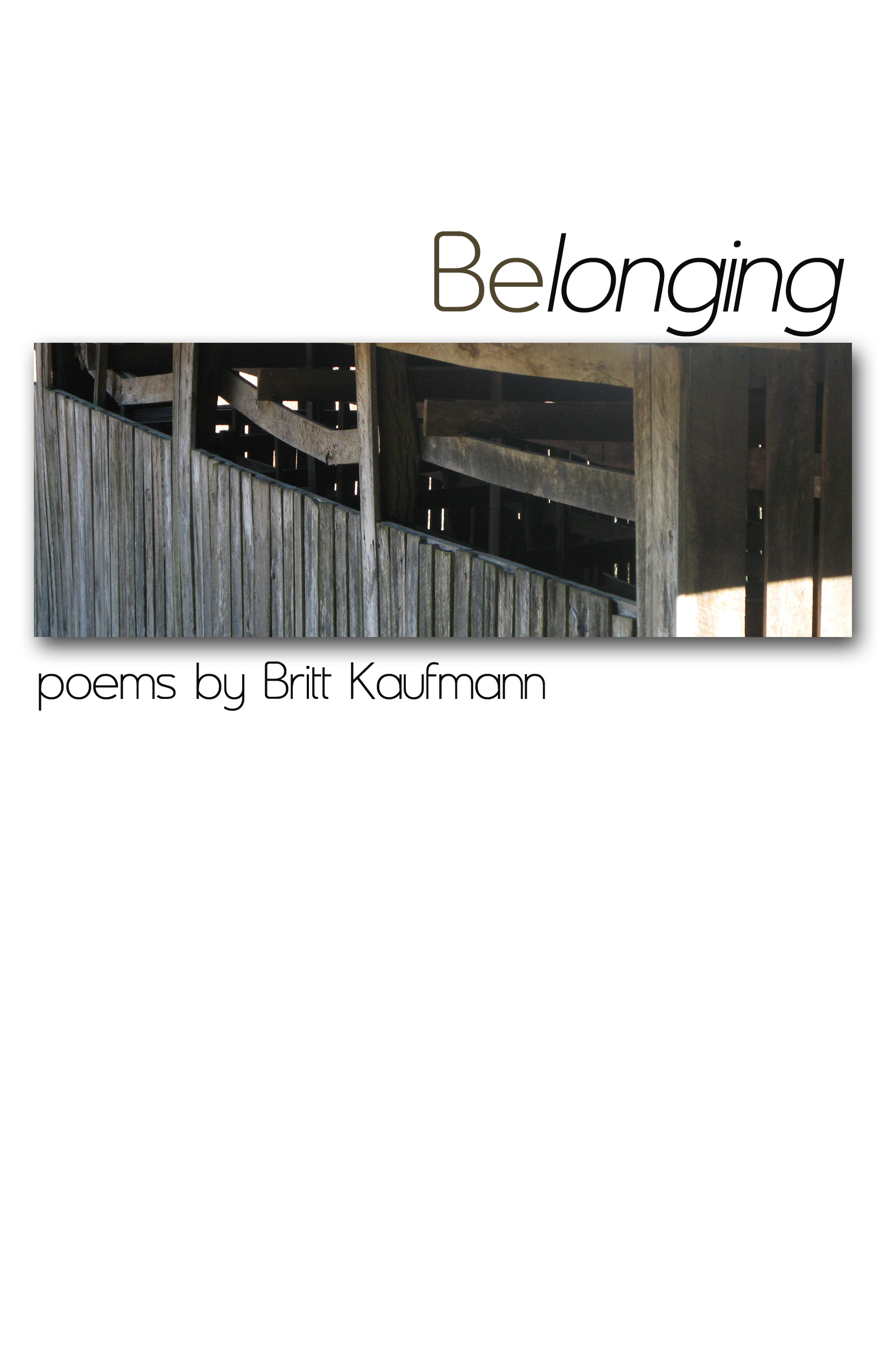
Belonging by Britt Kaufmann
Britt Kaufmann read next from her recently published chapbook BELONGING. Her chapbook was named a semi-finalist in the most recent competition for the New Women’s Voices Series at Finishing Line Press.
My introduction to Britt and her work was at a Flood Reading Series in February 2007. Poems read include: ‘Oak Leaf,’ Hand-Me-Down Gift,’ ‘Under Grandma’s Quilt, ‘Tobacco Barns,’ and others. Interestingly, the title poem to the chapbook is not included in the collection of poems. But Britt read it as her last poem of her portion of the event.
Britt’s poetry evokes a celebration of everyday moments too often overlooked. A lyrical ache subtly emerges from each poem the way daffodils quietly appear in late February here in the mountains. There’s a longing for meaning in each poem and a sense of contentment to just be.
If you missed Poetrio, Britt is scheduled to read on Friday May 6, 2011 at 4 p.m. at Wordfest at Grateful Steps Publishing House and Bookshop.
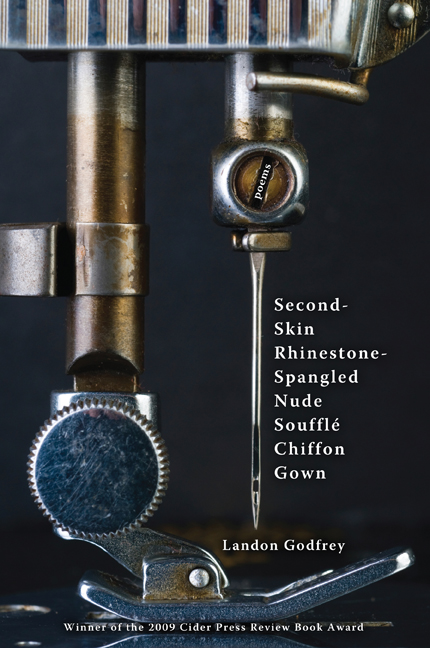
Second-Skin Rhinestone Spangled Nude Souffle Chiffon Gown by Landon Godfrey
The final poet to read at Sunday’s Poetrio event was Landon Godfrey. She read from her recently published book, SECOND-SKIN RHINESTONE-SPANGLED NUDE SOUFFLE CHIFFON GOWN. David St. John chose her manuscript as the winner of the 2009 Cider Press Review Book Award.
A book title like this is hard to forget, and equally difficult to remember. I first heard Landon read the title poem at a Flood Reading Series in March 2009 [listen to the audio] and later at May 2009 Poetrio event. Other poems read at those 2009 readings included ‘Chanel No. 5,’ ‘Labor in Vain,’ ‘There Are Thousands of Stones in the Sky,’ and ‘On Black Cloth with White Chalk I Drew the Stars.’ Landon read some of those poems at Sunday’s Poetrio reading as well as others: ‘Landscape with Dialectical Materialism and Milk,’ ‘Hotel Beds,’ and ‘Compositions in Grey and Grey.’
Landon’s poems provide a rich, lush tapestry of memorable moments that haunt you long after you’ve heard or read them. There’s tense, delicious balance between smooth sensuous lines and jarring acrimony in her poems.
Again if you missed Sunday’s Poetrio, Landon is scheduled for a reading and book signing at Warren Wilson College’s Sage Cafe with March 24, 2011 at 7 p.m. She is also scheduled for a reading and book signing at Wordfest, on May 7, 2011 at 7 p.m.
On Sunday afternoon, March 6 at 3:00 p.m., Malaprop’s Bookstore/Café will welcome poets Landon Godfrey (SECOND-SKIN RHINESTONE-SPANGLED NUDE SOUFFLE CHIFFON GOWN), Luke Hankins (I WAS AFRAID OF VOWELS / THEIR PALENESS), and Britt Kaufmann (BELONGING). The reading and booksigning event is free and open to the public, and we hope that you will join us at this monthly poetry event.
Poet, artist, and actress Landon Godfrey read her poetry at the Malaprop’s Poetrio event in May 2009, and some of you may remember that this versatile practitioner of many arts has had work published in the Black Mountain College Museum + Arts Center chapbook, Voicing BMC: The Women; in Best New Poets 2008, selected by Mark Strand; and in Orbis, The Missouri Review, The Southwest Review, Beloit Poetry Journal, and many other literary journals. You may also have seen her on the stage of the BeBe Theatre in Asheville, and she’ll be appearing in Labyrinth at the Magnetic Theatre in April. For the manuscript of her just-published poetry book, SECOND-SKIN RHINESTONE-SPANGLED NUDE SOUFFLE CHIFFON GOWN, she won the 2009 Cider Press Review Book Award. Writes poet David St. John, who judged the 2009 award competition, “Never has the sumptuous materiality of language felt more seductive than in Landon Godfrey’s remarkable debut collection, SECOND-SKIN RHINESTONE-SPANGLED NUDE SOUFFLE CHIFFON GOWN. These exquisite poems are both sensually compelling and intellectually rigorous — a rare feat indeed. The iridescence of this marvelous volume continues to glow long after one has turned out the lights. . . .”
Luke Hankins has served as an Associate Editor of Asheville Poetry Review since 2006. His poetry, prose, and translation have appeared in numerous publications, including The Cortland Review, New England Review, Poetry East, Southern Poetry Review, and The Writer’s Chronicle, as well as on the blog of the NPR program “Being.” He graduated from the Indiana University M.F.A. program in 2009, where he held the Yusef Komunyakaa Fellowship in Poetry, the program’s highest poetry fellowship. At Malaprop’s, Luke Hankins will be reading from I WAS AFRAID OF VOWELS / THEIR PALENESS, his recent bilingual chapbook of translations from the French poems of Stella Vinitchi Radulescu. Radulescu was born in Romania but left in 1983, first seeking political asylum in Rome and then immigrating to the United States. A scholar and teacher as well as a poet, she has written and published books of poetry in Romanian, French, and English but does not translate her own work. In his Translator’s Note, however, Luke Hankins acknowledges “her partnership in finalizing the translations” for I WAS AFRAID OF VOWELS / THEIR PALENESS — selected poems from Radulescu’s book UN CRI DANS LA NEIGE (A CRY IN THE SNOW). Writer and translator Hoyt Rogers admires both the original poetry and Luke Hankins’ translations: “Like seashells with light shining through, these poems by Stella Vinitchi Radulescu express the tough fragility of being; in his lucid translation, Luke Hankins mirrors perfectly their deftness and their strength.”
Britt Kaufmann’s poetry has been published in The Mennonite, Western North Carolina Woman, Now & Then: The Appalachian Magazine, Main Street Rag, LiteraryMama.com, and elsewhere. Her chapbook BELONGING was named a semi-finalist in the most recent competition for the New Women’s Voices Series at Finishing Line Press. The poetry in her new collection loosely chronicles Britt Kaufmann’s upbringing in Mennonite Goshen and her move to the mountains of Western North Carolina. Her hometown of Burnsville, North Carolina, hosts the Carolina Mountains Literary Festival, for which she serves on the planning committee. Among others, Fred Chappell and Kathryn Stripling Byer, former Poets Laureate of North Carolina, admire Britt Kaufmann’s new collection of poetry. Fred Chappell has written, “‘Belonging,’ that word is the best possible title for Britt Kaufmann’s earnest, engaging, affectionate, and wonderfully enjoyable collection of poems. ‘Be,’ says the land and the nature that enfolds it. ‘Longing’ is what we feel when we gaze upon the land and try to search its meaning.” Kathryn Stripling Byer adds, “[Britt Kaufmann’s] words call up the things of everyday life and make them last. This poet belongs unapologetically to that moment when joy pushes its way to the surface, like a crocus through snow, never hesitating to praise it and its many gifts, opening her arms wide to welcome its arrival.”
Hope to see you at Malaprop’s on Sunday!
UPDATE: Due to the scheduled the Asheville Mardi Gras parade for 3:00 p.m. Sunday, March 6, Malaprop’s staff recommends arriving early (the parade line-up begins at 2:00 p.m.). The city of Asheville has several parking solutions. Here’s a link to parking garages in near Malaprop’s Bookstore: Link.
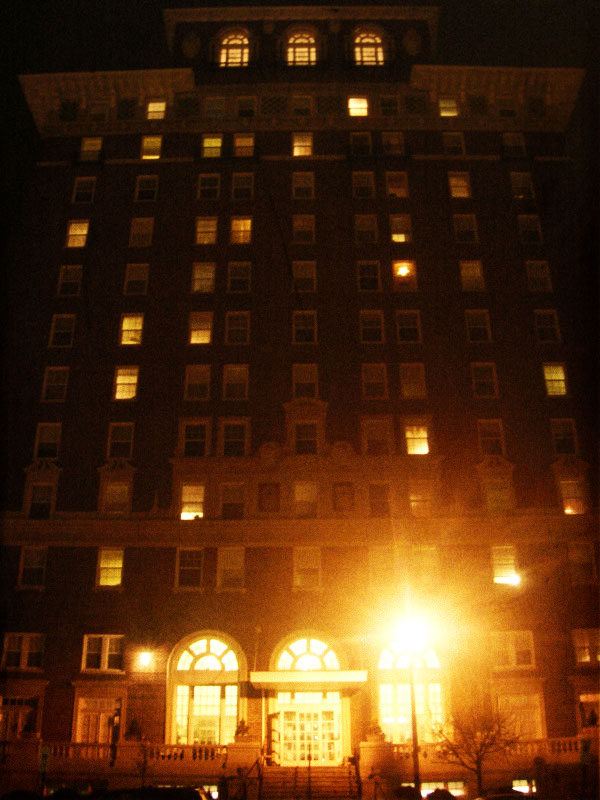
You are invited to a literary salon at the Roof Garden of the historic Battery Park Hotel. Whether you dabble in poetry or prose or you’re a published poet or writer or maybe you just love art and books; join the Rooftop Poets for a stimulating evening of literature, music and conversation.
Come prepared to participate in engaging dialogue about art, books, literature and life. Discussions will be lead by Barbara Gravelle, Matt Mulder and Brian Sneeden. Please bring work by someone you admire or something you’ve written to share at the salon.
Snacks and hors d’oeuvres will be provided, along with music by Mattick Frick and the Bloodroot Orkaestarr.
$10.00 admission includes all food and beverages.
Join us Friday, February 18, 8:00pm – 11:00pm at the historic Battery Park Hotel, 1 Battle Square, Asheville, NC (located north of the Grove Arcade building).
You are invited to a literary salon at the Roof Garden of the historic Battery Park Hotel. Whether you dabble in poetry or prose or you’re a published poet or writer or maybe you just love art and books; join the Rooftop Poets for a stimulating evening of literature, music and conversation.
Come prepared to participate in engaging dialogue about art, books, literature and life. Discussions will be lead by Barbara Gravelle, Matt Mulder and Brian Sneeden. Please bring work by someone you admire or something you’ve written to share at the salon.
Snacks and hors d’oeuvres will be provided, along with music by Mattick Frick and the Bloodroot Orkaestarr.
$10.00 admission includes all food and beverages.
Join us Friday, February 18, 8:00pm – 11:00pm at the historic Battery Park Hotel, 1 Battle Square, Asheville, NC (located north of the Grove Arcade building).
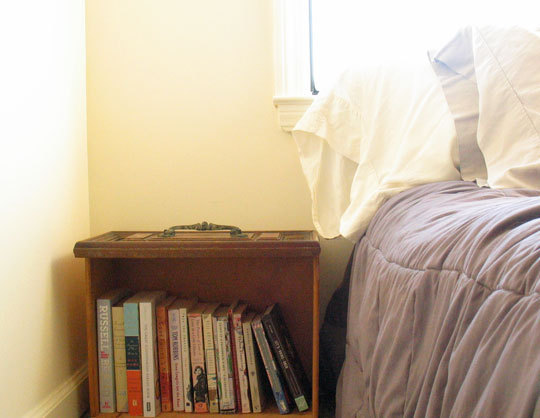
Apartment Therapy1 has a pretty decent project for turning an old drawer into a new bookshelf/nightstand. But like my old stand,2 you still can’t hide much in it. (52books3)
Will the Rooftop Poets love poems? You’ll have to come and find out.
The Rooftop Poets perform at Accent on Books on Fri., Feb. 11, 6 PM. Barbara Gravelle, Matt Mulder and Brian Sneeden will be accompanied by special guest musician Mattick Frick.
This event is free and open to the public and light refreshments will be served.
Friday, February 18th, the Rooftop Poets host a literary salon at the Roof Garden of the historic Battery Park Hotel.
Whether you dabble in poetry or prose or you’re are a published poet or writer or maybe you just love art and books prepare for a stimulating evening of literature, music and conversation.
That’s the size of today’s Asheville Citizen-Times. Monday’s newspaper was only 20 pages. And most of what I read is reprinted content from USA Today or AP. AC-T is a city newspaper that barely prints city news. When will AC-T print something the people of Asheville want to read?
In those days—they were long ago—
The snow was cold, the night was black.
I licked from my cracked lips
A snowflake, as I looked back
Through branches, the last uneasy snow.
Your shadow, there in the light, was still.
In a little the light went out.
I went on, stumbling—till at last the hill
Hid the house. And, yawning,
In bed in my room, alone,
I would look out: over the quilted
Rooftops, the clear stars shone.
How poor and miserable we were,
How seldom together!
And yet after so long one thinks:
In those days everything was better.
Tonight at 7 PM, Poetry at The Pulp features Pat Riviere-Seel. The reading is followed by an open-mic. So, if you can not make the trip to Warren Wilson College, hangout at the Orange Peel’s members-only club, The Pulp, and enjoy an evening of poetry.
This morning Kevin McIlvoy and Alan Shapiro presented lectures as part of the MFA Program for Writers at Warren Wilson College. [1] Tonight, Dean Bakopoulos, Martha Rhodes, Alix Ohlin, and Ellen Bryant Voigt read their work at 8:15 PM at the Fellowship Hall behind the Chapel. [2]
The last few years I’ve taken advantage of the free public readings by guest poets and writers at the MFA Program for Writers at Warren Wilson College. It’s free and open to the general public.
A few years ago I heard Marianne Boruch present a lecture discussing ars poetica in contemporary and American poetry. It opened my eyes to the poetic process. Another year I heard a poet deliver a lecture for the MFA Program for Writers at Warren Wilson College and then, months later, discovered an essay based on that lecture printed in a notable literary journal. I thought to myself, I heard it first before it made print!
One evening [1] I heard Mark Jarman, Stephen Dobyns and Percival Everett read new and or forthcoming work. And yet another time, I heard a lecture by Maurice Manning [2] that continues to haunt me. I think back to some of the other notable readings, [3] notable to me at least, and chart the influence [4] of some poets in my work.
One poet who was a regular guest of the MFA Program for Writers at Warren Wilson College was Steve Orlen. He passed away recently [5] [6] [7] and I’ll miss hearing him read “I Love You. Who Are You?”? [8]
What I find amusing is that the public readings don’t attract larger crowds. Maybe this is one of Asheville’s best kept secrets.
Twice a year, the MFA Program for Writers at Warren Wilson College offers public readings by guest lecturers and graduating students. Here’s the schedule for this year (as posted on their web site):
Monday, January 3, 8:00pm – in Gladfelter, Canon Lounge
Antonya Nelson, Dana Levin, Patrick Somerville, Maurice Manning
Tuesday, January 4, 8:15pm – Fellowship Hall behind the Chapel
Rick Barot, Michael Parker, Eleanor Wilner, Megan Staffel
Wednesday, January 5, 8:15pm – Fellowship Hall behind the Chapel
Dean Bakopoulos, Martha Rhodes, Alix Ohlin, Ellen Bryant Voigt
Thursday, January 6, 8:15pm – Fellowship Hall behind the Chapel
Brooks Haxton, Karen Brennan, Alan Shapiro, Stacey D’Erasmo
Friday, January 7, 8:15pm – Fellowship Hall behind the Chapel
Debra Allbery, Liam Callanan, Jennifer Grotz, C.J. Hribal
Saturday, January 8, 6:00pm – “Fastest Readings in the World” with MFA Faculty at Malaprop’s Bookstore/Cafe, 55 Haywood Street, Asheville.
Sunday, January 9, 8:15pm – in Gladfelter, Canon Lounge
Marianne Boruch, David Haynes, C. Dale Young, Kevin McIlvoy
Monday, January 10, 8:15pm – Fellowship Hall behind the Chapel
Graduating fiction student readings: Zoe Lasden-Lyman, Scott Nadelson, Brian Tai
Tuesday, January 11, 8:15pm – Fellowship Hall behind the Chapel
Graduating poetry student readings: Leslie Contreras Schwartz, RJ Gibson, Jenny Johnson, Glenis Redmond
Wednesday, January 12 – 4:30pm, followed by Graduation Ceremony
Graduating student readings: Diana Lueptow, Nathan Poole, Andy Young
In the past, I’ve enjoyed lectures from notable poets like Marianne Boruch and Maurice Manning. This year the MFA Program for Writers at Warren Wilson College offers public readings by the following guest lecturers:
All lectures will be held in the Fellowship Hall behind the Chapel unless indicated otherwise.
Tuesday, January 4
MARIANNE BORUCH: The End Inside It
11:15am
Wednesday, January 5
KEVIN McILVOY: Sentencing & Summoning: Reflections on the Sentence and the Poetic Line
9:30am
Wednesday, January 5
ALAN SHAPIRO: Technique of Empathy: Free Indirect Style in Poetry
10:45am
Friday, January 7
MICHAEL PARKER: Transvestite Hermaphrobite: All Hail the Semi-Colon
9:30am
Tuesday, January 11
STACEY D’ERASMO: On the Unsayable
9:30am
Tuesday, January 11
RICK BAROT: The Sea and the Zebra: Visual Effects in Poems
10:45am
Wednesday, January 12
DEAN BAKOPOULOS: Hot Dog Station! Show Show Show!: Expressionism, Exclamations, and the Lyricism of Upheaval
10:00am
Wednesday, January 12
MAURICE MANNING: Place and the Composition of Poetic Self
11:15am




 Coffeehouse Junkie