Last night for a few minutes it felt like August 1988. Driving west on Highway 11, a half moon rising to the southwest, a line of red radio tower lights on the horizon to the northwest, the evening star the Greeks named Hesperus straight on to the west and Def Leppard’s hit song “Pour Some Sugar on Me” explodes from the auto’s stereo speakers. For a moment, I’m planning to leave this place and pursue an art degree. And I’m thinking about auditioning for the high school musical. And I’m wondering if… Then the song ends. And it’s not August 1988. And yet here I am again driving west on Highway 11.
If you’re a writer who has lost a manuscript due to your computer crashing, here are two online options to protect your work. For a few years, I’ve been using Google docs to organize manuscript… read more »
Racine’s Wind Point Lighthouse.
From today’s The Writer’s Almanac, an excerpt from “Midwest” by Stephen Dunn:
The church
always was smaller than the grain elevator, though we pretended otherwise.
Interlude
From today’s The Writer’s Almanac, an excerpt from “Midwest” by Stephen Dunn:
The church
always was smaller
than the grain elevator,
though we pretended otherwise.
As a child, the largest structures I ever saw included farm silos and grain elevators. They were the closest thing to a cathedral the Heartland has to offer a child.
Two online helps for writers
If you’re a writer who has lost a manuscript due to your computer crashing, here are two online options to protect your work.
For a few years, I’ve been using Google docs to organize manuscript drafts and as an online storage, back-up option. The nice thing about Google Docs is that is works almost seamlessly with Word Docs. Google Docs offers the following online apps: text, spreadsheet, form and presentation. Truth be told, I haven’t used a Microsoft product since I began using Google docs.
Recently I began using Dropbox to store audio files, images and other documents and really enjoy it.
Advice to authors regarding indie bookstores and Amazon.com
The Southern Independent Booksellers Alliance (SIBA) offers advice to authors seeking to work with indie books stores:
- Know the Marketplace
- Know Who And How To Contact
- Know the Terms (i.e. your business arrangement with the bookstore)
- Don’t shoot yourself in the foot (avoid mentioning that you book is available on Amazon.com)
This is good advice for authors when working with indie booksellers. The operative words are “with indie booksellers.” Truth be told, the majority of the sales for books I’ve helped publish come from Amazon.com. The reason for this, I suspect, is that Amazon.com is where the masses go to buy books.
Know that I am a big supporter of indie bookstores. But I’m also practical and know that indie bookstores attract a niche audience of readers. Some book titles do better at indie bookstores than others. For example, if you’re a local writer with a book on regional hiking trails or you’re a local poet with a book, you may do better at an indie store than on Amazon.com. That being said, Amazon offers a 45/55 terms of sale (a smidge better than indie stores offering a 40/60 terms of sales). That may not seem like much, but if you’re a small publisher, that 5% difference may cover cost of shipping products to bookstores which directly impacts breakeven numbers for book titles.
As an author (or small press publisher), know that you have sales options. And avoid mentioning Amazon.com when working with indie booksellers — it gives them ulcers.
Renovated Main Street

A couple of years ago the main street was ripped up and busy with construction trucks and earth movers. Now it’s quite lovely on a quiet August morning.
A couple of years ago the main street was ripped up and busy with construction trucks and earth movers. Now it’s quite lovely on a quiet August… read more »
The Southern Independent Booksellers Alliance (SIBA) offers advice to authors seeking to work with indie books stores: Know the Marketplace Know Who And How To Contact Know the Terms read more »
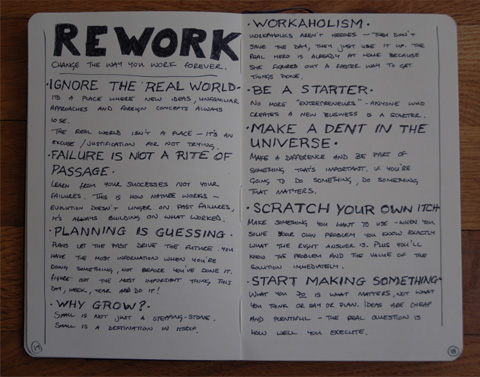
Rework is a really smart business book written by the crew from 37signals. If you haven’t checked it out, you must. In the meantime, Gnat Gnat has done a nice job of summarizing the highlights in this downloadable cheat sheet (pdf).
30 poems in 30 days: update five
The 30 poems in 30 days challenge is complete. Since the last update the poems have veered all over the place in regards to theme, subject and tone. The main reason for the challenge was to:
- generate new material and
- unclutter my mind.
A lot of new material was produced but I cannot say my mind is more or less cluttered than before the challenge. I’m still trying to make heads or tails of what I wrote.
Learning patience by installing a/v software

The new MacBook Pro arrived this afternoon. It’s wicked sweet! Also included is a 24″ display screen for Tweetdeck (jus’ kiddin’). The additional display screen helps with the running various tools while editing multitrack audio files.
Now I’m patiently waiting to load all the audio/video software so I can work on some more podcasts.
When to sell and when to market
Often I hear people use the term “marketing” when they mean “sales” and vice versa. A Melbourne advertising professional succinctly defines the terms this way:
Marketing tells a story that spreads.
Sales overcomes the natural resistance to say yes.
Link: The difference between marketing and sales
So, If your “marketing” campaign isn’t yielding the “sales” you projected, it’s probably because you need to rewrite your campaign story and retool your pitch.
Learn what your social media specialist should know about podcasting
Last week I posted, “Learn what your social media specialist should know,” and received some response on- and offline. In the post I mentioned a report on podcasting I wrote for a client. Below is a non-client specific synopsis of the report that focuses on four key areas: workflow, programming, strategy and user interface.
Workflow:
There is a misconceptions that podcasts just magically appear in you iTunes podcast menu. Whether you’re producing a podcast a month or a podcast a day, a workflow chart is essential for podcast production.
My workflow looks something like this: audio capture, audio content review, script intro and outro, record intro and outro plus ad sponsor (if none is provided), mix it, save audio file as MP3, uploaded to web hosting server.
If you’re doing podcasts on your own (without the benefit of an IT team) you may have the added responsibility of: writing a XML file (complete with all details that tag your audio podcast which may require a bit of knowledge if writing basic HTML), and publish XML file to web hosting server.
Programming:
On the wild frontier of audio podcasts there are podcasts that listeners subscribe to and then there are podcasts that get lost in the vast obscure expanse of the internet. In spite of the harbingers of the decline of mainstream radio, the best podcast programming follows the same tenets of great radio shows. Your audio gear and your audio capture technique is important, but ultimately the podcasts content is what sells the show. Good content for good listeners.
Strategy:
As much as I love MAC products iTunes isn’t necessarily friendly to serious podcasters. iTunes does not provide any podcast download metrics. Still, iTunes is where most people subscribe to podcasts. Whether it is a necessary evil or not, I’ll let you decide.
The primary way to track audio content is through webstreaming content on your website. Webstreaming audio content provides recordable metrics that assist in establishing ROI and sponsor related data.
An alternate aggregating service for audio podcast is Youtube, which has better metrics to track user data. It also happens to be where the masses go to find video and audio content. Case in point: Ozzy’s new album is available on Youtube (not actual music videos but rather a still image of album art) and I have yet to see an actual music video of the new material.
Just because you have a podcast doesn’t mean anyone will listen to it. Use social media to build a community and share podcast links. It’s perfectly fine to leak/tweet that you’re working on an upcoming podcast featuring (fill in the blank). Promoting your podcast on Facebook and Twitter is a bit tricky because no one wants to be spammed on social media sites. But if you maintain a running conversation with your fans/audience then there’s a bit of anticipation when the podcast is released.
Train your listening audience to expect your podcasts every Thursday at 4 p.m. (or what every time you see fit). The point is to ritualize the experience and present a casual contract with your listeners. Also, a routine scheduled podcast may actually grab the attention of the podcast deities at iTunes and they may actually feature your podcast in the directory.
User interface:
Most users will use iTunes to access your podcast. Make sure you provide the necessary titles, descriptions and other details to help listeners access your podcast.
If not on iTunes, users will find your podcast on your website. If you have a separate podcast page, make sure to promote it on the landing page. A podcast page works best when it provides users quick access. Set up the podcast page like a table of contents. List of podcasts on the podcast page with headline, deck (or brief 10-word description), byline (host, co-host, or featured guest), date and “listen to” feature. Users can listen to the webstreaming content or download the audio podcast.
Last week I posted, “Learn what your social media specialist should know,” and received some response on- and offline. In the post I mentioned a report on podcasting I wrote for a client. Below… read more »
Making its own app adds revenue for beleaguered newspaper
And the key words are:
…revenue from sources beyond the traditional core streams of ad sales and circulation…
Link: New York Times Offers IPhone, IPad App Platform to Other Publishers
It’s not news that daily newspapers are struggling to maintain profit margins with online competitors. The financially struggling Newsweek published a stat, in the recent July 26 issue, that in 2000 the U.S. had 1480 daily newspapers. By contrast, a decade late, there are 1302 daily newspapers.
Basically, AdAge reports that The New York Times has an app, Press Engine, that allows the:
publishers keep any advertising and circulation revenue the apps bring in; they pay the Times a one-time license fee for the platform and then a monthly maintenance fee.
And just when we thought the newspaper business was going the way of the slide rule. Silly us.
Remember that sketch I was working on last Monday? Here’s the final illustration. Looks like it is scheduled to be published in an ad in a magazine — street date August 14th.
And the key words are:
…revenue from sources beyond the traditional core streams of ad sales and circulation…
Link: New York Times Offers IPhone, IPad App Platform to Other Publishers
It’s… read more »
Learn what your social media specialist should know
In a recent podcast workshop, a social media strategist said, “Just because you build it doesn’t mean anyone will hear it.” Today I spent the morning writing a report on podcasting with that thought in mind. Here’s a summarized, abridged version of Erik Deckers’s list of questions to ask your social media expert:
- Does your social media consultant avoid using Twitter?
- Who are your social media followers?
- Do you have a social media strategy?
Keep in mind that social media isn’t a cheap promotional tool. It’s a conversation.
What will you spend your minutes doing?
I love these lines from Rachel Zucker’s poem:
With my minutes, I chip away at the idiom,
an unmarked pebble in a fast current.
Are your paint chips calling you?
Okay, the 30 poems in 30 days challenged hasn’t been completed yet and I found my next assignment (if I chose to accept it). Rachel Berger, a graphic designer in San Francisco, wrote short writings inspired by paint chips. Read some of her samples.
30 poems in 30 days: update four: targeted venom
Somewhere around day ten or eleven I fell off schedule. A lot of distractions and stress hit me like one tsunami wave after another. Last night I caught up with a binge writing session at a local bookstore. While having lunch (if a bagel and coffee qualify as a lunch) this afternoon at a cafe, I read through what I wrote last night and discovered some emotionally raw lyrics. Some of it is so personal it is not accessible to a casual reader. A closer investigation of the poem sketches reveal a controlled form providing a vehicle for anger. Whereas a poetic rant is the literary equivalent to vomit or oil gushing from the floor of the Gulf of Mexico, an angry poem attempts a focused avenue for venom much like a fire hose targets the base of a fire. Not all the poems composed last night are angry poems; only a couple. However, the angry poem sketches I composed shift from formal to informal dimeter (an example of dimeter is “The Robin” by Thomas Hardy or the use of dactylic dimeter in Tennyson’s “Charge of the Light Brigade”). I wonder if editing the poems with longer lines, maybe like Whitman’s “Leaves of Grass” or Ginsberg’s “Howl,” would change the tone dramatically.
 Coffeehouse Junkie


