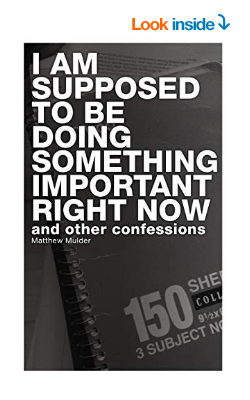
I am supposed to be doing something important right now

To post or not to post. To repeat old habits, or to start new ones.

That is how I concluded last week’s blog post. Further, I revealed that I wrote multiple drafts of the post. From a few different angles. And did not plan on posting them online.

However, a little bird told me it might be worth reading. So, in the tradition of chapbooks, I pulled together the scraps and assembled a small e-book.

The e-book runs 4000 words. Part one is a preface (basically, last week’s blog post). Part two contains five short chapters of blog extras. Consider it bonus material. Like 90s audio CD hidden tracks. Part three is a collection of twelve confessions.

The e-book is available FREE for those who have Kindle unlimited. Otherwise it is a meager $0.99 to download a copy.

Hope you enjoy it. If you like what you find, please leave a comment below or give it a starred review on Amazon. Much gratitude!

Patience – your writing finds the right audience

Have you ever written something that developed a life — even an audience — unexpected? The final chapter of a literary biography I read recently featured an introductory note that caught my attention. The author stated that of all the essays he had written during his long career the final essay of the book received the most attention. And the most requests for permission to reprint it in various publications.

Those were different days, I reflected. A time when permission was requested to reprint material an effort to share thoughtful writings. Rather than copy, paste, click and post.

In a very small way, a similar observance was made regarding a piece I wrote more than a decade ago.

This was back in the days before iPhones, Facebook, or Twitter. A time when SMS messaging — later texting — was a novelty that would be the most used mobile data service. But that was a couple years away.

A reader of my blog requested a review of a poem. I was suspicious of the request. Thought it might be a college student seeking someone to write his or her literature paper. I accepted the challenge.

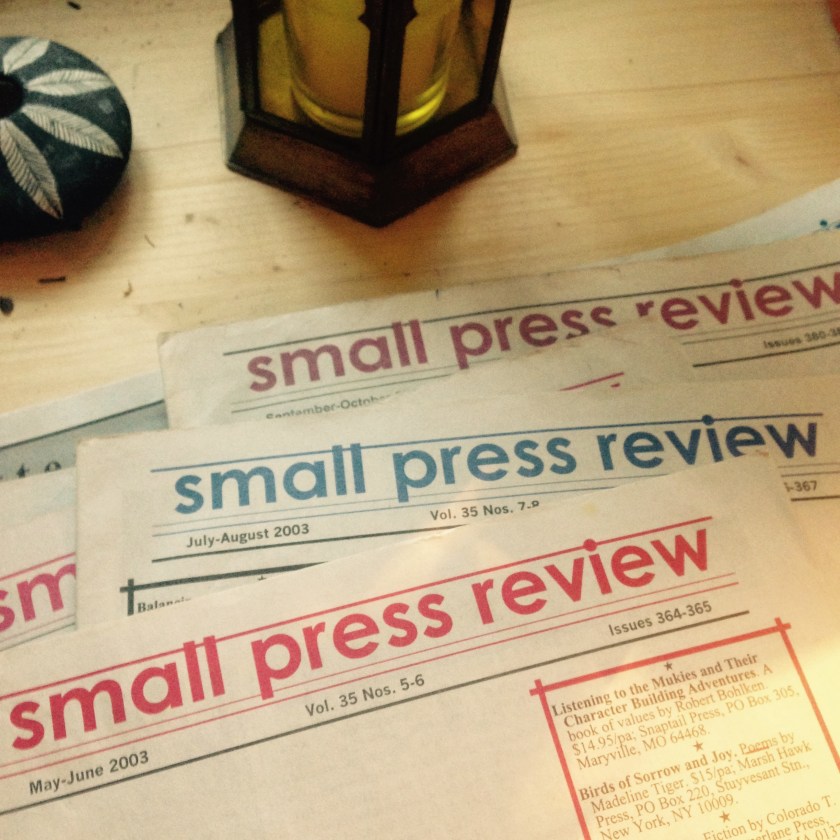
At the time, I was writing book reviews, essays, interviews and such. Mostly for local publications. But a few journals and magazines on the West Coast published some of my work. I reached out to Len Fulton of Small Press Review and asked if I could submit the poem review. He graciously agreed.

I wrote a review of Charles Simic’s poem “Old Soldier” in an esoteric manner that could not easily be passed off as a high school literature paper. I sent off the review for publication. And waited. Months went by. Issue after issue of Small Press Review arrived in the mail box. Impatient, I posted an abridged, clumsy version of the review on my blog. A month later I submitted it to editor, publisher, and friend Pasckie Pascua who published it in the September 2005 edition of The Indie. When the November-December 2005 issue of Small Press Review arrived I was surprised to see my review had — in fact — been published.

The review of Simic’s poem “Old Soldier” remains one of the most read posts on this blog. It is embarrassing to me for a couple reasons. One, the lack of virtue in my life. The selfish rush to be published. Patience is a virtue I am still learning to practice. Another reason for the embarrassment is that the online, perennial version of the review is a shadow of the original. The writing that appeared in the Small Press Review has never been released online. And maybe that is best for now.

The review of the poem is the final chapter of a book manuscript I finished. As of this writing it remains unpublished. But maybe one day it will greet an audience of its own. And maybe wander online as well.

Typewriter poetry and blogging — updated

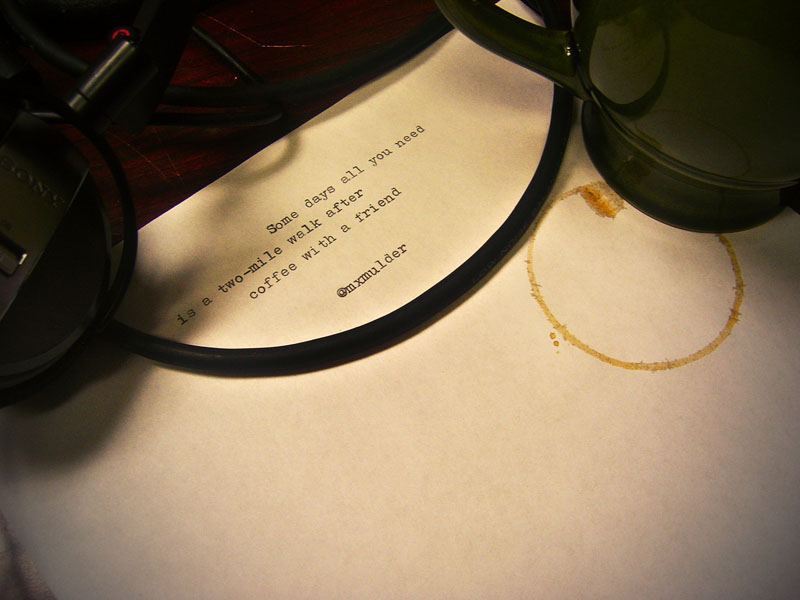
Some days all you need
A poem for a friend composed on a manual typewriter

At least eight years ago, an old beat up manual typewriter provided a platform to compose poetry and other writings.1 It was an effort to return to an intentional practice of crafting poetry and prose without distraction of disruptive media.

For years and years, a notebook, journal or sketchbook was never far from reach. But one night after a long night of poetry and music at Beanstreets followed by an even longer time of coffee and conversation at Old Europe, a friend convinced me to try blogging.

Photo courtesy of @mxmulder
Sample journal page of poetry

The immediate response to blogging was infections.2 Connecting with people all over the country, sharing writing samples or books read and being part of an active digital community was exciting. And the feedback on written work was quick — sometimes within a couple days or hours. The practice of writing allowed me to hone the craft of creative writing and exposed me to other writers across the country. One of those bloggers actually showed up at a poetry gig I did. She was on a cross-country trip to visit friends and wanted to visit in real life.

Over time, I noticed that my practice of writing notes, daily sketches and other activities had all but disappeared. Relying on keyboards, display screens, hard drives and servers presented became a crutch. My writing drafts and sketches appeared deceptively crisp and final in neatly formatted text documents and web blog interface windows.

So, I pulled the plug. Returned to handwriting and typing as practice.3 Some friends and fellow poets saw a few samples of typewritten work and suggested I post it on my blog. It was a novelty. A curiosity. So, I did.

One of the first photographs of a poem I composed on a typewriter was written for a friend. It was posted about this time of year — in 2011.4 A few days later I followed up with another poem5 that was later read at poetry event where I and other poets were dubbed “the next generation” of Asheville poets.6

I do not claim to be the first person to post an image of a poem typed on a manual typewriter. But I noticed a trend in that direction about a year after posting those images of typed poem sketches.7 Not sure exactly if I started the trend. Probably not. Maybe other like-minded individuals who sought to return an organic practice of handwriting and typing as a mode of composing their visions and ideas.

After relocating to the southern boarder of the Great White North,8 I continued using the manual typewriter as a mode of composing new work — both poetry and prose. Some of this was due to the original intent of the practice — crafting content without distraction of disruptive media. Some of the use of the manual typewriter was due to a period of time that I was without a functional laptop and no internet access. A local writers group saw a lot of typed first drafts from that manual typewriter. One of those typed drafts was later published as a short story.9

Most recent first drafts have all been handwritten if not typed on one — of now two — of the manual typewriters. Blogging. Well, that has atrophied. Maybe I’ll post some photos of typewritten drafts this year as a way to keep the blog active. But, to celebrate an eight year anniversary of analog writing — I’ll keep most of it offline and on paper.10

Keep your stick on the ice and remember to use the lowercase L key when typing the numeral one.

NOTES:
[1] In truth, I composed poems on an electric typewriter prior to that. Did it for decades. Did not own a personal computer until… well, that is another story.
[2] That was when there were a mere couple million web blogs in the world. Now, there are some platforms, like Tumblr, boasting 100 million blogs. The blogosphere has become quite congested.
[3] Examples of some the 30 poems in 30 days journal posts with photos: here, here and here.
[4] April 1, 2011, blog post.
[5] Poem: “Never Look A Doughnut Dealer in the Eyes”
[6] “Rhyme and reason” by Alli Marshall, Mountain Xpress, April 6, 2011. Accessed April 2, 2018. “https://mountainx.com/arts/art-news/040611rhyme-and-reason/”
[7] Examples include Typewriter Poetry (though it seems the web site has not been active since March 19, 2015), Remington Typewriter Poetry (this site too has become inactive with the last entry posted June 2016), and the most popular is Tyler Knott (though his web page has an archive going back to 2003 (which is odd because he uses Tumblr as a platform and Tumblr was launched in early 2007… maybe he migrated his content from some other source to Tumblr… but I digress) the posted images do not begin until 2012 (unless I am mistaken).
[8] A reference to Bob and Doug McKenzie, fictional brothers who hosted the show Great White North (a reference to Canada, aye). For sample episode view Youtube video: https://www.youtube.com/watch?v=0pPRaD6TKLc
[9] Left of the Lake published “Mortal Coil” in 2015. https://coffeehousejunkie.net/2015/08/31/publication-of-mortal-coil/
[10] Original post published on April 21, 2015 https://coffeehousejunkie.net/2015/04/21/typewriter-poetry-and-blogging/

Typewriter poetry and blogging

Some days all you need
A poem for a friend composed on a manual typewriter

At least five years ago, an old beat up manual typewriter provided a platform to compose poetry and other writings.1 It was an effort to return to an intentional practice of crafting poetry and prose without distraction of disruptive media.

For years and years, a notebook, journal or sketchbook was never far from reach. But one night after a long night of poetry and music at Beanstreets followed by an even longer time of coffee and conversation at Old Europe, a friend convinced me to try blogging.

Photo courtesy of @mxmulder
Sample journal page of poetry

The immediate response to blogging was infections.2 Connecting with people all over the country, networking, sharing and being part of an active digital community was exciting. The practice of writing allowed me to hone the craft of creative writing and exposed me to other writers across the country. One of those bloggers actually showed up at a poetry gig I did. She was on a cross-country trip to visit friends and wanted to visit in real life.

Over time, I noticed that my practice of writing notes, daily sketches and other activities had all but disappeared. Relying on keyboards, display screens, hard drives and servers presented became a crutch. My writing drafts and sketches appeared deceptively crisp and final in neatly formatted text documents and web blog interface windows.

So, I pulled the plug. Returned to handwriting and typing as practice.3 Some friends and fellow poets saw a few samples of typewritten work and suggested I post it on my blog. It was a novelty. A curiosity. So, I did.

One of the first photographs of a poem I composed on a typewriter was written for a friend. It was posted about this time of year — in 2011.4 A few days later I followed up with another poem5 that was later read at poetry event.

I do not claim to be the first person to post an image of a poem typed on a manual typewriter. But I noticed a trend in that direction about a year after posting those images of poem sketches.6 Not sure exactly if I started the trend. Probably did not. Maybe other like-minded individuals who sought to return an organic practice of handwriting and typing as a mode of composing their visions and ideas.

Here is to a five year anniversary of analog writing.

NOTES:
[1] In truth, I composed poems on an electric typewriter prior to that. Did it for decades. Did not own a personal computer until… well, that is another story.
[2] That was when there were a mere couple million web blogs in the world. Now, there are some platforms, like Tumblr, boasting 100 million blogs. The blogosphere has become quite congested.
[3] Examples of some the 30 poems in 30 days journal posts with photos: here, here and here.
[4] April 1, 2011, blog post.
[5] Poem: “Never Look A Doughnut Dealer in the Eyes”
[6] Examples include Typewriter Poetry, Remington Typewriter Poetry, and the most popular is Tyler Knott (though his web page has an archive going back to 2003 (which is odd because he uses Tumblr as a platform and Tumblr was launched in early 2007… maybe he migrated his content from some other source to Tumblr… but I digress) the posted images do not begin until 2012 (unless I am mistaken).

[Podcast] Re-release of episode 13

As mentioned last week, here is a re-release of episode 13 of the Coffeehouse Junkie audio podcast. This episode features the essay “The Field” as well as two poems that are discussed in the fourth session of the poetry writing workshop I directed at the The Flood Fine Arts Center in Asheville, North Carolina.

As a side note, each poetry writing workshop I lead concluded with a class chapbook featuring the best of the students’ work and a poetry reading. Additionally, the essay featured in this podcast is abridged and will be released in an expanded version in a forthcoming book.

Here is: Episode 013

As always, I look forward to your feedback. Post comments, question and/or requests in the comment section of this blog post and I will address it in the upcoming episode 15. Episode 14 will be re-released later this week. Thanks for listening!

Book Launch for Look Up Asheville Collection II

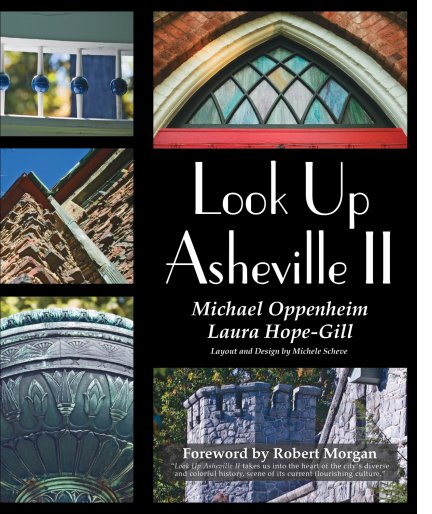
Look Up Asheville II by Michael Oppenheim and Laura Hope-Gill

Tonight at 6:30 p.m. the Look Up Asheville II book launch begins at the Battery Park Champagne Bar/Book Exchange. Join the festivities for the launch of Look Up Asheville II featuring photography by Michael Oppenheim and essays by Laura Hope-Gill. Poet Robert Morgan writes: “Look Up Asheville II takes us into the heart of the city’s diverse and colorful history, scene of its current flourishing culture.”

From the event invitation: “Look Up Asheville II features more architectural details captured by local photographer, Michael Oppenheim, accompanied by historical essays by Laura Hope-Gill, with a Foreword by premier author and poet Robert Morgan (Gap Creek, Lions of the West, Terroir). Designed by Michele Scheve, Look Up Asheville II does more than inform readers and viewers of the architectural, social and creative history of Asheville; it celebrates all these with stories and luminous images. The new book contains Asheville’s grand Bed and Breakfasts and more of the exquisitely built churches, inns, museums and downtown treasures.”

Essay: Writing, Painting and Thoughts about Spirituality

Last year, about this time, I contributed to “Resonance” Art Opening/Multimedia Performance. The Grey Eagle Tavern and Music Hall hosted the event. I read some of my new poems at the time and then Philip (guitarist) and Julie (rock vocalist) joined me with a music/performance set based on my book Late Night Writing. Julie contributed an original song to the set while Philip added an original soundtrack. The collaboration between the three of us was inspiring (to me at least). It was kind of weird hearing Julie sing my poems “Fragile” and “Driftwood” back to me and to the audience. In a way it was a relief to hear someone else claim them, own the words, project the ideas. I miss that. There are a few live bootleg recordings of the three or four gigs we did together. Maybe when I find some server space, I’ll offer them as free downloads.

Three paintings represented me at “Resonance” Art Opening/Multimedia Performance. “Fragile,” named after the poem I wrote, was painted last summer. Previously, I had done a series of four paintings inspired by the poet Kahlil Gibran (which was part of the 2003 “Resonance” art show) with bright, dramatic abstractions using a simple palette of red, yellow and black. With “Fragile,” the colors deepened in order to create a stark, lyrical image. A young poet from South Carolina once confessed he didn’t particularly get into modern art, but he liked “Fragile” because it seemed like a place he would like to visit. The poem I wrote that inspires this work includes these lines: “I am naked/ When truth strips me/ Of a lie.” And later: “I am reborn/ When the old shattered remains/ swept away, replaced with/ a new vessel to contain my soul.”

“Among The Myrtle,” named after a passage from the book of Zechariah, was also painted last summer. Most people who view this painting don’t know the passage that inspires this work. The passage reads:
“In a vision during the night, I saw a man sitting on a red horse that was standing among some myrtle trees in a small valley… I asked the angel who was talking with me, ‘My lord, what are all those horses for?’ ‘I will show you,’ the angel replied. So the man standing among the myrtle trees explained, ‘They are the ones the LORD has sent out to patrol the earth.’ Then the other riders reported to the angel of the LORD, who was standing among the myrtle trees, ‘We have patrolled the earth, and the whole earth is at peace.’

Again, as with the painting “Fragile,” I attempt to present a sparse place for the eye and the mind to roam—a place someone would like to sit and rest and visit often. In a way, I was trying to create a sanctuary were “the whole earth is at peace.”

My son, who was two at the time, painted along side me. We would paint outside, on the front deck on Saturday mornings. It became a weekend ritual. At the time he merely enjoyed mixing the colors on an old canvas I had forsaken. He named one dinosaur and the next weekend he would paint over dinosaur and call it puppy. During the winter we stopped the outdoor painting sessions and he began working with pencil and paper. By springtime he graduated to markers. As spring gave way to summer he had developed a curious visual language that inspired me. He began drawing people with arms and legs that didn’t quite fit and dots and lines representing eyes. The smile became his creative signature—it sliced across the heads as if to say “it is what it is.”

One Saturday, after we resumed our painting ritual, I created “I’m Putting on My Socks” in honor of his drawings. Three other paintings were created that day (which I may post at a later date) and a series of twelve drawings. He told me I needed more gray. I told him gray was not a color I liked to use because it’s too bland. He insisted by adding a few strokes of his own. After moving him back to his canvas, I conceded. Gray became the visual language that supported the red, black, copper and white motifs.

I don’t know if there will be a “Resonance” Art Performance this year. Whether collaborating with adults or children, an artist needs support in order to grow. Hearing a poem or viewing a painting from another perspective opens up a world of opportunity. Irving Stone mused that “Art’s a staple. Like bread or wine or a warm coat in winter… Man’s spirit grows hungry for art in the same way his stomach growls for food.” For those who have supported my growling stomach, I thank you.

* * *

A couple weeks ago I had lunch with a friend and I was amazed (again) by his intellectual prowess. I commented to him that I wish I could have time to read more books. “Better to read deeply than to read extensively,” he said as we stood in line to pay for our meal. Coming from a gentleman who reads deeply and extensively, I think I understand what he means—concentrate on one thing and read it well. Too often I find something interesting to read but it turns out to be more of a distraction than a help for my writing efforts.

The writer studies literature, not the world. He lives in the world; he cannot miss it… He is careful of what he reads, for that is what he will write. He is careful of what he learns, because that is what he will know.

The writer knows his field—what has been done, what could be done, the limits—the way a tennis player knows the court. And…plays the edges.
Annie Dillard, The Writing Life

Examining the books I’m currently reading, (Nine Gates: Entering the Mind of Poetry, Come to the Quiet: The Principles of Christian Meditation, An Explanation of America (Princeton Series of Contemporary Poets), Handwriting: Poems, Teaching a Stone to Talk: Expeditions and Encounters, The Blessing: A Memoir, Don’t Waste Your Life, Job and Hebrews (from the Christian Bible), A Poetry Handbook, Road to Reality, True Spirituality and Can Poetry Matter?: Essays on Poetry and American Culture) it’s safe to say the concentration is in poetry, non-fiction literature and spirituality. Examining the magazines and newspapers I read reveals more diversity, and the blogs I read regularly are even more varied than that. Play the edges and avoid the mire of the middle. That’s the challenge.

* * *

I attended the Writers at Home Series at Malaprop’s Bookstore/Cafe featuring Brenda Flanagan and Robert McGee ()Sunday September 18th.

Brenda Flanagan was a joy to hear as she read two short pieces. Yeah, I was a bit disappointed. I would have liked to read more. Her lyrical quality to prose simply inspires me. And the fact that she introduced her first short fiction section by singing the first couple bars of Bob Marley’s “No Woman, No Cry” was the bow on the package.

Robert McGee read from an upcoming book that impressed everyone. It’s a series of short stories based on the personalities in an office. Think “Office Space” without the campy humor. Not that there wasn’t any humor, but the humor was sparsely sardonic—more of an urbane edginess. I look forward to reading his book when it is released.

Afterward: Usually I chat with the authors after the readings or at least thank them for reading their work. But Sunday I felt like I had feasted on the morsels that fell from the table of masters. I didn’t know what to say to them and they seemed to be surrounded by well-wishers or groupies. I couldn’t tell.

I lost myself in between bookshelves trying to figure out what to say, but realized I had nothing to say. Or at least nothing I wanted to say. If I could say or ask something those things had probably already been said and asked: Do you write full-time? Or is it a hobby? Where do you get your inspiration? I love that story you read, but I’ll buy your book online because it’s cheaper than buying here at the bookstore. How can I be just like you? Do you use MS Word to compose your manuscript? Would you autograph my copy of your book?

Idiot, I said to myself in my best Napoleon Dynamite voice. Then I silently left the bookstore.

* * *

What are my goals? Are they in the right priority? Why is there so much clutter? Is blogging a waste of time or an essential part of my life?

I’m glad I’m not the only one considering this. Jennifer Rice of What’s Your Brand Mantra? seems to have re-evaluated her priorities and reinvented her blog.

“After 18 months of writing about branding and marketing, I hit the point of burn-out. So I’m making some changes that I hope will keep me interested and engaged in the blogosphere.”

She drew inspiration from a post by Jack/Zen: “The question about creating simplicity in our life spaces, life styles, relationships, and work is the question: ‘What is the essence of my life?’ “

In the Christian tradition, the essence of life refers to spirituality or spiritual intuition. A Taoist would agree with that. Shen, or essence, refers to the spirit of a man. Yet, the question “What is the essence of my life?” is not complete until the body and soul (mind) are included. Maybe a better question would be “What is the purpose of my life?” In order for the essence to have purpose it must engage the mind (soul). If your mind is anything like mine, it must be disciplined they way the body is disciplined with exercise and diet.

Here’s an example of what I mean. My spirit (essence) is in need of purpose. I read a psalm written by Jeremy Huggins (body in action) that caused meditation (mind in action) which lead to moments of contemplation (spirit in action). As I contemplated (essence) my life and this blog my soul (mind) wandered in many directions. One of those directions lead me to spend almost four hours tonight writing (body).

(c) Matthew Mulder. All rights reserved.
Originally published in
The Indie, November 2005
Essay: Filling My Love Basket

The first time I heard the music of U2 was from a double vinyl release of Rattle and Hum. Before cassettes and CDs and iPods there were vinyl records. The black and white grainy photos and reversed out lyrics (white text on black background) created an experience that’s difficult to explain. I listened to it for days if not weeks and months. It expanded how I saw the world and expanded me a bit too. For those older than I, the musicians may have different names: Bob Dylan or Bruce Springsteen. For me it was the rebel Irish rockers of U2.

I don’t own a television. So, I was delighted the morning after the Grammys to hear NPR broadcast the results. U2 dominated the Grammys with Best Rock Song, Best Rock Album, Song of the Year and Album of the Year (there may have been more but that’s enough for now).

Here’s something NPR did not cover. The previous week Bono spoke at the National Prayer Breakfast. I know. It is very odd indeed and he thought so too. “If you’re wondering what I’m doing here, at a prayer breakfast,” began Bono. “I’m certainly not here as a man of the cloth, unless that cloth is leather.”

He continued his introduction at the National Prayer Breakfast by commenting how “unnatural” it seems to have a rock star behind a “pulpit and preaching at presidents.” After a couple more comments he offered this reflection:

“I avoided religious people most of my life. Maybe it had something to do with having a father who was Protestant and a mother who was Catholic in a country where the line between the two was, quite literally, a battle line. Where the line between church and state was… well, a little blurry, and hard to see.”

He went on to observe how “religion often gets in the way of God” and his general contempt of the “religious establishment.”

“I must confess,” Bono said. “I wanted my MTV. Even though I was a believer. Perhaps because I was a believer.”

I share the same cynicism toward organized religion that Bono confessed in his address. When people are placed in positions of power, whether it be religious or political, there is always the potential for the abuse and perversion of that power. Abraham Lincoln is credited for saying: “Nearly all men can stand adversity, but if you want to test a man’s character, give him power.”

Bono also presented a topic near to his heart — poverty — by stating that “It’s not a coincidence that in the scriptures, poverty is mentioned more than 2,100 times… ‘As you have done it unto the least of these my brethren, you have done it unto me’ (Matthew 25:40).” The Christian Scriptures mention money and possessions over 2,300 times. Heaven is mentioned to over 500 times. I dare say this isn’t something you hear often in an American church service. He concluded his speech at the National Prayer Breakfast on the topic of “a completely avoidable catastrophe” — AIDS in Africa.

I don’t know about you, but I still find it difficult to believe that Bono didn’t drop the f-bomb during his National Prayer Breakfast address. I suppose NPR would have run that story if he had. However, this really got me to think about why I don’t like to go to church. And further, why I still go despite me feelings about it.

Like Bono, I feel disillusioned by organized religion — more specifically, Christianity (or church-ianity). Many Christians become so busy being religious and being political that they completely miss spirituality all together. Also like the stubborn Irish rocker, I’m not going to give up on God even though people can be down right disappointing.

It has been a long spiritual journey for me, and it’s not over yet. I don’t have it all together. I blow it more times than I’d like to admit. Sometimes I think I am more of a curse than a blessing to those around me. But I think that’s exactly why God pursues me. God knows I need help. I guess, like Saint Peter trying to walk on water, God wants me to ask for help and He’s ready to keep me from drowning. I guess that’s why I have a particular interest in Bono’s story. He’s dealing with his Christian spirituality in a very public manner. Sure, he drops the f-bomb more times than is comfortable for television executives. But he’s also known for his intense spirituality and a relationship with the God that listens.

***

It’s difficult explaining to my children why I go to church because sometimes I just don’t want to go. Why should I force them to do something I don’t want to do? Yet, I remind them to brush their teeth and wash their hands and eat wholesome organic foods and vegetables. Should I make them go to church? After all, Christianity is fubar. It’s a like an auto that is well beyond an oil change and the engine has locked up but the gears are still hammering away as if it will still move forward another inch. It’s like you can’t go to a Christian church in America that isn’t pressuring you to be a good little conservative Republican or insisting Democrats are social saviors. American politics is not what it means to be Christian. True spirituality is what it means to be a Christian.

***

Some days I don’t brush my teeth after breakfast, but I should. Some times I sneak over to a downtown café for confectionary goodness though I know full well that a spinach salad would be better for me. In the same manner, I force myself to go a small church up on a hill. There are a lot of really nice people there. They help the poor and sick and they put up with me — unconditionally, I hope. I’m sure I’m one of those people who show up at church and congregates wonder, “Why the hell is he here? If he is here, then I had better find another church.” I explain to my children that I go to church for God not for the people that show up week after week. It’s like going to get me spiritual car refueled from a week’s worth of travel. A friend of mine calls it filling one’s love basket.

One Sunday I was daydreaming during one of those sermons that included a political rabbit trail that totally pissed me off. I dreamt that I was late for the morning service and there was only one seat available which was not quite in the front and not quite near the back and not quite near the end of a row. I had to squeeze in front of nicely-seated people in order to reach that chair. As I nervously approached that single vacancy I noticed the guy near it was wearing a leather jacket and looked a lot like Bono. I sat down abruptly and didn’t notice his Bible on the empty chair.

“Shit,” I said under my breath and hoped no one heard. But it was clear people did hear me for they all looked in my direction with angry eyebrows.

“Are you saving this seat for someone?” I asked as I handed the Bible to the guy who looked a lot like Bono.

“I was saving that seat for you,” he said and sounded a lot like Bono. “It’s about fucking time you showed up.”

I looked at him again, as did other congregates around us, and, oddly, I felt at home. This must be the right place for me. After all, the guy who looked and sounded a lot like Bono had saved me a seat.

“Perfect people don’t come to church,” he said. “Now quit gawking at me and pay attention to the minister. His homely is about not showing partiality to people whether they are rich or poor, clean or foul. It’s from the book of James.”

I guess the sermon that day must have ended shortly after that point in my daydream. Or maybe I actually said “shit” in church recognizing a political rabbit trail was about to take place and buried my eyes in the scriptures hoping nobody heard me and nobody saw me. But the idea from the daydream is still profound. One doesn’t go to an emergency room if one is healthy. So, if I’m spiritually hungry, then wouldn’t it be the perfect place to fill my basket?

***

True spirituality conveys unconditional love. Maybe that’s the hope I have when I go to the small church up on a hill. I hope that if I sit next to some stranger from Asheville or Ireland that I’ll unconditionally love him rather than love him on the condition that he needs to clean up his life to attend church. Maybe that’s one reason why I keep attending that small church up on a hill — people show up just as they are not as they pretend to be or think they should to be.

I go to church because I’m broken, fragile, hurt, abused or just down right rotten. In fact, I’ve shown up at church in a rather fowl mood a time or two or maybe more than I’d like to confess. And there are times I’ve stormed out of church because of one thing or another. I don’t go to church to impress my neighbors. I don’t go to church to impress the congregates. I sure as hell don’t go to impress the minister. I go to church to because I’m spiritually hungry and need to be feed unconditionally even if I don’t like the taste of the sermon. God looks beyond what I’m wearing or what I drove to church. God even looks beyond why I was late for church or why I was daydreaming in church. God looks at my intentions. More importantly, God knows all about me and still listens and still helps and still loves me. People are people and need, as my friend says, their love baskets filled with wholesome, unconditional goodness. It’s a spirit thing not a religious thing.

(c) Matthew Mulder. All rights reserved.
Originally published in
Blue Sky Asheville, Volume 1, Number 1

Essay: Books and Desktop Icons

A copy of Shakespeare’s collected plays wedges itself between bookends and several issues of literary magazines on the kitchen counter. It’s an odd home for literature, but what better breakfast than iambic pentameter in the morning light?

Did you know you can download the complete works of Shakespeare online–for free? You can download it and place the bits and bytes somewhere on your computer’s hard drive. Small ones and zeros represent some of the greatest verse written in the English language. Compare that micro file taking up a fraction of space on a personal computer to the five-pound black clothed volume trimmed in fading gold leaf collection of comedy and tragedy and history.

I try to live a simple life, but I can’t bear the thought of removing a Shakespeare tome and replacing it with a desktop icon that is smaller than a thumbnail. I can’t flip through a digital file—only scroll down through those never ending windows of copy. Even small books I can’t remove from my library. A hardcover reprint of Gibran’s The Prophet from the 60’s rests underneath a Kenny Wayne Shepherd audio CD and Sylvia Plath’s final collection. Plath’s original hardback seems to smell of its survival of the Kennedy assassination and the Cold War. I wrap myself in the yellowed musty pages of a twenty-five cent copy of Tortilla Flats and enjoy a dollar reprint paperback of Hesse’s Gertrude featuring a Milton Glaser cover design. That silly desktop icon looks so feeble and anemic next to Annie Dillard’s slim copy of The Writing Life.

I know the information is the same in pulp as it is in bites. Its pixeled letters converted from Garamond to electronic on and off switches that splash across a computer’s monitor. But page turning is an activity that warrants laud when the final page has been accomplished.

Words should be handled, pages touched, paperback spines broken, hard covers smashed on a table surface with the weight of its literary value. Throw the book at them? You can’t throw a desktop icon. It just blinks at me from a hard drive, pleading to me of its authenticity. Yes, the electronic clone has words and chapters and line breaks like a book. The digital literature has been authored and represents great stories like a book.

But an e-book can’t feel or smell of being read on a beach during summer vacation—grains of sand falling from the pages as a reminder of the event. It doesn’t have the human stain of being held nor can you place a fallen autumn leaf between the pages of a Hemingway novel. There are no inscriptions on a PDF book’s end pages reading “To my son for Christmas 2004.” Not even the sound of being removed from my canvas bag and thumbed open to where the bookmark (an old gas station receipt) reminds me of last night’s reading. An electronic book can never replace the printed page. The word must be tangible to be loved. The digital icon only reminds me of the lovely manuscript on my kitchen counter.

(c) Matthew Mulder. All rights reserved.
Originally published in
The Indie, September 2005

Poem Review: “Old Soldier” by Charles Simic

About four months ago I wrote a review of a poem by Charles Simic for an editor, but I have not received word as to its status. So, here’s an abbreviated form of the review.

A couple months ago, my son and I planted seven white pine saplings along the east side of the property. As a three-year old, he doesn’t really “plant” trees but rather roams the near vicinity in search of new wonders to discover. Each dandelion must be plucked and examined and each twig must be picked up and relocated. A chestnut branch, which had fallen during a recent storm, particularly interested his imagination. With chestnut branch in hand, my son defended the homestead from cardinals, squirrels and a trespassing cat.

As I recall my three-year son chasing a yellow rubber ball across the backyard and waving his chestnut branch over his head, I think of how new readers of poetry need to wade into the greater pool of literature by first enjoying what will get their feet wet. This doesn’t diminish the quality of Simic’s work but rather supports the notion that if a poet can speak to the children he will be able to guide them into a broader, deeper appreciation for poetry. The Academy of American Poets recently cited, in their 2003-2004 annual report, that 68% of their active members became interested in poetry before the age of 18.

“Old Soldier” opens with a list of credentials and a storyteller’s wink of wit. The image of this warrior wanting to impishly pull the tail of “a cat lying in the grass” suggests a mischievous tone for Simic’s 22-line poem. The mother figure introduces a contrast of gentleness and the serene garden solitude against the “flying cinders” of aerial bombardment. What’s interesting about the mother figure is that she doesn’t leave the soldier alone but takes him “by the hand.” It’s tempting to wonder if this is a historical account or merely a narrative. Vernon Young, a contributor to the Hudson Review, suggests that Simic writes “by the fable; his method is to transpose historical actuality into a surreal key.“

Simic tells that the soldier’s sword was cardboard and only lacked a horse–particularly a horse which pulled “a hearse/With a merry wave of his tail.” The last lines are striking in that they suggest a ten-year old boy who chooses a funeral horse for his military campaigns instead of a warhorse. Ripe imagery presents numerous literary interpretations.