Typewriter poetry and blogging — updated

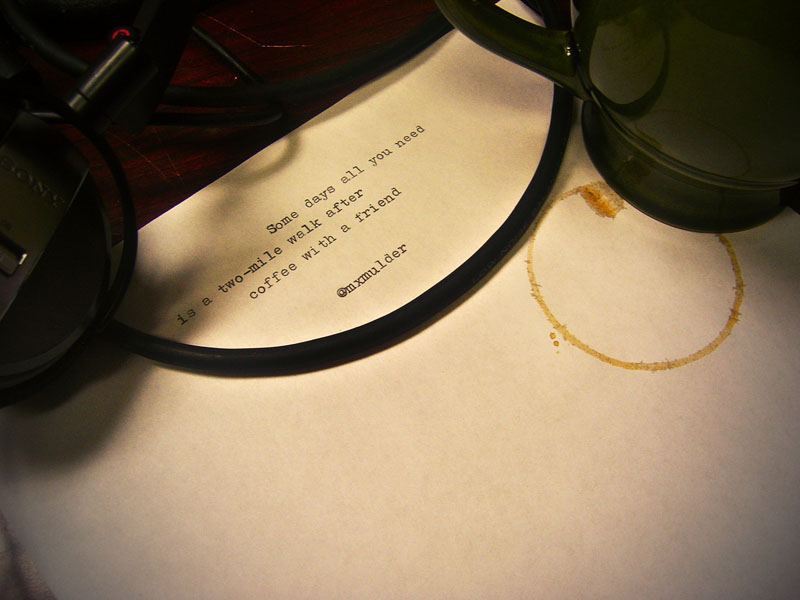
Some days all you need
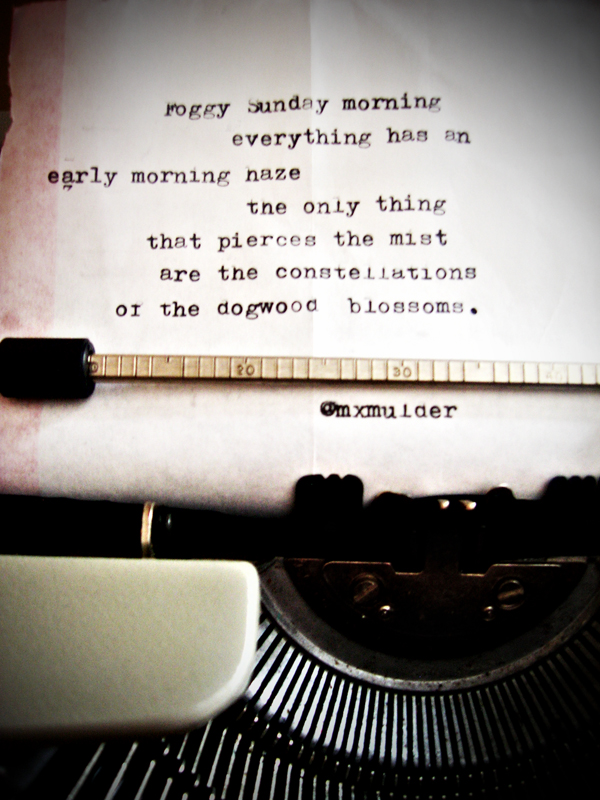
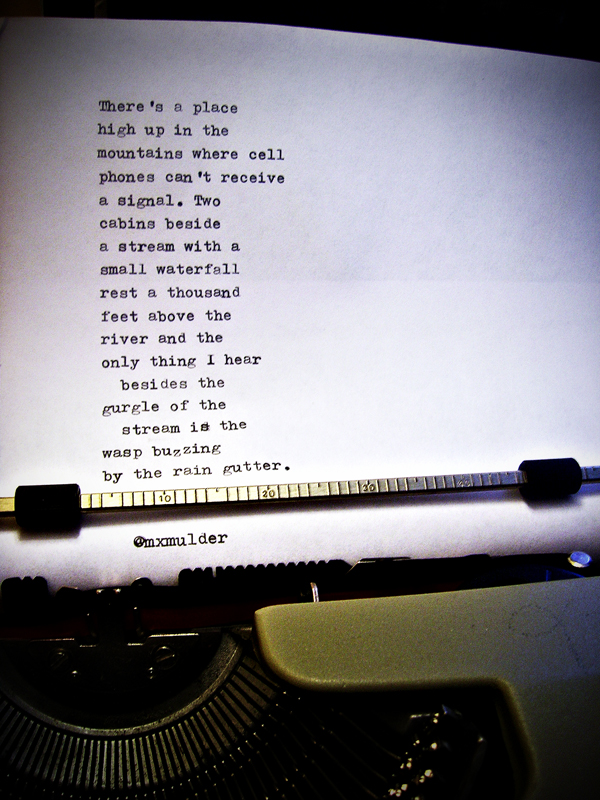
A poem for a friend composed on a manual typewriter

At least eight years ago, an old beat up manual typewriter provided a platform to compose poetry and other writings.1 It was an effort to return to an intentional practice of crafting poetry and prose without distraction of disruptive media.

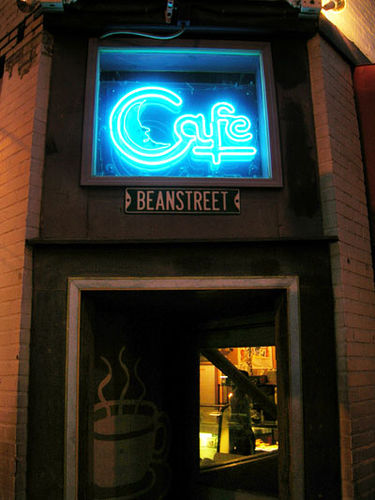
For years and years, a notebook, journal or sketchbook was never far from reach. But one night after a long night of poetry and music at Beanstreets followed by an even longer time of coffee and conversation at Old Europe, a friend convinced me to try blogging.
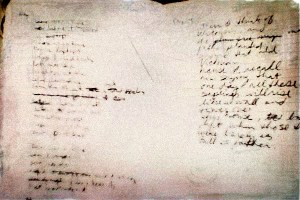
Photo courtesy of @mxmulder
Sample journal page of poetry

The immediate response to blogging was infections.2 Connecting with people all over the country, sharing writing samples or books read and being part of an active digital community was exciting. And the feedback on written work was quick — sometimes within a couple days or hours. The practice of writing allowed me to hone the craft of creative writing and exposed me to other writers across the country. One of those bloggers actually showed up at a poetry gig I did. She was on a cross-country trip to visit friends and wanted to visit in real life.

Over time, I noticed that my practice of writing notes, daily sketches and other activities had all but disappeared. Relying on keyboards, display screens, hard drives and servers presented became a crutch. My writing drafts and sketches appeared deceptively crisp and final in neatly formatted text documents and web blog interface windows.

So, I pulled the plug. Returned to handwriting and typing as practice.3 Some friends and fellow poets saw a few samples of typewritten work and suggested I post it on my blog. It was a novelty. A curiosity. So, I did.

One of the first photographs of a poem I composed on a typewriter was written for a friend. It was posted about this time of year — in 2011.4 A few days later I followed up with another poem5 that was later read at poetry event where I and other poets were dubbed “the next generation” of Asheville poets.6

I do not claim to be the first person to post an image of a poem typed on a manual typewriter. But I noticed a trend in that direction about a year after posting those images of typed poem sketches.7 Not sure exactly if I started the trend. Probably not. Maybe other like-minded individuals who sought to return an organic practice of handwriting and typing as a mode of composing their visions and ideas.

After relocating to the southern boarder of the Great White North,8 I continued using the manual typewriter as a mode of composing new work — both poetry and prose. Some of this was due to the original intent of the practice — crafting content without distraction of disruptive media. Some of the use of the manual typewriter was due to a period of time that I was without a functional laptop and no internet access. A local writers group saw a lot of typed first drafts from that manual typewriter. One of those typed drafts was later published as a short story.9

Most recent first drafts have all been handwritten if not typed on one — of now two — of the manual typewriters. Blogging. Well, that has atrophied. Maybe I’ll post some photos of typewritten drafts this year as a way to keep the blog active. But, to celebrate an eight year anniversary of analog writing — I’ll keep most of it offline and on paper.10

Keep your stick on the ice and remember to use the lowercase L key when typing the numeral one.

NOTES:
[1] In truth, I composed poems on an electric typewriter prior to that. Did it for decades. Did not own a personal computer until… well, that is another story.
[2] That was when there were a mere couple million web blogs in the world. Now, there are some platforms, like Tumblr, boasting 100 million blogs. The blogosphere has become quite congested.
[3] Examples of some the 30 poems in 30 days journal posts with photos: here, here and here.
[4] April 1, 2011, blog post.
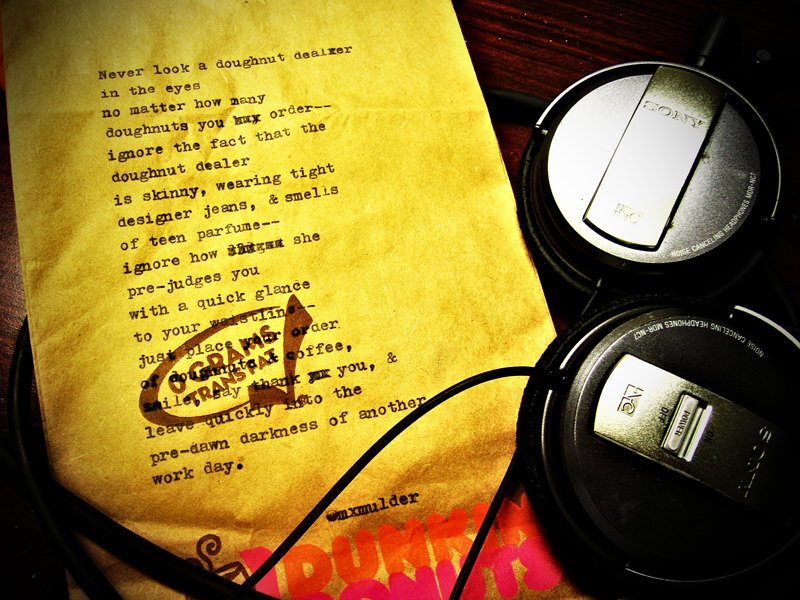
[5] Poem: “Never Look A Doughnut Dealer in the Eyes”
[6] “Rhyme and reason” by Alli Marshall, Mountain Xpress, April 6, 2011. Accessed April 2, 2018. “https://mountainx.com/arts/art-news/040611rhyme-and-reason/”
[7] Examples include Typewriter Poetry (though it seems the web site has not been active since March 19, 2015), Remington Typewriter Poetry (this site too has become inactive with the last entry posted June 2016), and the most popular is Tyler Knott (though his web page has an archive going back to 2003 (which is odd because he uses Tumblr as a platform and Tumblr was launched in early 2007… maybe he migrated his content from some other source to Tumblr… but I digress) the posted images do not begin until 2012 (unless I am mistaken).
[8] A reference to Bob and Doug McKenzie, fictional brothers who hosted the show Great White North (a reference to Canada, aye). For sample episode view Youtube video: https://www.youtube.com/watch?v=0pPRaD6TKLc
[9] Left of the Lake published “Mortal Coil” in 2015. https://coffeehousejunkie.net/2015/08/31/publication-of-mortal-coil/
[10] Original post published on April 21, 2015 https://coffeehousejunkie.net/2015/04/21/typewriter-poetry-and-blogging/
National Poetry Month, weekend edition, part three

National Poetry Month is nearly at an end. One poet, Ann E. Michael, mentioned that she participated in this year’s National Poetry Month “by reading more than by writing.”[1] I agree with that sentiment.

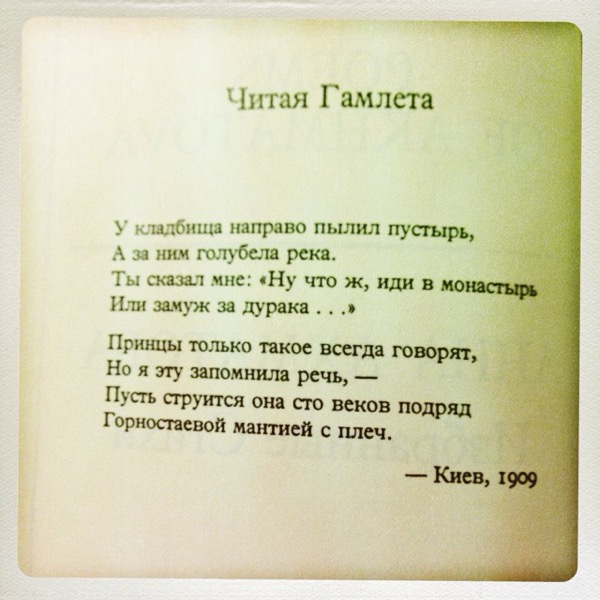
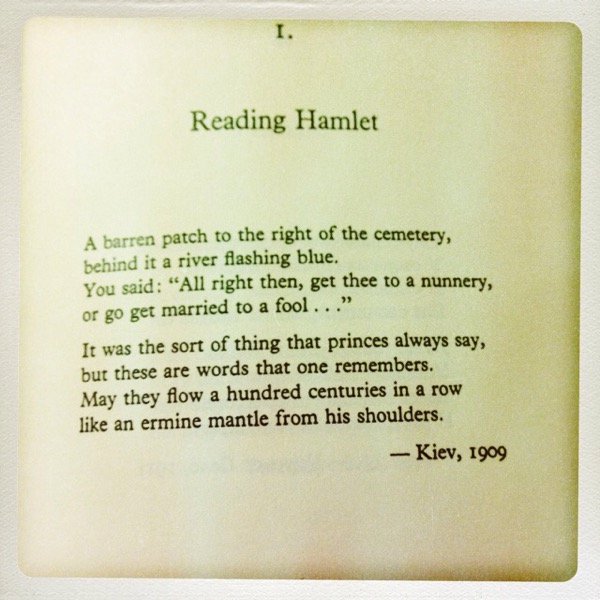
One book I have been reading is a bilingual collection of poems by Anna Akhmatova. The modernist approach Akhmatova displayed in a Russian poem about an English play — Hamlet — amuses me. The line that gets me every time I read it is: “It was the sort of thing that princes always say.”

For people who do not know that they may actually like poetry, I like how Dick Allen put it in this blog post:
“Think of books of poetry the way you think of music CDs. A CD may have 12-15 songs on it. A small book of poetry may have 30-50 poems in it. Just as good songs will be played over, so good poems will be read over and over.”[2]

Following the thread of these two poets, I have read and reread some poetry books. A few favorite poems are on my repeat playlist. This poem by Akhmatova. Another poem by Han Shan. A couple poems by Li-young Lee from his book The City in Which I love You. A poem by Tu Fu.

In Sam Hamill’s notes regarding his translation of a Tu Fu poem he wrote about the mingled joy and deep resignation expressed in the work. “What is implied in the original, . . . is the notion that somehow, . . . he will not waste away sitting before the wine jug. . . . [Tu Fu] asks the question every poet asks under such circumstances: Why do we do it?”

Indeed. Why do we do it? My reply is to continue the Great Conversation.

NOTES:


Poem Sixteen: Honey Bee

Poem: The honey bee

NOTE: Originally published April 19, 2011, https://coffeehousejunkie.net/2011/04/19/poem-the-honey-bee/

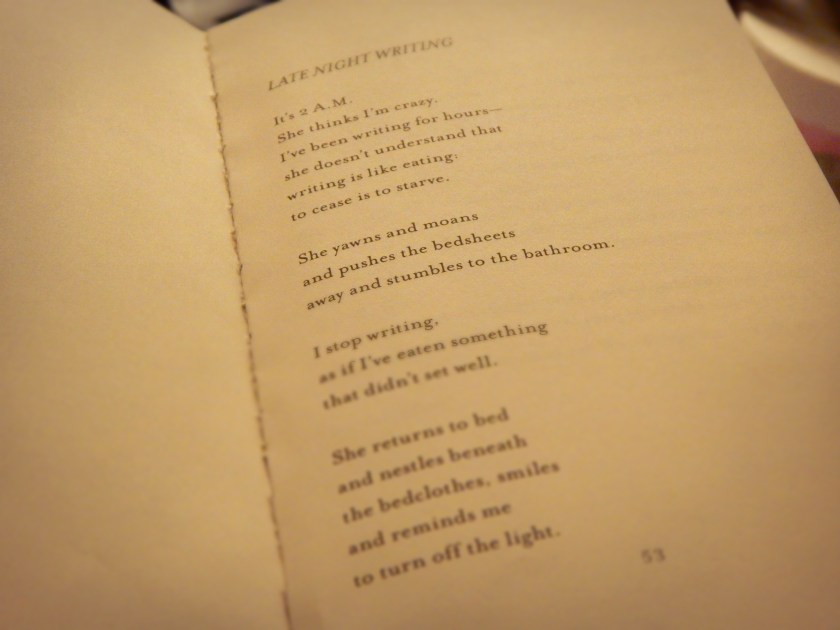
Poem Fifteen: Late Night Writing

Title poem by Matthew Mulder from the book Late Night Writing.

Poem Fourteen: Sunrises I and III

DSCN5427[bsc-lomo-dusk]

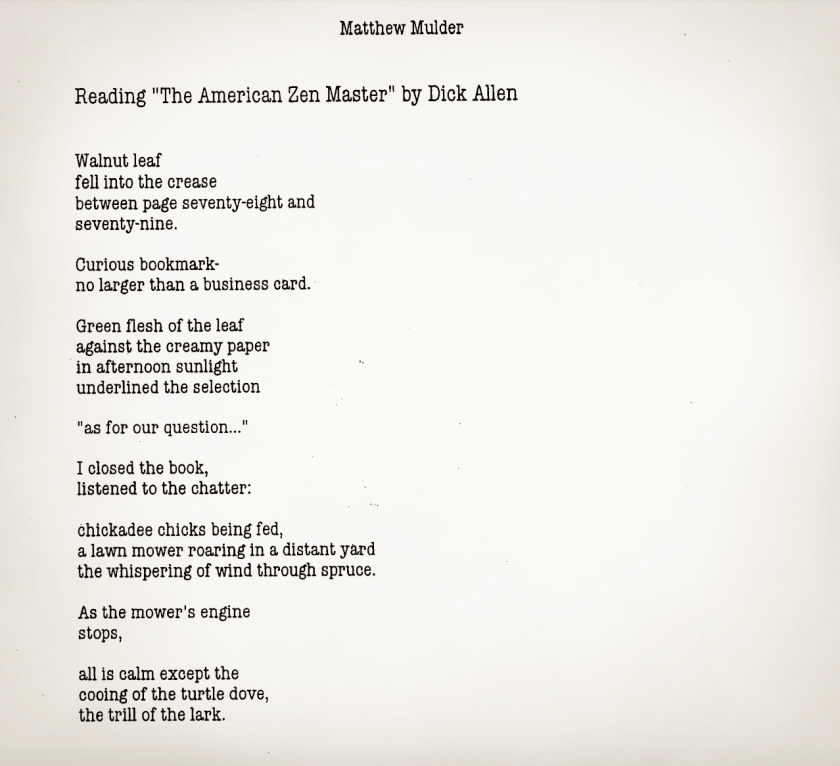
Poem Thirteen: Reading “The American Zen Master” by Dick Allen

Reading The American Zen Master

Poetry reading list for National Poetry Month, part four

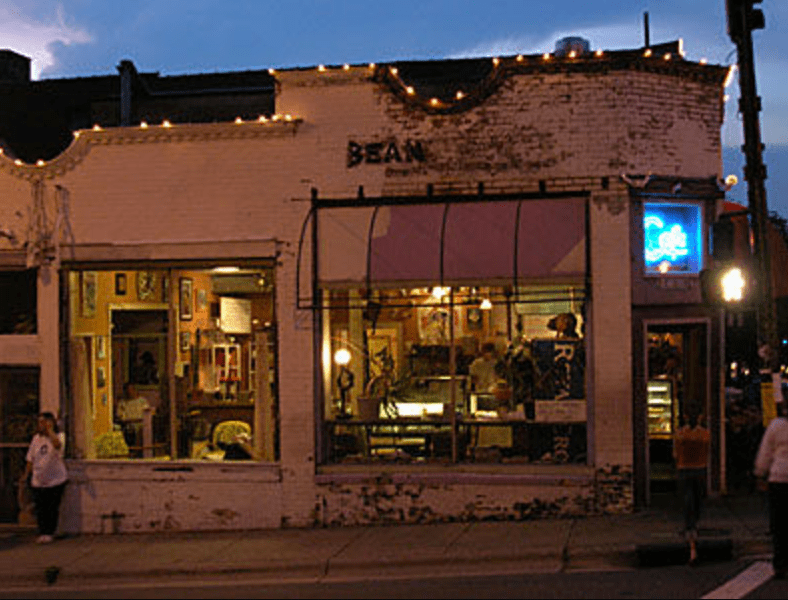
Beanstreet coffeehouse, July 2005

Our paths first met at open mic night at Beanstreet café during a time of national crisis and local transition. The aftermath of 9/11 brought a lot of poets and singer songwriters to open mics for reasons of catharsis and later to protest.

But Barbie Angell[1] brought something different to the Beanstreet musicians and poets. Part Dorothy Parker, part Shel Silverstein, Barbie Angell became a regular favorite of scene and a poetic force.

We first met around the time my book Late Night Writing[2] was published. I was working hard on new material and trying it out on the open mic crowd. We exchanged a few conversations and notes at that time and then we lost track of each other for a couple years.

Beanstreet dramatically closed. The poetry scene was adrift for awhile. Eventually the Courtyard Gallery off Walnut Street filled the space. And that is where Barbie and I reconnected. From those late nights at the Courtyard Gallery open mics until my departure from Asheville, we spent a lot of time sharing poetry, discussing literary world domination, challenging and encouraging each other about all things regarding a poets life.

Roasting Questions,[3] her collection of poems and illustrations, was released a few years ago. We talked much about that publication and the supporting book tour.

Though our poetic styles were different we still sought to encourage one another toward success.

There was one night I remember in particular. Two different events were going on in Asheville and she was to read poetry at one while I read at another. She picked me up at my house, drove downtown, and after the separate events we met up at Sazerac for refreshments. We talked about the night’s events, avoided how jealous we were of the others’ success and then she drove me back home. That is what friends do.

That is a glimpse into the story behind this short poem. With friends like Barbie, you have the strength to walk further, to try harder, and to be better.[4]

NOTES:

[1Read all about Barbie Angell: http://www.barbieangell.com/about-barbie-angell/
[2Late Night Writing is still available in print. Contact me for details. Or you can purchase an e-book version here: https://www.amazon.com/Late-Night-Writing-Matthew-Mulder/dp/1932852204
[3Find out more about Barbie’s book, Roasting Questions: http://www.barbieangell.com/roasting-questions/
[4Originally published May 4, 2017 https://coffeehousejunkie.net/2017/05/04/poetry-reading-list-for-national-poetry-month-part-three/

Poem Twelve: Foggy Sunday morning

Poem: Foggy Sunday Morning

NOTE: Originally published April 11, 2011, https://coffeehousejunkie.net/2011/04/11/poem-foggy-sunday-morning/

Poem Eleven: Narrative kernel

DSCN5426[sqr-bsc-lomo-dusk]

Poem Ten: Values

DSCN5431[sqr-bsc-lomo-dusk]

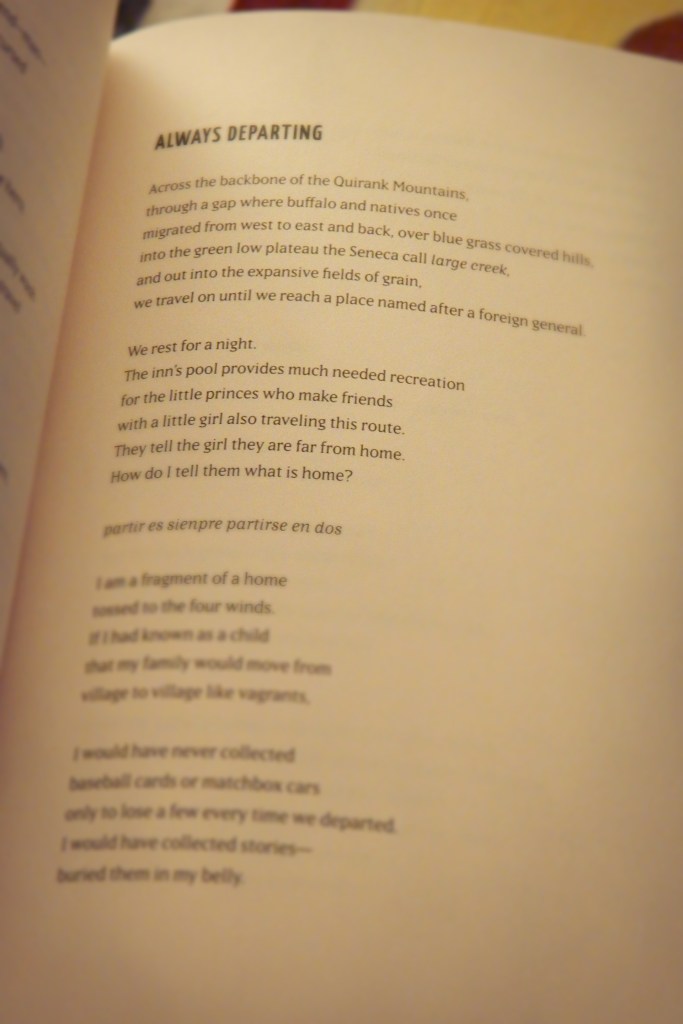
Poem Nine: Always Departing

An excerpt of
An excerpt of “Always Departing” by Matthew Mulder from the anthology Rooftop Poets.

Poetry reading list for National Poetry Month, part three

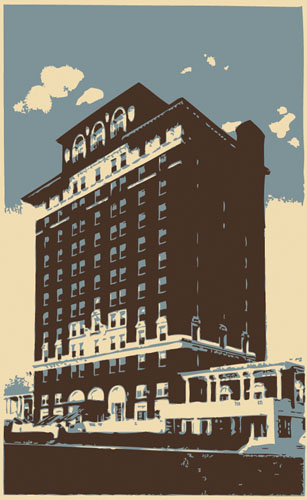
Historic Battery Park Apartments, Asheville, North Carolina

Some of you know this, others may not, but there is a lot of labor involved if you put your hand to the practice and turn of poetry. There was a lot of hard work and late nights at cafés, open mics and taverns and copious amounts of coffee and hours of mic time that provided me the opportunity to read poems at an art gallery — the Flood Gallery Fine Art Center.

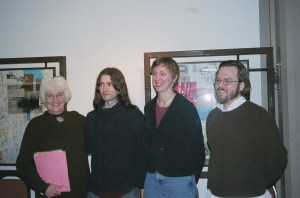
Flood Gallery Fine Art Center, February 2007

The Flood Gallery Fine Art Center[1] organized a poetry reading series that featured local poets. That evening marked a milestone — in my mind. Before that night at the Flood Gallery, the poets — Britt Kaufmann, Brian Sneeden, Barbara Gravelle and myself — were barely familiar with each other. But something alchemical happened during the reading.

Britt Kaufmann’s Belonging was published sometime after that reading.[2] I remember Britt emailing me drafts of the poems prior to publication as well as discussing the nuances of navigating publishing challenges. Barbara Gravelle has published several books of poetry.[3] Her collection of Greek island poems came together before my eyes. One afternoon we looked at illustrations and poems side by side to consider the flow of art and poetry. Brian Sneeden has several forthcoming books of translations and poetry.[4] The first time I heard him read his work was at Malaprop’s Bookstore/Cafe for a Traveling Bonfires event.

Barbara, Brian and myself went on to form a poetic collective called the Rooftop Poets. We collaborated on an invitation-only event of music and poetry at the private ballroom of the Historic Battery Park Apartments. Attendees were given a commemorative, limited edition anthology of our poems. There were a few more public gatherings of the Rooftop Poets, but for me the treasure was sharing our compositions privately. Discussing everything from modern Greek poetry to religion to archeology to feminism to poetry to local gossip as well other aspects of life. I greatly miss that face-to-face time with these friends.

Shortly before my departure from Asheville,[5] I sat in a side room of a wine bar on a Sunday afternoon. The room was filled with aspiring and novice poets. We went around the room reading poems. At the conclusion of the readings I overheard a few people commenting about the Rooftop Poets. They discussed — even mythologized — who the Rooftop Poets were, what they did, how many people attended a private reading, what happened at that reading and so on and so forth. The eavesdropping made me smiled. I did not correct factual errors. I walked to the main bar. Someone bought me a beer. We talked about employment and jazz and all things Asheville. And I left.

These poets and friends made in impact in my life — as well as the local and regional community.[6]

NOTES:

[1Flood Gallery Fine Art Center poetry reading. http://www.floodgallery.org/poetryinthepresence.html
[2Read more about Britt Kaufmann and her work as a poet and playwright. http://www.brittkaufmann.com/poetry
[3Some of Barbara’s books are out of print, but worth the read if you can find them. Here’s a link to one of her published poems: http://www.salomemagazine.com/search.php?search=1
[5The reason for leaving my adopted hometown of Asheville, North Carolina is captured in this article, “Why I Left Asheville,” published in The Asheville Blade: http://ashevilleblade.com/?p=306
[6Originally published May 1, 2017 https://coffeehousejunkie.net/2017/05/01/poetry-reading-list-for-national-poetry-month-part-two/


National Poetry Month, weekend edition, part two

Poetry continues the Great Conversation. What is truth? How do we know it? Who are we and how should we live? Often reserved for philosophers, these surface questions are the result of the friction from winds of poetry.

What came first? Philosophy? Or Poetry? Since Theogony pre-dates many philosophical writings, I submit that poetry came first. Poetry is the wind that troubles the water.

But I am no scholar. Only a modern-day peasant who watched as twelve- to eighteen-foot waves battered the rocky Lake Michigan shoreline this weekend.

On a gray, stormy afternoon, I retreated to the public library in Racine. A book of translations of Han Shan needed to be renewed for the fourth or fifth time. And the children needed to get out of the apartment. Besides, the more you check out books of poetry the more funding the library gets based on your activity and/or interest in certain subjects. Or so I am led to believe by local librarians.

I was introduced to the Cold Mountain poems during one of the library’s writers groups. Since then I have read and studied several books of translations from Wang Wei, Ryokan, Han Shan, Basho and others.

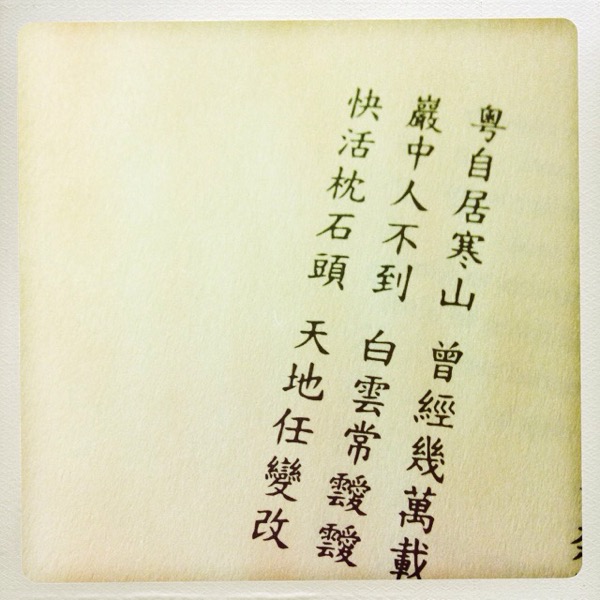
During the last few years, I find my writings turning toward dialogues with these poets. Here is a sample Cold Mountain poem from Han Shan, a Taoist/Buddhist hermit, as translated by Red Pine:

Since I came to Cold Mountain
how many thousand years have passed
accepting my fate I fled to the woods
to dwell and gaze in freedom
no one visits the cliffs
forever hidden by clouds
soft grass serves as a mattress
my quilt is the dark blue sky
a boulder makes a fine pillow
Heaven and Earth can crumble and change

A quick read reveals a surface feast of images and imagination. After reading and thinking about this poem for a few months there are things inferred and/or referenced. Is the An Lu-shan Rebellion referred to in the third line? Is there a reference to the bodhisattva Avalokiteshvara? Heaven means the emperor. Earth means the empire. Is the last line political? Or philosophical?

While Han Shan wrote this poem on rocks or trees, elsewhere in the world Beowulf was composed. Charles Martel expanded the Frankish Empire. What do I say to Han Shan? Why did you flee? What and/or who did you leave behind?

Earlier this year I shared poems with a high school group on invitation of the tutor. Han Shan was one of the poets I recited (among other poets like Ghalib and Akhmatova). After the class, one of the tutors thanked me for visiting the class. She was grateful that the young men in the class saw a man engaged and enthusiastic about poetry and literature. The tutor asked how I became interested in poetry. My answer was that poetry is part of the Great Conversation.

Poem Eight: There’s a place

Poem: Theres A Place

NOTE: Originally published April 12, 2011, https://coffeehousejunkie.net/2011/04/12/poem-theres-a-place/

Poem Seven: Saturday Night, Coffeehouse

DSCN5416[sqr-basic-lomo-dusk-tilt]

NOTES: Originally published in Rapid River Arts & Culture Magazine, April 2004.

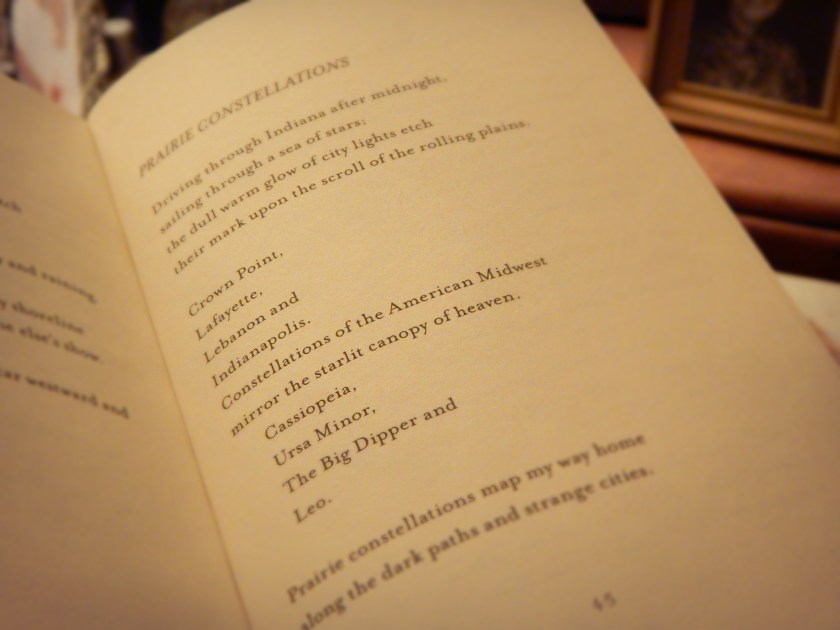
Poem Six: Prairie Constellations

“Prairie Constellations” by Matthew Mulder from the book Late Night Writing.

Poem Five: Last night at the New French Bar

DSCN5432[sqr-bsc-lomo-dusk-tilt]

Last night at the New French Bar, was published in Crab Creek Review.

Poetry reading list for National Poetry Month, part two

Asheville’s Beanstreet coffeehouse, circa 2005.

As stated previously, the poetry reading list for National Poetry Month is designed to encourage you to seek out the influence of living poets — where they live and and where they read. Allow me to introduce you to a few of the living poets I met at the open mics and coffee dens of Asheville, North Carolina.

One of those souls is an editor, poet, journalist and friend, Pasckie Pascua.[1] He has published several chapbooks and collections of poetry and prose. We first met at a coffeeshop in West Asheville and later haunted Beanstreets and other places from North Carolina to New York City. He left the back door to the poetry scene open for me and allowed me to grow and mature as a poet and writer. He also published many of my early writings. Lines from his poems still echo in my mind, like this one:

“The color of my poem

is also the color of my brother’s soul,

the color of my friend’s heart.”[2]

Another poet I wrote with and read alongside is Jessica Newton.[3] She facilitated a writers group when I first moved to Asheville. We gathered at the UNCA library or other spots around Asheville to write and read our compositions. Sometimes she brought writing prompts or other sources of inspiration. We shared prompts and poems. One night Mara Leigh Koslen[4] brought examples of haibun.[5] She introduced the poetic form and then we wrote. It was that night that I composed the first draft of a poem that would later be published.[6] Several other poets and writers visited the writers group.

My poetry reading list is really an introduction to friends and poets who I have met face-to-face. We read and wrote poetry together. We drank coffee at sidewalk cafés until dark-thirty. We shared wine after a moonlit poetry reading. Met in cafés and coffeehouse, taverns and art galleries, bookstores and basements and rooftop ballrooms. We did life together.

When I introduce you to poetry, I introduce you to friends.

I’ll continue the reading list, introductions throughout this month. [7]

NOTES:

[1]Learn more about Pasckie Pascua from this Rapid River Magazine article. http://www.rapidrivermagazine.com/2015/red-is-the-color-of-my-night/
[2]Read the full poem, “Red is the color of my night” and other poems. http://pasckiepascuawords.blogspot.com/p/poetry-red-is-color-of-my-night.html
[3]Jessica Newton is published in several literary journals. The last time we read together was at the Asheville 100 Thousand Poets For Change event. https://coffeehousejunkie.net/2013/10/03/100tpc-quote-jessica-newton/ Jessica was also a finalist in the Mountain Xpress poetry prize: https://coffeehousejunkie.net/2011/04/07/who-will-be-the-winner-of-the-2011-mountain-xpress-poetry-prize/
[4]Mara Leigh Koslen bio: https://palimpsestgarden.com/about/bio/


National Poetry Month, weekend edition, part one

Poems well composed haunt readers. Like an old injury, they return with an ache during inclimate weather. It is April. Yet snow covered the ground earlier this week. Along edges of many fields near Whitewater, small mounds of unmelted snow still remained.

It is National Poetry Month. Like the season, it is time to celebrate in spite of the frosty conditions.

An open mic I visited this week featured one young poet amid a variety of singer songwriters. The poem shared was morose, hurried and full of mixed metaphors. Nothing wrong with that. I dare say a lot of my early work resided in that landscape. I hope to hear more of her work.

A prominent poetry publication arrived in the mail a couple weeks ago. I read nearly midway through the publication searching for a memorable line or image. Nothing. A lot of doleful activism and academic rubric. Maybe it was the reader’s fault. Maybe after more rest I will pick up the publication, reread the poems and find something notable.

This weekend, while rearranging a bookshelf I noticed a stack of books, newspapers and magazines. Included were old issues of The New York Times, books of poetry translations, a couple American poetry books and a copy of the May 2011 edition of Poetry magazine.

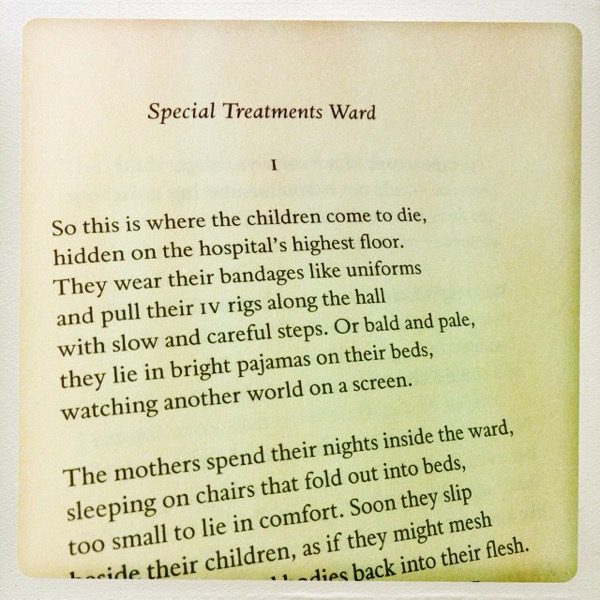
The publication featured a Dana Gioia poem with a haunting opening line “So this is where the children come to die, . . .” How can you not keep reading this poem? It is so good. In the second part of the poem, the speaker reflected, “I’d lost one child/and couldn’t bear to watch another die” and ended that part of the poem with “But there are poems we do not choose to write.” From the first line of the first part of the poem to the last line of the third part, the poem “Special Treatments Ward” was exceptional.

A poem that possesses a reader like Dana Gioia’s poem “Special Treatments Ward” will survive long after the April snow has melted.

Poem Four: Never look a doughnut dealer in the eyes

Never Look A Dealer in the Eyes

NOTES:
1) Originally published April 5, 2011, https://coffeehousejunkie.net/2011/04/05/poem-never-look-a-doughnut-dealer-in-the-eyes/
2) This is a rough draft and includes typos, erroneous grammar and other literary warts. In this case, perfume is intentionally misspelled to represent a unique American accent.

Poem Three: Loneliness visits

DSCN5435[basic-lomo-sangria]

Loneliness visits, was published in ISM Quarterly.

Poem Two: Reading “My American Body”

DSCN5421[bsc-lomo-dusk]

Reading “My American Body” by W. K. Buckley
by Matthew Mulder

Fireflies sparkle
outside. I see them through the
living room window.
It’s the time between
times as I
examine a new hole in
my jeans and consider
“Picking up their shreds
to the tangled light.”
Condensation rolls down
St. Pauli Girl who
makes me sparkle
inside.

NOTES:
(c) Matthew Mulder. All rights reserved.
Originally published in Rapid River Arts & Culture Magazine, October 2005

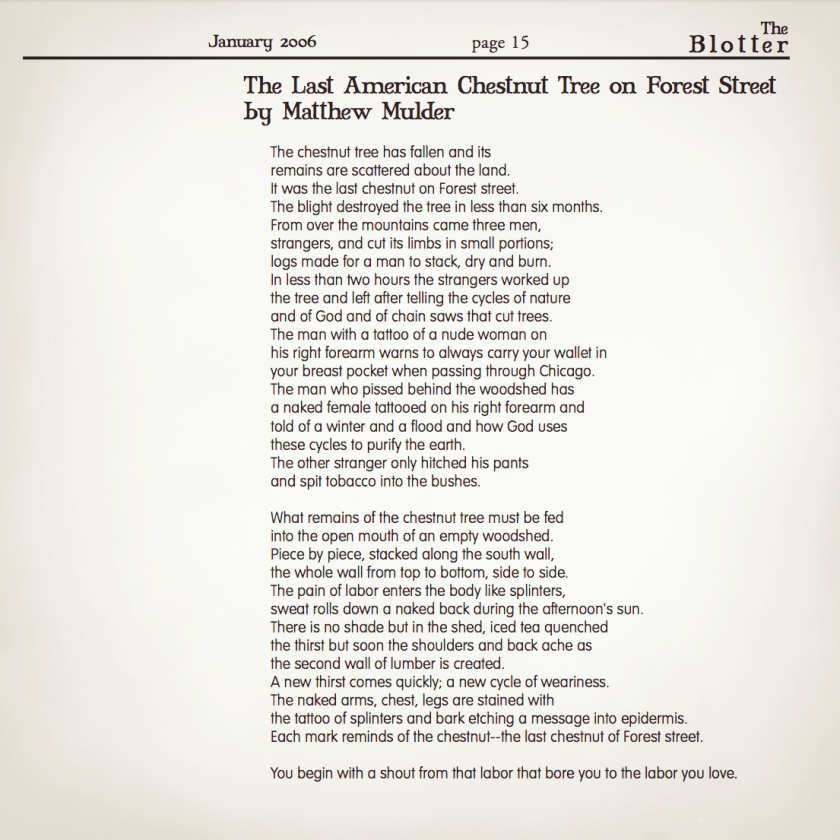
Poem One: The Last American Chestnut Tree on Forest Street

The Last American Chestnut Tree on Forest Street

The Last American Chestnut Tree on Forest Street, was published in The Blotter.

Poetry reading list for National Poetry Month, part one

The best way to share poetry with people — who do not know that they may like poetry — is to start by reading the works of living poets. That is the basic idea of my poetry reading list for National Poetry Month.

Most books lists of are just lists. Promotional bullet points. Usually there is an image of the book or photo of the poet, a brief description or summary, sometimes even a list of credentials and awards, and a hyperlink to the poetic work or an online retail store. That is an approach I will try to avoid.

I read recently that the ancient Greeks and Romans enjoyed literature in a very different way than our modern culture — where we silently read books. The ancient poets read and/or recited their work out loud to a public audience.

So, my poetry reading list for National Poetry Month is designed to encourage you to seek out the influence of living poets — where they live and and where they read.[1]

NOTES: