Meformer, informer, which one are you?

Meformer or Informer

“Meformer” (vs “informer”) is not a new term,[1] but for some reason it is making its rounds on social media the last few[2] months.[3]

NOTES:
[1] Jennifer Van Grove, Mashable,  “STUDY: 80% of Twitter Users Are All About Me”, September 29, 2009, accessed July 15, 2014, http://mashable.com/2009/09/29/meformers/
[2] Patrick Allan, LifeHacker, “Be an Informer, Not a ‘Meformer’, To Get More Followers On Social Media”, May 29 2014, accessed July 15, 2014, http://lifehacker.com/be-an-informer-not-a-meformer-to-get-more-followers-1583508468
[3] Kirk Englehardt, LinkedIn, “Are you a Twitter ‘Informer’ or ‘Meformer’?”, June 03, 2014, accessed July 15, 2014,
https://www.linkedin.com/today/post/article/20140603184736-3091133-are-you-a-twitter-informer-or-meformer

Quote: “Our brains are affected … by the media we use”

I’ve always been suspicious of those who seek to describe the effects of digital media in generational terms, drawing sharp contrasts between young “Internet natives” and old “Internet immigrants.” Such distinctions strike me as misleading, if not specious. If you look at statistics … the average adult has spent more time online than the average kid. …. And the idea that those who grow up peering at screens will somehow manage to avoid the cognitive toll exacted by multitasking and persistent interruptions is a fantasy contradicted by neuroscientific research. All of us, young and old alike, have similar neurons and synapses, and our brains are affected in similar ways by the media we use.”

Nick Carr, from the afterword of the paperback edition of The Shallows (via wwnorton)

Last day of spring? Where did the time go?

UX Design Icons
It is a long week when Friday morning reveals 40 hours worked and it will be two more 10-hour days before a rest.

Still, I managed to attend the Racine Public Library’s writers group this week after a long absence. If you’re looking for a friendly group poets and writers in the Racine area, visit the group.

Also, I have not forgot about this week’s Coffeehouse Junkie audio podcast. It is in production and due to release this weekend. It features a listener’s comments, special dedication and original music between the segments by John Hayes.

So, why the busy week? Oh, boy… where do I start?

Let’s just say, designing a few software application icons and buttons that allow for best user experience is one matter. Designing dozens and dozens is a whole different critter. And that was Monday. And then Tuesday… well… maybe later.


How to be successful in life and business

WP_IMG_9959Does the world need another advertorial[1] on how to be successful in life and business?

This morning I read the article, “Books To Change Your Life And Your Business,”[2] on LinkedIn. It is rubbish. The books listed will not change your life, but might place you in a better neighborhood. Jeffrey J. Fox’s How to Become CEO[3] includes a chapter on required reading for those interested in rising to the top of the corporate ladder. It is a far better and engaging booklist than the one Linda Coles provides.

But, maybe Americans ask the wrong question. Maybe our culture seeks the wrong definition of success in life and business.

Earlier this week, Sunday morning, I was reminded that Americans who have enough to eat, adequate clothing, a place to sleep and a car, are in the top 15 percent of the world’s wealthiest. Further, if you have plenty to eat, a modest collection of clothing, a savings account, two cars and own your home, you are in the top five percent of the wealthiest people in the world.

What if success in life and business is simply a matter of doing what aught to be done? And doing it the best of an individual’s abilities?

NOTES:
[1] A “blend of advertisement and editorial.” http://www.merriam-webster.com/dictionary/advertorial
[2] “Books To Change Your Life And Your Business” by Linda Coles, May 21, 2014, accessed May 21, 2014, https://www.linkedin.com/today/post/article/20140521221520-33236097-7-book-choices-for-a-better-life The books mentioned in the article include: Choose the Life You Want by Tal Ben-Shahar, How to Win Friends and Influence People by Dale Carnegie, The E-Myth Revisited by Michael Gerber, Influence: The Psychology of Persuasion by Robert Cialdini and others
[3] Booklist from How to Become CEO include: The Bible, The Art of War, The Book of Five Rings, The Prince, The Complete Works of William Shakespeare, anything by Thomas Jefferson, The Sun Also Rises by Hemingway, and others.

Weekend reading

20140518-154923.jpg

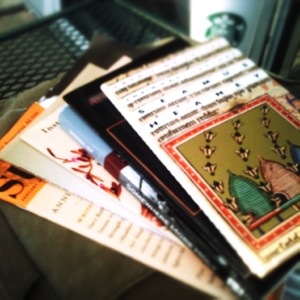
A light breeze from the south, sunshine, blue skies, and the chirp and trill of birds set the stage for a lovely Sunday afternoon. I am sitting outside the apartment reading a book. Or rather reading through a stack of books.

Across the courtyard a guy enthusiastically shouts at his television regarding the baseball game. To the south, the theme music for the television show Dr. Who is heard from an open second-floor window. Why not sit outside and read a good book? Or two. In this northern climate there have been only a few days like this so far this year.

One of the books I have already read, but wanted to reread a selection of poems. One book I bought because I ran up such a large fine at the public library it made practical sense to purchase a copy and finish reading it. Others were on a list of books I have intended to read. One book I put off reading, but am more than 50 pages into it and wonder why I put it off for so long.

What about you? What are you reading this weekend?

Want your words to reach millions of people?

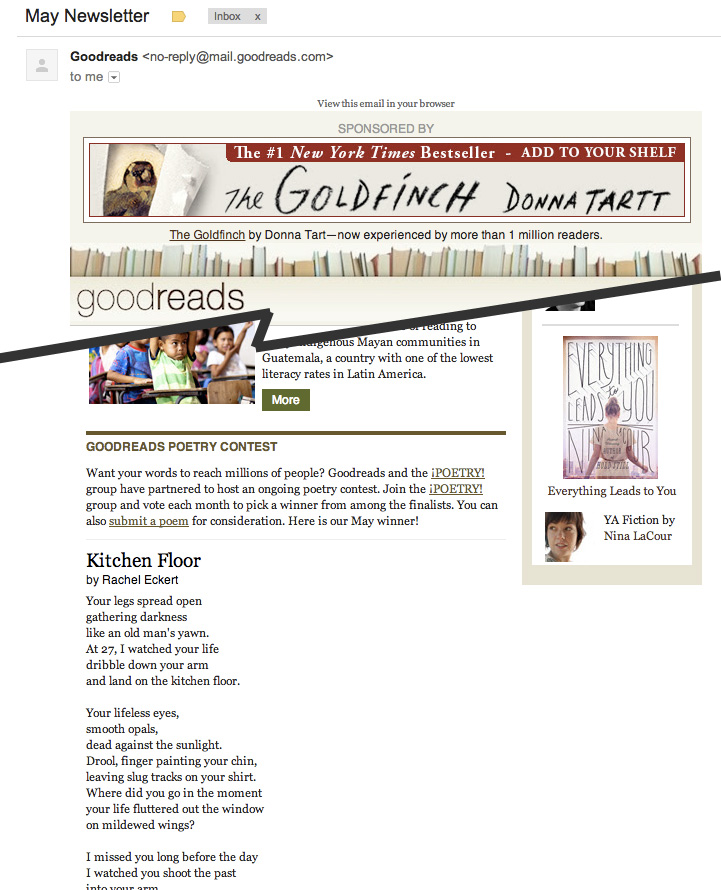
Goodreads May 2014 e-newsletter announces winning poem
Goodreads May 2014 e-newsletter announces winning poem and poet

It is very attractive. Even tempting. Imagine that you are a poet and “more than 20 million people” read one of your poems. That is equivalent to everyone in the state of New York reading your single work of poetic vision and craftsmanship. That is the claim of the monthly poetry contest promoted by Goodreads and the ¡Poetry! group.

The contest rules are simple. All you need to do to enter the monthly contest is to post your poem in the monthly feed of the group. [1] Each month the contest receives hundreds of poems [2] — enough to fill a large print anthology book. I have contributed twice, [3] [4]  but have not won a contest. The May finalists — four of them selected by the judges — were posted on April 29, 2014 [5] for readers to vote on their favorite poem of the contest. [6] On May 14th, a Goodreads e-newsletter arrived in my inbox announcing the poetry contest winner for the May contest. Congrats to the winner!

Yet, there is a part of me that is a bit sad. Not because I did not win. But because I almost deleted the email. In order to read the winning poem, I had to scroll all the way to the very bottom of the e-newsletter. And then I wondered — how many of the 20 million recipients actually read the poem? Even if one percent of the people who receive the e-newsletter actually read that poem — it is still more readers than any published literary journal or magazine in America can reach in a single month. That is impressive.

NOTES:
[1] The June 2014 Goodreads Newsletter Contest, accessed May 14, 2014, https://www.goodreads.com/topic/show/1818448-please-post-your-poem-for-the-june-2014-goodreads-newsletter-contest
[2] 384 poems to be exact. That is the total number of poems submitted for the May 2014 Goodreads Newsletter Contest, accessed May 14, 2014,  https://www.goodreads.com/topic/show/1769435-please-post-your-poem-for-the-may-2014-goodreads-newsletter-finalists
[3] I contributed the 148th entry for the May 2014 contest (accessed May 14, 2014): https://www.goodreads.com/topic/show/1769435-please-post-your-poem-for-the-may-2014-goodreads-newsletter-finalists?page=3#comment_96303966
[4] Also, the 104th contributor for the March 2014 contest (accessed May 14, 2014): https://www.goodreads.com/topic/show/1690565-please-post-your-poem-for-the-march-2014-goodreads-newsletter-contest?comment=92342509&page=3#comment_92342509
[5] If I remember correctly, there were supposed to be six finalists, but two were disqualified, accessed May 14, 2014, https://www.goodreads.com/topic/show/1802873-please-vote-for-the-may-2014-goodreads-newsletter-finalists
[6] For the next two weeks, finalists wait and/or self-promote their way to the top spot and winner of the contest, accessed May 14, 2014, https://www.goodreads.com/topic/show/1802873-please-vote-for-the-may-2014-goodreads-newsletter-finalists

“Lock up your libraries if you like…”

“Lock up your libraries if you like, but there is no gate, no lock, no bolt that you can set upon the freedom of my mind.”

Virginia Woolf (via nocureforcuriosity)

Quote: “Art is not a handicraft…”

“Art is not a handicraft, it is the transmission of feeling the artist has experienced.”

Leo Tolstoy (via subcreation)

Experiencing technical difficulities

Technical difficulties
Technology offers great time-saving efficiencies. Until something breaks. You probably know what I mean.

Your faithful laptop suddenly experiences hard drive issues. Instead of waiting until it is too late, you preemptively order a replacement and it arrives. But it is the wrong model. How did that happen? So you return it and its replacement delivers to your apartment (according to the online package tracking system). But you never see it. Nor does your neighbor, who nicely inquires about the missing package with other apartment dwellers. But alas. It is missing. How does something as simple as replacing a hard drive eat up nearly a month of hassle? So, disappointed by the delay, you place another order for the hard drive. It arrives! Yay! You do the happy dance. (Until you realize that you now have a month of backlogged freelance and contract work to do in a single week.) And you’re back to business.

Well, maybe you do not know what I mean. That never happens to you, right? Yeah, me neither.

All that to say, the relaunch of the audio podcast has been delayed, but is on its way. As soon as I catch up on some projects. Stay tuned.

Quote: “The short story is the art form…”

“The short story is the art form that deals with the individual when there is no longer a society to absorb him, and when he is compelled to exist, as it were, by his own inner light.”

Frank O’Connor (via libraryland)

Quote: “Turn the unspeakable into words”

“The writer’s job is to turn the unspeakable into words – not just any words, but, if you can, into rhythm and blues.”

Anne Lamott (via teachingliteracy)

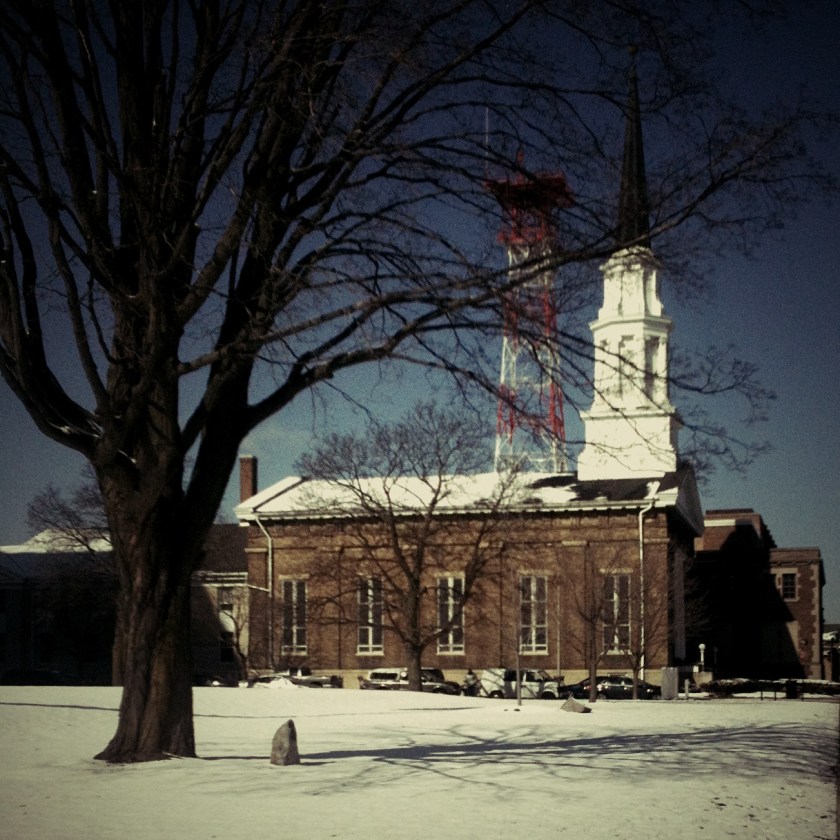
Last snow before Easter?

The week before Easter - a light snow
The week before Easter – a light snow

Quote: “If you want others to follow, learn to be alone with your thoughts”

How do you publicize the necessity to disengage from status quo and social media pressures? Read this article, “Solitude and Leadership.” Actually, it is an essay/lecture by William Deresiewicz. Take your ear buds out. Put away your mobile device (and tablet). Find a quiet corner of a public library (as I am doing presently). And read the essay from beginning to end. Here’s another acorn from the tree to whet your appetite:

“…true leadership means being able to think for yourself and act on your convictions.

One of the consequences for following this wisdom is you will not be popular. Here is another acorn to digest:

“Multitasking, in short, is not only not thinking, it impairs your ability to think. Thinking means concentrating on one thing long enough to develop an idea about it. Not learning other people’s ideas, or memorizing a body of information, however much those may sometimes be useful. Developing your own ideas. In short, thinking for yourself. You simply cannot do that in bursts of 20 seconds at a time, constantly interrupted by Facebook messages or Twitter tweets, or fiddling with your iPod, or watching something on YouTube.”

Does that sound familiar? Do you see the need for undistracted time and space to develop ideas?

NOTES:

[1] William Deresiewicz, “Solitude and Leadership,” The American Scholar, Spring 2010 accessed April 8, 2014 http://theamericanscholar.org/solitude-and-leadership/#.U0QWZa1dXKI

Calling antiquarian book collectors

For those how love a well-crafted book, AbeBooks.com has a special featured titled “The Wonder of Woodcuts” by Scott Laming. The selections posted here, The Wonder of Woodcuts, are high quality (and high priced) books for antiquarian collectors.

Acoustic music and poetry

If you were to match a musician with a poet for an evening of culture and entertainment, who would they be?

A month ago I noticed this ad:

An evening of acoustic music and spoken word/poetry at Pepperdine University
An evening of acoustic music and spoken word/poetry at Pepperdine University[1]
Who wouldn’t want to attend this event? Two great artists on one stage for one evening. Makes sense to me.

Acoustic music and poetry fit together. Nearly a decade ago, I participated at a bookstore café event with musicians.[2] It is something I really enjoyed doing. The marriage of poetry and music resonates with an audience—especially an audience who does not know that they might enjoy poetry.

A few years ago, the Rooftop Poets (somewhat legendary) roof garden book launch and poetry performance featured jazz to accompany an evening of poetry.[3]  Three poets and two musicians joined for a lively evening of poetry, music and light refreshments.

What about you? As a poet, who would you love to work with for an evening of acoustic music and poetry? I have my wish list. What about you?

NOTES: [1] An evening of acoustic music and spoken word/poetry
[2] Malaprop’s Music/Poetry Gig Meditations
[3] A poetry reading and jazz show on the Roof Garden of the Battery Park Hotel

Poem: Original Instagram

Poem Original Instagram

The return of the Coffeehouse Junkie audio podcast is coming soon

Many, many moons ago in a far distant place there used to be a Coffeehouse Junkie audio podcast. For professional reasons I had to place it on hiatus for an indefinite period of time. In, short, I launched and produced nearly 500 audio podcasts for a national news group earning nearly 800,000 downloads in a little more than two years. Since those professional obligations no longer exist, it is time to resume some Coffeehouse Junkie audio podcasting.

There will be some new features to the audio podcast.

  1. A few topics that seem to be popular on this blog include writing, poetry and publishing. Since I have years of experience in the publishing industry, I will feature some episodes on a behind-the-scenes look at publishing.
  2. Additionally, I plan to open up the request lines (to use an antiquated terrestrial radio expression) . If you have read something on this blog that you would like me to address, I will plan an episode around that topic. Please include your name, Twitter handle and request in the comment section of this blog post.

I will re-release the last three episodes of  the Coffeehouse Junkie audio podcast in the next week or so to prime the pump for the relaunch. The last episodes released featured essays and poems that were presented and discussed in a poetry writing workshop I taught at the Flood Fine Arts Center in Asheville, North Carolina. Episode 12 will be re-released later this week, episode 13 early next week and episode 14 the end of next week.

Best reads of 2013

The best books I read in 2013 (that may or may not have been published during the calendar) follow an eclectic path―from fiction to poetry, non-fiction to graphic novels. Instead of providing a review of each book or why I consider it a “best read,” I will provide a quote from each book if possible.

1. A Wrinkle in Time by Madeleine Lengle

“A straight line is not the shortest distance between two points.”
― Madeleine L’Engle, A Wrinkle in Time

“Life, with its rules, its obligations, and its freedoms, is like a sonnet: You’re given the form, but you have to write the sonnet yourself. – Mrs. Whatsit”
― Madeleine L’Engle, A Wrinkle in Time

2. American Primitive by Mary Oliver

3. Blankets by Craig Thompson

“I wanted a heaven. And I grew up striving for that world– an eternal world- that would wash away my temporary misery.”
― Craig Thompson, Blankets

“How satisfying it is to leave a mark on a blank surface. To make a map of my movement – no matter how temporary.”
― Craig Thompson, Blankets

4. Bonhoeffer: Pastor, Martyr, Prophet, Spy by Eric Metaxas

“The worlds of folklore and religion were so mingled in early twentieth venture German culture that even families who didn’t go to church were often deeply Christian.”
― Eric Metaxas, Bonhoeffer: Pastor, Martyr, Prophet, Spy

“Bonhoeffer thought of death as the last station on the road to freedom.”
― Eric Metaxas, Bonhoeffer: Pastor, Martyr, Prophet, Spy

5. Channel Zero by Brian Wood

“…and all of a sudden, world cultures become the Monoculture, the same conversation, the same clothes, the same show.”
― Brian Wood, Channel Zero

“And, all over the world, one by one, we quit fighting it.”
― Brian Wood, Channel Zero

“It’s about learning how to give a shit again, about finding ways to make things better. It’s about anger as a positive force of creation. It’s about your right to not have to live in the world they’ve built for you.”
― Brian Wood, Channel Zero

6. The Cost of Discipleship by Dietrich Bonhoeffer

“Judging others makes us blind, whereas love is illuminating. By judging others we blind ourselves to our own evil and to the grace which others are just as entitled to as we are.”
― Dietrich Bonhoeffer, The Cost of Discipleship

“Cheap grace is the grace we bestow on ourselves. Cheap grace is the preaching of forgiveness without requiring repentance, baptism without church discipline, Communion without confession…. Cheap grace is grace without discipleship, grace without the cross, grace without Jesus Christ, living and incarnate.”
― Dietrich Bonhoeffer, The Cost Of Discipleship

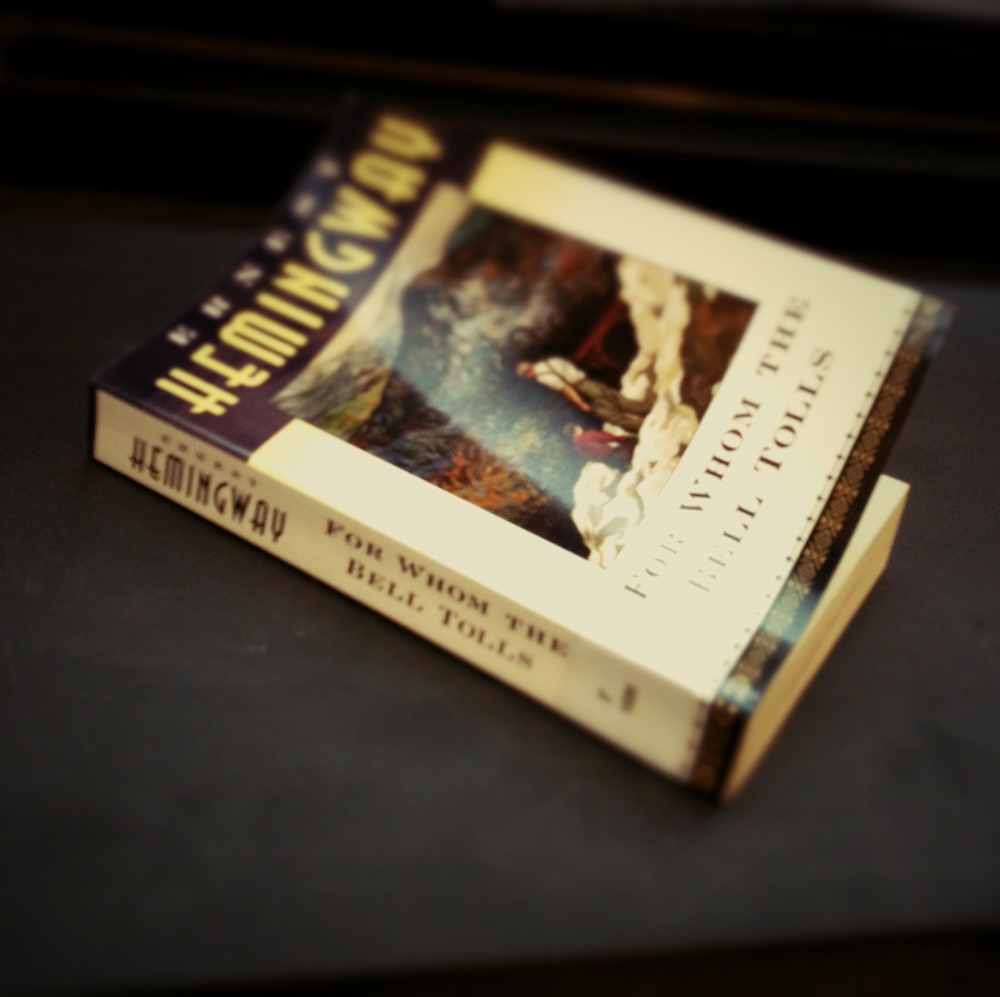
7. For Whom the Bell Tolls by Ernest Hemingway

“For what are we born if not to aid one another?”
― Ernest Hemingway, For Whom the Bell Tolls

“The world is a fine place and worth fighting for and I hate very much to leave it.”
― Ernest Hemingway, For Whom the Bell Tolls

8. Jayber Crow by Wendell Berry

“What can’t be helped must be endured.”
― Wendell Berry, Jayber Crow

“This religion that scorned the beauty and goodness of this world was a puzzle to me.”
― Wendell Berry, Jayber Crow

9. The Old Man and the Sea by Ernest Hemingway

“But man is not made for defeat,” he said. “A man can be destroyed but not defeated. ”
― Ernest Hemingway, The Old Man and the Sea

“Perhaps I should not have been a fisherman, he thought. But that was the thing that I was born for.”
― Ernest Hemingway, The Old Man and the Sea

10. The Prodigal God  by Timothy Keller

“Jesus’s teaching consistently attracted the irreligious while offending the Bible-believing, religious people of his day. However, in the main, our churches today do not have this effect. The kind of outsiders Jesus attracted are not attracted to contemporary churches, even our most avant-garde ones. We tend to draw conservative, buttoned-down, moralistic people. The licentious and liberated or the broken and marginal avoid church. That can only mean one thing. If the preaching of our ministers and the practice of our parishioners do not have the same effect on people that Jesus had, then we must not be declaring the same message that Jesus did.”
― Timothy Keller, The Prodigal God

11. The Red Tent by Anita Diamant

“If you want to understand any woman you must first ask about her mother and then listen carefully. Stories about food show a strong connection. Wistful silences demonstrate unfinished business. The more a daughter knows about the details of her mother’s life – without flinching or whining – the stronger the daughter.”
― Anita Diamant, The Red Tent

“The painful things seemed like knots on a beautiful necklace, necessary for keeping the beads in place.”
― Anita Diamant, The Red Tent

12. River Inside the River: Three Lyric Sequences by Gregory Orr

13. Sailing Alone Around the Room: New and Selected Poems by Billy Collins

14. The Shallows: What the Internet Is Doing to Our Brains by Nicholas Carr

“What the Net seems to be doing is chipping away my capacity for concentration and contemplation. Whether I’m online or not, my mind now expects to take in information the way the Net distributes it: in a swiftly moving stream of particles. Once I was a scuba diver in the sea of words. Now I zip along the surface like a guy on a Jet Ski.”
― Nicholas G. Carr, The Shallows

“Culture is sustained in our synapses…It’s more than what can be reduced to binary code and uploaded onto the Net. To remain vital, culture must be renewed in the minds of the members of every generation. Outsource memory, and culture withers.”
― Nicholas G. Carr, The Shallows

15. Who Killed Homer?: The Demise of Classical Education and the Recovery of Greek Wisdom by Victor Davis Hanson, John Heath

“[We owe the Greeks] our present Western notions of constitutional government, free speech, individual rights, civilian control over the military, separation between religious and political authority, middle-class egalitarianism, private property, and free scientific inquiry.”
― Victor Davis Hanson, John Heath, Who Killed Homer?

The best books I should have read before 2013

Hemingway - book

The 2013 lists are in. From The Seattle Times[1] to The Economist,[2] from NPR[3] to Publisher’s Weekly[4] to The Paris Review[5] and even Bianca Stone’s Poetry Picks[6], everyone seems to be sharing the best books to read of the year.

In some unknown manner, I feel obligated as a reader, and a dabbler in spilled ink and exploded pens, that I should offer a list of best reads of 2013. However, when I look back at the last twelve months of reading material only a few of them were published in the last calendar year.

It is true that as a practice my family congregates at the public library at least once a week, sometimes more. And, since I am an agnostic[7] as far booksellers go, at least a couple nights a week myself and some family members can be observed wandering through the aisles of a Barnes & Noble or a used bookstore. Often I am disappointed in bookstores and libraries because they tend to focus on the bestsellers and popular trends rather than the well-written and perennial books.

So, maybe I should title the list, “the best books I should have read before 2013”. Next week I will share some of the best books I read in 2013 (that may or may not have been published during the calendar).

UPDATE: Here is my list best reads of 2013.

NOTES:
[1] The Seattle Times, 31 of the best titles of 2013
[2] The Economist, A bountiful offering
[3] Our Guide To 2013’s Great Reads
[4] Publisher’s Weekly, Best 20 Books of 2013
[5] The Paris Review, Best of the “Best”
[6] My Poetry Picks for 2013
[7] By agnostic, I refer to the lesser used denotation of the word meaning unwilling to commit to an opinion. This is my quiet response to local matters. Bumper stickers and posters decorate the downtown area declaring “Local is the new black” or “Choose Independents, Buy Local”. This is all well and good, but I am not dogmatic on the point. To demonize corporate retail outlets is a moral pretense that I disagree with on the grounds that the people of Asheville need work. In these economic hard times, any work is good work. Why should I shame one hard worker who is employed at Barnes & Noble and not also shame one hard worker who is employed at a local independent bookseller? Seems like undeserved discrimination to me. My preference is to visit corporate and independent bookstores alike and maintain a bookseller agnosticism in the hopes that neither employees of Barnes and Noble or Malaprop’s loss their jobs as they try to support their families and communities. And no, I am not running for city council.

What did I write?

Block print Christmas card

What did I write that got some much traffic?

A few weeks ago I noticed that the traffic on my blog spiked due to a post I wrote a year ago: “Advent Poems (or the 12 days of Christmas poetry)”.[1] At first, I thought it was a fluke, but for weeks now many of you have visited this blog. Many thanks! And I hope the Advent Poems are a blessing and encouragement to you this year.

Also, feel free to look around and enjoy other poetry related blog posts.

NOTE:
[1] Advent Poems (or the 12 days of Christmas poetry)

Thanksgiving by Ralph Waldo Emerson

Thanksgiving
By Ralph Waldo Emerson

For each new morning with its light,
For rest and shelter of the night,
For health and food,
For love and friends,
For everything Thy goodness sends.

Day 8 of the November PAD Challenge

Blank Visual Poem

The Biltmore Coffee Traders new addition is now open for customers. Willie Nelson singing from the house sound system. Earlier, Van Morrison and Dave Matthews warmed up a chilly, windy but sunny sort of November day as patrons enjoyed gluten-free breakfast cookies and granola bars.

It is day eight of the November PAD (Poem-A-Day) Chapbook Challenge (Details are available on Writer’s Digest website.). Senior Content Editor of the Writer’s Digest Writing Community offers this writing prompt for today: “inanimate object poem.” I have not used the prompts for this challenge. Though I am keeping track of the prompts for later use.

For a  gift, I received a limited printing of book on Korean poetry forms. So, the poems composed so far for this challenge have run in a vein of Japanese and Korean inspired forms. Though, to be fair, most of the compositions are corruptions of the poetry forms.

How about you? How has your November PAD Challenge gone so far?

As a bonus, if you want to play along, fill in the blanks with a poem to accompany the images posted above. Next week, I’ll post what I placed in the blanks.

The November PAD challenge begins

Biltmore Coffee Traders

It is the first of November, often celebrated as All Saints’ Day. For me, the day started out with cloudy skies and a light drizzle as I walked to Biltmore Coffee Traders.

It is also the first day of the November PAD (Poem-A-Day) Chapbook Challenge (Details are available on Writer’s Digest website.). Senior Content Editor of the Writer’s Digest Writing Community, Robert Lee Brewer, offers this writing prompt: “write an appearing poem.”

It is not necessary to use a writing prompt for the challenge, but it is a helpful tool. How about you? Have you started composing your first poem for the challenge?

November PAD is almost here

Over two months of writing a poem a day

Anyone interested in the November PAD (Poem-A-Day) Chapbook Challenge? Details are available on Writer’s Digest website.

It has been awhile since I mentioned the writing exercise I often practice of writing 30 poems in 30 days. A couple of years ago I stopped posting poems on this blog under the advice of a published poet. Poems posted on blogs qualify as “published” and therefore are ineligible to be published in a literary journal or magazine.

So, I started writing poems for friends and others on a manual typewriter and posting the photos—like this short poem for a fellow poet, writer and friend: “Some days all you need.” Or this poem written for the wonderful staff at Dunkin Donuts who always know my order and have it ready for me before I get to the counter: “Never look a doughnut dealer in the eyes.” It is not that I wouldn’t like to get published in a literary journal or magazine, but I really enjoy the process of writing to a specific person or persons.

Due to unemployment followed by new employment challenges, the practice of using the manual typewriter to compose poems ceased due to circumstances I can not share at this point. But I kept composing and writing offline—analog, if you will. In lieu of a manual typewriter, I discovered an app awhile ago. There’s always an app for something, right? During the last month or so, I composed several poem sketches. In the next weeks, I shall share some of these visual poems. Tomorrow, the first one will be posted.

For the month of November I plan to compose a poem a day. Who is with me?