Literature takes a habit of mind that has disappeared. It requires silence, some form of isolation, and sustained concentration in the presence of an enigmatic thing.
Philip Roth (via libraryland)
Literature takes a habit of mind that has disappeared. It requires silence, some form of isolation, and sustained concentration in the presence of an enigmatic thing.
Philip Roth (via libraryland)
This morning while waiting for a bus, I saw a man reach in his pocket, pull out a knife and slit open a stamped envelope. He carefully opened a three page, handwritten letter and slowly began to read. To avoid being any more a voyeur, I focused my attention elsewhere for the next twenty minutes until the bus arrived. As we boarded, I caught two words on the last page of the letter. Soon we were swallowed by the bus and deposited at our separate destinations.
The man, his knife and letter disappeared, but a thought remained and also a question, who still writes handwritten letters? The thought of a handwritten letter in a stamped envelope haunts me as I reflect on how smartphone usage, social media sites, and the endless barrage of emails has changed my thinking and in some regards my behavior (not to mention how my spelling and grammar have increasingly deteriorated).
Consider how much of emails, social media updates and smartphone use is not actionable (to use a David Allen GTD expression). Consider how to eliminate access data assault and focus on learning through connections the way many geniuses and polyglots learn. And unless these thoughts have actions they are but vain ponderings. So, beginning September 1, I plan to focus on the essence of handwritten letters: communication and connection. This means I will not access social media sites (apologies in advance if I have begun a conversation through Facebook or Twitter), and only post updates using my Tumblr and WordPress accounts (and maybe I’ll decide on one of those platforms as the best one for communication and connection). This is an experiment. I’m not retreating to a monastery hidden somewhere near Mount Athos (though, I must confess, I do find that an attractive idea). So we’ll see what happens. And maybe I’ll start writing handwritten letters.
Every morning I tell myself, Today has to be productive—and then something happens that prevents me from writing.
Italo Calvino (via theparisreview)
Writing a story is like crossing a stream, now I’m on this rock, now I’m on this rock, now I’m on this rock.
Ann Beattie (via theparisreview)
Telecommuting via laptop and wireless Internet is a relatively new phenomenon. There is, however, a long history of people – especially writers – working from a favorite coffee shop or cafe rather than an office. Today we tend to associate the phenomenon with the Paris of Ernest Hemingway and F. Scott Fitzgerald, or the coffeehouses of Vienna at the turn of the 20th Century. The poet Peter Altenberg was even known to have mail delivered to his favorite hangout.In many ways, however, the golden age of the coffeehouse workday is now, as any barista can attest.
(via utnereader)1 (via The Atlantic)2
NOTES:
1) Utne Reader, accessed May 16, 2011, https://utnereader.tumblr.com/post/4781366430 (page no longer available, Tumblr account deactivated)
2) Conor Friedersdorf, “Working Best at Coffee Shops,” April 15, 2011, The Atlantic, accessed May 16, 2011, https://www.theatlantic.com/business/archive/2011/04/working-best-at-coffee-shops/237372/
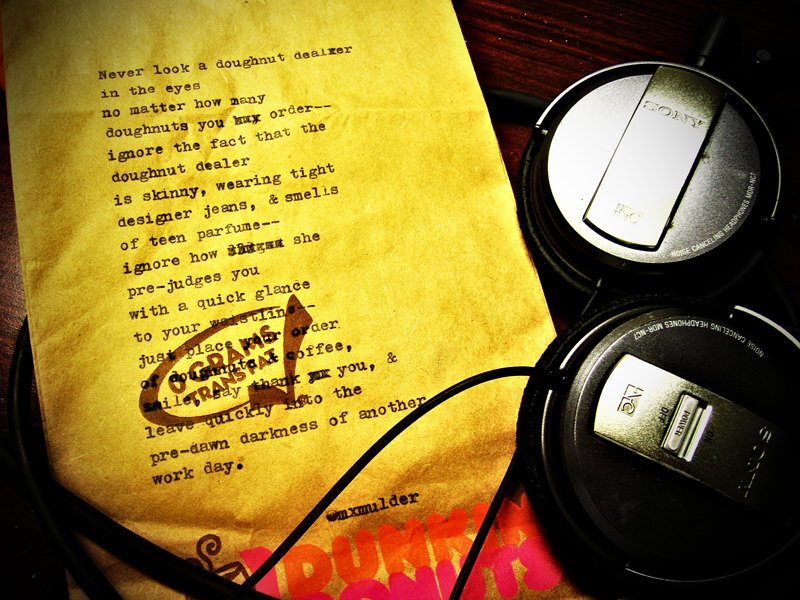
Note: These poems are rough drafts and include typos, erroneous grammar and other literary warts. In this case, perfume is intentionally misspelled to represent a unique American accent.
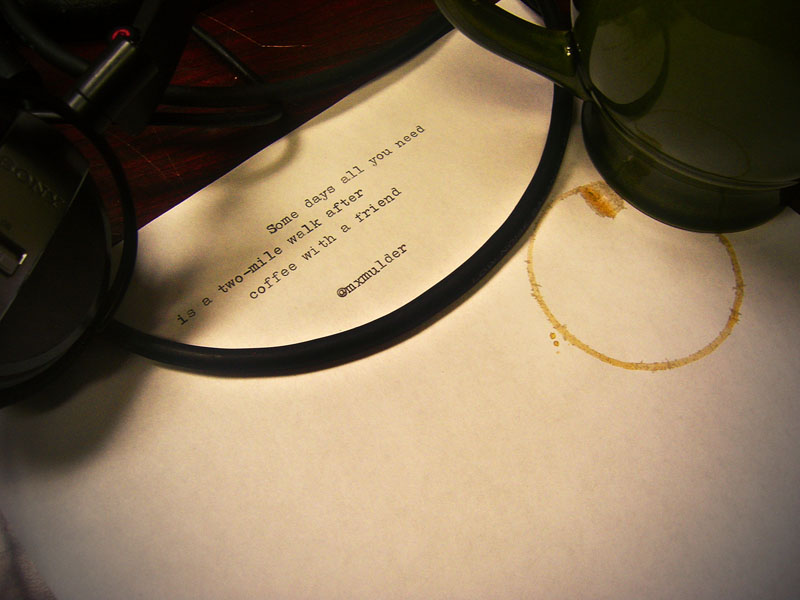
In the September issue of Writer’s Digest, Sherman Alexie says:
Every word on your blog is a word not in your book.
As someone who has been blogging for a few years, that’s conflicting advice. I was encouraged by a friend to start a blog as a way to work on my writing skills. So, I started blogging as a way to discipline myself to write every day. Six years later I have several working or completed manuscripts and no books. Mr. Alexie may have a point. He also offers this:
Don’t Google search yourself.
If you’re a writer who has lost a manuscript due to your computer crashing, here are two online options to protect your work.
For a few years, I’ve been using Google docs to organize manuscript drafts and as an online storage, back-up option. The nice thing about Google Docs is that is works almost seamlessly with Word Docs. Google Docs offers the following online apps: text, spreadsheet, form and presentation. Truth be told, I haven’t used a Microsoft product since I began using Google docs.
Recently I began using Dropbox to store audio files, images and other documents and really enjoy it.
The 30 poems in 30 days challenge is complete. Since the last update the poems have veered all over the place in regards to theme, subject and tone. The main reason for the challenge was to:
A lot of new material was produced but I cannot say my mind is more or less cluttered than before the challenge. I’m still trying to make heads or tails of what I wrote.
As stated previously, Deborah offered a challenge to write 30 poems in 30 days. So far, I’ve been able to keep up with it in spite of a summertime cold and an urgent freelance job that evolved into a larger project than I anticipated. Still, the discipline of writing a poem a day, or at least a poem sketch a day, has proved to be rewarding in and of itself. Two benefits have come out of this exercise so far:
At least one poem sketch so far helped articulate something I’ve been struggling with for a few months. Forcing myself to write at least once a day brought that struggle up from the subconscious and allowed me to form it into a personal poem. Somewhere in my reading I came across a poet, or writer, that said writing every day, even if it’s only for your own eyes, is good practice in writing content for others. My writing professor at the university encouraged students to write a novel for yourself first. Even if the novel is intended only for you, it is worth writing it. And sometimes it may find audience elsewhere.
How do you like that emotionally rich, evocative headline? Copyblogger offers 12 other emotive headlines with emotional benefits explained after each headline. The emotional benefit to the above headline, How to Take Command of Any Meeting” is “feeling respected.”
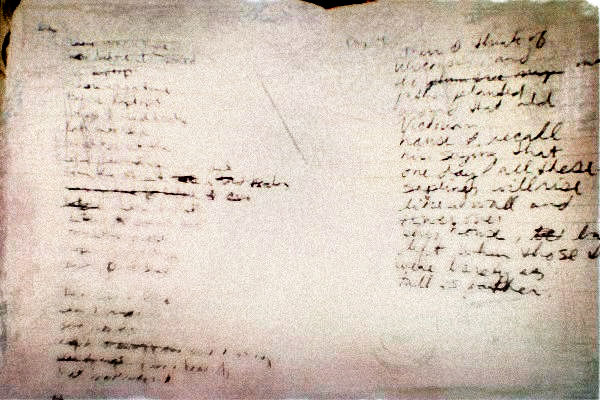
Deborah offered a challenge to write 30 poems in 30 days. I took up the challenge and so far I’m on schedule with one poem a day. Maybe after the challenge I’ll translate the poems from handwritten form to digital, but for me the urgency is to get it all down first. It’s kind of like catching butterflies or lightening bugs.
One interesting item is that the poems have developed a theme. When I accepted the challenge I wasn’t planning on writing 30 theme-based poems, but somewhere under the surface it appears in each page of the poems I’m composing. I guess I’ll find out if it changes course by the end of the challenge.
Deborah (of 32 Poems) invites interested persons to write a poem a day for the next 30 days. The invite was sent out on Sunday (and I didn’t read it until today… so, I’m a bit late), but I think I’m up for the challenge. Anyone else?
Read more details about the challenge here: 30 Poems in 30 Days.
language matters… language is not merely descriptive. it’s creative.

The magazine editor asked me to write reviews. Can’t wait to start reading… and then writing.
…students don’t consult enough sources. Wikipedia is so easy and accessible that it stands out from all other reference works. Thirty years ago, students might check several encyclopedias…. Now, it’s Wikipedia first and, too often, last.
Mark Bauerlein, via The Chronicle of Higher Education. Link.
Next week, I start another 30-day Poetry Marathon… I’ll write one poem per day.
Deborah Ager. Link.
The Indie features part one of my creative non-fiction comic, Strange Familiar Place, this month. It has been a year of trying to find a place courageous enough to take the risk on a no-name amateur artist.
The Indie is available at: Malaprops, True Blue Arts, Pack Library, Woolworth Walk, Rosetta’s Kitchen, Mellow Mushroom, Hannah Flannagan’s, Fine Arts Theater, Early Girl Eatery, Port City Java, Burgermeisters, Lucky Otter, West End Bakery and many other locations.
Previous thoughts and intimations on creative non-fiction comics: [1] [2] [3] [4] [5] [6]
The publisher received the first installment of my creative non-fiction comic this week. It has been almost a year since a posted about a creative non-fiction comic I’ve been illustrating and writing. Previous posts on creative non-fiction comics: [1] [2] [3] [4] [5]
The irony is that Drawn, an illustration and cartooning blog, posted this on Monday:”Goodbye one-page diary comics; everyone’s blogging now.”
It appears the one the inspirations for my work now has a blog (which isn’t bad) but he posted this: “In the old days i’d have made a one-page … but today we squander our narratives in a blog.”
The first installment is due to hit the streets in December and the medium is horribly dated. Another source of inspiration has a blog as well but hasn’t updated since 2003. However, Vertigo released a five-issue miniseries by him that began in September.
Maybe it’s not as bad as Drawn considered.
A while back, I mentioned that the first installment of my creative non-fiction comic is complete and pending publication. The first installment is titled “Higgins: Inside the Box.” Last weekend I completed half of the second installment (four strips or roughly 12 panels) which is the conclusion to the story arch, “Higgins: Inside the Box.” Then I began scripting a 5-part comic strip for a third installment which features a story line about this event. There isn’t an official title to this one. However, “Higgins: Outside the Box” seems like a logical progression.
Last Tuesday was the SECNCS meeting and fellow artists encouraged me regarding my inking techniques and suggested some tips on lettering comic strips. One artist, who is regularly featured in the Rapid River magazine, recommended that dialogue text be all caps and narrative text be upper and lower case. The recommendation is already being implemented beginning with the second installment.
This endeavor of combining illustration and creative non-fiction, have inspired me to study the poet William Blake. The illuminated text is not a new media; many ancient manuscripts were illuminated. For example, The Book of Kells is famously known for its illuminated text. Years ago, I studied under a calligrapher who taught me the secret of the Celtic knot work and spirals represented in the Book of Kells. The discipline of the knot-work has served me well, though not in my recent illustrations.
But William Blake illuminated his own poems and printed his own collections with the help of his wife. It helped that he was trained as an engraver and went on to apply his trade for book and magazine publishers. Being an innovator in his own right, he applied his trade to illuminate and print his own literature. Like William Blake, I studied graphic design (the modern day digital engravers if you will) and know how to produce books and magazines for clients. I wonder what William Blake would think of creative non-fiction comics?
Previous posts on creative non-fiction comics: [1] [2] [3] [4]
Flash fiction + Asheville = Flasheville.com
Flasheville published “Another Empty Glass” over the weekend.
I had tea not long ago with the writer of a very nice article about Asheville blogs. I didn’t realize he was such a comics aficionado. Over tea, he presented me with the idea of illustrating non-fiction narratives and personal memoir. I illustrated a 14-panel story about our meeting. The drawings are quick suggestions of setting and characters. I didn’t want to get too realistic.
Brian commented: “Such an exercise cannot help but broaden and deepen your writing… This is really fascinating. Taking everyday situations, finding the drama, illustrating them – you’re developing a wealth of back-story. I could see one of these scenes popping up under a bigger story… I don’t think you’re wasting time on this project.”
I hope he’s right in regards to the exercise assisting my writing.
Narrative Non-Fiction Comics is not new. Harvey Pekar’s American Splendor was famously made into a movie. Jessica Abel’s journalistic comic Radio: An Illustrated Guide records the making of a This American Life show. Joe Sacco’s books “Safe Area Gorazde: The War in Eastern Bosnia 1992-95” and “Palestine: In The Gaza Strip” are journalistic graphic novels.
Eddie Campbell’s Alec McGarry stories offer extensive inspiration in the genre of autobiographical comics/graphic novels. Alec McGarry is Eddie Campbell’s stage name (or rather comic page name). That is like Samuel Clemens writing an autobiography in which Mark Twain was the main character.
I must confess I’m enamored by that idea, but not as a narcissist. In the arena of stories, the most compelling tales are true, personal accounts–narrative non-fiction. Also, persuasive arguments are often won by personal example/experience. That’s what makes Elie Wiesel’s book, Night, so riveting–he was there. He survived Auschwitz, Buna, Buchenwald and Gleiwitz. He has first hand experience.
I know, I know–I’ve just sprinkled a lot of names throughout this post like confetti. Mark Twain I am not. Nor have I the life experiences of Elie Wiesel. I don’t know if I really want to follow in Eddie Campbell’s footsteps, either (he reveals all areas of his life–i.e. no trouble drawing himself nude which unnerves me–but maybe that helps him gain perspective on his own life).
I have a sketch of an idea of where I want to go with narrative non-fiction comics. This is what they call in Corporate America the development stage. It’s what I call drawing 1000 black lines before presenting a finished drawing.
Previous post on creative non-fiction comics: [1]
 Coffeehouse Junkie
