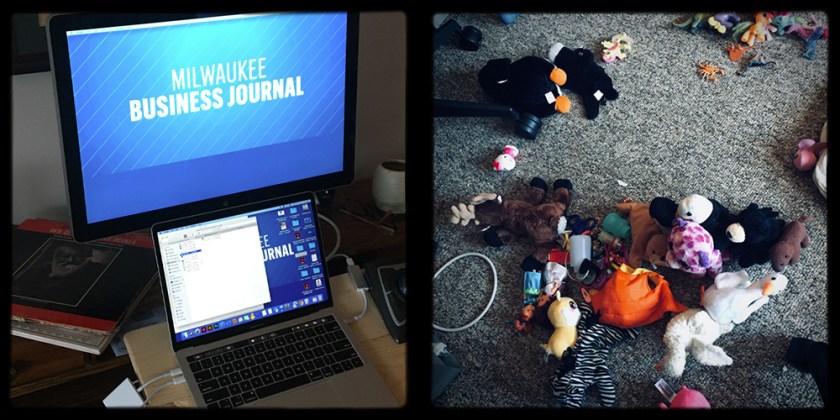
What happens off camera. . . stays off camera

What happens off camera. . . stays off camera. Mostly. As video conferencing becomes normative so also does the occasional crumb-cruncher intrusion. One article put it this way, we are all the BBC dad now.

Another dynamic that manifested itself with business and education now primarily being conducted virtually, is the reality of economic inequities among employees and students. We are now looking into our co-workers’ living rooms, kitchens, home offices, or ceilings. As one Twitter user stated, “financial inequities in the classroom are on full display. . .”

https://twitter.com/juliarburnham/status/1247660439657254912


Co-workers and classmates may not know that you do not have internet at home. That you go to the public library for internet usage. Or that you drive to the Dunkin Donuts eight miles away when the library closes in order to use free WiFi to finish a project.

Maybe you do have internet at your apartment. But it is really slow, because you cannot afford a larger internet package. Or that you live in a rural location and high-speed internet is not available.

Or there is a hardware issue. The computer laptop you have does not have the capability to run the latest video conferencing software application.

The COVID-19 pandemic appears to be an equalizer of sorts. We are all vulnerable. During this season when we all feel unsafe, exposed it presents opportunities to show compassion and understanding. My hope is that when we are on the other side of this crisis we will show empathy towards each other.

How to tame the email dragon

Enter “how to tame the email dragon” in the Google search engine and about 2,300,000 results are available (in 0.50 seconds).

Fact.
The average length of an email is 50-100 words. Most emails are longer.[1]

Fact.
You spend at least 13 hours a week at the office[2] reading and replying to emails.
That is 650 hours a year![3]

Perspective.
It takes 12 to 13 hours to read John Updike’s Rabbit, Run.
Or (for non-readers) that is equivalent to a ten-episode Game of Thrones binge watching marathon.

Fact.
Most full-time employees work 1700 hours per year.[4] That means nearly 40 percent of your work life is engaged in reading and replying to emails.

NOTES:
[1] The Muse, Are Your Emails Too Long? (Hint: Probably), Forbes, March 11, 2014, accessed December 18, 2017. https://www.forbes.com/sites/dailymuse/2014/03/11/are-your-emails-too-long-hint-probably/#7e9f22965400
[2] Jordan Weissmann, Re:Re:Fw:Re: Workers Spend 650 Hours a Year on Email, The Atlantic, JUL 28, 2012, accessed December 18, 2017. https://www.theatlantic.com/business/archive/2012/07/re-re-fw-re-workers-spend-650-hours-a-year-on-email/260447/
[3] Megan Garber, You Probably Write a Novel’s Worth of Email Every Year, The Atlantic, JAN 8, 2013, accessed December 18, 2017. https://www.theatlantic.com/technology/archive/2013/01/you-probably-write-a-novels-worth-of-email-every-year/266942/
[4] Joe Weisenthal, Check Out How Much The Average American Works Each Year Compared To The French, The Germans, And The Koreans, Business Insider, Aug. 17, 2013, accessed December 18, 2017. http://www.businessinsider.com/average-annual-hours-worked-for-americans-vs-the-rest-of-the-world-2013-8

Solitude and leadership and you

Being a leader does not always mean your job title is CEO or office manager or creative director. Leading from within is as affective if not more than leading from the top of the corporate structure. Based on William Deresiewicz’s essay/lecture (which I quoted portions of back in April, but for a refresher, read the article here: Solitude and Leadership), how would you apply some of the principles he suggests in “Solitude and Leadership”?

Maybe your work life is something like this. You have a full, eight-hour day work load of project management tasks (that you are trying to squeeze into ten hours), production items and internal and external clients to assist. Shortly after you sit down at your desk and take a sip of coffee, your email inbox audibly notifies you of an email from your supervisor. You do not respond to the email immediately because you are processing files from yesterday for today’s activities. These are files the supervisor needs by 10 a.m. That allows you one hour to complete the task. Within a few minutes you receive a Skype message from the supervisor asking if you saw the email. When you do not reply to the Skype message immediately, you receive a text message on my personal mobile device asking if you saw the Skype message about the email. Does this sound familiar? How do you handle such distraction and meet your supervisors requests and requirements?

This may be a mundane example, but it is more accessible to most readers than that of a Wall Street broker. So, how would you apply some of the principles Deresiewicz suggests in “Solitude and Leadership”?

How to be successful in life and business

WP_IMG_9959Does the world need another advertorial[1] on how to be successful in life and business?

This morning I read the article, “Books To Change Your Life And Your Business,”[2] on LinkedIn. It is rubbish. The books listed will not change your life, but might place you in a better neighborhood. Jeffrey J. Fox’s How to Become CEO[3] includes a chapter on required reading for those interested in rising to the top of the corporate ladder. It is a far better and engaging booklist than the one Linda Coles provides.

But, maybe Americans ask the wrong question. Maybe our culture seeks the wrong definition of success in life and business.

Earlier this week, Sunday morning, I was reminded that Americans who have enough to eat, adequate clothing, a place to sleep and a car, are in the top 15 percent of the world’s wealthiest. Further, if you have plenty to eat, a modest collection of clothing, a savings account, two cars and own your home, you are in the top five percent of the wealthiest people in the world.

What if success in life and business is simply a matter of doing what aught to be done? And doing it the best of an individual’s abilities?

NOTES:
[1] A “blend of advertisement and editorial.” http://www.merriam-webster.com/dictionary/advertorial
[2] “Books To Change Your Life And Your Business” by Linda Coles, May 21, 2014, accessed May 21, 2014, https://www.linkedin.com/today/post/article/20140521221520-33236097-7-book-choices-for-a-better-life The books mentioned in the article include: Choose the Life You Want by Tal Ben-Shahar, How to Win Friends and Influence People by Dale Carnegie, The E-Myth Revisited by Michael Gerber, Influence: The Psychology of Persuasion by Robert Cialdini and others
[3] Booklist from How to Become CEO include: The Bible, The Art of War, The Book of Five Rings, The Prince, The Complete Works of William Shakespeare, anything by Thomas Jefferson, The Sun Also Rises by Hemingway, and others.

Why share your work in social networks?

One of the book cover designs I promote on the social network Behance.

“Why share our work in social networks?” was a question recently asked on a professional forum. My reply: two reasons: 1) promotion and 2) personal brand. It was a Malcolm-Gladwell-Blink response and I clicked the “add comment” button without much thought (which is not my usual practice). My thoughts still linger on that question, “Why…?”

A few months ago I came across a few articles asking the question “Does social media promote or enable narcissism?” [1] [2] The article that impacted me most was from a source I never read. In the post, the author, Dodai Stewart, reflects on piece in The New Yorker and her comments are stinging and self-revelatory.

Just look around: Between Twitter, Facebook, Tumblr, Instagram and Pinterest, the whole ME ME ME thing has swept the nation. Here are MY thoughts, MY pictures, MY shopping wish lists! We call it sharing, but it’s just egoistic self-indulgence, usually. LET ME TELL YOU WHAT I WANT. But wait: Enough about me… what do you think about me? [3]

Hm, narcissism and self-absorption. Herein rests the lingering thoughts of a week or so ago.

As a professional, promoting my goods, services and whatnot help to grease the gears of capitalism, right? Conventional wisdom (or at least American business wisdom), purports that if consumers are not aware of your product/service, customers will not purchase from ME. So, I am advised by business owners and other professionals to promote MY skills, services, products, etc. And not only that, I need to establish MY personal brand (so that consumers can be more emotionally and psychologically invested in the products/services I provide).

Maybe social networks are not promoting narcissism and self-absorption as much as one might think. There may be a greater systemic issue that only social networks magnify.

NOTE: [1] Tara Parker-Pope, “Does Facebook Turn People Into Narcissists?,” New York Times, May 17, 2012 accessed January 2, 2013 http://well.blogs.nytimes.com/2012/05/17/does-facebook-turn-people-into-narcissists/ [2] Steve Tobak, “Social networks and the narcissism epidemic,” CBSNEWS Money Watch, August 29, 2012, accessed January 2, 2013 http://www.cbsnews.com/8301-505125_162-57502035/social-networks-and-the-narcissism-epidemic/ [3] Dodai Stewart, “Self-Absorbed Is the New Normal,” Jezebel, June 26, 2012, accessed January 2, 2013 http://jezebel.com/5921468/self+absorbed-is-the-new-normal.

How to write a business bio

Or not. Here’s what professional copywriters will tell you. There are two steps to writing your business bio:

  • provide an overview of your skills and experience.
  • include related or interesting facts to punctuate your credentials.

Pretty simple, right. Wrong. Why is it so difficult to write in third-person? About yourself? (And I need send this to the publicist later today.) So, I wrote a first draft. It works. It’s short. Simple. To the point. But something is missing. So, I searched a couple web sites for help. Here’s a few basic principles I gleaned from Terje Johansen:  [1]

  • write in third person
  • list facts, not wishes
  • cite relevant experiences
  • belong somewhere
  • write tight
  • add a hook

Here’s a few things to add to that list:

  • audience
  • storytelling
  • social media

The business bio I’m writing is to be placed on a publishing house’s web site. So that audience will be authors and readers. A dash of storytelling to the bio helps readers remember who you are because of the narrative you share. And be sure to include your LinkedIn info. Here’s what I plan to send to the publicist:

Matthew Mulder began his career in a quiet Wisconsin studio of a calligrapher where he learned a hands-on approach to color, design, typography and the ancient art of Celtic knots. As creative director, he brings more than sixteen years of experience to the art department and provides creative, strategic solutions to the publishing business. After-hours, Matthew is a culture-maker in the literary community of Asheville, North Carolina where he is invited to present his work to audiences at bookstores, cafés, and fine art centers. His published work appears in such literary journals as Crab Creek Review, H_NGM_N, Small Press Review and others. Follow Matthew on Twitter @mxmulder or LinkedIn.

What do you think?

NOTES: [1] Terje Johansen provides the basics of writing a business bio . Here’s a couple other resources: 16 questions to help you write a douche-free bio and A Great Professional Bio.

What does a goat and a mule have in common with social media?

There’s an old proverb that goes something like this: one should avoid the front of a goat, the back of a mule, and every side of a fool. If you don’t want a private message, comment or opinion printed in 60 point, bold type headlines on the front of The New York Time, you shouldn’t email it, tweet it, post it to Facebook or your blog. That’s what prompted the following advice to job seekers:

1.) Don’t post inappropriate pictures or make any comments on the web that could be offensive to anybody.  If they’re already up, delete them now!

2.) Mark all of your settings on any type of social media as private.  Don’t let people who aren’t connected to you view your pictures or read your comments.  If friends posted a ridiculous comments, delete them now!

3.) If you want to share your personal beliefs, call a friend.  Don’t share them through social media.

4.) Google yourself because future employers will.  If you find things that you don’t think a future employer would like, find a way to get rid of it!

5.) I’ve shared all of the negative things about social media but don’t forget that there are a lot of positive things too.  If you’re actively volunteering, fundraising, running a marathon, or writing a motivational blog these are all things that can help you get a job.  Make sure these are public to future employers.

Link

It’s just common sense and good business practice. Yet it seems missing from the American culture as people display their most private details and opinions. If you truly want to maintain private details avoid the internet entirely. But if you are using the internet for social media and emailing, remember that the internet is immediate, permanent, and global.

Gen-Yers changing the workplace

Gen-Yers are using their personal networks and profiles as an extension of their professional personality. Even though they are using Facebook to mostly socialize with family and friends, they are inadvertently blending the two. Sixty-four percent of Gen-Y fails to list their employer on their profiles, yet they add an average of 16 co-workers each to their “friend” group.

Generation Y: The New Kind of Workforce (via thenextweb)

How These Magazines Increased Circulation While the Industry Declined

Print Design Garners 93% of All Media Created

(via Full Circle – Paper + Print + Design)

Top 10 Things You Should Never Say at Work

9 Things That Motivate Employees More Than Money

ROWE (Results Only Work Environment)

Kelly and Moen—who published their work this week in The Journal of Health and Social Behavior—found that employees who switched to ROWE took better care of themselves. Not only did they get an extra 52 minutes of sleep before workdays on average, they were also less likely to feel obligated to work when sick and more likely to see a doctor when they needed to. And the turnover rate among employees that switched to ROWE was only 6%, compared to 11% with the control group. In addition, their increased sense of schedule control and reduced work-family conflict led to increased self-reported energy levels and decreased psychological distress. (via Bosses, Stop Caring If Your Employees Are At Their Desks) (via fastcompany)

What does a creative director do?

‘What does a creative director do at a publishing house?’ he asked after we were introduced to each other at a party. That question was asked at several events I attended this weekend. At the party, I paused to consider general day to day tasks that consume me. Took a sip from the Belgian-style wheat ale we were enjoying and said, ‘A creative director is like an air traffic controller for an art department.’ As that metaphor seemed to resonate and take form in his mind I added, ‘An air traffic controller who often has to pilot the aircraft that is landing.’ That seemed to raise a few eyebrows.

I’d like to know how other creative directors define their role.

#1 root cause of small business failures

Got this tip from a business mentor of mine:

“If you understand the technical work of a business, you understand a business that does that technical work.

And the reason it’s fatal is that it just isn’t true.

In fact, it’s the root cause of most small business failures!

The technical work of a business and a business that does that technical work are two totally different things!

But the technician who starts a business fails to see this…”

(via e-myth)

How to Answer the 5 Toughest Interview Questions You’ll Face

  1. Why Should I Hire You?
  2. What is your greatest fault?
  3. What three historical figures would you invite to dinner and why?
  4. What are your salary requirements?
  5. Where do you see yourself in five years?

Read more.

(via moneywatch)

Build a Successful Online Portfolio

1. Ask the question

2. Focus on simplicity

3. Optimize your ‘About’ page

4. Provide a clear means of contact

Read five more steps…

(via freelance switch)

Read: 200 million Tweets per day

Every day, the world writes the equivalent of a 10 million-page book in Tweets or 8,163 copies of Leo Tolstoy’s War and Peace. Reading this much text would take more than 31 years and stacking this many copies of War and Peace would reach the height of about 1,470 feet, nearly the ground-to-roof height of Taiwan’s Taipei 101, the second tallest building in the world.

The Twitter Blog, 200 million Tweets per day. (via futurejournalismproject)

4 things to do while waiting for a reply

The silence after sending out resumes and cover letters is frustrating. Here’s four tips from Gerry Corbett for Talent Zoo:

  • Be patient.
  • Tap the network.
  • Grab a hook.
  • Move on.

read more »

(via talentzoo)

4 things to do if you just lost your job

When I received the notice from the CEO that the office was closing for business and the entire staff would be out of work, I was devastated. But there are a lot of resources available to help cope with that stressful situation. Here’s a few tips if you just got laid off:

  • Network in unlikely places.
  • Evaluate your financial planner.
  • Get out of the house and look ready to be hired.
  • Exercise.

(via msnbc, ‘10 things to do if you have just lost your job’)

1. Being Wrong

2. Failure Doesn’t Suck

3. Fear of Failure

4. Real Change Involves Failure

5. How the Lizard Brain Holds Us Back

6. Six Types of Failure, Only a Few Help You Innovate

7. Roll with the Punches

8. Trial, Error and the God Complex

9. The Fringe Benefits of Failure

(via 99%)

Link: 9 Reasons Why Failure Is Not Fatal

Deviating slightly off theme here’s something about connections. Here’s an article by Scott Young is a blogger and author of Learn More, Study Less.Here’s some quotes from the article:“K. Anders Ericsson[’s]…. research had a fairly groundbreaking conclusion: practice, not potential, defined our level of ability. Studying everyone from athletes to typists, he found that a person’s potential could commonly be surpassed, with focused effort and practice.”“If you understand something in only one way, then you don’t really understand it at all. The secret of what anything means to us depends on how we’ve connected it to all other things we know.” – AI researcher Marvin Minsky“Compare learning through connections to its opposite: rote memorization. Rote memorization involves learning merely by repeated exposure. Even if it can work, it rarely produces the speed or brilliance we associate with extraordinary mental abilities.”“Many of us learn by rote, simply because nobody ever taught us a better method. It’s difficult to imagine a professional basketball player who was never instructed in how to dribble or shoot. Yet most people are never taught how to learn; instead, we are expected to just pick it up as we play.”   “Across a variety of learning theories and mnemonic tricks, one broad generalization stands out: Smart people learn through connections.”  ”One way is to create metaphors. A metaphor is a connection between two ideas that aren’t actually related. Describing differential calculus in terms of the speedometer and odometer on a car is an example.”“Good metaphors and analogies aid in understanding because it forces you to really examine the idea. You can’t draw out similarities without understanding how a concept works. Metaphors also aid in memory because they make the ideas more vivid. Vivid imagery also appears to be an almost universally used tactic of brilliant thinkers.”“Another way is to create visual associations. Memory works better storing pictures and places than facts and figures. By translating those abstract details into vivid mental pictures, you’re leveraging your brain’s strengths.”(via 99%)

Link: Training Genius: The Learning Secrets of Polyglots and Savants

The relationships between leaders and teams, and among peers – how the challenge is framed, what managers say to their teams, and how team members support, encourage, and challenge each other.Money buys you people’s time. It should also guarantee you basic professional competence. But you don’t get outstanding creativity by simply offering more money. You get mercenaries. If you want real creativity – the magic ingredient X that sets the product apart – you need to inspire it, by showing them what makes the work fascinating, challenging, meaningful, and fun. And you need to give them freedom to do it their way, rather than micro-managing every step.

(via 99%)

Link: You Can’t Buy Creativity

Read: 10 Strategies to Reinvent Your Personal Brand

10. Be a leader.

9. Be a resource.

8. Be a relationship builder.

7. Be a good listener.

6. Be on the lookout.

5. Be enlightened.

4. Be a communicator.

3. Be credible.

2. Be a catalyst.

1. Be involved.

(via talentzoo)
Link: 10 Strategies to Reinvent Your Personal Brand