Next week I’ve been invited to read some of my poems at one of the Asheville Wordfest 2012 events. The schedule is still fluid. So, you’ll have to check the official Wordfest website for the schedule details. Suffice it to say, I am extremely humbled and honored to read with great local and global poets.
Category: poetry
Life is lived as a messy first draft
How do you explain a poem without revealing its mystery? I thought about that question this weekend after a private poetry reading session. A few poets gathered under a full moon to read new work….
[read more]
UPDATE: This blog post is available as part of an audio podcast.
Listen now:
Or listen on:
PodOmatic: coffeehousejunkie.podomatic.com
SoundCloud: soundcloud.com/coffeehousejunkie
E-book: This blog post will be featured in a forthcoming e-book. More details coming soon.
Asheville Wordfest Kickstarter campaign begins
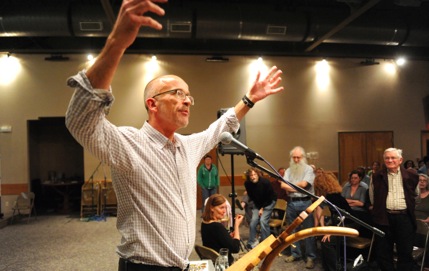
The Asheville Wordfest Director, Laura Hope-Gill, announced last weekend that the Asheville Wordfest 2012 began a Kickstarter campaign to help fund the poetry festival. Wordfest celebrates its fifth year of providing a space for poets of various cultures and contexts to share their work with enthusiastic supporters of poetry.
This year’s poetry festival features many local poetry luminaries as well as notable national and international poets. Various events are scheduled at the Grateful Steps Foundation Bookshop, the Altamont Theater and other locations in Asheville, NC between May 2-6, 2012.
Here’s an excerpt from an e-newsletter that was sent last Friday night regarding the Asheville Wordfest 2012 Kickstarter campaign:
Please kindly help Wordfest by donating to the Kickstarter campaign through Poetry Month: Asheville Wordfest 2012 Kickstarter campaign.
Asheville Wordfest 2012: HOME: Place and Planet takes place from Wednesday May 2 through Saturday May 5, 2012. North Carolina Humanities Council generously funds the festival in part, and we need your help to really bring it to life.
Along with our stellar guest poets, Wordfest 2012 aims to present as many local voices as is possible within the scope of a few days. Because our local voices resonate with the global whole, we welcome the following guest poets: Choctaw scholar, author and poet LeAnne Howe, Guggenheim and NEA Fellow Arthur Sze; Egyptian-American poet Matthew Shenoda; American Book Award Winner Allison Adelle Hedge Coke of Cherokee and Huron Nations. Learn about these stellar poets at www.ashevillewordfest.com. Thank you for your help in promoting multiculturalism and community through poetry.
Write 30 poems in 30 days: a challenge
During the summer of 2010, I took up the challenge to write 30 poems in 30 days with two goals in mind:
- generate new material and
- unclutter my mind.
Yesterday I began a new cycle of poems with the goal of writing 30 poems and 30 days during National Poetry Month (if your following National Poetry Month on twitter, the hashtag is #NPM12).
April Poetrio at Malaprop’s Bookstore/Cafe
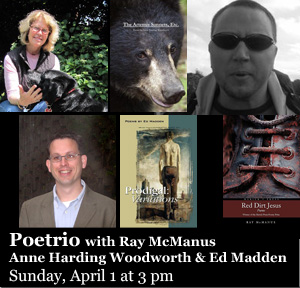
National Poetry Month begins at Malaprop’s Bookstore/Cafe with Poetrio this Sunday at 3:00 p.m. This month’s featured poets include Ed Madden, Ray McManus and Anne Harding Woodworth.
Here’s an abridged version of the poets bios from the Malaprop’s Bookstore/Café news release:
Anne Harding Woodworth is a member of the Poetry Board at the Folger Shakespeare Library in Washington, D.C. She is a part-time resident of both Washington, D.C. and the Western North Carolina mountains. On April 1 this year, she will read from her fourth book, THE ARTEMIS SONNETS, ETC.
Ray McManus teaches creative writing, Irish literature, rhetoric, and composition at the University of South Carolina, Sumter. We are very pleased to welcome him back with his second poetry collection, RED DIRT JESUS, for which he won the Marick Press Poetry Prize.
At the November 2009 Poetrio event here at Malaprop’s, Ed Madden read from Signals, the 2008 poetry collection for which he won the South Carolina Poetry Book Prize. His most recent collection of poetry is PRODIGAL: VARIATIONS.
Learn more about the April 2012 Poetrio at Malaprop’s Bookstore/Cafe at their web site.
Poetry at the Altamont

Tonight from 7:00 p.m. until 8:30 p.m., Poetry at the Altamont continues with this month’s featured poet, Laura Hope-Gill.
It’s been awhile since I visited the The Altamont Theatre. I believe it was during last year’s Wordfest. It’s a gorgeous setting to hear poets read their work. I’m looking forward to tonight’s event.
Here’s more details about the event Poetry at the Altamont from their Facebook invite page:
Poetry at the Altamont is a reading series for poets and poetry lovers commencing on the third Monday of each month at seven o’clock in the evening at The Altamont Theatre in downtown Asheville. The event consists of a reading by the feature poet followed by an open microphone, for which readers may sign up and recite one or two short pieces. During the open portion of the event, we encourage new voices and accomplished poets alike to share what they have been working on, a space where writers have the opportunity to try out new works in front of an audience on a regular basis. Please join us for consistent, fine poetry in a setting that is equally fine.
Hosted by Jeff Davis and Laura Hope-Gill
Produced by Caleb Beissert and Aaron Price$5 at door
Beer and wine served(link)
Literary reading series continues at Posana Cafe this weekend
Saturday night, March 17, 6:00 p.m. at Posana Cafe in downtown Asheville, NC. The literary reading features writer Elizabeth Lutyens and poet Tina Barr.
From a press release:
Elizabeth Lutyens teaches the Prose Master Class in the Great Smokies Writing Program of UNC Asheville and is Editor of The Great Smokies Review, its online literary journal. A former journalist, she got her MFA in Creative Writing from Warren Wilson College, and since has been at work on a novel set in the mid-19th century in Boston and the Port Royal Islands of South Carolina.
Tina Barr has received Fellowships from the National Endowment for the Arts, the Tennessee Arts Commission and the Pennsylvania Council on the Arts. Her awards include the Editor’s Prize for book publication from Tupelo Press. Her poems are published in anthologies and journals like The Harvard Review, The Southern Review and The Paris Review.
Poetrio at Malaprop’s

The monthly poetry reading series Poetrio continues Sunday, March 4, 2012, 3:00 p.m. at Malaprop’s Bookstore/Café. The March Poetrio features Megan Volpert with SONICS IN WARHOLIA, Rupert Fike with LOTUS BUFFET, and Jethro Clayton Waters with SOUTH OF ORDINARY.
Please note that UNC-A has a champion basketball event downtown this weekend and the public parking garages will charge a special daily “event fee.” Park away from the center of downtown Asheville and enjoy a lovely Sunday afternoon stroll to Malaprop’s. They have a wonderful café with refreshments and poetry for after a nice walk through the city.
POETRIO readings and booksignings:
Megan Volpert, Rupert Fike, Jethro Clayton Waters
Sunday, March 4, 2012, 3:00 p.m.
Malaprop’s Bookstore/Café, 55 Haywood Street, Asheville, NC 28801
www.malaprops.com
Big week for poetry shows in Asheville
Today at 7:00 p.m. Poetry at The Altamont is a NEW monthly series. Hosted by Laura Hope-Gill and Jeff Davis. $5 Cash at the door. The event consists of a full reading by a featured published poet followed by an open mic for new voices and accomplished poets alike.
Open Mic at the Vanuatu Kava Bar
Every Wednesday at 8:30 p.m. Hosted by poet and translator, Caleb Beissert. Poetry, comedy, spoken word and music. This is a poetry open mic, but we welcome all forms of artistic self expression.
Barbie Angell’s Bar Poetry Show & Benefit.
Saturday, February 25, 2012, 8:00 p.m. at Tressa’s Downtown Jazz and Blues. Event features Asheville Poet, Barbie Angell performing her charming, audacious “bar poetry” with special guest Asheville singer/songwriter Chelsea LaBate, known as Ten Cent Poetry. The evening is a benefit performance for Grateful Steps Foundation, a local nonprofit publishing house, bookshop and community space.
Representing nations through poetry
Today, I followed a link to a web site that I rather enjoy — the United Nations of Poetry. Serendipitously I found the link and learned that it presents a catalog of international poets. I noticed, however, that some nations are missing from the list. For example, Germany is not represented. Consider including German language poets Durs Grünbein, Michael Hofmann and Sarah Kirsch. Also notably missing are Polish and Russian poets. Vera Pavlova makes a good addition to the United Nations of Poetry representing Russia. For Poland, Eugeniusz Tkaczszyn-Dycki might make a good contribution. And last, but not least, add Greek poet Dimitris Varos to the list of poetry dignitaries. One thing that is unique to the United Nations of Poetry is the inclusion of poets from America representing the indigenous peoples.
Why is this important? I think C. S. Lewis wrote that literature “irrigates the deserts that our lives.” Along that line of thinking, to know and understand the inner life of a nation or culture is to explore the fertile literature of their poets and writers. Film tends to present caricatures and stereotypes of Germans, Russians and Americans, but literature plumbs the depth of cultural nuances. For example, you might miss the significance of the shamrock and the lily in a film about two brothers in North Ireland. In a novel, the weight of those two images will elucidate the drama between the two siblings, and a reader will come to realize that the tensions between two brothers are often the same between nations.
Juniper Bends Literary Reading
This week the Juniper Bends reading series continues this Friday, February 10th, at 7:00 p.m. at Downtown Books and News. The event features readings by: Kate Zambreno, Katherine Soniat, Jesse Rice-Evans and Adam Jernigan. Visit the Facebook event page for more details. (link)
The Top 3 Poems of 2011
NPR Books published the top three poems of 2011 according to poet Tracy K. Smith. [1] The three poems include:
- Laura Kasischke’s “Look,” from Space, in Chains [2]
- Rae Armantrout’s “Soft Money,” from Money Shot [3]
- and Ross Gay’s “Love, You Got Me Good,” from Bringing the Shovel Down. [4]
I haven’t read any of these poems nor the books from which they originate.
What do I think the top three poems of 2011 should be? Where does one begin to select the top poems of the year? Maybe, what is most memorable? Or has the most enduring image?
I can think of a few books that captured my attention, but there are small number of contemporary American poets that disturb my universe. [5] This may be in part because I have purchased only a few poetry books this year and I have allowed all my favorite literary magazine subscription lapse. And the only poems that really disturb the cosmos of my mind are the poems I endeavored to translate from German and Russian. Due to the obscurity of these poets, I’ll simply offer that the Mountain Xpress’s first annual poetry prize presented a lot of very talented poets to watch in the coming year. [6]
NOTES: [1] Read Tracy K. Smith’s reasons why she selected these three poems as the top three poems of 2011 at NPR Books: Savage Beauty: The Top 3 Poems Of 2011 [2] Read Laura Kasischke’s “Look” [3] Read Rae Armantrout’s “Soft Money” [4] Read Ross Gay’s “Love, You Got Me Good” [5] With apologies to T. S. Eliot, “The Love Song of J. Alfred Prufrock.” [6] Not that I am biased in any way, but the Mountain Xpress’s 2011 poetry event was most memorable and I look forward to their 2012 event.
‘For Christmas Day’ by Charles Wesley
Hark, how all the welkin rings,
“Glory to the King of kings;
Peace on earth, and mercy mild,
God and sinners reconcil’d!”
Joyful, all ye nations, rise,
Join the triumph of the skies;
Universal nature say,
“Christ the Lord is born to-day!”
Christ, by highest Heaven ador’d,
Christ, the everlasting Lord:
Late in time behold him come,
Offspring of a virgin’s womb!
Veil’d in flesh, the Godhead see,
Hail th’ incarnate Deity!
Pleas’d as man with men to appear,
Jesus, our Immanuel here!
Hail, the heavenly Prince of Peace,
Hail, the Sun of Righteousness!
Light and life to all he brings,
Risen with healing in his wings.
Mild he lays his glory by,
Born that man no more may die;
Born to raise the sons of earth;
Born to give them second birth.
Come, desire of nations, come,
Fix in us thy humble home;
Rise, the woman’s conquering seed,
Bruise in us the serpent’s head.
Now display thy saving power,
Ruin’d nature now restore;
Now in mystic union join
Thine to ours, and ours to thine.
Adam’s likeness, Lord, efface,
Stamp thy image in its place.
Second Adam from above,
Reinstate us in thy love.
Let us thee, though lost, regain,
Thee, the life, the inner man:
O, to all thyself impart,
Form’d in each believing heart.
(via Poetry Foundation)
‘Advent’ by Donald Hall
When I see the cradle rocking
What is it that I see?
I see a rood on the hilltop
Of Calvary.
When I hear the cattle lowing
What is it that they say?
They say that shadows feasted
At Tenebrae.
When I know that the grave is empty,
Absence eviscerates me,
And I dwell in a cavernous, constant
Horror vacui.
(via Poetry Foundation)
‘Mosaic of the Nativity (Serbia, Winter 1993)’ by Jane Kenyon
On the domed ceiling God
is thinking:
I made them my joy,
and everything else I created
I made to bless them.
But see what they do!
I know their hearts
and arguments:
“We’re descended from
Cain. Evil is nothing new,
so what does it matter now
if we shell the infirmary,
and the well where the fearful
and rash alike must
come for water?”
God thinks Mary into being.
Suspended at the apogee
of the golden dome,
she curls in a brown pod,
and inside her the mind
of Christ, cloaked in blood,
lodges and begins to grow.
‘The God We Hardly Knew’ by Óscar Romero
No one can celebrate
a genuine Christmas
without being truly poor.
The self-sufficient, the proud,
those who, because they have
everything, look down on others,
those who have no need
even of God- for them there
will be no Christmas.
Only the poor, the hungry,
those who need someone
to come on their behalf,
will have that someone.
That someone is God.
Emmanuel. God-with-us.
Without poverty of spirit
there can be no abundance of God.
‘Into The Darkest Hour’ by Madeleine L’Engle
It was a time like this,
War & tumult of war,
a horror in the air.
Hungry yawned the abyss-
and yet there came the star
and the child most wonderfully there.
It was time like this
of fear & lust for power,
license & greed and blight-
and yet the Prince of bliss
came into the darkest hour
in quiet & silent light.
And in a time like this
how celebrate his birth
when all things fall apart?
Ah! Wonderful it is
with no room on the earth
the stable is our heart.
‘Annunciation’ by Denise Levertov
Denise Levertov
‘Hail, space for the uncontained God’
From the Agathistos Hymn, Greece, VIc
We know the scene: the room, variously furnished,
almost always a lectern, a book; always
the tall lily.
Arrived on solemn grandeur of great wings,
the angelic ambassador, standing or hovering,
whom she acknowledges, a guest.
But we are told of meek obedience. No one mentions
courage.
The engendering Spirit
did not enter her without consent.
God waited.
She was free
to accept or to refuse, choice
integral to humanness.
____________________________
Aren’t there annunciations
of one sort or another
in most lives?
Some unwillingly
undertake great destinies,
enact them in sullen pride,
uncomprehending.
More often
those moments
when roads of light and storm
open from darkness in a man or woman,
are turned away from
in dread, in a wave of weakness, in despair
and with relief.
Ordinary lives continue.
God does not smite them.
But the gates close, the pathway vanishes.
______________________________
She had been a child who played, ate, slept
like any other child – but unlike others,
wept only for pity, laughed
in joy not triumph.
Compassion and intelligence
fused in her, indivisible.
Called to a destiny more momentous
than any in all of Time,
she did not quail,
only asked
a simple, ‘How can this be?’
and gravely, courteously,
took to heart the angel’s reply,
perceiving instantly
the astounding ministry she was offered:
to bear in her womb
Infinite weight and lightness; to carry
in hidden, finite inwardness,
nine months of Eternity; to contain
in slender vase of being,
the sum of power –
in narrow flesh,
the sum of light.
Then bring to birth,
push out into air, a Man-child
needing, like any other,
milk and love –
but who was God.
(via chriscorrigan.com)
Advent Calendar
by Rowan Williams
He will come like last leaf’s fall.
One night when the November wind
has flayed the trees to bone, and earth
wakes choking on the mould,
the soft shroud’s folding.
He will come like frost.
One morning when the shrinking earth
opens on mist, to find itself
arrested in the net
of alien, sword-set beauty.
He will come like dark.
One evening when the bursting red
December sun draws up the sheet
and penny-masks its eye to yield
the star-snowed fields of sky.
He will come, will come,
will come like crying in the night,
like blood, like breaking,
as the earth writhes to toss him free.
He will come like child.
(via the guardian)
Mighty Mercy
by John Piper
Why did He choose a northern maid
From Nazareth, who had to trade
Her Galilee for Judah just
To get Messiah where He must
Be born? A strange and roundabout
Procedure for a God, no doubt,
Who values His efficiency
And rules the world from sea to sea!
Why not a girl from Bethlehem?
Well half the girls in town would stem
From David’s line. And carpenters
Aplenty there could bear the slurs
And gossip on a virgin got
with child, who blushed and said she’d not
Once kissed her man this whole year past.
Why not? Because God’s power is vast,
And in one little virgin birth
His sovereign joy and mighty mirth
In saving us from evil bent
Could never, never rest content.
Instead He turned and set His sight
To spangle Rome with all His might;
And took a girl from Galilee
To magnify His sovereignty.
And made the Roman king conspire
With God, to serve a purpose higher
Than he or any in the realm
Could see—a stroke to overwhelm
A few with faith and cause their heart
To know the truth, at least in part,
That, though God loves efficiency
And rules the world from sea to sea,
He does not go from here to there
By shortest routes to save His fare.
He’d rather start in Galilee,
Then pass a law in Rome, you see,
To get the child down south at length,
And magnify His sovereign strength.
God rules the flukes of history
To see that Micah’s prophecy
Comes true. Why did He choose a maid
From Nazareth? Perhaps she prayed
That endless mercy might abound
And take the longer way around.
The mighty mercy we adore
As we light advent candle four.
(By John Piper. © Desiring God. Website: desiringGod.org)
Advent Poems
Why is it so difficult to find well-written Advent poems? Last year I posted a few poems on the theme of Advent. It was a project that was more challenging than I anticipated. I learned that there is a wealth of seasonal poems including Christmas or winter related themes and populated with snowflakes, elves, reindeer, snowmen, chestnuts, and other such nostalgia. Also, I discovered many religious poems that are too horrid to post. Maybe ‘horrid’ is too strong of a word, but it did concern me that these religious poems were so badly composed that I almost abandoned the project. Suffice it to say, I did find a few good poems to mark the season of Advent.
If you are of a Christian liturgical or orthodox tradition you already know that Sunday marks the fourth Sunday of Advent. [1] This Sunday I will post an Advent poem a day until Christmas Day. Hope you enjoy the selections, and feel free to add suggestions in the comments section of the blog.
NOTES: [1] November 27 – First Sunday of Advent, December 4 – Second Sunday of Advent, December 11 – Third Sunday of Advent, December 18 – Fourth Sunday of Advent
Poetrio on hiatus until February 2012
Some of you may already know this, but I received an email from Malaprop’s informing that the Poetrio readings will be on hiatus until February 2012. Here’s an excerpt from an email I received:
Here at Malaprop’s, we’ll take a break from Poetrio in December 2011 and in January 2012. Proximity of holidays and sometimes risky weather often make it difficult for visiting poets and some of you to travel to Poetrio in December and January; but be sure to mark your 2012 calendars for the first Poetrio of the new year: 3:00 p.m. on Sunday afternoon, February 5.
Big night in Asheville for poetry readings
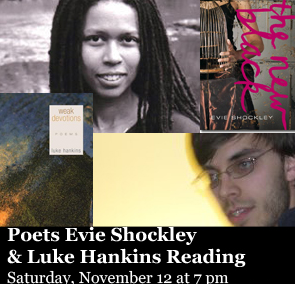
Last night Asheville hosted two great poetry readings.
Loretta’s Cafe featured the Flood Reading Series with poets DeWayne Barton, Gyorgyi Voros, and Landon Godfrey.
Malaprop’s featured readings by Evie Shockley and Luke Hankins.
Unfortunately, I missed both readings because I was on the road and didn’t return to my adopted hometown until after the readings. Anyone have a report to how the readings went? Please feel free to offer a review of the readings in the comments.
Tomorrow, Poetrio at Malaprop’s
POETRIO reading/booksigning featuring Tony Abbott, Scott Owens, Katherine Soniat.
Sunday, November 6, 2011, 3:00 p.m.
Malaprop’s Bookstore/Café
55 Haywood Street
Asheville, NC 28801
www.malaprops.com
 Coffeehouse Junkie