What magazines do you receive?

Deborah of 32 poems magazine wants to know:

I’m getting Cimarron Review, Bloomsbury Review, Ninth Letter, Virginia Quarterly Review, The New Yorker and some others. The New Yorker hardly needs my support, but there you go. I am morally opposed to The Atlantic, because they do not publish enough poetry. The amount of poetry they publish withered to nearly nothing the last time I checked. That’s about the time I decided to subscribe only to magazines that offered a large poetry presence. You could easily tell me how few poems The New Yorker publishes. Well, The New Yorker is The New Yorker. The prose is also good.

Some other magazines that invite my interest include Southwest Review, Barn Owl Review, and Pebble Lake Review to name a few. I’m only including magazines one can subscribe to, so that leaves out many excellent online magazines.

What magazines do you like?

American Poetry Review, Poetry, Poets & Writers and Small Press Review.

Magazines I used to subscriber to, but had to cancel due to lack of funds: Entrepreneur, Fast Company, Main Street Rag, New York Review of Books, Paste, Salamander and Slipstream.

Unwritten Poetry Rules

Deborah’s unwritten poetry rules are now written.

And Mary’s rules.

And Diane’s rules

Poet Billy Collins sells out

“[Billy] Collins, the former U.S. poet laureate, is the keynote speaker for the Decatur Book Festival Friday night at Agnes Scott College. Word from the festival organizers is that all of the free tickets have been given out…” Link

Poets & Writers magazine explains why in the recent issue:

“What makes Billy Collins one of America’s best-known (and best-selling) poets? Perhaps it’s his attention to what matters most — his audience.”

Poetry Is Dead

Society… did not favor the reading of poetry…. By the ’90s, it was all over…. consider that poetry is the only art form where the number of people creating it is far greater than the number of people appreciating it…. People don’t possess the patience to read a poem 20 times before the sound and sense of it takes hold….

I am part of a world that apotheosizes the trendy, and poetry is just about as untrendy as it gets. I want to read books with buzz… and I can’t remember the last book of poetry that created even a dying mosquito’s worth of hum. I am also lazy, and poetry takes work.

–Bruce Wexler1

NOTES:
1) Bruce Wexler, “Poetry Is Dead. Does Anybody Really Care?” May 5, 2003, Newsweek, accessed July 7, 2008, http://www.newsweek.com/id/59182/page/1 (page no longer available)

Caffeinated poem

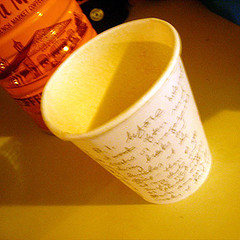
Caffeinated poem: A few weeks ago I had compiled a set of poems to submit to various poetry contests including Boston Review. But I was reading Robert Pinsky’s book Gulf Music and never sent them. It’s not that I forgot to send them. It is just that compared to Robert Pinsky, my poems appear un-submittable. So instead I wrote a poem on a paper cup after drinking a latte from The Dripolator.

Take this poem and read it

Take this poem and read it (or not, I was just suggesting you might like it… or maybe need it… oh, nevermind).

Deborah wonders if poets need to do a “better job of writing with an audience in mind.”1

Seth suggests that people might improve their writing2 if they think like bloggers. He offers 9 tips:

  1. Use headlines.
  2. Realize that people have choices.
  3. Drip, drip, drip.
  4. It’s okay if you leave.
  5. Interactivity is a great shortcut.
  6. Gimmicks aren’t as useful as insight.
  7. Don’t be afraid of lists.
  8. Show up.
  9. Say it.

What would happen if poets adapted those nine tips into their poetry? 

NOTES:
1) Deborah Ager, “Border’s Books,” April 2008, 32 Poems, accessed April 7, 2008, https://32poems.com/prose/borders-book/
2) Seth Godin, “Write like a blogger,” April 07, 2008, Seth Godin’s Blog, accessed April 7, 2008, http://sethgodin.typepad.com/seths_blog/2008/04/write-like-a-bl.html (page no longer available, web site deactivated)

Beanstreets open mic

Most Thursday nights a few years ago you would find me haunting the Beanstreets open mic. Then Beanstreets closed and there was an open mic vacuum.

The Dripolator used to offer an open mic event every Thursday, but that has changed to the first Thursday of the month. And it’s a different atmosphere from the Beanstreets days.

Courtyard Gallery has an open mic every Thursday. But last night it was canceled due to lack of host and attendees.

I sat on a bench beneath the Vance monument drinking coffee from a paper cup and wondered where to soak up some poetry vibes. Plenty of singer/songwriter open mics. But where’s a poet to go to squander a few verses on a polite crowd?

What is your book cover trying to tell us

Next week, I start another 30-day Poetry Marathon… I’ll write one poem per day.

Deborah Ager. Link.

The secret lives and desires of poets and writers

From The New Yorker:

Part of the reason there were no real biographies is that little was known about Gibran’s life, and the reason for that is that he didn’t want it known.

Link.

And from Slate:

…one of the most troubling dilemmas in contemporary literary culture…. the question of whether the last unpublished work of Vladimir Nabokov, which is now reposing unread in a Swiss bank vault, should be destroyed–as Nabokov explicitly requested before he died.

Link.

From 1000 Black Lines:

  1. Jessica Smith, Burn it. Poetry burns well. And it is a fitting end for poetry, esp. anything from that angsty juvenile period…
  2. 1000 Black Lines, Thanks for the advice. I’ll burn it along with all the friendship bracelets, florescent T-shirts…. Who needs to worry about the high cost of heating fuel when burning poetry is such an affordable alternative?

Link.

How to write a marketing poem

Step One:
Read anything and everything Seth Godin writes.

From Seth Godin:

used bookstores hate Amazon
And so do independent bookstores

Link.

Who vs. how many.

Link.

More marketing links than you can read…

Link.

Step Two:
Write a 31-syllable waka.
Step Three:
Publish the waka on your own blog, because no prestigious literary journal would waste the time to print it.

Used bookstore owners
hate Amazon. But why? The
staff and owners of
used bookstores know the hands and
faces of bibliophiles.

Lost in translation

From The Times:

The Prince of Wales has watercolours, it’s true, but it’s hard to imagine him getting to grips with the waka, with its 31 syllables, strictly arranged into five lines in the 5-7-5-7-7 structure. Akihito and Empress Michiko knock out four waka apiece for New Year’s Eve as well, reflecting on the year just gone by, and this year’s offerings were helpfully put out in English by the Imperial Household Agency last week. Translating poetry is notoriously difficult and the waka usually come out sounding as poetic as the instruction manual for a vacuum cleaner. Link.

Maybe if I translate my grocery list into Japanese it will sound poetic.

Warren Wilson College reading — review

Brief review of last night’s Warren Wilson College MFA faculty reading.

Marianne Boruch read first and from her new book that she didn’t know had been published and available at the book store. Always a delight to hear her read. Poems read include: “Still Life,” “New Paper,” “A Musical Idea,” and others.

Charles D’Ambrosio read a lengthy, intriguing piece that I assume is the opening to a novel. When he finished, I wanted to shout, “What happens next?”

Van Jordan read about a half dozen poems both old and new (from his recent book). His personae poems and eulogies were delightful and haunting.

Michael Martone read one of his “contributor notes” from his book Michael Martone: fiction. You would have had to been there to understand the unique humor of his story. As one amazon.com reviewer put it, “Mind-bending multiple views of Martone’s real and/or imagined lives, written in 2-3 page faux contributor’s notes.” His piece was hilarious and a great way to end a rich reading.

Maurice Manning’s poetry lecture summary and thoughts

As promised, some highlights from yesterday’s Maurice Manning poetry lecture.

The lecture centered on “Some Thoughts on Sympathy.” Maurice began by defining sympathy. First, it is not the “I feel your pain” emotion that is manipulative, fake and inaccessible — a show of feeling rather than creation of feeling (i.e. the desire that you feel me feeling your pain). Sympathy defined as honest feeling, common understanding — as in “two beasts bound together” like oxen — of suffering.

Maurice cited the Romantic period as the historical place where sympathy in literature is born — where the outward reaching heart surveys the humanity of the world and returns to the mind where it is changed, sympathetic, and reaches outward again. “Isn’t that what we seek in poetry, to be changed?” Maurice asked. From there he presented the two-step machinery of Romanticism — heart and mind cycle — using the physics examples of sympathetic motion in plucked strings and pendulum motion.

This is the part of the lecture where I was deeply engaged. He went deep into physics and linguistics to make the point that sympathy occurs naturally — it is part of our nature. It is the transfer of energy from one property to another, one person to another, from the page to the spirit. This is the kind of lecture that challenges me, resonates with me, makes me want to go deep. I’m starved for it.

Maurice used Robert Burns’s poem “To a Mouse” and Coleridge’s “Frost at Midnight” as examples of sympathy in poetry. After an in depth analysis of the linguistic patterns of “To a Mouse,” he concluded his lecture by stating that the poets he referenced found the self in these poems. “We’re always yoked to something…” he said. “The mysterious force of the poem stays with us even after we have closed the book.”

The applause was loud and seemed not to affect him as he paper clipped his lecture notes. As the applause subsided he quietly stated, “I guess it’s lunch now.”

Maurice Manning’s poetry lecture…

…was ARGH-sum!

I arrived at Warren Wilson College’s Fellowship Hall a few minutes early and waited for the earlier session to conclude. First one out the door was none other than Steve Orlen. I wonder if he read my prediction? More interesting, how did he make it from the front row of a packed hall to be the first one out into the bright, cold morning? He looked at me fidgeting with my gloves. As he fished a cigarette out of its package he told me I should put the gloves away and get in there so I won’t miss the lecture. I smiled, said thanks and headed into the bustling hall.

I’ll provide highlights from Maurice Manning’s poetry lecture later. Gotta get my mind back into work mode. Just discovered that after two rounds of proofreading the word “foreword” was misspelled on a manuscript that is en route to the printer. ARGH. So much for quality control. Then again, I’ve been looking at this manuscript for months and it wouldn’t surprise me if the author’s name is misprinted.

Did any of ya’ll out there make it to Maurice’s lecture?

Poetry blogosphere rawk star

Holy Shoot! About.com’s poetry blog listed and linked to my list of 7 things you should know about being a poet.

Crazy, right? Does this make me a poetry blogosphere rawk star? No. It means I spend way too much time blogging when I should be working… er… writing… like poetry or something.

Okay, so, About.com visitors, thanks for visiting. If you want to actually read schtuff that was published (poems, essays, etc.) follow this link. To read a weekly column I used to write go here.

7 things you should know about: being a poet

Since lists and confessions seem to be on my mind; Aaron McCollough, a University English lecturer, offers his advice. Here’s the first two, read the rest by following the link:

  • There’s generally no such thing as royalties in poetry. You don’t get a dime from the books you publish, even if someone actually buys a copy. If your heart is set on being a professional poet, either score a lecturing job or get used to Ramen.
  • The most common way for new poets to get their work published is by entering in poetry contests. They cost money and are usually only won by people already established in the poetry community. Good luck.

(via Deborah Ager) Link.

Deborah Ager offers her 7 things here.

Coffeehouse Junkie offers 7 Things:

  1. Consider it a hobby if you live anywhere outside NYC.
  2. It is a selfish drug that deepens your addiction the more it is practiced.
  3. Open mic events are both the Poetry Den and Poets Anonymous.
  4. Get a real job–preferably a job that requires brainless activity so you can focus your addiction with lucidity.
  5. Get used to the rejection of literary journal editors, poetry contest judges, friends, family and countrymen.
  6. No matter how well crafted your poetry becomes, it will be read far less than the graffiti adorning urinals in Waffle Houses across the country.
  7. Expect to lose your house, spouse, dog, and dinner for the sake of poetry, and if you don’t lose any of the previously mentioned count your blessings because you’re probably losing sleep in exchange.

Peace out, my lit junkies.

Feelin’ Asheville

It’s been a long time since I did an Asheville open-mic circuit on a Thursday night.

The Open Mic at Dripolator offered quite a full evening. Kapila hosts the event. The Drip sure pulls a crowd. Parking was an issue–I had to park two blocks away. Kapila read some of his work around 9 p.m. In one, he laments that this city is now called Ashevegas when Ashevillage is he would dream she be called.

I hung out for awhile and listened to several good singer/songwriters and poets. But I left with an annoying thought–I’m not feeling Asheville. It’s an expression I lifted from another local writer. He uses the expression when a line of prose or poetry works: “Yeah, man, I’m feelin’ it now.” I suspect the expression has jazz or blues roots.

The Courtyard Gallery Open Mic offered a sparse gathering, but I arrived after 10 p.m. So there may have been a larger crowd earlier. Jarrett Leone graciously invited me to read a couple poems I found in my notebook. The same notebook I haven’t been able open since the writers residency back in July. I read a couple blues poems because it seemed to be the only sketches I was feelin’. My voice strained to pull the words off the page and send it to the audience. Jim, a regular at the Courtyard and previously Beanstreets, greeted me warmly and told me he was thinking about me the other night when he was reading through my old chapbook, Late Night Writing. Before I left the Courtyard, Jarrett gave me a big hug and we shared a few words.

I began to feel Asheville again, but it was awkward–like kissing an ex-lover. A lover that has moved onto to someone else, and the space between us is more than physical. It is an annoying thought that troubles me tonight. I’m not feelin’ Asheville. And I don’t know why.

Asheville after the storm


I missed the bus last night. Seems like I’ve been missing a lot this week. Work has been a storm of activity. A project, a Weekly Planner, I sent to press at the beginning of the month finally arrived and looks fantastic. But like two weather fronts colliding, the Weekly Planner crashes into another project, a paperback book, and it seems the days and nights wrestle for control of my energy.

I missed The Kakalak Poets on Saturday, but caught the Bernstein and Cabanis-Brewin reading at Malaprop’s on Sunday. Their reading centered around place; specifically Western North Carolina. It was an unusually balm mid-October afternoon and I felt like a stranger at the event even though I’ve been to Malaprop’s dozens if not hundreds of times. It was the way their work spoke of this region; deeply intimate.

Marvin Bell read at UNC Asheville’s Reuter Center Wednesday night. I attend the reading. Arriving early, I found a place in the back and began reading through a copy of the American Poetry Review. It arrived last weekend, but I hadn’t had time to read it. Someone kicked my foot and I looked up to find a smiling Sebastian Matthews who found a seat next to me. That reading was marvelous and the conversation afterwards with other poets and writers was equally nice. I wanted to greet Marvin Bell, but I lost courage and remembered I had to get home and check on correspondence with the author of the paperback book project I’m developing.

Thursday night, after missing the bus, I realized I’d missed my exercise routine all week. I had a 30-minute, two mile routine that I try to accomplish three times a week. So I walked to the Asheville Transit Center as a way to get back on track. It’s two miles exactly. Since I was a block away from Asheville Brewing Company, I popped in for a quick pint of Ninja Porter and a Rocky’s Philly Cheesteak. I think Drinking Liberally was meeting there, but I had to dash off or I’d miss the bus again. I’m glad it’s Friday. I hope I don’t miss the weekend.

Blotter Blurbs & Words: June 16

The Traveling Bonfires invade Durham


The Traveling Bonfires prepare for their first appearance in Durham. Read the press release below:

Blotter Blurbs & Words: June 16: FAME: Summer LUAU
FAME is having it’s first “open reading” night! We look forward to this as we celebrate popular local magazine, the BLOTTER. Special guests poets Pasckie Pascua and Matthew Mulder from Asheville and his friends female songwriters Sally Spring (www.sallyspring.com) and Ophir Drive (http://myspace.com/ophirdrive). We look forward to hearing what they have to say!

Join us at RINGSIDE: 308 West Main Street, Durham.
Doors open at 10pm: 18+

Is Asheville the wrong place to try to make it as a poet?

A call from an acquaintance in NYC prompted me to ask the question: Is Asheville the wrong place to try to make it as a poet? The Check out the D.C. scene and the Baltimore scene.

Sebastian Matthews on national broadcast of The Writer’s Almanac

I woke up to the voice of Garrison Keillor reading “Live at the Village Vanguard” by Sebastian Matthews from, We Generous: Poems. © Red Hen Press. Link.

Tonight at Osondu Booksellers

Tonight, April 28, 7-9pm
The Traveling Bonfires & Osondu Booksellers present
Matthew Mulder, Margaret Osondu, Pasckie Pascua, and guest poets.

Osondu Booksellers, Waynesville, NC.

FREE.
For info, (828) 456 8062 or (828) 505-0476.