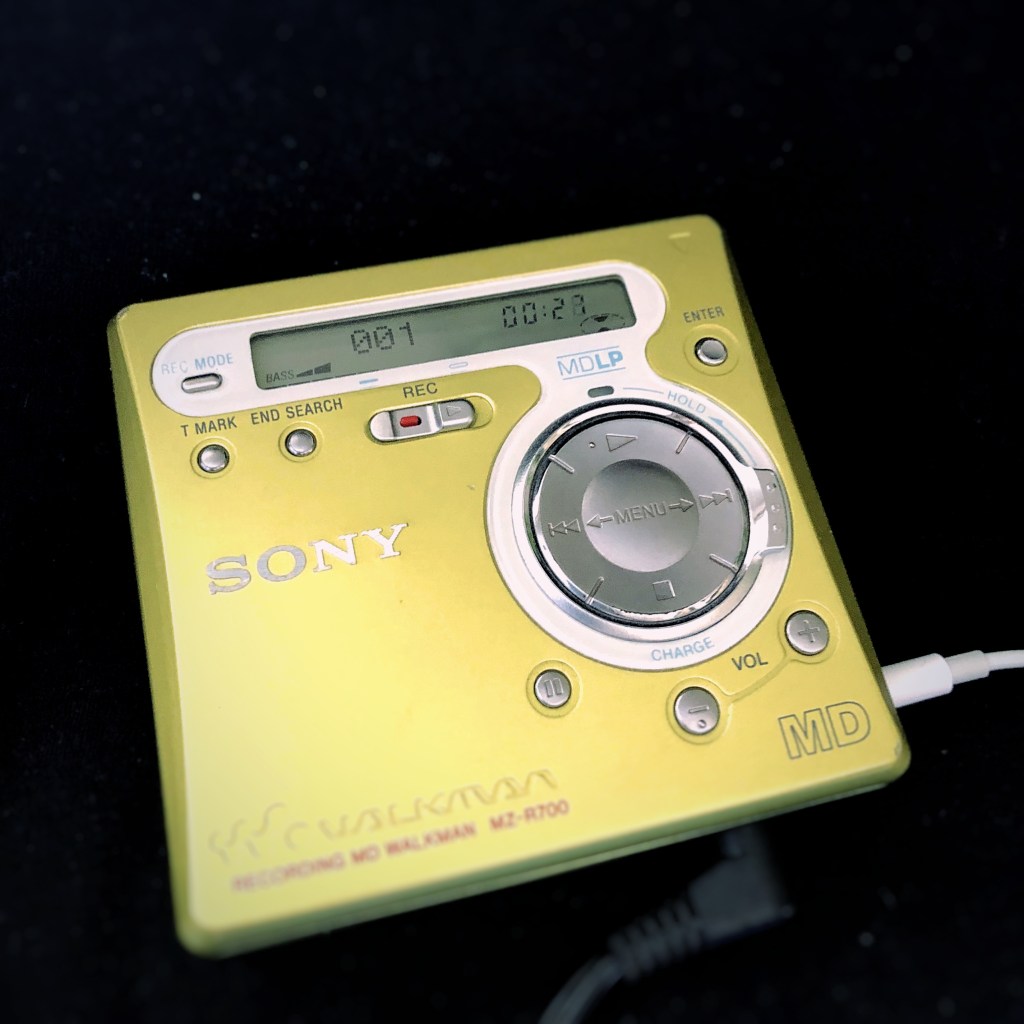
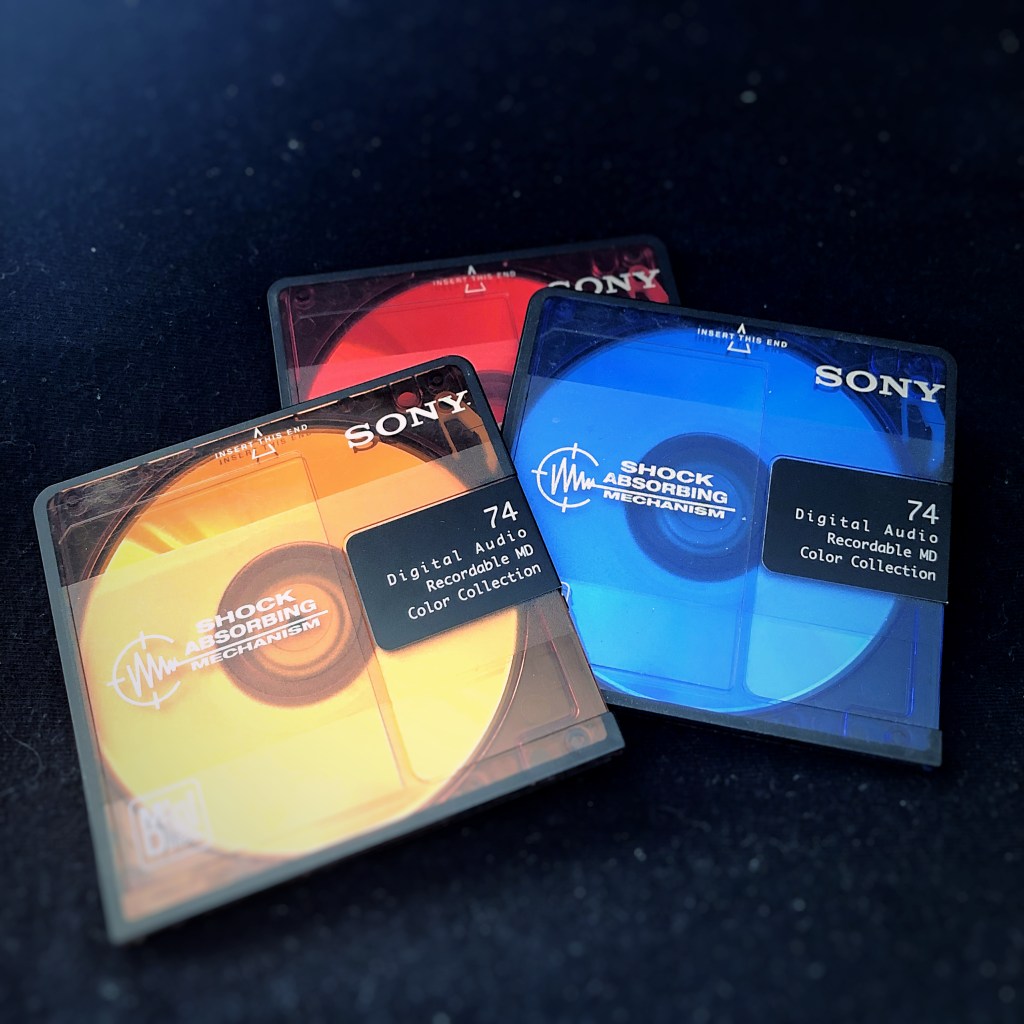
Vintage audio technology still works. Found a stack of minidiscs from back in the day when I did radio.
Some minidiscs contain uncut, uncensored interviews with hard rock musicians from the late 1990s. Some minidiscs store alt rock music playlists. Some of the minidiscs hold dozens and dozens of radio stingers (five to ten second audio used to transition between songs or segments) and bumpers (ten to fifteen second audio featured station ID, show branding, music, or voiceover like “we’ll be right back” to avoid dead air or an abrupt cut or transition to top of the hour news). But the old tech still works!
For a few years in the late 1990s, the technology of recordable/playable minidiscs emerged with market growth opportunity that was quickly destroyed by the first generation Apple iPod. 60 to 80 minutes of audio on a minidisc versus 50 to 60 hours of audio on an iPod is not even a competition.
A first gen iPod holds a thousand songs. By comparison, back in the 1990s, a top 40 radio station had a catalog of 150 or more songs that they played 24 hours a day. An alternative rock radio station (like the one I was on) had a library of 300 to 500 songs. On one minidisc I curated a 12-song playlist that included three songs by Tsunami Bomb, three songs by Big In Japan, P.O.D., Temple of Rain, and Audio Karate. At the time, that musical selection meant enough for me to organize and store it on a minidisc. A thousand songs? That is too much to manage. Pick your 12 favorite songs and enjoy.
What am I going to do with these vintage audio and radio archives? The temptation is to place them online somewhere. But maybe it is better to leave what happened in the 1990s to stay in the 1990s.
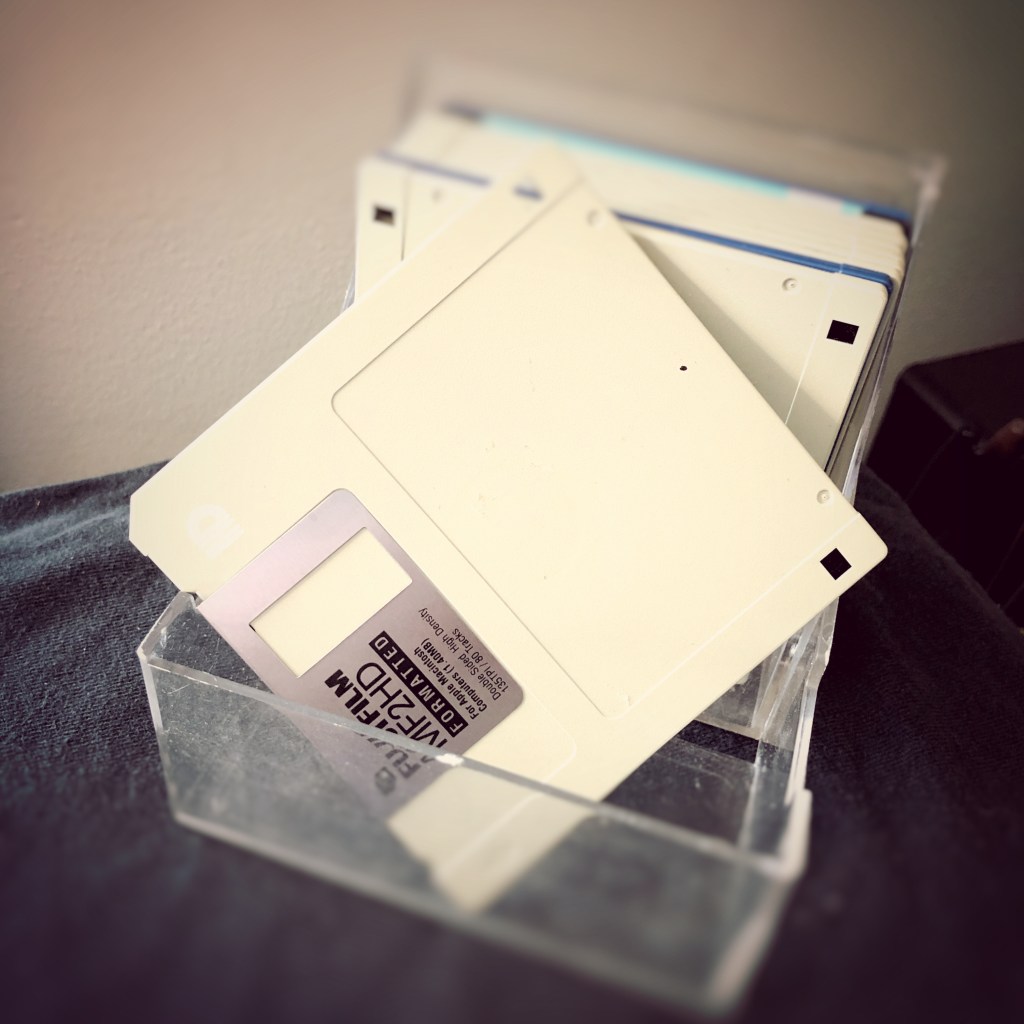
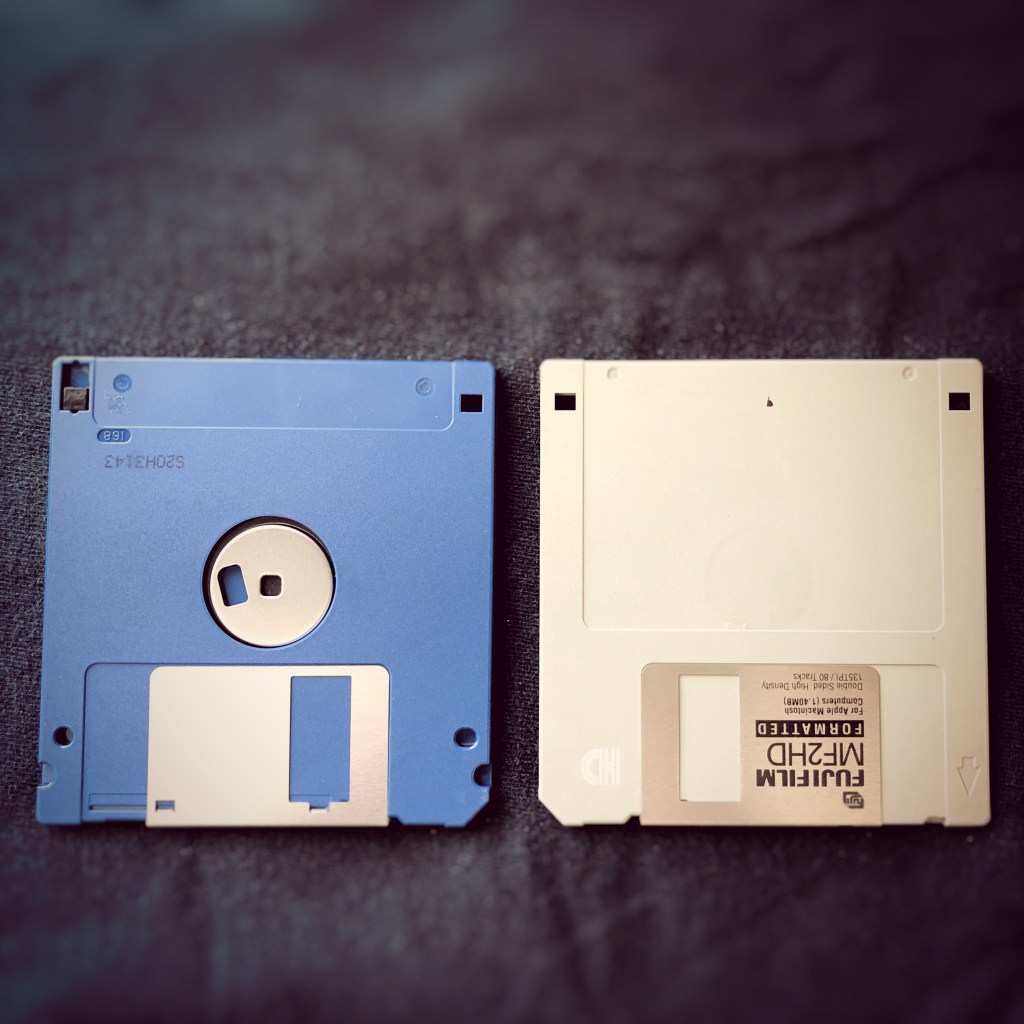
Storage capacity of a three and a half inch floppy disk (from the 30 years ago) is 1.4 megabytes. The digital image of these floppy disks requires two floppy disks to store the data.
The challenge with working outdoors is no internet connectivity and barely a mobile device signal. It makes checking emails and updating social media status and blog posts nearly impossible. But, really, the technological detox is quite rewarding.
The contract job orders are nearly complete. Word of mouth has lined up another job in the… well… I cannot really disclose the location at this point. But I will say that the red and white oak trees provide wonderful shade and an orchestra of bird song. Or is a symphony of bird song?
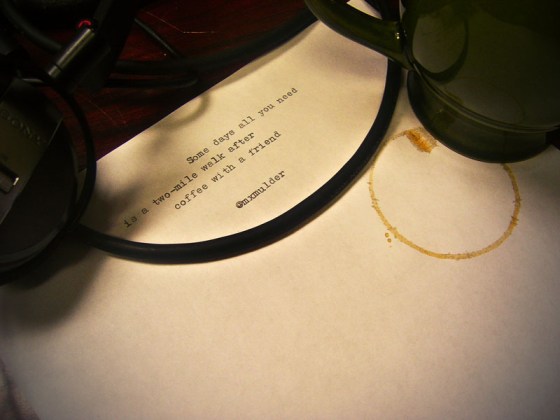
A poem for a friend composed on a manual typewriter
At least five years ago, an old beat up manual typewriter provided a platform to compose poetry and other writings.1 It was an effort to return to an intentional practice of crafting poetry and prose without distraction of disruptive media.
For years and years, a notebook, journal or sketchbook was never far from reach. But one night after a long night of poetry and music at Beanstreets followed by an even longer time of coffee and conversation at Old Europe, a friend convinced me to try blogging.
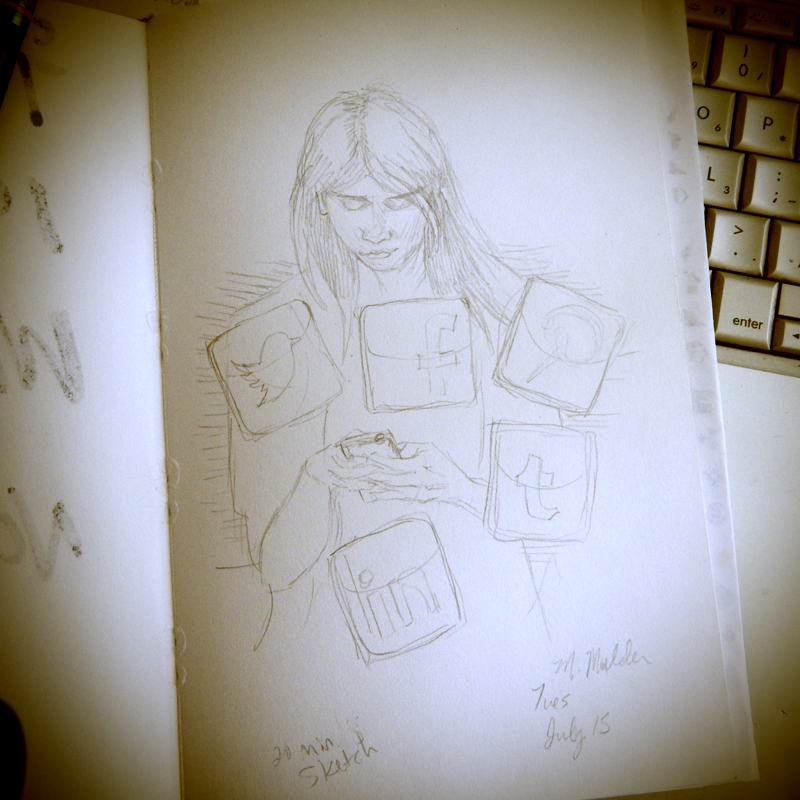
Sample journal page of poetry
The immediate response to blogging was infections.2 Connecting with people all over the country, networking, sharing and being part of an active digital community was exciting. The practice of writing allowed me to hone the craft of creative writing and exposed me to other writers across the country. One of those bloggers actually showed up at a poetry gig I did. She was on a cross-country trip to visit friends and wanted to visit in real life.
Over time, I noticed that my practice of writing notes, daily sketches and other activities had all but disappeared. Relying on keyboards, display screens, hard drives and servers presented became a crutch. My writing drafts and sketches appeared deceptively crisp and final in neatly formatted text documents and web blog interface windows.
So, I pulled the plug. Returned to handwriting and typing as practice.3 Some friends and fellow poets saw a few samples of typewritten work and suggested I post it on my blog. It was a novelty. A curiosity. So, I did.
One of the first photographs of a poem I composed on a typewriter was written for a friend. It was posted about this time of year — in 2011.4 A few days later I followed up with another poem5 that was later read at poetry event.
I do not claim to be the first person to post an image of a poem typed on a manual typewriter. But I noticed a trend in that direction about a year after posting those images of poem sketches.6 Not sure exactly if I started the trend. Probably did not. Maybe other like-minded individuals who sought to return an organic practice of handwriting and typing as a mode of composing their visions and ideas.
Here is to a five year anniversary of analog writing.
NOTES:
[1] In truth, I composed poems on an electric typewriter prior to that. Did it for decades. Did not own a personal computer until… well, that is another story.
[2] That was when there were a mere couple million web blogs in the world. Now, there are some platforms, like Tumblr, boasting 100 million blogs. The blogosphere has become quite congested.
[3] Examples of some the 30 poems in 30 days journal posts with photos: here, here and here.
[4] April 1, 2011, blog post.
[5] Poem: “Never Look A Doughnut Dealer in the Eyes”
[6] Examples include Typewriter Poetry,Remington Typewriter Poetry, and the most popular is Tyler Knott (though his web page has an archive going back to 2003 (which is odd because he uses Tumblr as a platform and Tumblr was launched in early 2007… maybe he migrated his content from some other source to Tumblr… but I digress) the posted images do not begin until 2012 (unless I am mistaken).
Ever feel like you are asked to do the work of three people? Ever feel that most of your day is spent reading emails and sitting in meaningless meetings?
I am not sure I have answers for these questions, but it got me thinking about a couple articles I have read. One explores the shrinking size of the original content creators — i.e. newsrooms. The other touches on the devaluation of work hours.
Years ago, I worked for a news organization. After a meeting, the publisher told me that opinions are cheap to publish because it does not require the writer to do anything but write. But a good story is hard work and costs the company a lot of money to put boots on the ground, staff to interview and research a subject, photograph and edit lead stories. The quality of the content that goes into a lead story suffers when an organization is understaffed. Further, the consumers of the content receive sub-quality work. Is the fault with the consumer that wants free online content? Or the content creator that is unable to provide high-quality work on a limited budget that consumers will actually purchase?
It sort of overturns my apple cart when a script for an upcoming podcast — that I have worked on for months — seems to be summed up in under four minutes . . . on Youtube . . .
The American Psychiatric Association’s Diagnostic and Statistical Manual of Mental Disorders, Fourth Edition contains definitions and diagnostic criteria for every mental disorder you can imagine…. In 2008, the Journal of American Psychiatry argued that “Internet addiction appears to be a common disorder that merits inclusion in DSM-V.” …. The following pathologies run rampant on the ‘Net:
Why can’t I find a copy of Kurt Vonnegut’s Slaughterhouse-Five at a local public library? I’m wandering through the aisles of bookshelves thinking, It’s not an obscure title. Is it? Earlier, I visited a couple library branches and couldn’t find a single copy. How is that possible? Later I would find a copy at a bookstore (actually, I would find copies at three of the local bookstores, but I would be out of cash and wouldn’t be able to afford to buy a copy… more on that later… like, wait-for-my-memoir later…).
Is it possible? Are American libraries moving toward booklessness? At the main, downtown city library I stare at a whole wall of bookshelves emptied of books (see photo). Glancing around the place it appears that the only thing people do at that library is use the toilet, enjoy the air conditioned space on hot summer days, and rent CDs and DVDs. The magazine racks are full and there is an man, probably in his 60s, reading the latest copy of the New Yorker. Beyond the reference desk, I see that every computer terminal is occupied. My mood is turning away from searching for a copy of Slaughterhouse-Five, to mischievous. I want to walk over to the reference desk librarian and ask, “Where might I find a book about Tralfamadore?” From experience, I know what the reference desk librarian will do. The scene will go something like this:
“Excuse me, but where might I find a book about Tralfamadore?”
“Tralfamadore? Let me see,” he says as he opens a web browser on the computer and sounds out the word tral-fam-a-dore under his breath. “Oh, Tralfamadore. From Kurt Vonnegut’s novel Slaughterhouse-Five.”
“Did you just google that?” I ask.
He looks at me and doesn’t say anything.
“Shouldn’t that be unholy sacrilege to use Google in a library?” I ask. “I mean, this is supposed to be a house of intellect.”
He folds his hands in front of the keyboard and says, “I used Wikipedia.”
“Wikipedia?” I snort.
The reference desk librarian catches the eyes of the library’s security guard who walks toward us.
The scene concludes with me mumbling something about the democratization of content leaves an intellectual void that is too quickly filled with bits of data rather than depth of knowledge and wisdom.
But I don’t walk to the reference desk. I get lost somewhere in the fiction aisles–somewhere in the section where books by authors with last names beginning with “k” are placed. The whole thing–the search for a single copy of a book and the failure to locate it at a public library–is loathsome to me. I have this uneasy feeling that Ray Bradbury’s Fahrenheit 451 may be prophetic. And I want to start memorizing large volumes of literature for the mere preservation of it to share with the next generation. Isn’t that why books are written? To share not just with this present age, but to extend beyond the life of the writer? My eye’s find a book about bean trees–or rather, a novel. It’s not a very thick novel, but it seems to have found me and I can’t just leave it on the bookshelf and I don’t want to leave the library empty-handed.
After the book is processed silently by a librarian, I walk to catch a bus home. Reading the first few pages at the transit center I know I have found a new friend in this book. It’s a feeling I can’t say I have regarding Google or Wikipedia. To me, they are repositories of data–vapid of personality in the same fashion as the Borg–to be mined or to be assimilated.
Kelly and Moen—who published their work this week in The Journal of Health and Social Behavior—found that employees who switched to ROWE took better care of themselves. Not only did they get an extra 52 minutes of sleep before workdays on average, they were also less likely to feel obligated to work when sick and more likely to see a doctor when they needed to. And the turnover rate among employees that switched to ROWE was only 6%, compared to 11% with the control group. In addition, their increased sense of schedule control and reduced work-family conflict led to increased self-reported energy levels and decreased psychological distress. (via Bosses, Stop Caring If Your Employees Are At Their Desks) (via fastcompany)
The problem I am concerned with here is not the Wikipedia in itself…. the problem is in the way the Wikipedia has come to be regarded and used; how it’s been elevated to such importance so quickly. And that is part of the larger pattern of the appeal of a new online collectivism that is nothing less than a resurgence of the idea that the collective is all-wise…. This is different from representative democracy, or meritocracy. This idea has had dreadful consequences when thrust upon us from the extreme Right or the extreme Left in various historical periods. The fact that it’s now being re-introduced today by prominent technologists and futurists, people who in many cases I know and like, doesn’t make it any less dangerous….The beauty of the Internet is that it connects people. The value is in the other people. If we start to believe that the Internet itself is an entity that has something to say, we’re devaluing those people and making ourselves into idiots….The hive mind should be thought of as a tool. Empowering the collective does not empower individuals — just the reverse is true. There can be useful feedback loops set up between individuals and the hive mind, but the hive mind is too chaotic to be fed back into itself.
“Users can see the passion of the team behind their products. That’s my number one advice for everyone; take the time you need to create the best result you’re able to create, forget ‘release early, release often’ and move to ‘It’s done, when it’s done’.”
Telecommuting via laptop and wireless Internet is a relatively new phenomenon. There is, however, a long history of people – especially writers – working from a favorite coffee shop or cafe rather than an office. Today we tend to associate the phenomenon with the Paris of Ernest Hemingway and F. Scott Fitzgerald, or the coffeehouses of Vienna at the turn of the 20th Century. The poet Peter Altenberg was even known to have mail delivered to his favorite hangout.In many ways, however, the golden age of the coffeehouse workday is now, as any barista can attest. (via utnereader)1 (via The Atlantic)2
Many aspects about web ‘zines and journals I enjoy. However, publications that still do things the old way (i.e. print only, no web version) really resonate with me and maybe you as well….
[read more]
UPDATE: This blog post is available as part of an audio podcast.

![DSCN3405[...]](https://coffeehousejunkie.net/wp-content/uploads/2015/06/dscn3405.jpg?w=560)


 Coffeehouse Junkie