// trying to figure out if this poem will work better in a 6-line, 3-stanza form or a 3-line, 6 stanza form…
Tag: poetry
// weird. fell asleep reading an ezra pound bio and woke up thinking i’m late for class.
// i didn’t know ezra pound had wisconsin connections… chippewa falls connections at that.
Two things poets should consider
With the market plunging, here’s two encouraging items to consider as a poet:
1) “The state’s jobless rate began the year at 4.9 percent and has steadily increased since then. It stood at 6.6 percent in July.” Link The unemployment rate in N.C. is presently 7 percent.
DO NOT try to make a living writing poetry. Keep your day job (and your night job, too).
2) In the Asheville area, almost $400,000 was donated to political campaigns.
NONE of that money was spent on your livelihood as a poet, buying your poetry books, or purchasing coffee and other goodies at your public poetry readings.
Love ’em/hate ’em — poetry book cover designs
Gary Sullivan on poetry book cover designs:
“Stephen Paul Miller’s Skinny Eighth Avenue… has enough design problems to send me quickly in the other direction…. screams not just DESKTOP PUBLISHING but PRINT ON DEMAND.
“In the 60s and 70s, amateurish often meant a simple type on a white cover with a hand-drawn black & white image. These items often have a kind of funky charm, and sometimes even elegance, to them…. With the rise of desktop publishing in the 80s, things began heading south. Link
Avoid scaring off potential readers with “desktop publishing/print on demand” covers and hire me a professional graphic designer.
Next week, I start another 30-day Poetry Marathon… I’ll write one poem per day.
Deborah Ager. Link.
The elegant lie
Sunday, I had the opportunity to sit in the WPVM studios during a broadcast of WordPlay. Katherine Min read from Secondhand World
Lost in translation
From The Times:
The Prince of Wales has watercolours, it’s true, but it’s hard to imagine him getting to grips with the waka, with its 31 syllables, strictly arranged into five lines in the 5-7-5-7-7 structure. Akihito and Empress Michiko knock out four waka apiece for New Year’s Eve as well, reflecting on the year just gone by, and this year’s offerings were helpfully put out in English by the Imperial Household Agency last week. Translating poetry is notoriously difficult and the waka usually come out sounding as poetic as the instruction manual for a vacuum cleaner. Link.
Maybe if I translate my grocery list into Japanese it will sound poetic.
Warren Wilson College reading — review
Brief review of last night’s Warren Wilson College MFA faculty reading.
Marianne Boruch
Charles D’Ambrosio read a lengthy, intriguing piece that I assume is the opening to a novel. When he finished, I wanted to shout, “What happens next?”
Van Jordan
Michael Martone
Maurice Manning’s poetry lecture summary and thoughts
As promised, some highlights from yesterday’s Maurice Manning
The lecture centered on “Some Thoughts on Sympathy.” Maurice began by defining sympathy. First, it is not the “I feel your pain” emotion that is manipulative, fake and inaccessible — a show of feeling rather than creation of feeling (i.e. the desire that you feel me feeling your pain). Sympathy defined as honest feeling, common understanding — as in “two beasts bound together” like oxen — of suffering.
Maurice cited the Romantic period as the historical place where sympathy in literature is born — where the outward reaching heart surveys the humanity of the world and returns to the mind where it is changed, sympathetic, and reaches outward again. “Isn’t that what we seek in poetry, to be changed?” Maurice asked. From there he presented the two-step machinery of Romanticism — heart and mind cycle — using the physics examples of sympathetic motion in plucked strings and pendulum motion.
This is the part of the lecture where I was deeply engaged. He went deep into physics and linguistics to make the point that sympathy occurs naturally — it is part of our nature. It is the transfer of energy from one property to another, one person to another, from the page to the spirit. This is the kind of lecture that challenges me, resonates with me, makes me want to go deep. I’m starved for it.
Maurice used Robert Burns’s poem “To a Mouse” and Coleridge’s “Frost at Midnight” as examples of sympathy in poetry. After an in depth analysis of the linguistic patterns of “To a Mouse,” he concluded his lecture by stating that the poets he referenced found the self in these poems. “We’re always yoked to something…” he said. “The mysterious force of the poem stays with us even after we have closed the book.”
The applause was loud and seemed not to affect him as he paper clipped his lecture notes. As the applause subsided he quietly stated, “I guess it’s lunch now.”
Maurice Manning’s poetry lecture…
…was ARGH-sum!
I arrived at Warren Wilson College’s Fellowship Hall a few minutes early and waited for the earlier session to conclude. First one out the door was none other than Steve Orlen
I’ll provide highlights from Maurice Manning’s
Did any of ya’ll out there make it to Maurice’s lecture?
Blotter Blurbs & Words: June 16

Jaye Bartell poetry reading at The New French Bar

Here’s some images from last week’s farewell poetry reading at The New French Bar. Sorry I didn’t post these sooner. I have been cur-AY-zee BIZ-ee (that’s listless lingo for “crazy busy”).

If you missed it… too, bad. The place was packed–standing room only! The entire Asheville literary scene was there… OK, maybe not the entire literary scene. Jeff Davis, Keith Flynn, Sebastian Matthews (BTW, congrats on your Pushcart nomination), Chall Gray and many more came to enjoy a night of poetry and say good-bye to poet Jaye Bartell.

Jaye invited several local poets to read and then he closed out the evening by reading from his chapbooks and yes–his beer coaster poems. His beer coaster poems are scheduled to be published in April 2008 by someone who I can’t remember. Anyone remember?
Notes from last night’s poetry reading
Instead of writing an eloquent report of last night’s reading, I will just post the notes I scribbled into my notebook. Yeah, if you were there, I was the one with my head buried in a notebook frantically writing. Blame it on my ADD tendencies. Apart from running spell check these notes are as they generally appear in my notebook–complete with poor punctuation, abbreviated thoughts and for some odd reason attention poets’ fashion. Right on … here I go …

Chall Gray
Breaks the ice nicely with a humorous poem about furniture and contrasts it with a poem about a brother and a sister who observe but do not talk about things. He wears a black long-sleeved button down shirt rolled up to the elbow–blue jeans–hair dark, pulled back into tight short ponytail. He ends with a moving homage to his departed father by asking “why.”
Ingrid Carson
Begins with a poem asking what color is the American dream. “What Now” is read second. She wears a black top, wavy brown hair pulled back, framing her face. “What am I going to do now?” she asks and ends; “What am I going to do now?” Her last poem is in two parts; “Still Life” and “My Hands.” She reads, “a violence of flowers…” She reads with purpose and poise and through delicate lips and intense blue eyes as if to say, I know something you don’t know and I have the floor for a few more lines. “You have pushed the mind to the limits…” She concludes that beauty is found in the ugliest of things.
Thomas Rain Crowe
Wearing all black–he tunes up a wooden flute–poet is participant–reads a letter to the editor of a local newspaper in Jackson county–admits he spent a lot of time writing editors. He reads of beauty and uses metaphor–King Kong movie cements his argument to turn corporate development back to nature’s beauty. He next reads an extended haiku written for Steve Earl for some event last year. “What profit? What Price?” he asks. “We can do better than this,” he concludes the poem powerfully. His poem “Peace Will Come” is accompanied by the evening’s featured keyboardist, Steve Davidowski. “Peace will come one day” is lifted over the ambient keyboard harmonics–his reading intensifies. “When peace comes to stay” ends his poem. He steps back, places the flute to his lips and plays–the keyboardist joins the melody which concludes that session.
Emoke B’Racz
First poem is recited in Hungarian. “Fragmented Life” is about her father who she says is bigger than life–sometimes everyday. “Try not to talk about the time,” she reads. She reads about her father’s internment camp experience: “Now take that.” She shares of the hard life of the punished young men in those camps. “Silently he left.. to give your youth for democracy…taken…” She wears a white blouse, gold necklace with pendant, black suit jacket–1965–“Poets Among Each Other” translated and published in 1970-something (’76?). “This is how we stand my brothers,” she reads her translation. It’s a short work. She rolls her tongue across her lower lip from right to left frequently before saying “I could use some water” then reads her last poem of the evening.
15-minute intermission
Will Hubbard
Reads several poems–long brown hair wrapped behind his ears–as he gazes down upon his papers it rests on his shoulders like a hood–he reads a poem called “Porn” with cynical tones of humor and wry sensibility. “5 for 5 for 3 Straight” is his last poem “and one learns where to leave off” he reads. His left hand casually in his pants pocket, his right hand holds his loose-leaf manuscript. “Saying it how it was originally said…” He reads as one might read a tele marketer’s script.

Rose McLarney
She reads a collection of poems concerning the over development of Madison county–lose of land to corporate contractors–overgrowth of urban/suburban sprawl. “Shouldn’t fight … farms let them go,” she reads. Her thin lips clip her words nervously as if she is unaccustomed to public reading. She wears a black sleeveless top with flowing flowery patterned skirt–hair pulled back, leaving dark curls to cascade down the back of her neck. Her last poem: “… the peace of the American South.”

Laura Hope Gill
She tells of her BMC connections–reads “Ponco” with an eruption of words and demands social justice “when she was the question” referring to the dead old woman under a poncho many Americans saw after Hurricane Katrina–The image of a woman who died waiting for medical assistance in the aftermath of the hurricane that destroyed New Orleans. She wears hoop earrings, thin gold necklace upon her chest, low-cut white blouse and black sweater. She reads several poems of childhood witness “we slept in our bunk beds … spelled out in silk.” She reads about a stallion. She reads with proficiency and like Ingrid has a smile and sparkle in her eyes suggesting a joke that only she knows the punch line. Her speech skills draw several people forward in their seats. Or maybe its the hard wooden seats we all endure. “The wind of their grandfather’s song… ” she reads.
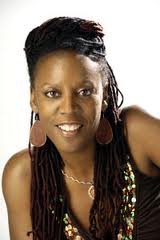
Glenis Redmond
“Enter through the door of war…” she begins after adjusting the microphone. “Grief is an uttering tongue.” She begins with a powerful recitation. She is a performer–practiced in public settings. Her second poem is “Lifting” about the Kenilworth slave cemetery near her neighborhood. “Bid us ride,” she reads. By far she is the most charismatic poet of the evening. “Looking back to the land where courage was born.” Due to the lateness of the evening she says she’ll only read three poems. Her next poem is about Nina Simone: “bitter aint born black.” Her final poem is a recitation: “Every time I hear King speak I feel a rumble…” she starts and concludes, “We shall.”
Intellectual swimsuit contest
A number of poetry submissions were sent out this weekend.
The one thing I abhor about the whole process is the “write a brief bio” portion of the submission letter. I mean, shouldn’t my publicist do that (not that I have one).
It’s like an intellectual swimsuit contest for a literary pageant. How do you look in a two-piece swimsuit with a tiara on your head? If you fit the definition of intellectual beauty and you’ve been published by notable literary magazines than you avoid the slush pile. If not, try finding another line of work.
So, here’s a new bio I wrote to accompany my latest submissions. It’s me in a red thong with a bright yellow Wisconsin cheese wedge on my head.
Bio: I am a cultural creative theory slut from Asheville, NC who is considered by some a true postmodernist. I collect hard cover books in foreign languages, eat critical theory articles for breakfast, bath in Icelandic and mythology and digest ancient manuscripts for light reading.
Do you think it’s too over the top?
Poetry, painting and other thoughts
 Fragile
Last year, about this time, I contributed to “Resonance” Art Opening/Multimedia Performance. The Grey Eagle Tavern and Music Hall hosted the event. I read some of my new poems at the time and then Philip (guitarist) and Julie (rock vocalist) joined me with a music/performance set based on my book Late Night Writing. Julie contributed an original song to the set while Philip added an original soundtrack. The collaboration between the three of us was inspiring (to me at least). It was kind of weird hearing Julie sing my poems “Fragile” and “Driftwood” back to me and to the audience. In a way it was a relief to hear someone else claim them, own the words, project the ideas. I miss that. There are a few live bootleg recordings of the three or four gigs we did together. Maybe when I find some server space, I’ll offer them as free downloads.
Three paintings represented me at “Resonance” Art Opening/Multimedia Performance. “Fragile,” named after the poem I wrote, was painted last summer. Previously, I had done a series of four paintings inspired by the poet Kahlil Gibran (which was part of the 2003 “Resonance” art show) with bright, dramatic abstractions using a simple palette of red, yellow and black. With “Fragile,” the colors deepened in order to create a stark, lyrical image. A young poet from South Carolina once confessed he didn’t particularly get into modern art, but he liked “Fragile” because it seemed like a place he would like to visit. The poem I wrote that inspires this work includes these lines: “I am naked/ When truth strips me/ Of a lie.” And later: “I am reborn/ When the old shattered remains/ swept away, replaced with/ a new vessel to contain my soul.”
 Among The Myrtle
“Among The Myrtle,” named after a passage from the book of Zechariah, was also painted last summer. Most people who view this painting don’t know the passage that inspires this work. The passage reads:
“In a vision during the night, I saw a man sitting on a red horse that was standing among some myrtle trees in a small valley… I asked the angel who was talking with me, ‘My lord, what are all those horses for?’ ‘I will show you,’ the angel replied. So the man standing among the myrtle trees explained, ‘They are the ones the LORD has sent out to patrol the earth.’ Then the other riders reported to the angel of the LORD, who was standing among the myrtle trees, ‘We have patrolled the earth, and the whole earth is at peace.’
Again, as with the painting “Fragile,” I attempt to present a sparse place for the eye and the mind to roam–a place someone would like to sit and rest and visit often. In a way, I was trying to create a sanctuary were “the whole earth is at peace.”
My son, who was two at the time, painted along side me. We would paint outside, on the front deck on Saturday mornings. It became a weekend ritual. At the time he merely enjoyed mixing the colors on an old canvas I had forsaken. He named one dinosaur and the next weekend he would paint over dinosaur and call it puppy. During the winter we stopped the outdoor painting sessions and he began working with pencil and paper. By springtime he graduated to markers. As spring gave way to summer he had developed a curious visual language that inspired me. He began drawing people with arms and legs that didn’t quite fit and dots and lines representing eyes. The smile became his creative signature–it sliced across the heads as if to say “it is what it is.”
One Saturday, after we resumed our painting ritual, I created “I’m Putting on My Socks” in honor of his drawings. Three other paintings were created that day (which I may post at a later date) and a series of twelve drawings. He told me I needed more gray. I told him gray was not a color I liked to use because it’s too bland. He insisted by adding a few strokes of his own. After moving him back to his canvas, I conceded. Gray became the visual language that supported the red, black, copper and white motifs.
I don’t know if there will be a “Resonance” Art Performance this year. Whether collaborating with adults or children, an artist needs support in order to grow. Hearing a poem or viewing a painting from another perspective opens up a world of opportunity. Irving Stone mused that “Art’s a staple. Like bread or wine or a warm coat in winter… Man’s spirit grows hungry for art in the same way his stomach growls for food.” For those who have supported my growling stomach, I thank you.
Poem Review: “Old Soldier” by Charles Simic
About four months ago I wrote a review of a poem by Charles Simic for an editor, but I have not received word as to its status. So, here’s an abbreviated form of the review.
A couple months ago, my son and I planted seven white pine saplings along the east side of the property. As a three-year old, he doesn’t really “plant” trees but rather roams the near vicinity in search of new wonders to discover. Each dandelion must be plucked and examined and each twig must be picked up and relocated. A chestnut branch, which had fallen during a recent storm, particularly interested his imagination. With chestnut branch in hand, my son defended the homestead from cardinals, squirrels and a trespassing cat.
As I recall my three-year son chasing a yellow rubber ball across the backyard and waving his chestnut branch over his head, I think of how new readers of poetry need to wade into the greater pool of literature by first enjoying what will get their feet wet. This doesn’t diminish the quality of Simic’s work but rather supports the notion that if a poet can speak to the children he will be able to guide them into a broader, deeper appreciation for poetry. The Academy of American Poets recently cited, in their 2003-2004 annual report, that 68% of their active members became interested in poetry before the age of 18.
“Old Soldier” opens with a list of credentials and a storyteller’s wink of wit. The image of this warrior wanting to impishly pull the tail of “a cat lying in the grass” suggests a mischievous tone for Simic’s 22-line poem. The mother figure introduces a contrast of gentleness and the serene garden solitude against the “flying cinders” of aerial bombardment. What’s interesting about the mother figure is that she doesn’t leave the soldier alone but takes him “by the hand.” It’s tempting to wonder if this is a historical account or merely a narrative. Vernon Young, a contributor to the Hudson Review, suggests that Simic writes “by the fable; his method is to transpose historical actuality into a surreal key.“
Simic tells that the soldier’s sword was cardboard and only lacked a horse–particularly a horse which pulled “a hearse/With a merry wave of his tail.” The last lines are striking in that they suggest a ten-year old boy who chooses a funeral horse for his military campaigns instead of a warhorse. Ripe imagery presents numerous literary interpretations.
Density of Poetry
Malaprop’s Gig in 4 days!
At supper tonight, a friend was telling me that she is looking forward to attending Thursday night’s poetry/music gig. But she couldn’t understand why I chose to read/write poetry.
“Why not stories?” she asked.
I told her that I do write in other genres but I chose poetry as my concentration because it required deep thought to write and read. Not that prose is easy to write, but poetry buries textured truths in metaphor which require those who seek it to search deliberately. What may be investigated in a novel is compressed in 32 lines of a poem.
The German word for poetry is Gedichte or Dichtung. The definition of poetry in German encompasses the idea of compression or density–to condense a thought or theme. The English understanding of poetry embraces beauty and harmony–graceful elegance.
My hope is that in four days I present condensed ideas in a lyrical framework.
 Coffeehouse Junkie