Keep calm and write something

Back in January I submitted more than 50 poems to various publishers. So, how many poems have been accepted? or rejected? More on that later….

[read more]

UPDATE: This blog post is available as part of an audio podcast.

Listen here:

Or listen on:
PodOmatic: coffeehousejunkie.podomatic.com
SoundCloud: soundcloud.com/coffeehousejunkie

E-book: How long does it take to write a haiku?: and other stories

Purchase the e-book Kindle Edition for $0.99!

What do you think about when you see a stack of books? In this short collection of stories you will also learn what a creative director thinks of when he sees a stack of books. Who is the audience for your poems? Is possible to write in your sleep, or not?

How did you come to poetry?

Over the weekend, an editor made a comment on Facebook that got me thinking about the question, how did you come to poetry?

My response is not an academic reply. The mechanics of poetry make the art good and great. But the best way to ruin poetry for young minds or new readers, is to have people study the architecture of a poem–its meter, rhyme, enjambment, stanzas, etc. Is this the way you learn about a new home? When you enter a friend’s home for the first time, do you inquire as to house’s foundation (is it a slab foundation?), framing (stick frame or post and beam?) or roof (you get the point)? So why do educators insist on destroying poetry for young readers? Make the home inviting. Make poetry inviting.

As a poetry reader, I approach a poem (or body of poems) as I would a new home of a friend I just met. I enter the door, look at the paintings on the wall, run my fingers along the spines of the books on the shelf, scan over the vinyl collection beside the stereo and sit on the futon near the front window. This is how to see what the poet sees through the window of the poem. This is when I see what the poet says about love, injustice or various other subjects and topics.

Not all poems are created equal. Sometimes I get the impression that someone or something is shouting at me from an open door. I tend to quicken my steps along the street and find a more inviting home–a more inviting poem.

Poetry is not something I studied in school. There were, of course, the required literature classes, and some teachers that opened the landscape of great poetry and prose. But for me, someone left the back door to the house of poetry open and I slipped in to explore. A house doesn’t seem so intimidating or formal when you enter, casually, from the backdoor.

Which came first philosophy or poetry?

Foreign language section at Downtown Books & News

Someone asked how many of today’s poets are also philosophers?[1] The question presents some assumptions. One assumption is that poets merely express themselves in literary work through distinctive style and rhythmic fashion. This notion tends to present the  emotional aspect of poetry, but ignores the intellect of poetry. There is a dichotomy to poetry that mingles and merges into philosophy. The study of knowledge, reality and existence is at the core of philosophy, and the expression of these ideas is at the center of poetry.

Readers of poetry know that the subject matter of most serious literary poetry is an investigation of knowledge, reality and existence. One might argue, that light verse also presents a philosophical truss and girder to the support of the work. Truly, poetry puts a face on ideas, clothes abstractions in tangible, beautiful garments and builds images from the exploration of the meaning of life.[2]

Western philosophy began in 6th century BCE. It interesting to me that before philosophy there was poetry. Hesiod composed Theogony more than 100 years before Thales of Miletus and the Pre-Socratics. About that time period Homer released the Iliad. It is not by accident that poetry informs philosophy nor that poets birth philosophical conversations.

To address the question that sparked this post, I’m still considering the question of who I might regard as a great modern poet philosopher. My mind runs in two veins: one is the craft of the poet (i.e. the strength of the literary work) and two is the ideas of the poet (i.e. the strength of the logic and rhetoric of the argument). A couple of modern poets come to mind, but they have long since passed from this world. Two names of living poets simmer in the back of my mind. What do you think? How many of today’s poets are also philosophers? Are you a poet? Do you consider yourself a philosopher? What examples of philosophy do you find in poetry?

NOTES: [1] Gael, “Wondering how many poets are also philosophers and intuitives as well as creative.?” LinkedIn, April 21, 2013 accessed May 6, 2013 http://www.linkedin.com/group.
[2] There is a whole discussion that could be had regarding avant-garde poetry and the challenges with poetic forms that are not accessible to the average reader, but this post deals only with the question of philosophy as it relates to poetry.

Scrambled eggs and poets

Over two months of writing a poem a day
These are not scrambled eggs.

Have you ever typed a message into your smartphone and the autocorrect delivers an amusing sometimes intriguing option? That’s were the title of this post comes from. I was trying to text: scrambled eggs and toast please. Don’t ask. It’s been a long weekend, but I wanted to provide an update to a February post [1] where I detailed the number of poems submitted to publication and how many have been accepted. And the grand total is: none. I haven’t heard from all the publishers yet, but so far it has been rejection letters and emails. [2]

And now, scrambled eggs and poets.

It is a rare evening these days when I am able to attend a literary reading in my adopted hometown. The Juniper Bends Reading Series for May [3] featured Mandy Gardner, Collin Garrity, Rose McLarney and Jerry Stubblefield. I arrived late, but enjoyed a truly amazing reading. The highlight, for me, was Rose McLarney’s reading. It had been almost seven years since I first heard Rose McLarney read her poems at the Black Mountain College Museum + Arts Center. And since then, her acclaimed collection of poems was published by Four Way Books. [4]

After the reading concluded, and this is where things get a bit scrambled, I waited with others to chat with the poets and writers. The longer I waited the more I wanted to ask her about the publishing process. How did she manage to get her collection published? What tips would she recommend? You know, all those predictable, pithy questions unpublished poets ask published poets.

And then, like Billy Pilgrim, [5] I sort of time travelled. No longer standing inside the crowded Downtown Books & News, [6] it was night and I was walking up Eagle Street toward Pack Square Park with a poet how was asking me, “How do I get my poems published? What tips do recommend?” With my experience in publishing, I began telling her any information that I thought might help. And then, as we were parting ways, I was telling her not to sweat it, “When the poems are ready, the audience will be there.”

And then, I time traveled back to May 2013, it was night again. I walked to my auto as a SUV full of kids drove by with the windows down. Their ruckus noise spilt onto the street. They slowed and someone threw hot pennies at me. They sped away. Why do kids heat pennies with cigarette lighters and throw them at complete strangers? I entered my car and drove home saying, “When the poems are ready, the audience will be there.”

More scrambled eggs and poets.

Scrambled yet? Don’t worry. It’s Monday. You have the whole week ahead of you.

Let’s do some more time traveling. Last year, I provided some teasers for an upcoming book. [7] The manuscript is nearly novel length and I’ve sought out a couple editors to assist me. Truly, this is not a story I wanted to write, but it has found me and apparently an audience.

NOTES:
[1] So far, I’ve submitted almost 70 poems for publication. You can read the details in the post: 50 poems in 30 days
[2] Why do poets write, if not to be published? These thought have occupied my thoughts since last week’s post.
[3] Juniper Bends Reading Series
[4] Four Way Books
[5] Everyone knows who who that is, right? And if you have to google it, just know that it is not the American folk musicians from Atlanta.
[6] Downtown Books and News
[7] You may read the teasers here

Write now, set writing goals

...any road wil get you there.[1]
“If you don’t know where you’re going any road will get you there.”[1]
Is it writer’s block? Procrastination? What’s keeping you from completing that collection of poetry or that novel you started years ago and you can’t quite get around to finishing it?

A few years ago I sat in a writing workshop and noticed that I was the only member of the group under the age of 50 years old. Further, most of the students at the workshop had been working on a memoir or a novel or something that began at a university. Now enjoying their retirement, the nostalgic desire to complete these literary works grip those writers who had been dribbling out small passages of poetry and prose for what seems to be my lifetime.

I determined at that time to set writing goals and not let time slowly bleed me of creative efforts. So, I adapted some of the productivity and time management skills I use at work to my writing life. Here’s some productivity, or time management, habits I practice at the office.

1. Don’t check email first thing in the morning.

At the office, I schedule two times a day were I read and reply to emails: once in the morning and then again in the afternoon. If I reply to every email that lands in my inbox at the moment it arrives, I would spend more than half the work day reading and replying to emails. I found that if I batch tasks, like emailing, I can maintain focus on accomplishing those tasks more efficiently.

2. Make a list.

First thing I do when I get to the office is make a list. This is a combination of project management and mind-sweeping. This activity allows me to organize and prioritize large and small tasks for the day and week.

3. Declutter the desktop.

This is something that is both on- and offline. And by “declutter” I don’t mean empty your desktop of everything. Declutter has to do with a collection system. How do you collect the papers or files? Years ago I began the practice of collecting items in folders based on the 43 folders system. Here’s how it is presented by Merlin Mann:

  1. identify all the stuff in your life that isn’t in the right place (close all open loops)
  2. get rid of the stuff that isn’t yours or you don’t need right now
  3. create a right place that you trust and that supports your working style and values
  4. put your stuff in the right place, consistently
  5. do your stuff in a way that honors your time, your energy, and the context of any given moment
  6. iterate and refactor mercilessly[2]

Again, the goal of this practice is not to have a clean, empty desktop, but a productivity system in place to help get things done.

4. Plan. Revisit the plan. Stay on task.

Your co-workers and supervisors think every task is an emergency and everything is a priority. Planning and staying on task is one of the most annoying practices my co-workers and supervisors must endure. Yet, unless I identify the goals and chart a trajectory to hit those goals, I’ll never me able to meet deadlines on time or successfully accomplish projects. How does the old adage go? If you don’t know where you’re going, any road will get you there.

Let’s do this!

Avoid waiting until you retire to complete that novel you’ve been working on, or that collection of poems you’ve been tinkering with for years. Find a writers group that can help you with accountability and encouragement. It is written that no one knows the number of his or her days. Our life is a shadow.[3] Whether it is writer’s block, procrastination, internal or external distraction, find that writing project you’ve been working on and commit to finishing it.

NOTES:
[1] Source: This Isn’t Happiness, accessed May 8, 2013 http://thisisnthappiness.com/post/48296644589/any-road
[2] Merlin Mann, “Getting started with ‘Getting Things Done’,” September 8, 2004 accessed May 4, 2013 http://www.43folders.com/2004/09/08/getting-started-with-getting-things-done
[3] Shane Claiborne, Jonathan Wilson-Hartgrove and Enuma Okoro, Common Prayer: A Liturgy for Ordinary Radicals (Zondervan, 2010), 271.

Why do poets and writers write?

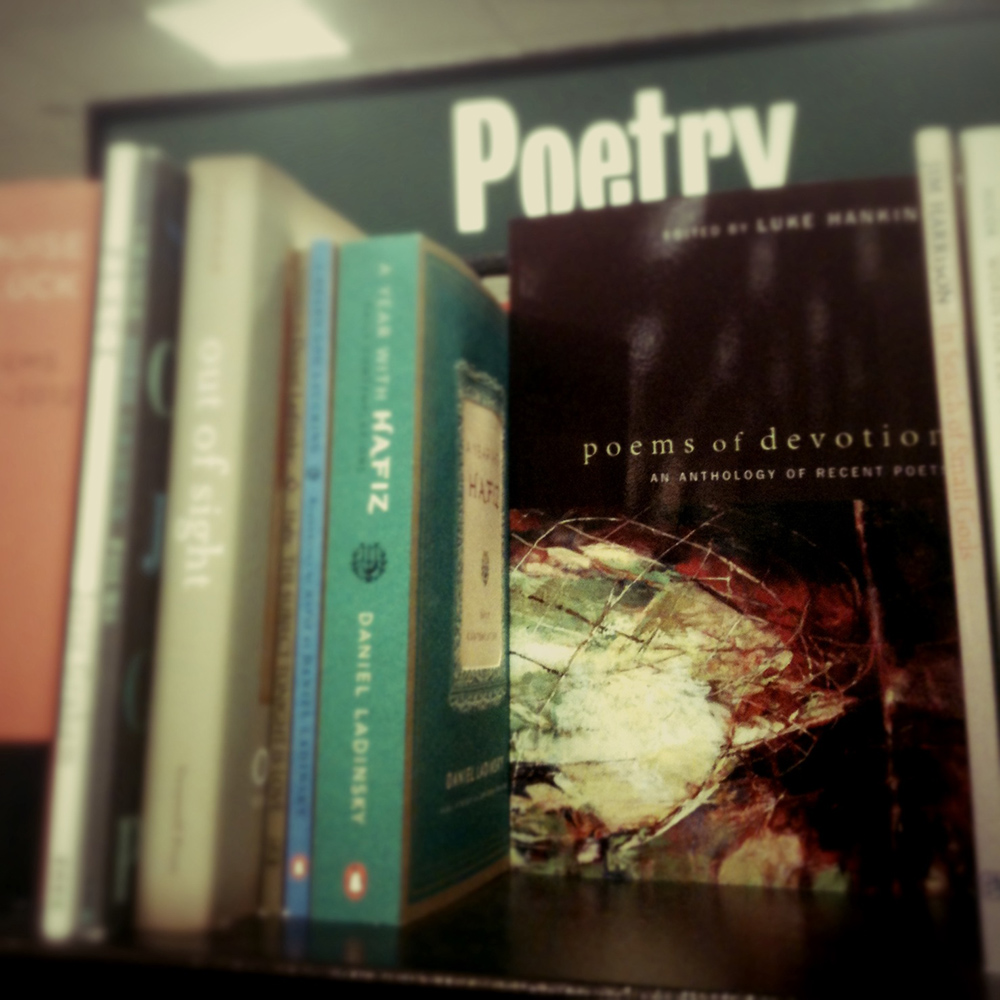
Bookstore Poetry Shelf

This is a question like a sliver that gets under your skin. It is like that wood splinter you received from running your hand along a wooden fence and the painful acceptance of it to the soft spot below your thumb sends you to the medicine cabinet where you try to remove it with tweezers. But it’s too deep and requires a poultice to draw the splinter to the surface for removal. It is that way with answering the question, why do poets and writers write?

In an online discussion[1] of poets and writers and arm-chair philosophers, I offered this to the ongoing conversation: Emerson wrote that “The poet is the sayer, the namer, and represents beauty.”[2][3] This rings true as to why writers write. Years ago I heard someone say, “We are God’s poème.”[4] (Poème derives from the Latin word poema meaning poem.) I have often pondered that as an answer for why writers write and wonder if that is what Emerson had in mind when he wrote those lines. We are God’s poem, that is why we say, name, and represent beauty.

What are your thoughts on the matter? What motivates you to write? and why?

NOTE: [1] Renée, “Why write?,” LinkedIn, April 25, 2013 accessed May 6, 2013 http://www.linkedin.com/group.
[2] The quote is from Ralph Waldo Emerson’s book Essays, Second Series from the essay “The Poets.” Here’s a link to an excerpt: http://www.goodreads.com/quotes/495734-the-poet-is-the-sayer-the-namer-and-represents-beauty?.
[3] Or you can read the entire essay in this handsome collection: Emerson: Essays and Lectures: Nature: Addresses and Lectures / Essays: First and Second Series / Representative Men / English Traits / The Conduct of Life (Library of America) [Hardcover].
[4] This is a reference to a passage in chapter two of The Epistle of St. Paul to the Ephesians. William D. Mounce writes on the matter of the original Greek text in this article, Are We God’s Poem?.

Do you submit poetry for publication?


So, you write poems. Maybe you read your poems at a local bookstore, music venue or coffeeshop at a monthly or weekly open mic. And maybe you even sign up for a writing workshop and the teacher hosts a public reading at a fine art center or library at the conclusion of the course. But do you submit your poetry for publication?

Last month I submitted over 50 poems for publication. So far I’ve receive quite a few reject letters. Some replies were so quick I wonder if the editor read the submission. A week after I submitted poems to one editor I received this:

“I enjoyed reading your poems but I’m unable to use them…”

A day later I received this from a different editor:

“Thank you for your recent submission…. This group of poems wasn’t right for us, but we’re grateful for the opportunity to consider your work…”

These replies are courteous, non-confrontational and sterile. Last weekend I received my favorite rejection letter so far. It reads,

“We sincerely appreciate your interest … and are very glad you are getting your pieces published….  we wish you the best of luck in your continued writing. Never give up on what your high school literature teacher told you!”

Why do I like that rejection letter? Here’s three reasons:

  1. The editor actually read the cover letter. Not just the first few lines of the cover letter, but all the way to the third paragraph. You see, buried in the third paragraph of my cover letter is an homage to an inspirational high school literature teacher.
  2. Clearly it is not an automated reply to a submission for publication.
  3. The way the letter is crafted is a sandwich. By that I mean, the letter opens positively, nicely rejects the submission with two reasons and concludes with a personal and positive note.

Literary journal editors should take note of this rejection letter. It is a good model to follow.

If you submit your poetry for publication, I am interested to learn how it is going for you. If you don’t submit your poems for publication, I’d like to know why.

Found poem: The courage to live [annotated]

POET’S NOTE: As an exercise to try something new in composing a poem, I wrote this short piece as a found poem based on news headlines and related blog posts. John Hollander wrote in Vision and Resonance: Two Senses of Poetic Form that “anyone may ‘find’ a text; the poet is he who names it, ‘Text’.” With that introduction, I offer this found poem.

The courage to live

1.

It seems like the very heavens [1] rupture [2]
with news of the Pontiff’s decision [3]
to abdicate the Holy See.

2.

Somewhere in America, for nearly a week,
film and fiction collide with a John Rambo-like [4]
manhunt [5] that ends as expected. [6]

3.

She sings, [7]
When you get to Asheville
send me an email…. 
[8]

Will she tell me that the President is coming to town? [9] [10]
Will there be a hollywood celebrity to greet him, [11]  when he arrives?
Will he retire to the Paris of the South [12] after this whole presidency thing[13]

4.

Whether it comes from above [14] or snakes its way through the dark depths below, [15]
the number one regret on the lips of the dying is
to have lived true to one’s self rather than the expectation of others. [16]

NOTES:
[1] Phil Plait, “BREAKING: Huge Meteor Blazes Across Sky Over Russia; Sonic Boom Shatters Windows [UPDATED],” Slate, Feb. 15, 2013 accessed February 15, 2013 http://www.slate.com/blogs/bad_astronomy/2013/02/15/breaking_huge_meteor_explodes_over_russia.html
[2] CBS/AP, “Meteorites slam into Russia as meteor seen streaking through morning sky,” CBSNews.com, February 15, 2013, accessed February 15, 2013 http://www.cbsnews.com/8301-202_162-57569551/meteorites-slam-into-russia-as-meteor-seen-streaking-through-morning-sky/
[3] Mark Memmott, “Pope Benedict XVI Is Resigning,” NPR’s The Two-Way, February 11, 2013, accessed February 15, 2013 http://www.npr.org/blogs/thetwo-way/2013/02/11/171680715/pope-benedict-xvi-is-resigning.
[4] “Christopher Dorner manhunt: police hunt ‘Rambo’ cop killer” The Week, February 8, 2013, accessed February 15, 2013 http://www.theweek.co.uk/us/51429/christopher-dorner-manhunt-police-hunt-rambo-cop-killer.
[5] Halimah Abdullah, “L.A. manhunt reminiscent of D.C. sniper case,” CNN, February 9, 2013, accessed February 15, 2013 http://www.cnn.com/2013/02/08/politics/lapd-attacks-dc-sniper/index.html?iid=article_sidebar.
[6] “Dorner manhunt: Charred human remains found in burned cabin,” Los Angeles Times, February 13, 2013, accessed February 15, 2013 http://latimesblogs.latimes.com/lanow/2013/02/dorner-manhunt-charred-human-remains-found-in-burned-cabin.html.
[7] Jennifer Saylor, “New single from Steve Martin and Edie Brickell: ‘When you get to Asheville’,” Ashvegas.com, February 14, 2013, accessed February 15, 2013 http://www.ashvegas.com/new-single-from-steve-martin-and-edie-brickell-when-you-get-to-asheville.
[8] Alec Wilkinson, “EDIE BRICKELL AND THAO NGUYEN,” The New Yorker, February 5, 2013, accessed February 15, 2013 http://www.newyorker.com/online/blogs/culture/2013/02/listen-to-new-albums-by-edie-brickell-and-thao-nguyen.html.
[9] Jeff Willhelm, “Obama in Asheville,” The Charlotte Observer, February 13, 2013, accessed February 15, 2013 http://www.charlotteobserver.com/2013/02/13/3852979/obama-in-asheville.html.
[10] Jennifer Saylor, “Obama in Asheville, Part 1: Fourth visit,” Ashvegas.com, February 13, 2013, accessed February 15, 2013 http://www.ashvegas.com/obama-in-asheville-part-1-fourth-visit.
[11] James Franco, “Obama in Asheville,” Yahoo! News, January 21, 2013, accessed February 15, 2013 http://news.yahoo.com/president-obama-in-asheville-a-james-franco-poem–231846640.html.
[12] Jennifer Saylor, “Obama in Asheville, Part 2: President says he might retire here,” Ashvegas.com, February 13, 2013, accessed February 15, 2013 http://www.ashvegas.com/obama-in-asheville-part-2-president-says-he-might-retire-here
[13] Donovan Slack, “Obama on barbecue, life ‘after this whole presidency thing’,” Politico 44, February 13, 2013, accessed February 15, 2013 http://www.politico.com/politico44/2013/02/obama-on-barbecue-life-after-this-whole-presidency-156963.html.
[14] Joel Achenbach, “Asteroid’s pass near Earth a close call in cosmic terms only,” The Washington Post, February 14, 2013, accessed February 15, 2013 http://www.washingtonpost.com/national/health-science/asteroid-to-pass-near-earth-but-you-dont-need-to-duck/2013/02/14/615d5848-73cb-11e2-aa12-e6cf1d31106b_story.html.
[15] Mark Wilson, “Infographic: The 550,000 Miles Of Undersea Cabling That Powers The Internet,” Co.Design, accessed February 15, 2013 http://www.fastcodesign.com/1671777/infographic-the-550000-miles-of-undersea-cabling-that-powers-the-internet#1.
[16] Susie Steiner, “Top five regrets of the dying,” The Guardian, February 1, 2013, accessed February 15, 2013 http://www.guardian.co.uk/lifeandstyle/2012/feb/01/top-five-regrets-of-the-dying.

50 poems in 30 days

Over two months of writing a poem a day
Photo courtesy of coffeehousejunkie.

More than 50 poems were sent to publishers in January. Encouraged by another poet who submits somewhere in the neighborhood of 60 poems a month, I thought it would be a good discipline as well. It’s exhausting as well.

A few years ago, I was encourage not to post my poems on this blog (or Facebook), because a lot of small press publishers consider those poems “published.” So, I’ve been writing offline and sharing the new poems at private salons, a poetry festival and with friends. But I have not pursued publication until this year.

Talking with Al Maginnes after his recent reading at Malaprop’s, he told me how is first poetry submission was accepted immediately. Encouraged by this, he submitted more poetry to publishers. He said it was years before anything else was published.

So far, two publishers replied with rejection notices. That’s alright. I will submit those poems to other publishers.

Interview: Laura Hope-Gill on Soul Tree Solstice

Soul Tree Solstice

Laura Hope-Gill is a poet, teacher and author of Look Up Asheville: An Architectural Journey and Look Up Asheville II. She is a NCArts Fellow, founding director of Asheville Wordfest and Coordinator of M.A. in Writing Program at Lenoir-Rhyne University Center for Graduate Studies in Asheville. Laura was named the first poet laureate of the Blue Ridge Parkway following the publication of The Soul Tree: Poems and Photographs of the Southern Appalachians. On December 20th she will perform selections from The Soul Tree with musicians at the “Living Room” above the Asheville Visitors Center at 36 Montford at 7 p.m. There is a $10.00/sliding scale admissions cost. Laura graciously agreed to a short interview regarding the book The Soul Tree and the event Thursday night, Soul Tree Solstice.

Coffeehouse Junkie Blog

You recently wrote on Facebook that The Soul Tree poems “were the poems I had been preparing (… being prepared?) to write since I first fell in love with the music of language as a child…” If you would, please explain that statement and then tell how they developed into the book The Soul Tree.

Laura Hope-Gill

I view the Soul Tree poems as a miracle in my life. They were the “finishing touch” on a years-long journey to understand something. That something has its stirrings in my childhood. I was a very nature-bound child. I could sit for hours out there just watching, absorbing the air, the sounds, the presences of animals. These poems took me back to that, only it was with the knowledge of what felt like all I’ve read and learned and wondered about since that time. I felt all that wonder we can hold as children but lose as we grow older. Somehow the music of language opened it up in me again. What a gift.

Coffeehouse Junkie Blog

The Soul Tree poems were (still are?) healing and transformative for you. Explain that process and how these poems have grown you (or are continuing growing you).

Laura Hope-Gill

Still, when I read them, they take me back to that space of awe and wonder. They unjade me, and they bring me back to nature, back to my soul, and that’s where all the medicine is. They grow me because we don’t live in a world where we can walk around with that wonder and awe, that innocence and still work at the good we need to bring into the world. We need to shelve our innocence. We can’t check out and still be effective. What we can do is catch a glimpse from time to time of our divine state, that nascence. I think that’s our awe, the way we feel when a view of the mountains takes our breath away, when something deep inside us connects with something deep inside the earth. It’s a sort of recognition. Writing the poems was a submersion in that recognition. It taught me a lot, much of which I’m still learning to hear when I read them.

Coffeehouse Junkie Blog

The upcoming Soul Tree Solstice event on December 20th will be the second time that you and Doug and Darcy Orr will perform together. Share about the first time you preformed with them and what people might expect of the upcoming event.

Laura Hope-Gill

Doug and Darcy have invited Joe and Karen Holbert to perform in their place due to a family sadness. We do have plans to continue collaborating, the five of us. A mutual friend gave Doug a copy of The Soul Tree a few years ago. He has since given it to his friends. Recently, he forwarded a note one of these friends had sent to him, thanking him for the book. I was so moved. Also, at that time, I had just given a reading at Lenoir-Rhyne University, and I realized while reading that I was finally “ready” to collaborate musically. I remembered playing with Doug and Darcy in a circle on the grounds of Warren Wilson College at Swannanoa Gathering. That night I was supposed to read on stage with Doug but due to some motherhood scheduling problems I arrived late. We ended up reading and playing together much later, in a much less intentional setting, and there was a magic to it. It was like the poems were home. It’s taken some time, though, for me to be able to read the poems whole. I mean I could get up in front of people and say them, but I was afraid to embody them, because they hold stuff that’s enormous to me. I have long believed that poet has a responsibility when performing to hold the audience in a safe place. The poet has to be solid, to be strong. I can do that with poems written in a voice people are more accustomed to. But the Soul Tree poems had their own voice, something more core. Maybe they were a promise of what I would one day be able to hold. Maybe they were a challenge inviting me to grow into them, that when I did I would be fully standing in myself. I can do that now,and I can read the poems. And I’m thrilled to read them with this extraordinary group of musicians.

Advent Poems (or 12 days of poetry)

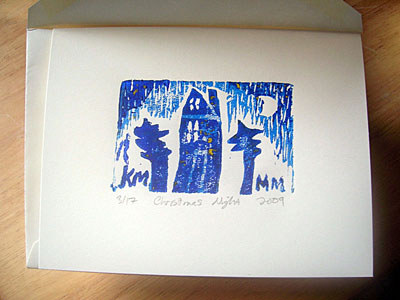
“Christmas Night,” a limited edition woodblock print/greeting card

It is so difficult for me to locate well-written Advent poems. A couple years ago I began collecting and posting some of my favorites. The list includes some well known poets as well as some lesser known individuals. As a way to celebrate the season, I offer the 12 days of Advent poetry:

Hope you enjoy the list. Let me know of Advent poems that are not listed here.

Interview: Barbie Angell on Roasting Questions

Roasting Questions Flyer

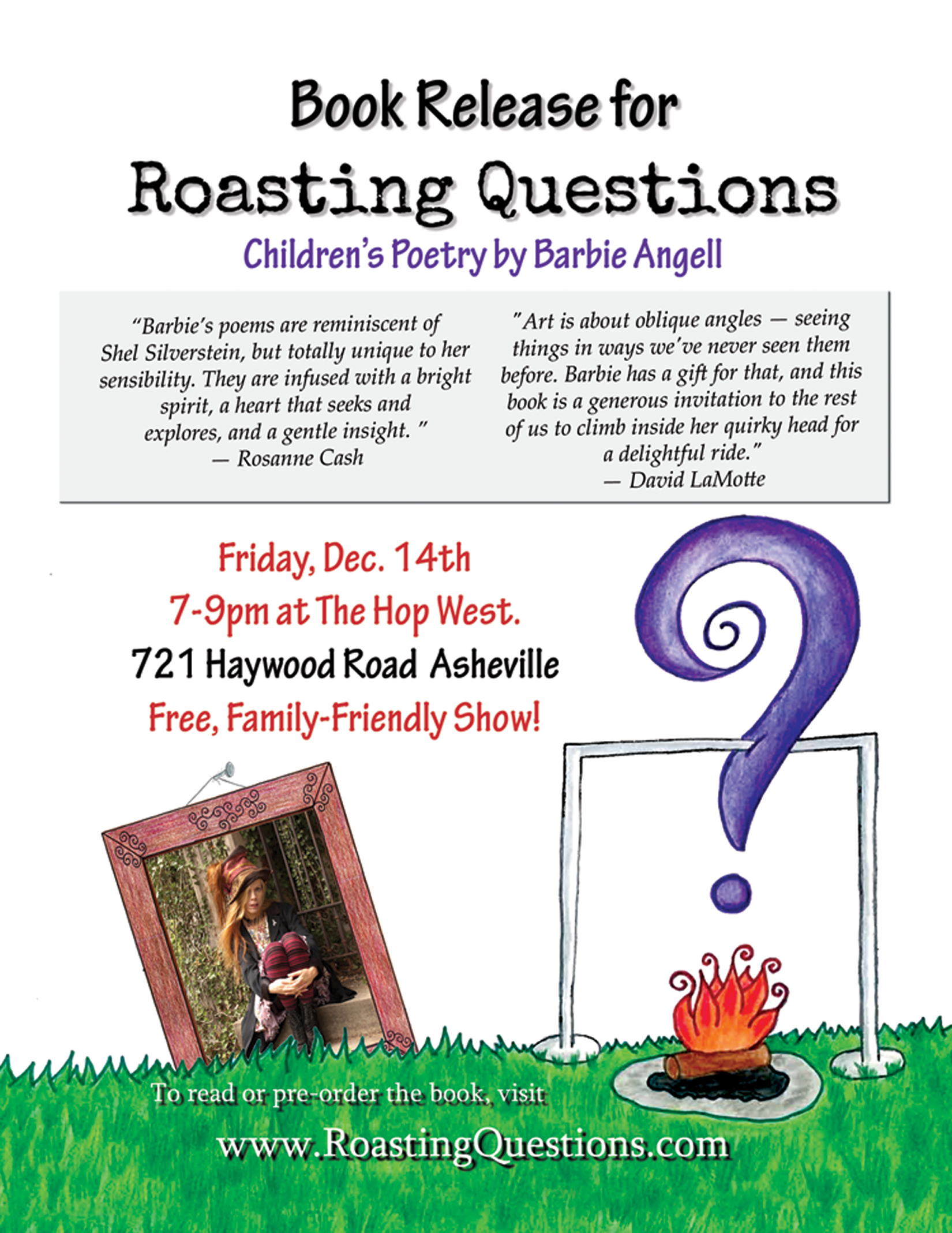
Barbie Angell is Asheville’s “poetess extraordinaire.” She has performed her poetry before audiences at bars, coffee shops and this Friday she’ll be at The Hop West promoting her new book Roasting Questions, a collection of children’s poems. The Hop West book release event is free and runs from 7 – 9 p.m. Visit Barbie’s web site for more details or visit The Hop West for directions.

Her previous self-published volumes of poetry have sold over 500 copies, according to her publisher, and she has earned a loyal audience from people who don’t know they like poetry to celebrated artists like Rosanne Cash and David LaMotte. Barbie kindly agreed to an interview to discuss the release of her first book Roasting Questions.

Coffeehouse Junkie Blog

For those who don’t know a thing about you, tell a little about yourself and how you came to poetry.

Barbie Angell

As a child, I loved reading Shel Silverstein. I was sick a lot & often alone and Shel’s poetry really grabs hold of loneliness and pushes the reader into a new world with quite tilted perspectives. My first Christmas in Mooseheart, a sort of orphanage, I was given a diary. Knowing I didn’t have the privacy required to keep an actual diary, I chose to hide my thoughts in poems. When I was in college I realized that, while poets didn’t appreciate my rhyming style, people who didn’t normally go to poetry events really loved my work. I was able to tap into an entirely new audience who had previously been ignored. In 1997 I was offered a children’s poetry gig which paid $75 for a half hour of performing. I didn’t write children’s poetry, but I needed the money, so I chose some of my rhyming pieces that were G-rated and the event was so successful that they gave me the job the next 2 years.

Coffeehouse Junkie Blog

Roasting Questions has been in the works for a little more than a year. Tell how the Roasting Questions developed as a collection of poems for children of all ages.

Barbie Angell

The book has changed a great deal since its inception. Originally it was going to have poems with blank sections for the children to draw a picture and also pictures with blank sections to write a poem. I still plan to do that book, most likely as a black and white supplemental to Roasting Questions. The pieces that ended up in this book were all given final approval by my seven year-old son. About half of them are also ones which I perform when I do bar shows and get the same incredible response from adults as they do at my children’s performances.

I’m unbelievably proud of Roasting Questions. Laura Hope-Gill assisted in the editing of the pieces and Michele Scheve and I brainstormed about the layout. With each “problem” that arose, I ended up finding a solution that made the book even more rich and quirky. Those two ladies from Grateful Steps Publishing House taught me a great deal and because of them the book is everything I could have hoped for.

Coffeehouse Junkie Blog

This is your first published book. Years from now, and hopefully many published books down the road, when you look back at Roasting Questions what do you hope readers will remember as the enduring idea of the book?

Barbie Angell

I absolutely hope you’re right and that this is the first of many books. The main philosophies behind Roasting Questions are fairly simple. I try to speak to the reader the way that Shel did, not over their heads or talking down to them, but speaking directly to them. Letting them know that we are all confused at times, all struggling with who we are and who we want to be. In the end, even though we’re all different, we want to connect with each other and be the best “us” we can be.

Interview: Luke Hankins on Poems of Devotion

Poems of Devotion

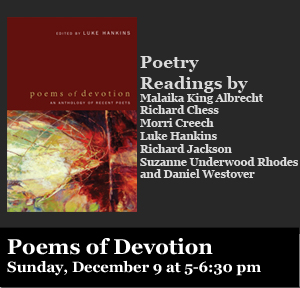
Luke Hankins is Senior Editor at Asheville Poetry Review and the author of a collection of poems, Weak Devotions, a chapbook of translations of French poems by Stella Vinitchi Radulescu, I Was Afraid of Vowels…Their Paleness and editor of Poems of Devotion: An Anthology of Recent Poets. This Sunday, December 9 at 5 p.m., at Malaprop’s Bookstore/Cafe, Luke will read selections from Poems of Devotion: An Anthology of Recent Poets along with other featured contributors: Malaika King Albrecht, Richard Chess, Morri Creech, Richard Jackson, Suzanne Underwood Rhodes, and Daniel Westover. Luke agreed to a quick interview to discuss the recently published Poems of Devotion.

Coffeehouse Junkie Blog

Tell me how the anthology, Poems of Devotion, developed from concept to final printed book.

Luke Hankins

In my final year of graduate school, I took an independent study course with the superb poet and teacher Maurice Manning, which essentially meant that I chose an academic/creative project and he offered input on and evaluation of it. I have had a strong interest in spiritual poetry for many years, so it was natural that I would choose a topic that reflected this passion. The essay I wrote for that class was an examination of a particular set of qualities that characterized many of my favorite spiritual poems, qualities which, in my mind, constituted a distinct mode of composition. The essay was an early form of what is now the introductory essay of the anthology, examining what I call the devotional mode in poetry. When I first wrote it, the idea of editing an anthology hadn’t occurred to me, but as I continued to revisit and revise the essay after graduate school, I felt increasingly that the compiling “poems of devotion” would make for a superb collection of poems. As an experiment, I began gathering poems that I would include in a theoretical anthology, and that’s when I began to feel a real impulse — a “call,” if you will — to bring these poems together in an anthology. I sent out a proposal to several publishers, and I eventually signed a contract with Wipf & Stock Publishers.

What followed was — well, let’s just say a year of very hard work! Gathering the poems I wanted to include was one aspect: reading widely, taking recommendations, spending long days in the library or in coffee shops with large stacks of books. But all of that, though difficult, was full of pleasure and felt deeply rewarding. The other aspect was obtaining — and paying for! — permission from copyright holders to reprint the poems. That process was often labyrinthine, frustrating, and, not least of all, expensive. But it was worth it. I’m very excited about the finished anthology, and am moved and challenged anew each time I read it. Truly.

Coffeehouse Junkie Blog

Maurice Manning is becoming one of my favorite living poets. At the public library, I discovered his book Bucolics and then had an opportunity to attend one of his lectures at Warren Wilson. But I digress. You beat me to the second question which is what did you learn most? Seems like the whole publishing side of the anthology was quite a classroom of experience. If you will, highlight one moment during that year long process that “felt deeply rewarding” for you.

Luke Hankins

I think approaching the copyright aspect of the anthology with a certain level of naivety in many instances worked to my advantage. People were more inclined to take mercy on me and my minuscule budget! But there were a few publishing houses who were absolutely unmovable, and I had to pay out my teeth, so to speak, to include poems I felt were necessary to the anthology. So I learned to rejoice in small mercies where they came, and to practice stoicism about what I saw as exorbitant pricing from some of the major publishing houses.

Regarding your second question, I wouldn’t want to try to single out one moment that felt rewarding. I’ll just say that the process of discovering poets I came to love, whose work I had never read or had only read cursorily, was one of the most rewarding aspects. Re-reading poets whose work has been very impactful for me was another aspect. Also, there was an overall sense of being blessed to be able to dedicate myself to an undertaking that felt like an important fulfillment of who I am. I felt that I was working with real purpose. I felt that I was doing what I was meant to do.

Coffeehouse Junkie Blog

One final question, what’s the biggest thing you hope readers take away from Poems of Devotion?

Luke Hankins

I hope that readers — whether religious or non-religious, theistic or non-theistic — come away with a conviction that the devotional mode is a powerful, ongoing, vital mode in literature. I believe in these poems and their ability to do just that.

How long does it take to write a haiku?

It is twilight. A meager meal of potatoes and cheese provides a father and his children sustenance. As they eat he tells them about a son who lived a long time ago in a far, distant land. He was the son of a samurai and is famously know for his poetry…. [read more]

UPDATE: This blog post is available as part of an audio podcast.

Listen here:

Or listen on:
PodOmatic: coffeehousejunkie.podomatic.com
SoundCloud: soundcloud.com/coffeehousejunkie

E-book: How long does it take to write a haiku?: and other stories

Purchase the e-book Kindle Edition for $0.99!

What do you think about when you see a stack of books? In this short collection of stories you will also learn what a creative director thinks of when he sees a stack of books. Who is the audience for your poems? Is possible to write in your sleep, or not?

Rebecca Baggett, Joseph Mills & Nan Watkins

Poetry, December 2, 2012
Poetrio, December 2, 2012, 3 P.M.

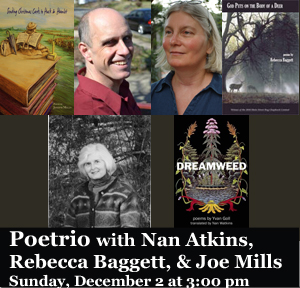
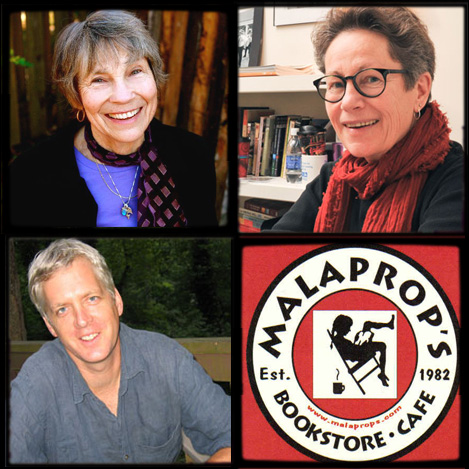
Join poets Rebecca Baggett, Joseph Mills, and Nan Watkins for Malaprop’s monthly reading series Poetrio, Sunday, December 2, 2012, 3:00 p.m.

From Malaprop’s Bookstore’s Virginia McKinley news release:

Rebecca Baggett…. earned a bachelor’s degree in classical languages at Salem College and is the author of two previous chapbook collections…. GOD PUTS ON THE BODY OF A DEER, the poetry collection Rebecca Baggett will present on December 2, won the 2010 Main Street Rag chapbook contest.  Sarah Gordon has this praise for GOD PUTS ON THE BODY OF A DEER: “Rebecca Baggett’s strong collection…. The voice in these lyrics is original, the imagery fresh and vital, the subject matter compelling….  Throughout these poems the poet emerges as a soul leaning, leaning toward the light.”

Joseph Mills has…. has published fiction, drama, and criticism, as well as four books of poetry from Press 53…. Poet Anthony S. Abbot offered this enthusiastic response to Joseph Mills’ most recent book: “SENDING CHRISTMAS CARDS TO HUCK & HAMLET… is one of the most original collections of poetry I have ever encountered — original because it treats the whole world of books, poems, stories, fairy tales not only as being somehow more real than reality itself but as our most important lifelines to reality itself. There is about this book a sense of everything happening for the first time, even those literary events that seem to happen over and over.  What a pleasure this book gives the reader.”

Nan Watkins is a writer, translator, and musician who lives in the Blue Ridge Mountains of Western North Carolina. She holds degrees in German from Oberlin College and Johns Hopkins University, with further study at the University of Munich and the Academy of Music in Vienna…. Nan Watkins’ DREAMWOOD is the first English translation of Traumkraut, the final (and posthumously published) poems of Yvan Goll (1891-1950).  Goll is considered one of the finest European poets of the twentieth century.  He was born in Alsace-Lorraine and was bilingual in French and German.  In addition to writing as a poet, he became known as a novelist, playwright, translator and publisher who produced collaborations with Chagall, Dali, Picasso, Leger, Weill, Joyce, and others. Among those he published during his exile years in New York were W.C. Williams, Breton, Patchen, and Henry Miller.  In New York he also published his own book in English, Fruit From Saturn.  Poet Neeli Cherkovski has written of DREAMWEED, “This collection not only brings forth… a great poet’s voice, but also stands as a remarkable achievement in the art of translation.”

Hope to see you there.

For more info, contact: Malaprop’s Bookstore/Cafe, 55 Haywood Street, Asheville, NC 28801 (828) 254-6734

www.malaprops.com

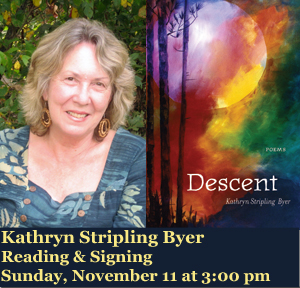
Kathryn Stripling Byer Poetry Reading & Booksigning

Sunday, November 11, 2012, 3:00 p.m., Malaprop’s presents a poetry reading and book signing for Kathryn Stripling Byer.

From Malaprop’s news release:

Poetry reading and booksigning event with Kathryn Stripling Byer, former North Carolina Poet Laureate and another favorite here at Malaprop’s.  On November 11 she will read from and sign DESCENT, a collection of poems described as “navigating the dangerous currents of family and race,” in which Byer “confronts the legacy of southern memory, where too often ‘it’s safer to stay blind.'”

We bury secrets deep into lyrics

There are secrets between singer songwriters and poets. We share them in dark corners of pubs or cafés. We talk about live performances and audiences and the craft of writing. A singer songwriter confesses that “at least a guitar is between me and the audience, but poets are left completely vulnerable on stage.” Yes, indeed. Naked before audiences that, in general, don’t care about poetry or don’t know anything about it. We wonder why singer songwriters embrace lyricism while academic poets skitter away from deep lyrics and the hint of rhyme. We will bury our secrets deep into the lyrics of a song or poem–so deep that it requires of map to locate ars poetica.

September 16, 2012: poetry at Malaprop’s

Writers at Home – Sept. 16th

This Sunday at the Malaprop’s cafe at 3:00 p.m. on Sunday, September 16, join the following poets as they read from their recent books: Holly Iglesias (ANGLES OF APPROACH), Sebastian Matthews (MIRACLE DAY: MID-LIFE SONGS), and Katherine Soniat (THE SWING GIRL). More details here. Link.

Peace Is a Flower: A Night of Poetry and Music

Peace is a flower – poetry and music

Tomorrow, 8:30 p.m. join James McKay, Laura Hope-Gill, Caleb Beissert, Pasckie Pascua, and Aaron Price at Battery Park Book Exchange & Champagne Bar, 1 Page Avenue, Asheville on SEPT 11, 8:30 to 11PM. This event is free to the public. Read poet and musician bios as well as other information on the Facebook events page. Link.

Quote: “Poetry exists… to sing the praises…”

I think poetry exists partly in order to sing the praises of who and what we love. . . . As well as for the purpose of showing us ourselves, at our worst as well as at our best.

—Sharon Olds [1]

SOURCE: [1] Megan O’Grady, “Fine Print: Poet Sharon Olds Chronicles the End of Her Marriage in a New Collection,” Vogue, accessed August 28, 2012, http://www.vogue.com/culture/article/fine-print-poet-sharon-olds-chronicles-the-end-of-her-marriage-in-a-new-collection/#1.

Poetrio, this Sunday, at Malaprop’s Bookstore

August Poetrio — 2012

This sunday, Malaprop’s Bookstore/Café continues the monthly poetry reading series, Poetrio, with Meta Commerse, Cassie Premo Steele, and Pauletta Hansel.

In an email from Virginia McKinley, of Malaprop’s, here’s a write up about August’s featured poets:

Meta Commerse. . . is the author of six books, including a novel intended to be a book of hope for middle-school-aged black girls.  That book began as her culminating project for the MFA degree in creative writing at Goddard College.  RAINSONGS: POEMS OF A WOMAN’S LIFE is her most recent book of poetry. . . .

Cassie Premo Steele’s poetry has appeared in numerous anthologies, magazines, and journals, including such publications as Sagewoman and Calyx. Her work has been nominated twice for a Pushcart Prize. . .  Her most recent book of poetry, THE POMEGRANATE PAPERS, is based on the Persephone/ Demeter myth and addresses the themes of mothers, daughters, creative cycles, loss, healing, and living in harmony with the seasons. . . .

According to Jackie Demaline of The Cincinnati Enquirer, Pauletta Hansel has been “an arts administrator and an unflagging arts advocate, [but] doesn’t like to talk about herself.”  Yet she seems happy to talk about the work she finds most interesting: “community organizing and community arts.”  . . . . Pauletta Hansel has published poems in . . . journals . . . and . . . has three previous collections of poetry, Divining, First Person, and What I Did There; at Malaprop’s she will read from her most recent book, THE LIVES WE LIVE IN HOUSES. . . .

Hope to see you Sunday, August 5, at 3:00 p.m. for Poetrio!

Last Night, Poetry at the Altamont – Featuring Evie Shockley

Evie Shockley reading at The Altamont Theater, Asheville, NC

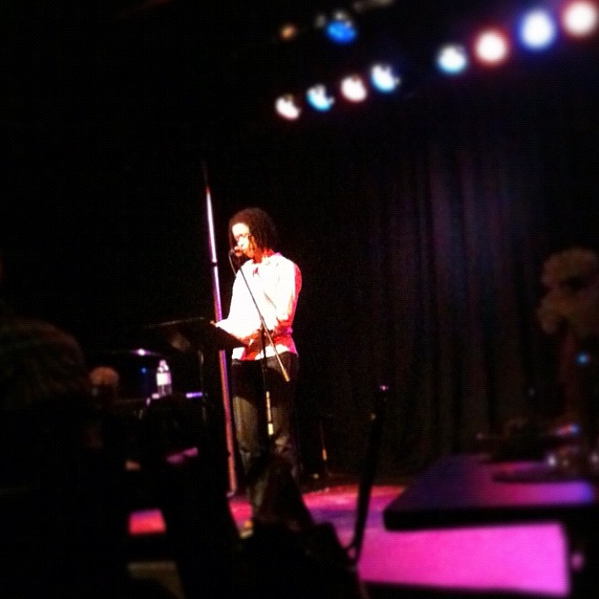
If it is possible to be drunk on poetry, than I am still sobering up from last night’s event Poetry at the Altamont featuring Evie Shockley. It was quite a special night as Evie Shockley read selections from the new black and a half-red sea as well as some new poems in progress.

Other highlights include poems read by notable poets including Lee Ann Brown, Jeff Davis (who also hosted the event), Eric Steineger, Caleb Beissert and many others whom I have forgotten there names, but not their words. There were verses read about five drinks at a bar with reflections of a homeless man in a cardboard box home and another poem about bees and honey and lazy hippies squatting in someone’s home all summer.

I also read some poems last night. Earlier in that day I had mailed off a manuscript to a publisher and had intended to read selections from that manuscript, but I changed up what I read. I can’t tell you what I read. You’ll have to ask someone who was there last night at The Altamont.

It was such a pleasure to join this gathering of poets and share works in progress in sort of literary laboratory. Looking forward to the next gathering.

Afternoon poetry and jazz

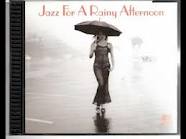
Jazz for a Rainy Afternoon Audio CD

Sometimes a few notes of music follow you for days are weeks or years. Sometimes a line of poetry haunts you like a memory you can’t quite recall. It’s like rain, it permeates the air, wets the ground, even makes tea taste more pronounced.

Here’s part of a story I can share with you. After I was at university studying art and design, I found an audio CD in a music store titled Jazz for a Rainy Afternoon. What attracted me to the album, a compilation, was the fact that the cover art reminded me of a sexier version of Gustave Caillebotte’s famous painting. I purchased the audio CD. It was background music initially. Something to edge off lonely days as a poor graduate beginning a career in graphic design. About the same time I discovered, and purchased, a copy of William Kistler’s poetry book America February.

I have always enjoyed poetry and music, but reading Kistler’s work was rigorous for me. Light verse and traditional poems, the variety that fill American and English school book anthologies, were what I was familiar with. But Kistler’s poetry was a new dish for my inexperienced palate. Equally, understanding the musical selections of Jazz for a Rainy Afternoon as more than a background soundtrack was challenging.

A line from one of Susan L Daniels’s poems has captured my attention this past week—the way jazz and poetry sometimes do. The speaker in the poem answers a question, so you like jazz, by saying: “…the answer is no/I live it sometimes…” That’s what I have come to enjoy about the complicated progression in a song or a poem that avoids a clean resolution.

Jazz and poetry work into you. It takes you down that familiar path of a rainy day afternoon, a common enough subject, but it is a variation of that theme. Never the same way twice. Like reading a poem as a school boy and reading it later as a graduate and later as a professional. Same poem printed on the page, but different. Always different. But familiar, because you “live it.” There’s more to this story. Maybe I’ll share it with you on another rainy day afternoon.

July Poetrio 2012

Sunday, at 3:00 p.m. at Malaprop’s Bookstore/café, the Poetrio series continues with three poets: James Davis, Kyle P. Harper, and Laura Walker.