Soundtrack to the late 90s

I can’t complain and all my bills have been paid.
Thank you so much for all the wonderful…

Link: PlankEye

This weekend, I visited the 90s through the portal of my compact disc collection and discovered that some of my favorite, modern, alternative, somewhat indie, but mostly obscure bands released their creative energy upon the world around 1995. Most of them didn’t survive the threshold of Y2K. Those who did survive Y2K, panted, sputtered, and collapsed shortly after 9-11. As I listen to some of the old tunes I recall how some of these songs resonated with me. Room Full of Walters came out with a song that articulated a message I didn’t have words for. At the time, I lived in the gun-totting, bible-thumping, concealed-arms permits Southern state. First time I heard the song, I said out loud, “You read my mind!”

Jesus Christ would never carry a gun
but you defend your right to bare one….
What’s up with you?
Why do you do the things
you do in the name of God?

Link: Room Full of Walters

Straight out of the university with a degree in graphic design, I had a passion for art. During the day I’d work at a small publishing company designing newsletters and booklets for residential and commercial properties, but at night I was painting, writing and reading. My goal was to have a solo show with at least 20 paintings. That’s when the music of Dimestore Prophets hit me like a two by four.

Truth is getting so hard to paint
Just chasing the wind, no place to begin
Mister, you’re not the first
Try working with dirt
Yeah sure ok Monet

Link: Dimestore Prophets

By the time the curtain closed on the 90s I finally had that solo art exhibit.

Another Dimestore Prophets song that stung me like a bee and wouldn’t let me ignore it was a tune called “Soothsayer.” At the time, I was recovering from the effects of being in a Christian fundamentalist environment and I just couldn’t stomach religion anymore. “Soothsayer” complicated my thoughts about God and faith and life in a way that still haunts me today.

Kneel down to the
system, hail religious
grind

Now jump like a
circus
dog through my hoops of fire

You won’t find a
back door to
heaven

Link: Dimestore Prophets

And then there are girls. Futile attempts at romance. Negotiating various relationships. And this song sometimes captured those moments at night on the patio, drinking coffee, smoking a cheap cigar, trying to read a book about two lovers who just don’t quite connect because of class or taste or some other issue that complicates life (but makes great novels).

Better off if things were left unsaid.
Tomorrow’s sorrows waiting there once again.
The silver pinholes of the night
refuse to sing their starry song tonight.

Link: PlankEye

And I realize that these songs are kind of like milestones. Some chosen, others placed in my way, but markers nonetheless to surviving the late 90s and progress on to the new century — new millennia.

Is it possible to be a polymath in today’s culture?

Are polymaths extinct? In the ancient world polymaths shared expertise in various fields of knowledge. One example is Leonardo da Vinci — not merely a painter, but sculptor, architect, musician, scientist, mathematician, engineer, cartographer, botanist and writer. More recently, Thomas Jefferson fits that definition as a horticulturist, political leader, architect, inventor, and founder of the University of Virginia. Is it possible to be a polymath in this modern world? As it relates to blogging, can effective bloggers be polymaths?

Copyblogger offers some habits of effective bloggers. The list includes:

  • prolific
  • concise
  • focused and consistent

(Link: 8 Habits of Highly Effective Bloggers)

One of the things stated as an attribute of an effective blogger is:

Successful bloggers choose a topic and stick to it.

They write consistently about their chosen subject… Even when they write about something that seems to be off-topic, they relate it back to the niche they know…

This makes practical sense as far as marketability. You don’t expect comic books sold at a doughnut shop. But what about a gas station? Of course, you purchase gas at a gas station, but most gas station owners don’t make profits from the sale of gasoline. Most of their revenue comes from products sold inside the gas station. In high school, I stopped by the gas station routinely to purchase comic books. Should blogs be doughnut shops or gas stations?

In the marketing world, as in the blogosphere, an individual who chooses a topic and sticks to it is a specialist or consultant. In Peter Rubie’s Telling the Story, he presents this definition of genres:

The development of genres came about as a marketing necessity. “Category” and “genre” are marketing terms… Their purpose is basically to help you more easily find what it is you’re looking for.

Telling the Story then goes on to list seven narrative nonfiction categories: adventure, travel books, biography, history, military, memoir and true crimes. The music industry follows the same protocol: country, pop, rock, hip-hop, and so on into the sub-genres of goth-metal, indie-folk-americana, afro-celt, etc. What Copyblogger proposes is to be marketable to your online audience. If you’re a tech blog, write about technology. If you’re an organic gardener, write about gardening. If you’re a mom, write about mommy stuff. That way your online readers are trained to expect only doughnuts at the doughnut shop.

The question is this: if blogs are specialized, will that make the community more or less knowledgable? I’ve noticed that art blogs often link to other art blogs. I understand that the reason for this is to create a strong community. The challenge with specializing content is that the specialists become islands of highly focused, topical knowledge surrounded by the waters of ignorance of other general knowledge. Jacques Barzun explores the idea of specialized knowledge and more in The House of Intellect. Let me go back to the opening paragraph where I stated “more recently, Thomas Jefferson…” Between Thomas Jefferson and our present information age, the society and culture has changed so dramatically that I wonder if our institutions of intellect suppress the nurture and nature of polymaths.

Should you do an audio or video podcast?

Here are a few thing to consider before you start:

People will remember:

  • 10% of what they read
  • 20% of what they hear
  • 50% of what they see and hear

(Link: Is Web video really effective?)

I’m not sure about the accuracy of those numbers, but here is another thing to consider: who is producing the content? Video takes a lot longer to produce than audio, and there are a lot more variables to video capture (like what’s in the background, natural lighting, audio, etc.)

An audio podcast — providing there is good audio capturing technique — is relatively easy to produce on a regular basis. Using a good digital recorder and mic, you can capture audio relatively quickly, download it to a laptop, edit it using various audio software, export it as a MP3 file and upload it to a Web server for online distribution.

“Last Night at the New French Bar” to be published

My poem “Last Night at the New French Bar” has been accepted for publication in an upcoming issue of Crab Creek Review — a distinguished literary publication from the Northwest.

Mickey’s First Day: an indie comic

A comic book about a hair salon called Tease and a cosmetologist named Mickey may not be the first floppy you look for when you shop at your local comic book dealer. Then again, I’m not your typical comic book reader. Last week I picked up an Asheville indie comic from Deaver Park Press at Comic Envy. Tiziana Severse and Brent Baldwin team up to self-publish Mickey’s First Day (I was able to secure #69 of 75 limited edition copies). As far as slice-of-life drama comic books, it’s off to a good start.

A few years ago I read an excellent black and white graphic novel titled House of Java (now collected in two trades). The artwork wasn’t particularly top notch, but the stories were engaging and the characters were always interesting. Maybe that’s the appeal of indie comics: great writing and engaging stories. I don’t expect Barry Windsor Smith artwork from indie comics. I expect a raw art form found in Mickey’s First Day and House of Java. Another indie comic book I eagerly collected as floppies was The Waiting Place (now beautifully collected in one volume). Again, the artwork is good, but the storytelling is great. I hope to see more good material from the team of Deaver Park Press.

A good poem is like a good film — haunting

The past few weeks I’ve returned to a few poems that capture my imagination and thoughts. I tend to read poems the way some people view great film dramas — something like Big Night— enjoying all the subtle nuances, characters and texture. One such poem is from Vera Pavlova, titled “If There Is Something to Desire, 9, 17, 18”. Here’s a few lines:

Why is the word yes so brief?
It should be
the longest,
the hardest,
so that you could not decide in an instant to say it…

(Link: If There Is Something to Desire, 9, 17, 18)

Khaled Mattawa poem “Ecclesiastes” needs to be read a couple times to enjoy it. I particularly enjoy this stanza:

The rule is everyone is a gypsy now.
Everyone is searching for his tribe.

(Link: Ecclesiastes)

And final, from an English Romantic poet John Keats, a few lines from “On the Grasshopper and the Cricket”:

The poetry of earth is never dead:
When all the birds are faint with the hot sun,
And hide in cooling trees…

(Link: On the Grasshopper and the Cricket)

Getting things done: first define your goals

The simplest approach is not always the most effective. Seth Godin offers a Simple five step plan for just about everyone and everything. The operative word is “simple.” The one-size-fits-all approach may work for someone, but other situations are complicated with many variables. So, when you want to “make something happen,” try this:

  • Define your goals.
  • Determine a desired outcome.

Once those two actions are accomplished, prioritize tasks by:

  • doing
  • delegating
  • deferring
  • or deleting nonessential actions that don’t contribute to the defined goal and determined outcome.

More advice about GTD (getting things done) is available at GTD Times.

What’s easier, selling books or flipping burgers?

Here’s a fantastic infographic that presents a visualizes the answer to the following question: How Much Do Music Artists Earn Online? If you think those results look abysmal, try publishing a book.

Here’s a book publishing case study to consider. A couple of years ago I worked on a 72-page book. The book features one-color illustrations on the text pages and full-color cover. The cover price is $5.99. It costs $1.58 per copy to have the books printed and delivered to the warehouse. You’re probably thinking that’s not so bad. There’s a $4.41 profit and the author (assuming the author receives a 10% royalty) walks away with $0.44 per copy sold. Not really impressive is it?

The publisher has to ship inventory to booksellers (online or brick-and-mortar) and that costs quite a bit. For example, let’s say the publisher receives an order from Amazon.com and one product is ordered. It costs the publisher $0.97 to properly pack and label the order and $2.13 to mail it using USPS. So far, the publisher costs for one book sold through Amazon.com is $4.68. That reduces the profit margin to $1.31 per copy. Like most retailers, Amazon.com buys books at 55% off the cover price: $2.70. You’ll notice that the publisher is running a deficit. It literally costs the publisher $1.98 to sell a $5.99 book title. The author receives no royalty.

If the publisher sells the book through its own web store, then the net profit is $1.31 for one book sold. The publisher pays the author $0.13 per copy sold.

All that to say, the author of the book in this case study needs to sell 2,240 copies on the publisher’s web store to earn the same amount of money that an employee at Hardee’s (earning minimum wage) earns in a 40-hour week.

Last night I stood in a bookstore transfixed

Last night I picked up some art supplies downtown. The staff at True Blue is not only helpful, but offered me a cup of water after I coughed a couple of times. For some reason the pollen this year is especially irritating to my throat. It’s not often that staff voluntarily offer a cup of water to store customers, and that kind of service is why I plan to return often.

Being downtown, I couldn’t resist dropping by Malaprop’s for a visit to one of my favorite booksellers. Wandering through the book aisles I came across two book titles that caught my attention. The first book is by Thomas Merton, New Seeds of Contemplation.  I haven’t read much of Merton’s writings. But as I was flipping through pages of New Seeds my eyes fell upon the following passage:

If I am supposed to hoe a garden or make a table, then I will be obeying God if I am true to the task I am performing. To do the work carefully and well, with love and respect for the nature of my task and with due attention to its purpose, is to unite myself to God’s will in my work. In this way I become His instrument.

The work ethics idea in this passage seems so foreign in today’s culture that it caused me to stand, shifting my weight from one foot to the other, and ponder the question: am I true to the task I am performing? However menial the task, do I accomplish tasks with due attention to its purpose?

The other book that caught my attention while I walked through the book aisles at Malaprop’s is The Poetics of Space by Gaston Bachelard. Here’s a passage that arrested my attention:

And whereas philosophical reflection applied to scientific thinking elaborated over a long period of time requires any new idea to become integrated in a body of tested ideas, even though this body of ideas be subjected to profound change by the new idea (as is the case in all revolutions of contemporary science), the philosophy of poetry must acknowledge that the poetic act has no past, at least no recent past, in which its preparation an appearance could be followed.

This took me a couple of readings to unpack the idea in this passage, and I’m not sure if I agree with it or disagree with it. My initial thought is not to agree with it simply on the basis that there is nothing new under the sun. However, counterpoint to my initial thought is a recollection of Jane Hirshfield’s thoughts on creativity and originality in poetry.

I wish I could have purchased these books last night, but I spent my money at True Blue and will have to wait until new funds arrive to purchase these titles.

Writing tips: Establish writing goals

Here’s some writing tips from Copyblogger:

  • Write down your goal
  • Divide your ideas into sections
  • Editing, your deadly new friend

For more tips visit this link: 7 Quick-Start Techniques for Fighting the Fear to Write

On a personal, blogging note — I took a hiatus from blogging awhile ago. I switched blogging platforms and then quietly began blogging on WordPress.

Back in 2004, a good friend of mine encouraged me to begin blogging after he attended an open mic where I read a few poems. He told me that my poems connected with listeners and said my writings might resonate with blog readers. So I committed to writing a thousand blog posts. For three years I posted something almost every day. As I drew closer to the goal, I sort of cheated by posting links and videos with brief commentary, but I wasn’t posting original material as I did when I began. When I had reached that goal of a thousand posts I stopped. Quietly, I hoped that the blog writing would lead to a book manuscript and maybe publication. Book publishing is quite a challenge (I’ll share more about that later in the week). But, if I didn’t have the encouragement of a friend and a goal, I would not have written prolifically for a three or four years.

One thing to add to Copyblogger’s list is a writing partner or writing group. Writing can be a lonely craft and the support of friends is essential to stay on task and accomplish your writing goals.

Vigilant fact checking is still essential to journalism

It appears that you can’t just say 70% of what you read online is by your friends on Facebook or Twitter. You actually need to provide reference material.

Silly me. I thought everything on the internet was true. [citation needed]

Link: Is 70 percent of what we read online really by our friends?

Publishers considering iPad apps need to be agnostic evangelists

Yesterday, during a conversation about publications preparing apps for iPad, I said that an iPad app that allows me to flip through digitized pages of a magazine is, wait for it, boring. The challenge for magazine or newspaper publishers is to provide a consistent brand by enhancing the consumer’s experience.

I suspect the people sitting around the table enjoying coffee beverages thought I missed what they said. They were sharing details about iPad apps and I was responding with comments about branding. But that is exactly the challenge. To repeat what a Seattle branding studio said: Brand Is Product. Brand Is Service. Brand Is Experience. (via AdPulp)

So, what does an ink-on-deadwood-pages publisher need to know about new technology and providing consistent experience, service and product? Part of that answer is addressed in the following article from Der Spiegel:

Part of the reason for all the hesitation is that many publishing executives and journalists, as enthusiastic as they are about the new Apple device, are having trouble developing concepts to bring together the various media worlds: online journalism, magazine feel, the dramaturgy of computer games, video effects and the look and feel of a touchscreen.

Many publishers have long held the erroneous view that the iPad in itself represents the solution for all of the print media’s problems. Only gradually are they realizing that it will not be enough to simply pour the usual content that is normally printed in newspapers and magazines into the iPad, through some sort of electronic funnel, as it were — and expect everything to turn out for the best.

In fact, it is now clear that more and different ingredients are necessary. But what exactly should this “more and different” consist of? Or could it be that precisely the opposite is needed, and will the all-too-convenient magic of multimedia merely end up exhausting readers?

Lukas Kircher, the managing director and principal founder of a newspaper and online design firm, is currently serving as a consultant to several iPad projects of German newspapers, including Bild. He is one of the most important representatives of his trade. “It is a huge mistake to believe that we already have the content, and that the iPad is just another distribution channel,” he says. In fact, he adds, readers will expect a “much stronger visual form of narration” on the iPad.

According to Kircher, iPad users will expect something from journalism that they have found predominantly in computer games until now: the ability to examine an event, relive it and almost experience it directly themselves. “The 20-page essay won’t replace that,” says Kircher. “At the same time, however, a new way of telling stories will emerge.” According to Kircher, the reader will expect, to a far greater extent than in the past, to be cleverly seduced into acquiring information and knowledge. Kircher believes that we should not be searching for the model in today’s online journalism, but in computer games and e-learning programs, and that these are presumably the most important motivating factors for many people to buy such a device — and not, for example, the apps of daily newspapers.
(Link: Will the iPad Save the Publishing Industry? By Markus Brauck, Martin U. Müller and Thomas Schulz)

So, my take away is this: publishers need to adapt ink-on-deadwood-page content to multimedia formats that enhance consumer emotional and psychological investment in their brand. One example that seems to have it right is Paste Magazine. I’m not aware of Paste’s financial situation nor their business model, but they present a product that enhances user experience and provides a product and service that reflects their readers’ lifestyle choice and value system. Another example of an ink-on-deadwood-page publisher that seems to understand their readers’ investment in their brand is The Economist.

Bottom line is this: publishers need to be technologically agnostic and brand evangelists.
367,000 podcast downloads

This morning I checked the podcast stats. The total downloads for 2009 (12 months) and the total downloads for 2010 (five months) are almost dead even — over 367,000 total podcast downloads to date. Heading into June, all podcasts feature paid sponsors.

Video: Traveling Bonfires poetry reading at Malaprop’s

Here’s a video of Pasckie Pascua from last week’s Traveling Bonfires poetry reading at Malaprop’s Bookstore/Café.

Publishers, present a reason to buy your artifact

“Consumers need powerful emotional & psychological reasons to buy your books rather than just grab the nearest free e-book,” says Audry Taylor, creative director of Go! Comi. Earlier this month, Robot 6 announced that Go! Comi closed shop “due to a combination of economic downturn and digital theft.” In a recent article she offers five suggestions for publishers who want to avoid going out of business due to digital piracy:

  1. Make a story available world-wide simultaneously in all major languages.
  2. In a digital format.
  3. With perks for pre-orders.
  4. And goodies that digital pirates can’t reproduce. (And yes, that’s possible. Goodies they can’t compete with, like author chats.)
  5. Rip off business model 4 pirate sites & one-up them. They offer a Wii raffle for a subscription to a d/l site, u offer author-signed Wii

Though this is written primarily for a manga/comic publishing audience, I think this is good advice for any book publisher.

I’ve said this before, but books need to be designed in way that compels consumers to buy a souvenir, dead-tree product (maybe in a decade a book will be called an artifact). In light of Audry Taylor’s comments, I plan to amend that note to encompass a broader reach than well-designed, dead-tree products. She continues by saying, “My dream pub company is multimedia + print + Etsy + Cafepress + Goodreads + Facebook + fan community.” I agree. The more you compel readers/content users to make emotional and psychological investments in your content, the better the relationship your brand will have with your loyal followers (dare I say, your brand’s evangelists?).

Garden project: how to eliminate unwanted slugs

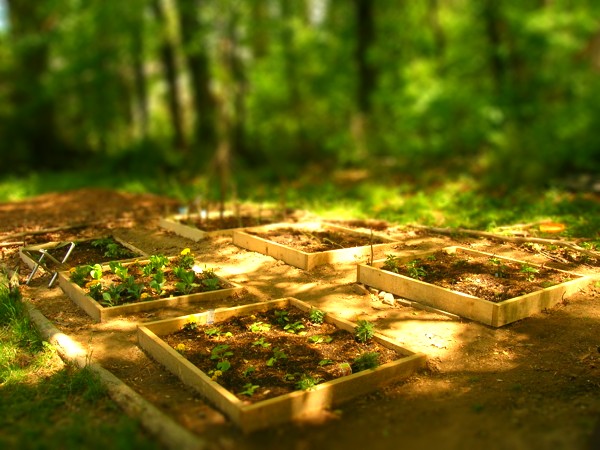
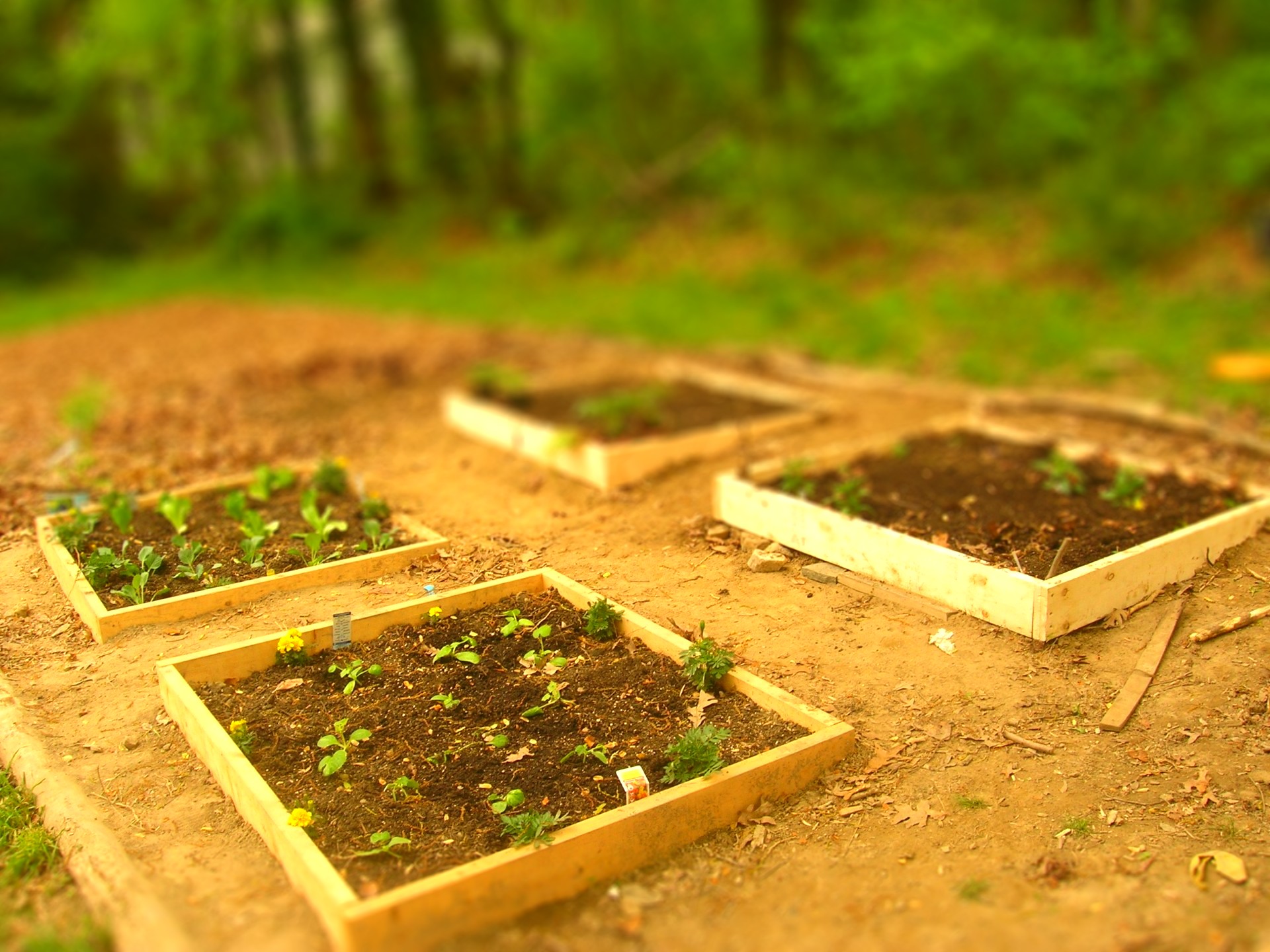
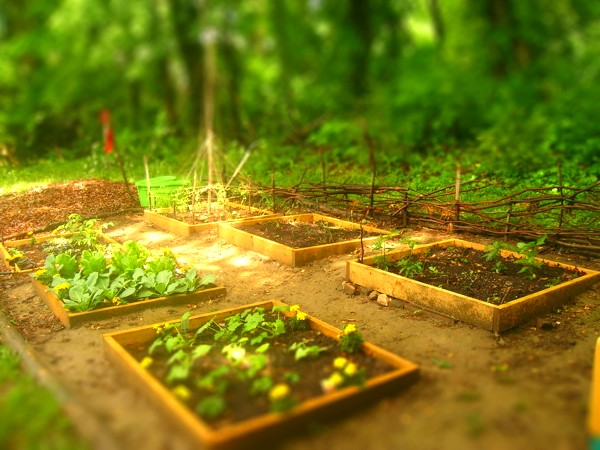
Garden project: garden beds almost complete as of early May.

All six garden beds are in and mostly full. A couple more tomato and pepper plants would be a nice addition. Plus I’m waiting for the kale and chard to mature enough to put them in the ground.

The lettuce leaves are big enough to pull a couple for a sandwich a couple of nights ago.

Only thing that’s a bit annoying is how the slugs seem to attempting to take over the southeastern corner of the garden. Two techniques to organically get rid of unwanted snails include beer and salt. First I’ll try the beer bait first. If the slugs persist, I’ll use salt.

The beer technique works like this:

  1. Fill a small container (like a baby food jar) about a third full of beer and place them in the infested areas of the garden.
  2. Place the slug bait in the garden in the morning or evening. I usually place the beer containers in the garden at dusk and check it the next morning.
  3. Empty the beer containers of the dead slugs and repeat the process.

If this doesn’t curb the invasion, the next phase of attack is salt.

Always be prepared to read your poems

When I mentioned earlier today that you should join the Traveling Bonfires tonight at Malaprop’s, you really were invited to join the reading. Two of the three poets were unable to show up for tonight’s reading. The emcee of the poetry reading and founder of the Traveling Bonfires invited anyone in the audience to read poems. He asked me to read my poems as well.

I wasn’t prepared to read; only to listen. But no one else came prepared to read. So, I frantically dug into my old messenger bag and found two poetry chapbook manuscripts by other poets. For a brief moment I thought I would read from their manuscripts, but I didn’t want to read poems that weren’t ready for the public. Sandwiched between loose papers and a copy of Selected Cantos of Ezra Pound and Narrow Road to the Interior was my red notebook containing poem sketches and revisions. I had half of a thought to read selections from Pound and Basho, but in my notebook I found six poem sketches and revisions to test in front of an audience.

The moral of the story is this: always be prepared to read your poems and if you’re a poet in the Asheville area (or if you’re a poet traveling near the Asheville area) contact me or the Traveling Bonfires (travelingbonfires@yahoo.com) and we’ll find a space and a mic and a crowd of listeners.

Poetry reading: Traveling Bonfires at Malaprop’s

Join the Traveling Bonfires tonight — Monday, May 17th — at Malaprop’s from 7 to 8pm for a poetry reading featuring poets Pam Israel, Dave Rowe and special guest. Emcee: Pasckie Pascua.

Poem: Appalachian omens

“Appalachian omens” by Matthew Mulder

Anticipation
of rain and Sunday dinner,
we see a groundhog
resting on a rock near the
restaurant entrance.

And on the way home,
above the road we see a
hawk gripping a snake
while evading two large crows.

If I were the priest
Kalchas, I might proclaim that
I see the war-like
sons of Atreus, or some
other such omens.

Google says, my bad

Google’s history of scanning books without author/publisher permission to populate their online book catalog makes me suspect there’s something askew with this story. From the WSJ:

Google had previously said it was collecting the location of Wi-Fi hot spots from its StreetView vehicles, but not the information being transmitted over those networks by users.

“It’s now clear that we have been mistakenly collecting samples of payload data from open (i.e. non-password-protected) Wi-Fi networks, even though we never used that data in any Google products,” wrote Mr. Eustace. “We are profoundly sorry for this error and are determined to learn all the lessons we can from our mistake.”

Read more: link

350,000 downloads in 17 months

As of this morning, total downloads for this year are set to eclipse total downloads of last year.

Also, the last two months of podcasts feature paid sponsors — thanks to a great sales team.

I’ll write more about what gear I use to produce a podcast in an upcoming post.

Remember when you didn’t use your real name on the Internet?

Facebook is ubiquitous. In many ways it has replaced blogging. As an individual who has been blogging, well, since before the advent of Facebook, there were certain silent codes to blogging. Local bloggers like Edgy Mama, Ashvegas and Modern Peasant (who I recall may have been blogging before the advent of the internet), maintained a thirdtier level of intimacy with blog readers. In other words, there were third-tier personal details that were disclosed on blogs, but other more intimate personal details that may or may not be disclosed in real life at local blogger meet ups. It appears that Facebook disregards a third-tier relationship between content provider and content consumer. Here’s a couple of articles I’ve read recently about Facebook.

Some excerpts from Gizmodo: Top Ten Reasons You Should Quit Facebook

10. Facebook’s Terms Of Service are completely one-sided: Facebook’s Terms Of Service state that not only do they own your data (section 2.1), but if you don’t keep it up to date and accurate (section 4.6), they can terminate your account (section 14)….

9. Facebook’s CEO has a documented history of unethical behavior: According to BusinessInsider.com, [Zuckerberg] used Facebook user data to guess email passwords and read personal email in order to discredit his rivals. These allegations, albeit unproven and somewhat dated, nonetheless raise troubling questions about the ethics of the CEO of the world’s largest social network…

8. Facebook has flat out declared war on privacy: Founder and CEO of Facebook, in defense of Facebook’s privacy changes last January: “People have really gotten comfortable not only sharing more information and different kinds, but more openly and with more people. That social norm is just something that has evolved over time.” … Essentially, this means Facebook not only wants to know everything about you, and own that data, but to make it available to everybody.

3. Facebook makes it incredibly difficult to truly delete your account

And here’s an excerpt from Wired: Facebook’s Gone Rogue; It’s Time for an Open Alternative

So in December, with the help of newly hired Beltway privacy experts, it reneged on its privacy promises and made much of your profile information public by default. That includes the city that you live in, your name, your photo, the names of your friends and the causes you’ve signed onto.

This spring Facebook took that even further. All the items you list as things you like must become public and linked to public profile pages. If you don’t want them linked and made public, then you don’t get them — though Facebook nicely hangs onto them in its database in order to let advertisers target you.

This includes your music preferences, employment information, reading preferences, schools, etc. All the things that make up your profile. They all must be public — and linked to public pages for each of those bits of info — or you don’t get them at all.

[Read More: http://www.wired.com/epicenter/2010/05/facebook-rogue/#ixzz0nY6uIYRD]

  • How will you remember anybody’s birthday?
  • How will you hear about parties?
  • You don’t care about privacy anymore. Remember when you wouldn’t use your real name on the Internet?
  • 80 million of you are addicted to Zygna’s Facebook game, FarmVille.

The Internet has allowed access to volumes of data. Yet, some personal details should be maintained behind firewalls or offline. I’m not sure if it’s entirely Facebook’s fault. Facebook users willingly surrender intimate details to the Internet gods. A good, old school blogger rule is this: the Internet is immediate and permanent; only post stuff you want to remain permanent and searchable.

the garden project: late april

April 2010

New feet within my garden go,
New fingers stir the sod;
A troubadour upon the elm
Betrays the solitude.
—Emily Dickinson, “The Garden”

Unlike the poem, the troubadour is a male cardinal and the tree is an red oak. And no, I didn’t color coordinate the bird and tree. Actual bird and tree reside on or near the location of the garden. A cardinal couple made their home east of the garden project and routinely perch on a lower limb of the red oak tree and comment on my gardening progress.

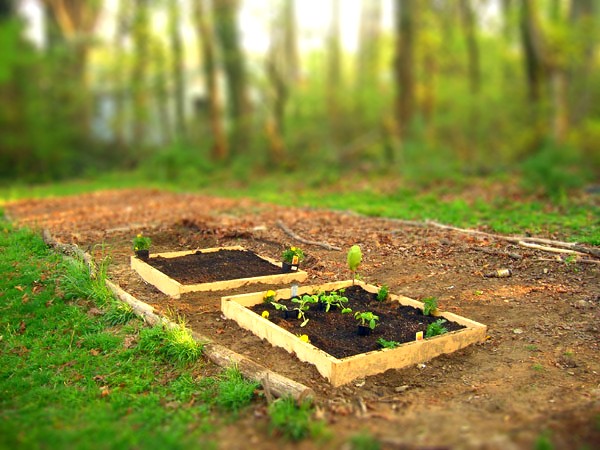
At this point, all six garden boxes are built, soil turned, topsoil added and plants planted. Plants yet to plant include chard and kale and a couple blueberry bushes. The blueberry bushes will go in the northwest corner.

The garden receives at least six to eight hours of direct sunlight each day, but not until after noon. On an early morning in late April the sunlight provides dappled shadows on the garden. By May, the surrounding trees are in full green dress and the garden remains in full shade until noon.

The garden project: diy terrace gardening

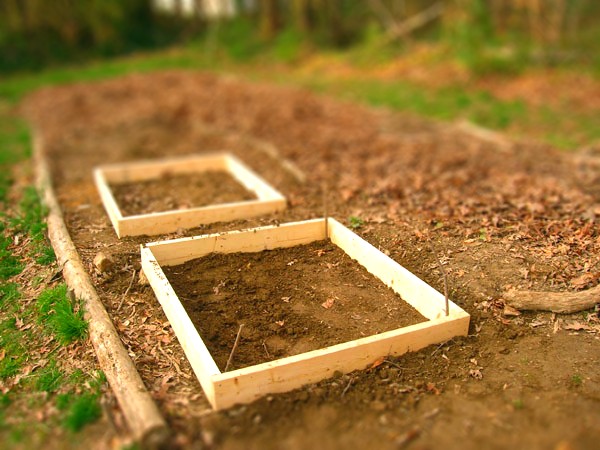
April garden 2010The garden project revealed something very obvious the other weekend; I really underestimated is the slope of the land. Two more boxes were built on the east side of the garden; otherwise known as the top of the garden. Each box is level, but east boxes are almost six inches higher than the west boxes. At this point, the only thing that’s in the ground are cucumbers, cabbage, lettuce and some assorted plants that lost their labels (I’ll know what I planted later this year from the fruit they yield).

Initially, the idea in my head was terrace gardening, but a challenge presented itself. Mainly this, more lumber is required for proper terracing of a slope. I suppose I could use stone for terracing a slope, but the transportation costs of delivering stones exceeds my budget. So, with limited resources, I maintain the raised bed/container gardens strategy, but have to build the boxes into the slope in such a way that each box varies in elevation from two inches to six inches. From the southeast corner to the northwest corner is a difference of almost a foot. And remember, the goal is six garden boxes.