Earlier this week, someone in a writers group I attend asked me where do I get the ideas I write about. My answer was a paraphrase of something Hemingway wrote to Fitzgerald. Here’s the exact quote from his letter in 1929:
“The good parts of a book may be only something a writer is lucky enough to overhear or it may be the wreck of his whole damn life–and one is as good as the other.”
–Ernest Hemingway
He also wrote something to the idea that he learned to write by examining the simplest of things.
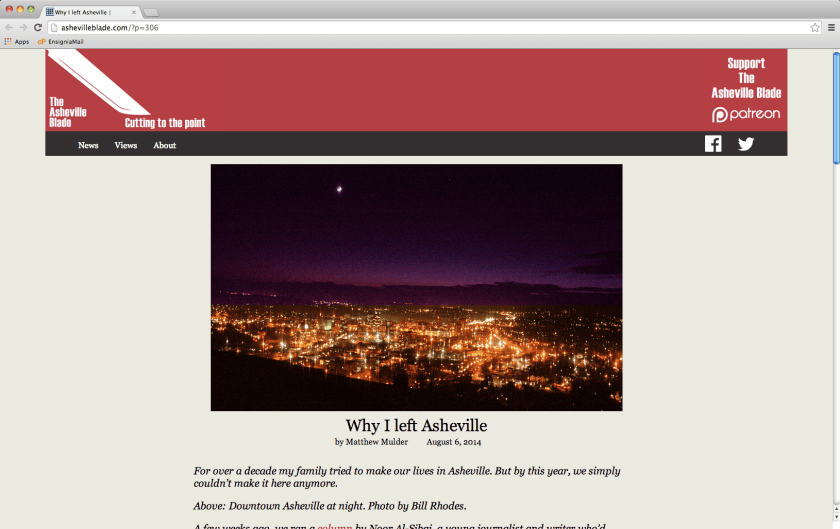
There was something else I intended to share today. But a story I wrote that was published in August is making its rounds again. [Read the full story here: Why I Left Asheville]
First, big thanks to David Forbes — editor of The Asheville Blade — for accepting and publishing the story. I had no idea that the story would resonate with so many readers. And, to be honest, I did a poor job of promoting the story here and through social media.
There are many Asheville — shall we say — expats who have similar stories. And, there are many citizens of Asheville that continue to struggle. I hope the story I shared shines a light on the forgotten men, women and families of Asheville.
Is it difficult for you, as a writer, to classify your literary work? You have spent much of your time writing it and rewriting it, but when someone asks you what it is how do you respond?
That is a challenge I am struggling through with novella-length non-fiction manuscript. One publisher seeks manuscripts that focus on spirituality, personal growth, women’s interest and religion. The manuscript I completed includes two out of the four — and loosely at that.
Should I rewrite chapters to fit the publisher’s preferences? Or find a different publisher? Or better yet, find a literary agent to help get the manuscript published so I can work on the next project?
“The process of writing . . . is . . . a journey by boat. . . . If you get distracted or allow yourself to drift, you will never make it to the destination. . . . The journey is your narrative.”
The response to that story has been overwhelming. If you have not read the story yet, please give it a read and share your thoughts in the comment section. Thanks for your support!
The weekly Racine Public Library Wordshop gathering of poets and writers is always lively and engaging. Last week there was a special presentation of Beat literature.
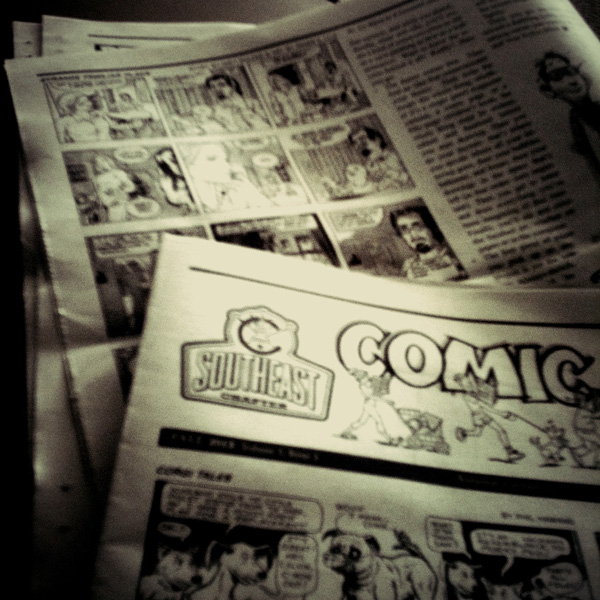
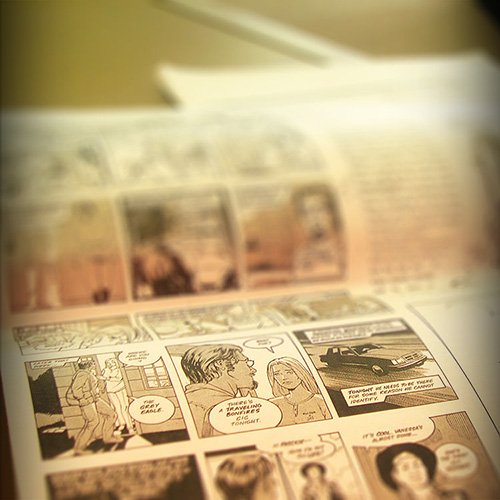
After a long sabbatical, Hudson and Heather Stillwater return to print in the comic strip “Strange Familiar Place,” a slice-of-life drama. Previously unpublished comic strips of “Strange Familiar Place” are now available in limited distribution in the fall issue of Comic Stroll, a publication of the Southeast Chapter of the National Cartoonist Society (SECNCS).
One of the SECNCS members provided me copies of Comic Stroll on Monday. Later this week, copies will be distributed at the annual SECNCS meeting as well as VA and childrens hospitals in the region.
After a very long hiatus, “Strange Familiar Place” will be back in print. Or at least it will be in a very limited capacity. More details on that later.
The creative non-fiction comic “Strange Familiar Place” first appeared in The Indie. Inspired by the works of Harvey Pekar, Jessica Abel, and Eddie Campbell, I wrote and illustrated “Strange Familiar Place.” Eventually I collaborated with illustrator and comic book artist James E. Lyle on six comic strips.
Comic Stroll, a publication of the local chapter of the National Cartoonist Society, will feature that collection of previously unpublished comic strips. Read the evolution of what started as a couple drawings and became a creative non-fiction comic:
What do you mean by audience of one? one reader replied to “Keep calm and write something.” He is referring to how I concluded a blog post: “If I have an audience of only one, that is sufficient.” So, what does that mean, an audience of one? …
[read more]
UPDATE: This blog post is available as part of an audio podcast.
Have you ever typed a message into your smartphone and the autocorrect delivers an amusing sometimes intriguing option? That’s were the title of this post comes from. I was trying to text: scrambled eggs and toast please. Don’t ask. It’s been a long weekend, but I wanted to provide an update to a February post [1] where I detailed the number of poems submitted to publication and how many have been accepted. And the grand total is: none. I haven’t heard from all the publishers yet, but so far it has been rejection letters and emails. [2]
And now, scrambled eggs and poets.
It is a rare evening these days when I am able to attend a literary reading in my adopted hometown. The Juniper Bends Reading Series for May [3] featured Mandy Gardner, Collin Garrity, Rose McLarney and Jerry Stubblefield. I arrived late, but enjoyed a truly amazing reading. The highlight, for me, was Rose McLarney’s reading. It had been almost seven years since I first heard Rose McLarney read her poems at the Black Mountain College Museum + Arts Center. And since then, her acclaimed collection of poems was published by Four Way Books. [4]
After the reading concluded, and this is where things get a bit scrambled, I waited with others to chat with the poets and writers. The longer I waited the more I wanted to ask her about the publishing process. How did she manage to get her collection published? What tips would she recommend? You know, all those predictable, pithy questions unpublished poets ask published poets.
And then, like Billy Pilgrim, [5] I sort of time travelled. No longer standing inside the crowded Downtown Books & News, [6] it was night and I was walking up Eagle Street toward Pack Square Park with a poet how was asking me, “How do I get my poems published? What tips do recommend?” With my experience in publishing, I began telling her any information that I thought might help. And then, as we were parting ways, I was telling her not to sweat it, “When the poems are ready, the audience will be there.”
And then, I time traveled back to May 2013, it was night again. I walked to my auto as a SUV full of kids drove by with the windows down. Their ruckus noise spilt onto the street. They slowed and someone threw hot pennies at me. They sped away. Why do kids heat pennies with cigarette lighters and throw them at complete strangers? I entered my car and drove home saying, “When the poems are ready, the audience will be there.”
More scrambled eggs and poets.
Scrambled yet? Don’t worry. It’s Monday. You have the whole week ahead of you.
Let’s do some more time traveling. Last year, I provided some teasers for an upcoming book. [7] The manuscript is nearly novel length and I’ve sought out a couple editors to assist me. Truly, this is not a story I wanted to write, but it has found me and apparently an audience.
NOTES:
[1] So far, I’ve submitted almost 70 poems for publication. You can read the details in the post: 50 poems in 30 days
[2] Why do poets write, if not to be published? These thought have occupied my thoughts since last week’s post.
[3] Juniper Bends Reading Series
[4] Four Way Books
[5] Everyone knows who who that is, right? And if you have to google it, just know that it is not the American folk musicians from Atlanta.
[6] Downtown Books and News
[7] You may read the teasers here
“If you don’t know where you’re going any road will get you there.”[1]Is it writer’s block? Procrastination? What’s keeping you from completing that collection of poetry or that novel you started years ago and you can’t quite get around to finishing it?
A few years ago I sat in a writing workshop and noticed that I was the only member of the group under the age of 50 years old. Further, most of the students at the workshop had been working on a memoir or a novel or something that began at a university. Now enjoying their retirement, the nostalgic desire to complete these literary works grip those writers who had been dribbling out small passages of poetry and prose for what seems to be my lifetime.
I determined at that time to set writing goals and not let time slowly bleed me of creative efforts. So, I adapted some of the productivity and time management skills I use at work to my writing life. Here’s some productivity, or time management, habits I practice at the office.
1. Don’t check email first thing in the morning.
At the office, I schedule two times a day were I read and reply to emails: once in the morning and then again in the afternoon. If I reply to every email that lands in my inbox at the moment it arrives, I would spend more than half the work day reading and replying to emails. I found that if I batch tasks, like emailing, I can maintain focus on accomplishing those tasks more efficiently.
2. Make a list.
First thing I do when I get to the office is make a list. This is a combination of project management and mind-sweeping. This activity allows me to organize and prioritize large and small tasks for the day and week.
3. Declutter the desktop.
This is something that is both on- and offline. And by “declutter” I don’t mean empty your desktop of everything. Declutter has to do with a collection system. How do you collect the papers or files? Years ago I began the practice of collecting items in folders based on the 43 folders system. Here’s how it is presented by Merlin Mann:
identify all the stuff in your life that isn’t in the right place (close all open loops)
get rid of the stuff that isn’t yours or you don’t need right now
create a right place that you trust and that supports your working style and values
put your stuff in the right place, consistently
do your stuff in a way that honors your time, your energy, and the context of any given moment
iterate and refactor mercilessly[2]
Again, the goal of this practice is not to have a clean, empty desktop, but a productivity system in place to help get things done.
4. Plan. Revisit the plan. Stay on task.
Your co-workers and supervisors think every task is an emergency and everything is a priority. Planning and staying on task is one of the most annoying practices my co-workers and supervisors must endure. Yet, unless I identify the goals and chart a trajectory to hit those goals, I’ll never me able to meet deadlines on time or successfully accomplish projects. How does the old adage go? If you don’t know where you’re going, any road will get you there.
Let’s do this!
Avoid waiting until you retire to complete that novel you’ve been working on, or that collection of poems you’ve been tinkering with for years. Find a writers group that can help you with accountability and encouragement. It is written that no one knows the number of his or her days. Our life is a shadow.[3] Whether it is writer’s block, procrastination, internal or external distraction, find that writing project you’ve been working on and commit to finishing it.
Earlier today I notice that Poetryblogs.org features my blog (I guess this means I should update the blog more often). Thanks for visiting Coffeehouse Junkie’s Blog and hope you return and share what you like. If you’re a new reader of Coffeehouse Junkie’s Blog check out the 10 most recent blog posts listed in the right column, the most liked posts in the left column and search through the subject list in the lower right column for content that I’ve contributed since 2004. You may also sign up for email subscription to this blog so that every time I post something new, you receive an email.
Dear friends and loyal followers of Coffeehouse Junkie’s Blog, I do intend to write more posts. Presently, I am buried in work as creative director for an international publishing company. Until I finish designing other writers’s book covers, blogging will be limited. Enjoy browsing some of the recent book designs here, here, here and here.
There are secrets between singer songwriters and poets. We share them in dark corners of pubs or cafés. We talk about live performances and audiences and the craft of writing. A singer songwriter confesses that “at least a guitar is between me and the audience, but poets are left completely vulnerable on stage.” Yes, indeed. Naked before audiences that, in general, don’t care about poetry or don’t know anything about it. We wonder why singer songwriters embrace lyricism while academic poets skitter away from deep lyrics and the hint of rhyme. We will bury our secrets deep into the lyrics of a song or poem–so deep that it requires of map to locate ars poetica.
What do you think about when you see a stack of books? In this short collection of stories you will also learn what a creative director thinks of when he sees a stack of books. Who is the audience for your poems? Is possible to write in your sleep, or not?
While I wait for editors to reply to my narrative non-fiction submissions, I grow impatient and want to post these writings on this blog. Some teasers like Shuffling through the ruins of a summer and Ma Rainey, don’t sing them blues no more were released. One astute reader provoked this post: Yes, it is true. But on the advice of published writers, I can’t post much more without jeopardizing publication. So, I wait. Keep writing. And reading. This weekend one blogger reminded me of OctPoWriMo–31 poems/31 days. This seems to me like a good exercise to do while I wait on editors.
In this scene, the main character stands on a busy sidewalk beside a slender tree. He looks down at the scattered ruins of a summer of expectations. “How should I have prepared for this?” he asks himself. “What do I do now?” He feels relief and that surprises him. This is a new beginning. A fresh start. Unlimited opportunities. However, this is also the first time in his adult life he is unemployed. And without an automobile. Adjusting the strap of his laptop attache, he walks up Lexington Avenue to catch a bus. The feeling of relief is quickly replaced with a deep, consuming despair. In this scene, the crowds of tourists walking down College Street talk loudly and trample the gathering leaves under their shoes as the main character weaves his way toward Pritchard Park. He doesn’t hear them, only hears the sound of his own boots on the sidewalk and wonders where will he be a year from now.
There’s a story behind this image that wants to be told. It’s a reminder that seasons and people transition. Loyalty tested against the panes of transparency. Everything goes sideways when turning the corner and down the street of uncertainty, when faith and doubt pressed up against a steamy autumn window and all they see is loss. It’s a story still worrying the line. Still blue enough, blue enough, still bluer than Ma Rainey singing “Bo Weevil Blues.” It’s a story where the clarinet sweeps back and forth, sweeps low and easy, sweeps in a song looking for a place to stay, sweeps in a song saying “don’t sing them blues no more…” Don’t tell me ’bout the job you lost. Don’t tell me ’bout your broken down car. Ma Rainey, Ma Rainey, “don’t sing them blues no more…”
A very observant reader and friend asked of this week’s post: “Is this story related to the teases from other photos?” Yes, they are all teasers for scenes from a narrative non-fiction book I’m writing. Some of the chapters have either been sent or are in the process of being sent to journals and magazines for publication. I am waiting on editors at this phase in the process.

 There was something else I intended to share today. But a story I wrote that was published in August is making its rounds again. [Read the full story here: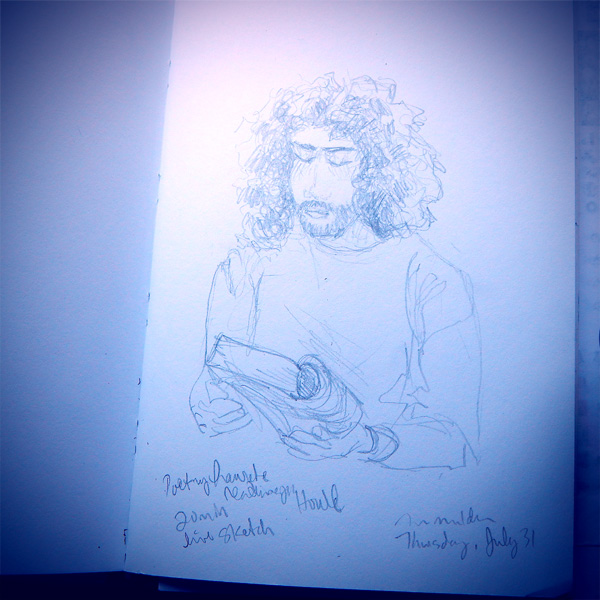

![...any road wil get you there.[1]](https://coffeehousejunkie.net/wp-content/uploads/2013/05/tumblr_mlgvegmtir1qz6f9yo1_500.png)



 Coffeehouse Junkie