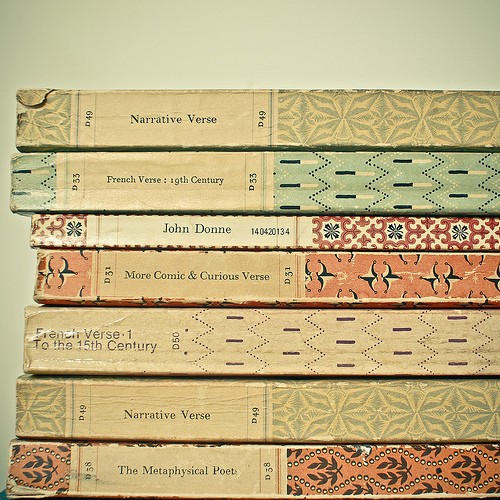
A house without books…

Ein Haus ohne Bücher ist arm, auch wenn schöne Teppiche seinen Boden und kostbare Tapeten und Bilder die Wände bedecken.

(A house without books is poor, even if beautiful carpets cover its floor and expensive wallpapers cover the walls.)

Hermann Hesse (via germanheit)

“High times in publishing!”

There was a brief, shiny moment sometime in the early 90s when Barnes & Nobles and Borders were opening on every corner, and at the same time the bubbling dot-coms were luring editorial talent away from print and into digital publishing. Those two factors converged to make life as a Publisher or Acquisitions editor pretty lush for a few years — salaries in the industry went up by over 30% and the enormous competition to sign talent to fill the shelves of all those miles of shelves in those new stores (and that mysterious new thing called Amazon.com too) made way for expense accounts and advance budgets that were unprecedented. That crazy growth, however, was totally unsustainable. Once the dot-com bubble burst, and new stores were no longer coming online, we were left with no new growth, a significant erosion of independent bookstores, consumer trained to expect cheap prices on books, and a overabundance of new “B-level” titles.

High times in publishing! « ConfessionsOfAnITGirl.com (via fluffynotes)
“A bookstore’s experiment with microdistribution”

The “Recommended” section at the Boulder Book Store, an independent bookseller in Colorado, features a mix of titles and genres. And also: a mix of distribution models. Among the traditionally published works on display stand a smattering of print-on-demand titles — many of them being sold on consignment by authors from the Boulder area.

A bookstore’s experiment with microdistribution

Editors and publishers as midwives

Publishers typically sign on new projects, do some big-picture editing, then pass the project to the editor, who does the more painstaking work of carrying the project from its detailed editing and design stages to production. The life of an editor and publisher involves more reading than you can fit into a day at the office. We have to keep up with the publishing world, know what people want to buy, work closely and diplomatically with authors, and lug around heavy satchels of manuscripts. People often liken editors and publishers to midwives. The industry is dominated by women who aren’t paid all that well, but who are working in this helping, nurturing role, counselling authors and helping bring their “baby” into the world.

The scoop on working in publishing (via fluffynotes)

Mickey’s First Day: an indie comic

A comic book about a hair salon called Tease and a cosmetologist named Mickey may not be the first floppy you look for when you shop at your local comic book dealer. Then again, I’m not your typical comic book reader. Last week I picked up an Asheville indie comic from Deaver Park Press at Comic Envy. Tiziana Severse and Brent Baldwin team up to self-publish Mickey’s First Day (I was able to secure #69 of 75 limited edition copies). As far as slice-of-life drama comic books, it’s off to a good start.

A few years ago I read an excellent black and white graphic novel titled House of Java (now collected in two trades). The artwork wasn’t particularly top notch, but the stories were engaging and the characters were always interesting. Maybe that’s the appeal of indie comics: great writing and engaging stories. I don’t expect Barry Windsor Smith artwork from indie comics. I expect a raw art form found in Mickey’s First Day and House of Java. Another indie comic book I eagerly collected as floppies was The Waiting Place (now beautifully collected in one volume). Again, the artwork is good, but the storytelling is great. I hope to see more good material from the team of Deaver Park Press.

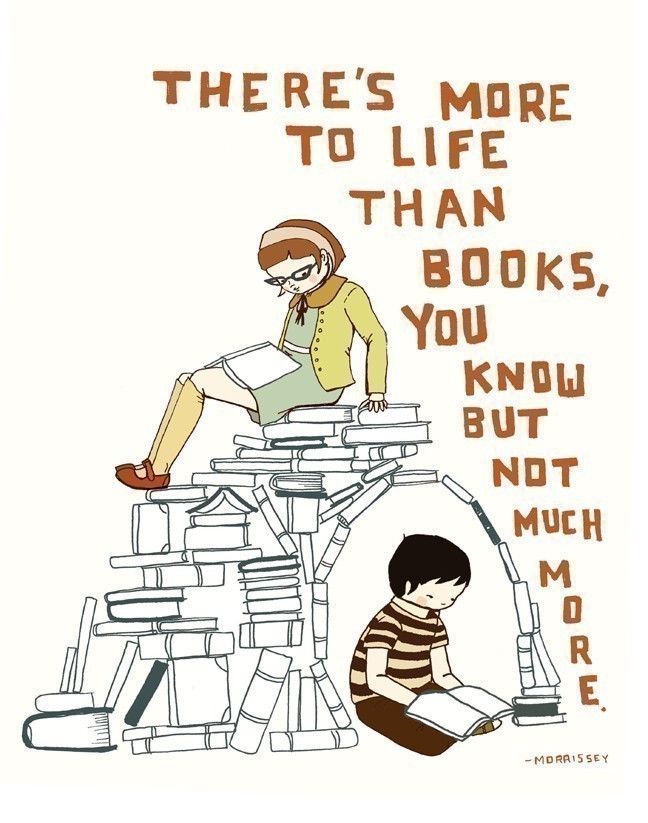
There’s more to life than books.

What are the top ten books you believe designers should read?

Earlier this week we did a post on a printed piece created by British design firm Spin that details the top 10 books from 50 major figures in graphic design.We sorted through the 500 listed books and found that there were 14 books that appeared in almost every list.

Here’s the list in no particular order:
01. A Designer’s Art Paul Rand
02. Typographie Emil Ruder
03. Mode en Module Wim Crouwel
04. A History of Graphic Design Phillip Meggs
05. Jan Tschichold: Typographer Ruari McLean
06. Design as Art Bruno Mari
07. 8vo: On the Outside Mark Holt
08. Tibor Kalman: Perverse Optimist Peter Hall
09. Weingart: My Way to Typography Wolfgang Weingart
10. Designed Peter Saville
11. How to be a graphic designer with…Adrian Shaughnessy
12. The Tipping Point Malcolm Gladwell
13. Modern Typography: An Essay in Critical… Robin Kinross
14. Envisioning Information Edward Tufte

liz:1 plaidinc:2

NOTES:
1) Liz, “Follow up: Spin asks: What are the top ten books you believe designers should read?” accessed January 27, 2010, https://liz.tumblr.com/post/352754770/follow-up-spin-asks-what-are-the-top-ten-books
2) Plaid-Creative, accessed January 27, 2010, http://blog.plaid-creative.com/post/346685665/follow-up-spin-asks-what-are-the-top-ten-books-you (page no longer available, Tumblr account deactivated)

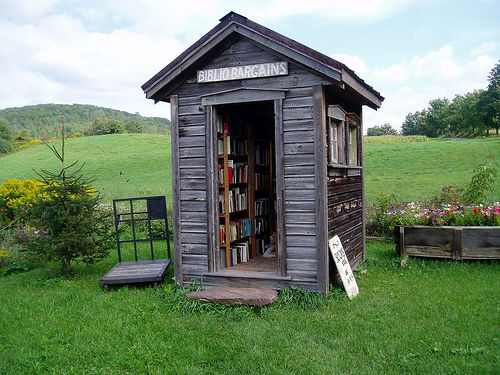
how can i get one of these for my backyard?

creativeinspiration: adorablelife: bookspaperscissors: The Bibliobarn’s Bibliobargains! (via yeksitra)

Good books are truer than reality

All good books are alike in that they are truer than if they had really happened and after you are finished reading one you will feel all that happened to you and afterwards it all belongs to you; the good and the bad, the ecstasy, the remorse and the sorrow, the people and the places and how the weather was. If you can get so that you can give that to people, then you are a writer.

Ernest Hemingway, Esquire, December 1934 (via 52books)

the creative class

… the people of the creative class are fairly certain they are destined to be creative, but can never be certain about just how creative they are. So they must seek outward signs of their blessed inner superiority, must seek or contrive recognition for their creativity whenever possible. This is that class’s essential self-consciousness, and when it is acute, it becomes hipsterism.

“Creative writing and crippling self-consciousness,” Marginal Utility (via somethingchanged)

I miss reading

Source: whatannaloves

NOTE:
“i miss reading,” whatannaloves.tumblr.com, accessed November 4, 2009, https://whatannaloves.tumblr.com/post/220026161/i-miss-reading (page no longer available, web site deactivated)

When everyone is a book critic, no one i

this reminds me that i need to finish writing my book reviews for spr…

What I always say to creative writing students when I talk about book reviewing is that they’re entering a landscape vastly different from the one I entered, and I only entered a few years ago.  Obviously, the Internet has rapidly and irrevocably changed the way  books—and anything—are talked about.  We now live in an age where some large segment of “professional” book criticism takes place in a medium somewhere between the customer comment and the fancy print book review.  Literally, everyone’s a critic, if they want to be and can type. (via)

An argument for self-publishing your poetry manuscript

if you had $2000 to spend on publishing your poetry manuscript, why give that money to 76 publishers?

from the book of kells:

So in total, 76 presses had the opportunity to consider it over 5 years (plus 9 that ALMOST got to consider it…) Don’t do the math on how much it cost me in postage, paper, and contest fees (I’m estimating about $30 a shot) or you’ll end up with about $400 a year on submissions (I’d guess about $2000 total). This makes me a little ill as that’s a lot of money. Thankfully, it was over 5 years, so my family still ate well and was fully clothed while I tried my best to be published. (via)

this is a really good argument for self-publishing your own poetry manuscript… imho… i’m just saying, if i had $2000 to spend on my own book, i’d hire a professional editor, art director, & spend the rest on printing, ad/marketing & distribution.

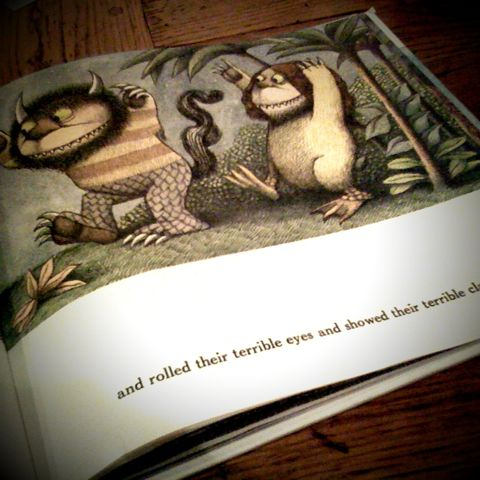
Let the wild rumpus start!

(via 52books)

when i realized the kidlinger’s library didn’t have this book… i went out & bought it… right after dinner at frank’s pizza…

Field notes

// anyone out there familiar with terry tempest williams’s book an unspoken hunger? if yes, i have a question for you.

Field notes

// just received a package of books & magazines from an editor. what a wonderful weekend gift-an assignment to read (& write reviews) & read

Jack Kerouac reads from “On The Road”

Field notes

// returned books to the library. ran an errand. back in time for supper. back to gardening… before it starts to rain…

It is a good rule after reading a new book, never to allow yourself another new one till you have read an old one in between.

C.S. Lewis

Book blogs are the enemy of reading

Book blogs are the enemy of reading. I discovered several such fascinating blogs this year and spent hours enamored of reading, listing the books I wanted to read, and reading others’ lists. Imagine my surprise when I realized that I had frittered away precious reading time staring at a computer screen. Apparently I was getting all the warm, fuzzy, readerly feelings without the commitment of turning pages. Sad. (via brilynne)1

NOTES:
1) brilynne, “Reading 2008,” December 31, 2008, briary.blogspot.com, accessed January 1, 2009, https://briary.blogspot.com/2008/12/reading-2008.html

Print is dead, long live print

From Print is Dead blog:

…even though I wrote a book called Print is Dead, even I don’t think that publishing is over. Rather, it just needs to change and be willing to embrace new ideas and business models.
Link

Can intelligent literature survive in the digital age?

A transatlantic debate is currently raging about whether a decade of staring at computer screens, sending emails and text messages, and having our research needs serviced instantly by Google and Wikipedia, has taken a terrible toll on our attention, until our brains have been reconfigurated and can no longer adjust the tempo of our mental word-processing to let us read a book all the way through.

NOTES:
1) Andrew Cowan, “Books special: Can intelligent literature survive in the digital age?,” The Independent, accessed September 18, 2008, https://www.the-independent.com/arts-entertainment/books/features/books-special-can-intelligent-literature-survive-in-the-digital-age-926545.html

A stack of books arrived


The magazine editor asked me to write reviews. Can’t wait to start reading… and then writing.

Can a computer write books?

From Jeff Gomez, author of Print Is Dead: Books in our Digital Age:

Philip Parker, a science professor who has “written” more than 200,000 books…. But Parker doesn’t really write the books; instead he has invented a series of “computer algorithms that collect publicly available information on a subject… and… turns the results into books in a range of genres….”

…just because the rats in Ratatouille are computer generated, the idea and the story and the dialogue weren’t computer generated. Computers are increasingly helping us be more creative but, in the end, that’s all they’re doing: helping.

Link

There’s already services available that convert blog content to book format. Like Gomez stated, it still requires the human touch to generate the content. Technology made it easier to collect the information into an enjoyable package.