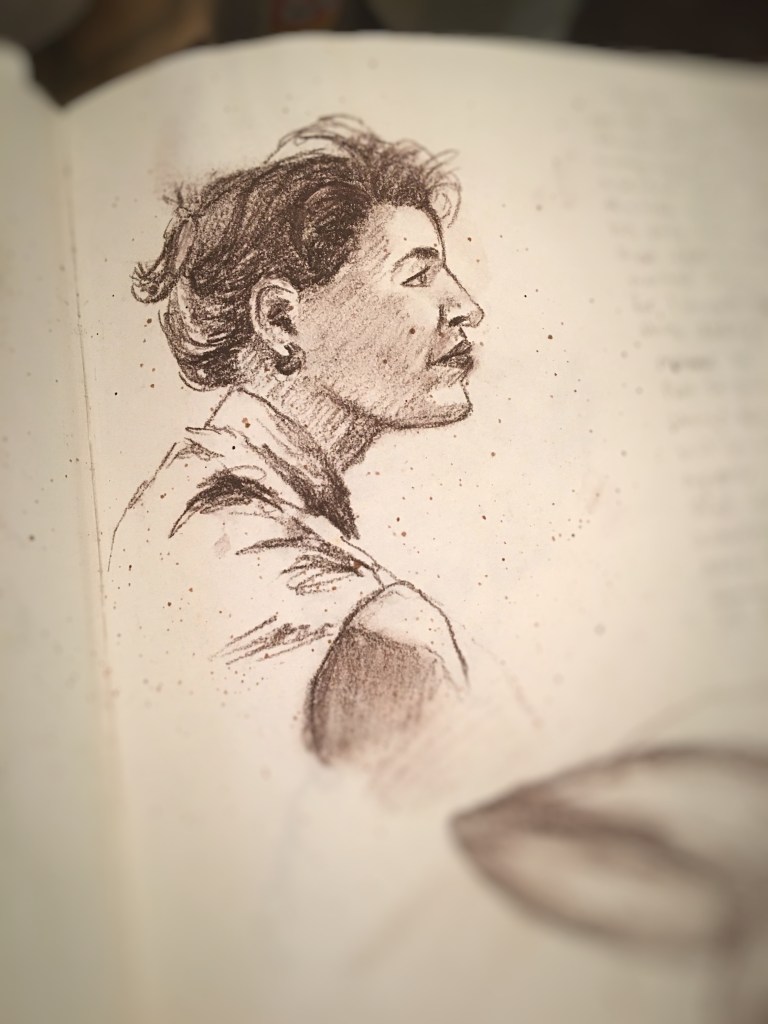
Previously mentioned, the above image is an old sketch of the Luther Terry painting.
On weekends, I visited an art museum when I was younger. With pen and black cloth sketchbook, I recorded the painting in to my sketchbook. Practiced drawing. Researched an allegory.
But capitalism is a poor cultivator of the arts. For the price of an item of beauty and value, some would pay the same price for a 728 pixel wide by 60 pixel high web banner. A digital item that pastes at the top of a web page or email for a week or two and then disappears.
The lesson I quickly learned is that beauty is not useful. Art and design that is practical and commercial are valued in America. Sacrifice the permanent on the alter of immediate. This utilitarian principle fuels professional success. Or at least provides employment.
This drawing in my sketchbook reminds me that I once believed that beauty is lasting. And, I still do.
“Yeah. I was cleaning up some stuff in the garage and wanted to see of the easel was in working order.”
“Is it?”
“Sort of. . . the base wobbles. . . but that can be repaired with a wooden shim.”
“And you have a canvas on the easel.”
“Yes. . . well. . . wanted so see if the canvas was secure on the front lower horizontal bar. The top bar works. But I may need to replace the wing nut on the lower bar.
“Looks like you started painting.”
“No. Not really. Gessoed over an old painting. . . Several years ago.”
“What was wrong with the old painting?”
“It was a sketch. . .”
“Well, looks like supper is almost ready.”
“Yeah. . . you hungry?”
Later. After supper.
In the garage, old sketch books revealed ideas for paintings. Sharpie marker drawings. Charcoal sketches. Conte crayon drawings. Graphite sketches.
The sketch of a female profile. To be used in a composition inspired by a Luther Terry painting. An allegory. But who should model for the composition’s three figures? Many sketches. Poses. Lighting. All collected in thick hardcover black sketch books. One sketch earns a few minutes of consideration. Maybe. . .
A sigh. A glance outside the garage. Shadows lengthened to darkness. Sun has set.
The genre of blog writing is nearly obsolete. As far as I can tell. This is based on a conversation I had a couple months ago.
“You’re son told me you have a blog,” she said.
“Huh?” I replied.
My family was invited to a small, casual dinner party.
“Yeah, he also said you’re an artist and poet,” she said. “I used to have a blog. I mean. That was years ago. I’m not really a writer, but I blogged.”
She continued to tell me what she blogged about and where. We were both active around the same time period (by active I mean posting writings nearly daily). That was before the rise of the major social media platforms. I shared that part of what I enjoyed about the genre was the interaction with people. The exchange of ideas. The sense of being part of a greater community.
“I mostly just write on Facebook now,” she confessed. “Remember, back when, you could only leave a comment on a blog post?”
“That’s right,” I recalled out loud. “There were no like buttons or social media share icons.”
After that dinner party, I updated the art page of my blog. And planned to contribute more time and resources to blogging again.
2.
I composed a post about the value of journaling with plan to publish it the first week of March. But it ended up in the draft folder.
Mid-March I wrote another post. This one was about discovering a collection of my old art work. But it too is in the draft folder. Well. Actually. I eventually posted it near the end of April.
But the genre of blog writing is passé. Outdated. Why do I still do this?
Then I remembered rule number eight: “Every word on your blog is a word not in your book.”
3.
Shifting focus, I started work on a book. Or rather a series of books. Inspired by August Derleth’s Sac Prairie books, like Walden West and Countryman’s Journey. I set to work on the first manuscript.
Derleth presented a non-linear collection vignettes and entries about his home town. I moved in the direction of a daybook, or journal. Instead of spending a year at Walden Pond, or Sac Prairie, I collected entries and stories of a year in the life of a cultural creative edging toward a digital nomad.
Thoreau and Derleth drew from nature, whether from a pond or prairie. I discovered the ubiquitous screen became the prominent pool of inspiration for the first manuscript. One book manuscript became two and three. The metaphor of the glowing computer laptop screen began to crack and shatter by the fourth book manuscript.
The book series is part confession and part cautionary tale.
4.
I deleted the blog. The only thing that remains of that original blog is the screen shot featured in this post.
In truth, I deleted all blogs I maintained. Except this one.
After supper, kidlingers helped with laundry. And kitchen dishes. Provided a few minutes for me to organize and store some of my art work.
Some ink on paper drawings fell to the floor. Collected at the back of an art portfolio presentation book, they escaped when I opened it. Not sure why they were loose. Too small? Or, I was in a hurry and stuffed them there years ago. Now scattered on the floor, I considered their future.
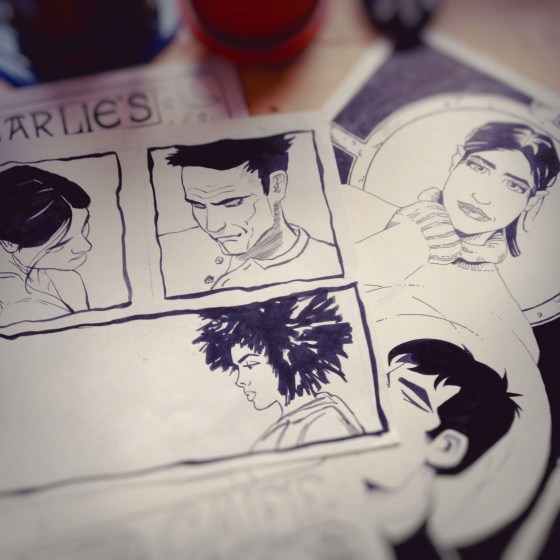
I picked up a mocked up advertisement for Charlie’s Golden Beetle Café. It was part art deco and part art nouveau. And had a dash of Alphonse Mucha-inspired design with a Patrick Nagel homage. Inked with crow quill and brush, the shellac of the pigment still shined. I placed it on my desk and picked up another page. A character model sheet for a comic book proposal displayed across several pages. Half pages and scrap illustration board. Some in black ink. Some had splashes of red to highlight an aspect of the character’s costume. I gathered up a couple pages of ink brush sketches. Practice sheets. Or illustration exercises.
What to do with this stuff?
Someone called from the other room. It sounded urgent. And yet not desperate. But still. Family duties called.
I picked up the presentation book. It collected a comic book art pages I drew many years ago. A sixteen-page indie comic book story and two other short comic stories. There were no empty clear pockets to place the loose art.
I grabbed the ink drawing pages from the desk and began placing them. The presentation book featured 24 clear pockets. Each pocket sandwiched two comic book art pages and a black paper divider. I slide one of the ink drawings between the black paper divider and a finished comic art page. I continued hiding drawings in that manner until all the desk was clean.
And someone called again.
I closed the presentation book. And placed it in The New Yorker magazine tote bag along with another art portfolio. I paused. Looked at the pencils, pens, and brushes on the desk. Then answered the call.
Ever have one of those moments when you realize you are not what you claimed or thought you were? Where an illusion of yourself, either self-imagined or externally imposed, dissipates.
Well, an interesting thing happened to me on the way to the Intermodal Station. While I had thirty minutes to spend, I lost my way through the labyrinthian shelves of Downtown Books in search of a Latin dictionary. Instead, I found a used English dictionary.
Knowing that half of the English language is built on the foundation of Latin, I found a delicious word: florilegium. Culling flowers is the literal definition. But “a volume of writings” reminded me of something else. The idea of gathering literary flowers or collecting the flowers of one’s reading. Somewhere between the Middle Ages and Renaissance the practice of writing quotes and excerpts from other texts began. Later it manifested itself in European culture as…
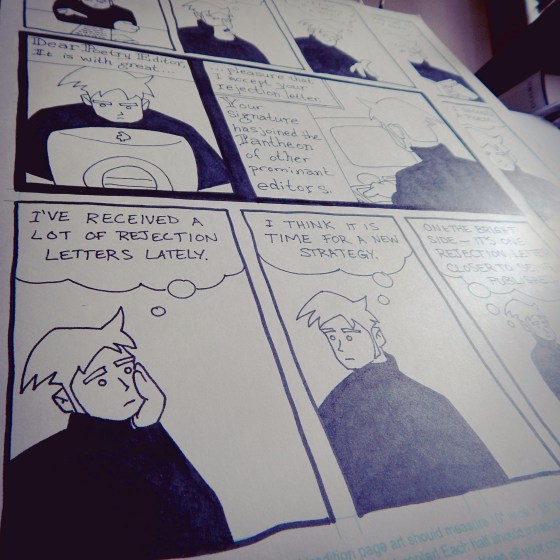
From the archives. This goes back quite a few years. Before social media. And iPhones. How did I manage to create a regular comic strip with a full-time day job?
In truth it took a few years. Little by little. The style developed from pen and brush inking techniques — more realistic illustrations — to Sharpie® marker and Sakura Micron pen illustrations — more graphic and cartoonish. The intent was to streamline the process and art style in order to work quicker. However, the reality is that the graphic, cartoonish style takes just as much time as pen and brush. Just in different applications.
The character remains unnamed — loosely referred to as a young artist. Dressed with black turtleneck and unkept hair. The comic strip ran for maybe a year before the newspaper ended publication. A lot of newspapers and magazines shuddered that year.
I return to the “young artist.” To practice art work. A creative workout. Similar to physical fitness routines. An effort to keep the motor skills of drawing and illustration in shape.
Recent practice comic strips created remain unpublished. Private exercises. Not published in an independent newspaper. Not for public show on Instagram. Or Facebook. I do not have accounts on those social media platforms.
I may share them here. This has become a digital repository of material I find in old art portfolios and sketch books.
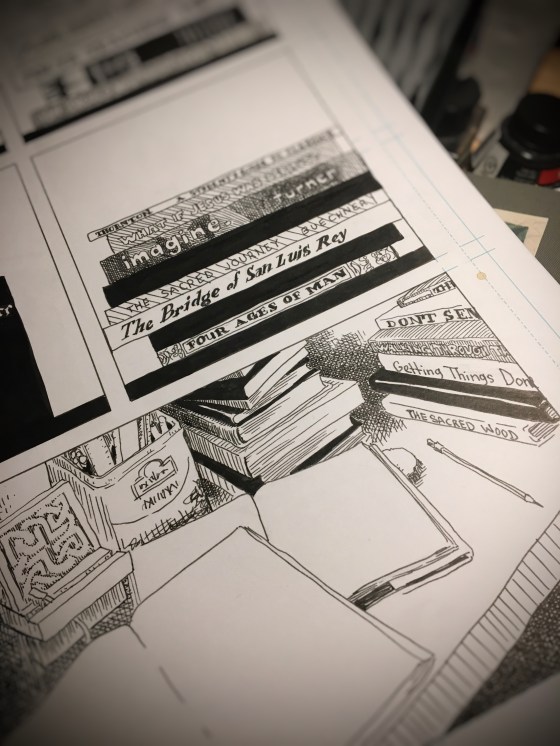
A drawing of my desk with books read, unread, or partially read.
It is a challenge for me. When I am introduced as an artist and/or poet. Still not comfortable with either of those nouns. The next question is inevitable. It usually goes something like this:
My wife turns and introduces me to her friend and adds, “He’s also an artist and poet, too.”
“Wow, can I see your art work on Facebook?”
“No. I am not on Facebook.”
“Oh. Instagram?”
“No. Not on Instagram, either.”
“Well. Um. What do you do? Oil paintings? Do you have a gallery somewhere?”
“He posts some of his work on his blog,” my wife offers.
About that time the bread crumb trail ends and the conversation shifts to something else.
The trouble is that some of the work I create I cannot contractually share. Technically, I do not own the copyrights to the final art. And so, I cannot distribute or display it on this or other online platforms. Frustrating. Yes. Bad. No. It is the cost of commercial arts.
For example, a couple weeks ago I drew a portrait. A line art drawing. The portrait will be featured as an etching in either crystal or acrylic as part of a lifetime award. Sometime in March. You may have seen such awards in business offices. A crystal award on black base sitting on someone’s desk or shelf or trophy case.
I am reminded of one of Milton Glaser’s mottos: “Art is work.”
Milton Glaser, celebrated graphic designer, may not be a household name. Not even in my home. But most Americans will recognize the I [heart] NY logo. It is highly unlikely that school children will study designers as part of their art curriculum. (My children are presently studying the American painter Andrew Wyeth.)
Too often I lament, or rather, complain that I spend too much time creating work in front of a screen. It was so nice to ditch the screen and work in ink on vellum and illustration paper. Took nearly four hours to draw the portrait. And that is with the interruptions of replying to emails and designing elements for a multi-page editorial piece. It would take four weeks if I tried to craft the portrait as an oil painting.
In order to answer a request (Where may I find your art work?), I drew the above page last weekend. Inspired by Jane Mount’s Ideal Bookshelf, I managed to draw the stacks of books on my desk by the bedroom window. At least fifty books. So many books. So little time. I enjoyed the exercise. It felt good to pencil a sketch, flesh out the details, and ink the page.
“Wait. You write poetry, too?”
“Um…” I start.
“Have you been published?”
“Yes,” I say.
And this time the bread crumb trail ends quickly. Because most people do not know where to begin to look for published poetry.
“He posts some of his published poems on his blog,” my wife adds.
Three years ago I rediscovered these 11 inch by 17 inch pages. Illustrated comic book pages hidden in a storage container. A gray Rubbermaid® Roughneck® storage tote of the 18 gallon variety. I stored art supplies, books, family keepsakes, manuscripts, and tools in dozens of similar totes. Living in a humid subtropic climate at the time, I did this to avoid water damage and mold ruining art and other supplies. Additionally, heavy duty polypropylene bags also prevent mold and water damage. To offer an added level of protection I used the technique of poly bagging art pages and then placing them within totes. When I moved across the country this also acted as a good way to pack.
However, that was not the case with these pages of art I discovered three years ago. Like an archeologist, I excavated those pages from a gray Rubbermaid® tote. They were loose in the tote. Not poly bagged. Print samples of graphic design projects filled the tote as well. And also old newspapers and magazines. Either these publications featured something I wrote or something I designed.
In an effort to preserve the illustrated comic book pages, I found an old presentation book used for interviews. The Itoya Original Art Portfolio presentation books work the best. Good for professional presentation and storage.
During the holiday season I found one of the portfolio books with those illustrated comic book pages. Examined them again. This time one of the kidlingers was spying over my shoulder.
“These are really good,” the kidlinger said. “Better than I can draw.”
“These are practice pages.” I said. Paused to let the kidlinger read the panels on the page. For a brief moment a wave of vulnerability washed over me. A child-like anxiety of examinations. The kind of fear I had when a school teacher reviewed my arithmetic work during class. Found an error and announced it so that all the class might hear. Why had I felt that way about my child reading this page? There were no objectionable elements to the story. Nor art. Nothing inappropriate for the kidlinger’s age. The moment passed.
“What language is this?” Kidlinger pointed at one of the panels on the page.
“German.” I answered. “Deutsche.”
The kidlinger hesitated. I considered translating the passage: Im Schatten sah ich. . .
“Lines from a German poem,” I said. “I added it to the story to help me remember the poem.”
Or to add texture to the short slice-of-life comic book story I composed. Sequential art as some have called it. A clever way of renaming comic book art.
I did not purchase my own comic book until I was in high school. An art teacher suggested that it may be a good way to study human anatomy. And it was. Exaggerated, dynamic anatomy. Superhero comic books were the only type sold at the local gas station on the way to school. The public library carried collections of Peanuts. But nothing like Superman or Batman. They did, however, carry the Classics Illustrated book series. Excalibur was the name of the comic book I bought at the gas station.
Though superhero comic books introduced me to sequential art, it was the slice-of-life stories that intrigued me. At the time, I had not heard of nor read American Splendor, Berlin, Cerebus, or Strangers in Paradise. But that was the direction I was headedcreatively.
I probably added lines of German poetry to seem more sophisticated. To elevate comic book pages to sequential art.
“You wrote each of these stories, too?”
“Yes,” I answered the kidlinger. “Every one.”
I started to say something. To explain that these were practice stories and drawings. I wrote the script and illustrated the pages a decade ago. No. Maybe two. Each page, each panel pencilled and inked with crow quill and brush. It was practice for greater things.
My goal in those days was to publish a comic book or a childrens book. I did not know how. But the owner of a comic book store suggested I visit some comic book conventions. I did. And even booked a table on artists alley for a couple comic cons.
Artists alleys are a feature in nearly every comic con. The alleys feature artists and writers showing their work in hopes of securing a job with a major publisher. Or any publisher for that matter. Or trying to sell their own artwork. I met several artist and writers at these comic cons. And learned how hard I needed to work. Over time, I connected with writers and got a few independent projects. Some of them published. Most remained unpublished.
The kidlinger flipped through the entire portfolio. Read through several 2-page and 5-page stories.
“Nice,” said the kidlinger. An expression newly formed in the teenager’s mind to mean awesome or fantastic or good.
“What do you think?” I asked.
“I don’t know,” said the kidlinger and ambled out of the room.
I thought about that for awhile. What had the kidlinger found in looking through these pages? These artifacts? In a way, this portfolio is a childrens book for at least one child — my child — mein Kind. But these pages remain unpublished. Hidden in a black portfolio book. Even a fragment of a German poem remained hidden: Im Schatten sah ich/Ein Blümchen stehn. . .
I stumble through a translation:
In shadow I saw
a flower stand. . .
Or maybe:
In shade I saw
a flower grow. . .
What is that? Goethe? Was I reading Goethe back then?
I will not deny the desire that someday I would like these early drawings and writings published. But why? Maybe my desire is misplaced. Maybe these pages should remain in the shadow. In the shade. They are practice pages after all.
And then I have discovered something else. I was reading Goethe when I illustrated those pages. A fragment from Goethe’s poem “Gefunden.” Or, in English, “Found.”
They came over the snow to the bread’s
purer snow, fumbled it in their huge
hands, put their lips to it
like beasts, stared into the dark chalice
where the wine shone, felt it sharp
on their tongue, shivered as at a sin
remembered, and heard love cry
momentarily in their hearts’ manger.
They rose and went back to their poor
holdings, naked in the bleak light
of December. Their horizon contracted
to the one small, stone-riddled field
with its tree, where the weather was nailing
the appalled body that had asked to be born.
To lie back under the tallest
oldest trees. How far the stems
rise, rise
before ribs of shelter
open!
To live in the mercy of God. The complete
sentence too adequate, has no give.
Awe, not comfort. Stone, elbows of
stony wood beneath lenient
moss bed.
And awe suddenly
passing beyond itself. Becomes
a form of comfort.
Becomes the steady
air you glide on, arms
stretched like the wings of flying foxes.
To hear the multiple silence
of trees, the rainy
forest depths of their listening.
To float, upheld,
as salt water
would hold you,
once you dared.
To live in the mercy of God.
To feel vibrate the enraptured
waterfall flinging itself
unabating down and down
to clenched fists of rock.
Swiftness of plunge,
hour after year after century,
O or Ah
uninterrupted, voice
many-stranded.
To breathe
spray. The smoke of it.
Arcs
of steelwhite foam, glissades
of fugitive jade barely perceptible. Such passion—
rage or joy?
Thus, not mild, not temperate,
God’s love for the world. Vast
flood of mercy
flung on resistance.
Dear Lord, I have swept and I have washed but
Still nothing is as shining as it should be
For you. Under the sink, for example, is an
uproar of mice – it is the season of their
many children. What shall I do? And under the eaves
and through the walls the squirrels
have gnawed their ragged entrances– but it is the season
when they need shelter, so what shall I do? And
the raccoon limps into the kitchen and opens the cupboard
While the dog snores, the cat hugs the pillow;
what shall I do? Beautiful is the new snow falling
in the yard and the fox who is staring boldly
up the path, to the door. And still I believe you will
come, Lord: you will, when I speak to the fox,
the sparrow, the lost dog, the shivering sea-goose, know
that really I am speaking to you whenever I say,
As I do all morning and afternoon: Come in, Come in.
Remembering that it happened once,
We cannot turn away the thought,
As we go out, cold, to our barns
Toward the long night’s end, that we
Ourselves are living in the world
It happened in when it first happened,
That we ourselves, opening a stall
(A latch thrown open countless times
Before), might find them breathing there,
Foreknown: the child in the straw,
The mother kneeling over Him,
The husband standing in belief
He scarcely can believe, in light
That lights them from no source we see,
An April morning’s light, the air
Around them joyful as a choir.
We stand with one hand on the door,
Looking into another world
That is this world, the pale daylight
Coming just as before, our chores
To do, the cattle all awake,
Our own white frozen breath hanging
In front of us; and we are here
As we have never been before,
Sighted as not before, our place
Holy, although we knew it not.
This Advent moon shines cold and clear,
These Advent nights are long;
Our lamps have burned year after year,
And still their flame is strong.
“Watchman, what of the night?” we cry,
Heart-sick with hope deferred:
“No speaking signs are in the sky,”
Is still the watchman’s word.
The Porter watches at the gate,
The servants watch within;
The watch is long betimes and late,
The prize is slow to win.
“Watchman, what of the night?” but still
His answer sounds the same:
“No daybreak tops the utmost hill,
Nor pale our lamps of flame.”
One to another hear them speak,
The patient virgins wise:
“Surely He is not far to seek,”–
“All night we watch and rise.”
“The days are evil looking back,
The coming days are dim;
Yet count we not His promise slack,
But watch and wait for Him.”
One with another, soul with soul,
They kindle fire from fire:
“Friends watch us who have touched the goal.”
“They urge us, come up higher.”
“With them shall rest our waysore feet,
With them is built our home,
With Christ.” “They sweet, but He most sweet,
Sweeter than honeycomb.”
There no more parting, no more pain,
The distant ones brought near,
The lost so long are found again,
Long lost but longer dear:
Eye hath not seen, ear hath not heard,
Nor heart conceived that rest,
With them our good things long deferred,
With Jesus Christ our Best.
We weep because the night is long,
We laugh, for day shall rise,
We sing a slow contented song
And knock at Paradise.
Weeping we hold Him fast Who wept
For us,–we hold Him fast;
And will not let Him go except
He bless us first or last.
Weeping we hold Him fast to-night;
We will not let Him go
Till daybreak smite our wearied sight,
And summer smite the snow:
Then figs shall bud, and dove with dove
Shall coo the livelong day;
Then He shall say, “Arise, My love,
My fair one, come away.”
Saturday mornings. The work week is done. Sunrise is an hour or more away. The windows open. And have been all week. Unusual for this time of year and this part of the country. Birds create a pre-dawn cacophony in the evergreens outside the windows to the east.
The oldest kidlinger is up early doing laundry. Needs clean clothes for work later today. We move about the apartment quietly.
Saturday mornings are time for jazz. Brubeck. Coltrane. Evans. Tatum. But it is too early for Saturday morning jazz. It is time for stillness. A time to plan, think, and meditate.
* * *
Conversations from the week come to mind. What makes a good book?
There are good books. Or at least, interesting books. There are poorly written books. And bad books. Meaning stylistically bad (as in the content is unsuccessfully researched, appallingly argued, or intentionally misleading). There are well-written books with poorly argued thesis statements. There are dull books with good data. And there is a bookshelf that holds them together.
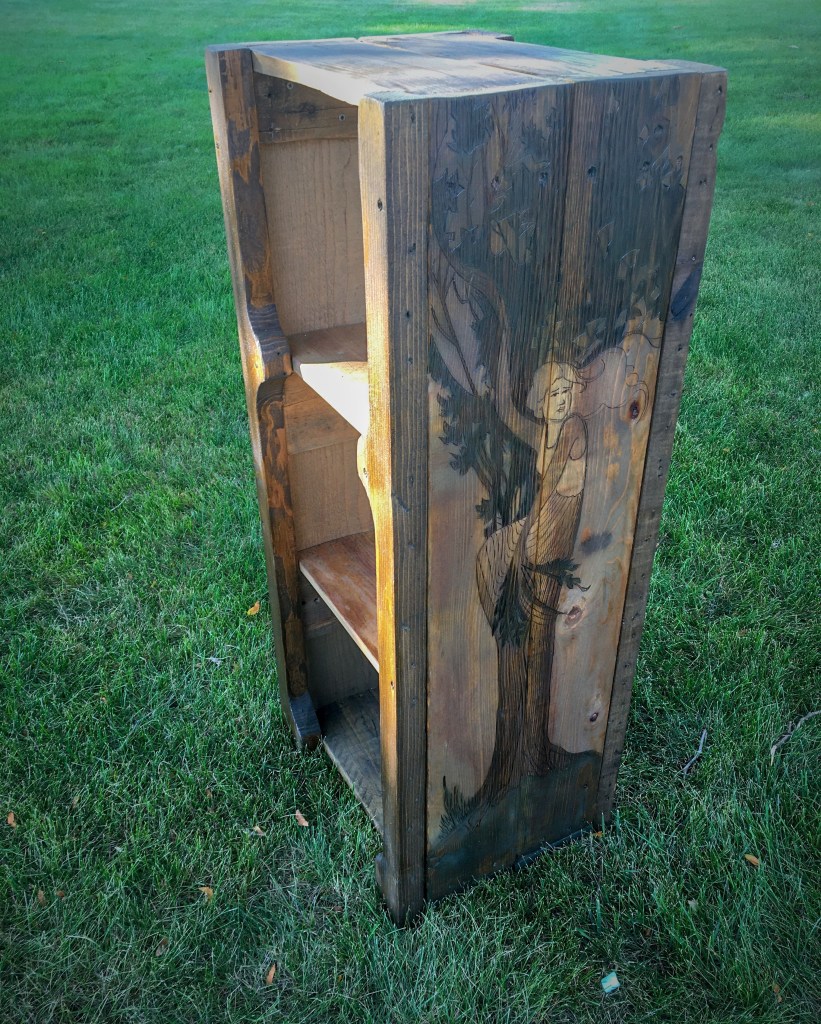
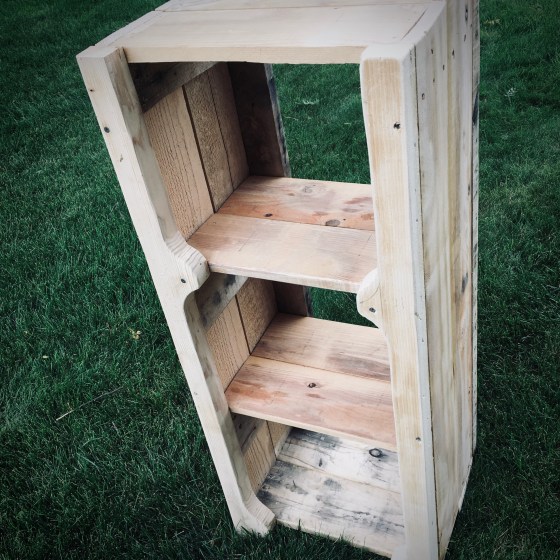
The no-plan, salvaged-wood bookshelf collects a portion of my library. The space between the work-from-home station and the vintage stereo is the new home of the bookshelf. The summer therapy project was completed so late that the intended use for the bookshelf for school materials was no longer relevant.
The relevance is now my education. My continuing education in art, science and religion. Essentially, philosophy. What is truth? And, how do I know it? Variations on a theme. A book about technology. Another about project and time management. The top shelf nearly all books of poetry and essays. Some memoirs and novels. Several books on theology and spirituality. Books by American writers. British writers. And German writers.
The second shelf. A mix of poetry, fiction, essays, art and design. The third shelf. Memoirs, classical education, technology, theology, and philosophy.
Reading an abundance of books does not make an individual well-read. Reading great books does not make one well-read. Understanding the great conversation makes a reader well-read.
* * *
“I don’t read books,” he said. I did not know what to say. “I read the newspaper. Mainly the sports page. But that’s it.”
I recalled the conversation from a few years ago. At lunch. On the patio of the Knickerbocker Hotel. The thought appalled me. Not the person. He’s a good guy. But no book reading? How is that possible?
And I know how this happens. Happened. Long days of work. Long commute. Family responsibilities. Community engagement. And other demands. Priorities need to be made in order to set and accomplish goals.
* * *
Found myself in the recliner. Everyone asleep. It was late. The lamp near the recliner was on. All other lights were off. The apartment was dark. A copy of the New Yorker on my chest. The record player was on. Three records on the platter. Waiting to be reloaded on the center spindle.
I had fallen asleep. Midway through the tables for two section of the magazine. Could not even keep my eyes open. Did I eat supper? Or dream of eating it? Or dream of reading that I ate it?
Who has time to read legacy publications? Will try again on the weekend.
I folded the magazine cover to the back so that the page I had read was open. And placed it on the top of the bookshelf to read later. Then turned off the lamp.
* * *
How did it get to be noon? How did it get to be Saturday?
The sun is bright. Warm November breeze rattles the remaining brown leaves on the tree outside. Art Tatum plays from the record player.
I return a small book to the bookshelf. I place it open on the top shelf of the no-plan, salvaged-wood bookshelf I built this summer. The shelves are deep. At least a foot deep. Could hold two rows of standard-sized paperback books.
I place the book open on the top shelf. A reminder for me to return to the passage that captured my attention. Imagination. A bread crumb trail back to an idea.
The next vinyl record drops down the spindle. Bill Evens. Peace Piece. It is Saturday morning jazz slouching toward afternoon.
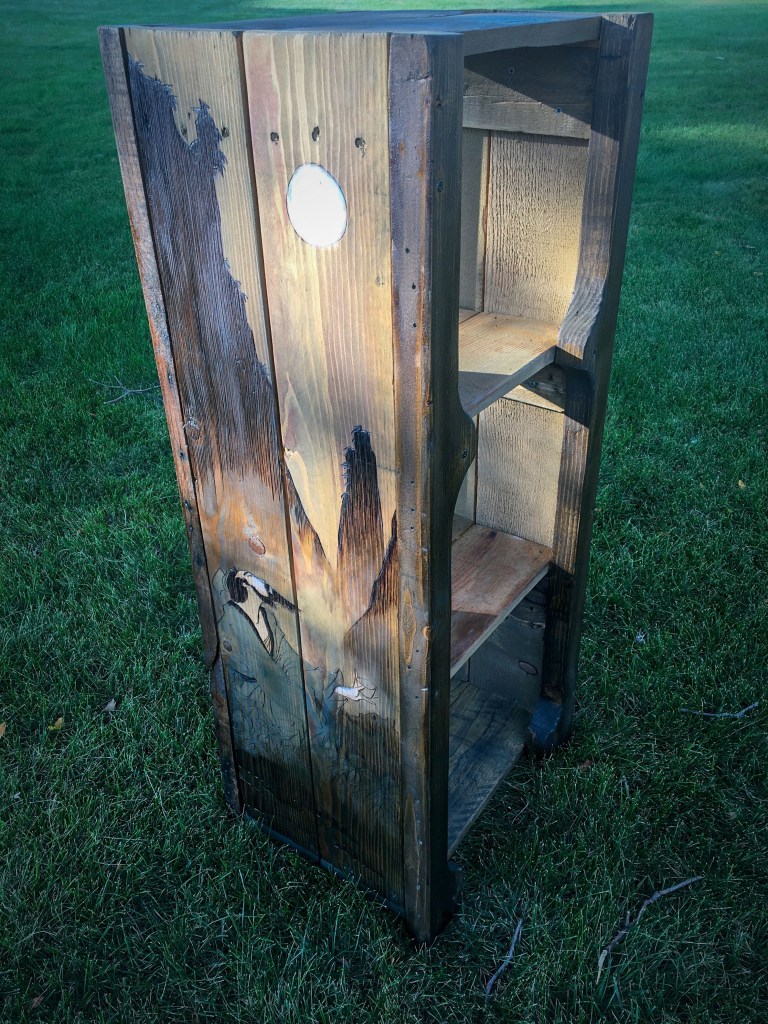
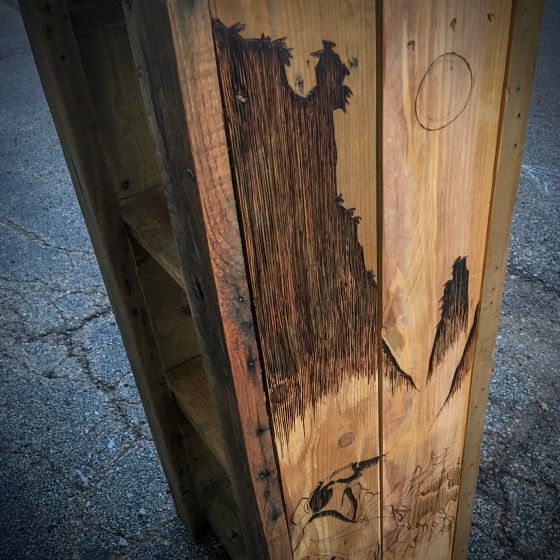
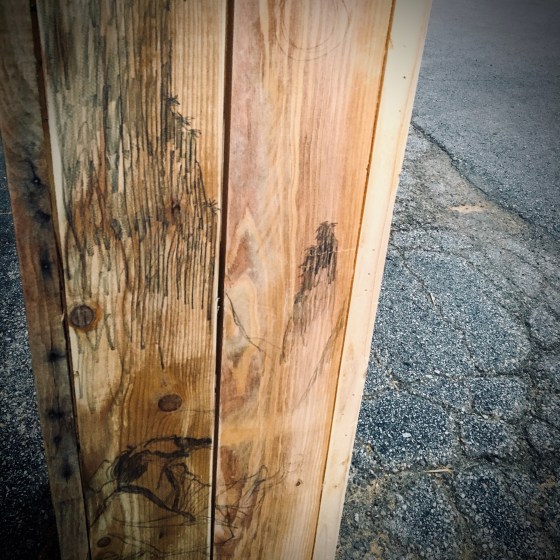
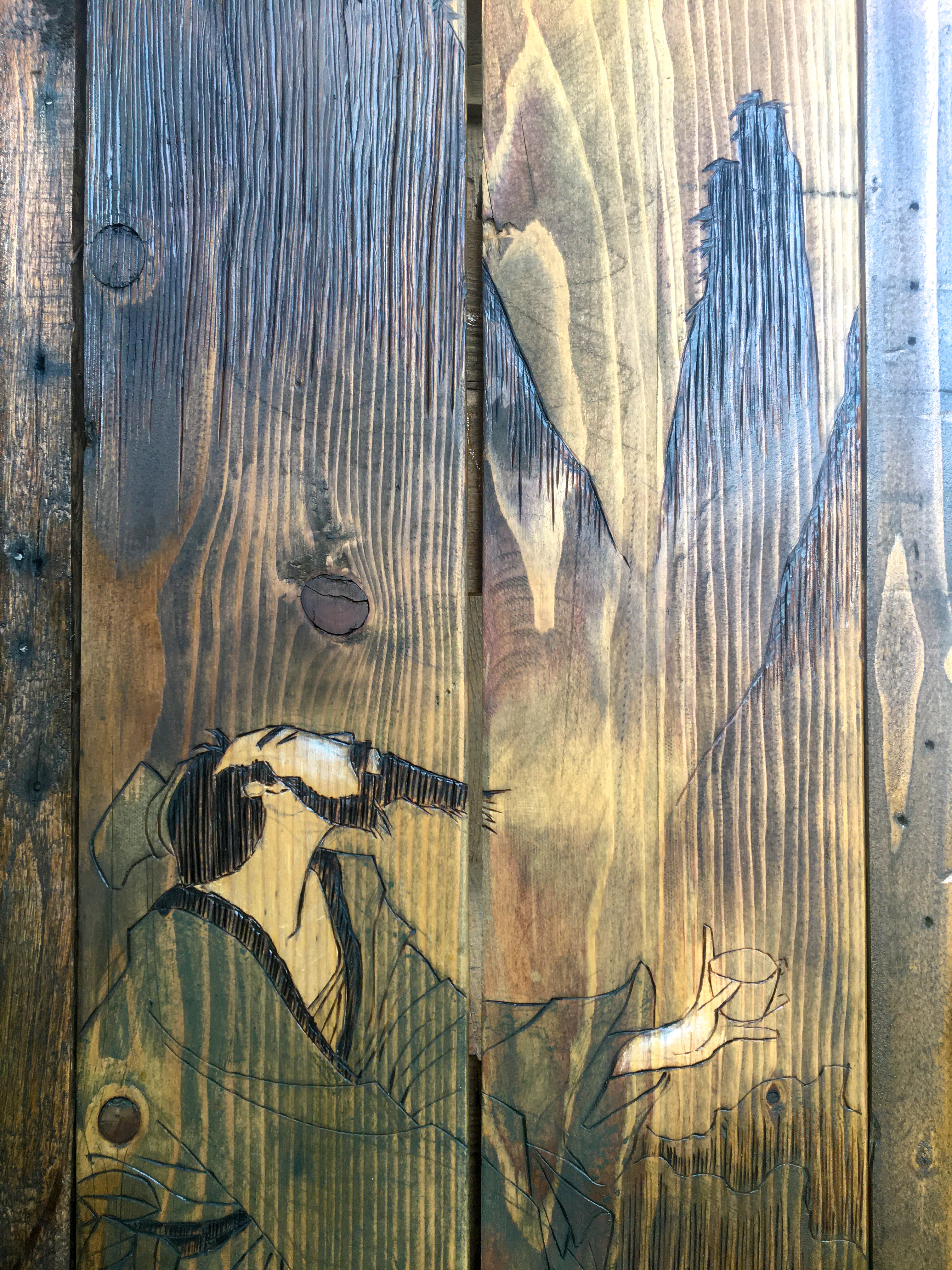
With the scenes from Eastern and Western literature burned into the side boards, I added three shades of of wood stain. Three tones if you will: gray, green, and dark brown. And a little bit of white oil paint for the moon. Maybe the addition of white paint was too much — a flourish, embellishment. No take backs. What is done is done. Only two more steps remain: wood finish and installation.
I am a little embarrassed by how long it took to build and decorate this no-plan, salvaged-wood bookshelf. And yet, the process was enjoyable, painful, and therapeutic.
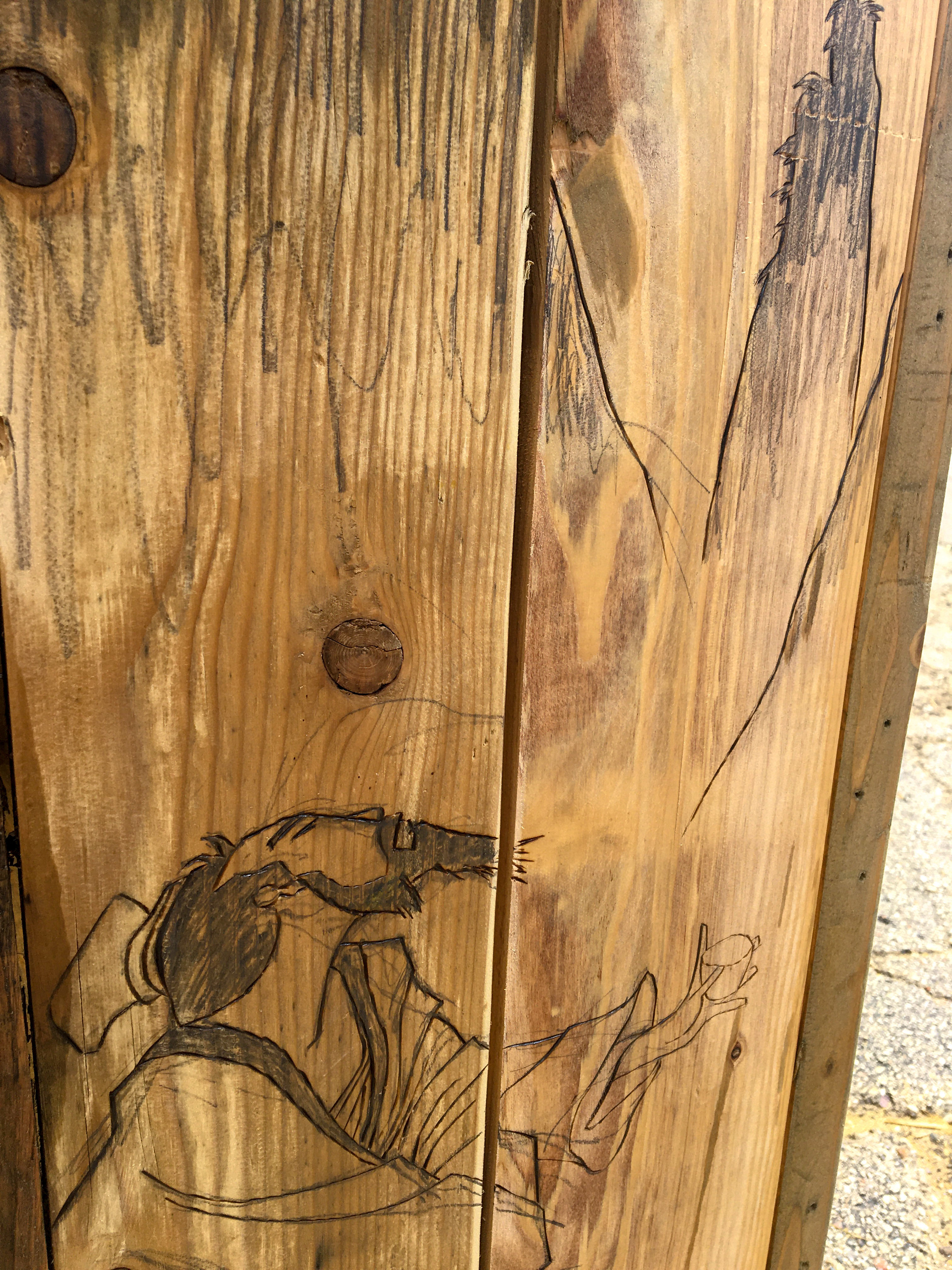
In the back of my mind I wanted the artwork on the bookshelf to be imperceptible. To be part of the wood. To appear as if it were coming out from the wood. Something that a casually observer might miss. But an astute observer would cast a second and a third glance and then walk up close to inspect the nearly hidden image.
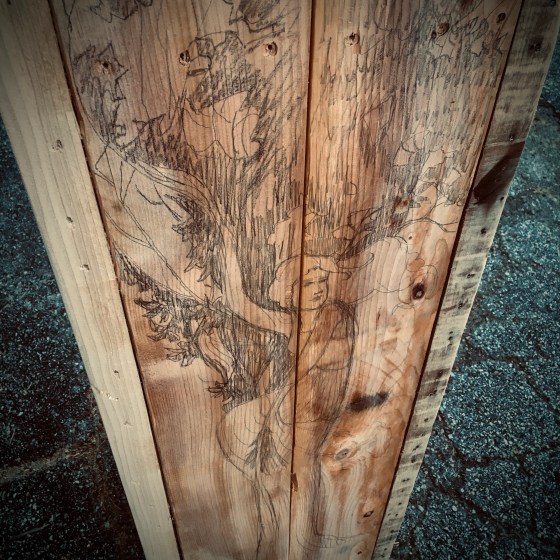
Instead of painting the scenes on to the bookshelf, I chose woodburning. The results surprised me. And my kidlingers. The long process of transforming the graphite sketches into dramatic burnt dark figures amazed them. And the craft and process of making the art renewed my imagination.
Too often I spend my day in front of a screen reading, researching and replying to emails. It’s knowledge work. It’s spreadsheets, production reports, and project management. These are all important elements in the workflow of art direction and graphic design. But they can become a psychic vampire as one coworker likes to say. And this summer therapy project was part of the remedy.
What is a challenge if it is too easily accomplished? Why not decorate the salvaged-wood, no-plan bookshelf?
Who suggested the idea is forgotten. Whether it was one of the kidlingers, or my wife, or myself is not important. But through the summer week nights and weekends a conversation took place as to decorating the bookshelf.
Since the bookshelf was intended to house schoolbooks, I decided to draw a scene inspired from Eastern literature and a scene inspired from Western literature.
Earlier in the year I had been reading Tu Fu, the autobiography of a Chinese poet, translated by Florence Ayscough. The author records Tu Fu’s reflection of his early years,
“Aged nine, I wrote large characters There were enough to fill a hard-bottomed bag.”
Tu Fu, from “Years of Strength Travel”
I intended on drawing a scene from that book. But decided upon Li Po instead. One poem captured my imagination.
I raise my cup to invite bright moon, . . .
I sing and the moon dances, I dance, and my shadow tumbles Sober, we share the joy we knew…”
from Li Po’s “Drinking Alone under the Moon”
I found a couple paintings of Li Po on the internet. That became the drawing for the Eastern side of the bookshelf.
For the Western side of the bookshelf, I selected the story of Daphne and the laurel tree. Years ago I acquired Myths and Enchantment Tales by Margaret Evens Price. During the first month of the safer-at-home orders from the state I rediscovered the book. The story of Cupid and Apollo caught my eye because of a detail I had overlooked. Peneus, the river god and father of Daphne, turned his daughter in to a tree in the forest to protect her from a love-struck Apollo. Price’s lovely illustration was the source of the inspiration. And gave me an excuse to play the woodgrain of the side boards into the illustration.
Jigsaw puzzles appeal to many people because the scrambled mess has a decisive solution. Usually, because the path to success is printed on the outside of the puzzle’s cardboard box. Build the edges first and then fill in the center. The strategy is fairly simple. The execution presents the delightful journey.
Building a bookshelf without plans is like dumping several jigsaw puzzles on to a table top, throwing away their cardboard boxes, and trying to create one solution from the many parts.
After selecting boards for the shelves, sides, supports, and legs, I started cutting the pieces to fit.
One of the therapeutic aspects of working with your hands is the tactile creation of the project. So much of what I do for a living is done by proxy. I design images for print and web. But I never touch the art. A pointer displayed on a screen by way of a handheld device that tracks two-dimensional motion allows me to design a variety of material. But it also presents a barrier. Glass, metal, and plastic separates me from the art I created. Should the art maker and the art object be divided in such a manner?
The physicality of this salvaged-wood, no-plan bookshelf presented joy. The smell of the sawdust. The feel of the drill boring into hardwood. The motion of sanding off the rough edges.
Sure, there were some mistakes. A board was too warped to use. Another board split when screwed in place. Four legs that do not match. But that is part of the riddle. Part of the delight.
When the assembled jigsaw pieces from several puzzles were set on the grass one weekend, it resembled a bookshelf.
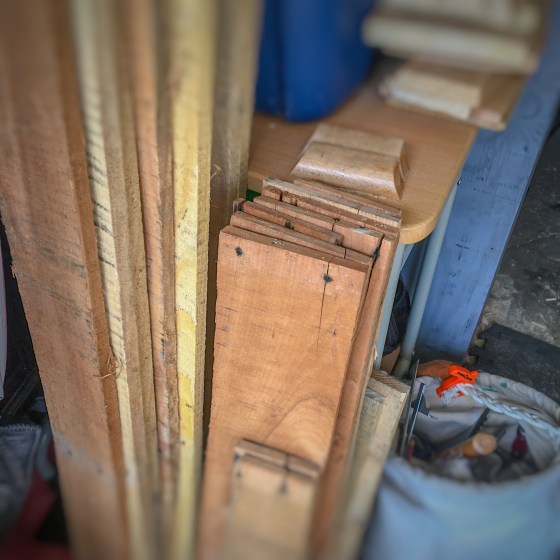
It was as much a challenge as it was therapy. Discarded pallet wood salvaged from a curb. The pallets rested there for weeks. One of the kidlingers helped me load it in to the automobile and take it back to the apartment’s garage. The pallets were broken down into boards. Nails were removed. And boards stacked in order of length and thickness. As well as amount of damage. Some boards were broken. Others split when nails were removed. Some boards had mold while others had oil residue.
We formed plans. The kidlingers and I could build boxes. Handy, useful boxes. Boxes with handles. Boxes for storage. A doll house? What about a bookshelf? A bookshelf for schoolbooks.
And I needed something to do amid the quarantine. Something away from computer screens, teleconference video meetings, and email notifications. Americans adapted to local and state restrictions in order to mitigate the spread of the pandemic back in the Spring. Some worked from home. Set up remote offices at the kitchen table, basement desk, or spare room. For me, a window table I built in the bedroom became the office work space. Working and sleeping in the same room became claustrophobic. When the warm days of summer arrived I eagerly looked forward to the time of day when I turned off the computer, changed clothes, and went to the garage to work on a wood project.
I settled on building a few small boxes for starters. Something to get the hands and mind prepared for something bigger—a new bookshelf built from salvaged wood.
It was cold. A political rally mangled traffic downtown. Everything seemed off schedule. I missed the street car to the train station by minutes and had to walk. The winter weather depleted the battery of my smartphone. Commuters waited at the Intermodal. The last train of the night was late.
There was a special one-hour podcast on obscure tunes from the Real Book loaded on my smartphone. I wanted to listen to jazz music. But I didn’t want to run out of battery. In case the train was delayed. And I had to call my wife to pick me up.
The previous weekend I checked out a book of poetry from the public library. A collection of poems, translated into English, of Li Po. Before I knew it I had found a friend. The translator made it inviting to enter the world and work of Li Po.
Soon the train arrived and I boarded. Found a seat. Plugged my phone into the outlet. Opened the book and continued reading. The train passed over the river and had nearly cleared the Third Ward when I caught a glimpsed of the moon over Lake Michigan.
“I raise my cup to invite the bright moon, . . .” wrote Li Po.
Maybe that endured me to Li Po. Or at least inspired me to feature an illustration of Li Po on a bookshelf I built this summer.
There are a couple Li Po illustrations I made during the last year or so. But the one for the new bookshelf is the most ambitious and detailed. Maybe I will share some posts about the bookshelf project with you later. I had considered writing a series of short posts about how it all came together. Sort of a how-to, or how it was done, type of posts. But the story about why I chose to decorate the sides of the bookshelf seems to interest people more than how I built it.
As the nights grow longer and colder, the illustrated bookshelf is now installed in the living room.
“What did you do last night?” she asked as we walked through the neighborhood in the pre-dawn moments of the day.
“I worked ’til six. Clocked out. Made supper. And spent a couple hours drawing.”
She did not say anything for a few dozen steps. She took the kidlingers on an adventure the night before. And she was tired.
I continued. “The challenge is that it takes me nearly an hour to set up. Not just gathering tools like pencil, ink, brush, illustration board, and setting up a space to work. But planning. Composing a page. Thumbnail sketches. Reference materials and such.”
She listened. We walked further. In the hour before sunrise, I looked East. I saw Venus. Or maybe Regulus. Possibly both.
“By the time everyone got home,” I said. “I had finished marking out a page and composing three panels.”
She told me about a conversation with the one of the kidlingers as we walked. We exchanged comments about plans for the day. We continued for a quarter mile or so before returning home.
Thoughts of last night’s drawings were pushed into the shadows of a day filled with choses sérieuses.






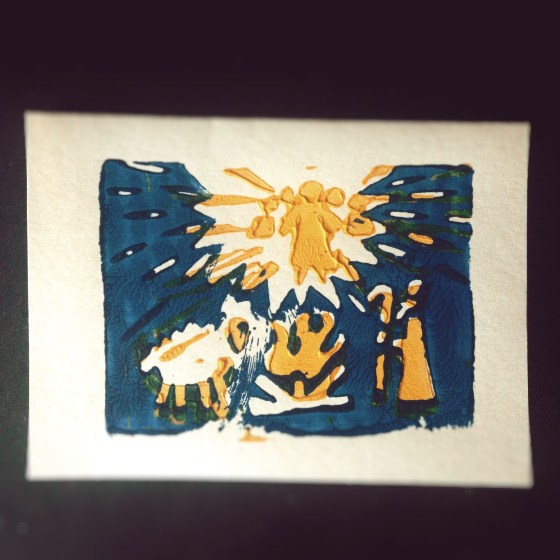
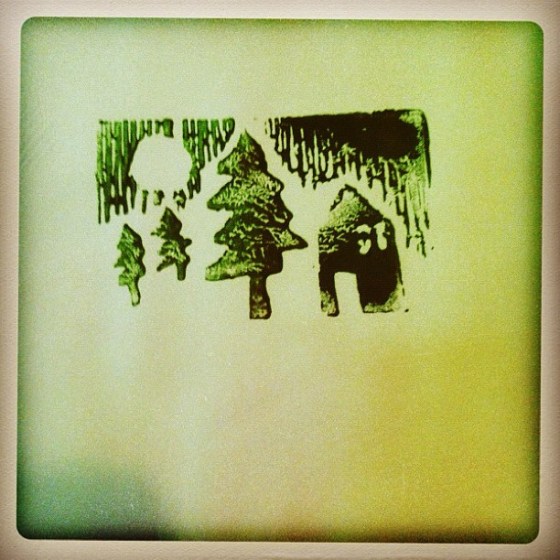 This Advent Moon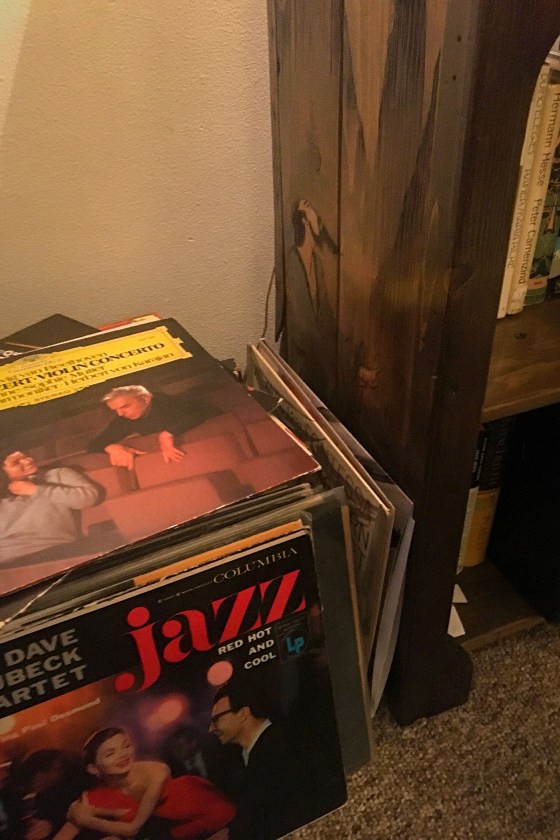

 Coffeehouse Junkie