After the storm

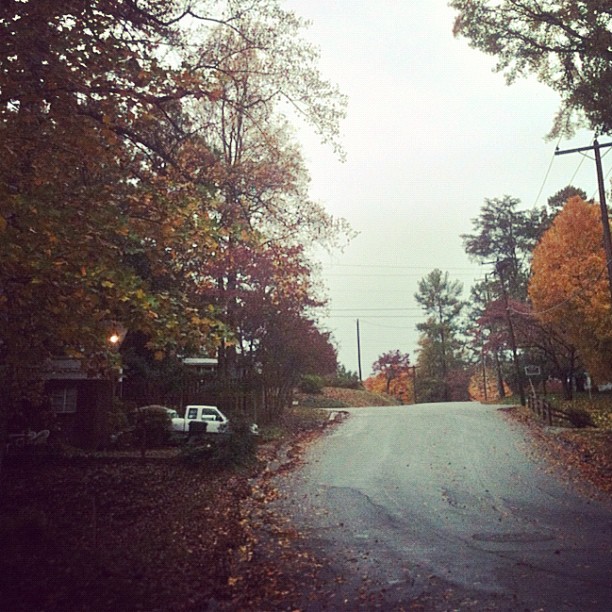
Asheville after the storm
Asheville, North Carolina

15 year anniversary

Historic Battery Park Apartments, Asheville, North Carolina
Rooftop Poets

Vision in motion, an exercise

Never waste money on purchasing a tube of black paint, I was told.

With three or four colors you can mix a pigment as dark as black. And a richer shade of pigment. Is black even a color?

These thoughts remind me of color theory and composition class at the university. My professor was a student of Josef Albers. At the time, that fact did not have a great impression on me. But I wonder about the lessons he must have learned. Not so much the academic rigor of craftsmanship and applied fine arts. That is important. But lessons of integrity and legacy. Was it Albers who taught him that quip about black paint? Or did that come from Willem de Kooning?

A couple days later, the middle child looks at this project. “What’s this about?”

I do not answer. It is an exercise. It is practice.

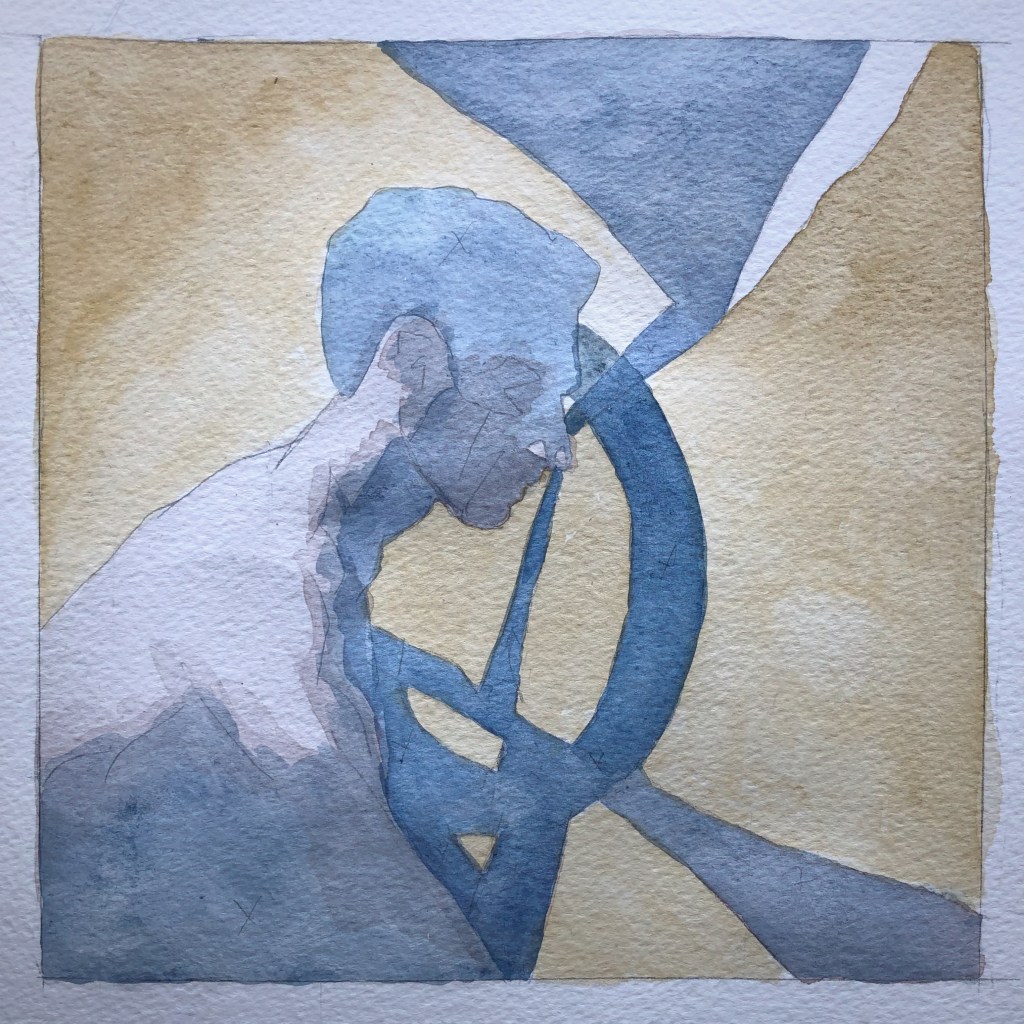
Vision in motion, paint big

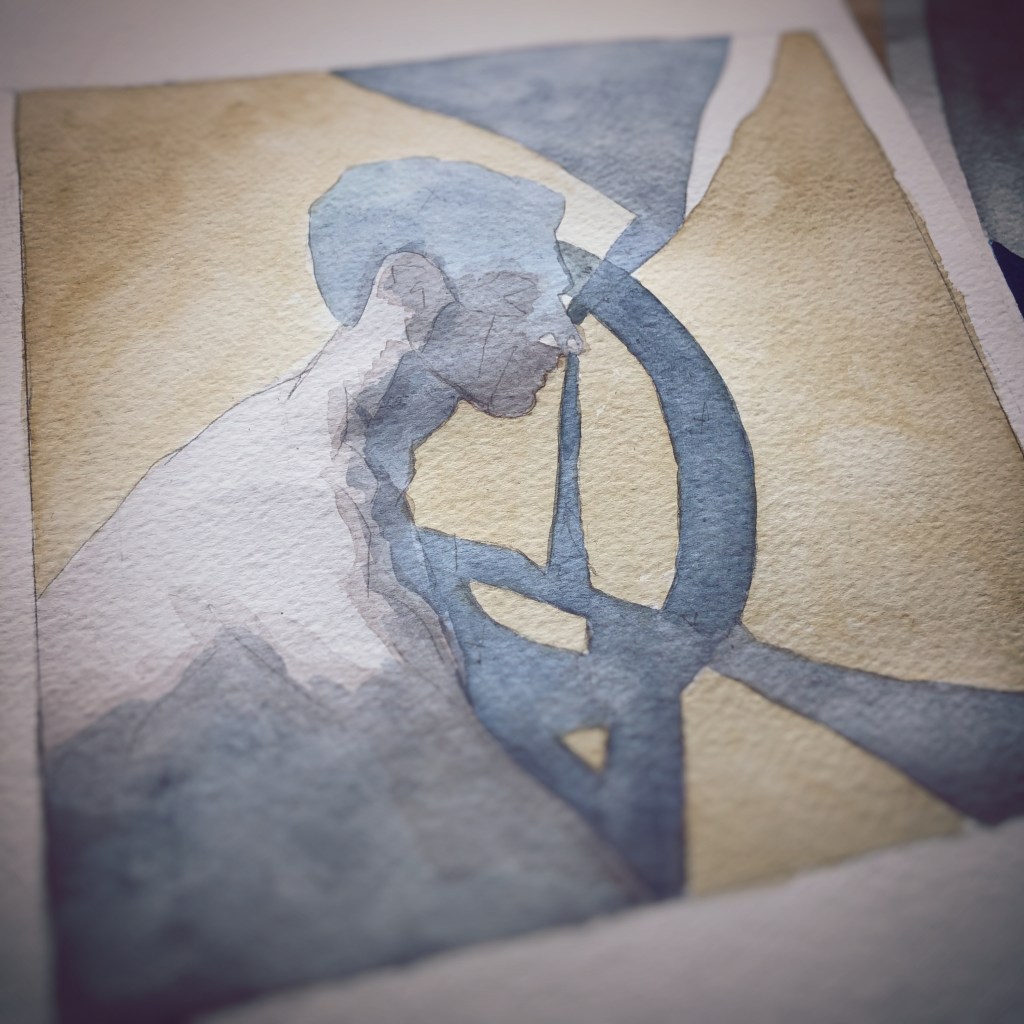
This is practice. An exercise. Form and color.

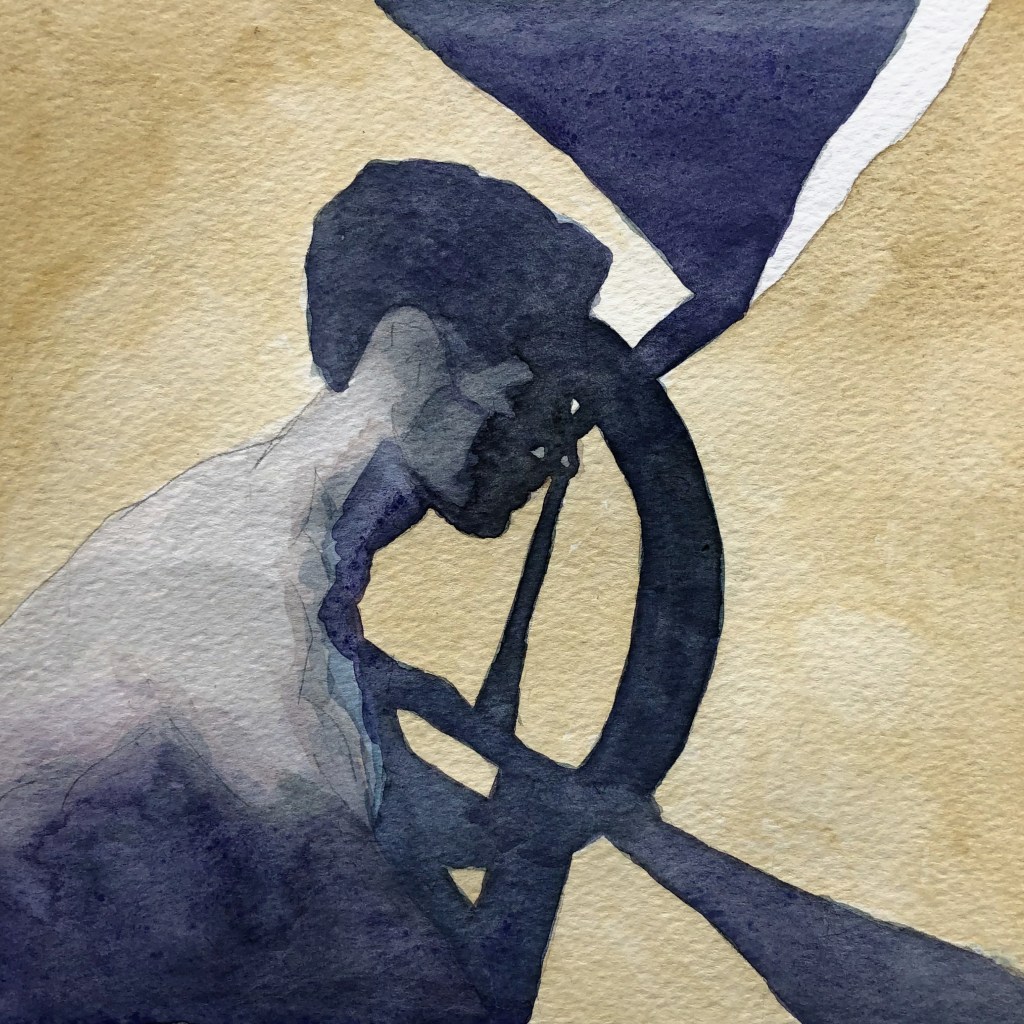
Do you see a character? As in, a letter of the alphabet.

Or do you see a character in human form?

The daylight quickly fades for this January afternoon. I chose a larger brush to apply pigment. At the university, the art professor instructed, “If you can’t paint well, paint big.”

It was not criticism, but rather a modernist declaration. He provided an atmosphere that allowed guidance rather than dogma.

I load the larger brush with the muddy water from the tray and a touch of pigment found between two watercolor cakes. The transparent layer is applied to the dry paint. A technique called glazing.

This is not an art lesson. It is a conjuring up of an image.

Vision in motion, layer upon layer

This is an exercise. Form and color. Loading the brush with pigment and applying it to the paper. Quick strokes. Vision in motion.

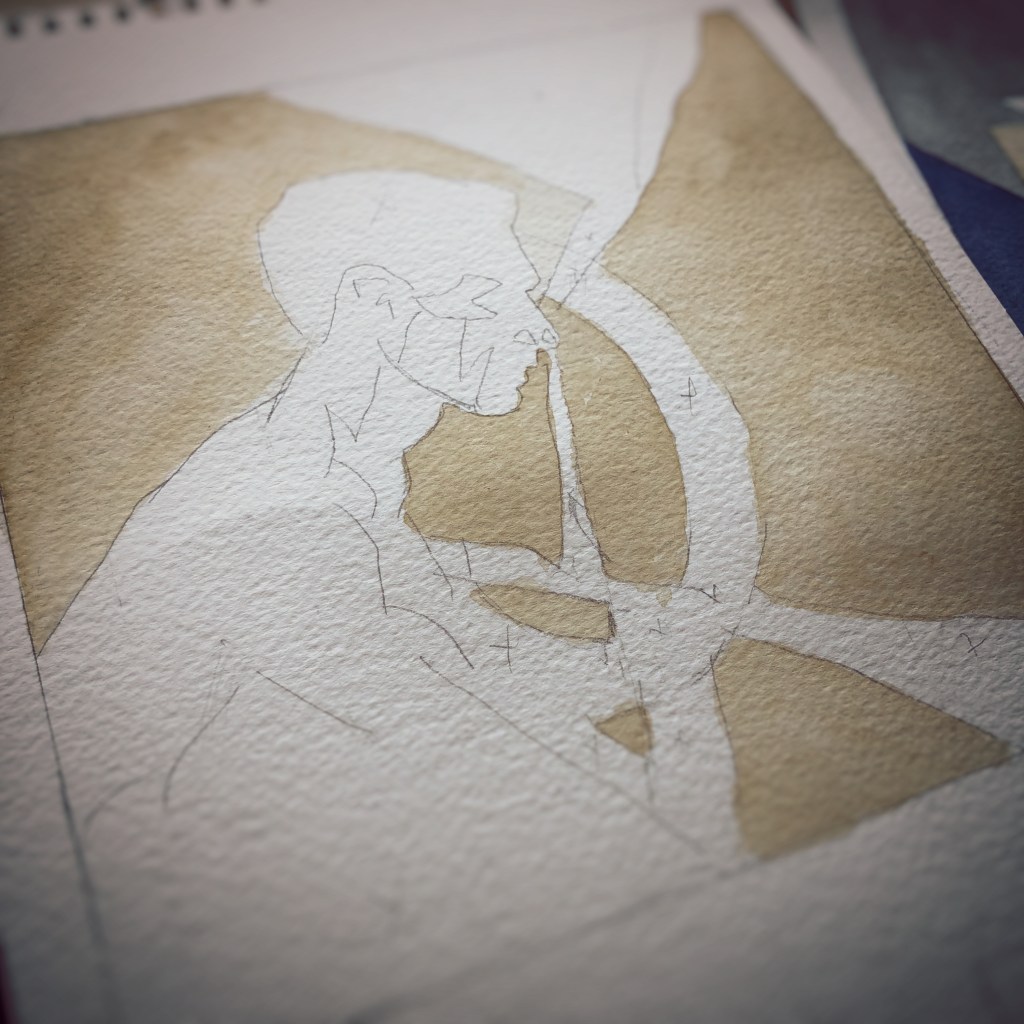
Painting by the light of the apartment’s living room window. The sun light is best in the morning. But I have continued this project well past the noon hour.

“Why do you keep painting,” asks my child.

“It’s underpainting,” I say as I clean the brushes and prepare for an afternoon walk. “The lighter tones provide the base. When the paint dries I add more color layers.”

It is January. It is Winter. The outdoor temperature is above the freezing point. We walk to the library and return books. We continue to talk.

Vision in motion

Trying something new. Or, rather, returning to something old.

Here is a first draft for consideration.

Will provide details as updates are available. Let’s see how this turns out.

What is the story?

Meformer or Informer

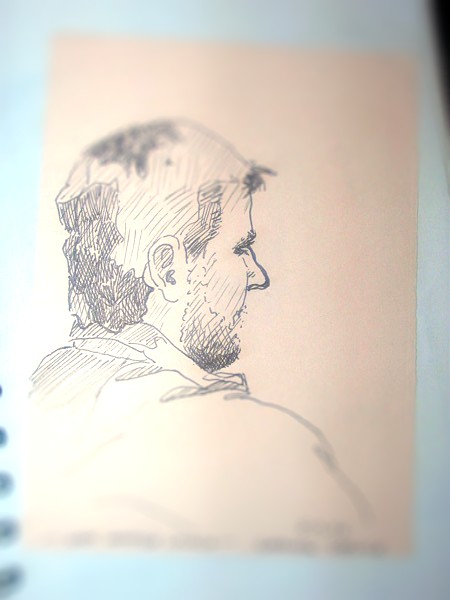
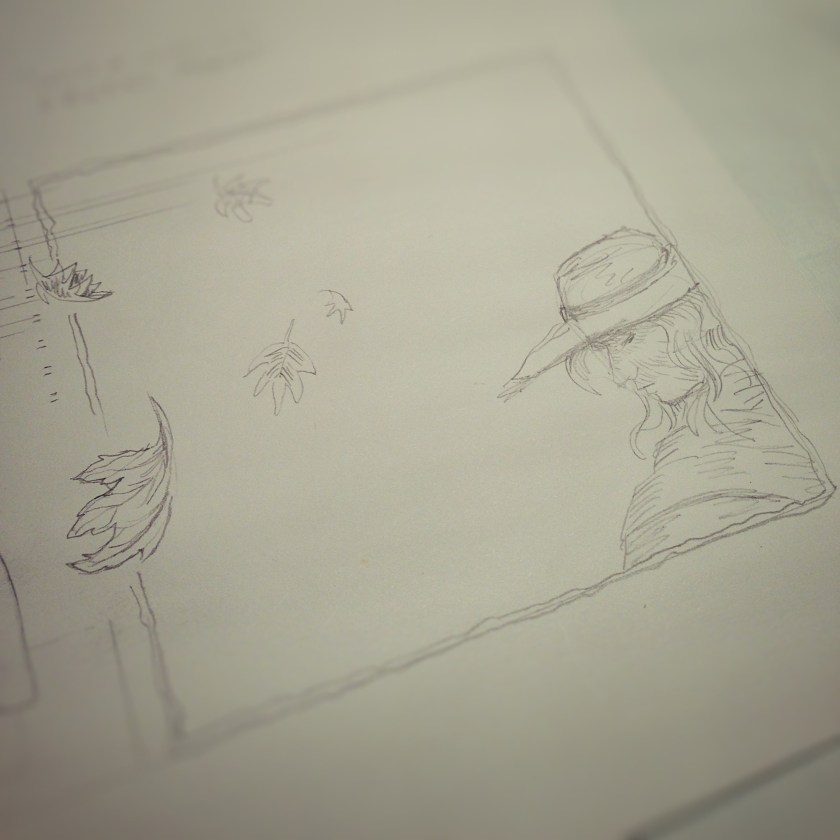
A picture is worth a thousand words. A common expression. Or common illusion. The story behind the image used in a post, “Meformer” (vs “informer”), does not tell the whole story. Not even part of the story. The post deflects the writer’s fears and anxiety. What do you see in the twenty minute sketch captured by an outdated iPhone photo?

DSCN3428[sqr-tilt-dallas]

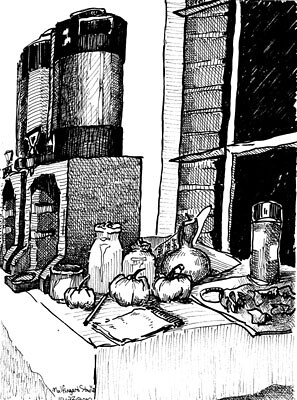
Another images portrays an artist’s workspace. An unfinished ink and watercolor painting. The related post reveals part of the story. Fear motivates. But there is a whole story arch of dreams and desires. Hopes and aspirations. And failure. If you were to write a thousand words about this photo, what story would you tell?

DSCN6003[DSCN6002[sqr-basic-lomo-dusk-tilt]]

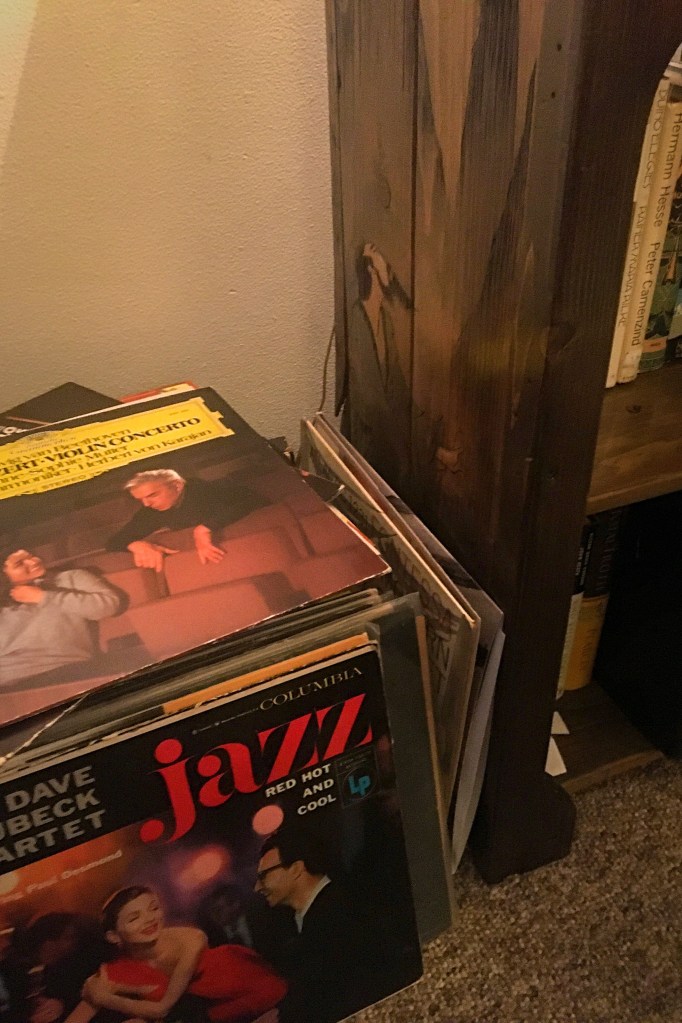
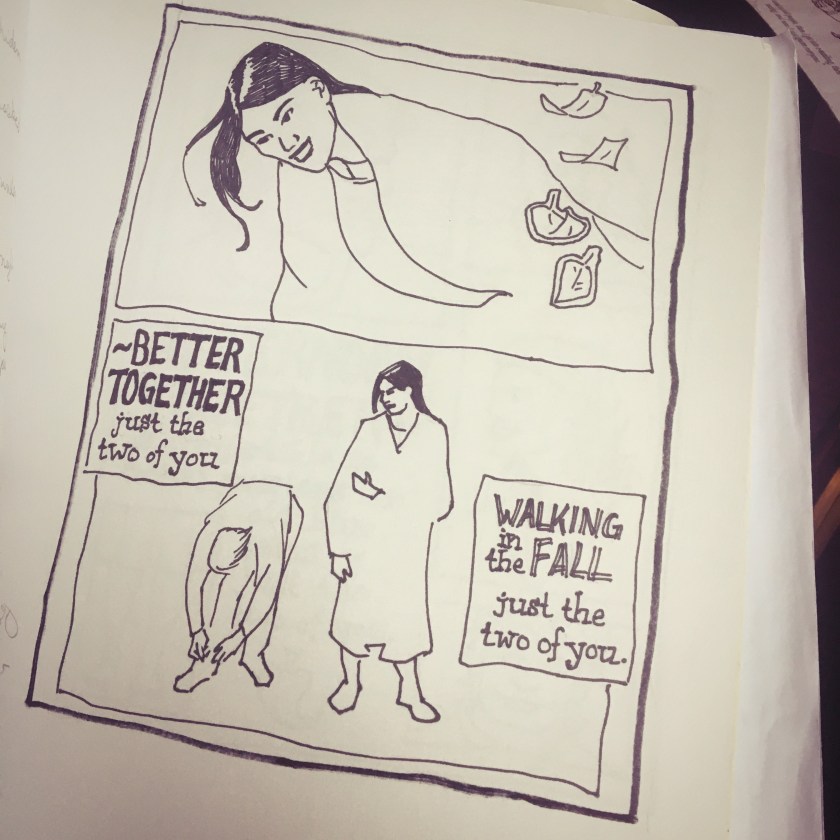
Notepads capture interesting details. To do lists. Contact information. Grocery lists. Project tasks. Appointments. Or this photo of an anatomy of print advertising. Why this list? What story does this relate?

The illusion of these photos is the framing. The information that is cropped out of the image is equally as important as what is framed within it.

Selective reading habits

Interlibrary loan system

The interlibrary loan system provides access to books. Books that are not available at the local rural public library. Books requested using the library system’s web site arrive as they are available. Sometimes the combinations of titles display a curious serendipity. Slow Productivity. And History of Graphic Design Volume 1 1890 – 1959.

The principles featured in Slow Productivity appear to contrast with the other book. At least at first glance.

Graphic design projects and tasks were once defined by art and drafting skills. Tactile skills of cutting an oval with an X-Acto knife for a Rubylith overlay sheet. Or drafting skills of using a T-square ruler and triangle to layout the ad copy for an advertisement. Or the skill of painting a headline with gouache paints or pigment inks. Or the photographic skills of loading, shooting, processing, and printing 35mm film. Graphic design work prior to the 1990s required more physical activity. Often, a design shop featured multiple creative talents. A photographer. An illustrator. A copywriter. A director and assistant. A typographer and designer. A videographer and film and audio editors. That is a team of ten creatives. Now graphic design projects and tasks encompass project management and problem solving. And a single designer needs to do the work of ten creatives.

Can graphic designers do their projects and tasks without burnout? That is the question. And, maybe, that is where the interlibrary loan library books compliment each other. Can the past inform the present? And future? And, more uregently, can I read these books before they are due back to the library?

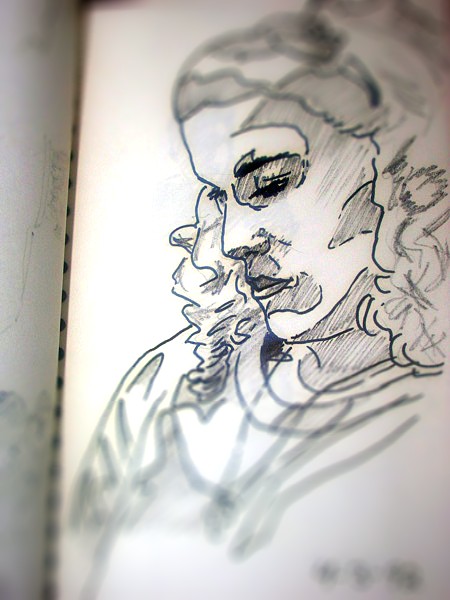
Weekend sketch – Sarah and the king of the goblins

Another sketch from the weekend. Inspired by the film Labyrinth, I reimagined Jareth, the king of the goblins, and Sarah. The first time I saw the film was in art class. The high school art teacher thought it would be inspiring. It has captivated my imagination ever since.

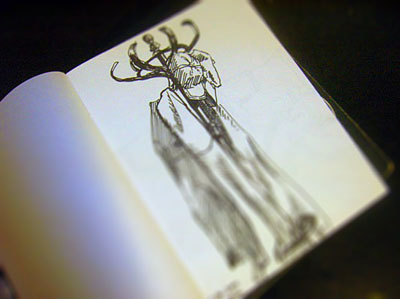
Weekend sketch – Jareth, the Goblin King

Inspired by the 1986 film Labyrinth, I sketched a portrait of Jareth the Goblin King.

Jazz with Bob Parlocha on a rainy night

The children tucked in to their beds. Stories read. Prayers said. I walked to the kitchen and turned on the radio. A reward for getting the children to bed on schedule. If everything was on time, than I heard Bob Parlocha introduce his radio broadcast. Jazz with Bob Parlocha began at the top of the hour, eight o’clock, on the local public radio station. I washed the dishes, figured out bill payments, or some other domestic chore while listening to music.

That was a different time. And in a different place. The local public radio station signal received is full of static. Their evening programming does not include Jazz with Bob Parlocha. That is understandable. He died almost a decade ago.

The Sageza Group archives jazz radio broadcasts. On their web site, jazzstreams.org, they collect Bob Parlocha’s original broadcasts that were digitized. “Commercial jazz radio is just about gone from North America,” they write.

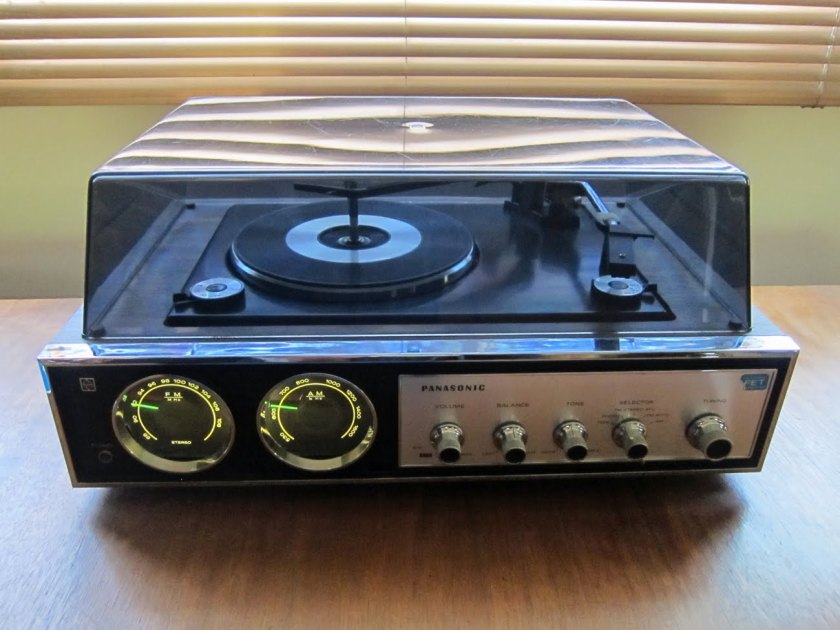
On evenings like tonight, when the radio reception is poor and the needle for the record player needs to be replaced, I find the Jazz with Bob Parlocha archives.[1] What was Bob broadcasting ten years ago on this date? Or eleven years ago? I select the date of a broadcast[2] and I am transported to a different time and a different place.

NOTES:

[1] The Sageza Group, Jazz with Bob Parlocha archives accessed April 16, 2024 http://jazzstreams.org/JwBP/JwBP-index.php

[2] Jazz with Bob Parlocha, April 16, 2013 broadcast accessed April 16, 2024 http://jazzstreams.ddns.net:8808/JwBP/Jazz-with-Bob-Parlocha-(2013-04-16).mp3

“Strife like this does people good”

The world harbors two kinds of strife. One promotes healthy competition among neighbors. The other determined by the will of the gods. Or so the rustic poet proposed.

Due to personal and professional reasons, my commuting practice has not included Amtrak®. At least not for the last few months. The last time I took the train to work snow remained on the ground. Yet, in spite of the long absence a fellow commuter kindly informed me of recent service changes. I was on the wrong side of the train platform. Due to summer construction, the northbound train runs on a different track. She shared other details as a long lost friend might. A thread of conversation resumed based on our mutual commuting practice.

When I boarded, one conductor greeted me with a common honorific and my surname. As I took a seat, another conductor passed by with a welcoming, casual good morning and my first name. As if I had only been gone for a long weekend. “Good morning,” I replied.

The idea of relationships and strife are themes I have considered since that summer day. This may be a contrast between the modern (relationships) and the ancient (strife). Personal or professional, the desire to belong or feel wanted or at least tolerated is vital. This is true for individuals as well as community. To nurture a relationship requires work. And intent. The commuter and the conductors thought I was important enough to connect with. If only in a casual or professional capacity, it provided a feeling of belonging. Should relationships be free of conflict? Should relationships exclusively nurture polite exchanges? What about course correction?

If I ignored the commuter, I would have been on the southbound train instead of the northbound train. The poet wrote: “when a person’s lazing about sees his neighbor/getting rich. . .” Or in my case, with headphones on I see my neighbor on the other side of the track and heading north. . . “Strife like this does people good.” In this manner, strife does not need to be abrasive. To achieve good correction and instruction apply decency and respect. Even honor.

August archives

Were all summers like this one? What were the stories of previous Augusts?

The summer passed. Choked by excessive heat and wildfire smoke. Like the blur of highway signs in the predawn light, it sped by. Were all summers like this one? What were the stories of previous Augusts?

From three years ago:

Something in front of you right now was designed by some unseen modern peasant who worked long hours with short deadlines. . .

The visible and invisible nature of graphic design

From five years ago:

Have you ever written something that developed a life — even an audience — unexpected?

Patience – your writing finds the right audience

That August Asheville evening, more than a decade ago, was one of the last nights our two families enjoyed supper and stories together.

Language is communal

Eight years ago:

“There is juju with these things,” he said inspecting one of the shields I painted. “People connect with this stuff, because it was created with human hands. Not some computer.”

From the office in the oak grove

Dare I go back any further? Ten years ago. Nothing appears to be written in August. What about fifteen years ago?

It is interesting to learn which individual poems became the foundation of my journey into poetry.

What’s your all time favorite poems

Eighteen years ago:

A poetry reading is like an art gallery portfolio review.

Poetry, a gift

Looking back over these August thoughts, essays, meditations. . . this modern peasant needs to devote more time to things made by human hands. So much of my professional life is filled with screen time, that it is time to return to handmade art, design, and poetry.

And now it is July

West of the highway that heads north and south, the country opens like a John Steinbeck novel. West of the highway, field upon field of alfalfa, corn, and other grains line rural roads reaches to the setting sun. How long has that highway been there; dividing the land? A hundred years ago Highway 57 connected Milwaukee to Chicago. Before that, the land bore the raised scars of the railway system. And before that. . . well, it is difficult to image.

The land east of the highway stretches to the shores of the great lake. A sliver of land, eight to ten miles in width, rests between the lake and the highway. East of the highway bustles with industry and manufacturing. Almost a quarter of the population of the state lives in that corridor. To the east of the highway, a wall of concrete and steel supply chain warehouses and distribution centers fortifies an expanding arcade of streetlights for commercial and residential harbors.

The land west of the highway covers a 150 miles or more to the Mississippi River. It is a different country — quantum distat ortus ab occidente. An ocean of fields and pastures dotted with islands of trees, farm houses and villages contrast against the land to the east of the highway. Occidentis means “region of the setting sun” or “western part of the world/its inhabitants.” The native name for this land is disputed. The original name is “where the waters gather” or “red stone place” or something. The name of the land was Gallicized by explores and later Anglicized by settlers. Aldo Leopold observed, “Land, . . . is not merely soil; it is a fountain of energy flowing through a circuit of soils, plant, and animals.”

The month of May registered a trace of rain along the patchwork landscape of the calendar. The sandhill cranes flew in from the south lands. Nested. And within a month, they cared for hatchlings. Ducks and geese followed the migration pattern. The robins were next. Though this year, a robin was spotted in late February. The red winged blackbirds gathered around the marsh areas.

As June warmed the countryside, mulberry bushes squeezed fruit from its branches. Rabbits and squirrels populated the backyards and fields of the village. The pale cloudless skies led to the longest day of the year. Fields of corn flickered to life with lightning bugs. Summer temperatures arrived. As did wildfire smoke from a thousand miles away.

Turtle doves made their nest in the corner of the apartment’s roof gutter back in May. The nest constructed at the end of the gutter and before the downspout bore two chicks. By summer solstice they had grown and flown away. The nest is empty now.

And now it is July. Bullfrogs sing a deep throaty “jug-o-rum” as the Buck Moon arrives. After sunset, Altair comes in to view high in the eastern sky. Or is that Vega?

Reflections in a mud puddle

From the archives, ten years ago…

coffeehousejunkie's avatarCoffeehouse Junkie

20130701-123531.jpgIt is an early summer morning. It rained the night before as I walk a mile or so before I climb into the car for the morning’s mega commute. The parking lot near my home is dappled with puddles slowly evaporating. It reminds me of when I first started taking black and white photographs in high school. One of my favorite subjects was reflections of the sky in puddles.

I don’t remember what initially attracted me to the subject matter, but I remember loading a 35mm SLR manual camera–either an Olympus or a Pentex–with a spool of film, pulling the leader and lining the sprocket holes with the sprockets, securing the leader to the spindle, closing the back door and advancing the film a couple frames. I’d sling the camera over my shoulder and head outdoors to capture a surreal glimpse of the heavens from the perspective of puddles on…

View original post 227 more words

“The only way for human beings/is to choose”*

Instagram montage

It rained all day. A perfect day for reading books and drinking tea. By the opened window I listened to the rain and struggled with a dozen pages of one of Thomas Carlyle’s lectures. That afternoon I turned to Epstein for consolation. If he found it difficult to read Carlyle’s prose about the French Revolution, I may be in good company. Not that I should be compared to such a man of letters.

Many years ago I aspired to a career in letters. A local independent newspaper published my work. Then a few national and international literary journals picked up my work. Surrounded by writers who supported me and encouraged me to continue along that path, I composed a series of narrative non-fiction pieces. Sketches for a full-length book. Searching through this site’s archives, ten years ago (almost to the date), I teased these efforts. Writers had reviewed the three or four of the chapter sketches. An editor was sought to help finish the process. And publications were selected for submission to publication. And then. . .

These stories remain unpublished to date.

NOTES:
*The title of the post is a line from “In Rainy September” by Robert Bly.

Apparently I was so tired that I forgot to click the button marked “publish” on Sunday, September 11, 2022 at 9:48PM.

These were posted ten years ago:
Yes, it is true, September 7, 2012: https://coffeehousejunkie.net/2012/09/07/yes-it-is-true/
There is a story behind this photo, July, 10, 2012: https://coffeehousejunkie.net/2012/07/10/11796/
What hides behind this foggy morning photograph?, July 11, 2012: https://coffeehousejunkie.net/2012/07/11/11798/
Sisyphus tears down the mountain in a Chevy, July 12, 2012: https://coffeehousejunkie.net/2012/07/12/11802/
There’s a story… about double red doors…, September 5, 2012: https://coffeehousejunkie.net/2012/09/05/doublereddoors/

Archive 6

Are polymaths extinct? In the ancient world polymaths shared expertise in various fields of knowledge. One example is Leonardo da Vinci — not merely a painter, but sculptor, architect, musician, scientist, mathematician, engineer, cartographer, botanist and writer. More recently, Thomas Jefferson fits that definition as a horticulturist, political leader, architect, inventor, and founder of the University of Virginia. Is it possible to be a polymath in this modern world?

As it relates to blogging, can effective bloggers be polymaths? Copyblogger offers some habits of effective bloggers. The list includes:

  • prolific
  • concise
  • focused and consistent

(Link: 8 Habits of Highly Effective Bloggers)

One of the things stated as an attribute of an effective blogger is:

Successful bloggers choose a topic and stick to it.

They write consistently about their chosen subject… Even when they write about something that seems to be off-topic, they relate it back to the niche they know…

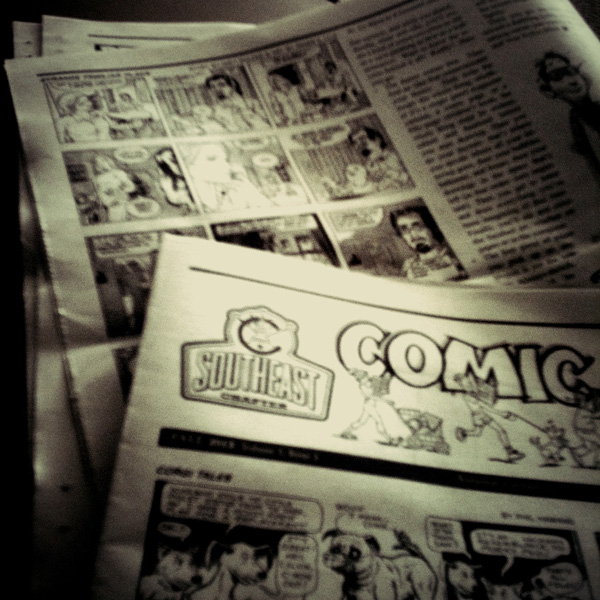
This makes practical sense as far as marketability. You don’t expect comic books sold at a doughnut shop. But what about a gas station? Of course, you purchase gas at a gas station, but most gas station owners don’t make profits from the sale of gasoline. Most of their revenue comes from products sold inside the gas station. In high school, I stopped by the gas station routinely to purchase comic books. Should blogs be doughnut shops or gas stations?

In the marketing world, as in the blogosphere, an individual who chooses a topic and sticks to it is a specialist or consultant. In Peter Rubie’s Telling the Story, he presents this definition of genres:

The development of genres came about as a marketing necessity. “Category” and “genre” are marketing terms… Their purpose is basically to help you more easily find what it is you’re looking for.

Telling the Story then goes on to list seven narrative nonfiction categories: adventure, travel books, biography, history, military, memoir and true crimes. The music industry follows the same protocol: country, pop, rock, hip-hop, and so on into the sub-genres of goth-metal, indie-folk-americana, afro-celt, etc. What Copyblogger proposes is to be marketable to your online audience. If you’re a tech blog, write about technology. If you’re an organic gardener, write about gardening. If you’re a mom, write about mommy stuff. That way your online readers are trained to expect only doughnuts at the doughnut shop.

The question is this: if blogs are specialized, will that make the community more or less knowledgable? I’ve noticed that art blogs often link to other art blogs. I understand that the reason for this is to create a strong community. The challenge with specializing content is that the specialists become islands of highly focused, topical knowledge surrounded by the waters of ignorance of other general knowledge. Jacques Barzun explores the idea of specialized knowledge and more in The House of Intellect. Let me go back to the opening paragraph where I stated “more recently, Thomas Jefferson…” Between Thomas Jefferson and our present information age, the society and culture has changed so dramatically that I wonder if our institutions of intellect suppress the nurture and nature of polymaths.

NOTE: https://coffeehousejunkie.wordpress.com/2010/06/18/is-it-possible-to-be-a-polymath-in-todays-culture/

A poem for the fifth Sunday of Lent (Passion Sunday), 2022

Saturday, the first weekend in April, snow fell thick all afternoon. A recording of Bach played from the living room stereo.

As I cleaned the kitchen, I remembered a conversation from earlier in the week. After a long thirteen-hour day, my co-worker asked what kind of books I’ve read recently. I shared a few titles. She replied, “Oh, wow, you read the classics. I only ready modern fiction.” It stung a bit. And I wanted to defend myself from being considered a fossil. The truth of the matter is that I do, in fact, read old books. And I enjoy reading them. But it does make conversations with people difficult.

I closed the dishwasher door and pressed the start button. I thought of another moment in the week. While troubleshooting a video looping file for a 42-inch display screen, I remembered how hungry I was that day. During lent, skipping one meal a day is manageable. Even if it was a long day. But it was more than “to keep/the larder lean. . . ” as Robert Herrick wrote in his poem “To Keep a True Lent.” [1] He concluded: “To starve thy sin,/Not bin;/And that’s to keep thy Lent.”

Another recollection while cleaning the kitchen. I read Geoffrey Hill’s translation of “Lachrimae Amantis.” [2] Hill’s poem was featured in an anthology. When I searched the public library system for his book Tenebrae I came up empty. (Not to be confused with his poem by the same name.)[3] Yet it seemed appropriate to consider “Lachrimae Amantis” on Passion Sunday.

At this dark solstice filled with frost and fire
your passion’s ancient wounds must bleed anew

“Lachrimae Amantis” by Geoffrey Hill

There was some leftover oatmeal at the bottom of a pot on the stove. As I cleaned the kitchen, I finished the rest of the steel cut oats with a sprinkle of brown sugar, almonds, a dozen raisins, and a tablespoon of yogurt. Is this breaking a lenten fast? Maybe I shouldn’t have added the yogurt. I washed it down with cup of black tea. Then proceeded to wipe down the stove top and counter. The oats and raisins reminded me of a poem by Dylan Thomas. The poem contains no Latin and no “thys.” Just the “oat and grape.”


This Bread I Break[4]
by Dylan Thomas

This bread I break was once the oat,
This wine upon a foreign tree
Plunged in its fruit;
Man in the day or wine at night
Laid the crops low, broke the grape’s joy.

Once in this time wine the summer blood
Knocked in the flesh that decked the vine,
Once in this bread
The oat was merry in the wind;
Man broke the sun, pulled the wind down.

This flesh you break, this blood you let
Make desolation in the vein,
Were oat and grape
Born of the sensual root and sap;
My wine you drink, my bread you snap.


NOTES:
[1] Robert Herrick’s poem “To Keep A True Lent. Accessed April 3, 2022. https://www.bartleby.com/360/4/180.html.

[2] Geoffrey Hill, Tenebrae (1979).

[3] Geoffrey Hill, “Tenebrae,” Accessed April 3, 2022 https://www.poetryfoundation.org/poems/48463/tenebrae.

[4] Dylan Thomas, This Bread I Break, Accessed April 3, 2022 https://allpoetry.com/This-Bread-I-Break.

A poem for the fourth week of Lent (Laetare Sunday), 2022

Cloudy, wet, cold, and windy. Weather report? Or state of the soul? Friday, I left the office to catch the street car in order to take the last train out of the city. But the street car seemed off schedule. I picked up my two bags of work gear and hiked through the city streets to discover that the East St. Paul Avenue bridge was out of commission. Orange cones and barricades blocked both ends of the bridge. That explained the dilemma of the street car. No bridge. No street car. At that point, the bags carried felt twice as heavy as when I left the office. I headed north on foot to the next bridge and made it in time to board the train home.

For a moment, as I stood outside the Milwaukee Public Market, home seemed so far away, if not out of reach. The invitation of home a distant sound. Once on the train, I reread a poem by Bei Dao. I read it earlier in the day, but sought to pick up the thread and continue digesting the poem. But in my fatigue, I skipped ahead a few pages and read a poem by Gu Chen. In that poem the speaker reports that his dark eyes seek the light.

After a few attempts at reading, I closed the book and watched the landscape pass by the window. I thought of a Lenten reading from Soren Kierkegaard: Christ sought followers not admirers. And John Donne’s meditation on the Scripture passage: they took My Lord away. Donne proposed that often “you yourself cast him away.” He offered that his followers diligently “seek him, . . . and seek him with a heavy heart, . . .” My mind pondered these thoughts. Do you want a comfortable life? An easy life on your own terms? Christ invites followers to something more.


The Risk
by Marcella Marie Holloway

You take a risk when you invite the Lord
Whether to dine or talk the afternoon
Away, for always the unexpected soon
Turns up: a woman breaks her precious nard,
A sinner does the task you should assume,
A leper who is cleansed must show his proof:
Suddenly you see your very roof removed
And a cripple clutters up your living room.

There’s no telling what to expect when Christ
Walks in your door. The table set for four
Must often be enlarged and decorum
Thrown to the wind. It’s His voice that calls them
And it’s no use to bolt and bar the door:
His kingdom knows no bounds of roof, or wall, or floor.

A poem for the third Sunday of Lent, 2022

Unseasonably warm for this time of year and this part of the country, my oldest children and I had an opportunity to go for a walk after a noon meal last week. The sun’s warmth felt good in spite of the wind. We discussed school and work and lent. At one point in the conversation I stated that three practices of the Christian faith include prayer, fasting, and almsgiving.

“What is almsgiving?” asked one child as we walked along a gravel path. I explained that almsgiving may be an antiquated term for giving to the poor and needy. Usually money and food. But may also include giving your time, energy and resources.

We walked a mile or so in the late-winter, Spring-like weather before returning to our tasks for that day.

My intention this lenten season was to share six poems — one for Ash Wednesday and five for the Sundays in Lent. But the search for good Lenten poems was quite challenging. Poems exploring prayer, repentance, self-denial, and generosity are difficult to find. At least poems that are crafted with integrity and sincerity.

Chris Davidson’s poem “Ash Wednesday” caught my attention. And the poem “The Risk” by Marcella Marie Holloway. Both of these poems I returned to and considered. This is the best way to understand a poem. Return to it and reread and meditate on it.

Malcolm Guite’s poetry, specifically his Stations of the Cross sonnets,[1] I recently discovered. In one sonnet, on the body of Christ removed from the cross, he ends with this couplet: “Yet in that prising loose and letting be/He has unfastened you and set you free.”

At this week’s worship gathering, after the Fraction and Eucharist the congregation sang “Holy Ground.”[2] Half way through the worship song is a bridge of double-word lines that punctuate the message. It was this song that reminded me of a Kathleen Norris poem.


Imperatives, Part 2 of Mysteries of the Incarnation
by Kathleen Norris

Look at the birds 
Consider the lilies 
Drink ye all of it 
Ask 
Seek
Knock
Enter by the narrow gate 
Do not be anxious 
Judge not; do not give dogs what is holy 
Go: be it done for you 
Do not be afraid 
Maiden, arise 
Young man, I say, arise 
Stretch out your hand 
Stand up, be still
Rise, let us be going . . .
Love
Forgive
Remember me


NOTES:
[1] Malcolm Guite’s Stations of the Cross sonnets. Accessed March 20, 2022. https://malcolmguite.wordpress.com/tag/stations-of-the-cross/.

[2] Passion – Official Live Video for “Holy Ground (feat. Melodie Malone).” Accessed March 20. 2022 https://youtu.be/xU771D5AYWE.

Now it is winter

The Repository of Neglected Things, published

Why was The Repository of Neglected Things written, illustrated and published?

The idea of this published project began grudgingly.

First, some background. Old sketchbooks, from decades ago, resurfaced when I cleaned the garage a year or so ago. 

“What am I going to do with these?” I asked my wife. 

“Save them,” she answered. 

The cleaning plan was to throw away or sell garage items. Throwing away these large sketchbooks was not an option. And neither was selling them. The black cloth cover hardback sketchbooks varied in sizes. Most of them were nine inches wide by 12 inches high with 96 to 110 pages. Some were smaller. The smallest was four inches wide by six inches high. The largest was 11 inches wide by 14 inches high. 

A navy blue cloth cover hardback sketchbook made its way from the garage to my desk. It measured six inches wide by nine inches high. The little blue book was half full of sketches. Or half empty. As many as 40 blank pages. My wife encouraged me to fill the blue cloth sketchbook with drawings. My children asked me to make more drawings. One of the children requested I storyboard a comic book. Or picture book. Reluctant, I began a few pencil drawings. My wife bought me some brush markers. I added more sketches. Once the blue sketchbook was filled with drawings, I reviewed it. Should I return it to the garage with the other black sketchbooks?

Summer faded to Autumn. A plan formed around the recently filled blue sketchbook. A mission to show my children that they can write and illustrate their own stories, their own books. The goal. Showcase their work in a print publication. A comic book. With creativity and energy they pulled their stories together. They learned about the process of creating a story, illustrating, organizing pages and layout, and basic pre-press tasks. The stories from the children featured one about cats baking muffins and another of a mouse warrior. My contribution to the anthology was selected drawings from the blue sketchbook. The art inside spanned twenty years. A single narrative titled “The Little Blue Sketchbook” tied the drawings together.

Finally, the publication The Repository of Neglected Things arrived. The children celebrated by flipping through the pages. They paused to examine their contributions. They read selections to each other. And then collected copies to send to friends and family. One child asked, “So, when do we publish the next edition?”

Shelter amid cold winter nights

“The first awareness of night was a world of darkness bounded by a streetlight’s glow, the barking of a distant dog, the stars, trees, dim houses. The sense of being enclosed by the night, of being protected, as it were, by the darkness, is ancient.” 

–August Derleth

January. The sun set half past four o’clock. Air temperature registered fifteen degrees Fahrenheit. As wind gusts rocked the automobile from side to side, the windchill felt more like five below zero. Pools of parking lot lights blurred from time to time with blowing snow.

I waited outside the grocery store for the oldest child’s shift to end. In better weather, the child walked to the grocery store. Or rode a scooter. But the long expected Wisconsin winter arrived with a fury. And walking, or riding, to work presented challenges.


The old auto’s engine idled as the heater worked to warm the vehicle’s interior. In spite of the effort, my feet were cold after twenty minutes of waiting in the south part of the parking lot. I wore insulated gloves as I read a library book from the glow of the parking lot lights.

As the heater fan moaned and engine grumbled, I thought of night and darkness and protection. From one of the books in the Sac Prairie Saga, these ideas rose before me like my breath in the winter air. The long nights of winter. The home brightened by Christmas tree lights. The contrast of the light and darkness. Protection and vulnerability. Is it vulnerability? Or destruction? Does not Epiphany land during the longest nights of the astronomical year?

A truck parked in front of my automobile. Head lamps blinded me. I looked away to the store exit until the driver turned off the headlamps and shuffled into the grocery store entrance. My eyes returned to the book and reread the passage. And the a half dozen more pages before a familiar stride passed below the parking lot light nearest me. I welcomed the child into the warm protection of the vehicle and drove home.

The young moon, a waxing crescent, appeared in the southwest like a cold smile. Jupiter, above the right tip of the crescent, glared down upon the frozen fields and village. I recalled not what we talked about on the way home, but the idea of shelter and safety persisted in my thoughts.

Later that night. After supper. After even prayers. I wrestled with an illustration. Measured, composed, and sketched. A world of darkness “bounded” by street lamps? The image of darkness leaping or jumping over glowing spheres of street lamps captivate my thoughts as I inked over the pencil marks on the illustration paper. Pen stroke after pen stroke filled the page until my eyes grew weary. And I surrendered to that ancient enclosure of night.