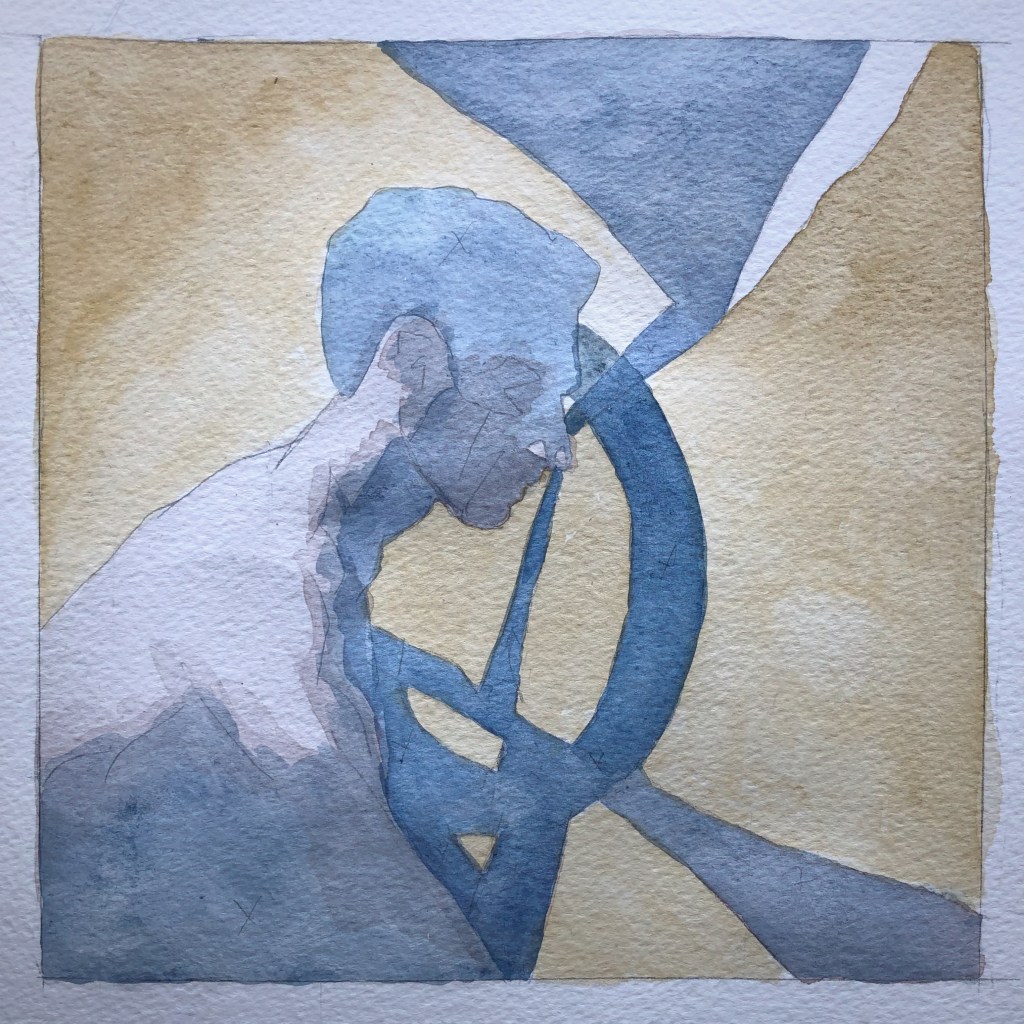
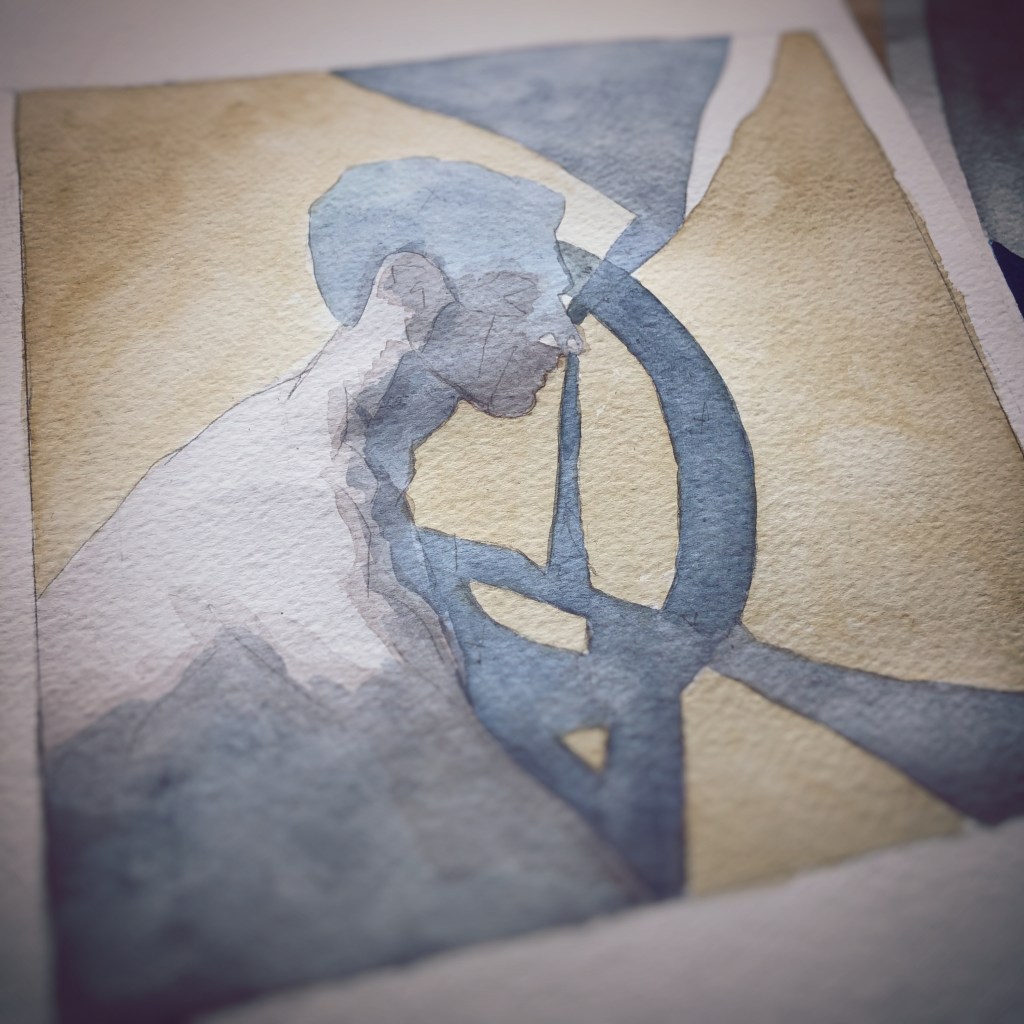
Vision in motion, layer upon layer

This is an exercise. Form and color. Loading the brush with pigment and applying it to the paper. Quick strokes. Vision in motion.

Painting by the light of the apartment’s living room window. The sun light is best in the morning. But I have continued this project well past the noon hour.

“Why do you keep painting,” asks my child.

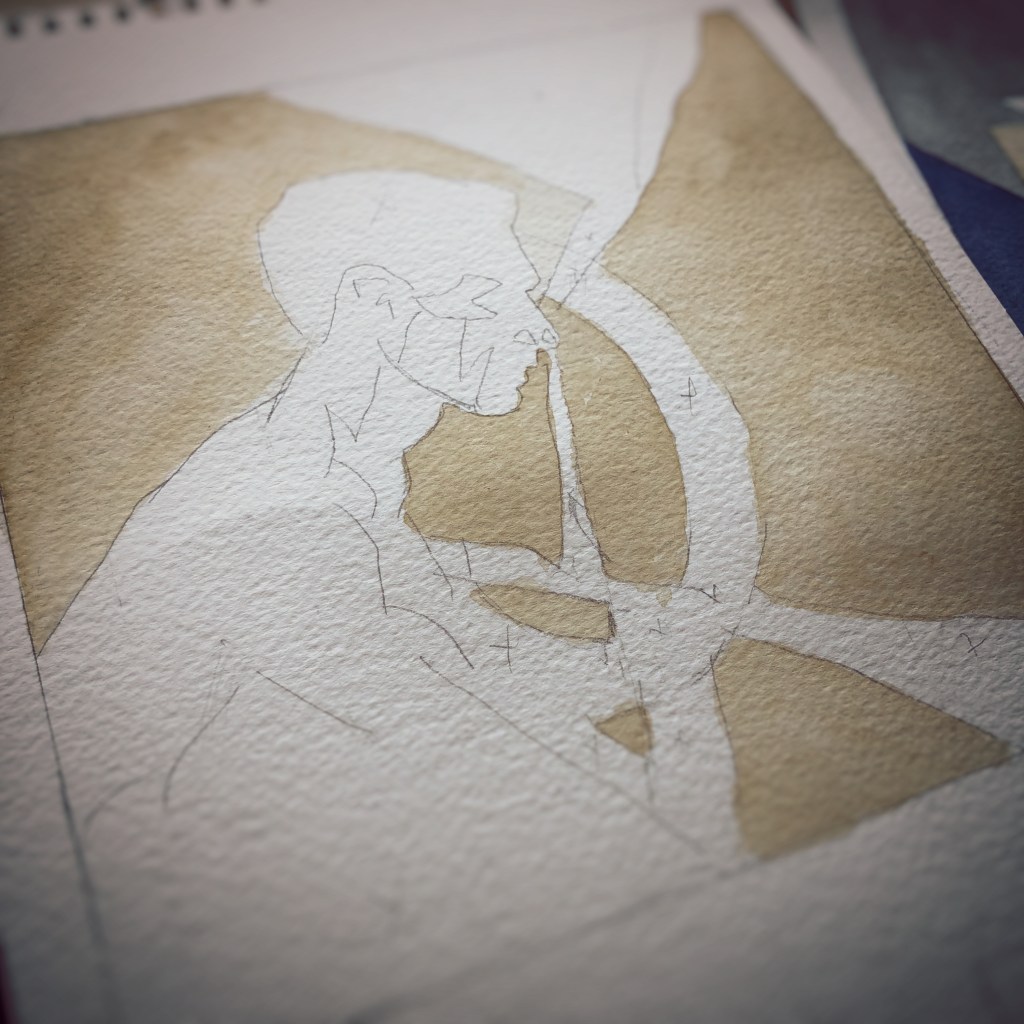
“It’s underpainting,” I say as I clean the brushes and prepare for an afternoon walk. “The lighter tones provide the base. When the paint dries I add more color layers.”

It is January. It is Winter. The outdoor temperature is above the freezing point. We walk to the library and return books. We continue to talk.

Vision in motion

Trying something new. Or, rather, returning to something old.

Here is a first draft for consideration.

Will provide details as updates are available. Let’s see how this turns out.

Weekend sketch – Sarah and the king of the goblins

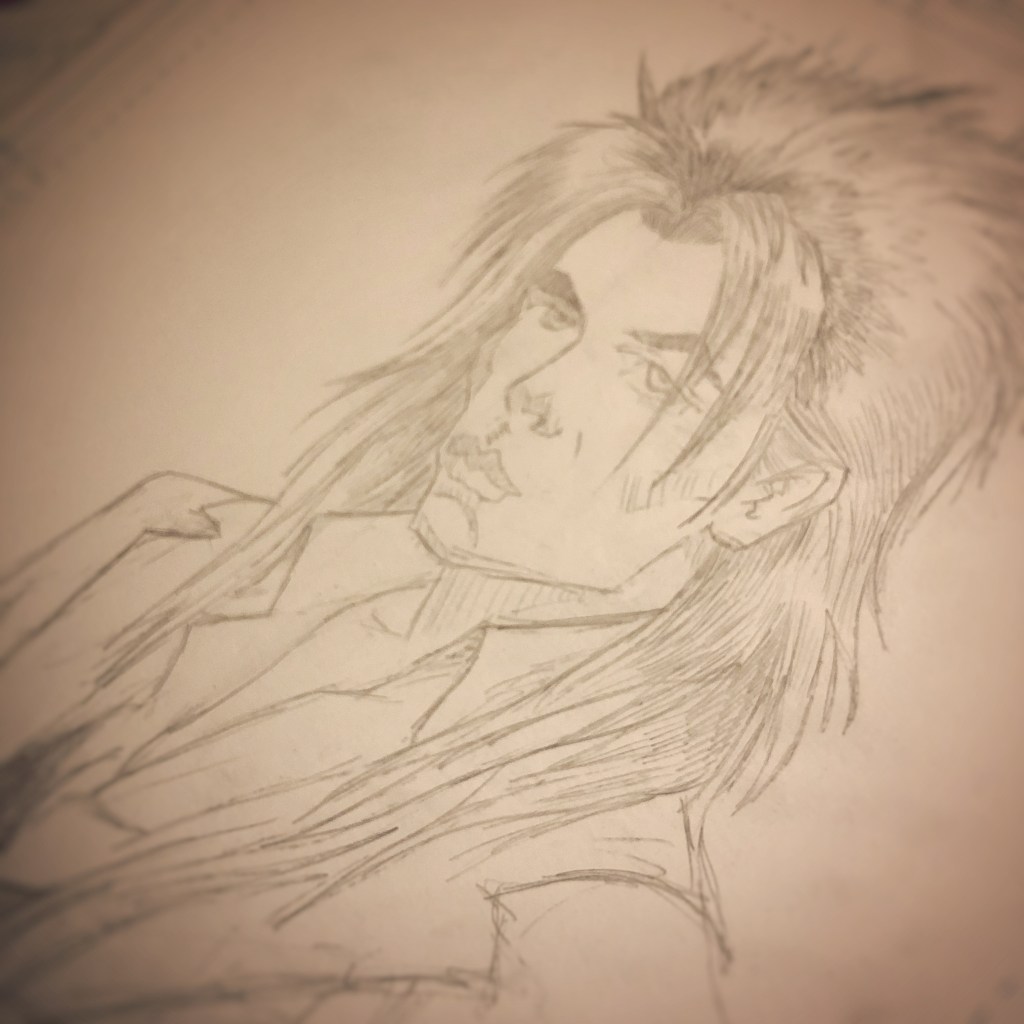
Another sketch from the weekend. Inspired by the film Labyrinth, I reimagined Jareth, the king of the goblins, and Sarah. The first time I saw the film was in art class. The high school art teacher thought it would be inspiring. It has captivated my imagination ever since.

Weekend sketch – Jareth, the Goblin King

Inspired by the 1986 film Labyrinth, I sketched a portrait of Jareth the Goblin King.

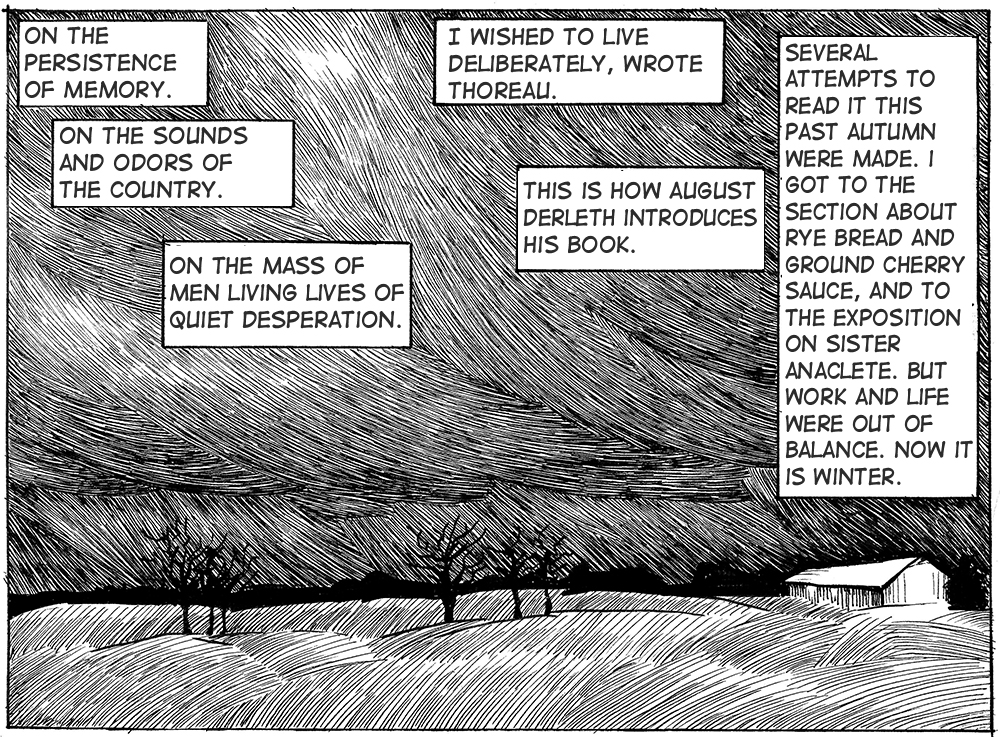
Now it is winter

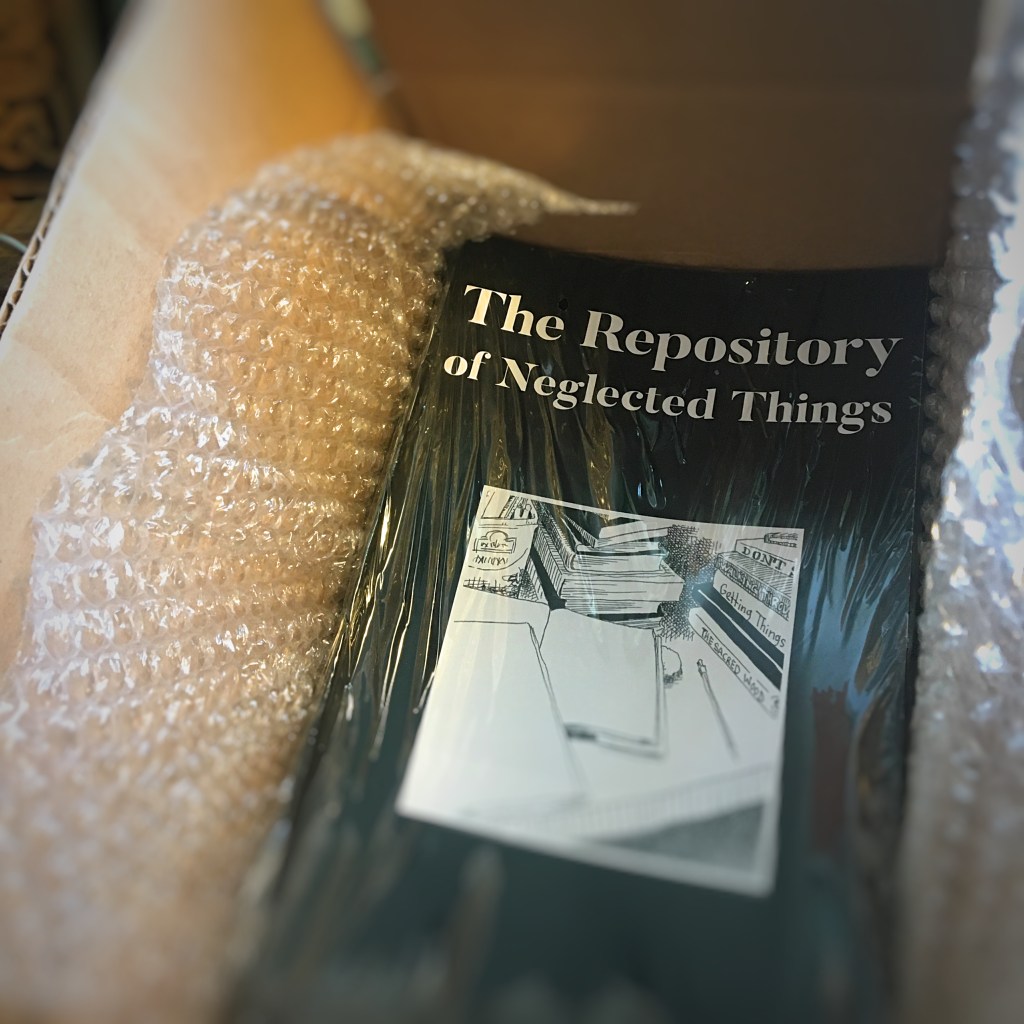
The Repository of Neglected Things, published

Why was The Repository of Neglected Things written, illustrated and published?

The idea of this published project began grudgingly.

First, some background. Old sketchbooks, from decades ago, resurfaced when I cleaned the garage a year or so ago. 

“What am I going to do with these?” I asked my wife. 

“Save them,” she answered. 

The cleaning plan was to throw away or sell garage items. Throwing away these large sketchbooks was not an option. And neither was selling them. The black cloth cover hardback sketchbooks varied in sizes. Most of them were nine inches wide by 12 inches high with 96 to 110 pages. Some were smaller. The smallest was four inches wide by six inches high. The largest was 11 inches wide by 14 inches high. 

A navy blue cloth cover hardback sketchbook made its way from the garage to my desk. It measured six inches wide by nine inches high. The little blue book was half full of sketches. Or half empty. As many as 40 blank pages. My wife encouraged me to fill the blue cloth sketchbook with drawings. My children asked me to make more drawings. One of the children requested I storyboard a comic book. Or picture book. Reluctant, I began a few pencil drawings. My wife bought me some brush markers. I added more sketches. Once the blue sketchbook was filled with drawings, I reviewed it. Should I return it to the garage with the other black sketchbooks?

Summer faded to Autumn. A plan formed around the recently filled blue sketchbook. A mission to show my children that they can write and illustrate their own stories, their own books. The goal. Showcase their work in a print publication. A comic book. With creativity and energy they pulled their stories together. They learned about the process of creating a story, illustrating, organizing pages and layout, and basic pre-press tasks. The stories from the children featured one about cats baking muffins and another of a mouse warrior. My contribution to the anthology was selected drawings from the blue sketchbook. The art inside spanned twenty years. A single narrative titled “The Little Blue Sketchbook” tied the drawings together.

Finally, the publication The Repository of Neglected Things arrived. The children celebrated by flipping through the pages. They paused to examine their contributions. They read selections to each other. And then collected copies to send to friends and family. One child asked, “So, when do we publish the next edition?”

Charlie’s golden beetle cafe and other sketches

After supper, kidlingers helped with laundry. And kitchen dishes. Provided a few minutes for me to organize and store some of my art work.
 
Some ink on paper drawings fell to the floor. Collected at the back of an art portfolio presentation book, they escaped when I opened it. Not sure why they were loose. Too small? Or, I was in a hurry and stuffed them there years ago. Now scattered on the floor, I considered their future.
 
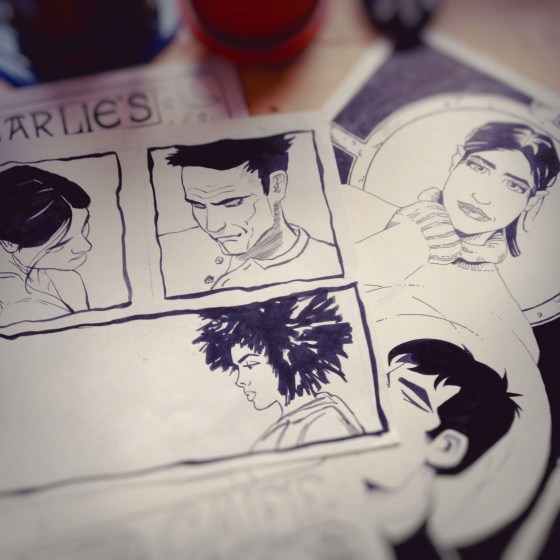
I picked up a mocked up advertisement for Charlie’s Golden Beetle Café. It was part art deco and part art nouveau. And had a dash of Alphonse Mucha-inspired design with a Patrick Nagel homage. Inked with crow quill and brush, the shellac of the pigment still shined. I placed it on my desk and picked up another page. A character model sheet for a comic book proposal displayed across several pages. Half pages and scrap illustration board. Some in black ink. Some had splashes of red to highlight an aspect of the character’s costume. I gathered up a couple pages of ink brush sketches. Practice sheets. Or illustration exercises.
 
What to do with this stuff?
 
Someone called from the other room. It sounded urgent. And yet not desperate. But still. Family duties called. 
 
I picked up the presentation book. It collected a comic book art pages I drew many years ago. A sixteen-page indie comic book story and two other short comic stories. There were no empty clear pockets to place the loose art.
 
I grabbed the ink drawing pages from the desk and began placing them. The presentation book featured 24 clear pockets. Each pocket sandwiched two comic book art pages and a black paper divider. I slide one of the ink drawings between the black paper divider and a finished comic art page. I continued hiding drawings in that manner until all the desk was clean.
 
And someone called again.
 
I closed the presentation book. And placed it in The New Yorker magazine tote bag along with another art portfolio. I paused. Looked at the pencils, pens, and brushes on the desk. Then answered the call.

Practice art work

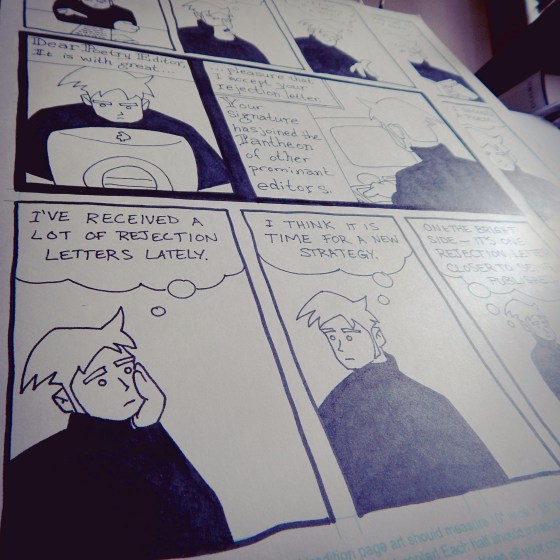
From the archives. This goes back quite a few years. Before social media. And iPhones. How did I manage to create a regular comic strip with a full-time day job?

In truth it took a few years. Little by little. The style developed from pen and brush inking techniques — more realistic illustrations — to Sharpie® marker and Sakura Micron pen illustrations — more graphic and cartoonish. The intent was to streamline the process and art style in order to work quicker. However, the reality is that the graphic, cartoonish style takes just as much time as pen and brush. Just in different applications.

The character remains unnamed — loosely referred to as a young artist. Dressed with black turtleneck and unkept hair. The comic strip ran for maybe a year before the newspaper ended publication. A lot of newspapers and magazines shuddered that year.

I return to the “young artist.” To practice art work. A creative workout. Similar to physical fitness routines. An effort to keep the motor skills of drawing and illustration in shape.

Recent practice comic strips created remain unpublished. Private exercises. Not published in an independent newspaper. Not for public show on Instagram. Or Facebook. I do not have accounts on those social media platforms.

I may share them here. This has become a digital repository of material I find in old art portfolios and sketch books.

“Art is work”

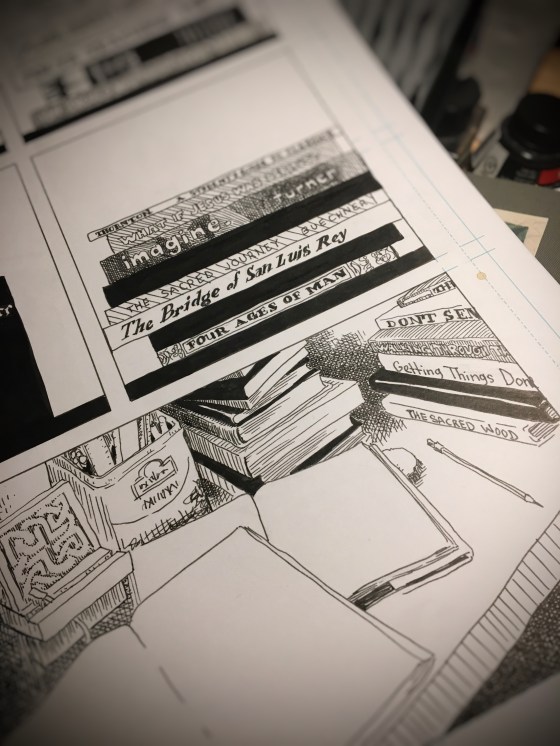
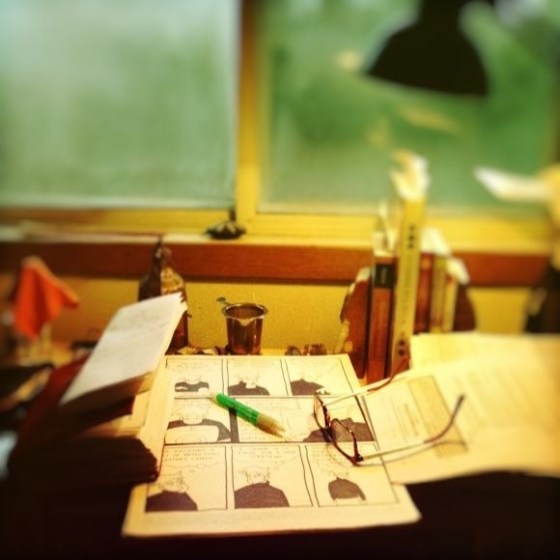
A drawing of my desk with books read, unread, or partially read.

It is a challenge for me. When I am introduced as an artist and/or poet. Still not comfortable with either of those nouns. The next question is inevitable. It usually goes something like this:

My wife turns and introduces me to her friend and adds, “He’s also an artist and poet, too.”

“Wow, can I see your art work on Facebook?”

“No. I am not on Facebook.”

“Oh. Instagram?”

“No. Not on Instagram, either.”

“Well. Um. What do you do? Oil paintings? Do you have a gallery somewhere?”

“He posts some of his work on his blog,” my wife offers.

About that time the bread crumb trail ends and the conversation shifts to something else.

The trouble is that some of the work I create I cannot contractually share. Technically, I do not own the copyrights to the final art. And so, I cannot distribute or display it on this or other online platforms. Frustrating. Yes. Bad. No. It is the cost of commercial arts.

For example, a couple weeks ago I drew a portrait. A line art drawing. The portrait will be featured as an etching in either crystal or acrylic as part of a lifetime award. Sometime in March. You may have seen such awards in business offices. A crystal award on black base sitting on someone’s desk or shelf or trophy case.

I am reminded of one of Milton Glaser’s mottos: “Art is work.”

Milton Glaser, celebrated graphic designer, may not be a household name. Not even in my home. But most Americans will recognize the I [heart] NY logo. It is highly unlikely that school children will study designers as part of their art curriculum. (My children are presently studying the American painter Andrew Wyeth.)

Too often I lament, or rather, complain that I spend too much time creating work in front of a screen. It was so nice to ditch the screen and work in ink on vellum and illustration paper. Took nearly four hours to draw the portrait. And that is with the interruptions of replying to emails and designing elements for a multi-page editorial piece. It would take four weeks if I tried to craft the portrait as an oil painting.

In order to answer a request (Where may I find your art work?), I drew the above page last weekend. Inspired by Jane Mount’s Ideal Bookshelf, I managed to draw the stacks of books on my desk by the bedroom window. At least fifty books. So many books. So little time. I enjoyed the exercise. It felt good to pencil a sketch, flesh out the details, and ink the page.

“Wait. You write poetry, too?”

“Um…” I start.

“Have you been published?”

“Yes,” I say.

And this time the bread crumb trail ends quickly. Because most people do not know where to begin to look for published poetry.

“He posts some of his published poems on his blog,” my wife adds.

Comic book pages found

“What’s that?”
 
I turned to give the kidlinger a better view. 
 
“Did you draw all that?”
 
I nodded. 
 
Three years ago I rediscovered these 11 inch by 17 inch pages. Illustrated comic book pages hidden in a storage container. A gray Rubbermaid® Roughneck® storage tote of the 18 gallon variety. I stored art supplies, books, family keepsakes, manuscripts, and tools in dozens of similar totes. Living in a humid subtropic climate at the time, I did this to avoid water damage and mold ruining art and other supplies. Additionally, heavy duty polypropylene bags also prevent mold and water damage. To offer an added level of protection I used the technique of poly bagging art pages and then placing them within totes. When I moved across the country this also acted as a good way to pack.
 
However, that was not the case with these pages of art I discovered three years ago. Like an archeologist, I excavated those pages from a gray Rubbermaid®  tote. They were loose in the tote. Not poly bagged. Print samples of graphic design projects filled the tote as well. And also old newspapers and magazines. Either these publications featured something I wrote or something I designed.
 
In an effort to preserve the illustrated comic book pages, I found an old presentation book used for interviews. The Itoya Original Art Portfolio presentation books work the best. Good for professional presentation and storage.
 
During the holiday season I found one of the portfolio books with those illustrated comic book pages. Examined them again. This time one of the kidlingers was spying over my shoulder. 
 
“These are really good,” the kidlinger said. “Better than I can draw.”
 
“These are practice pages.” I said. Paused to let the kidlinger read the panels on the page. For a brief moment a wave of vulnerability washed over me. A child-like anxiety of examinations. The kind of fear I had when a school teacher reviewed my arithmetic work during class. Found an error and announced it so that all the class might hear. Why had I felt that way about my child reading this page? There were no objectionable elements to the story. Nor art. Nothing inappropriate for the kidlinger’s age. The moment passed.
 
“What language is this?” Kidlinger pointed at one of the panels on the page. 
 
“German.” I answered. “Deutsche.” 
 
The kidlinger hesitated. I considered translating the passage: Im Schatten sah ich. . .
 
“Lines from a German poem,” I said. “I added it to the story to help me remember the poem.”
 
Or to add texture to the short slice-of-life comic book story I composed. Sequential art as some have called it. A clever way of renaming comic book art.
 
I did not purchase my own comic book until I was in high school. An art teacher suggested that it may be a good way to study human anatomy. And it was. Exaggerated, dynamic anatomy. Superhero comic books were the only type sold at the local gas station on the way to school. The public library carried collections of Peanuts. But nothing like Superman or Batman. They did, however, carry the Classics Illustrated book series. Excalibur was the name of the comic book I bought at the gas station.
 
Though superhero comic books introduced me to sequential art, it was the slice-of-life stories that intrigued me. At the time, I had not heard of nor read American Splendor, Berlin, Cerebus, or Strangers in Paradise. But that was the direction I was headed creatively.
 
I probably added lines of German poetry to seem more sophisticated. To elevate comic book pages to sequential art.
 
“You wrote each of these stories, too?”
 
“Yes,” I answered the kidlinger. “Every one.”
 
I started to say something. To explain that these were practice stories and drawings. I wrote the script and illustrated the pages a decade ago. No. Maybe two. Each page, each panel pencilled and inked with crow quill and brush. It was practice for greater things.
 
My goal in those days was to publish a comic book or a childrens book. I did not know how. But the owner of a comic book store suggested I visit some comic book conventions. I did. And even booked a table on artists alley for a couple comic cons.
 
Artists alleys are a feature in nearly every comic con. The alleys feature artists and writers showing their work in hopes of securing a job with a major publisher. Or any publisher for that matter. Or trying to sell their own artwork. I met several artist and writers at these comic cons. And learned how hard I needed to work. Over time, I connected with writers and got a few independent projects. Some of them published. Most remained unpublished.
 
The kidlinger flipped through the entire portfolio. Read through several 2-page and 5-page stories.
 
“Nice,” said the kidlinger. An expression newly formed in the teenager’s mind to mean awesome or fantastic or good.
 
“What do you think?” I asked. 
 
“I don’t know,” said the kidlinger and ambled out of the room. 
 
I thought about that for awhile. What had the kidlinger found in looking through these pages? These artifacts? In a way, this portfolio is a childrens book for at least one child — my child — mein Kind. But these pages remain unpublished. Hidden in a black portfolio book. Even a fragment of a German poem remained hidden: Im Schatten sah ich/Ein Blümchen stehn. . .
 
I stumble through a translation:
 
In shadow I saw
a flower stand. . .
 
Or maybe:
 
In shade I saw
a flower grow. . . 
 
What is that? Goethe? Was I reading Goethe back then?
 
I will not deny the desire that someday I would like these early drawings and writings published. But why? Maybe my desire is misplaced. Maybe these pages should remain in the shadow. In the shade. They are practice pages after all.
 
And then I have discovered something else. I was reading Goethe when I illustrated those pages. A fragment from Goethe’s poem “Gefunden.” Or, in English, “Found.”

Three-tone stained pallet wood bookshelf

Summer therapy project, part five

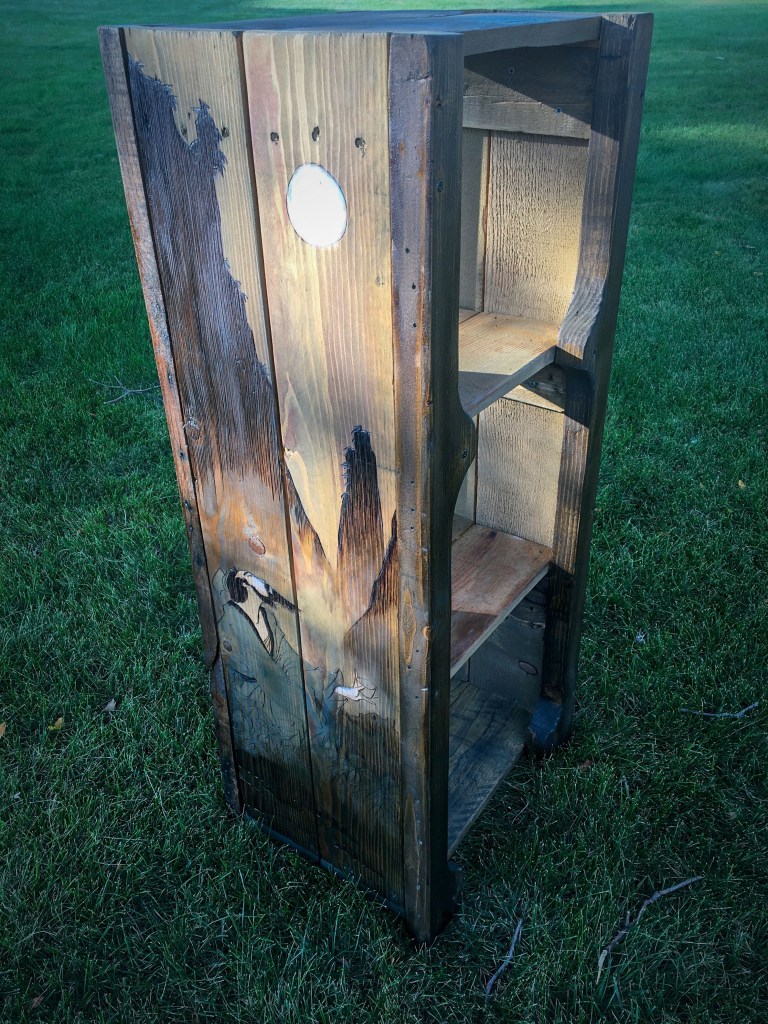
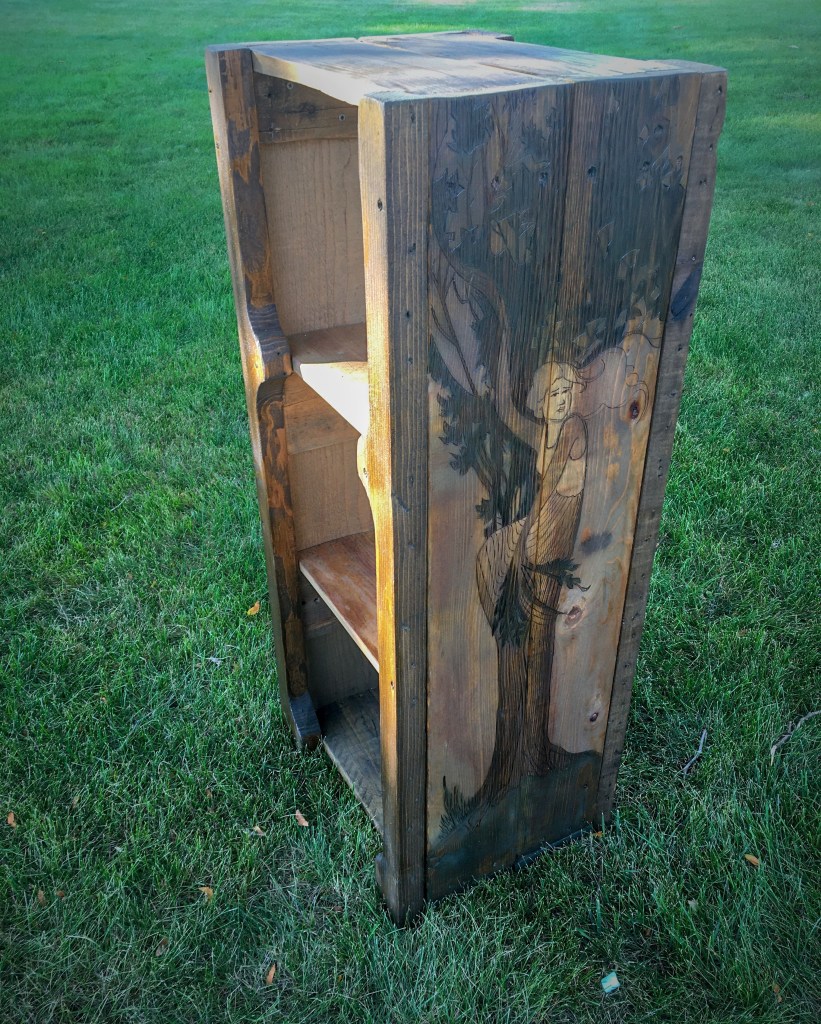
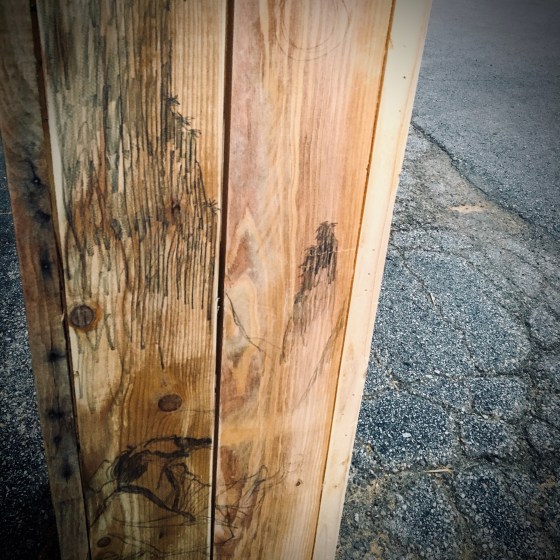
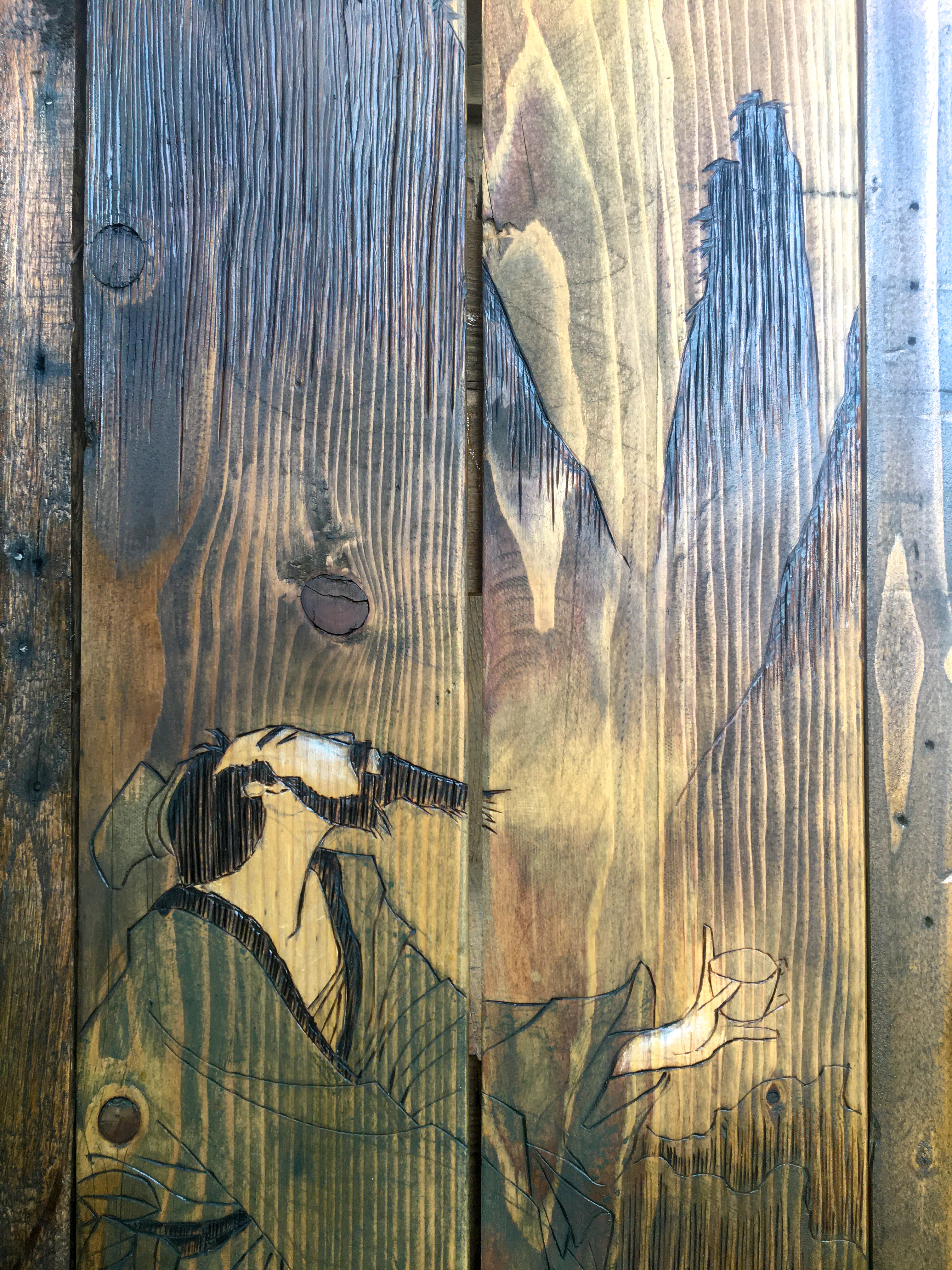
With the scenes from Eastern and Western literature burned into the side boards, I added three shades of of wood stain. Three tones if you will: gray, green, and dark brown. And a little bit of white oil paint for the moon. Maybe the addition of white paint was too much — a flourish, embellishment. No take backs. What is done is done. Only two more steps remain: wood finish and installation. 

I am a little embarrassed by how long it took to build and decorate this no-plan, salvaged-wood bookshelf. And yet, the process was enjoyable, painful, and therapeutic. 


Summer therapy project, part four

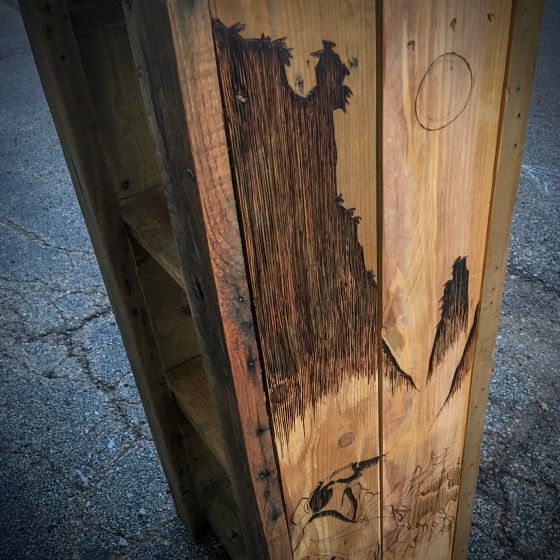
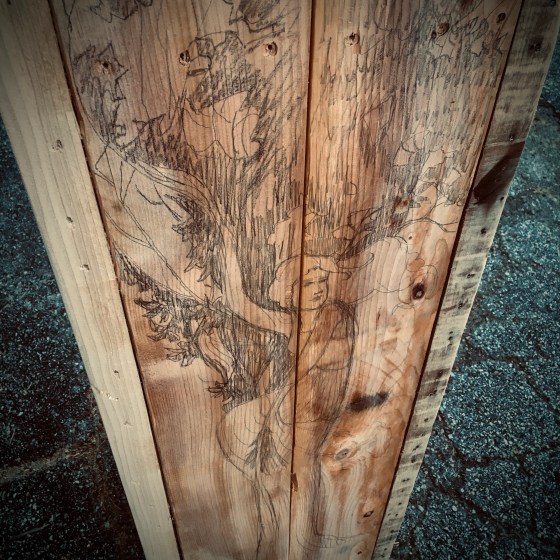
In the back of my mind I wanted the artwork on the bookshelf to be imperceptible. To be part of the wood. To appear as if it were coming out from the wood. Something that a casually observer might miss. But an astute observer would cast a second and a third glance and then walk up close to inspect the nearly hidden image.

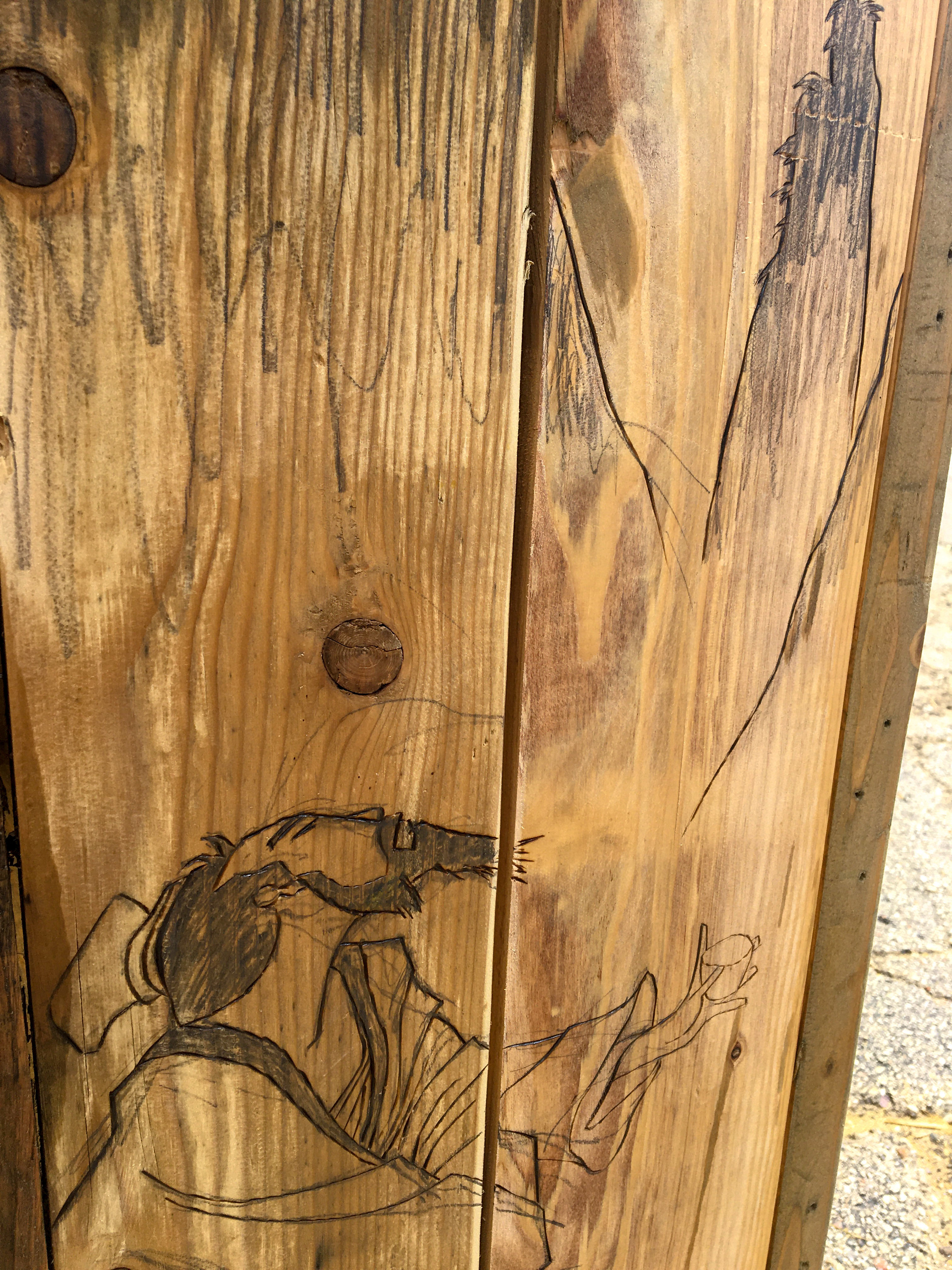
Instead of painting the scenes on to the bookshelf, I chose woodburning. The results surprised me. And my kidlingers. The long process of transforming the graphite sketches into dramatic burnt dark figures amazed them. And the craft and process of making the art renewed my imagination.

Too often I spend my day in front of a screen reading, researching and replying to emails. It’s knowledge work. It’s spreadsheets, production reports, and project management. These are all important elements in the workflow of art direction and graphic design. But they can become a psychic vampire as one coworker likes to say. And this summer therapy project was part of the remedy.

Literary scenes from the East and the West


Summer therapy project, part three

What is a challenge if it is too easily accomplished? Why not decorate the salvaged-wood, no-plan bookshelf?

Who suggested the idea is forgotten. Whether it was one of the kidlingers, or my wife, or myself is not important. But through the summer week nights and weekends a conversation took place as to decorating the bookshelf.

Since the bookshelf was intended to house schoolbooks, I decided to draw a scene inspired from Eastern literature and a scene inspired from Western literature.

Earlier in the year I had been reading Tu Fu, the autobiography of a Chinese poet, translated by Florence Ayscough. The author records Tu Fu’s reflection of his early years,

“Aged nine, I wrote large characters
There were enough to fill a hard-bottomed bag.”

Tu Fu, from “Years of Strength Travel”

I intended on drawing a scene from that book. But decided upon Li Po instead. One poem captured my imagination.

I raise my cup to invite bright moon, . . .

I sing and the moon dances,
I dance, and my shadow tumbles
Sober, we share the joy we knew…”

from Li Po’s “Drinking Alone under the Moon”

I found a couple paintings of Li Po on the internet. That became the drawing for the Eastern side of the bookshelf.

For the Western side of the bookshelf, I selected the story of Daphne and the laurel tree. Years ago I acquired Myths and Enchantment Tales by Margaret Evens Price. During the first month of the safer-at-home orders from the state I rediscovered the book. The story of Cupid and Apollo caught my eye because of a detail I had overlooked. Peneus, the river god and father of Daphne, turned his daughter in to a tree in the forest to protect her from a love-struck Apollo. Price’s lovely illustration was the source of the inspiration. And gave me an excuse to play the woodgrain of the side boards into the illustration.


Raised cup to invite the moon


Bookshelf art – before and after

It was cold. A political rally mangled traffic downtown. Everything seemed off schedule. I missed the street car to the train station by minutes and had to walk. The winter weather depleted the battery of my smartphone. Commuters waited at the Intermodal. The last train of the night was late.

There was a special one-hour podcast on obscure tunes from the Real Book loaded on my smartphone. I wanted to listen to jazz music. But I didn’t want to run out of battery. In case the train was delayed. And I had to call my wife to pick me up.

The previous weekend I checked out a book of poetry from the public library. A collection of poems, translated into English, of Li Po. Before I knew it I had found a friend. The translator made it inviting to enter the world and work of Li Po.

Soon the train arrived and I boarded. Found a seat. Plugged my phone into the outlet. Opened the book and continued reading. The train passed over the river and had nearly cleared the Third Ward when I caught a glimpsed of the moon over Lake Michigan.

“I raise my cup to invite the bright moon, . . .” wrote Li Po.

Maybe that endured me to Li Po. Or at least inspired me to feature an illustration of Li Po on a bookshelf I built this summer.

There are a couple Li Po illustrations I made during the last year or so. But the one for the new bookshelf is the most ambitious and detailed. Maybe I will share some posts about the bookshelf project with you later. I had considered writing a series of short posts about how it all came together. Sort of a how-to, or how it was done, type of posts. But the story about why I chose to decorate the sides of the bookshelf seems to interest people more than how I built it.

As the nights grow longer and colder, the illustrated bookshelf is now installed in the living room.

Serious things

“What did you do last night?” she asked as we walked through the neighborhood in the pre-dawn moments of the day.

“I worked ’til six. Clocked out. Made supper. And spent a couple hours drawing.”

She did not say anything for a few dozen steps. She took the kidlingers on an adventure the night before. And she was tired.

I continued. “The challenge is that it takes me nearly an hour to set up. Not just gathering tools like pencil, ink, brush, illustration board, and setting up a space to work. But planning. Composing a page. Thumbnail sketches. Reference materials and such.”

She listened. We walked further. In the hour before sunrise, I looked East. I saw Venus. Or maybe Regulus. Possibly both.

“By the time everyone got home,” I said. “I had finished marking out a page and composing three panels.”

She told me about a conversation with the one of the kidlingers as we walked. We exchanged comments about plans for the day. We continued for a quarter mile or so before returning home.

Thoughts of last night’s drawings were pushed into the shadows of a day filled with choses sérieuses.

Try again another night

How long did I look at this drawing the other night? 15 minutes? 30 minutes?

Calculated the time it would take to complete the drawing. Did I have the time?

Considered if the time spent on this illustration was valuable.

Too late. A kidlinger requested help. Followed by a short list of other household chores.

The illustration was placed back in the portfolio with 60 other drawings in various stages of completion.

Try it again another night.

Art making in quarantine

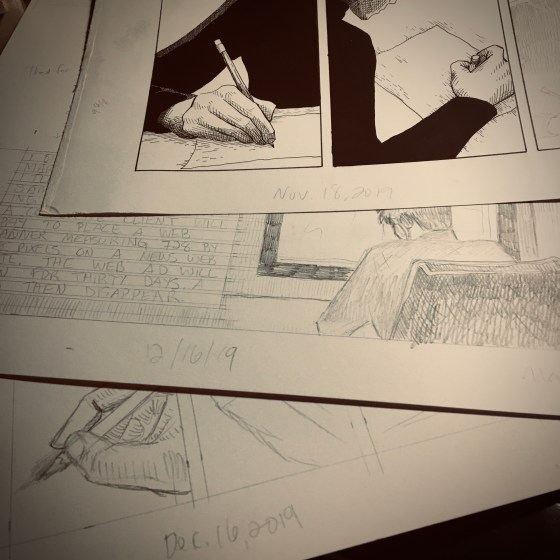
Inspired by Inktober 2019, I kept working on illustrations throughout November and December. For me, this was intentional art exercise. Keeping up the practice of crafting pencil compositions on illustration board. It was a private affair. No commercial application. Just me, a pencil, and board. But I hit a dry spell entering the new year. Actually, it was not a dry spell, but rather a lack of designated time to practice.

Commuting for two hours a day was part of the daily routine. By train and by street car. Or by automobile. Traveling sapped my energy. But now with state and government safe at home orders, I tried to ease back into evening illustration exercise.

Working from home had its own set of demands. Working from home with a family in an area of less than 1000 square feet presented additional challenges. But these are first world problems.

The first week was difficult. Routines and life patterns merged. A lot of discovery. Kidlingers and spouse realized what I did for work all day. Or at least attempted to do in spite of technological challenges with internet speed and video conferencing.

All evening activities outside the home had been cancelled until further notice. I had more time to catch up on reading and art projects. But resuming the exercise of illustration was difficult.

The first evening all I did was organize and clean the art tools and space. The next night all I did was ink one of the drawings. The plan for the illustrations were simple, clean drawings in the fashion of cartoons and comic books. Another night all I did was tone an illustration with shading and hatching. The direction shifted to a stylized portrait. The results surprised and pleased me.

This encouraged me to continue the practice. And it also encouraged the kidlingers to make art as well.

Reflections on a decade of sharing Advent poetry and art


A 183-word blog post published a few years ago became the most visited blog post I have written. How did this all begin? Part of the story started with a family tradition of creating handmade greeting cards. Part of the story involved a search for good seasonal, Christmas poems. Part of the story was how a father learned about Advent.

Last year I had the ambition to share a poem a day throughout the season of Advent. Newly discovered poems by Czeslaw Milosz, Christian Wiman, Edmund Spenser, and others. Unfortunately, work life became unmanageable due to circumstances beyond my control. Only six poems shared during last year’s 2018 Advent season.

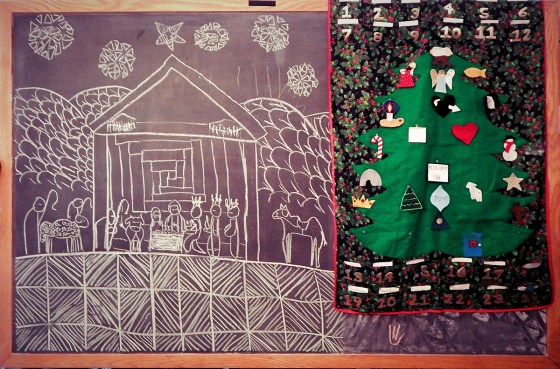
This year the plan was to share twelve poems during the Advent season. But again, work life demands became excessively burdensome. The poems were not released. They remain in the draft category of the content management system. In spite of the hurly-burly of this December, one of the children drew a very nice drawing on the chalkboard. It accompanies the Advent calendar that our family has used each year for more than a decade.

Finally, I wrote a long-ish essay to mark the decade. A story about the handmade greeting cards, the search for good Christmas poems, and how a father learned about Advent. But I decided not to publish it. I doubt anyone is interested in the story. In lieu of that, here are blog links that highlight the last ten years of Advent art, audio recordings, blog posts, and poems.

2018

Let Evening Come, Jane Kenyon
A Scandal in the Suburbs, X.J. Kennedy
Hill Christmas, R. S. Thomas
Remembering that it happened once, Wendell Berry
Advent, Mary Jo Salter
Advent, Patrick Kavanagh

2017

Exploring 12 Days of Advent poetry

2016

A holiday podcast for Christmas Day

2015

It’s that time of year
First Sunday of Advent — Poems
Second Sunday of Advent — Poems
Third Sunday of Advent — Poems
Fourth Sunday of Advent — Poems

2012

Advent Poems (or 12 days of poetry)

2011

Mighty Mercy, John Piper
Advent Calendar, Rowan Williams
Annunciation, Denise Levertov
The God We Hardly Knew, Óscar Romero
Mosaic of the Nativity (Serbia, Winter 1993), Jane Kenyon
Advent, Donald Hall
For Christmas Day, Charles Wesley

2010

Into The Darkest Hour, Madeleine L’Engle
The Winter Is Cold, Is Cold, Madeleine L’Engle

2009

Woodblock printing on a budget
Diy woodblock prints/greeting cards
“Christmas night,” a limited edition woodblock print
Woodblock prints/greeting cards
“Peace on earth,” a limited edition woodblock print

Finish what was started


One of the challenges of an artist and designer is the amount of unfinished sketches or mock-ups (a working sample of an illustration or design) that collect over the years.

Found a unfinished illustration from over five years ago. Decided to finish the ink drawing. Added watercolor as a painting exercise.

Never too late to complete an unfinished illustration.

A good test of skills


Tested a couple old brushes using a dozen watercolor half pans on illustration paper. Purchased the art supplies for a book cover illustration project a few years ago. Have not had the occasion to use them since then. Apart from recreational sketches and practice.


Painted some studies of graphic design advertisement posters from the 1960s. Muscle memory atrophied more than expected. How does the aphorism go? Either control the watercolors or they will control the painting. Some clumsy mistakes. A good test of skills. Not ready to paint a book cover illustration. But the exercise warmed up the muscles and mind to consider more opportunities.

Inktober — Day 23 #inktober #inktober2019

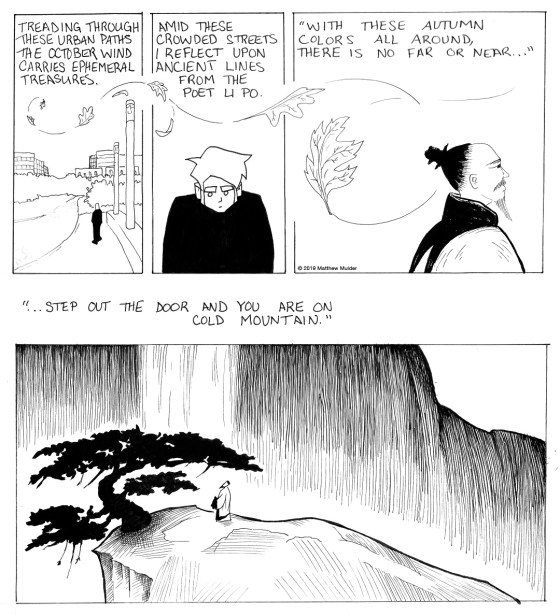
Tried to accomplish four Inktober prompts in this illustration — days 20 through 23. Inspiration for the piece comes from reading the poetry of Li Po.

Enjoy — and keep inking!

Inktober — Day 15 #inktober #inktober2019

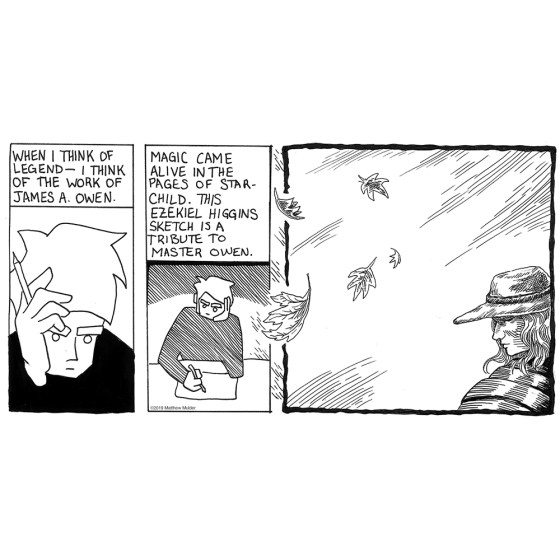
Inktober’s rules are simple: draw something in ink each day for the month of October, post it online, hashtag it, and repeat. So, if I draw three panels in a single day, does that make up for two missed days?

Ever watch those drawing challenges? Do a drawing or illustration in 10 minutes, 1 minute, and 10 seconds. My self-imposed challenge for day 15 was two hours.

The prompt that day was “legend.” The inspiration: two-fold. One, I revived a cartoon character I created long, long ago. Two, an homage to Starchild, created by James A. Owen.

The big challenge for me is that a two-hour block of time is a lavish luxury for me. It means I can not begin until the work day is done, household chores completed, and kidlingers in bed. Mostly.

Before I finished the inking process, one of the kidlingers reminded me that within the two-hour window I stopped twice. Once to spend 15 minutes brewing a pot of tea for the night owls of the household. And once to re-tuck a younger kidlinger into bed.

Hope you enjoy the results of day 15 of Inktober.

Thursday reminder to keep going


What does one do with old, unpublished artwork? Dozens upon dozens of illustrations remain hidden. Housed in art portfolio cases and cardboard boxes. These sketches, drawings and illustrations remain artifacts of decades of work.

They resurfaced this summer. Drawings and illustrations created with the purpose of advancing a career as a children’s book writer/illustrator, comic book artist and/or cartoonist. Several four-page comic book stories present an exercise toward a full-length comic book. Inspired by the 1990s indie comic scene, a lot of the stories are slice-of-life scenes and dramas. One collection of illustrations is a story written by a friend. Another set of drawings features character drawings for a writer seeking to pitch a proposal to Image Comics.

There is a portfolio case filled with pages of a first issue and half a second issue of an indie comic. It was created for a writer who contacted me to collaborate on the project. The pages display pen and brush illustrations. Think of the early work of David Collier. If he drew every page with his right hand. (He is left-handed. If I recall correctly.) On second thought, maybe it doesn’t look anything like David Collier’s work. The struggle with this indie project was that I learned that I do not illustrate fast and well at the same time. Back in those pre-iPhone/pre-Twitter days, I worked as a graphic designer during the day and an artist by night. A 30-day deadline to complete 22 pages plus cover art was a difficult task. If I had worked eight hours a day on the project instead of two hours a day, maybe the results would have been better. The indie comic was never published.

Another sketch book has pages of comps for a cartoon strip. The idea was that if I cannot draw detailed panels and pages fast, maybe I can draw cartoons faster. So, I created a cartoon character and comic strip and discovered that drawing a cartoon is just as time intensive as illustrating detailed comic pages. I pivoted toward a cartoon style similar to Jim Davis. In short, a comic strip with near static panels and subtle changes in art between one panel and the next. Sort of a pre-Adam Ellis templated four-panel strip. The comic strip was published regularly in a North Carolina alternative newspaper until the paper took an extended sabbatical.

“I like that one,” my bride commented. Dozens of cartoon pages rest on a desk in our bedroom.

“Maybe I should collect these pages into a book,” I offered.

“What do mean?”

“You know, like an artist’s sketchbook or portfolio book. I’ve got several of those type of books.” I think of books like Michael Wm. Kaluta Sketchbook or C. Vess Sketchbook.

“Yeah, but aren’t those more like retrospectives of an artist’s celebrated career?”

“Hm. Yeah. I guess you’re right,” I answered. But why can’t it be used to promote a career, I think to myself.

“Maybe after you’ve published your magnum opus.”

“Yeah. I guess so.”

The illustration boards still rest on the desk I built from salvaged wood. A reminder to keep going.

Milwaukee Art Museum school tour

The tour agenda planned for Nov. 11 will highlight paintings and sculptures covering nearly 700 years of Western art. With thousands of art objects to consider, I narrowed the focus to the list provided below. The idea is to feature on one or two works of art per century with the exception of the last two centuries. The tour is organized chronologically in reverse beginning with Wiley’s St. Dionysus, 2006 and concluding with Nardo di Cione’s Madonna and Child, 1350. Below is the planned list of art pieces for Sunday’s tour:  

Contemporary

Kehinde WileySt. Dionysus, 2006

http://collection.mam.org/details.php?id=17255

 Chuck Close, Nancy, 1968

http://collection.mam.org/details.php?id=1114 

Modern

Josef Albers, Homage to the Square, 1958

http://collection.mam.org/details.php?id=2018

Anne TruittSummer Sentinel, 1963–72

http://collection.mam.org/details.php?id=2249

Pablo Picasso (Spanish, 1881–1973)

The Cock of the Liberation (Le Coq de la Liberation), 1944

http://collection.mam.org/details.php?id=7139

Georgia O’Keeffe (American, 1887–1986)

Grey and Brown Leaves, 1929

http://collection.mam.org/details.php?id=11193


1800-1899

Thomas Moran (American, b. England, 1837–1926)

Three Mile Harbor, Long Island, 1889

http://collection.mam.org/details.php?id=31680

Jules Bastien-Lepage (French, 1848–1884)

Le Père Jacques (The Wood Gatherer), 1881

http://collection.mam.org/details.php?id=21819

Winslow Homer (American, 1836–1910)

Hark! The Lark, 1882

http://collection.mam.org/details.php?id=19577

Christian Ludwig Bokelmann (German, 1844–1894)

The People’s Bank Shortly Before the Crash, 1877

http://collection.mam.org/details.php?id=16919


1700-1799

Adriaen van der Werff (Dutch, 1659–1722)

Doubting Thomas (The Incredulity of St. Thomas), 1710

http://collection.mam.org/details.php?id=10243

Antonio Balestra (Italian, 1666–1740)

The Meeting of Telemachus and Calypso, ca. 1700

http://collection.mam.org/details.php?id=13519


1600-1699

Giovanni Benedetto Castiglione (Italian, 1609–1664)

Noah and the Animals Entering the Ark, ca. 1650

http://collection.mam.org/details.php?id=5020

Matthias Stom[er] (Dutch, ca. 1600–after 1652)

Christ Before the High Priest, ca. 1633

http://collection.mam.org/details.php?id=4902


1500-1599

Triptych with Josiah and the Book , ca. 1550

http://collection.mam.org/details.php?id=15359

Battista Dossi (Italian, ca. 1490–1548)

Noli Me Tangere, ca. 1520

http://collection.mam.org/details.php?id=3626


1400-1499

Francesco Botticini (Italian, 1446–1497)

Madonna Adoring the Child, ca. 1480

http://collection.mam.org/details.php?id=381


1300-1399

Nardo di Cione (Italian, ca. 1320–1365 or 1366)

Madonna and Child, ca. 1350

http://collection.mam.org/details.php?id=6953