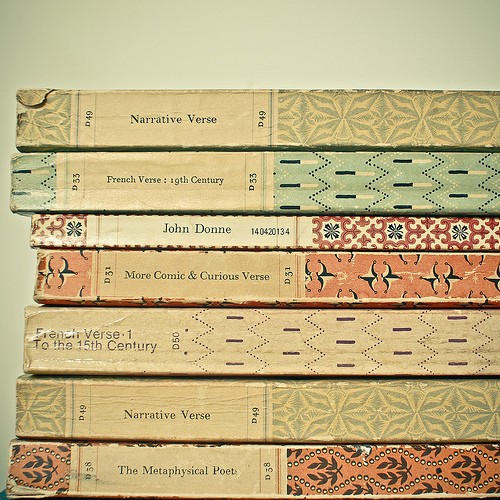
Brinkmann’s book Künstliches Licht begins with a poem titled after the French architectural style of roughly-finished concrete. Nothing more interesting than translating a German poem with French words and deeper contextual elements.

Look what arrived from across the pond. Forgive me for being rather spare with my online presence these last few weeks. I’ve got two good reasons and a surprise.
Okay so the big surprise is still in the works. Sorry for the tease. I’ve been working on something new and plan to launch it here in the near future. That’s all I can say at this point. By the end of the week I should have more details that I will share.
How did I overlook this? The Rapid River Magazine’s 14th annual poetry contest winners were announced earlier this month. Congrats Tracy Darling on receiving first place for the winning poem: ‘Offering Up the Main Course.’ All finalists are published in this month’s issue of the Rapid River Magazine as well as a review of Thomas Rain Crowe’s new book Crack Light.

Tomorrow We Sweat Poetry (paperback, 20 pgs, 8″x5″ $8 + s/h) is officially out of print.
Tomorrow We Sweat Poetry is the result of the workshop I directed called “Write and do not waste time” and features poems by Susan Ryonen Keene. A digital sample is available here. Each poetry writing workshop I direct invites students to contribute their best poems for publication in a poetry book. If you’re interested in an upcoming poetry writing workshop, please leave a comment or email me at coffeehousejunkie [at] gmail [dot] com.
Thank you all for your support!
Maybe ‘review’ is a bit of an erudite word to use in this blog title regarding Sunday’s poetry reading at Malaprop’s Bookstore/Café. But Sunday’s poetry reading may be one of the best Poetrio readings I’ve attended in a long time. After the snow flurries ceased the poetry began. Several local literary luminaries were in attendance including Pat Riviere-Seel, Gary Hawkins, Sebastian Matthews, Keith Flynn among others.

The first poet who read was Luke Hankins, Associate Editor of Asheville Poetry Review. I first learned about Luke from an article he wrote for the The Writer’s Chronicle and then I had the privelege to met him at one of the Poetry at The Pulp events last year.
He read from his recently published bilingual chapbook of translations, I WAS AFRAID OF VOWELS / THEIR PALENESS, of French poems by Stella Vinitchi Radulescu. Poems read include: ‘landscape in three movements,’ ‘children of the fog,’ ‘a cry in the snow,’ and the poem where the title of the chapbook originates — ‘adagio.’ Radulescu’s poems tend to be spare and short and afforded Luke opportunity to read some of his own poems. The difference between Luke and Stella’s styles offered a stimulating contrast to his portion of the Poetrio reading. Luke read another translation he had made of a different French poet. I didn’t catch the name of the poem or poet, but the poems essence was atmospheric (and reminded me of the poet Jean Orizet) and provided a beautiful centerpiece to his portion of Sunday’s reading.

Britt Kaufmann read next from her recently published chapbook BELONGING. Her chapbook was named a semi-finalist in the most recent competition for the New Women’s Voices Series at Finishing Line Press.
My introduction to Britt and her work was at a Flood Reading Series in February 2007. Poems read include: ‘Oak Leaf,’ Hand-Me-Down Gift,’ ‘Under Grandma’s Quilt, ‘Tobacco Barns,’ and others. Interestingly, the title poem to the chapbook is not included in the collection of poems. But Britt read it as her last poem of her portion of the event.
Britt’s poetry evokes a celebration of everyday moments too often overlooked. A lyrical ache subtly emerges from each poem the way daffodils quietly appear in late February here in the mountains. There’s a longing for meaning in each poem and a sense of contentment to just be.
If you missed Poetrio, Britt is scheduled to read on Friday May 6, 2011 at 4 p.m. at Wordfest at Grateful Steps Publishing House and Bookshop.

The final poet to read at Sunday’s Poetrio event was Landon Godfrey. She read from her recently published book, SECOND-SKIN RHINESTONE-SPANGLED NUDE SOUFFLE CHIFFON GOWN. David St. John chose her manuscript as the winner of the 2009 Cider Press Review Book Award.
A book title like this is hard to forget, and equally difficult to remember. I first heard Landon read the title poem at a Flood Reading Series in March 2009 [listen to the audio] and later at May 2009 Poetrio event. Other poems read at those 2009 readings included ‘Chanel No. 5,’ ‘Labor in Vain,’ ‘There Are Thousands of Stones in the Sky,’ and ‘On Black Cloth with White Chalk I Drew the Stars.’ Landon read some of those poems at Sunday’s Poetrio reading as well as others: ‘Landscape with Dialectical Materialism and Milk,’ ‘Hotel Beds,’ and ‘Compositions in Grey and Grey.’
Landon’s poems provide a rich, lush tapestry of memorable moments that haunt you long after you’ve heard or read them. There’s tense, delicious balance between smooth sensuous lines and jarring acrimony in her poems.
Again if you missed Sunday’s Poetrio, Landon is scheduled for a reading and book signing at Warren Wilson College’s Sage Cafe with March 24, 2011 at 7 p.m. She is also scheduled for a reading and book signing at Wordfest, on May 7, 2011 at 7 p.m.
All these fine poetry books are available at Malaprop’s Bookstore/Café for purchase.
From Malaprop’s e-newsletter:
On Sunday afternoon, March 6 at 3:00 p.m., Malaprop’s Bookstore/Café will welcome poets Landon Godfrey (SECOND-SKIN RHINESTONE-SPANGLED NUDE SOUFFLE CHIFFON GOWN), Luke Hankins (I WAS AFRAID OF VOWELS / THEIR PALENESS), and Britt Kaufmann (BELONGING). The reading and booksigning event is free and open to the public, and we hope that you will join us at this monthly poetry event.
Poet, artist, and actress Landon Godfrey read her poetry at the Malaprop’s Poetrio event in May 2009, and some of you may remember that this versatile practitioner of many arts has had work published in the Black Mountain College Museum + Arts Center chapbook, Voicing BMC: The Women; in Best New Poets 2008, selected by Mark Strand; and in Orbis, The Missouri Review, The Southwest Review, Beloit Poetry Journal, and many other literary journals. You may also have seen her on the stage of the BeBe Theatre in Asheville, and she’ll be appearing in Labyrinth at the Magnetic Theatre in April. For the manuscript of her just-published poetry book, SECOND-SKIN RHINESTONE-SPANGLED NUDE SOUFFLE CHIFFON GOWN, she won the 2009 Cider Press Review Book Award. Writes poet David St. John, who judged the 2009 award competition, “Never has the sumptuous materiality of language felt more seductive than in Landon Godfrey’s remarkable debut collection, SECOND-SKIN RHINESTONE-SPANGLED NUDE SOUFFLE CHIFFON GOWN. These exquisite poems are both sensually compelling and intellectually rigorous — a rare feat indeed. The iridescence of this marvelous volume continues to glow long after one has turned out the lights. . . .”
Luke Hankins has served as an Associate Editor of Asheville Poetry Review since 2006. His poetry, prose, and translation have appeared in numerous publications, including The Cortland Review, New England Review, Poetry East, Southern Poetry Review, and The Writer’s Chronicle, as well as on the blog of the NPR program “Being.” He graduated from the Indiana University M.F.A. program in 2009, where he held the Yusef Komunyakaa Fellowship in Poetry, the program’s highest poetry fellowship. At Malaprop’s, Luke Hankins will be reading from I WAS AFRAID OF VOWELS / THEIR PALENESS, his recent bilingual chapbook of translations from the French poems of Stella Vinitchi Radulescu. Radulescu was born in Romania but left in 1983, first seeking political asylum in Rome and then immigrating to the United States. A scholar and teacher as well as a poet, she has written and published books of poetry in Romanian, French, and English but does not translate her own work. In his Translator’s Note, however, Luke Hankins acknowledges “her partnership in finalizing the translations” for I WAS AFRAID OF VOWELS / THEIR PALENESS — selected poems from Radulescu’s book UN CRI DANS LA NEIGE (A CRY IN THE SNOW). Writer and translator Hoyt Rogers admires both the original poetry and Luke Hankins’ translations: “Like seashells with light shining through, these poems by Stella Vinitchi Radulescu express the tough fragility of being; in his lucid translation, Luke Hankins mirrors perfectly their deftness and their strength.”
Britt Kaufmann’s poetry has been published in The Mennonite, Western North Carolina Woman, Now & Then: The Appalachian Magazine, Main Street Rag, LiteraryMama.com, and elsewhere. Her chapbook BELONGING was named a semi-finalist in the most recent competition for the New Women’s Voices Series at Finishing Line Press. The poetry in her new collection loosely chronicles Britt Kaufmann’s upbringing in Mennonite Goshen and her move to the mountains of Western North Carolina. Her hometown of Burnsville, North Carolina, hosts the Carolina Mountains Literary Festival, for which she serves on the planning committee. Among others, Fred Chappell and Kathryn Stripling Byer, former Poets Laureate of North Carolina, admire Britt Kaufmann’s new collection of poetry. Fred Chappell has written, “‘Belonging,’ that word is the best possible title for Britt Kaufmann’s earnest, engaging, affectionate, and wonderfully enjoyable collection of poems. ‘Be,’ says the land and the nature that enfolds it. ‘Longing’ is what we feel when we gaze upon the land and try to search its meaning.” Kathryn Stripling Byer adds, “[Britt Kaufmann’s] words call up the things of everyday life and make them last. This poet belongs unapologetically to that moment when joy pushes its way to the surface, like a crocus through snow, never hesitating to praise it and its many gifts, opening her arms wide to welcome its arrival.”
Hope to see you at Malaprop’s on Sunday!
UPDATE: Due to the scheduled the Asheville Mardi Gras parade for 3:00 p.m. Sunday, March 6, Malaprop’s staff recommends arriving early (the parade line-up begins at 2:00 p.m.). The city of Asheville has several parking solutions. Here’s a link to parking garages in near Malaprop’s Bookstore: Link.
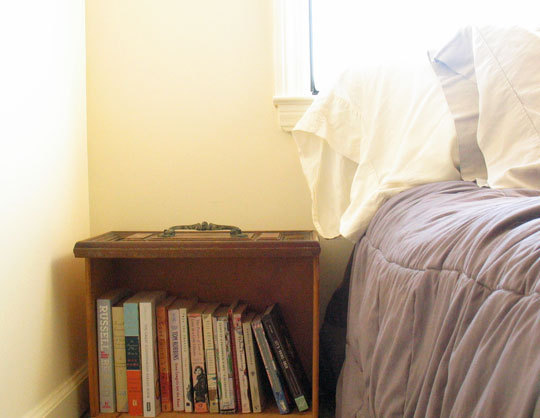
Apartment Therapy has a pretty decent project for turning an old drawer into a new bookshelf/nightstand. But like my old stand, you still can’t hide much in it.
Rooftop Poets
Barbara Gravelle, Matthew Mulder, Brian Sneeden
with music by Vendetta Creme & Aaron Price
1 Battle Square, Asheville, North Carolina
Friday, October 22 · 8:00pm – until
doors open at 7:30pm — event begins at 8:00pm
In celebration of the publication of Barbara Gravelle’s latest book, Poet on the Roof of the World, join the Rooftop Poets under a full moon on the Roof Garden of the Battery Park Hotel for a Prohibition-era poetry reading, book-signing and jazz show.
Local poets Barbara Gravelle, Matthew Mulder and Brian Sneeden will perform alongside the French jazz music sensations Vendetta Creme and Aaron Price at the Roof Garden of the illustrious Battery Park Hotel.
Tickets are $10 and include a signed and numbered, limited-edition, 64-page book of poems featuring the work of all three poets, as well as complimentary light refreshments and hors d’oeuvres.
Few people have access to the Battery Park Hotel’s Roof Garden. Join us for a fine evening of poems, songs and full-moon revelry.
Space is limited. Reserve your tickets today by emailing: info@coffeehousejunkie.com
The evening’s cast of characters include:
Barbara Gravelle, author of several poetry books including, Keepsake, Dancing the Naked Dance of Love, and her latest collection of poems, Poet on the Roof of the World.
Matthew Mulder, one of the original members of the Traveling Bonfires, his poetry and prose have appeared or are forthcoming in Crab Creek Review, Small Press Review, The Indie, H_NGM_N, and other publications.
Brian Sneeden has produced, designed or written for more than a hundred theatrical performances. He is the current director and MC of Asheville Vaudeville.
Cabaret singer Vendetta Creme (aka Kelly Barrow) and Aaron Price (piano, guitar) perform lesser-known songs from yesteryear. This duo scour the globe for their songs including material from five continents weaved into a seamless, unforgettable show.
Last night I enjoyed a conversation around the kitchen table with friends from out-of-town. At one point in the conversation a parent told a story about a neighborhood child joining their family for an evening meal. As mastication commenced the mother noticed all her children had a book they were reading while the neighborhood child looked about awkwardly. The mother told her eldest not to ignore their friend, maybe offer the friend a book. Her eldest puts the book down and asked the friend, “Do you like reading?” The friend replied, “Not much.”
This story reminded me of something I read recently regarding “aliteracy” — being able to read and write, but choosing not to — and the decline of reading whole books — in other words, reading a book cover to cover versus reading world literature condensed to 140 characters or less (see Twitterature for an example). In a recent article published in The Chronicle, Carlin Romano writes:
Destructive cultural trends lurk behind the decline of readerly ambition and student stamina. One is the expanding cultural bias in all writerly media toward clipped, hit-friendly brevity—no longer the soul of wit, but metric-driven pith in lieu of wit.
Link: Will the Book Survive Generation Text?
This isn’t a new trend. I recall Socrates faced similar “cultural trends” in his age. When a culture has the immense wealth of knowledge and wisdom but choses to vapid soundbites and emotionalism, the “destructive… trends” are established like a rut society finds difficult to escape. Almost twenty years ago, The New York Times published an educational article with the following lead paragraph:
Illiteracy is primarily a problem of the third world. But it is the United States that appears to be leading the way in aliteracy — the rejection of books by children and young adults who know how to read but choose not to.
Link: The Lost Book Generation
This past weekend I attended a local poetry reading. An Irish poet lamented that a second-hand bookstore closed and now he has to go to Barnes & Noble to purchase books. He commented that Barnes & Noble is a place where people seem more interested in coffee drinks than books.
Best I can tell, The New York Times story may be the first mainstream publication to cover aliteracy (if you find others, please share them in the comments section or email me). George Orwell published an essay in the 1940s on a similar theme (Books v. Cigarettes) and in the 1930s Aldous Huxley presented a society without books in Brave New World. Toward the end of Brave New World, World Controller Mustapha Mond tells John the Savage:
Our world is not the same as Othello’s world… The world’s stable now. People are happy; they get what they want, and they never want what they can’t get… But that’s the price we have to pay for stability. You’ve got to choose between happiness and what people used to call high art.
I can’t help but wonder what we as a culture trade for happiness?
Many aspects about web ‘zines and journals I enjoy. However, publications that still do things the old way (i.e. print only, no web version) really resonate with me and maybe you as well….
[read more]
UPDATE: This blog post is available as part of an audio podcast.
Listen now:
Or listen on:
PodOmatic: coffeehousejunkie.podomatic.com
SoundCloud: soundcloud.com/coffeehousejunkie
E-book: This blog post will be featured in a forthcoming e-book. More details coming soon.
The Southern Independent Booksellers Alliance (SIBA) offers advice to authors seeking to work with indie books stores:
This is good advice for authors when working with indie booksellers. The operative words are “with indie booksellers.” Truth be told, the majority of the sales for books I’ve helped publish come from Amazon.com. The reason for this, I suspect, is that Amazon.com is where the masses go to buy books.
Know that I am a big supporter of indie bookstores. But I’m also practical and know that indie bookstores attract a niche audience of readers. Some book titles do better at indie bookstores than others. For example, if you’re a local writer with a book on regional hiking trails or you’re a local poet with a book, you may do better at an indie store than on Amazon.com. That being said, Amazon offers a 45/55 terms of sale (a smidge better than indie stores offering a 40/60 terms of sales). That may not seem like much, but if you’re a small publisher, that 5% difference may cover cost of shipping products to bookstores which directly impacts breakeven numbers for book titles.
As an author (or small press publisher), know that you have sales options. And avoid mentioning Amazon.com when working with indie booksellers — it gives them ulcers.
I’m reading an anthology of steampunk essays and fiction titled, well, Steampunk. It’s a sub-genre of science-, speculative-, historical-fiction. What’s intriguing to me is the hard-boiled speculative science with smartly dressed Victorian, British fashion. For those of you serious about Steampunk, would you believe there is a Steampunk Emporium (providing clothing and other accessories) and Clockwork Couture (another purveyor of fine clothing and accessories).
Here’s a fantastic infographic that presents a visualizes the answer to the following question: How Much Do Music Artists Earn Online? If you think those results look abysmal, try publishing a book.
Here’s a book publishing case study to consider. A couple of years ago I worked on a 72-page book. The book features one-color illustrations on the text pages and full-color cover. The cover price is $5.99. It costs $1.58 per copy to have the books printed and delivered to the warehouse. You’re probably thinking that’s not so bad. There’s a $4.41 profit and the author (assuming the author receives a 10% royalty) walks away with $0.44 per copy sold. Not really impressive is it?
The publisher has to ship inventory to booksellers (online or brick-and-mortar) and that costs quite a bit. For example, let’s say the publisher receives an order from Amazon.com and one product is ordered. It costs the publisher $0.97 to properly pack and label the order and $2.13 to mail it using USPS. So far, the publisher costs for one book sold through Amazon.com is $4.68. That reduces the profit margin to $1.31 per copy. Like most retailers, Amazon.com buys books at 55% off the cover price: $2.70. You’ll notice that the publisher is running a deficit. It literally costs the publisher $1.98 to sell a $5.99 book title. The author receives no royalty.
If the publisher sells the book through its own web store, then the net profit is $1.31 for one book sold. The publisher pays the author $0.13 per copy sold.
All that to say, the author of the book in this case study needs to sell 2,240 copies on the publisher’s web store to earn the same amount of money that an employee at Hardee’s (earning minimum wage) earns in a 40-hour week.
Last night I picked up some art supplies downtown. The staff at True Blue is not only helpful, but offered me a cup of water after I coughed a couple of times. For some reason the pollen this year is especially irritating to my throat. It’s not often that staff voluntarily offer a cup of water to store customers, and that kind of service is why I plan to return often.
Being downtown, I couldn’t resist dropping by Malaprop’s for a visit to one of my favorite booksellers. Wandering through the book aisles I came across two book titles that caught my attention. The first book is by Thomas Merton, New Seeds of Contemplation. I haven’t read much of Merton’s writings. But as I was flipping through pages of New Seeds my eyes fell upon the following passage:
If I am supposed to hoe a garden or make a table, then I will be obeying God if I am true to the task I am performing. To do the work carefully and well, with love and respect for the nature of my task and with due attention to its purpose, is to unite myself to God’s will in my work. In this way I become His instrument.
The work ethics idea in this passage seems so foreign in today’s culture that it caused me to stand, shifting my weight from one foot to the other, and ponder the question: am I true to the task I am performing? However menial the task, do I accomplish tasks with due attention to its purpose?
The other book that caught my attention while I walked through the book aisles at Malaprop’s is The Poetics of Space by Gaston Bachelard. Here’s a passage that arrested my attention:
And whereas philosophical reflection applied to scientific thinking elaborated over a long period of time requires any new idea to become integrated in a body of tested ideas, even though this body of ideas be subjected to profound change by the new idea (as is the case in all revolutions of contemporary science), the philosophy of poetry must acknowledge that the poetic act has no past, at least no recent past, in which its preparation an appearance could be followed.
This took me a couple of readings to unpack the idea in this passage, and I’m not sure if I agree with it or disagree with it. My initial thought is not to agree with it simply on the basis that there is nothing new under the sun. However, counterpoint to my initial thought is a recollection of Jane Hirshfield’s thoughts on creativity and originality in poetry.
I wish I could have purchased these books last night, but I spent my money at True Blue and will have to wait until new funds arrive to purchase these titles.
“Consumers need powerful emotional & psychological reasons to buy your books rather than just grab the nearest free e-book,” says Audry Taylor, creative director of Go! Comi. Earlier this month, Robot 6 announced that Go! Comi closed shop “due to a combination of economic downturn and digital theft.” In a recent article she offers five suggestions for publishers who want to avoid going out of business due to digital piracy:
- Make a story available world-wide simultaneously in all major languages.
- In a digital format.
- With perks for pre-orders.
- And goodies that digital pirates can’t reproduce. (And yes, that’s possible. Goodies they can’t compete with, like author chats.)
- Rip off business model 4 pirate sites & one-up them. They offer a Wii raffle for a subscription to a d/l site, u offer author-signed Wii
Though this is written primarily for a manga/comic publishing audience, I think this is good advice for any book publisher.
I’ve said this before, but books need to be designed in way that compels consumers to buy a souvenir, dead-tree product (maybe in a decade a book will be called an artifact). In light of Audry Taylor’s comments, I plan to amend that note to encompass a broader reach than well-designed, dead-tree products. She continues by saying, “My dream pub company is multimedia + print + Etsy + Cafepress + Goodreads + Facebook + fan community.” I agree. The more you compel readers/content users to make emotional and psychological investments in your content, the better the relationship your brand will have with your loyal followers (dare I say, your brand’s evangelists?).
“For some kinds of thought, especially moral decision-making about other people’s social and psychological situations, we need to allow for adequate time and reflection,” said… author Mary Helen Immordino-Yang.
(via Tweet this: Rapid-fire media may confuse your moral compass) (hat tip: monkeytypist and azspot)
This seems to contradict the premise of the best-selling book, Blink. The article continues:
The study raises questions about the emotional cost… of heavy reliance on a rapid stream of news snippets obtained through television, online feeds or social networks such as Twitter.
My take away: maybe it is best to marinate and ruminate than to tweet.
The advanced poetry class in which I am enrolled, began last night. Two of the four predictions I made regarding the class are right (the other two will be determined later):
1. 25 percent of the students are male
2. 16 percent of the students are under the age of 40
The first night of class was an amiable experience and it seems as if several of my classmates know each other from other writing classes. I’m bracing myself for an onslaught of confessional lyric poems about grandchildren or childhood or something along that line. A good gardening poem would be preferable, in my humble opinion.
One of the poetry books I am reviewing collects poems about the decline of the working class in America. It is a fantastic subject and book. Can’t wait to see what the editor thinks of my review. It’s that type of material I want to tackle in poetry; some subject that changes peoples life or at least causes a physical reaction. The editor of Main Street Rag once said that the poems he likes the most are ones that make him react physically; meaning he laughs or cusses or throws the book across the room. A few years ago, I witnessed someone shed a few tears after I read one of my poems. That’s the stuff I want to write (and hopefully publish); the stuff that creates a place for the reader to inhabit. The teacher told the class last night that the word “stanza” is Italian for “room.” If that is the only thing I learn from this class, it will be enough; the composition of inhabitable poems. Maybe that’s why I like today’s featured poem at Writer’s Almanac; I can get into its space.
“Literature in the 21st Century” by Ronald Wallace
Sometimes I wish I drank coffee
or smoked Marlboros, or maybe cigars—
yes, a hand-rolled Havana cigar
//read more
After scrambling to meet the overwhelming demand for its Sarah Palin biography… indie Epicenter Press has signed an exclusive distribution deal with Tyndale House. Tyndale has gone to press for 250,000 copies of the paperback about the newly minted Republican vice-presidential candidate and will begin shipping the books on September 10. Link
The little indie publisher I work with would love to secure a deal like that with our published authors. Oh, wait… it get’s better. Again from Publishers Weekly (just a few days later):
Tyndale House has ordered a second printing of 100,000 copies for Sarah: How A Hockey Mom Turned the Political Establishment Upside Down… Link
Here’s a dirty little publishing reality; how many of those books that ship to retailers will be returned to the publisher? Somewhere between 28 to 40 percent of books published return to the publisher (98,000 to 140,000 copies to return and recycle.). Unless, of course, you have a Dan Brown or Sarah Palin on your frontlist. But even then, consider the crowded head of publishing a best-seller versus a long tail best-seller like The Hobbit (selling, on average, over 1 million copies annually for more than 70 years). Working for an indie publisher, the hope is that I discover a long tail book that increases in value and enriches the world with beautiful literature and not waste the company’s efforts on immediate sales gratification.
*Further reading on the long tail here, here and here (notice that none of the links are to Wikipedia).
The nice thing about writing reviews of poetry books is the ongoing education I am receiving by reading contemporary poetry.
Often I am mistaken as a student on the bus. Last week an older woman asked me if I was a student at UNCA. I told her no and that I was reading a book to write a review of it. Later that week, a man on the bus asked me if I was in college. Again, I told him no and that I was reading a book (a different book of poems (I read two books last week)) to wrote a review about it. He then began to tell me about a book he read that absolutely amazed him. It was a narrative nonfiction book about Ernest Shackleton’s Antarctic expedition. The conversation was amiable.
I came away thinking that must I look like a student. I suppose there are worse things to look like.
Time: Friday, September 5, 2008 7:00 p.m.
Location: Malaprop’s Bookstore/Cafe
Title of Event: Jonathon Flaum-A Fable of Leadership
Local author and CEO of WriteMind Communications,Inc., Flaum will read from his new book, How the Red Wolf Found Its Howl: The Internal Journey to Leadership. A fable about a wolf striving to find its lost howl, Flaum’s book illustrates the struggle inherent in the journey towards “authentic leadership.”
Time: Sunday, September 7, 2008 3:00 p.m.
Location: Malaprop’s Bookstore/Cafe
Title of Event: Poetrio- 3 Readings by 3 Poets
Join us every first Sunday for Poetrio, poetry readings by three poets. This month’s featured poets are Scott Owens, author of The Fractured World, Beverly Jackson, author of Every Burning Thing, and Pat Riviere-Seel, author of No Turning Back Now (New Women’s Voices Series, No. 30).
A hiatus from blogging was needed and taken. Many reasons exist for disconnection from the matrix—the blogosphere—which I may detail later. The primary reason is that I could not maintain the luxury of blogging and accomplish work-related tasks.
After Christmas, and during the following six months, I released seven projects to the market: this book and this book
(both with new forewords) as paperbacks, another book for this organization, a new book
and accompanying audio book (which I produced), a childrens book
and an academic teachers planner for the coming school year. That may not mean a lot to most of you. But consider that each project requires a minimum of 480 to 960 hours to complete, there are more than 1000 hours (using a standard workweek of Monday to Friday for measurement) from January 1 to June 30, and I am only one designer/editor/marketing director/manager/publisher. Needless to say, work hours for me did not fit into a standard 40-hour work week. In fact, it was more often than not that I was working as early as 8 a.m. and finished around midnight or later. This took a toll on me physically, mentally and spiritually.
A respite was needed. So I took off three and a half weeks. I pointed the auto to parts unknown and hit the road in search of coffee houses and lost threads. Three thousand miles were traveled. For five nights during the journey, I slept in a different bed each night. For four nights, I spent in a cabin miles from the nearest phone and six miles from the closest town which is not marked on most maps. Three times I got lost. Twice it was my fault. Once it was not, but that once was a beautiful distraction.
I don’t know if the wind really “takes your troubles away.” I don’t know if I found those lost threads. I did find a couple excellent coffee houses (remind me to tell you where to find a Boris Latte). I’m back in Asheville now. I guess it is time to reconnect and get back to work.
now i read
books and magazines
during work breaks and lunches —
while someone else
in some other office
sells his/her x-men comic
collection and some other
digital fetus in another office
far far away
buys a x-men comic collection
during lunch hour
and later sells it
because he/her
didn’t make time
to read it.
Gary Sullivan on poetry book cover designs:
“Stephen Paul Miller’s Skinny Eighth Avenue… has enough design problems to send me quickly in the other direction…. screams not just DESKTOP PUBLISHING but PRINT ON DEMAND.
“In the 60s and 70s, amateurish often meant a simple type on a white cover with a hand-drawn black & white image. These items often have a kind of funky charm, and sometimes even elegance, to them…. With the rise of desktop publishing in the 80s, things began heading south. Link
Avoid scaring off potential readers with “desktop publishing/print on demand” covers and hire me a professional graphic designer.