Strange Throwback Thursday

Comic Stroll 2013


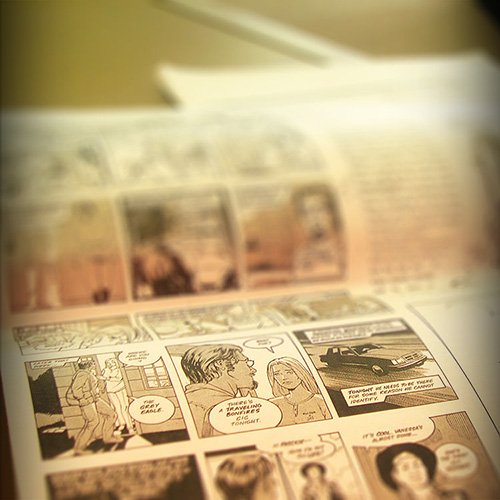
After nearly a six-year hiatus, I was excited to see a project that began with notes and sketches transform into a published comic strip. Even if it was a one-off. Even if I had to hand the responsibility of drawing each panel to someone else. It was done.

I had imagined that the creative non-fiction comic story I crafted would earn some interest. Maybe it would open a few doors to an audience. And allow me to write and illustrate. Even earn some money. Maybe I would quit my day job and provide for my household by doing something I loved. Telling stories. And drawing pictures.

That was five years ago.

A few weeks ago I found a box in the garage. It had several copies of a publication that printed my comic strip. I glanced over the pages and then placed them back into the box. I also found several books. Opened one book I remembered enjoying.

“What’s that?” asked one of the children.

“It’s a collection of comic strips.”

“Oh.”

I pulled a copy from the box and gave it to the child.

“There’s a story in there I wrote.” I said. “See if you can find it.”

The child took the copy of Comic Stroll and headed off to the couch in the living room.

I flipped through the pages of the book I had found. Read a few highlights.

Yeah, I resemble that, I thought to myself after reading a few lines at the end of the book. The author referenced a friend of his who gave up an art gig for a corporate job in order to provide for his family.

Yeah. I know what that is like.

How many comic pages might I have written and illustrated if I had. . . Well, what-ifs and might-have-beens are dangerous paths to pursue. What you did, great or small, is what matters.

Watching my progeny spend an afternoon reading comic strips I had a hand in creating was a pleasure.

NOTES:
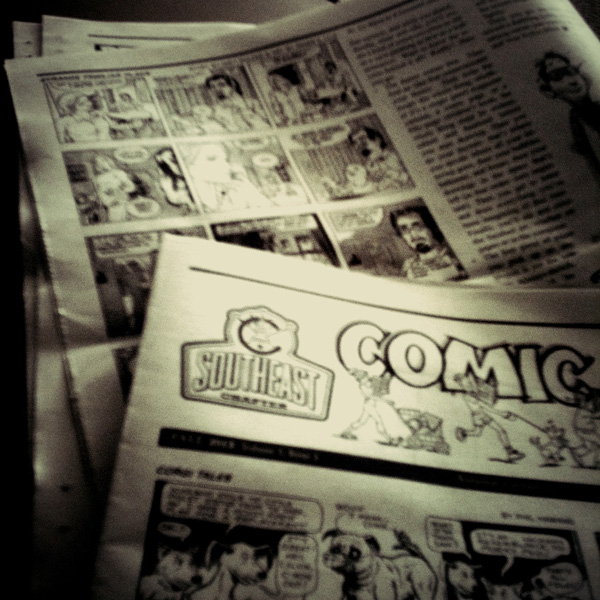
Comic Stroll, a publication of the Southeast chapter of the National Cartoonist Society, featured a collection of previously unpublished comic strips. You can read the whole journey of what started in November 2005 as a couple drawings and became a creative non-fiction comic strip:
[1] Comics and Narrative Non-Fiction
[2] Comics and Narrative Non-Fiction Continued
[3] Narrative Non-Fiction Comics: part 3
[4] Narrative Non-Fiction Comics: part 4
[5] Narrative Non-Fiction Comics: part 5
[6] Narrative Non-Fiction Comics: UPDATE
[7] Narrative Non-Fiction Comics: UPDATE
[8] Strange Familiar Place comic series
[9] Strange Familiar Place returns
[10] The return of Strange Familiar Place to print

Language is communal

If “language is communal” with the primary obligation of telling the truth, than poetry — the highest form of literature — is essential for addressing the fragmentation of communities and people.

Thirteen years ago, my wife and I hosted friends at our cottage on the outskirts of Asheville. A simple meal of salad, chicken and pasta, and red wine provided the vehicle for conversation and stories.

The husband told a story about being pulled over by local police near Old Fort. The officer asked for the husband’s driver’s license and registration. The requested items were provided through a narrow slit of a rolled down window.

“I still have to roll the window down,” he smiled. This attested to his mountain frugality and blue collar virtue.

The officer returned the license and registration and asked if he knew why he had been pulled over and if he had firearms.

“No. And yes,” he replied. The officer asked where the firearms were located. He told the officer that the guns and ammo were stored separately in the trunk. He was then asked to get out of the vehicle and show the officer the guns. Which he did.

The trunk was opened to reveal a chainsaw, climbing equipment, tools and containers for guns and ammo. The officer admired the make and model of one pistol. Asked what he did for a living. And requested to handle the pistol. The husband complied. The officer inspected the pistol. To the husband’s surprise, the officer commented that he would tell his wife about this. She might buy it for him as a birthday gift.

“Well,” said the officer. “Have a safe drive home. And repair that busted tail light within the month.”

I admired the husband’s story. His stories were like climbing a mountain road that rose and fell and wove between cove and valley and eventually arrived were it intended.

That night, as the dishes were cleared from the dining table and a second glass of wine poured, his wife shared that she and her mother planned to attend my reading at Malaprop’s Bookstore and Café on Thursday night. She confessed that she was looking forward to the scheduled night of poetry and music. But she wanted to know why I chose to read and write poetry.

“Why not stories?” she asked.

That question haunted me.

Poetry’s form and function is different from prose. It is more ancient. Where a novel’s exposition provides a landscape of hundreds of pages to expand the narrative plot of character, conflict, and theme, a poem compresses an idea, thought or theme into a few lyrical lines. This is an overly reductive and non-academic comparison of the two forms. But consider the etymology of the word “poetry.”

The English word for poetry comes from an ancient Greek word meaning “to make” or “to craft.” The German word for poetry comes from a Latin word meaning “to dictate.” The Romans often borrowed Greek ideas and themes and aped or improved them. Between the two etymologies I gather the impression that poets are conduits for The Muses — the source of inspiration and creativity. Poets dictate the message of The Muses. Poets craft the message of truth. The ancient Greeks invoked The Muses at the beginning of poems, hymns and epics.

At the time of the diner with friends, I held a casual understanding that poetry in the German language encompasses a compression or density of thought and theme. And that poetry in English embraces beauty and harmony–or graceful elegance. Then, as much as I could afford, I studied Persian, Chinese, Japanese and Korean poetry. And I learned there is much I did not know about continent of poetry.

“Why not stories?” she asked. Stories are important. Poetry is essential. Community is vital. Words must nurture a fractured community in order to bring it together and make it stronger. That August Asheville evening, more than a decade ago, was one of the last nights our two families enjoyed supper and stories together.

People leave. Find a better job. A greener pasture. Or at least a different job with a different view. Change is the only constant. The transience of American culture enables people to move every few years. Words, idioms and phrases fall in and out of fashion. How then are we to nurture a strong community? Maybe it requires each of us to dwell deeply and stand by language. Stand by words.

Complications

Delightful read on simplicity and complexity and teaching poetry and more.

Ann E. Michael's avatarann e michael

National Poetry Month has rolled around again, and sophomores enrolled in the Poetry classes are trying to interpret poems. Somewhere along the line, people in the USA acquired the notion that teachers ought to make things simple to understand so that students can learn the material. What about diving into the material in order to learn about it? Asking it questions? Having a heart-to-heart conversation with it? Those are alternate approaches to reaching an understanding.

Truly, one aspect of teaching that frustrates me is that the majority of human beings want everything to be simple. “Simple” has become a click-bait word, an advertising slogan. Even the American embrace of mindfulness largely bases its premise on the idea that mindfulness is simplicity itself, when anyone who has seriously attempted meditation and mindful living can attest that the theory sounds simple enough but the practice is more complex than it seems.

Now…

View original post 442 more words

“We need poets… to fill in the gaps…”

19481_10152918519307804_4016078293905995447_n

Haitian author Dimitry Elias Léger, in a recent interview, said “We need poets, music, literature to fill in the gaps between news reports,…”

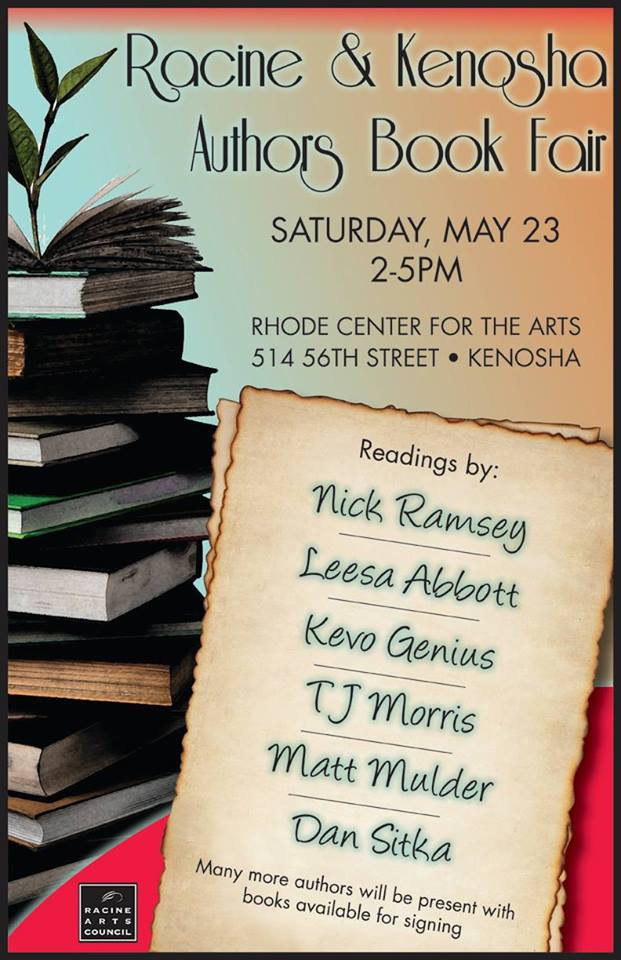
With that in mind, the Racine & Kenosha Authors Book Fair is next weekend, Saturday, May 23, 2015 at Rhode Center for The Arts (514 56th St, Kenosha, WI 53140). The book fair begins at 2 p.m. and concludes at 5 p.m. So you have plenty of time to do your morning errands or yard work,  join me and fellow authors and then spend the rest of the day enjoying Kenosha’s lovely lakefront area with an armful of books by local authors.

Copies of my books will be available for sale (and I will personally sign your copies) and I am scheduled to read at the event. Look forward to meeting you at the Racine & Kenosha Authors Book Fair nest weekend!

Tonight: Village Ink Creative Writers Guild open house

20150403-151950.jpg

The Village Ink Creative Writers Guild has an open house tonight at 6:30 p.m.

What to expect tonight? Expect puppy chow (yes, puppy chow) and cupcakes and maybe peanuts. Expect poetry and prose. Expect good stories by good writers. Expect to have a great time with local writers.

The Village Ink Creative Writers Guild authors plan to share recent works like “Animal Hospital” (children’s literature), “Disturbed” (fiction), “Popular Fiction” (fiction) “Genie-soul” (non-fiction) and selected poetry and prose.

The evening will conclude with a question and answer session for those who have questions about the guild and the craft of writing.

Hope to see you all there!

Graham Public Library, Union Grove, Wisconsin
April 7, 2015, 6:30 pm

FREE to the public. Light refreshments will be served.

Tomorrow: Village Ink Creative Writers Guild open house

20150403-151950.jpg

You are invited to the Village Ink Creative Writers Guild authors reading open house at

Graham Public Library
Union Grove, Wisconsin
Tuesday, April 7, 2015
6:30 pm

Five local writers present selections of their work. The Village Ink Creative Writers Guild meets every Tuesday at the Graham Public Library and is open to writers of all genres and disciplines.

The open house is a great way to celebrate National Poetry month and the event will highlight the last six months of creative energy and writing endeavors.

Selected works include children’s literature, fiction, poetry and creative non-fiction.

For more details, please leave a comment. Thanks!

The open house is FREE to the public. Light refreshments will be served.

Next week: authors reading open house

20150403-151950.jpg

You are invited to the Village Ink Creative Writers Guild authors reading open house at

Graham Public Library
Union Grove, Wisconsin
Tuesday, April 7, 2015
6:30 pm

Five local writers (including myself) present selections of their work. The Village Ink Creative Writers Guild meets every Tuesday at the Graham Public Library and is open to writers of all genres and disciplines. The open house is a great way to celebrate National Poetry month and the event will highlight the last six months of creative energy and writing endeavors. Selected works include children’s literature, fiction, poetry and creative non-fiction.

For more details, please leave a comment. Thanks!

The open house is FREE to the public. Light refreshments will be served.

Racine and Kenosha Authors Book Fair

10565080_10152376419532804_4810709820636602796_n

Rumor has it that I am one of the many authors at this event.

Here are details of the event from the Racine and Kenosha Authors Book Fair Facebook page:

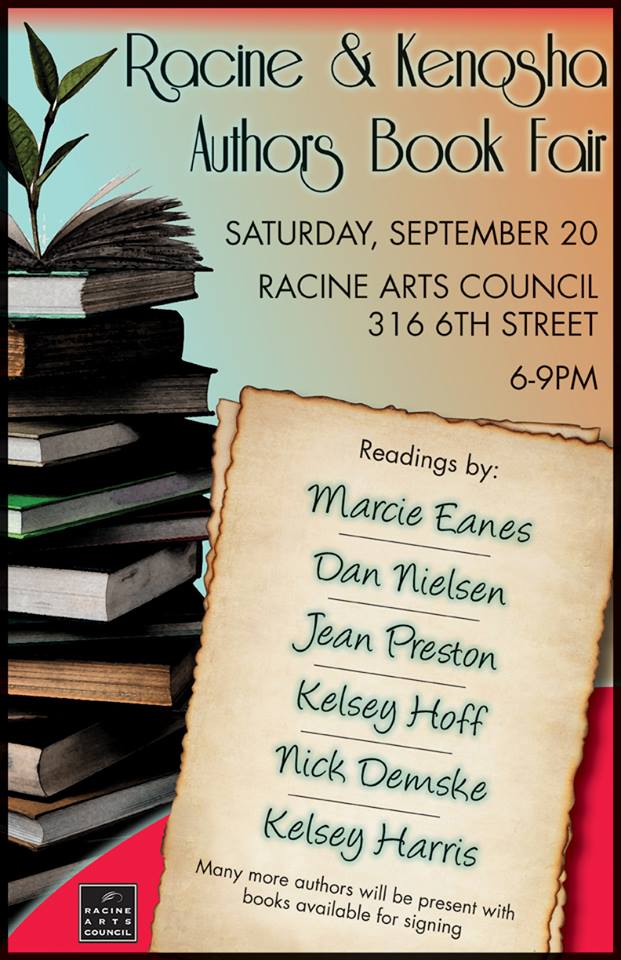
September 20 from 6 to 9 pm, authors from all over Racine and Kenosha will converge at the Racine Arts Council. Six featured poets and authors will give readings (Kenosha Poet Laureate Jean Preston, Kelsey Marie Harris, Dan Nielsen, Nick Demske, Marcie Eanes, and Kelsey Hoff), and many more will be present to sign their books and meet with readers. This event is also the official release of Sad Girl Poems, a chapbook self-published by Kelsey Hoff. Light refreshments will be served.

The Racine and Kenosha area is a thriving arts community, with a surprising number of authors and literary publications in residence. This event will represent the diversity of that community, with up-and-coming writers side by side with well-established ones in multiple genres including poetry, fiction, young adult, and nonfiction. Representatives from Left of the Lake and Straylight Literary Arts Magazine will be present with copies of their publications available.

Strange Familiar Place returns

Stange Familiar Place - Comic Strip

After a very long hiatus, “Strange Familiar Place” will be back in print. Or at least it will be in a very limited capacity. More details on that later.

The creative non-fiction comic “Strange Familiar Place” first appeared in The Indie. Inspired by the works of Harvey Pekar, Jessica Abel, and Eddie Campbell, I wrote and illustrated “Strange Familiar Place.” Eventually I collaborated with illustrator and comic book artist James E. Lyle on six comic strips.

Comic Stroll, a publication of the local chapter of the National Cartoonist Society, will feature that collection of previously unpublished comic strips. Read the evolution of what started as a couple drawings and became a creative non-fiction comic:

  1. Comics and Narrative Non-Fiction
  2. Comics and Narrative Non-Fiction Continued
  3. Narrative Non-Fiction Comics: part 3
  4. Narrative Non-Fiction Comics: part 4
  5. Narrative Non-Fiction Comics: part 5
  6. Narrative Non-Fiction Comics: UPDATE
  7. Narrative Non-Fiction Comics: UPDATE
  8. Strange Familiar Place comic series

More details about Comic Stroll distribution will be made available later.

Interview: Caleb Beissert on Beautiful translations of Federico García Lorca and Pablo Neruda

Beautiful by Caleb Beissert Caleb Beissert is a poet, translator and musician. His published work appears in International Poetry Review, Tar River Poetry, Asheville Poetry Review and Beatitude: Golden Anniversary, 1959-2009.

This week, Poetry at the Altamont celebrates the release of Caleb Beissert’s first book, Beautiful, a selection of poems by Pablo Neruda and Federico García Lorca translated into English. During the last few weeks, Beautiful was well received by enthusiastic audiences at Montford Books & More and Malaprop’s Books & Cafe and is a Small Press Distribution best-seller.

The Altamont theater doors open at 7:00 P.M. for Poetry at the Altamont. Admission is $5 at the door. Beer and wine sold at the bar and lounge will remain open for drinks after the reading. Event link.

UPDATE: Caleb Beissert is the featured guest of the Coffee with the Poet Series, Thursday, February 21st at 10:30 a.m. at City Lights Bookstore. Event link

Caleb graciously agreed to an interview to discuss poetry, translation work and Beautiful.

Coffeehouse Junkie Blog

First, for those who don’t know you, Caleb, please share a little about yourself and how you came to poetry.

Caleb Beissert

I arrived naturally at poetry. I had a strong interest in writing as a child, which stemmed from my mother’s and father’s both being journalists. They read to me constantly, even while I was in utero. I still love being read to, hence the poetry readings I attend. During my fugitive teenage years, I wrote notebooks full of song lyrics—songwriters such as Bob Dylan, Tom Petty, Robert Hunter, Kurt Cobain, Roger Waters, and The Beatles among my influences. When I went to college and took a poetry writing class, I discovered I’d been writing poetry for years. Of course songwriting is a different beast, but one does inform the other.

Throughout my time at Western Carolina University, I studied writing, foreign languages, philosophy, music, art—I wasn’t satisfied with the notion of going to college to get a job, rather I wanted to learn everything I could for the sake of knowing. I began publishing my poetry, traveling abroad, corresponding with accomplished writers, and I participated in the Gilbert-Chappell Distinguished Poet Series.

My literary heritage largely came from the American Beats, especially Allen Ginsberg and Richard Brautigan; the British poets, namely Blake and Coleridge; and mystics, like Hafiz, Rumi, Kabir, Mirabai; as well as Walt Whitman, E.E. Cummings, W.S. Merwin, early on Shel Silverstein, and then later the great Hispanic poets, particularly Federico García Lorca and Pablo Neruda. Now I’m living in Asheville, writing, producing poetry events, and also working as a musician.

Coffeehouse Junkie Blog

How did the translation work of these two poets, Federico García Lorca and Pablo Neruda, come about?

Caleb Beissert

As I glossed over previously, I was at WCU studying poetry and foreign language when I began translating these two poets. It must have been my attraction to Surrealism that led me to García Lorca. I had read a few translations in Bly’s Leaping Poetry, eaten up Lorca’s lecture Theory and Play of the Duende, and fallen into Poema del cante jondo. I was fascinated by this idea of the duende and also with the marriage of poetry with music, seen in the influence of Andalusian flamenco music on his work.

An interest in Neruda also came through my gravitating toward Surrealism, though I must acknowledge that neither of these poets wrote exclusively or even primarily in this style. One day my Spanish professor assigned the students to attempt a translation of Neruda’s famous “Poema 20” from Veinte poemas de amor y una canción desesperada. I thoroughly enjoyed the assignment—probably the only one who did—and it was then I realized I could translate. From there, of course, the complexities of poetry translation began to unravel. I studied essays by Gregory Rabassa, John Felstiner, Margaret Sayers Penden, Eliot Weinberger, and read many bilingual or “bisexual” editions, as a good friend likes to call them.

Eventually, I timidly showed my translations to a few trusted poet friends/mentors, among them Dr. Mary Adams and Thomas Rain Crowe, who encouraged me to continue the work. It has been a process of frustration, learning and accomplishment. Many late nights of pulling out my hair. I’ve dabbled in other Spanish-writing poets, such as César Vallejo, Rafael Alberti, Pedro Salinas, Vicente Aleixandre, Nicanor Parra, and Manuel González Prada; however, it was García Lorca and Neruda I spent the most time with, grew to know them through their words, heard their voices, conversed in dreams, and eventually compiled enough English-language adaptations for two books.

Coffeehouse Junkie Blog

How the translation work inform the craft of your own poetry?

Caleb Beissert

I find myself writing odes to people and places I’ve never known. I’ve written poems to or after these poets, places and ideas from their poetry, even employed mimicry for effect sometimes, but going deeper, I’m sure it has changed the way I think about language, construct lines, choose words, though the translation process itself does that as well. I have developed my own poetry while spending a great amount of time with these poets, therefore their impact on my work is tremendous. It is hard for me to see, because often one must step away from his or her work to get an accurate picture of it, but I know the influence is there.
Interview: Luke Hankins on Poems of Devotion

Poems of Devotion

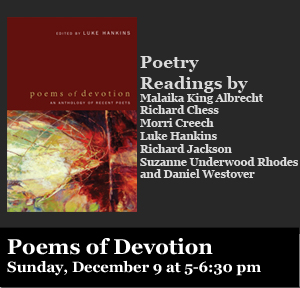
Luke Hankins is Senior Editor at Asheville Poetry Review and the author of a collection of poems, Weak Devotions, a chapbook of translations of French poems by Stella Vinitchi Radulescu, I Was Afraid of Vowels…Their Paleness and editor of Poems of Devotion: An Anthology of Recent Poets. This Sunday, December 9 at 5 p.m., at Malaprop’s Bookstore/Cafe, Luke will read selections from Poems of Devotion: An Anthology of Recent Poets along with other featured contributors: Malaika King Albrecht, Richard Chess, Morri Creech, Richard Jackson, Suzanne Underwood Rhodes, and Daniel Westover. Luke agreed to a quick interview to discuss the recently published Poems of Devotion.

Coffeehouse Junkie Blog

Tell me how the anthology, Poems of Devotion, developed from concept to final printed book.

Luke Hankins

In my final year of graduate school, I took an independent study course with the superb poet and teacher Maurice Manning, which essentially meant that I chose an academic/creative project and he offered input on and evaluation of it. I have had a strong interest in spiritual poetry for many years, so it was natural that I would choose a topic that reflected this passion. The essay I wrote for that class was an examination of a particular set of qualities that characterized many of my favorite spiritual poems, qualities which, in my mind, constituted a distinct mode of composition. The essay was an early form of what is now the introductory essay of the anthology, examining what I call the devotional mode in poetry. When I first wrote it, the idea of editing an anthology hadn’t occurred to me, but as I continued to revisit and revise the essay after graduate school, I felt increasingly that the compiling “poems of devotion” would make for a superb collection of poems. As an experiment, I began gathering poems that I would include in a theoretical anthology, and that’s when I began to feel a real impulse — a “call,” if you will — to bring these poems together in an anthology. I sent out a proposal to several publishers, and I eventually signed a contract with Wipf & Stock Publishers.

What followed was — well, let’s just say a year of very hard work! Gathering the poems I wanted to include was one aspect: reading widely, taking recommendations, spending long days in the library or in coffee shops with large stacks of books. But all of that, though difficult, was full of pleasure and felt deeply rewarding. The other aspect was obtaining — and paying for! — permission from copyright holders to reprint the poems. That process was often labyrinthine, frustrating, and, not least of all, expensive. But it was worth it. I’m very excited about the finished anthology, and am moved and challenged anew each time I read it. Truly.

Coffeehouse Junkie Blog

Maurice Manning is becoming one of my favorite living poets. At the public library, I discovered his book Bucolics and then had an opportunity to attend one of his lectures at Warren Wilson. But I digress. You beat me to the second question which is what did you learn most? Seems like the whole publishing side of the anthology was quite a classroom of experience. If you will, highlight one moment during that year long process that “felt deeply rewarding” for you.

Luke Hankins

I think approaching the copyright aspect of the anthology with a certain level of naivety in many instances worked to my advantage. People were more inclined to take mercy on me and my minuscule budget! But there were a few publishing houses who were absolutely unmovable, and I had to pay out my teeth, so to speak, to include poems I felt were necessary to the anthology. So I learned to rejoice in small mercies where they came, and to practice stoicism about what I saw as exorbitant pricing from some of the major publishing houses.

Regarding your second question, I wouldn’t want to try to single out one moment that felt rewarding. I’ll just say that the process of discovering poets I came to love, whose work I had never read or had only read cursorily, was one of the most rewarding aspects. Re-reading poets whose work has been very impactful for me was another aspect. Also, there was an overall sense of being blessed to be able to dedicate myself to an undertaking that felt like an important fulfillment of who I am. I felt that I was working with real purpose. I felt that I was doing what I was meant to do.

Coffeehouse Junkie Blog

One final question, what’s the biggest thing you hope readers take away from Poems of Devotion?

Luke Hankins

I hope that readers — whether religious or non-religious, theistic or non-theistic — come away with a conviction that the devotional mode is a powerful, ongoing, vital mode in literature. I believe in these poems and their ability to do just that.

Tonight, Juniper Bends reading series returns to Downtown Books & News

Juniper Bends reading series – August 2012

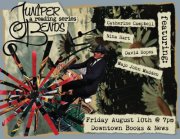
Tonight, 7PM at the Downtown Books & News, the Juniper Bends quarterly literary reading series presents Catherine Campbell, David Hopes, Majo John Madden and Nina Hart.

More information on the Juniper Bends Facebook events page. Link.

Hope to see you there!

A bookless American library

Empty shelves at the downtown city library

Why can’t I find a copy of Kurt Vonnegut’s Slaughterhouse-Five at a local public library? I’m wandering through the aisles of bookshelves thinking, It’s not an obscure title. Is it? Earlier, I visited a couple library branches and couldn’t find a single copy. How is that possible? Later I would find a copy at a bookstore (actually, I would find copies at three of the local bookstores, but I would be out of cash and wouldn’t be able to afford to buy a copy… more on that later… like, wait-for-my-memoir later…).

Is it possible? Are American libraries moving toward booklessness? At the main, downtown city library I stare at a whole wall of bookshelves emptied of books (see photo). Glancing around the place it appears that the only thing people do at that library is use the toilet, enjoy the air conditioned space on hot summer days, and rent CDs and DVDs. The magazine racks are full and there is an man, probably in his 60s, reading the latest copy of the New Yorker. Beyond the reference desk, I see that every computer terminal is occupied. My mood is turning away from searching for a copy of Slaughterhouse-Five, to mischievous. I want to walk over to the reference desk librarian and ask, “Where might I find a book about Tralfamadore?” From experience, I know what the reference desk librarian will do. The scene will go something like this:

“Excuse me, but where might I find a book about Tralfamadore?”

“Tralfamadore? Let me see,” he says as he opens a web browser on the computer and sounds out the word tral-fam-a-dore under his breath. “Oh, Tralfamadore. From Kurt Vonnegut’s novel Slaughterhouse-Five.”

“Did you just google that?” I ask.

He looks at me and doesn’t say anything.

“Shouldn’t that be unholy sacrilege to use Google in a library?” I ask. “I mean, this is supposed to be a house of intellect.”

He folds his hands in front of the keyboard and says, “I used Wikipedia.”

“Wikipedia?” I snort.

The reference desk librarian catches the eyes of the library’s security guard who walks toward us.

The scene concludes with me mumbling something about the democratization of content leaves an intellectual void that is too quickly filled with bits of data rather than depth of knowledge and wisdom.

But I don’t walk to the reference desk. I get lost somewhere in the fiction aisles–somewhere in the section where books by authors with last names beginning with “k” are placed. The whole thing–the search for a single copy of a book and the failure to locate it at a public library–is loathsome to me. I have this uneasy feeling ‪that Ray Bradbury’s‬ ‪Fahrenheit 451‬ may be prophetic. And I want to start memorizing large volumes of literature for the mere preservation of it to share with the next generation. Isn’t that why books are written? To share not just with this present age, but to extend beyond the life of the writer? My eye’s find a book about bean trees–or rather, a novel. It’s not a very thick novel, but it seems to have found me and I can’t just leave it on the bookshelf and I don’t want to leave the library empty-handed.

After the book is processed silently by a librarian, I walk to catch a bus home. Reading the first few pages at the transit center I know I have found a new friend in this book. It’s a feeling I can’t say I have regarding Google or Wikipedia. To me, they are repositories of data–vapid of personality in the same fashion as the  Borg–to be mined or to be assimilated.

Poetrio, this Sunday, at Malaprop’s Bookstore

August Poetrio — 2012

This sunday, Malaprop’s Bookstore/Café continues the monthly poetry reading series, Poetrio, with Meta Commerse, Cassie Premo Steele, and Pauletta Hansel.

In an email from Virginia McKinley, of Malaprop’s, here’s a write up about August’s featured poets:

Meta Commerse. . . is the author of six books, including a novel intended to be a book of hope for middle-school-aged black girls.  That book began as her culminating project for the MFA degree in creative writing at Goddard College.  RAINSONGS: POEMS OF A WOMAN’S LIFE is her most recent book of poetry. . . .

Cassie Premo Steele’s poetry has appeared in numerous anthologies, magazines, and journals, including such publications as Sagewoman and Calyx. Her work has been nominated twice for a Pushcart Prize. . .  Her most recent book of poetry, THE POMEGRANATE PAPERS, is based on the Persephone/ Demeter myth and addresses the themes of mothers, daughters, creative cycles, loss, healing, and living in harmony with the seasons. . . .

According to Jackie Demaline of The Cincinnati Enquirer, Pauletta Hansel has been “an arts administrator and an unflagging arts advocate, [but] doesn’t like to talk about herself.”  Yet she seems happy to talk about the work she finds most interesting: “community organizing and community arts.”  . . . . Pauletta Hansel has published poems in . . . journals . . . and . . . has three previous collections of poetry, Divining, First Person, and What I Did There; at Malaprop’s she will read from her most recent book, THE LIVES WE LIVE IN HOUSES. . . .

Hope to see you Sunday, August 5, at 3:00 p.m. for Poetrio!

On summer or winter in books and writing

One Day in the Life of Ivan Denisovich‬ and The Call of the Wild

“Do you prefer Summer or Winter in books and writing?” asks blogger Lea At Sea. What do you think? I had to think about that for a while.

I finished a few books recently by authors Ian McEwan and Barbara Kingsolver. Saturday, On Chesil Beach and The Bean Trees all have specific seasons and locations central to each novel. As I thought of how the seasons permeate a novel, two novels come to mind: ‪

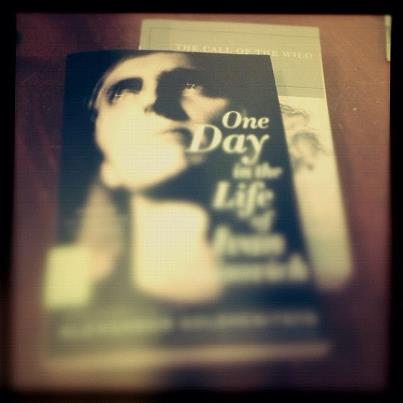
by ‪Aleksandr Solzhenitsyn‬ and ‪The Call of the Wild‬ by Jack London. [1] It never occurred to me to read One Day in the Life of Ivan Denisovich‬ because it begins on a cold winter morning. The character and narrative interested me. The gulag in winter is a prominent element of the story, but that isn’t the reason I read the book. It was the story.

By nature I’m a fall/winter sort of person. Maybe that’s why I recalled those two books:One Day in the Life of Ivan Denisovich‬ and ‪The Call of the Wild‬. But my reading choice is not directly influenced by that predisposition otherwise I would not have picked up a book set in spring/summer of the American southwest. However, I am curious to learn if your reading selections are influenced by that perimeter. Do you choose a book because it is seasonally based? Further, if you are a poet and/or writer, do you specifically write for a specific season?

NOTES: [1] Technically, ‪The Call of the Wild‬ and On Chesil Beach are novellas. Maybe I should refer to the works as books rather than their literary distinctions. Writing Forums offers distinctions between short story, novella and novel lengths. Basically, word count. Short Short Stories & Flash Fiction; usually under 1,000 words; Short Stories, 7,499 words to 15,000 words; Novelette, 7,500 to 17,499 words; Novella, 17,500 words to 39,999 words; Novel, minimum word count of 40,000 words. It is my understanding that a proper novel runs an average of 80,000 words. Since we’re on the topic of word count, Fiction Factor offers How Long Should Your Story Be? by Lee Masterson and Writer’s Relief presents Short Story Or Novella? What’s The Difference And Where To Publish Shorter Fiction.

The English novel versus the American novel

Which do you prefer, the English novel or the American novel? I’ve been thinking about that after reading some of Ian McEwan’s and Barbara Kingsolver’s books. Maybe it is the difference in the writers and not so much the country from which they live. There is a tone or manner that seems a marked distinction between the two styles. What do you think?

Tonight’s Malaprop’s reading featuring Sebastian Matthews, Sybil Baker and Chris Hale

Just received this email from Malaprop’s regarding tonight’s, June 1st, reading at 7 p.m.

Triple reading event, featuring new poems by Sebastian Matthews, and selected poems from his most recent collection: MIRACLE DAY: MID-LIFE SONGS; a reading by Sybil Baker from her novel INTO THIS WORLD; and a reading by novelist Chris Hale from her just-completed memoir, LINE OF SIGHT.

I’m very excited to learn of Sebastian Matthews’s new collection of poems.

There are days when I wonder what kind of novel Sal Paradise and Billy Pilgrim might make if they hit the road together.

Tomorrow night – Juniper Bends Literary Reading

The afterglow of Asheville Wordfest 2012 has barely faded. In truth, I’m still recovering from the rich, full weekend, but excited to announce tomorrow night’s literary reading.

Friday, May 11th at 7:00 p.m. the Downtown Books and News (67 North Lexington Ave., Asheville, NC) hosts the Juniper Bends Literary Reading featuring poets and prose writers: Abigail DeWitt, Anne Maren-Hogan, M. Owens and Mesha Maren. More details on the Juniper Bends Literary Reading Facebook events page: link.

Literary reading series continues at Posana Cafe this weekend

Saturday night, March 17,  6:00 p.m. at Posana Cafe in downtown Asheville, NC. The literary reading features writer Elizabeth Lutyens and poet Tina Barr.

From a press release:

Elizabeth Lutyens teaches the Prose Master Class in the Great Smokies Writing Program of UNC Asheville and is Editor of The Great Smokies Review, its online literary journal. A former journalist, she got her MFA in Creative Writing from Warren Wilson College, and since has been at work on a novel set in the mid-19th century in Boston and the Port Royal Islands of South Carolina.

Tina Barr has received Fellowships from the National Endowment for the Arts, the Tennessee Arts Commission and the Pennsylvania Council on the Arts. Her awards include the Editor’s Prize for book publication from Tupelo Press. Her poems are published in anthologies and journals like The Harvard Review, The Southern Review and The Paris Review.

Combatting Writer’s Block like A Master

Utne Reader: Classic Ways to Combat Writer’s Block

The Origin of Titles

It is amusing that modern readers have been spared the lengthy title of the 1859 first edition:

ON THE ORIGIN OF SPECIES.
OR THE PRESERVATION OF FAVOURED RACES IN THE STRUGGLE FOR LIFE.

hm?

British scientists have found scores of fossils the great evolutionary theorist Charles Darwin and his peers collected but that had been lost for more than 150 years (via libraryland)

Representing nations through poetry

Today, I followed a link to a web site that I rather enjoy — the United Nations of Poetry. Serendipitously I found the link and learned that it presents a catalog of international poets. I noticed, however, that some nations are missing from the list. For example, Germany is not represented. Consider including German language poets Durs Grünbein, Michael Hofmann and Sarah Kirsch. Also notably missing are Polish and Russian poets. Vera Pavlova makes a good addition to the United Nations of Poetry representing Russia. For Poland, Eugeniusz Tkaczszyn-Dycki might make a good contribution. And last, but not least, add Greek poet Dimitris Varos to the list of poetry dignitaries. One thing that is unique to the United Nations of Poetry is the inclusion of poets from America representing the indigenous peoples.

Why is this important? I think C. S. Lewis wrote that literature “irrigates the deserts that our lives.” Along that line of thinking, to know and understand the inner life of a nation or culture is to explore the fertile literature of their poets and writers. Film tends to present caricatures and stereotypes of Germans, Russians and Americans, but literature plumbs the depth of cultural nuances. For example, you might miss the significance of the shamrock and the lily in a film about two brothers in North Ireland. In a novel, the weight of those two images will elucidate the drama between the two siblings, and a reader will come to realize that the tensions between two brothers are often the same between nations.

Literary Reading at Posana Café

Later this week, a literary reading featuring Catherine Reid and Valerie Neiman. February 18, 2012, at Posana Cafe, at 7:30 p.m.

Catherine Reid is the author of COYOTE: SEEKING THE HUNTER IN OUR MIDST, as well as essays in such journals as GEORGIA REVIEW, MASSACHUSETTS REVIEW, FOURTH GENRE, and BELLEVUE LITERARY REVIEW. Currently, she directs the undergraduate creative writing program at Warren Wilson College, where she also teaches creative nonfiction and environmental writing.

Jane Alison calls  Valerie Nieman‘s third novel, Blood Clay “both a tense, plot-driven story about complicated issues of race and guilt, and a meditation on solitude, history, and ways of living.”

A former newspaper reporter, Nieman is also the author of a collection of short stories, Fidelities, and a poetry collection,Wake Wake Wake. She teaches at the John C. Campbell Folk School and serves as poetry editor of Prime Number magazine.

From an email from Mark Prudowsky and Katherine Soniat