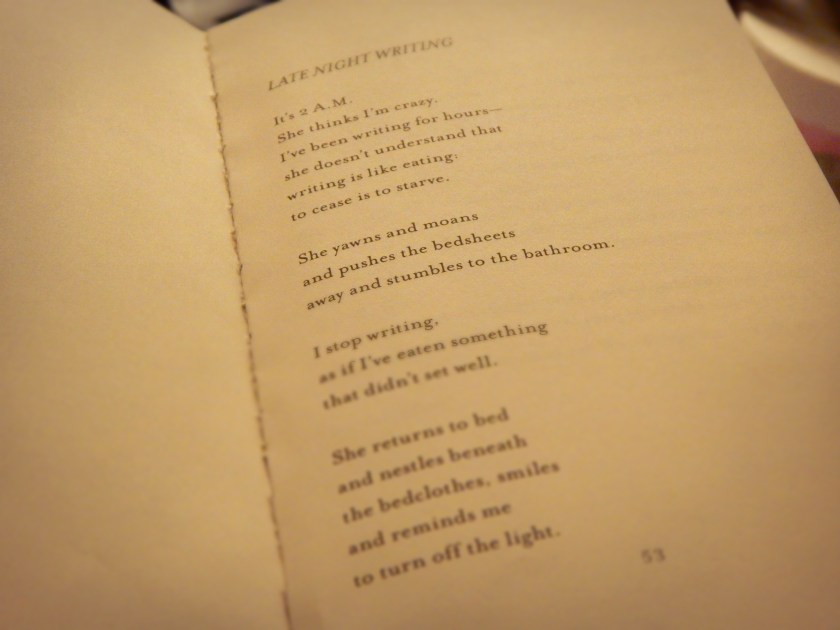
One week to go with the write 30 poems in 30 days challenge

DSCN5414[sqr-basic-lomo-lofi]

Do you write every day? Not typing or texting, but composing ideas and narratives and lines of poetry?

Earlier this month, I sat in a coffeehouse for almost an hour — during a late lunch break — and all I was able to produce was a 15-line sketch. A rough sketch, but the general motif and elements of the composition were represented.

The challenge of writing everyday is particularly rough when involved in knowledge work all day long. In my case, the mind is revved to creatively solve problems at the office and with internal and external clients. And for an hour in the afternoon, the part of the brain required to compose a few lines of poetry is so exhausted that the task is herculean.

Still. The discipline of exercise is part of the process. Keep training. Keep writing. Drink more coffee.

RELATED BLOG POSTS & NOTES:
[1] April – write 30 poems in 30 days
[2] April – National Poetry Month
[3] 30 poems in 30 days challenge
[4] Write 30 poems in 30 days: a challenge

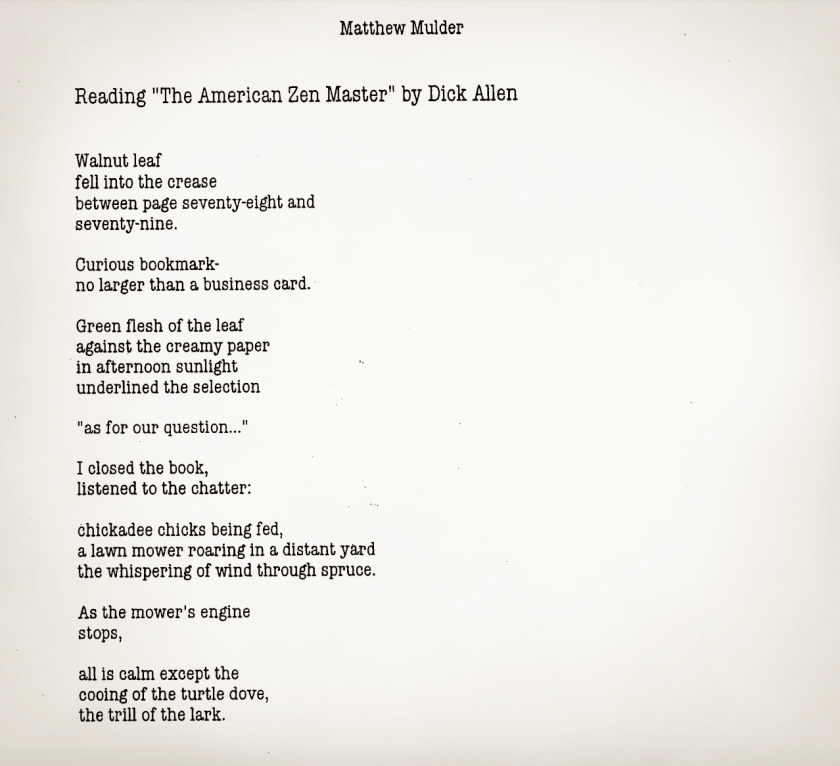
Poem 08: Reading “The American Zen Master” by Dick Allen

Reading The American Zen Master

Poem 07: A tube of wet rage

DSCN5420[bsc-lomo-dusk-tilt]

Complications

Delightful read on simplicity and complexity and teaching poetry and more.

Ann E. Michael's avatarann e michael

National Poetry Month has rolled around again, and sophomores enrolled in the Poetry classes are trying to interpret poems. Somewhere along the line, people in the USA acquired the notion that teachers ought to make things simple to understand so that students can learn the material. What about diving into the material in order to learn about it? Asking it questions? Having a heart-to-heart conversation with it? Those are alternate approaches to reaching an understanding.

Truly, one aspect of teaching that frustrates me is that the majority of human beings want everything to be simple. “Simple” has become a click-bait word, an advertising slogan. Even the American embrace of mindfulness largely bases its premise on the idea that mindfulness is simplicity itself, when anyone who has seriously attempted meditation and mindful living can attest that the theory sounds simple enough but the practice is more complex than it seems.

Now…

View original post 442 more words

April – write 30 poems in 30 days

DSCN5414[sqr-basic-lomo-lofi]

It is April 15th. If you are participating in the 30 poems in 30 days challenge, than you are half way there!

Some of the results of the daily discipline of writing looks more like sketches rather than fully composed poems. Nothing yet looks like a Coleridge “Kubla Khan” or a Ginsberg “Howl” or even a Bashō haiku. A few sparkling lines, but a lot of raw material.

Fifteen days down. Fifteen to go.

And then the editing begins.

Poem 06: Last night at the New French Bar

DSCN5432[sqr-bsc-lomo-dusk-tilt]

Poem 05: Values

DSCN5431[sqr-bsc-lomo-dusk]

Poem 04: Loneliness visits

DSCN5435[basic-lomo-sangria]

Poem 03: Reading “My American Body”

DSCN5421[bsc-lomo-dusk]

Reading “My American Body” by W. K. Buckley
by Matthew Mulder

Fireflies sparkle
outside. I see them through the
living room window.
It’s the time between
times as I
examine a new hole in
my jeans and consider
“Picking up their shreds
to the tangled light.”
Condensation rolls down
St. Pauli Girl who
makes me sparkle
inside.

NOTES:
(c) Matthew Mulder. All rights reserved.
Originally published in Rapid River Arts & Culture Magazine, October 2005

Poem 02: Saturday Night, Coffeehouse

DSCN5416[sqr-basic-lomo-dusk-tilt]

NOTES: Originally published in Rapid River Arts & Culture Magazine, April 2004. Unable to locate the printed artifact nor find a digital version on the publisher’s website, I photographed this draft of “Saturday Night, Coffeehouse.”

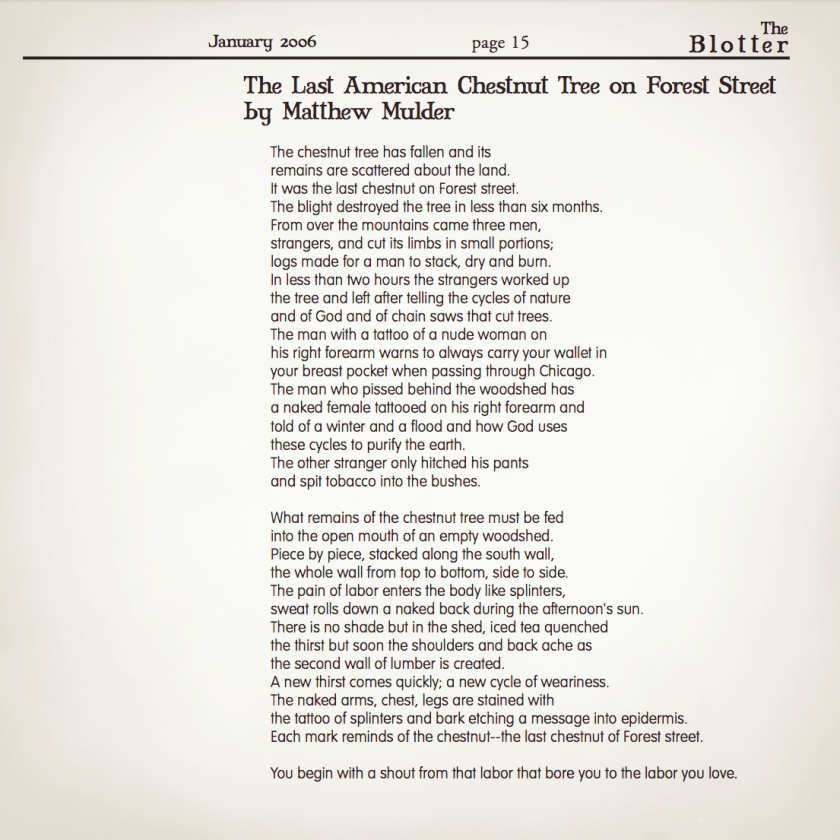
Poem 01: The Last American Chestnut Tree on Forest Street

The Last American Chestnut Tree on Forest Street

April – National Poetry Month

DSCN5411[sqr-basic-lomo-lofi]
It is no joke. It is April. And it is the beginning of National Poetry Month.

For poets and poetry fans, April is a special month-long celebration of poems and poets. For most of America, it is the beginning of baseball season.

One question that is asked of me when an individual learns that I compose lines poetry is this: “Are you published?”

The answer is yes.

Throughout the month of April I will post selections of my published work for your reading pleasure.

April is a good month to test your poetry writing skills. A few years ago I took up the challenge[1] to write 30 poems in 30 days.[2] You are invited to the challenge as well.

NOTES:
[1] 30 poems in 30 days challenge
[2] Write 30 poems in 30 days: a challenge

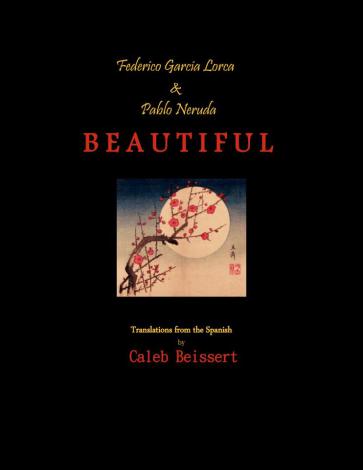
Interview: Caleb Beissert on Beautiful translations of Federico García Lorca and Pablo Neruda

Reposting this interview. Enjoy!

coffeehousejunkie's avatarCoffeehouse Junkie

Beautiful by Caleb Beissert Caleb Beissert is a poet, translator and musician. His published work appears in International Poetry Review, Tar River Poetry, Asheville Poetry Review and Beatitude: Golden Anniversary, 1959-2009.

This week, Poetry at the Altamont celebrates the release of Caleb Beissert’s first book, Beautiful, a selection of poems by Pablo Neruda and Federico García Lorca translated into English. During the last few weeks, Beautiful was well received by enthusiastic audiences at Montford Books & More and Malaprop’s Books & Cafe and is a Small Press Distribution best-seller.

The Altamont theater doors open at 7:00 P.M. for Poetry at the Altamont. Admission is $5 at the door. Beer and wine sold at the bar and lounge will remain open for drinks after the reading. Event link.

UPDATE: Caleb Beissert is the featured guest of the Coffee with the Poet Series, Thursday, February 21st at 10:30 a.m. at City Lights Bookstore. Event…

View original post 741 more words

Frosted window at sunrise

DSCN5167[sqr-basic]
When night winds leaves subzero signatures on the Saturday morning window, it is time for coffee and jazz and few lines of poetry… [1]

Try to count the colors
In a frosted window at sunrise
try to imagine the hues and shades
Of a Wisconsin winter morning…

NOTES
[1] With apologies to Three Crosses, inspired by song “Michelangelo”

Putting the finishing touches on a new book design

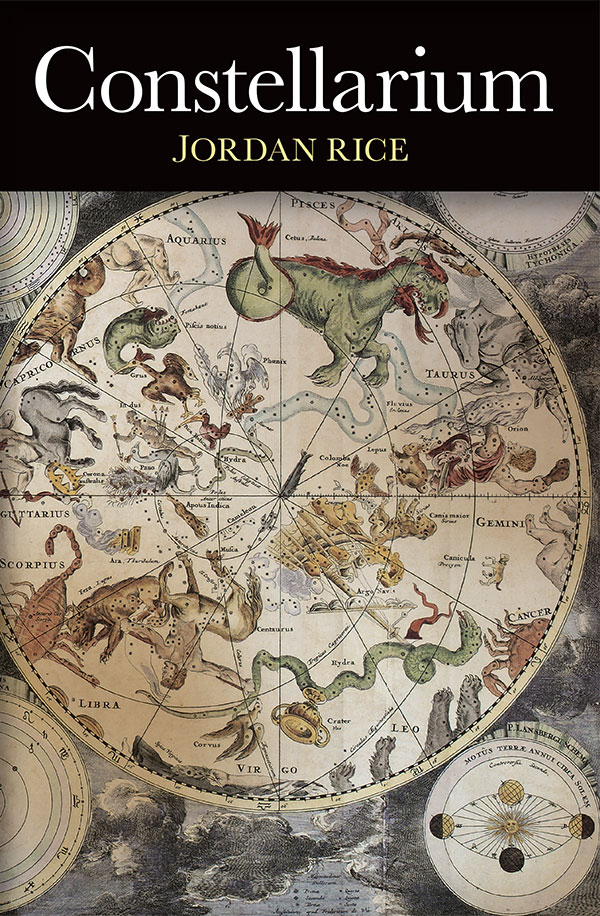
Constellarium_Cover_Final
Since the publisher posted the following on Facebook last night, I guess it is alright to unveil a new book I designed:

Jordan Rice’s debut poetry collection, CONSTELLARIUM, a finalist for the 2015 Orison Poetry Prize, is now available for pre-order at a discounted price! Order now and be among the first to receive the book when it’s released in April.

“Constellarium is a bold announcement of a new poetic voice to be reckoned with. These poems make us stare down shame and celebrate transition, celebrate the body inside. Jordan Rice does not flinch from what society would have us try to look away from, instead she carefully constructs a book in which we are forced to reckon, layer by layer, with her being. Let us be thankful that such a voice exists, that it is brilliant and shattering, and here to take us all on her journey.” –Fatimah Asghar

The process of cover design is exciting. Especially when the title of the project is constellarium.

There are so many stories behind the cover design that would be fun to share. Like, for example, how the kidlingers enjoyed the image of cetus — how cetus does not look like any image of a whale they have ever seen in a picture book. And how the eldest kidlinger is writing a report about rhinos.

And how a species of rhino has been reported extinct. And we wonder if these old drawings are accurate. And that maybe the cetus represented in the book cover art is correct. But maybe that species of ceti (is that the correct nominative plural of cetus, Latin students?) is now extinct.

Maybe these behind-the-scenes stories are more interesting to me than you.

See if you can find cetus in the cover art by pre-ordering Jordan Rice’s Constellarium!

Amazing readings, beautiful community

“Amazing readings, beautiful community,” tweeted one of the poetry marathon attendees Saturday night. Indeed it was a good night to visit Woodland Pattern Book Center to hear poets share their work. To be exact, 150 area poets shared their work.

I participated in the 9 o’clock hour. Featured poets included: Matt Cook, Tom Erickson, Peter Burzynski, Franklin K.R. Cline, Carmen Murguia, Peter Whalen, Bob Koss, Jane Lukic, Michael Wendt. One of the highlights of that hour was to hear a Czesław Miłosz poem read in Polish.

Each poet is afforded five minutes to read. The poems I selected earlier in the day loosely fit the motif of something old, something new, something borrowed and something blue. They were all short poems. One of the poems was a spare two lines. So, I read it slowly. In truth, I try to read all poetry at a slow pace. It is a technique I picked up from some of my favorite poets in Western North Carolina.

After the 9 o’clock hour readings concluded, one of the event coordinators commented that she likes this part of the marathon. She said that the poets are warmed up at this point and the poetry really engages the audience. While milling around after the reading, a board member of Woodland Pattern asked me if I was a visiting professor. I smiled. It is a question I get asked a lot after a public reading.

Old, New, Borrowed and Blue

How does a poet select poems to read at a poetry marathon? I have been asking myself and my wife that question all week. Tomorrow is the annual poetry marathon at Woodland Pattern Book Center in Milwaukee. Something like 150 poets will be at the all-day event.

As I peruse a collection of publications I am a little startled to realize that there is a decade or more of work published in various journals and reviews.[1] Some of the publications are regional to North Carolina while others are national.

My work does not have a lot of Milwaukee-area credentials and I am not well-known to this region (forthcoming work is to be published by a Milwaukee publisher). Even so, I feel like an outsider at the Woodland Pattern poetry community. This is familiar territory.[2]

During a conversation with my wife this week an idea formed. Selecting poems based on the wedding adage was the plan: something old, something new, something borrowed, something blue. This developed into an engaging exercise of finding poems to fit that motif. Looking forward to sharing the results tomorrow night — between 9 and 10 p.m. — at Woodland Pattern Book Center.

NOTES
[1] A SHORT LIST OF SEVEN PUBLISHED POEMS:”Saturday Night, Coffee House,” Rapid River, 2004; “Reading ‘My American Body’ by W. K. Buckley,” Rapid River, 2005; “Narrative Kernel,” Rapid River, 2005; “Last Bus,” H_NGM_N, 2005; “The Last American Chestnut Tree,” The Blotter, 2006; “Loneliness Visits,” .ISM Quarterly, 2006; “Last Night at the New French Bar,” Crab Creek Review, 2010
[2] A good friend and poet, Barbie Angell, once told me that I am on the cusp as far as a poet and writer is concerned. Meaning, that I am on the border or threshold of the academic (published) poetry scene and the street (unpublished) poetry scene. So, being a stranger to the Milwaukee poetry scene is familiar place for me.
This week is the Annual Poetry Marathon

Woodland Pattern Book Center, 720 East Locust Street, Milwaukee, WI 53212

Woodland Pattern Book Center’s 22nd Annual Poetry Marathon & Benefit is almost here and I have done a horrible job promoting the event.

This is the second time I will be reading poetry at the Woodland Pattern Book Center. If you are so inclined, you may sponsor me as I read poetry during the 9 -10 PM portion of the marathon. Details on sponsorship is here.

Or join the event and hear some of the poets in the area and beyond. Last year, if I recall correctly, some of the poets drove from as far as Madison to read at the marathon. Hope to see you there.

Spitting poetry at Grassroots

Day five

Several expressions are used in open mic circles when a poet or a singer songwriter is introduced to the audience. One of those expressions is, “Welcome, So-and-so to the stage. She going to bless the mic with her poetry.” Another expression often heard is, “Ya’ll give it up for What’s-his-name who is here to spit some poetry at you tonight.”

Last night I had the opportunity to read some recent, unpublished poems at the Grassroots open mic in Racine. That was the first time I have read at the Racine Arts Council ArtSpace Gallery (last summer I read some old poems at a Grassroots open mic at George’s Tavern). The poems seemed well received by at least a few people who talked to me at the end of the evening.

There was a time in my life when I used to read my work at open mics and other gigs at least once or twice a week. But those were different times and in a place far from here. Yet, the exercise of public speaking/reading returned quickly. There was fear in my mind that those skills had atrophied.

I will be reading at Woodland Pattern Book Center’s 22nd Annual Poetry Marathon & Benefit. It is a fundraising event. Your support is appreciated. It will be my second time reading at Woodland Pattern. For those interested attending and supporting the event, I will be reading on January 30th at 9 p.m. with a group of other poets — more details on that coming soon. If you would like to sponsor my reading, feel free to leave a note in the comments section or email me.

Fourth Sunday of Advent — Poems

The Winter Is Cold, Is Cold

by Madeleine L’Engle


The winter is cold, is cold.
All’s spent in keeping warm.
Has joy been frozen, too?
I blow upon my hands
Stiff from the biting wind.
My heart beats slow, beats slow.
What has become of joy?

If joy’s gone from my heart
Then it is closed to You
Who made it, gave it life.
If I protect myself
I’m hiding, Lord, from you.
How we defend ourselves
In ancient suits of mail!

Protected from the sword,
Shrinking from the wound,
We look for happiness,
Small, safety-seeking, dulled,
Selfish, exclusive, in-turned.
Elusive, evasive, peace comes
Only when it’s not sought.

Help me forget the cold
That grips the grasping world.
Let me stretch out my hands
To purifying fire,
Clutching fingers uncurled.
Look! Here is the melting joy.
My heart beats once again.[1]


This audio podcast features the poem “The Winter Is Cold, Is Cold” by Madeleine L’Engle and concludes with a selection from the Book of Common Prayer that is often read on Christmas Day.

NOTES:
[1] Source: The Winter Is Cold, Is Cold by Madeleine L’Engle
[2] Advent Poems (or the 12 days of Christmas poetry)

Third Sunday of Advent — Poems

The God We Hardly Knew

by Óscar Romero

No one can celebrate
a genuine Christmas
without being truly poor.
The self-sufficient, the proud,
those who, because they have
everything, look down on others,
those who have no need
even of God- for them there
will be no Christmas.
Only the poor, the hungry,
those who need someone
to come on their behalf,
will have that someone.
That someone is God.
Emmanuel. God-with-us.
Without poverty of spirit
there can be no abundance of God.[1]


This audio podcast features “The House of Christmas” by GK Chesterton, “The God We Hardly Knew” by Óscar Romero and a selection from the Book of Common Prayer.


FolkAngel_GladTidingsAlso, special thanks to Folk Angel for permission to use “O Little Town Of Bethlehem” from their album Glad Tidings – Christmas Songs, Vol. 4. If you are looking for some great Christmas records, check out their website, FolkAngle.com.

NOTES:
[1] Source: The God We Hardly Knew by Óscar Romero
[2] Advent Poems (or the 12 days of Christmas poetry)

Second Sunday of Advent — Poems

Nativity

from La Corona

by John Donne

Immensity cloistered in thy dear womb,
Now leaves His well-belov’d imprisonment,
There He hath made Himself to His intent
Weak enough, now into the world to come;
But O, for thee, for Him, hath the inn no room?
Yet lay Him in this stall, and from the Orient,
Stars and wise men will travel to prevent
The effect of Herod’s jealous general doom.
Seest thou, my soul, with thy faith’s eyes, how He
Which fills all place, yet none holds Him, doth lie?
Was not His pity towards thee wondrous high,
That would have need to be pitied by thee?
Kiss Him, and with Him into Egypt go,
With His kind mother, who partakes thy woe.[1]


This audio podcast features “Mosaic of the Nativity (Serbia, Winter 1993)” by Jane Kenyon, “Nativity” by John Donne, “A Christmas Carol” by Christina Georgina Rossetti and a selection from the Book of Common Prayer.


FolkAngel_Comfort&JoySpecial thanks to Folk Angel for permission to use “God Rest Ye Merry Gentlemen” from their album Comfort & Joy – Christmas Songs, Vol. 3. If you are looking for some great Christmas records, check out their website, FolkAngle.com.

NOTES:
[1] Source: “Nativity” by John Donne
[2] Advent Poems (or the 12 days of Christmas poetry)

First Sunday of Advent — Poems

Advent

by Donald Hall

When I see the cradle rocking
What is it that I see?
I see a rood on the hilltop
Of Calvary.

When I hear the cattle lowing
What is it that they say?
They say that shadows feasted
At Tenebrae.

When I know that the grave is empty,
Absence eviscerates me,
And I dwell in a cavernous, constant
Horror vacui.[1]


This audio podcast features “Annunciation” by Denise Levertov, “Advent” by Donald Hall, “Into The Darkest Hour” by Madeleine L’Engle[2] and a selection from the Book of Common Prayer.

NOTES:
[1] Source: Poetry Foundation
[2] Advent Poems (or the 12 days of Christmas poetry)

It’s that time of year

Block print Christmas card

For the last few years, around the end of September, traffic to this site increases dramatically due to a post I wrote titled “Advent Poems (or the 12 days of Christmas poetry).” This year is no different. Traffic continues to increase as the first Sunday of Advent approaches.

The original post was written in response to a search for good Advent poetry. A lot of seasonal, sentimental verse is available, but very little Advent specific poetry. So, I posted a list of twelve poems that not only presented the theme of Advent but also challenged me to meditate on the purpose of Advent.

Last year I tried something different. I produced four audio podcasts featuring Advents poems and additional sacred writings. The audio podcasts were recorded and released when me and my family were, for all practical purposes, homeless.

The reading of the poems and Advent writings brought courage in spite of circumstances. I hope you enjoy the audio recordings that I will release this year during the Advent season.