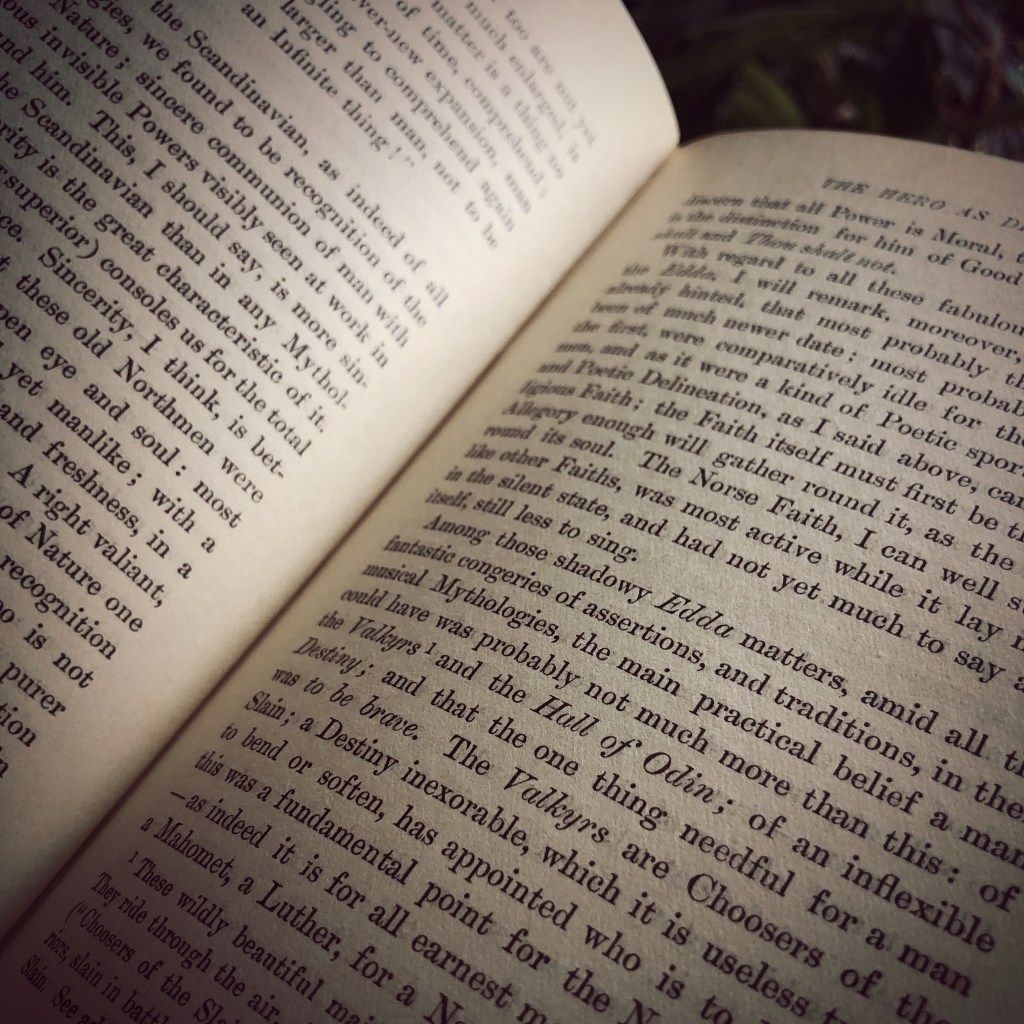
Stormy night reading

It was not the thunder or lightening that distracted me. It was the typeface. Was it the letter “s” or the letter “g” that offered a clue as to the typeface? Most likely Baskerville. But it could also be Caslon.

The wind and rain battered the window. The game’s afoot. The evidence was in a line across the page. Something about the letter “e” made me think I was wrong. The anatomy of the letter “e” features the eye on the top half of the oval. The finial is the tail and the open space between the top half of the letter and finial is the aperture.

The thunder faded as the rain slowed to a steady drizzle. It was the space of the aperture that made me consider that it was neither Baskerville or Caslon. For Baskerville, the eye should be higher and finial lower with a greater space in the aperture. But since this book was printed before the 1970s, maybe the original Baskerville typeface for Linotype looked different when printed. Computer typesetting replaced photo typesetting. And photo typesetting replaced Linotype. Maybe the form of the letters changed from Linotype Baskerville to digital Baskerville. The lights flickered but remained on.

The storm moved east. The downspout outside the window burbled from the rain. And I forgot what I had been reading. A mystery? Something about heroes.
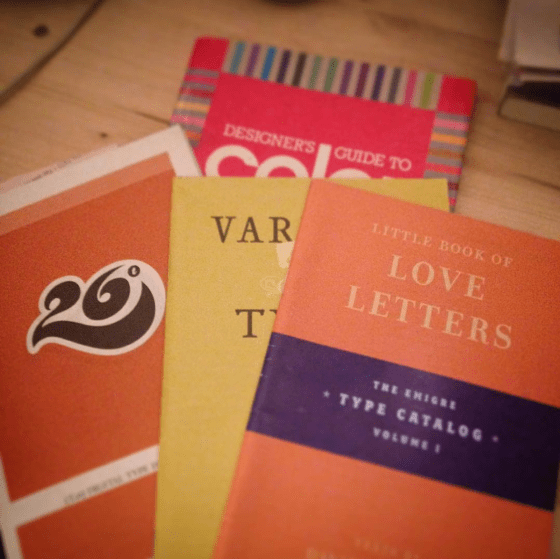
Love letters and various type catalogs

Type catalogs and color guide book circa 1991 and 2004. These artifacts of graphic design history turned up in the garage while I was searching for something else. These catalogs reminded me of a certain passion for the stories behind the creation of specific typefaces. As a young designer, I looked forward to receiving type catalogs from T26 and Émigré.

Émigré often featured text about what inspired the type designer to craft the typeface. For example, Frank Heine wrote in the catalog Various Types:

“I’ve always had a desire to design a typeface based on a Renaissance Antiqua. There are two reasons. First, the Renaissance Antiqua can be considered the prototype for most of today’s typefaces… Second, I am particularly attracted to its archaic feel,…”

I read those catalog pages the way, I imagine, a chef may read a sommelier’s writings on viticulture, enology, and food pairing.

A quiet love developed for the work of type designer Zuzana Licko. She created the typefaces Mrs. Eaves and Matrix II. Both typefaces were and still are my favorite typefaces to use in editorial projects.

If my digital tool box were restricted to only five typefaces, Helvetica, Baskerville, Mrs. Eaves, Matrix II and Gotham would be there. I thought briefly about Butler. But I know that is a passing phase. Ten years from now designed material that features Butler will look dated to this time period in the same manner that Copperplate of FF Trixie will always remind me of the late 1990s.