Interview: Luke Hankins on Poems of Devotion

Poems of Devotion

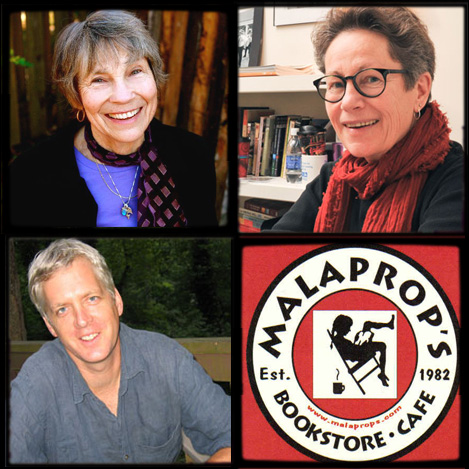
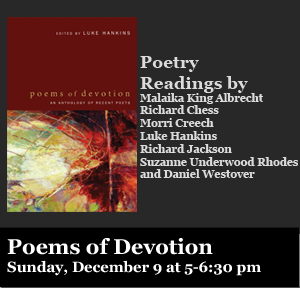
Luke Hankins is Senior Editor at Asheville Poetry Review and the author of a collection of poems, Weak Devotions, a chapbook of translations of French poems by Stella Vinitchi Radulescu, I Was Afraid of Vowels…Their Paleness and editor of Poems of Devotion: An Anthology of Recent Poets. This Sunday, December 9 at 5 p.m., at Malaprop’s Bookstore/Cafe, Luke will read selections from Poems of Devotion: An Anthology of Recent Poets along with other featured contributors: Malaika King Albrecht, Richard Chess, Morri Creech, Richard Jackson, Suzanne Underwood Rhodes, and Daniel Westover. Luke agreed to a quick interview to discuss the recently published Poems of Devotion.

Coffeehouse Junkie Blog

Tell me how the anthology, Poems of Devotion, developed from concept to final printed book.

Luke Hankins

In my final year of graduate school, I took an independent study course with the superb poet and teacher Maurice Manning, which essentially meant that I chose an academic/creative project and he offered input on and evaluation of it. I have had a strong interest in spiritual poetry for many years, so it was natural that I would choose a topic that reflected this passion. The essay I wrote for that class was an examination of a particular set of qualities that characterized many of my favorite spiritual poems, qualities which, in my mind, constituted a distinct mode of composition. The essay was an early form of what is now the introductory essay of the anthology, examining what I call the devotional mode in poetry. When I first wrote it, the idea of editing an anthology hadn’t occurred to me, but as I continued to revisit and revise the essay after graduate school, I felt increasingly that the compiling “poems of devotion” would make for a superb collection of poems. As an experiment, I began gathering poems that I would include in a theoretical anthology, and that’s when I began to feel a real impulse — a “call,” if you will — to bring these poems together in an anthology. I sent out a proposal to several publishers, and I eventually signed a contract with Wipf & Stock Publishers.

What followed was — well, let’s just say a year of very hard work! Gathering the poems I wanted to include was one aspect: reading widely, taking recommendations, spending long days in the library or in coffee shops with large stacks of books. But all of that, though difficult, was full of pleasure and felt deeply rewarding. The other aspect was obtaining — and paying for! — permission from copyright holders to reprint the poems. That process was often labyrinthine, frustrating, and, not least of all, expensive. But it was worth it. I’m very excited about the finished anthology, and am moved and challenged anew each time I read it. Truly.

Coffeehouse Junkie Blog

Maurice Manning is becoming one of my favorite living poets. At the public library, I discovered his book Bucolics and then had an opportunity to attend one of his lectures at Warren Wilson. But I digress. You beat me to the second question which is what did you learn most? Seems like the whole publishing side of the anthology was quite a classroom of experience. If you will, highlight one moment during that year long process that “felt deeply rewarding” for you.

Luke Hankins

I think approaching the copyright aspect of the anthology with a certain level of naivety in many instances worked to my advantage. People were more inclined to take mercy on me and my minuscule budget! But there were a few publishing houses who were absolutely unmovable, and I had to pay out my teeth, so to speak, to include poems I felt were necessary to the anthology. So I learned to rejoice in small mercies where they came, and to practice stoicism about what I saw as exorbitant pricing from some of the major publishing houses.

Regarding your second question, I wouldn’t want to try to single out one moment that felt rewarding. I’ll just say that the process of discovering poets I came to love, whose work I had never read or had only read cursorily, was one of the most rewarding aspects. Re-reading poets whose work has been very impactful for me was another aspect. Also, there was an overall sense of being blessed to be able to dedicate myself to an undertaking that felt like an important fulfillment of who I am. I felt that I was working with real purpose. I felt that I was doing what I was meant to do.

Coffeehouse Junkie Blog

One final question, what’s the biggest thing you hope readers take away from Poems of Devotion?

Luke Hankins

I hope that readers — whether religious or non-religious, theistic or non-theistic — come away with a conviction that the devotional mode is a powerful, ongoing, vital mode in literature. I believe in these poems and their ability to do just that.
How long does it take to write a haiku?

It is twilight. A meager meal of potatoes and cheese provides a father and his children sustenance. As they eat he tells them about a son who lived a long time ago in a far, distant land. He was the son of a samurai and is famously know for his poetry…. [read more]

UPDATE: This blog post is available as part of an audio podcast.

Listen here:

Or listen on:
PodOmatic: coffeehousejunkie.podomatic.com
SoundCloud: soundcloud.com/coffeehousejunkie

E-book: How long does it take to write a haiku?: and other stories

Purchase the e-book Kindle Edition for $0.99!

What do you think about when you see a stack of books? In this short collection of stories you will also learn what a creative director thinks of when he sees a stack of books. Who is the audience for your poems? Is possible to write in your sleep, or not?

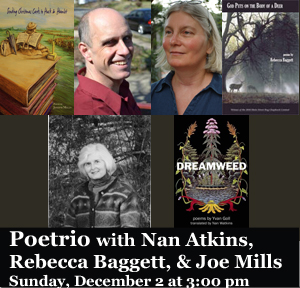
Rebecca Baggett, Joseph Mills & Nan Watkins

Poetry, December 2, 2012
Poetrio, December 2, 2012, 3 P.M.

Join poets Rebecca Baggett, Joseph Mills, and Nan Watkins for Malaprop’s monthly reading series Poetrio, Sunday, December 2, 2012, 3:00 p.m.

From Malaprop’s Bookstore’s Virginia McKinley news release:

Rebecca Baggett…. earned a bachelor’s degree in classical languages at Salem College and is the author of two previous chapbook collections…. GOD PUTS ON THE BODY OF A DEER, the poetry collection Rebecca Baggett will present on December 2, won the 2010 Main Street Rag chapbook contest.  Sarah Gordon has this praise for GOD PUTS ON THE BODY OF A DEER: “Rebecca Baggett’s strong collection…. The voice in these lyrics is original, the imagery fresh and vital, the subject matter compelling….  Throughout these poems the poet emerges as a soul leaning, leaning toward the light.”

Joseph Mills has…. has published fiction, drama, and criticism, as well as four books of poetry from Press 53…. Poet Anthony S. Abbot offered this enthusiastic response to Joseph Mills’ most recent book: “SENDING CHRISTMAS CARDS TO HUCK & HAMLET… is one of the most original collections of poetry I have ever encountered — original because it treats the whole world of books, poems, stories, fairy tales not only as being somehow more real than reality itself but as our most important lifelines to reality itself. There is about this book a sense of everything happening for the first time, even those literary events that seem to happen over and over.  What a pleasure this book gives the reader.”

Nan Watkins is a writer, translator, and musician who lives in the Blue Ridge Mountains of Western North Carolina. She holds degrees in German from Oberlin College and Johns Hopkins University, with further study at the University of Munich and the Academy of Music in Vienna…. Nan Watkins’ DREAMWOOD is the first English translation of Traumkraut, the final (and posthumously published) poems of Yvan Goll (1891-1950).  Goll is considered one of the finest European poets of the twentieth century.  He was born in Alsace-Lorraine and was bilingual in French and German.  In addition to writing as a poet, he became known as a novelist, playwright, translator and publisher who produced collaborations with Chagall, Dali, Picasso, Leger, Weill, Joyce, and others. Among those he published during his exile years in New York were W.C. Williams, Breton, Patchen, and Henry Miller.  In New York he also published his own book in English, Fruit From Saturn.  Poet Neeli Cherkovski has written of DREAMWEED, “This collection not only brings forth… a great poet’s voice, but also stands as a remarkable achievement in the art of translation.”

Hope to see you there.

For more info, contact: Malaprop’s Bookstore/Cafe, 55 Haywood Street, Asheville, NC 28801 (828) 254-6734

www.malaprops.com

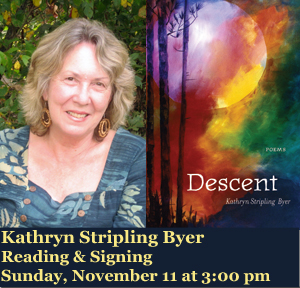
Kathryn Stripling Byer Poetry Reading & Booksigning

Sunday, November 11, 2012, 3:00 p.m., Malaprop’s presents a poetry reading and book signing for Kathryn Stripling Byer.

From Malaprop’s news release:

Poetry reading and booksigning event with Kathryn Stripling Byer, former North Carolina Poet Laureate and another favorite here at Malaprop’s.  On November 11 she will read from and sign DESCENT, a collection of poems described as “navigating the dangerous currents of family and race,” in which Byer “confronts the legacy of southern memory, where too often ‘it’s safer to stay blind.'”

Welcome new readers!

Earlier today I notice that Poetryblogs.org features my blog (I guess this means I should update the blog more often). Thanks for visiting Coffeehouse Junkie’s Blog and hope you return and share what you like. If you’re a new reader of Coffeehouse Junkie’s Blog check out the 10 most recent blog posts listed in the right column, the most liked posts in the left column and search through the subject list in the lower right column for content that I’ve contributed since 2004. You may also sign up for email subscription to this blog so that every time I post something new, you receive an email.

Dear friends and loyal followers of Coffeehouse Junkie’s Blog, I do intend to write more posts. Presently, I am buried in work as creative director for an international publishing company. Until I finish designing other writers’s book covers, blogging will be limited. Enjoy browsing some of the recent book designs here, here, here and here.

David Hopes, Holly Iglesias & Richard Krawiec

Malaprop’s presents Poetrio, November 4, 2012, 3 P.M., featuring David Hopes, Holly Iglesias and Richard Krawiec.

From Malaprop’s:

Richard Krawiec is an extraordinarily versatile writer who has published novels and short fiction as well as nonfiction (including textbooks on teaching writing), plays, and two books of poetry, Breakdown, and She Hands Me the Razor.  …AND LOVE… is the fifth anthology for which he has served in an editorial role, and this anthology includes his own poem “She Hands Me the Razor.”  The editors’ introduction to …AND LOVE… offers an enormous (and still not exhaustive) list of varieties and aspects of love, summarized, at least for the moment, in this way: “Whatever it brings, love is the only thing that makes everything else ring true.  And that’s what this collection is all about.  This burgeoning landscape of love, collected here, in the words of 125 poets.”

Holly Iglesias is well known to those who attend Malaprop’s poetry events regularly.  She last read at Malaprop’s for the October 2012 all-poetry Writers at Home event, and she has previously read on more than one occasion at Poetrio.  She has published several collections of poetry, the latest of which is Fruta Bomba (February 2012), and is the author of the critical study Boxing Inside the Box: Women’s Prose Poetry. Among her many honors is a 2011 fellowship in creative writing from the National Endowment for the Arts.  She teaches in the Master of Liberal Arts program at UNC-Asheville and contributed the poem “American Impressionists” (from her book Souvenirs of a Shrunken World) to the anthology …AND LOVE….

Poet David Brendan Hopes is also a prize-winning playwright, memoirist, and actor who lives in Asheville and is Professor of Literature and Language at UNC-Asheville.  His poetry has earned him the Juniper and Saxifrage prizes in poetry, and he continues his work as a playwright with a Lincoln trilogy for theater (the first two parts are completed), while working as well on a novel about Asheville.  He has published a number of poetry collections, and he read from his book Dream of Adonis at the Malaprop’s Poetrio event in 2008.  We are very happy to welcome him back for the presentation of …AND LOVE.., to which he contributed the poem “Before Supper.”

Ain’t that the blues

Beedy Eyes stops thumping the skins as Chaney sings an old Leadbelly work song as I recall the first time I heard the blues. It was somewhere between the music I heard as a child–primarily country, gospel and hymns. A skinny toe head growing up on the rolling northern prairies, I perceived the blues was somewhere between country and gospel–something you sing while dangling your feet off a hayrack weighed down with a full load, something you sing with others coming in from the field, something you sing when the sun is tilting toward the western horizon. For a young kid hearing the blues for the first time it was somewhere on my musical landscape between religious and profane, respect and discent, right and wrong, joy and despair and seemed to fit me like a glove.

The window is open to an autumn afternoon as I work on graphic design projects. I listen to Bill, Chaney and Junior sing about hard times. Neighborhood dogs barking and birds singing seem to be appropriate backup. It’s been hard times for a lot of us. The other night I walked into a friend’s home and he asked right off, with a smile, “Anything you need to repent of? We’re talking about repentance.” Yeah, I think to myself. I got a long list. There are times I want to rob and steal, cuss and swear, break stuff and hit someone and be all sizes of trouble. Hard times is life. Doing what I aught to do is not easy. Ain’t that the blues? Or is that gospel? The double edged swing of the blues kicking up the dust of life in your face, choking on pride and praying that you “remember you’re walkin’ up to heaven, don’t let nobody turn you round.”

Good design is more than this


(image via Jonathan Trier Brikner)

There’s more to being a design genius than this. Truly.

Just because you have a computer, laptop or tablet allowing you to download free fonts and free images and use some free app you discovered on Twitter does not make you a design genius.

Just because you “designed” a cool graphic image the way many misled souls believe they labored and “built” an IKEA bookshelf does not make you a design genius. [1]

Celebrated graphic designer, Milton Glaser, put it best:

Computers are to design as microwaves are to cooking.

Good design solves problems and presents stories. As a creative director for an international publishing house, my chief goal is to attract potential readers to new books by capturing a story in a single cover image. To illustrate the point further, an author (for whom I had just completed a book design) emailed me recently: “I’m getting some great feedback on my Facebook page about the cover. Thank you very much…” Good design is about communication: problem solved, story told.

NOTE: [1] For what it is worth, IKEA is not good design. It is nothing more than cheaper-than-Wal-mart veneer furniture, second-rate fabric products and wax-paper lamps. And don’t call IKEA “modern design” because modern design is so 1948. Seriously, the modernist movement began almost a century ago. But I digress.

We bury secrets deep into lyrics

There are secrets between singer songwriters and poets. We share them in dark corners of pubs or cafés. We talk about live performances and audiences and the craft of writing. A singer songwriter confesses that “at least a guitar is between me and the audience, but poets are left completely vulnerable on stage.” Yes, indeed. Naked before audiences that, in general, don’t care about poetry or don’t know anything about it. We wonder why singer songwriters embrace lyricism while academic poets skitter away from deep lyrics and the hint of rhyme. We will bury our secrets deep into the lyrics of a song or poem–so deep that it requires of map to locate ars poetica.

Last night, I fell asleep writing a poem

Realizing late in the evening that the day had almost past and I had not committed to composing a poem, I set to the task….

[read more]

UPDATE: This blog post is available as part of an audio podcast.

Listen here:

Or listen on:
PodOmatic: coffeehousejunkie.podomatic.com
SoundCloud: soundcloud.com/coffeehousejunkie


E-book: How long does it take to write a haiku?: and other stories

Purchase the e-book Kindle Edition for $0.99!

What do you think about when you see a stack of books? In this short collection of stories you will also learn what a creative director thinks of when he sees a stack of books. Who is the audience for your poems? Is possible to write in your sleep, or not?

How long should one wait on editors?

While I wait for editors to reply to my narrative non-fiction submissions, I grow impatient and want to post these writings on this blog. Some teasers like Shuffling through the ruins of a summer and Ma Rainey, don’t sing them blues no more were released. One astute reader provoked this post: Yes, it is true. But on the advice of published writers, I can’t post much more without jeopardizing publication. So, I wait. Keep writing. And reading. This weekend one blogger reminded me of OctPoWriMo–31 poems/31 days. This seems to me like a good exercise to do while I wait on editors.

Shuffling through the ruins of a summer

In this scene, the main character stands on a busy sidewalk beside a slender tree. He looks down at the scattered ruins of a summer of expectations. “How should I have prepared for this?” he asks himself. “What do I do now?” He feels relief and that surprises him. This is a new beginning. A fresh start. Unlimited opportunities. However, this is also the first time in his adult life he is unemployed. And without an automobile. Adjusting the strap of his laptop attache, he walks up Lexington Avenue to catch a bus. The feeling of relief is quickly replaced with a deep, consuming despair. In this scene, the crowds of tourists walking down College Street talk loudly and trample the gathering leaves under their shoes as the main character weaves his way toward Pritchard Park. He doesn’t hear them, only hears the sound of his own boots on the sidewalk and wonders where will he be a year from now.

Ma Rainey, don’t sing them blues no more

There’s a story behind this image that wants to be told. It’s a reminder that seasons and people transition. Loyalty tested against the panes of transparency. Everything goes sideways when turning the corner and down the street of uncertainty, when faith and doubt pressed up against a steamy autumn window and all they see is loss. It’s a story still worrying the line. Still blue enough, blue enough, still bluer than Ma Rainey singing “Bo Weevil Blues.” It’s a story where the clarinet sweeps back and forth, sweeps low and easy, sweeps in a song looking for a place to stay, sweeps in a song saying “don’t sing them blues no more…” Don’t tell me ’bout the job you lost. Don’t tell me ’bout your broken down car. Ma Rainey, Ma Rainey, “don’t sing them blues no more…”

September 16, 2012: poetry at Malaprop’s

Writers at Home – Sept. 16th

This Sunday at the Malaprop’s cafe at 3:00 p.m. on Sunday, September 16, join the following poets as they read from their recent books: Holly Iglesias (ANGLES OF APPROACH), Sebastian Matthews (MIRACLE DAY: MID-LIFE SONGS), and Katherine Soniat (THE SWING GIRL). More details here. Link.

Hidden in the closet

Hidden in an old portfolio

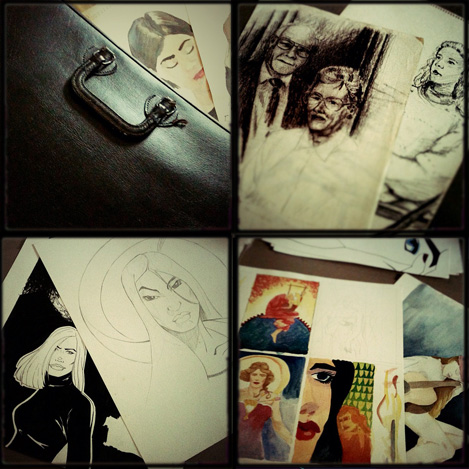
Something hides in the closet. Below the button down shirts and dress slacks for work, behind the winter wardrobe of sweaters, vests and jackets, and against the back wall is an old black leather portfolio with handles. Years ago it was a mandatory item for any and every graphic design student or young professional with goals of becoming an art director, illustrator or creative director. I pulled out the old portfolio and the oversized heavyweight document envelopes behind it and entered a gateway to another time and place.

Like time travel, I am back in the 1990s. There were three main portfolios I presented. One presentation was corporate, ad agency design samples. The kind of material that ranged from logo design, brand campaigns and the like. The second presentation was print design. That portfolio exhibited all manners of print designs from brochures, books, direct marketing collateral, magazine spreads, cover designs, etc. For presentations, I would rotate the design samples in the black leather portfolio based on the interview. Sometimes I presented a hybrid of both that included work that featured my copyrighting and marketing pieces. But the third portfolio was my favorite–the illustration portfolio.

Professors, peers and even my first art director advised it was the weakest of the three. The general critique was that technique needed improvement. So I kept working on improving technique and execution. A black cloth case bound sketch book always accompanied me almost everywhere I traveled. I’d sketch landscapes, still lifes, portraits and tried various techniques using pencils, Sharpie markers, charcoal, ink and watercolor. But soon I learned that I could earn more financially and find more consistent work with digital designs.

It is not that I abandoned illustration. A few years ago, a national news magazine featured one of my illustrations on the cover of its annual books issue. Earlier this year, another illustration was featured as a book cover design. Also this year, a few spot illustrations were published in a book.

As I look at these old illustrations and sketches, I see a younger, self-doubting me at a time before home computer, internet, or smartphone entered my life. Back in those days, the only entertainment devices I had was a stereo set with a five-CD player, a stack of maybe 30 audio CDs and a shelf full of books. Through the portal of this time capsule, I see the mistakes and accomplishments with a new perspective. Hidden away in that closet is a portfolio of dreams, aspirations and ideas that was slowly replaced with a portfolio of duty and responsibility. A thought occurs to me as I examine an unfinished sketch of a female portrait, did I focus on pursuing a career path rather than a vocation? Maybe that is a thought I should hide in the closet while I bring some of these illustrations into the daylight.

Peace Is a Flower: A Night of Poetry and Music

Peace is a flower – poetry and music

Tomorrow, 8:30 p.m. join James McKay, Laura Hope-Gill, Caleb Beissert, Pasckie Pascua, and Aaron Price at Battery Park Book Exchange & Champagne Bar, 1 Page Avenue, Asheville on SEPT 11, 8:30 to 11PM. This event is free to the public. Read poet and musician bios as well as other information on the Facebook events page. Link.

Yes, it is true

Instagram montage
Scenes from a story unfinished

A very observant reader and friend asked of this week’s post: “Is this story related to the teases from other photos?” Yes, they are all teasers for scenes from a narrative non-fiction book I’m writing. Some of the chapters have either been sent or are in the process of being sent to journals and magazines for publication. I am waiting on editors at this phase in the process.

For those who missed it, here’s the sequence so far: There is a story behind this photo, What hides behind this foggy morning photograph?Sisyphus tears down the mountain in a Chevy, and this week’s There’s a story… about double red doors….

There’s a story… about double red doors…


There’s a story I want to tell you about double red doors, but I can’t. Not yet. You see, the problem is that the story awaits an editor’s approval to publish. I can’t tell you which editor. I can’t tell you which publication. And I can’t post anything online without jeopardizing the publication of that story about her and an empty cup of liquid truffle and a vacant building with double red doors above a flight of steps and I may have said too much.

Quote: “Poetry exists… to sing the praises…”

I think poetry exists partly in order to sing the praises of who and what we love. . . . As well as for the purpose of showing us ourselves, at our worst as well as at our best.

—Sharon Olds [1]

SOURCE: [1] Megan O’Grady, “Fine Print: Poet Sharon Olds Chronicles the End of Her Marriage in a New Collection,” Vogue, accessed August 28, 2012, http://www.vogue.com/culture/article/fine-print-poet-sharon-olds-chronicles-the-end-of-her-marriage-in-a-new-collection/#1.

Tonight, Juniper Bends reading series returns to Downtown Books & News

Juniper Bends reading series – August 2012

Tonight, 7PM at the Downtown Books & News, the Juniper Bends quarterly literary reading series presents Catherine Campbell, David Hopes, Majo John Madden and Nina Hart.

More information on the Juniper Bends Facebook events page. Link.

Hope to see you there!

A bookless American library

Empty shelves at the downtown city library

Why can’t I find a copy of Kurt Vonnegut’s Slaughterhouse-Five at a local public library? I’m wandering through the aisles of bookshelves thinking, It’s not an obscure title. Is it? Earlier, I visited a couple library branches and couldn’t find a single copy. How is that possible? Later I would find a copy at a bookstore (actually, I would find copies at three of the local bookstores, but I would be out of cash and wouldn’t be able to afford to buy a copy… more on that later… like, wait-for-my-memoir later…).

Is it possible? Are American libraries moving toward booklessness? At the main, downtown city library I stare at a whole wall of bookshelves emptied of books (see photo). Glancing around the place it appears that the only thing people do at that library is use the toilet, enjoy the air conditioned space on hot summer days, and rent CDs and DVDs. The magazine racks are full and there is an man, probably in his 60s, reading the latest copy of the New Yorker. Beyond the reference desk, I see that every computer terminal is occupied. My mood is turning away from searching for a copy of Slaughterhouse-Five, to mischievous. I want to walk over to the reference desk librarian and ask, “Where might I find a book about Tralfamadore?” From experience, I know what the reference desk librarian will do. The scene will go something like this:

“Excuse me, but where might I find a book about Tralfamadore?”

“Tralfamadore? Let me see,” he says as he opens a web browser on the computer and sounds out the word tral-fam-a-dore under his breath. “Oh, Tralfamadore. From Kurt Vonnegut’s novel Slaughterhouse-Five.”

“Did you just google that?” I ask.

He looks at me and doesn’t say anything.

“Shouldn’t that be unholy sacrilege to use Google in a library?” I ask. “I mean, this is supposed to be a house of intellect.”

He folds his hands in front of the keyboard and says, “I used Wikipedia.”

“Wikipedia?” I snort.

The reference desk librarian catches the eyes of the library’s security guard who walks toward us.

The scene concludes with me mumbling something about the democratization of content leaves an intellectual void that is too quickly filled with bits of data rather than depth of knowledge and wisdom.

But I don’t walk to the reference desk. I get lost somewhere in the fiction aisles–somewhere in the section where books by authors with last names beginning with “k” are placed. The whole thing–the search for a single copy of a book and the failure to locate it at a public library–is loathsome to me. I have this uneasy feeling ‪that Ray Bradbury’s‬ ‪Fahrenheit 451‬ may be prophetic. And I want to start memorizing large volumes of literature for the mere preservation of it to share with the next generation. Isn’t that why books are written? To share not just with this present age, but to extend beyond the life of the writer? My eye’s find a book about bean trees–or rather, a novel. It’s not a very thick novel, but it seems to have found me and I can’t just leave it on the bookshelf and I don’t want to leave the library empty-handed.

After the book is processed silently by a librarian, I walk to catch a bus home. Reading the first few pages at the transit center I know I have found a new friend in this book. It’s a feeling I can’t say I have regarding Google or Wikipedia. To me, they are repositories of data–vapid of personality in the same fashion as the  Borg–to be mined or to be assimilated.

Poetrio, this Sunday, at Malaprop’s Bookstore

August Poetrio — 2012

This sunday, Malaprop’s Bookstore/Café continues the monthly poetry reading series, Poetrio, with Meta Commerse, Cassie Premo Steele, and Pauletta Hansel.

In an email from Virginia McKinley, of Malaprop’s, here’s a write up about August’s featured poets:

Meta Commerse. . . is the author of six books, including a novel intended to be a book of hope for middle-school-aged black girls.  That book began as her culminating project for the MFA degree in creative writing at Goddard College.  RAINSONGS: POEMS OF A WOMAN’S LIFE is her most recent book of poetry. . . .

Cassie Premo Steele’s poetry has appeared in numerous anthologies, magazines, and journals, including such publications as Sagewoman and Calyx. Her work has been nominated twice for a Pushcart Prize. . .  Her most recent book of poetry, THE POMEGRANATE PAPERS, is based on the Persephone/ Demeter myth and addresses the themes of mothers, daughters, creative cycles, loss, healing, and living in harmony with the seasons. . . .

According to Jackie Demaline of The Cincinnati Enquirer, Pauletta Hansel has been “an arts administrator and an unflagging arts advocate, [but] doesn’t like to talk about herself.”  Yet she seems happy to talk about the work she finds most interesting: “community organizing and community arts.”  . . . . Pauletta Hansel has published poems in . . . journals . . . and . . . has three previous collections of poetry, Divining, First Person, and What I Did There; at Malaprop’s she will read from her most recent book, THE LIVES WE LIVE IN HOUSES. . . .

Hope to see you Sunday, August 5, at 3:00 p.m. for Poetrio!

On summer or winter in books and writing

One Day in the Life of Ivan Denisovich‬ and The Call of the Wild

“Do you prefer Summer or Winter in books and writing?” asks blogger Lea At Sea. What do you think? I had to think about that for a while.

I finished a few books recently by authors Ian McEwan and Barbara Kingsolver. Saturday, On Chesil Beach and The Bean Trees all have specific seasons and locations central to each novel. As I thought of how the seasons permeate a novel, two novels come to mind: ‪

by ‪Aleksandr Solzhenitsyn‬ and ‪The Call of the Wild‬ by Jack London. [1] It never occurred to me to read One Day in the Life of Ivan Denisovich‬ because it begins on a cold winter morning. The character and narrative interested me. The gulag in winter is a prominent element of the story, but that isn’t the reason I read the book. It was the story.

By nature I’m a fall/winter sort of person. Maybe that’s why I recalled those two books:One Day in the Life of Ivan Denisovich‬ and ‪The Call of the Wild‬. But my reading choice is not directly influenced by that predisposition otherwise I would not have picked up a book set in spring/summer of the American southwest. However, I am curious to learn if your reading selections are influenced by that perimeter. Do you choose a book because it is seasonally based? Further, if you are a poet and/or writer, do you specifically write for a specific season?

NOTES: [1] Technically, ‪The Call of the Wild‬ and On Chesil Beach are novellas. Maybe I should refer to the works as books rather than their literary distinctions. Writing Forums offers distinctions between short story, novella and novel lengths. Basically, word count. Short Short Stories & Flash Fiction; usually under 1,000 words; Short Stories, 7,499 words to 15,000 words; Novelette, 7,500 to 17,499 words; Novella, 17,500 words to 39,999 words; Novel, minimum word count of 40,000 words. It is my understanding that a proper novel runs an average of 80,000 words. Since we’re on the topic of word count, Fiction Factor offers How Long Should Your Story Be? by Lee Masterson and Writer’s Relief presents Short Story Or Novella? What’s The Difference And Where To Publish Shorter Fiction.

The English novel versus the American novel

Which do you prefer, the English novel or the American novel? I’ve been thinking about that after reading some of Ian McEwan’s and Barbara Kingsolver’s books. Maybe it is the difference in the writers and not so much the country from which they live. There is a tone or manner that seems a marked distinction between the two styles. What do you think?