Confessions of a coffeehouse junkie, revisited

1.

The genre of blog writing is nearly obsolete. As far as I can tell. This is based on a conversation I had a couple months ago.


“You’re son told me you have a blog,” she said.

“Huh?” I replied.

My family was invited to a small, casual dinner party.

“Yeah, he also said you’re an artist and poet,” she said. “I used to have a blog. I mean. That was years ago. I’m not really a writer, but I blogged.”

She continued to tell me what she blogged about and where. We were both active around the same time period (by active I mean posting writings nearly daily). That was before the rise of the major social media platforms. I shared that part of what I enjoyed about the genre was the interaction with people. The exchange of ideas. The sense of being part of a greater community.

“I mostly just write on Facebook now,” she confessed. “Remember, back when, you could only leave a comment on a blog post?”

“That’s right,” I recalled out loud. “There were no like buttons or social media share icons.”

After that dinner party, I updated the art page of my blog. And planned to contribute more time and resources to blogging again.

2.

I composed a post about the value of journaling with plan to publish it the first week of March. But it ended up in the draft folder.

Mid-March I wrote another post. This one was about discovering a collection of my old art work. But it too is in the draft folder. Well. Actually. I eventually posted it near the end of April.

But the genre of blog writing is passé. Outdated. Why do I still do this?

Then I remembered rule number eight: “Every word on your blog is a word not in your book.”

3.

Shifting focus, I started work on a book. Or rather a series of books. Inspired by August Derleth’s Sac Prairie books, like Walden West and Countryman’s Journey. I set to work on the first manuscript.

Derleth presented a non-linear collection vignettes and entries about his home town. I moved in the direction of a daybook, or journal. Instead of spending a year at Walden Pond, or Sac Prairie, I collected entries and stories of a year in the life of a cultural creative edging toward a digital nomad.

Thoreau and Derleth drew from nature, whether from a pond or prairie. I discovered the ubiquitous screen became the prominent pool of inspiration for the first manuscript. One book manuscript became two and three. The metaphor of the glowing computer laptop screen began to crack and shatter by the fourth book manuscript.

The book series is part confession and part cautionary tale.

4.

I deleted the blog. The only thing that remains of that original blog is the screen shot featured in this post.

In truth, I deleted all blogs I maintained. Except this one.

Collision of jazz and Chinese poetry

The train was late. Or rather, I was late for the train. Work ran later than expected. Missed the 5:45. The street car was running. No mechanical problems like Monday. But a few minutes behind schedule due to a presidential rally.

I decided to skip the street car and walk to the station in order to catch the last train home. There is almost two hours between one train and the other. Walking gave me a chance to find a coffee shop and some time to catch up on reading. The Public Market was on the way, but it tends be loud. And crowded.

Stone Creek Coffee is nice and near the train station. And open until 7 p.m. It displays a nice interior design. But sometimes the atmosphere feels a bit too mod. The baristas are often impertinent. And I feel inelegant when I visit. Maybe I am getting too old to haunt swanky coffee shops. Stone Creek coffee is luxurious. In spite of pretentious barista I bought a cup and then walked to the train station to wait and read a book. It is an autobiography of the Chinese poet Tu Fu. The fact that a book published in the 1930s is still in circulation at a public library is impressive. Also interesting are the translator notes. A few weeks ago I finished reading a recent translation of Li Po poetry. The translator, Seaton, made observations similar to those made nearly 100 years ago by Ayscough and Lowell.

I struggled with one passage in the book as the train station grew loud with passengers arriving from one train and departing on a Greyhound bus. Pulling a mobile device out of my pocket I placed in ear buds and cued up episode 88 of the Discovering Jazz podcast. As I listened I read that one Chinese ideogram may require more than one word to transliterate. Sometimes an entire phrase is used to convey the idea of a single Chinese character. The last train arrived. I boarded. Found a seat. Continued reading. And listening.

The jazz podcast explored absolute pitch. The show host mentioned that Asian languages are tonal. Pronouncing a vowel with one pitch may mean one thing while pronouncing the same vowel with a different pitch provides a different meaning. I experienced that when I visited Japan. But I did not have the knowledge to appreciate it then as I do now.

Reading a dozen pages was all I managed to accomplish before the train stopped at the home station. Thankful to be homeward. Grateful for the travel disruption that mingled American jazz and Chinese poetry into one commute.

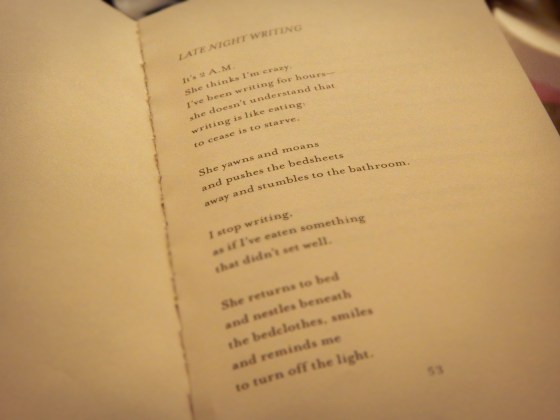
Poem Fifteen: Late Night Writing

Title poem by Matthew Mulder from the book Late Night Writing.

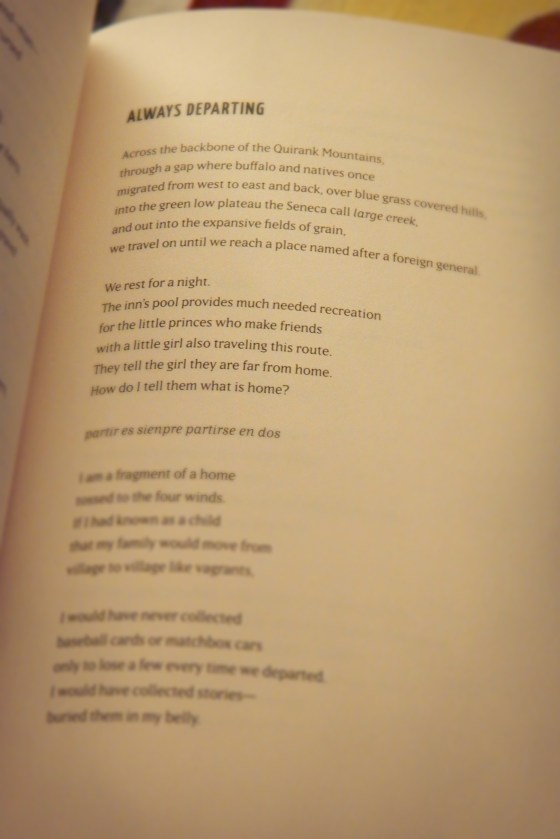
Poem Nine: Always Departing

An excerpt of
An excerpt of “Always Departing” by Matthew Mulder from the anthology Rooftop Poets.

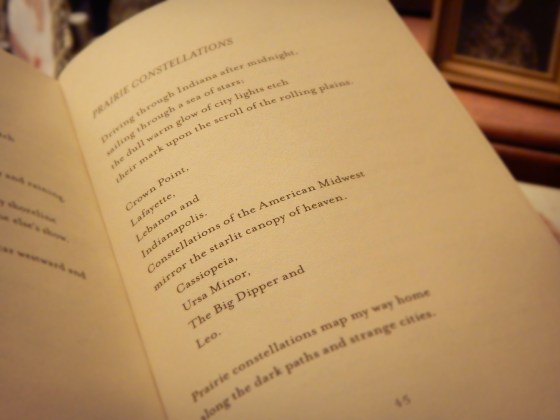
Poem Six: Prairie Constellations

“Prairie Constellations” by Matthew Mulder from the book Late Night Writing.

Poem 7: Always Departing

An excerpt of
An excerpt of “Always Departing” by Matthew Mulder from the anthology Rooftop Poets.

Poem 5: Prairie Constellations

“Prairie Constellations” by Matthew Mulder from the book Late Night Writing.

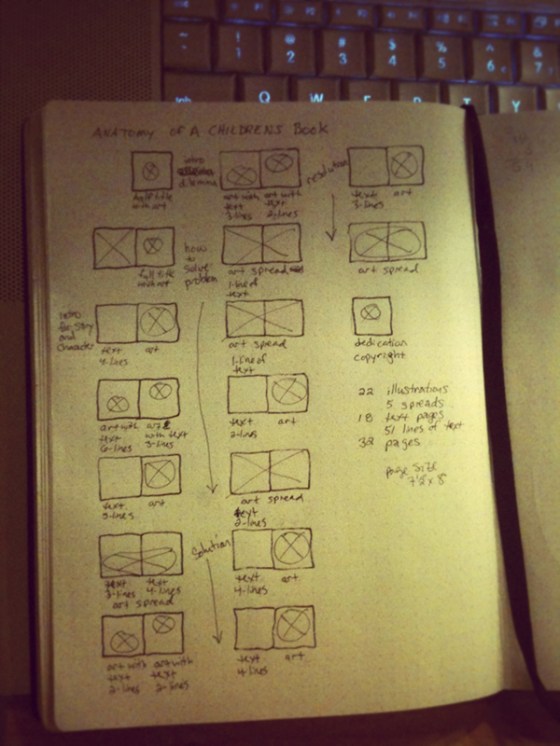
Template layout for a children’s book

This crude sketch is quite popular. A reader commented recently how the layout template helped his poetry book project.[1] The web site Moving Writers[2] posted “A Collaborative Writing Study That Will Rock Your Students’ World: Children’s Literature”[3] and linked to my rough layout template.

The origin of the drawing began at a local meet-up of illustrators and artists. The topic of children’s books came up. Several of the artists felt intimidated by the idea of creating a children’s book. As well they should. But it is not a path of labyrinthian impossibility. The big question is how to do it. At the time, I was a creative director for an international publishing company and had designed children’s books — specifically, picture books.

To encourage these artists and writers, here is a general anatomy of a children’s book:

  • 22 illustrations (five spreads)
  • 18 pages of text (51 lines to be specific) and
  • 32 pages (including title pages, front matter and back matter)
  • intro story and character on page four
  • intro dilemma on page 14
  • how to solve problem (pages 15 to 23)
  • problem solved on page 24 and
  • resolution on page 28

Several artists that night asked to take a photo of this sketch of an anatomy of a children’s book with their smart phones. Since then, several readers have expressed similar interest. So, I share this sketch again.

Like all recipes, what you do with the ingredients (i.e. text, words and pages) is up to the artist and writer. And, like any good disclaimer, results do very.

NOTES:
[1] “Anatomy of a children’s book,” coffeehousejunkie.net, December 10, 2012, accessed June 20, 2016 https://coffeehousejunkie.net/2012/12/10/anatomy-of-a-childrens-book/
[2] Moving Writers, accessed June 20, 2016 https://movingwriters.org/.
[3] Allison Marchetti, “A Collaborative Writing Study That Will Rock Your Students’ World: Children’s Literature,” movingwriters.org, May 30, 2016, accessed June 20, 2016 https://movingwriters.org/2016/05/30/a-collaborative-writing-study-that-will-rock-your-students-world-childrens-literature/.

Bonus Poem: Late Night Writing

Title poem by Matthew Mulder from the book Late Night Writing.

Poem 12: Prairie Constellations

"Prairie Constellations" by Matthew Mulder from the book Late Night Writing.
“Prairie Constellations” by Matthew Mulder from the book Late Night Writing.

Poem 10: Always Departing

An excerpt of "Always Departing" by Matthew Mulder from the anthology Rooftop Poets.
An excerpt of “Always Departing” by Matthew Mulder from the anthology Rooftop Poets.

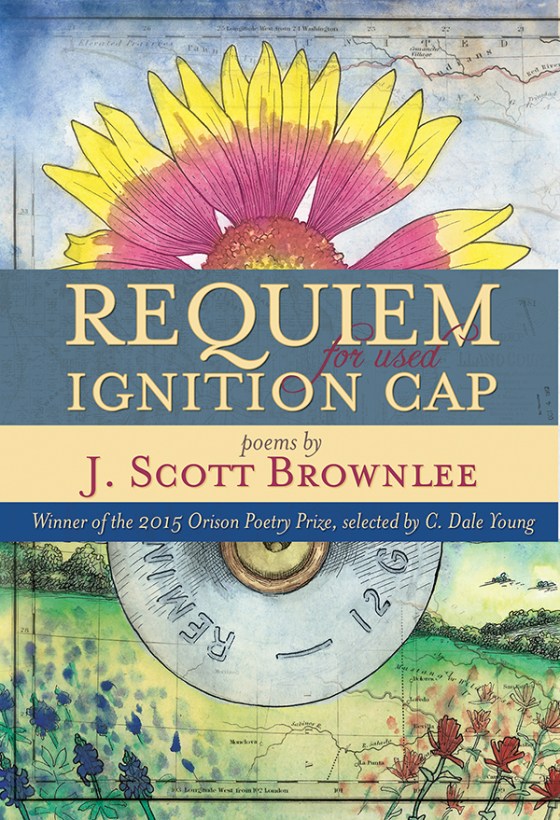
Book cover illustration – update

Fear motivates. The paralyzing fear that if I mess up the coloring of this book cover art, I will have to start the whole process over again. And the completion date is fast approaching. But the task needs to be done. So, onward.

DSCN3428[sqr-tilt-dallas]

Watercolor washes begin the color process for the book cover illustration.

DSCN3427[sqr-tilt-dallas]

Paint to the edges and then let the colors bleed. The basic color palette had already been determined weeks prior to the final execution of the cover art. But once the water and pigment are activated on the surface of the paper, the color palette organically builds to its own organized spontaneity.

DSCN3434[sqr-tilt-dallas]

Details. There are always small details that many casual observers may not detect at first glance. For example, the color for the shotgun shell includes multiple wash layers of different pigments — each layer pulling or pushing color from previous layer.

HardCover

Once the final art is approved, I finished the design with title bar and a map overlay to texture the collage art.

The pleasure of drawing

DSCN3386[sqr-tilt-dallas]

Nearly done with the back cover illustration. A brush is often forgotten in the process of keeping a clean drawing surface.

DSCN3396[sqr-tilt-dallas]

Detail of the back cover illustration — a catfish. I have to admit — besides the firewheel flower blossom on the front cover — drawing the catfish was a pleasure.

DSCN3400[sqr--dallas]

Front and back cover pen and ink collage drawing completed. Ready for the next phase — watercolor.

The purpose of drawing

The foundation of a great painting is a solid drawing. At least that was my goal when I worked on this book cover illustration for Orison Books. The collage features a firewheel — sometimes called Indian blanket — blossom, shotgun shell and expansive Texas landscape.

DSCN3395[sqr-tilt-dallas]
Nearly completed pen and ink work on the cover.

DSCN3390[sqr--dallas]

Detail of the firewheel flower blossom.


The purpose of thumbnail illustration

The purpose of thumbnail sketches is to advance the concept of artist, art director and editor to a final product. It seems like a lot of busy work, but three elements are essential: brainstorming, mind-mapping and closing the gap. The following images illustrate the process of thumbnail sketches as it relates to a book cover illustration. DSCN3558[sqr-tilt] Three thumbnail cover comps presented to the publisher a couple months back. DSCN3560[sqr-tilt] Full-size book cover sketch to gauge color temperature and composition of elements.
Interview: Luke Hankins on Poems of Devotion

Poems of Devotion

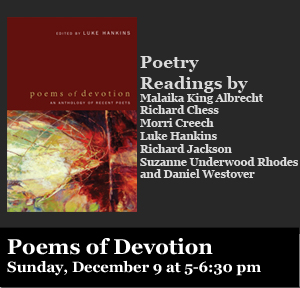
Luke Hankins is Senior Editor at Asheville Poetry Review and the author of a collection of poems, Weak Devotions, a chapbook of translations of French poems by Stella Vinitchi Radulescu, I Was Afraid of Vowels…Their Paleness and editor of Poems of Devotion: An Anthology of Recent Poets. This Sunday, December 9 at 5 p.m., at Malaprop’s Bookstore/Cafe, Luke will read selections from Poems of Devotion: An Anthology of Recent Poets along with other featured contributors: Malaika King Albrecht, Richard Chess, Morri Creech, Richard Jackson, Suzanne Underwood Rhodes, and Daniel Westover. Luke agreed to a quick interview to discuss the recently published Poems of Devotion.

Coffeehouse Junkie Blog

Tell me how the anthology, Poems of Devotion, developed from concept to final printed book.

Luke Hankins

In my final year of graduate school, I took an independent study course with the superb poet and teacher Maurice Manning, which essentially meant that I chose an academic/creative project and he offered input on and evaluation of it. I have had a strong interest in spiritual poetry for many years, so it was natural that I would choose a topic that reflected this passion. The essay I wrote for that class was an examination of a particular set of qualities that characterized many of my favorite spiritual poems, qualities which, in my mind, constituted a distinct mode of composition. The essay was an early form of what is now the introductory essay of the anthology, examining what I call the devotional mode in poetry. When I first wrote it, the idea of editing an anthology hadn’t occurred to me, but as I continued to revisit and revise the essay after graduate school, I felt increasingly that the compiling “poems of devotion” would make for a superb collection of poems. As an experiment, I began gathering poems that I would include in a theoretical anthology, and that’s when I began to feel a real impulse — a “call,” if you will — to bring these poems together in an anthology. I sent out a proposal to several publishers, and I eventually signed a contract with Wipf & Stock Publishers.

What followed was — well, let’s just say a year of very hard work! Gathering the poems I wanted to include was one aspect: reading widely, taking recommendations, spending long days in the library or in coffee shops with large stacks of books. But all of that, though difficult, was full of pleasure and felt deeply rewarding. The other aspect was obtaining — and paying for! — permission from copyright holders to reprint the poems. That process was often labyrinthine, frustrating, and, not least of all, expensive. But it was worth it. I’m very excited about the finished anthology, and am moved and challenged anew each time I read it. Truly.

Coffeehouse Junkie Blog

Maurice Manning is becoming one of my favorite living poets. At the public library, I discovered his book Bucolics and then had an opportunity to attend one of his lectures at Warren Wilson. But I digress. You beat me to the second question which is what did you learn most? Seems like the whole publishing side of the anthology was quite a classroom of experience. If you will, highlight one moment during that year long process that “felt deeply rewarding” for you.

Luke Hankins

I think approaching the copyright aspect of the anthology with a certain level of naivety in many instances worked to my advantage. People were more inclined to take mercy on me and my minuscule budget! But there were a few publishing houses who were absolutely unmovable, and I had to pay out my teeth, so to speak, to include poems I felt were necessary to the anthology. So I learned to rejoice in small mercies where they came, and to practice stoicism about what I saw as exorbitant pricing from some of the major publishing houses.

Regarding your second question, I wouldn’t want to try to single out one moment that felt rewarding. I’ll just say that the process of discovering poets I came to love, whose work I had never read or had only read cursorily, was one of the most rewarding aspects. Re-reading poets whose work has been very impactful for me was another aspect. Also, there was an overall sense of being blessed to be able to dedicate myself to an undertaking that felt like an important fulfillment of who I am. I felt that I was working with real purpose. I felt that I was doing what I was meant to do.

Coffeehouse Junkie Blog

One final question, what’s the biggest thing you hope readers take away from Poems of Devotion?

Luke Hankins

I hope that readers — whether religious or non-religious, theistic or non-theistic — come away with a conviction that the devotional mode is a powerful, ongoing, vital mode in literature. I believe in these poems and their ability to do just that.

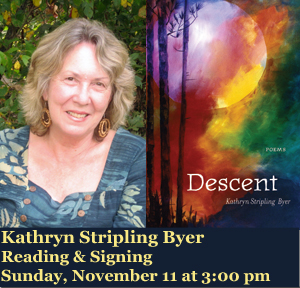
Kathryn Stripling Byer Poetry Reading & Booksigning

Sunday, November 11, 2012, 3:00 p.m., Malaprop’s presents a poetry reading and book signing for Kathryn Stripling Byer.

From Malaprop’s news release:

Poetry reading and booksigning event with Kathryn Stripling Byer, former North Carolina Poet Laureate and another favorite here at Malaprop’s.  On November 11 she will read from and sign DESCENT, a collection of poems described as “navigating the dangerous currents of family and race,” in which Byer “confronts the legacy of southern memory, where too often ‘it’s safer to stay blind.'”

Book Launch for Look Up Asheville Collection II

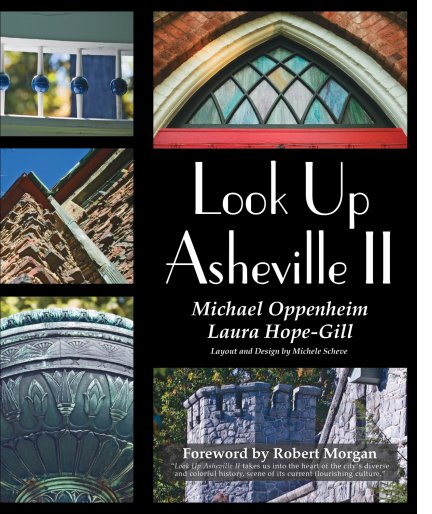
Look Up Asheville II by Michael Oppenheim and Laura Hope-Gill

Tonight at 6:30 p.m. the Look Up Asheville II book launch begins at the Battery Park Champagne Bar/Book Exchange. Join the festivities for the launch of Look Up Asheville II featuring photography by Michael Oppenheim and essays by Laura Hope-Gill. Poet Robert Morgan writes: “Look Up Asheville II takes us into the heart of the city’s diverse and colorful history, scene of its current flourishing culture.”

From the event invitation: “Look Up Asheville II features more architectural details captured by local photographer, Michael Oppenheim, accompanied by historical essays by Laura Hope-Gill, with a Foreword by premier author and poet Robert Morgan (Gap Creek, Lions of the West, Terroir). Designed by Michele Scheve, Look Up Asheville II does more than inform readers and viewers of the architectural, social and creative history of Asheville; it celebrates all these with stories and luminous images. The new book contains Asheville’s grand Bed and Breakfasts and more of the exquisitely built churches, inns, museums and downtown treasures.”

How to make a mini book

Here are instructions for folding a mini book.

Here’s how to make a handmade mini book in eight steps (and a published author/book artist in 10 steps).

Sold out: Tomorrow We Sweat Poetry

A Flood Gallery Fine Arts Center poetry chapbook

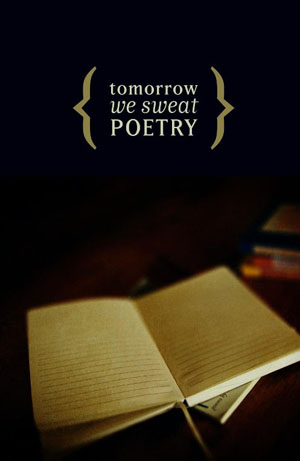
Tomorrow We Sweat Poetry (paperback, 20 pgs, 8″x5″ $8 + s/h) is officially out of print.

Tomorrow We Sweat Poetry is the result of the workshop I directed called “Write and do not waste time” and features poems by Susan Ryonen Keene. A digital sample is available here. Each poetry writing workshop I direct invites students to contribute their best poems for publication in a poetry book. If you’re interested in an upcoming poetry writing workshop, please leave a comment or email me at coffeehousejunkie [at] gmail [dot] com.

Thank you all for your support!

Wanna be a groupie?

This fits/agrees with the post about audio quality of MP3 files.

From Seth Godin:

The thing is, when you dumb stuff down, you know what you get?

Dumb customers.

And (I’m generalizing here) dumb customers don’t spend as much, don’t talk as much, don’t blog as much, don’t vote as much and don’t evangelize as much. In other words, they’re the worst ones to end up with.

Link.

You want quality customers/fans/groupies, give them quality schtuff. For example, the books I design are carefully crafted. A book is a book is a book, you may say. But in this info age, a book needs to be packaged as a souvenir in much the same way an album is packaged as a CD. Why is this important? Regarding the books I design, they are lifestyle objects. When people buy a copy of one of the books I design I want them to emotionally and intellectually connect with the book as one might connect with a new friend. My desire is that these book buyers invite/introduce other people to the experience. This translates to quality customers/fans/groupies.

Sketch: Woman Reading