…for a short time with longer-term benefits for your relationships…
June 2012 Poetrio reading series with Donna Lisle Burton, Alice Osborn, and Erica Wright

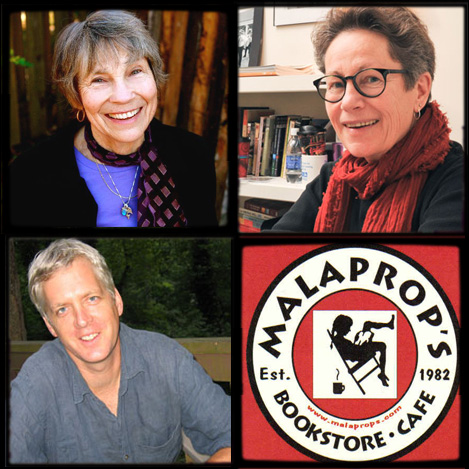
Sunday afternoon, June 3rd at 3 p.m., the Poetrio monthly reading series continues with Donna Lisle Burton, Alice Osborn, and Erica Wright. Details here [link].
From Malaprop’s community outreach director, Virginia McKinley:
Poet and visual artist Donna Lisle Burton. . . . has two previous collections of poems; is also an accomplished painter, portraitist, and photographer; and has four decades of experience as a special education teacher. Of Donna Lisle Burton’s third collection of poems, LETTING GO, award-winning Asheville poet Pat Riviere-Seel has written, “Do not be misled by the title: once you start reading, there will be no Letting Go [sic].” North Carolina Poet Laureate Cathy Smith Bowers has offered this additional appreciation: “Reading the poems of Donna Lisle Burton is like happening upon a cache of tender and beautifully crafted love letters. Among the objects of her most intimate affections are lovers both old and new — parents and siblings and children; students and friends; flowers and bridges and mills. And, finally, her luckiest of lovers, whoever might open the pages of this exquisite book.” The variations on letting go that are gathered in this collection are not entirely beautiful or easy, and not always for the reasons one might anticipate. . . .
Alice Osborn is another transplant to North Carolina. . . . AFTER THE STEAMING STOPS is her most recent collection of poetry; previous collections are Right Lane Ends, and Unfinished Projects. The latter prompted these remarks from writer Homer Hickam: “I love Alice’s poetry. She gives me thoughts I’ve never thought, and dreams I’ve never dreamed. She uses words like a master potter — molding the clay of the mind into vessels that hold not things, but life, place, and time.” AFTER THE STEAMING STOPS seems a book more of broken dreams than of new or unexpected ones. There is no sentimentality in the face of death, departures, endings. . . Before the fierceness of nature and life, love becomes fierce — but after the fact, and nearly as helpless as the child who declared, “I’ll find my own way!” — and bicycled off as a tornado approached, “no clue dueling cyclones ate children / near the road he and Daddy drive on every day to school.”
Erica Wright. . . . serves as poetry editor for Guernica, a magazine of art and politics, and teaches creative writing at Marymount Manhattan College. . . . Of her 2011 book, INSTRUCTIONS FOR KILLING THE JACKAL, Christopher Crawford observed in a recent review for the literary magazine Neon, “Wright is not afraid to use the darkest of imagery combined with a violence of language. A great number of the poems here are in tercets and couplets and Wright makes good use of these forms[,] which allows her to move her short, sharp-edged anecdotes with disquieting ease from beginning to end. Wright’s poems often follow the tracks of her thoughts through various twists, turns and enjambments. The darkness that informs these images is always just below the surface, the music in the lines is subtle and tense . . . The poems give a sense of someone trying to find something while at the same time avoiding it, leaving the scene while simultaneously confronting it. . . .” Erica Wright’s imagery, settings, and situations often recall the elements of tall tales — but tales whose paths soon wind toward mythical landscapes, the unsettling territory and characters of fables, a realm of constant metamorphosis and of faith mingled with superstition. . .
Hope to see you at this month’s Poetrio reading series.
Tonight’s Malaprop’s reading featuring Sebastian Matthews, Sybil Baker and Chris Hale

Just received this email from Malaprop’s regarding tonight’s, June 1st, reading at 7 p.m.
Triple reading event, featuring new poems by Sebastian Matthews, and selected poems from his most recent collection: MIRACLE DAY: MID-LIFE SONGS; a reading by Sybil Baker from her novel INTO THIS WORLD; and a reading by novelist Chris Hale from her just-completed memoir, LINE OF SIGHT.
I’m very excited to learn of Sebastian Matthews’s new collection of poems.
What is your creative space?

The window is open on a warm late May day and a cool mountain breeze moves the curtains like papery fingers. Occasionally, I glance at the Japanese maple outside or the grape vine wildly clinging to a handmade, crude trellis of found pine limbs….
[read more]
UPDATE: This blog post is available as part of an audio podcast.
Listen now:
Or listen on:
PodOmatic: coffeehousejunkie.podomatic.com
SoundCloud: soundcloud.com/coffeehousejunkie
E-book: This blog post will be featured in a forthcoming e-book. More details coming soon.
Are you dad enough?

This public response to a magazine cover begs the question (at least in my mind): would TIME ever run a story titled “Are you Dad Enough?” and cover the nurturing aspects of fatherhood? [6] Another question that comes to mind is: when was the last time you saw a father portrayed as a responsible father on the cover of TIME magazine? Or any other mainstream periodical for that matter? Has the model of a loving father vanished from the landscape of American culture? [7]
Plenty of examples of fathers are portrayed on television, but I’m not talking about the Tim Allen “Aarrrgghh, Aarrrgghh, Aarrrgghh” type dads who think going to a sporting goods store is fatherhood. Nor am I talking about the According to Jim beer-guzzling, television-watching, misogynists who seem to mess up everything and then Cheryl has to come in and fix the problems before the end of the show. [8] This portrait of American dads is degrading to those fathers out there who manage to change a child’s diaper, wash the dishes, do the laundry, fix a plugged tub on a Sunday morning when everyone needs a bath before church, [9] play trains with the younger children or stick ball with the older ones, and, in general, serve and sacrifice for their family. [10] I know plenty of fathers who are working crumby jobs just to feed their families and take care of their homes. They sacrifice their own dreams and aspirations because that’s what dad’s ought to do.
Now there are plenty of derelict dads out there who sit around and play video games all day, try to be cool with their kids and consider their children cultural objects. They are poor examples of fatherhood. Dear boy-dads, grow up. You are fathers now. You are no longer cool, hip, or awesome. Fatherhood is a difficult, thankless but ultimately rewarding vocation. Fathering a child only takes moments. Fatherhood is a lifetime commitment. Join the ranks of nurturing, responsible fathers and own it with dignity and grace. [11]
NOTES: [1] In my opinion, the reaction to the “Are You Mom Enough?” TIME cover is a combination of paleo-puritanism, meso-feminism, and neo-idiocy. [2] “Mika Brzezisnki… suggested on the air that the cover was needlessly sensational…” in the article TIME Magazine cover of breastfeeding mom sparks intense debate on “attachment parenting” [3] “Time magazine staff writer Kate Pickert defended the cover” saying “I think that we knew it would be a provocative cover but we’re thrilled that lots of people are responding to it… We’re happy to see that we’ve sparked a great conversation.” Read more: Breast-Feeding Time Cover Mom Responds to Critics [4] “There is no doubt that the TIME cover strikes the public as shocking. But, as Pickert points out, the women featured are at one extreme end of this always-controversial discussion.” Read: Jamie Lynne Grumet, Breastfeeding Mom On ‘TIME Magazine’ Cover, Illustrates Attachment Parenting [5] It is no longer shocking. At least, not to me. But maybe that’s because, as a culture, Americans are desensitized to shock. What really shocks us, as Americans, any more? [6] Can you imagine a bare-chested attractive father on the cover of TIME magazine? Okay, maybe a bare-chested Brad Pitt with his children might sell magazines. The truth is, magazine publishers need to sell magazines and a female with suckling will sell more copies to the over-sexualized masses than a cover of the opposite proportions. Think of the last few covers of TIME magazine that featured a male figure. Almost all of those covers feature men of power and influence. Has there ever been a magazine cover featuring a nurturing father? [7] If I were a conspiracy theorist, I might propose that there is a war on true, masculine fatherhood in America. But I’m not a conspiracy theorist. Just thought I’d beat you to the punch before I get pushed into that corner and painted as a FoxNews-watching/ditto-head/wing-nut. Which I am not. [8] The only role model on television I can recall that resembles those two characteristics is Heathcliff Huxtable of The Cosby Show. [9] Not that I’m using personal examples to boast of more “real” dad credentials, but fatherhood is about serving and sacrificing. [10] That is where the “amen,” “hell-yas” and other forms of applause is supposed to go. Read this post again and respond accordingly. [11] This post started out as a light-hearted, tongue-in-cheek imagining of a bare-chested father on the cover of TIME magazine, but became a rant. Apologies for the sudden fury. And blessings to those who actually read the small print. [12] PHOTO CREDITS: Though I created the mock TIME magazine cover, I found the retro father with children photo on this Tumblr page.
There are days when I wonder what kind of novel Sal Paradise and Billy Pilgrim might make if they hit the road together.
Asheville Wordfest – a reflection and a video

It was truly an honor to be invited to read a few poems at this year’s Asheville Wordfest. When I received the invitation I thought it was a mistake. So, I direct messaged the director using Twitter saying: “my twitter acct is wonky today. i received something from you re: wordfest… how can i help?” Previously, I had helped with audio during a previous Wordfest featuring the poet Li-young Lee. She direct messaged me on Twitter with a note of confirmation. So, I began selecting poems for the event.
Since I haven’t read my poetry publicly in more than a year, I was a bit anxious about the invitation to read at this year’s Wordfest. Last year was a busy year of readings at bookstores, [1] a literary salon, [2] and a featured guest at the Mountain Xpress poetry show. [3] Then employment for me became tricky and I endured the challenges of a transition to a new job, lay off, unemployment, and another job transition with a three-hour round trip commute. I kept writing new poems, but the new out-of-state job prevented me from participating in the active literary scene here in Asheville.
There were more than a hundred new poems I wrote last year to consider for the Asheville Wordfest poetry reading. I selected four or five new poems, but I didn’t feel confident enough in their craftsmanship to read publicly. One manuscript I have been developing for awhile had the strongest work that best fit this year’s Wordfest theme, “HOME: Place and Planet.” I started it when I took a writing workshop taught by Ashveille Wordfest Director, Laura Hope-Gill, a few years ago.
Two practices help me decide what poems to read. First, it is my practice to put a poetry manuscript in a presentation book with sheet protectors. That way pages don’t fall to the floor during a reading. You can usually purchase presentation books of that nature at office supply stores. I select a variety of poems on various subjects or themes. Further, it is my practice at an actual poetry reading featuring multiple poets to listen closely to the other poets. While the reading takes place, I select poems that speak to other poets’ work as a way to have a literary conversation. So, I brought four working manuscripts hoping that I might find a poem that might play off a poem read by Ronald Reginald King, DeWayne Barton, and Katherine Soniat.
As I walked to the podium after a very generous introduction by Laura Hope-Gill, I still hadn’t decided what poem would complete my reading. I knew the poem I would lead off with and I knew the one to follow, but the third and final poems I hadn’t quite decided. Improvisation is something I am developing in public readings, because each night the audience is different, with individual needs, interests and mood. A bar room poem might work in one setting and audience, but not work another night with a different audience. So, after I clumsily introduced myself, I knew by the time I finished reading the second poem where the narrative of the poem selection would lead. For better or worse, the reading was videocast and a recording is available. Here’s a link to the video [link here].
When I sat down next to my wife after completing my reading, I noticed a couple mentions on Twitter regarding the live videocast. One person [4] tweeted, “Goosebumps: poem dedicated to Jenny.”
NOTES: [1] As a member of the Rooftop Poets, I read with Barbara Gravelle and Brian Sneeden at Accent on Books in February. Barbara Gravelle and I read at the May 2011 Poetrio at Malaprop’s Bookstore & Café. That was my last public reading until last Friday night, May 4, 2012. [2] After a very successful book launch and poetry event, the Rooftop Poets presented Poet’s on the Roof: A Literary Salon. [3] The Mountain Xpress invited Brian Sneeden and myself to read on behalf of the Rooftop poets as featured poets at the 2011 Mountain Xpress Poetry Show [4] @anorawrites
Tomorrow night – Juniper Bends Literary Reading
The afterglow of Asheville Wordfest 2012 has barely faded. In truth, I’m still recovering from the rich, full weekend, but excited to announce tomorrow night’s literary reading.
Friday, May 11th at 7:00 p.m. the Downtown Books and News (67 North Lexington Ave., Asheville, NC) hosts the Juniper Bends Literary Reading featuring poets and prose writers: Abigail DeWitt, Anne Maren-Hogan, M. Owens and Mesha Maren. More details on the Juniper Bends Literary Reading Facebook events page: link.
How does one prepare for a poetry reading?
It’s less than two hours before the event and I find myself pacing the house with loose leaf pages of poems wondering if I’ve chosen the correct poems for tonight. I’ve been preparing for tonight’s reading all week. Reading poems I’ve written (and avoiding making additional edits). Selecting the poems I plan to bring to tonight’s reading at The Altamont Theater. I’ll read at the Asheville Wordfest event Voices of the City alongside Katherine Soniat, DeWayne Barton, Ronald Reginald King, Ekua Adisa and Roberto Hess. But I can’t help wonder, what do these fine poets do before a poetry reading? What rituals do they observe the day before an event like tonight?
Asheville Wordfest 2012 – poems that open conversations
It’s true. There is only one article I read from the pages of O: The Oprah Magazine. It is the interview between Maria Shriver and the poet Mary Oliver. [1] “I consider myself kind of a reporter. . .” Mary Oliver says. I think that’s the same sentiment Wordfest director Laura Hope-Gill expresses in this week’s Mountain Xpress article where she describes poetry as “citizens’ journalism.” [2]
“Poetry is a short line between different cultures,” says Laura Hope-Gill. “It can heal the cultural divides that still plague our city. It opens conversations that we need to have.”
The invitation to read my poems at this year’s poetry festival is something I don’t take lightly. I spent the last few nights reviewing poems I’ve written during the last year as well as poems composed during the last decade. The PR/marketing side of me wants to chose poems to read that promote a certain manuscript I’m developing or maybe only read published poems. It’s a promotional game poets play when they read their work publicly. They casually mention that “the next poem I’m going to read was published in the Atlantic Monthly…” or the American Poetry Review or some other notable journal as away to promote their ascendancy of poet extraordinaire.
But my thoughts returned to the idea Laura mentioned in the Mountain Xpress article. I looked through pages of my poems last night searching for material that addresses the idea of healing cultural divides or opening conversations. Selecting poems that fit the general theme presented a bit of a challenge, but there are subtle threads of those ideas in several of the poems I’ve written during the last few years.
Tonight, however, I’ll put aside the task of poem selection and venture to the Vanuatu Kava Bar for Poem-ing the 28801 [3] featuring Barbie Angell, Ten Cent Poetry, Jonathan Santos and Jadwiga McKay.
NOTES: [1] Dear Oprah, you stole my idea, but I’m not filing charges [2] A short line between different cultures [3] Wordfest 2012: Poem-ing the 28801
It’s here… Asheville Wordfest 2012 begins tomorrow
“It’s a good time to come together at the table of poetry,” says Laura Hope-Gill, the director of Asheville Wordfest, in a recent article in the Asheville Citizen-Times.[1] I’m very excited to be part of the local Asheville poets who will be reading during the festival. I’m also excited to listen to the guest poets attending this year’s poetry festival. Some of the guests include Arthur Sze [2] (author of The Ginkgo Light, Archipelago and other books) and Matthew Shenoda (author of Somewhere Else and Seasons of Lotus, Seasons of Bone of which A. Van Jordan writes, the poet “uses a quiet language to bring some of the most striking lyrical intensity.”).[3]
This year’s Wordfest includes a memorial reading for poet Carol Novack. On a rainy evening last summer at the Battery Park Book Exchange and Champagne Bar was the last time I saw her. She was with friends and admirers reading selections from Giraffes in Hiding.
This morning I received an email from the director of Asheville Wordfest with the official schedule for the Asheville Wordfest 2012. It is listed below for those who have not received the schedule:
Wednesday
• 9-11 p.m.
Open mic hosted by Caleb Beissert. Vanuatu Kava Bar, 15 Eagle St.
Thursday
• 7 p.m. “Poem-ing the 28801,”
with Barbie Angell, Ten Cent Poetry, Jonathan Santos and Jadwiga McKay at Vanuatu Kava Bar.
Friday
• Noon, informational luncheon with Lenoir Rhyne University graduate studies program director Paul Knott, who will talk about the Masters in Writing program. Chamber of Commerce building, 2nd floor, 36 Montford Ave. RSVP required to Sara Landry at 258-6136 or Sara.Landry@lr.edu.
• 5-7 p.m., MadHat Reception honoring Carol Novack. Refreshments.
• 7 p.m. “Voices of the City,”
Katherine Soniat, DeWayne Barton, Ronald Reginald King, Matt Mulder, Ekua Adisa and Roberto Hess.
• 9 p.m. “An Evening of Translation,”
with Erik Bendix, Caleb Beissert, Thomas Rain Crowe, Nan Watkins and Luke Hankins.
Saturday
• 11 a.m.-12:30 p.m., “The Poets of Press 53,”
with Terri Kirby Erickson, Joseph Mills and Kathryn Kirkpatrick.
• 1-2 p.m. The Carol Novack Memorial Reading,
with Terese Svoboda, Marc Vincenz and Jeff Davis, Asheville Wordfest co-founder and host of Wordplay.
• 3 p.m. “Fixing to Tell About Jack,”
a celebration and benefit for Ray and Rosa Hicks Fund, featuring storytellers Sheila Kay Adams, Gwenda Ledbetter, Vixi Jil Glen, David Novak, Connie Regan-Blake and Ted Hicks. $12; additional donations welcomed.
• 5:30-6:30 p.m.The Poets of the Asheville-Buncombe County Schools Poetry Slam.
• 7-9 p.m. “Our Honored Guests,”
with Sara Day Evans, LeAnne Howe, Allison Adelle Hedge Coke, Arthur Sze and Matthew Shenoda
• 10 p.m. until late. “Late Night Open Mic.”
Sunday
• 10:30-11:30 p.m. “Children’s Poetry and Children’s Poems,” hosted by Barbie Angell..
• Noon-1 p.m. “Morning of Spirit,” with Tracey Schmidt and James Davis of Logosophia Books, Michael Ivey on guitar and Matthew Cox from Shantavaani on tablas and hand drums. An open mic will invite people to share their own spiritual poems.
• 1:30-2:30 p.m. “Voices of the City,” with April Fox, Eric Steineger, Lisa Sarasohn and Meta Commerce.
• 3 p.m., “Poetrio,” with Maureen Sherbody, Mark DeFoe and Jessie Carty. Malaprops Bookstore/Café, 55 Haywood St.
• 5 p.m. until whenever, “Poetic Wine-Down,” Battery Park Book Exchange and Champagne Bar, Grove Arcade.[4]
NOTES: [1] “Asheville Wordfest celebrates poetry of all stripes, May 2-6” [2] The Poetry Foundations bio of Arthur Sze [3] Matthew Shenoda’s web site [4] Asheville Wordfest 2012
Wordfest — Voices of the City
Asheville Wordfest 2012 presents Voices of the City and features several local poets. I’m honored listed among the following local poets: Katherine Soniat, DeWayne Barton, Ronald Reginald King, Matthew Mulder and Roberto Hess.
I set up a Facebook page with more details. Friend me on Facebook to get an invitation to the event. If you’re not on Facebook, consider yourself invited to Asheville Wordfest’s Voices of the City.
Three ways for authors to promote their new book
This is obvious, but essential. Connecting with a local bookseller is vital to promoting your book. Most booksellers see your book title listed in their wholesale catalogs. All you need to do is remind them it’s there and then see if they’ll host an event. Be sure to contact the bookstore’s event coordinator, not the store’s book buyer. The PR & Events Coordinator schedules store events like readings and book signings and is the best point of contact for a newly published author.
Consider non-bookstore venues. Schools, public libraries, or other venues may have suitable audiences for your book title. Don’t just assume that your audience only buys books at Barnes & Noble. Libraries are great places to read. I’ve read in various locations including a tavern, café, ballroom, art studio, church and several other places. One author I know had a reading at a chocolate shop. Be creative with your events.
Social media sites like Twitter, Facebook, etc. are great tools to promote your book. If you don’t have an account, you’re already behind. Be authentic and approachable on these sites. If you sound like you’re a pushy salesperson, you’ll lose your audience. Share with your social media audience the same way you approach your book reading audience. Make converts from social media followers to book buyers.
Upcoming reading at Asheville Wordfest 2012
Next week I’ve been invited to read some of my poems at one of the Asheville Wordfest 2012 events. The schedule is still fluid. So, you’ll have to check the official Wordfest website for the schedule details. Suffice it to say, I am extremely humbled and honored to read with great local and global poets.
Two reasons why I quit Tumblr
What is Tumblr? Besides being a highly addictive micro-blogging platform, [1] it was the place I did most of my blogging during the last few years. That is, until a few weeks ago. Two primary reasons why I deep-sixed my Tumblr accounts: simplistic functionality and superficiality.
Those familiar with Tumblr know the distraction of the endless expanse of images that populate the majority of these micro-blogs. Tumblr subscribes to the lowest common denominator of web log functionality to allow for users to post photos, videos, audio & text. The Tumblr interface allows users with absolutely no HTML experience and no blogging experience to post a menagerie of online content without having to really think about it. Add to the mindless uploading or reblogging of content is the liking system. If you “like” a blog post viewed somewhere in the Tumblr stream of people you are following, then you click the heart icon. The system is reciprocated by other users in a virtual validation and comparison of or by other Tumblr users. What makes this system clumsy and superficial is that there is no real communication between users. In a way, it’s like an individual person in a large airport terminal with all the televisions droning on and on. It’s an extremely lonely experience.
The “follow” feature, like Twitter, allows users to track your posts — and you may follow in return. Curious as I am, I often clicked on Tumblr profiles to find out who is following my Tumblr account. Like Twitter, a lot of my account’s followers were users seeking to promote something or looking for personal validation and/or competition by earning return follows (it is a common practice on Twitter to earn more followers in order to expand audience reach or to just boasting rights to having thousands of tweeple following your tweets). Some people prefer Tumblr because it easily integrates with social media sites [2] making it more of a network tool than a blogging platform. When Tumblr was first launched it was very simple to aggregate your Tumblr content to Facebook, Twitter, and other social media outlets. But now most blogging platforms allow that too. Most of the followers to my Tumblr account didn’t connect or even communicate with me. They just “like” something I post and then “follow” my Tumblr account. It’s an empty, hollow interaction if not essentially dehumanizing.
Another issue I had with Tumblr is that the platform really doesn’t work well for long-form blog entries. There are exceptions, [3] but on the whole, most Tumblr users are there for photos or videos or reblogging someone’s photos and videos. As someone who enjoys reading and stimulating conversation, I became very aware of how my thinking was changing as I consumed the endless Tumblr stream of images. One night I speculated that some users must spend all day on Tumblr. There is a schedule feature on Tumblr that allows users to place posts in a queue to be published later, but the time investment to post photos seems vapid. Occasionally, I’d come across an intelligent quote or text-post and “like” it or even “reblog” it. I discovered, to my embarrassment, that not all quotes I reblogged or liked were accurate and stopped the practice.
Increasingly, I was disturbed that the lack of exchange of ideas was altering the way I think as I succumbed to an avalanche of images falling from the blue Tumblr interface screen. One blogger noted that someone said Tumblr is an intellectual version of Twitter, [4] and further noted correctly that most Tumblr users post photos. How is that intellectual? I must confess, when I began to use Tumblr as a blogging platform I posted a lot of text pieces. It was an easy platform to post my writings, art work and photography. I liked the ease that it offered. But I got caught in the cycle of seeking validation of posting content simply to earn “likes” from “followers.” So, like an addict, I’d post more content — images that I didn’t create, but I liked (and sometimes “liked”) or inspired or informed me. But there was little if any engagement with other Tumblr users. Facebook and Twitter offered more discussion and conversation than Tumblr. It felt like a completely self-centered arena that offered nothing but consumption of content with no way to seek the best in others. I was not growing or learning from my Tumblr experience. I wasn’t meeting new people and exchanging ideas.
For me, quitting Tumblr comes down to this. An online community cannot grow and flourish if the lowest common denominator is a micro-blogging platform for web-illiterate users who reblog each others photos with silent alacrity.
NOTES: [1] Not that you need to be introduced to the crack cocaine of blogging — Smashing Magazine provides A Complete Guide To Tumblr [2] Read Compete’s report “Tumblr vs. WordPress vs. Blogger: Fight!” where it states that Tumblr functions more like a social network. . .” and “reduces barriers to publishing content .” [3] Longreads collects long-form online content from various publications [4] Olsen Jay Nelson
How to capturing abstract ideas in a book cover design
How do you capture an abstract thought for a book cover design? That’s the question one person left in the comments section to Judging a book by its cover.
That is a challenge. A lot of abstract ideas — like love, grief, joy, freedom, etc. — have emotional and psychological weight. Photography is an easy tool to use in conveying physical responses to abstract thoughts. Photos illustrating love or grief become cliché. For example: how many books can you find at a local book seller on the topic of grief of a loved one that includes sun bursting through voluminous clouds? There are reasons for a majority of the bereavement books have similar titles — primarily marketing. Readers looking for books on how to cope with grief in a book store find themselves staring at a shelves of cloud cover books. So how does a graphic designer create a cover that competes with all the cloud-covered-grief-books?
Here are two other tools to consider: color and shape.
Color
Color psychology informs me what colors might work best to address a book on the topic of grief, freedom or spirituality. The challenge arises frequently — due to an enormous amount of books published every year — that most books on the topic of grief utilize the same color scheme or photographs of a path leading through a forest with a bright patch of light at the end or the ever-present sun breaking through the clouds. So I turn to color psychology as a tool to design a book cover dealing with the abstract concepts of grief, joy, love, etc. There has been a lot of research in this field to learn from. For example, blue (depending on the shade or tint) offers a feeling of peace, tranquility, confident, and as reliable as the sky and ocean. But blue can also be cold and corporate (again, depending on the shade or tint). Interestingly, brown can express reliable and authenticity.
Shapes
Recently, I’ve turned to the psychology of shapes and patterns as a way to define abstract ideas like endurance, peace or joy. According to research, there are three main categories of shapes: geometric, organic and abstract. Other distinctions remind me of primary school including: circles, squares, triangles, spirals, and more. Also, the orientation of the shape is essential — horizontal and vertical. Squares and rectangles are common but express peace, stability, conformity or other abstract concepts. For example, a horizontal rectangle expresses confidence in much the same manner as the color blue. Whereas a spiral shape my best represent grief as it expresses the idea of death, life and transformation.
As I share the psychology of color and shape with authors with whom I am designing their book covers, they often need to be educated on the visual vocabulary of these ideas. Most of the authors understand the premise of how color, shapes and patterns express the content of their book. Additionally, most of the authors prefer a photographic cover design. This is a bit off in my mind, because what is a photograph but a composition of colors and shapes? Is there a lack of visual literacy in our culture? Or is the graphic design community a cloistered cult of artists that do not share secrets with the outside world?
As I design book covers, these are the tools I fall back on consistently: color and shapes.
Life is lived as a messy first draft
How do you explain a poem without revealing its mystery? I thought about that question this weekend after a private poetry reading session. A few poets gathered under a full moon to read new work….
[read more]
UPDATE: This blog post is available as part of an audio podcast.
Listen now:
Or listen on:
PodOmatic: coffeehousejunkie.podomatic.com
SoundCloud: soundcloud.com/coffeehousejunkie
E-book: This blog post will be featured in a forthcoming e-book. More details coming soon.
Asheville Wordfest Kickstarter campaign begins

The Asheville Wordfest Director, Laura Hope-Gill, announced last weekend that the Asheville Wordfest 2012 began a Kickstarter campaign to help fund the poetry festival. Wordfest celebrates its fifth year of providing a space for poets of various cultures and contexts to share their work with enthusiastic supporters of poetry.
This year’s poetry festival features many local poetry luminaries as well as notable national and international poets. Various events are scheduled at the Grateful Steps Foundation Bookshop, the Altamont Theater and other locations in Asheville, NC between May 2-6, 2012.
Here’s an excerpt from an e-newsletter that was sent last Friday night regarding the Asheville Wordfest 2012 Kickstarter campaign:
Please kindly help Wordfest by donating to the Kickstarter campaign through Poetry Month: Asheville Wordfest 2012 Kickstarter campaign.
Asheville Wordfest 2012: HOME: Place and Planet takes place from Wednesday May 2 through Saturday May 5, 2012. North Carolina Humanities Council generously funds the festival in part, and we need your help to really bring it to life.
Along with our stellar guest poets, Wordfest 2012 aims to present as many local voices as is possible within the scope of a few days. Because our local voices resonate with the global whole, we welcome the following guest poets: Choctaw scholar, author and poet LeAnne Howe, Guggenheim and NEA Fellow Arthur Sze; Egyptian-American poet Matthew Shenoda; American Book Award Winner Allison Adelle Hedge Coke of Cherokee and Huron Nations. Learn about these stellar poets at www.ashevillewordfest.com. Thank you for your help in promoting multiculturalism and community through poetry.
Write 30 poems in 30 days: a challenge
During the summer of 2010, I took up the challenge to write 30 poems in 30 days with two goals in mind:
- generate new material and
- unclutter my mind.
Yesterday I began a new cycle of poems with the goal of writing 30 poems and 30 days during National Poetry Month (if your following National Poetry Month on twitter, the hashtag is #NPM12).
April Poetrio at Malaprop’s Bookstore/Cafe
National Poetry Month begins at Malaprop’s Bookstore/Cafe with Poetrio this Sunday at 3:00 p.m. This month’s featured poets include Ed Madden, Ray McManus and Anne Harding Woodworth.
Here’s an abridged version of the poets bios from the Malaprop’s Bookstore/Café news release:
Anne Harding Woodworth is a member of the Poetry Board at the Folger Shakespeare Library in Washington, D.C. She is a part-time resident of both Washington, D.C. and the Western North Carolina mountains. On April 1 this year, she will read from her fourth book, THE ARTEMIS SONNETS, ETC.
Ray McManus teaches creative writing, Irish literature, rhetoric, and composition at the University of South Carolina, Sumter. We are very pleased to welcome him back with his second poetry collection, RED DIRT JESUS, for which he won the Marick Press Poetry Prize.
At the November 2009 Poetrio event here at Malaprop’s, Ed Madden read from Signals, the 2008 poetry collection for which he won the South Carolina Poetry Book Prize. His most recent collection of poetry is PRODIGAL: VARIATIONS.
Learn more about the April 2012 Poetrio at Malaprop’s Bookstore/Cafe at their web site.
Three ways self-published authors fail
“Only idiots and the self-deluded think that being able to self-publish qualifies them to write,” concludes one person commenting on Two reasons why not to self-publish your book. It’s true. Not every self-published author writes well. For that matter, not every best-selling author writes well. I do agree in part with that comment–the logical part, not the jaded part. Like I said before, I am an advocate of self-publishing, but my views are changing.
Regarding self-publishing, I wrote a multi-part series titled The Economics of Writing. The basic premise of the series is this question: Why should a poet/writer spend his/her money on literary contests when they might self-publish his/her own work? You can read the whole series by following the links. What prompted the series was:
- I’ve been in publishing for a while and know how much it costs to produce and distribute print products and
- I read a story about a writer that spent more than $14,000 in a seven-year period on contest entry/reading fees, related postage, sample journals, literary memberships and writing conferences/workshops and won a $500 cash prize during that period.
I’ll avoid the analysis of literary contests [read about them in the second part of the series], and move to notable poets and writers who have self-published their work: Margaret Atwood, T.S. Eliot, Robert Service, Nikki Giovanni and Viggo Mortensen [read more details in the third part of the series].
When you consider the amount of time and energy–not to mention money–it takes to publish a book, self-publishing is an option to consider if you don’t want to wait for a publishing house to release your product. A poet and/or writer may spend years working with an agent to secure a book deal with a traditional publishing house. Whereas, self-publishing a book can make its way to the market in a matter of days or weeks.
Most self-published authors fail with their book releases in the following three areas:
- Cover design. And in general, book design. Just because you cleverly wrote your major literary work in MS Word does not mean you can print it in MS Word. Let a professional graphic designer package your literary endeavor. Further, just because you have Adobe products loaded on your fancy schmancy MAC machine, doesn’t qualify you as a designer either. Book design is not the same as designing a web site (that you really borrowed from WordPress or some other blog platform and told your client you designed their web site *sigh*). A book cover is the movie poster for the book. It must invite, entice, and coax readers to pull the book from the retail shelf (or etail shelf), read the back blurbs and first chapter, and ultimately buy the book.
- Editing. First draft, best draft is not the best practice in selling books. Having your ever-loving mother to review your manuscript is not that same as getting your manuscript edited. Even a good writing group is not enough–but it is a very good start. Hire a good editor to work on your literary masterpiece. A good editor will make a huge difference in the final product. So much of self-published books are deficient in quality work. There are gruesome typos, grammatical crime scenes, and abominable stylistic failures. A good editor is like a good film producer–a poet/writer may have the vision, but the editor knows best how to articulate it to readers. A good editor is one of your best friends. The last thing you want to do is release a book product that you immediately have to print a second revised edition because you used “their” instead of “there.”
- Production efficiency and quality. The financial bar has been lowered in matters of producing a book. Print-on-demand options are more affordable now than ever before. But more affordable doesn’t always equate to quality book product. A lot of do-it-yourselfers enjoy the look of the Etsy-ish, handcrafted book products that clutters the indie poetry and zine scene. And that’s fine. Those products are souvenir. People who purchase those items understand that they are a souvenir, book art object. But that option is more expensive than one might suspect. Consider a book’s cover price of $12 per copy for a 64-page literary chapbook. Most traditional publishers have a production markup of no less that 12 times. If, for example, the cover price is $12, than the book’s production cost–printing cost, cover art, book design, etc.–on a 1000 copies print run is $1 per copy. Most self-publishers don’t consider this fact and usually spend $6 per copy on a print run at Kinkos for a run of 100 copies. At that rate, it’s a hobby not a business.
I’ve been on both sides of the argument. I’ve self-published books that failed and succeeded. I launched two book imprints within a media organization that sold over 30,000 books in a couple of years. And here’s where I’m changing my position on self-publishing versus traditional publishing: idealism versus reality. Poet and blogger extraordinaire, Ron Silliman, offers these thoughts on idealism versus reality when he suggests that it would be ideal:
…if all bookstores carried every book of poetry that is in print… and if all poets had equal access to book publication.… But until then, it’s the real world I’m going to engage with…
So, where does that leave authors who don’t have a literary agent and don’t want to wait years and years to get their work published? Co-publishing. There are several reputable publishing houses that offer co-publishing services. A poet/writer still pays for the production of the book product, but the publishing house offers editors, publishers with decades of experience, a professional art department, a public relation staff, a warehouse facility, events coordination, distribution and other services. Consider the question that sparked the multi-part series I wrote. As a writer, would you rather spend seven years and $14,000 trying to win a literary contest and/or land a book deal? Or spend $14,000 and seven years selling your book, earning new readers and working on your upcoming books?
Book Launch for Look Up Asheville Collection II

Tonight at 6:30 p.m. the Look Up Asheville II book launch begins at the Battery Park Champagne Bar/Book Exchange. Join the festivities for the launch of Look Up Asheville II featuring photography by Michael Oppenheim and essays by Laura Hope-Gill. Poet Robert Morgan writes: “Look Up Asheville II takes us into the heart of the city’s diverse and colorful history, scene of its current flourishing culture.”
From the event invitation: “Look Up Asheville II features more architectural details captured by local photographer, Michael Oppenheim, accompanied by historical essays by Laura Hope-Gill, with a Foreword by premier author and poet Robert Morgan (Gap Creek, Lions of the West, Terroir). Designed by Michele Scheve, Look Up Asheville II does more than inform readers and viewers of the architectural, social and creative history of Asheville; it celebrates all these with stories and luminous images. The new book contains Asheville’s grand Bed and Breakfasts and more of the exquisitely built churches, inns, museums and downtown treasures.”
Poetry at the Altamont

Tonight from 7:00 p.m. until 8:30 p.m., Poetry at the Altamont continues with this month’s featured poet, Laura Hope-Gill.
It’s been awhile since I visited the The Altamont Theatre. I believe it was during last year’s Wordfest. It’s a gorgeous setting to hear poets read their work. I’m looking forward to tonight’s event.
Here’s more details about the event Poetry at the Altamont from their Facebook invite page:
Poetry at the Altamont is a reading series for poets and poetry lovers commencing on the third Monday of each month at seven o’clock in the evening at The Altamont Theatre in downtown Asheville. The event consists of a reading by the feature poet followed by an open microphone, for which readers may sign up and recite one or two short pieces. During the open portion of the event, we encourage new voices and accomplished poets alike to share what they have been working on, a space where writers have the opportunity to try out new works in front of an audience on a regular basis. Please join us for consistent, fine poetry in a setting that is equally fine.
Hosted by Jeff Davis and Laura Hope-Gill
Produced by Caleb Beissert and Aaron Price$5 at door
Beer and wine served(link)