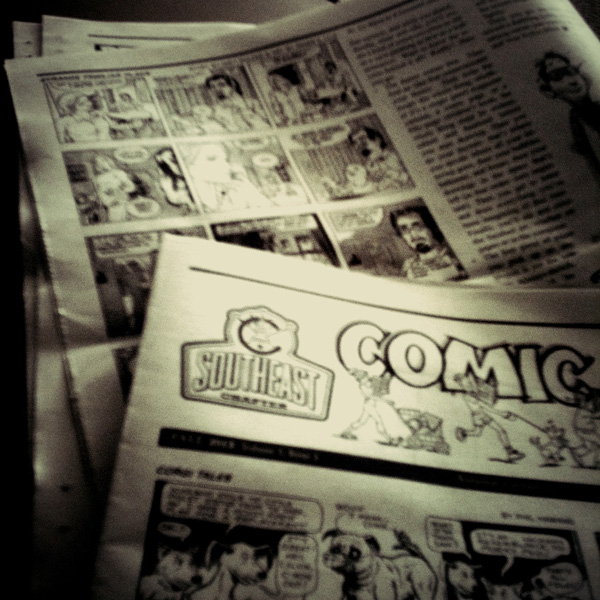
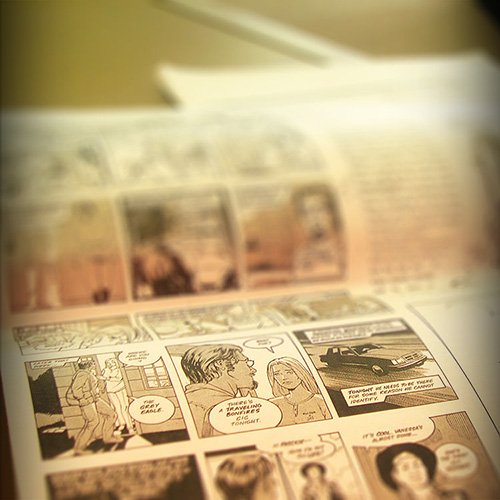
After nearly a six-year hiatus, I was excited to see a project that began with notes and sketches transform into a published comic strip. Even if it was a one-off. Even if I had to hand the responsibility of drawing each panel to someone else. It was done.
I had imagined that the creative non-fiction comic story I crafted would earn some interest. Maybe it would open a few doors to an audience. And allow me to write and illustrate. Even earn some money. Maybe I would quit my day job and provide for my household by doing something I loved. Telling stories. And drawing pictures.
That was five years ago.
A few weeks ago I found a box in the garage. It had several copies of a publication that printed my comic strip. I glanced over the pages and then placed them back into the box. I also found several books. Opened one book I remembered enjoying.
“What’s that?” asked one of the children.
“It’s a collection of comic strips.”
“Oh.”
I pulled a copy from the box and gave it to the child.
“There’s a story in there I wrote.” I said. “See if you can find it.”
The child took the copy of Comic Stroll and headed off to the couch in the living room.
I flipped through the pages of the book I had found. Read a few highlights.
Yeah, I resemble that, I thought to myself after reading a few lines at the end of the book. The author referenced a friend of his who gave up an art gig for a corporate job in order to provide for his family.
Yeah. I know what that is like.
How many comic pages might I have written and illustrated if I had. . . Well, what-ifs and might-have-beens are dangerous paths to pursue. What you did, great or small, is what matters.
Watching my progeny spend an afternoon reading comic strips I had a hand in creating was a pleasure.
NOTES:
Comic Stroll, a publication of the Southeast chapter of the National Cartoonist Society, featured a collection of previously unpublished comic strips. You can read the whole journey of what started in November 2005 as a couple drawings and became a creative non-fiction comic strip:
[1] Comics and Narrative Non-Fiction
[2] Comics and Narrative Non-Fiction Continued
[3] Narrative Non-Fiction Comics: part 3
[4] Narrative Non-Fiction Comics: part 4
[5] Narrative Non-Fiction Comics: part 5
[6] Narrative Non-Fiction Comics: UPDATE
[7] Narrative Non-Fiction Comics: UPDATE
[8] Strange Familiar Place comic series
[9] Strange Familiar Place returns
[10] The return of Strange Familiar Place to print

 How do you capture an abstract thought for a book cover design? That’s the question one person left in the comments section to
 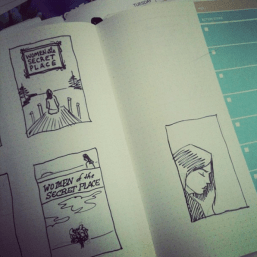 For me, every book cover I design begins with pencil sketches that eventually lead to ink drawings. Actually, I suppose it begins prior to that. The author receives a pre-publication questionnaire from me prior to the design process. The questionnaire asks the author what is his/her elevator pitch, what are the pillars of the book (i.e. what are three main concepts/ideas in the book?), and what is the book’s key audience? There are more questions that help me prepare for the design process, but reading through that document helps me form an idea of who the author is, what the book is about and how best to represent the book’s content with an attractive cover.
 The full-color design is often photographic, as in the case of this sample, but can also feature illustrated work or typographic designs. An illustrated cover is sent to a freelance artist who spends a week or so producing the cover art. The final cover design pulls together all the elements (art, photo, type and copy) to present a cover that, in theory, sells a 1000 to 3000 copies on face value. I know what you’re thinking, but books really are judged by their covers. Just watch people at a bookstore. They’re scanning covers before they even pick up a book to read the back copy blurb or open a book to read the first few chapters. If a book has amateurish art or less than professional photography, the audience will move to the next book cover that has great photography or stunning artwork. Further, if a book has poor quality cover art, it will be represented in poor book sales. Let me say it again: if a book has crappy cover art, the book will have crappy sales. No reader wants a crappy book on their bookshelf or e-reader. Half the battle for a reader’s attention is getting him/her to pick the book from the shelf. The same applies to e-book stores. Readers are scanning covers from the Kindle or Nook e-stores and deciding, based on cover design and book blurb, what title to purchase.
 Coffeehouse Junkie