
Time to set up the Roof Garden of the Battery Park Hotel for tonight’s Prohibition-era poetry reading and jazz show.
More event details are here: link.
Time to set up the Roof Garden of the Battery Park Hotel for tonight’s Prohibition-era poetry reading and jazz show.
More event details are here: link.

In September an idea was born to hold a poetry reading under a full moon at the Roof Garden of the Battery Park Hotel. Tonight is the culmination of that idea.
Few people have access to the Roof Garden. Join the Rooftop Poets for a fine evening of poems, songs and full-moon revelry. Doors open at 7:30PM and the event begins at 8PM. Tickets are $10 each. Guests arriving at the Battery Park Hotel will be let in by a doorman who will have your name on a guest list. If you’re not on the guest list, you have to ask yourself, why not?
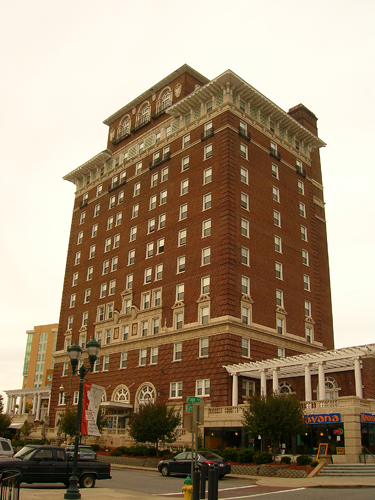
After some homemade latte and a walk through Asheville’s autumn splendor, I’ll wrap a couple last minute details and then head downtown to the Battery Park Hotel.
For tonight’s event, the doors open at 7:30PM and the event begins at 8PM. Tickets are $10 each. Guests arriving at the Battery Park Hotel will be let in by a doorman who will have your name on a guest list.
Listen to music samples of Vendetta Creme, the featured musical guests for the Roof Garden event. The doors open and the band starts playing at 7:30 p.m. The poetry reading begins at 8 p.m.

Rooftop Poets
Barbara Gravelle, Matthew Mulder, Brian Sneeden
with music by Vendetta Creme & Aaron Price
1 Battle Square, Asheville, North Carolina
Friday, October 22 · 8:00pm – until
doors open at 7:30pm — event begins at 8:00pm
In celebration of the publication of Barbara Gravelle’s latest book, Poet on the Roof of the World, join the Rooftop Poets under a full moon on the Roof Garden of the Battery Park Hotel for a Prohibition-era poetry reading, book-signing and jazz show.
Local poets Barbara Gravelle, Matthew Mulder and Brian Sneeden will perform alongside the French jazz music sensations Vendetta Creme and Aaron Price at the Roof Garden of the illustrious Battery Park Hotel.
Tickets are $10 and include a signed and numbered, limited-edition, 64-page book of poems featuring the work of all three poets, as well as complimentary light refreshments and hors d’oeuvres.
Few people have access to the Battery Park Hotel’s Roof Garden. Join us for a fine evening of poems, songs and full-moon revelry.
Space is limited. Reserve your tickets today by emailing: info@coffeehousejunkie.com
The evening’s cast of characters include:
Barbara Gravelle, author of several poetry books including, Keepsake, Dancing the Naked Dance of Love, and her latest collection of poems, Poet on the Roof of the World.
Matthew Mulder, one of the original members of the Traveling Bonfires, his poetry and prose have appeared or are forthcoming in Crab Creek Review, Small Press Review, The Indie, H_NGM_N, and other publications.
Brian Sneeden has produced, designed or written for more than a hundred theatrical performances. He is the current director and MC of Asheville Vaudeville.
Cabaret singer Vendetta Creme (aka Kelly Barrow) and Aaron Price (piano, guitar) perform lesser-known songs from yesteryear. This duo scour the globe for their songs including material from five continents weaved into a seamless, unforgettable show.
The 30 poems in 30 days challenge is complete. Since the last update the poems have veered all over the place in regards to theme, subject and tone. The main reason for the challenge was to:
A lot of new material was produced but I cannot say my mind is more or less cluttered than before the challenge. I’m still trying to make heads or tails of what I wrote.
As stated previously, Deborah offered a challenge to write 30 poems in 30 days. So far, I’ve been able to keep up with it in spite of a summertime cold and an urgent freelance job that evolved into a larger project than I anticipated. Still, the discipline of writing a poem a day, or at least a poem sketch a day, has proved to be rewarding in and of itself. Two benefits have come out of this exercise so far:
At least one poem sketch so far helped articulate something I’ve been struggling with for a few months. Forcing myself to write at least once a day brought that struggle up from the subconscious and allowed me to form it into a personal poem. Somewhere in my reading I came across a poet, or writer, that said writing every day, even if it’s only for your own eyes, is good practice in writing content for others. My writing professor at the university encouraged students to write a novel for yourself first. Even if the novel is intended only for you, it is worth writing it. And sometimes it may find audience elsewhere.
Deborah offered a challenge to write 30 poems in 30 days. I took up the challenge and so far I’m on schedule with one poem a day. Maybe after the challenge I’ll translate the poems from handwritten form to digital, but for me the urgency is to get it all down first. It’s kind of like catching butterflies or lightening bugs.
One interesting item is that the poems have developed a theme. When I accepted the challenge I wasn’t planning on writing 30 theme-based poems, but somewhere under the surface it appears in each page of the poems I’m composing. I guess I’ll find out if it changes course by the end of the challenge.
Deborah (of 32 Poems) invites interested persons to write a poem a day for the next 30 days. The invite was sent out on Sunday (and I didn’t read it until today… so, I’m a bit late), but I think I’m up for the challenge. Anyone else?
Read more details about the challenge here: 30 Poems in 30 Days.
When I mentioned earlier today that you should join the Traveling Bonfires tonight at Malaprop’s, you really were invited to join the reading. Two of the three poets were unable to show up for tonight’s reading. The emcee of the poetry reading and founder of the Traveling Bonfires invited anyone in the audience to read poems. He asked me to read my poems as well.
I wasn’t prepared to read; only to listen. But no one else came prepared to read. So, I frantically dug into my old messenger bag and found two poetry chapbook manuscripts by other poets. For a brief moment I thought I would read from their manuscripts, but I didn’t want to read poems that weren’t ready for the public. Sandwiched between loose papers and a copy of Selected Cantos of Ezra Pound and Narrow Road to the Interior was my red notebook containing poem sketches and revisions. I had half of a thought to read selections from Pound and Basho, but in my notebook I found six poem sketches and revisions to test in front of an audience.
The moral of the story is this: always be prepared to read your poems and if you’re a poet in the Asheville area (or if you’re a poet traveling near the Asheville area) contact me or the Traveling Bonfires (travelingbonfires@yahoo.com) and we’ll find a space and a mic and a crowd of listeners.
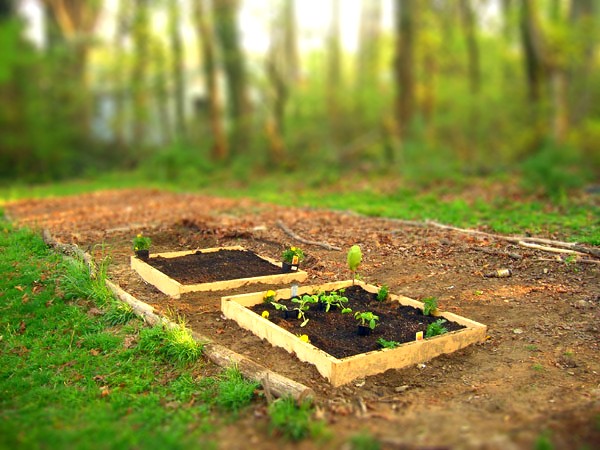
The last few weeks have been chaotic and I’ve had a challenge focusing on the garden project. The goal is to build six wood container boxes. But my weekly lumber allowance disappeared rather quickly; cost more over $17 to build two 4’x4′ boxes. The other challenge is the composting I did in the fall of ’09 only filled one box. So know I have to spend a few extra dollars purchasing topsoil.
Since I don’t own a motorized tiller, I resorted to a very old method of preparing the soil for planting. The New Self-sufficient Gardener by John Seymour offers an old English tradition for raised beds preparation. Basically, get a spade and dig down 6 to 10 inches and flip, or turn, the soil. After turning the soil in each box, I used a garden weasel tool to break up the soil even more. Finally, I added about two to three inches of topsoil before I began planting marigolds around the perimeter of the box. One source I read stated that marigolds provide an organic pest repellent. This is the first year I’ve used marigolds in the garden.
This weekend I received a letter in the post informing me that Free Lunch is closing shop. The news really disappointed me for two reasons. One, I was hoping to have some poems published. Two, I reviewed an issue of Free Lunch for Small Press Review and really enjoyed the publication. Some literary/poetry publications are dense with inaccessible poetry and my work doesn’t seem to fit. But Free Lunch felt like a good fit. Here’s an abridged version of the review I submitted to Small Press Review:
Free Lunch presents an engaging 20th Anniversary issue. Unlike many poetry magazines that contain a smattering of good poems and a couple great poems, the Spring 2009 issue of Free Lunch collects stellar work by Billy Collins, Stephen Dunn and many others. It is my habit as a reader to dog-ear pages in books or magazines that elicit some sort of physical response; like smacking a book on my knee and saying “yeah” to the amusement of fellow bus riders. Lyn Lifshin writes, “I love the sense/ of her contentment/ feel it moving/ inside me the/ way when a/ poem works…” in her poem “Writing a poem is like why and when a cat purs.” In “Advice from a Pro,” X. J. Kennedy writes, “I vowed to make my work intensley sober.” There are many great poems by poets Roger Aplon, Denise Duhamel, and others. And, in short, my copy of the 20th Anniversary of Free Lunch has almost every page dog-eared with praise.
“Saturday Night, Coffee House” by Matthew Mulder
The awkwardness is complete—
strangers sitting side by side
with nothing to offer but body heat
on this cold winter night;
and the only thing that
connects us is my brother’s wife
and the wooden bench we sit upon.
Conversation is embarrassingly
fumbled with references to
the chai we sip;
and at long silences we sip
more chai and look
around the coffee house
for more material to
discuss,
or some distraction
to fascinate our senses.
(Originally published in Rapid River Magazine, April 2004.)

The Traveling Bonfires return to Asheville with a one-hour poetry reading featuring founding members Pasckie Pascua and Matthew Mulder.
Friday, January 22, 2010
7:00pm
Malaprop’s Bookstore/Cafe Street, 55 Haywood Street City/Town: Asheville, NC
Sandpaper between two cultures which tear one another apart
I’m not a means by which you can reach spiritual understanding
Or even learn to do beadwork
I’m only willing to tell you how to make fry bread
1 cup flour, spoon of salt, spoon of baking powder
Stir, add milk or water or beer until it holds together
Slap each piece into rounds -let rest
Fry in hot grease until golden
This is Indian food
Only if you know that Indian is a government word
Which has nothing to do with our names for ourselves
I won’t chant for you
I admit no spirituality to you
I will not sweat with you or ease your guilt with fine turtle tales
I will not wear dancing clothes to read poetry Or explain hardly anything at all
I don’t think your attempts to understand us are going to work so
I’d rather you left us in whatever peace we can still
Scramble up- after all you continue to do
If you send me one more damn flyer about how to heal myself
For $300 with special feminist counseling
I’ll probably set fire to something
If you tell me one more time that I’m wiseI’ll throw up on you
Look at me
See my confusion, loneliness, fear, worrying about all our
Struggles to keep what little is left for us
Look at my heartNot your fantasies
Please don’t ever again tell me about your Cherokee great-great grandmother
don’t assume I know every other Native Activist
In the world personallyThat I even know names of all the tribes
or can pronounce names I’ve never heard
or that I’m expert at the peyote stitch
If you ever again tell me
How strong I am
I’ll lay down on the ground & moan so you’ll see
at last my human weaknessLike your own
I’m not strong, I’m scraped
I’m blessed with life while so many I’ve known are dead
I have work to do dishes, to wash a house to clean
There is no magic
See my simple cracked hands whichHave washed the same things you wash
See my eyes dark with fear in a house by myself late at night
See that to pity me or to adore me are the same
1 cup flour, spoon of salt, spoon of baking powder, liquid to hold
Remember this is only my recipeThere are many others
Let me rest
Here
At least– Chrystos, Menominee
(via deltafoxtrot)1
NOTES:
1) Delta Foxtrot, “I am not your princess,” January 8, 2010, Deltafoxtrot, accessed January 8, 2010, https://deltafoxtrot.tumblr.com/post/323784465/i-am-not-your-princess
[link]
Coffeehouse Junkie Podcast: An excerpt from Gregory Orr’s essay “Four Temperaments and the Forms of Poetry” will be read on today’s podcast plus an short poem.
“A haiku is far more than a concrete image of something ‘out there.’ It is very much about the cognitive awareness ‘in here.’” (via Roadrunner Journal)1
NOTES:
1) William M. Ramsey, “How One Writes in the Haiku Moment: Mythos vs. Logos,” May, 2009, Roadrunner Haiku Journal, Issue IX:2, accessed May 23, 2009, https://thehaikufoundation.org/omeka/items/show/1301
// i woke up from a dream in which coleman barks & i read sufi poetry in translation together…
// & now, a hafiz moment… ‘ever since happiness heard your name, it has been running through the streets trying to find you.’
// love the pejorative tone many bourgeois have toward the idea of poetry readings…
“[Khalil] Gibran’s ‘masterpiece’… turns not so much upon poetry as upon the genre of wisdom literature and its subgenre, the aphorism, which holds a particularly valued place in Arab culture. Like all good aphorists, he uses language that is both plain and metaphorical; it invites understanding yet in a way that brushes against the mysteries of being alive. There’s no doubt that the style occasionally ascends into comical elevations, and that its high tone seems lost in the ironies and specificities of American life. But that sort of spiritual homelessness pretty much describes a large swath of immigrant life.” (via poetry & popular culture)
// oh, insomnia, thanks for putting the recent issue of the american poetry review in my mailbox today-gives me something to read at 1am…
// i’d rather be reading hafiz; ‘we should make all spiritual talk simple today’ (http://www.powells.com/biblio/1-9780143037811-0)
// just returned from the BMCM+AC poetry reading wordfest event… two hours until the next reading at jubilee…
 Coffeehouse Junkie