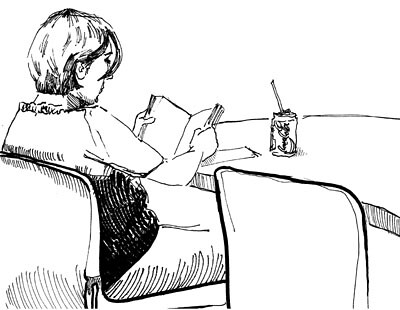
Reading a book in the office break room
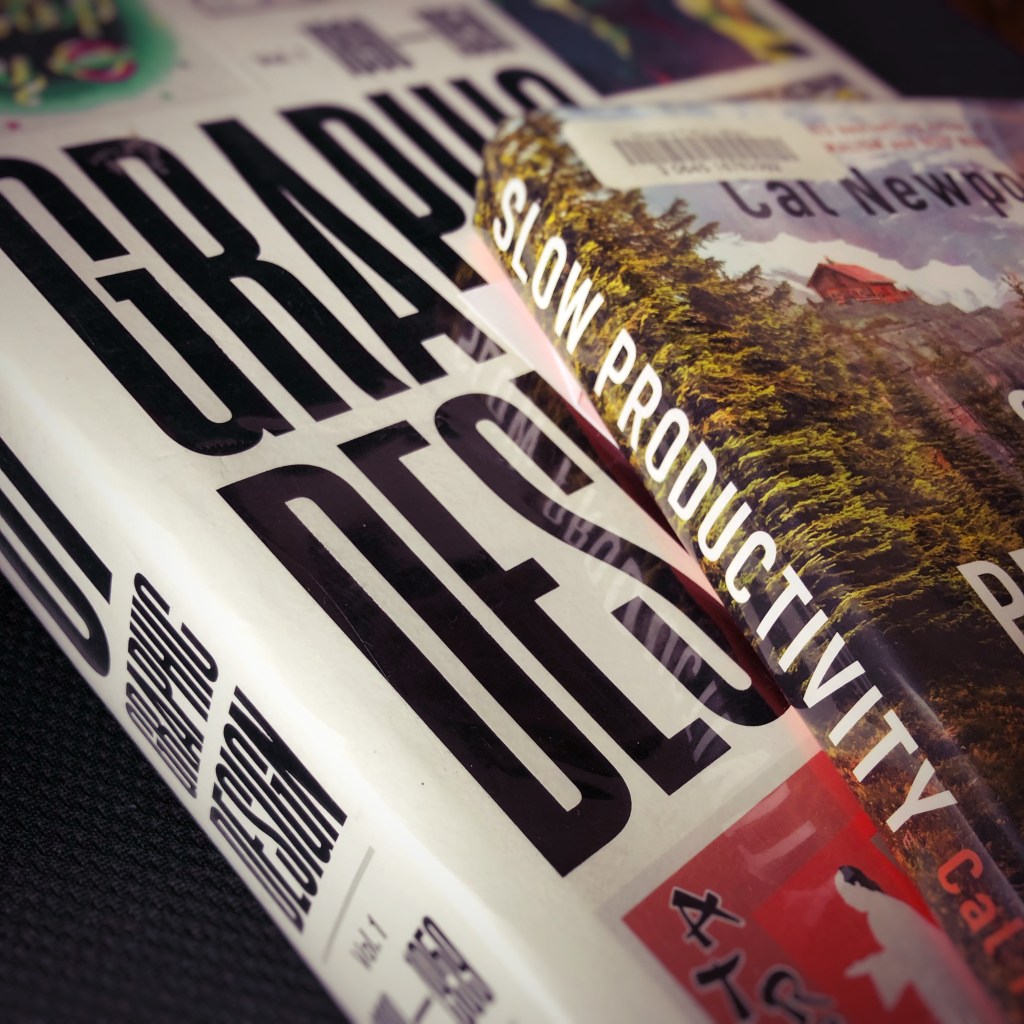
The interlibrary loan system provides access to books. Books that are not available at the local rural public library. Books requested using the library system’s web site arrive as they are available. Sometimes the combinations of titles display a curious serendipity. Slow Productivity. And History of Graphic Design Volume 1 1890 – 1959.
The principles featured in Slow Productivity appear to contrast with the other book. At least at first glance.
Graphic design projects and tasks were once defined by art and drafting skills. Tactile skills of cutting an oval with an X-Acto knife for a Rubylith overlay sheet. Or drafting skills of using a T-square ruler and triangle to layout the ad copy for an advertisement. Or the skill of painting a headline with gouache paints or pigment inks. Or the photographic skills of loading, shooting, processing, and printing 35mm film. Graphic design work prior to the 1990s required more physical activity. Often, a design shop featured multiple creative talents. A photographer. An illustrator. A copywriter. A director and assistant. A typographer and designer. A videographer and film and audio editors. That is a team of ten creatives. Now graphic design projects and tasks encompass project management and problem solving. And a single designer needs to do the work of ten creatives.
Can graphic designers do their projects and tasks without burnout? That is the question. And, maybe, that is where the interlibrary loan library books compliment each other. Can the past inform the present? And future? And, more uregently, can I read these books before they are due back to the library?

The train was late. Or rather, I was late for the train. Work ran later than expected. Missed the 5:45. The street car was running. No mechanical problems like Monday. But a few minutes behind schedule due to a presidential rally.
I decided to skip the street car and walk to the station in order to catch the last train home. There is almost two hours between one train and the other. Walking gave me a chance to find a coffee shop and some time to catch up on reading. The Public Market was on the way, but it tends be loud. And crowded.
Stone Creek Coffee is nice and near the train station. And open until 7 p.m. It displays a nice interior design. But sometimes the atmosphere feels a bit too mod. The baristas are often impertinent. And I feel inelegant when I visit. Maybe I am getting too old to haunt swanky coffee shops. Stone Creek coffee is luxurious. In spite of pretentious barista I bought a cup and then walked to the train station to wait and read a book. It is an autobiography of the Chinese poet Tu Fu. The fact that a book published in the 1930s is still in circulation at a public library is impressive. Also interesting are the translator notes. A few weeks ago I finished reading a recent translation of Li Po poetry. The translator, Seaton, made observations similar to those made nearly 100 years ago by Ayscough and Lowell.
I struggled with one passage in the book as the train station grew loud with passengers arriving from one train and departing on a Greyhound bus. Pulling a mobile device out of my pocket I placed in ear buds and cued up episode 88 of the Discovering Jazz podcast. As I listened I read that one Chinese ideogram may require more than one word to transliterate. Sometimes an entire phrase is used to convey the idea of a single Chinese character. The last train arrived. I boarded. Found a seat. Continued reading. And listening.
The jazz podcast explored absolute pitch. The show host mentioned that Asian languages are tonal. Pronouncing a vowel with one pitch may mean one thing while pronouncing the same vowel with a different pitch provides a different meaning. I experienced that when I visited Japan. But I did not have the knowledge to appreciate it then as I do now.
Reading a dozen pages was all I managed to accomplish before the train stopped at the home station. Thankful to be homeward. Grateful for the travel disruption that mingled American jazz and Chinese poetry into one commute.
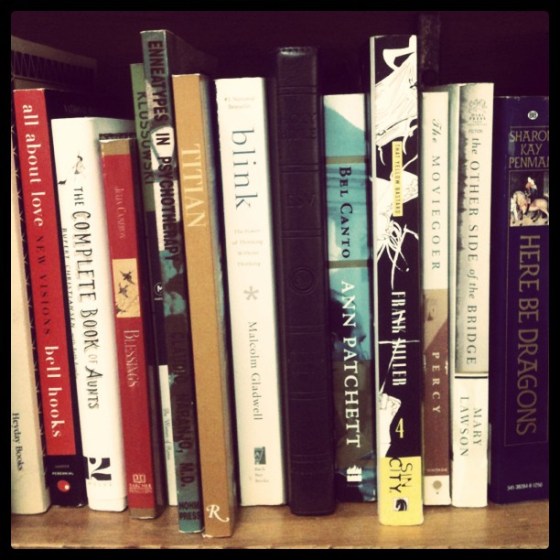
Have you ever wondered how fast you read? A stack of reading material on the nightstand begged for my attention. I considered how long it would take me to get through it.
Curious, I took an online test to find out.[1] I selected a blog post from a published poet/essayist and took the reading test. The results disappointed me. It took me less than two minutes to read a blog post with more than 300 words. According to a Forbes article, the average adult reads 300 words a minute.[2]
Test two. I selected the nut graph of a Slate.com article. Again, below average reading speed. Test three. Selected another blog post. This time from a professional blogger. I received an above average reading speed. Test four (and five). Two different New Yorker articles selected. I read the opening paragraphs. Two different writers. One wrote a news piece. One a literary critique. The results varied. The critique results were below average and the news piece was above average.
I turned my attention to the text read. Using an online app I graded the passages read.[3] The Slate.com article received a good readability rating. The professional blogger article earned an okay readability score. The literary critique received a poor readability grade. The news piece received a score worse than the literary critique.
The app rates the difficulty of a text. The readability grade based upon passive voice, adverbs, phrases with simpler alternatives, and sentences that are hard or very hard to read. In other words, difficult sentences that included compound or compound/complex sentence structures.
What I have noticed is that numbers (and analysis), abstract ideas and foreign words slow me down. There is so much I desire to read, but time limitations prevent the volume of literature I seek to explore. So, I have to be selective in my reading habits. And this reminds me of something Annie Dillard wrote:
“He is careful of what he reads, for that is what he will write. He is careful of what he learns, for that is what he will know.”
NOTES:
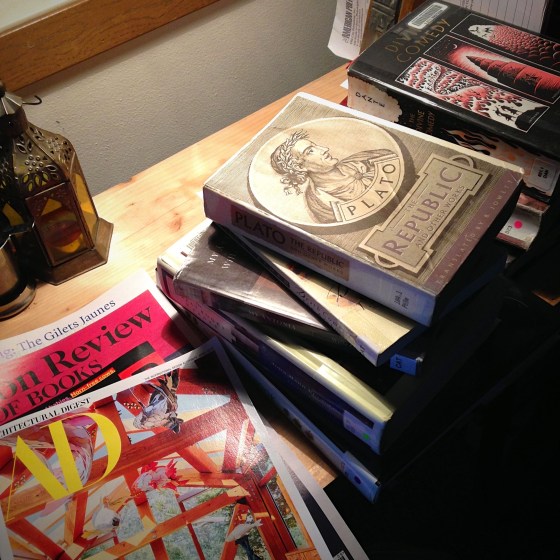
How many books did you read last year? According to some reports, one in four Americans did not read a single book in the last twelve months. Three out of the four who did read in the last year read only one book. But the reports are even more dismal when a distinction is made between any books and books of literature. For example, books on business, cooking, gardening or self-help are in a different category from books of literature. Further, books on business and marketing by Tim Ferriss, Seth Godin or Simon Sinek are not considered literary works. Books by Dante, Plato and Shakespeare are works of high literature. Books of literature by American authors include Flannery O’Connor, Robert Frost and Thornton Wilder.
My own reading pattern shadows the national trend. This discourages me. Years ago I read more than 50 books a year. In addition to that, I used to read several literary journals, magazines and newspapers on the bus ride to the office each day. It was a delicious and robust period of time. But life interrupted this reading regimen. A dream job, mega commute, cross-country move, career change, new job at a legacy media organization, and more commuting disrupted my reading habits.
It is a struggle for me to completely read one single book from cover to cover. The desk in front of the window holds eight books. I may have to return all these to the public library partially read. Or renew them. The library must be weary of me renewing a copy of a theological book. I must have renewed it several times over the last few months. One report I read stated the reason people do not read books is due to their busy work/life balance.
The interruption to the reading habit is due in part to the daily commute. 90 minutes a day spent traveling from home to work. Public transit would be nice. However, no public transit system services the rural communities surrounded by cultivated fields and farmland. Travel accounts for more than 15 days of my time each year. And then there are the long hours of production work. The job is mentally demanding. My fatigued mind only desires to turn on the record player and go to sleep when I return home.
Most Americans spend more than two hours each day on Facebook, Instagram, LinkedIn and Twitter. That equals more than 40 days a year. From an economic stand point that seems like a lot of wasted productivity. What that means in practical terms is that my social media feeds are on life support. I do not spend time on Facebook or Twitter at all. LinkedIn occasionally. And I deleted my Instagram account. Eliminating social media activity allowed me to reclaim some of the time lost to commuting and work.
A second action put into practice during the last few years included reading great books of literature. Mostly. Plato’s The Republic, Beowulf, Sir Gawain and the Green Knight, The Autobiography of Benjamin Franklin, Booker T. Washington’s Up from Slavery, The Autobiographies of Frederick Douglas, Tolstoy’s Anna Karenina are some of the books read during the last year and a half. The classical education curriculum of my children helped me form a list of great books to read. I added a few books to the list to include Asian and Near Eastern studies. I explored Basho’s The Narrow Road, an anthology of Rumi, Hafix and Lalla, and Ryokan’s Sky Above, Great Wind. Most recently I attempted to read and compare three different translations of Dante’s Divine Comedy. An ambitious task that I failed. Ended up focusing on selected cantos for comparison before the books were shuffled back to the public library.
Why is reading books, especially, great books, important? The virtue of being well-read is the goal. Do not leave it up to the academics and professionals to read great books. C. S. Lewis wrote that “the simplest student will be able to understand, if not all, yet a very great deal of what Plato said; but hardly anyone can understand some modern books on Platonism.” He continued by encouraging readers to acquire firsthand knowledge of the source material rather than to rely on secondhand commentary. Being a well-read individual has the potential to foster a civilized society. But you must be vigilant, designate time, pick up a book and read it cover to cover.

This question seems so simple. But, what is money? How is happiness defined? Does the question imply that money means an individual is rich? Is being rich and being wealthy the same? Or different?
My reading list, as of recent, includes a book on business management, two history books and a book researching the characteristics of the wealthiest Americans. Also, included are several books of poetry by Berryman, Bly and Carruth as well as a novel by A. S. Byatt.
Almost every one of those books mentioned either directly or indirectly touches on the subject of money and happiness.
![DSCN2479[squaretiltdallashi]](https://coffeehousejunkie.net/wp-content/uploads/2015/02/dscn2479squaretiltdallashi.jpg?w=560)
The blizzard ended Monday morning — the beginning of the week. But the flurry of activities the rest week kept me occupied with matters of consequence and so on and so forth.
Finally, Saturday night, as the sun set, I sat down with a cup of tea to read the Sunday edition of The New York Times and a few other books — Einstein’s Relativity, Sandman Overture #4 and a book on the history of time, or specifically the 365-day calendar.
Reading the newspaper days after Super Bowl amused me as it required an eye of an archivist. The news stories were lead pieces promoting the biggest game in American football. Knowing the outcome of the game shaded the stories in the Sunday edition. Shaded the stories in the way I might read modern history books — or marketing books.
But who really has time for this? Who has time to read heritage media? Who has time to dream? Seemed suitable questions while reading about space and time and dreams. And so, February begins.
NOTE: This was supposed to be posted Saturday night, but I was rather weary and fell asleep.

The 21st annual Poetry Marathon Benefit Reading for Milwaukee’s Woodland Pattern Book Center is this Saturday, January 31, 2015. If you are not familiar with Woodland Pattern Book Center, here is an introduction to this non-profit organization from their website:
Woodland Pattern’s… specializes in literature from small and independent presses and is well-stocked with over 25,000 titles.
The poetry section is among the best in the world, and has a comprehensive blend of classics and contemporary works, translations, and poets from all schools. Several ethnic sections include… poetry from African American/Black, Hispanic, Asian, Middle Eastern, and Native American writers. Nearly half… of our space is devoted to poetry, a commitment that few organizations can claim to match. (continue reading)
Woodland Pattern’s mission is:
…dedicated to the discovery, cultivation and presentation of contemporary literature and the arts.
Our goals are to promote a lifetime practice of reading and writing, to provide a forum and resource center for writers/artists in our region, and to increase and diversify the audience for contemporary literature through innovative approaches to multi-arts programming. (continue reading)
I will be reading during the marathon and would really appreciate your support. Please consider supporting me with a pledge. It is really easy and only takes three steps. Go to the website (here),
And thank you on behalf of the Woodland Pattern Book Center!
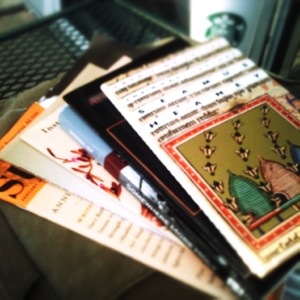
A light breeze from the south, sunshine, blue skies, and the chirp and trill of birds set the stage for a lovely Sunday afternoon. I am sitting outside the apartment reading a book. Or rather reading through a stack of books.
Across the courtyard a guy enthusiastically shouts at his television regarding the baseball game. To the south, the theme music for the television show Dr. Who is heard from an open second-floor window. Why not sit outside and read a good book? Or two. In this northern climate there have been only a few days like this so far this year.
One of the books I have already read, but wanted to reread a selection of poems. One book I bought because I ran up such a large fine at the public library it made practical sense to purchase a copy and finish reading it. Others were on a list of books I have intended to read. One book I put off reading, but am more than 50 pages into it and wonder why I put it off for so long.
What about you? What are you reading this weekend?
Welcome to the relaunch of the Coffeehouse Junkie audio podcast. A lot of things have happened during that time and there is much I plan to share with you, just not in this episode.
Yes, it is true. The last two years or so I have fasted from coffee. I almost had to rename this blog and audio podcast because of it. Thankfully, my sister introduced me to Maniac Coffee Roasting in Bellingham, Washington. Specifically, the Decaf Espresso Royale blend. Check them out at ManiacCoffeeRoasting.com. They are the unofficial sponsor of this episode. If you would like to officially sponsor an episode, email me at coffeehousejunkie [at] gmail [dot] com for details. Please include “podcast” in the subject line so that your email doesn’t end up in the spam folder.

Very special thanks to Amy Annelle for granting permission to use her song “Will Try” between the segments. Years ago, the album A School of Secret Dangers introduced me to her work. If you like her song, check out Amy Annelle’s latest album The Cimarron Banks. Visit the website HighPlainsSigh.com for more info about her music or find her music on Apple iTunes.
Here’s what’s coming up in this episode:
Listen here:
Or listen on:
PodOmatic: coffeehousejunkie.podomatic.com
SoundCloud: soundcloud.com/coffeehousejunkie
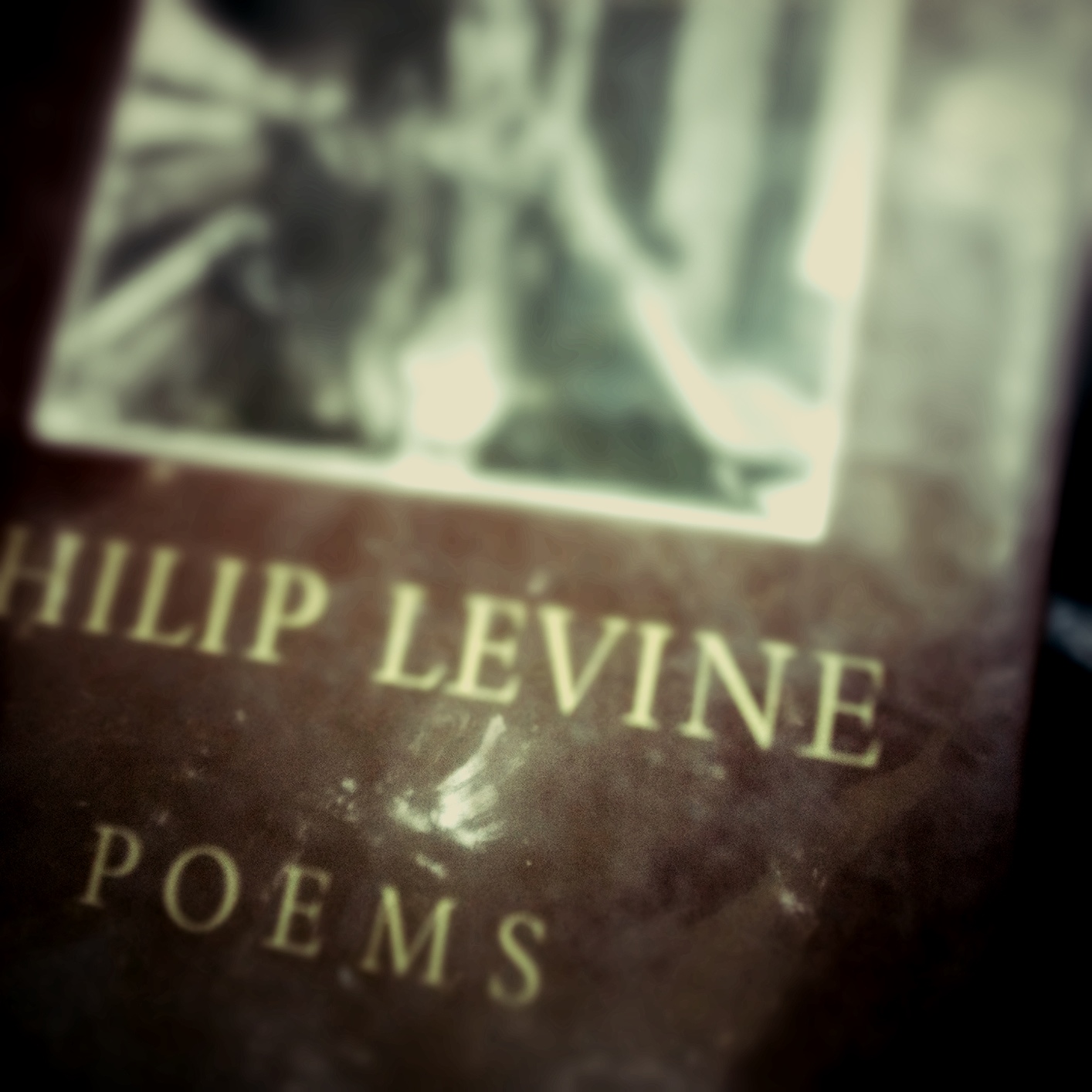
Over the weekend, an editor made a comment on Facebook that got me thinking about the question, how did you come to poetry?
My response is not an academic reply. The mechanics of poetry make the art good and great. But the best way to ruin poetry for young minds or new readers, is to have people study the architecture of a poem–its meter, rhyme, enjambment, stanzas, etc. Is this the way you learn about a new home? When you enter a friend’s home for the first time, do you inquire as to house’s foundation (is it a slab foundation?), framing (stick frame or post and beam?) or roof (you get the point)? So why do educators insist on destroying poetry for young readers? Make the home inviting. Make poetry inviting.
As a poetry reader, I approach a poem (or body of poems) as I would a new home of a friend I just met. I enter the door, look at the paintings on the wall, run my fingers along the spines of the books on the shelf, scan over the vinyl collection beside the stereo and sit on the futon near the front window. This is how to see what the poet sees through the window of the poem. This is when I see what the poet says about love, injustice or various other subjects and topics.
Not all poems are created equal. Sometimes I get the impression that someone or something is shouting at me from an open door. I tend to quicken my steps along the street and find a more inviting home–a more inviting poem.
Poetry is not something I studied in school. There were, of course, the required literature classes, and some teachers that opened the landscape of great poetry and prose. But for me, someone left the back door to the house of poetry open and I slipped in to explore. A house doesn’t seem so intimidating or formal when you enter, casually, from the backdoor.
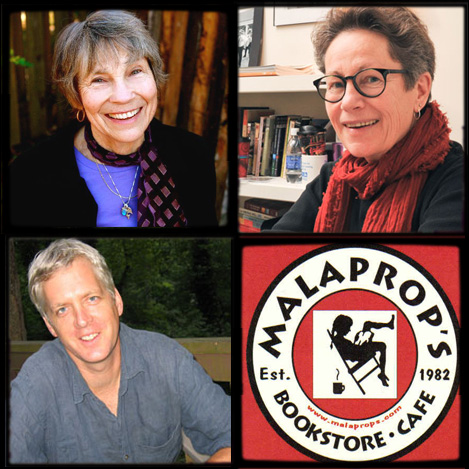
This Sunday at the Malaprop’s cafe at 3:00 p.m. on Sunday, September 16, join the following poets as they read from their recent books: Holly Iglesias (ANGLES OF APPROACH), Sebastian Matthews (MIRACLE DAY: MID-LIFE SONGS), and Katherine Soniat (THE SWING GIRL). More details here. Link.
Literature takes a habit of mind that has disappeared. It requires silence, some form of isolation, and sustained concentration in the presence of an enigmatic thing.
Philip Roth (via libraryland)
This week the Juniper Bends reading series continues this Friday, February 10th, at 7:00 p.m. at Downtown Books and News. The event features readings by: Kate Zambreno, Katherine Soniat, Jesse Rice-Evans and Adam Jernigan. Visit the Facebook event page for more details. (link)
POETRIO reading/booksigning featuring Tony Abbott, Scott Owens, Katherine Soniat.
Sunday, November 6, 2011, 3:00 p.m.
Malaprop’s Bookstore/Café
55 Haywood Street
Asheville, NC 28801
www.malaprops.com
Poets Diana Pinckney, Barbara Gravelle and Matthew Mulder plan to read from their recently published books for Poetrio at Malaprop’s Bookstore/Café May 1, 2011 at 3 p.m.
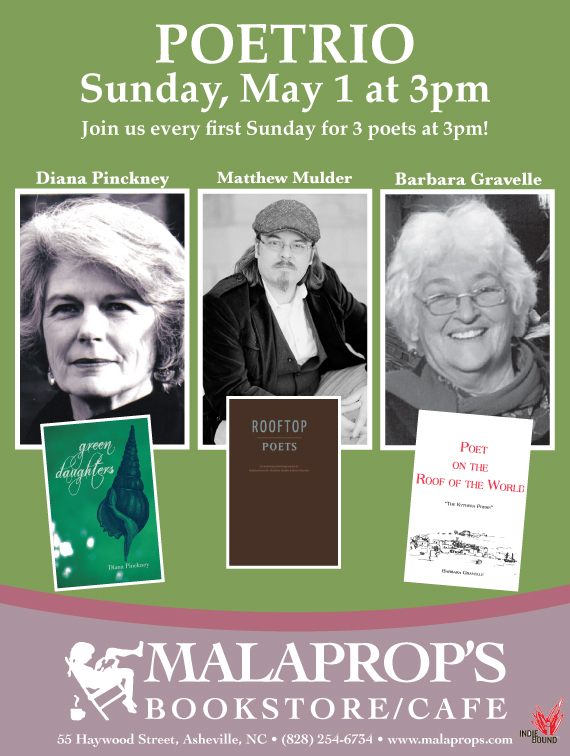
Diana Pinckney has published poetry and prose in such journals and magazines as Southern Poetry Review, Cream City Review, Tar River Poetry, Cave Wall, Sow’s Ear Poetry Review, Icarus International, Atlanta Review, Green Mountains Review, Main Street Rag, Kalliope, Iodine, Asheville Poetry Review, Calyx, RHINO, Charlotte Viewpoint… Magazine, The Pedestal Magazine.com, Creative Loafing and many others. Her chapbook, Fishing With Tall Women, won North Carolina’s 1996 Persephone Press Book Award and South Carolina’s Kinlock Rivers Memorial Chapbook Contest. Nightshade Press, Troy, Maine, published her second book of poems, White Linen, in 1998. Alchemy, the third collection was published by Main Street Rag Publishing Co. in 2004. The latest full-length book of poems concerns the many fascinations and mysteries of the sea, among other things. Green Daughters was released April 2011.
Barbara Gravelle, author of several poetry books including, Keepsake, Dancing the Naked Dance of Love, and her latest collection of poems, Poet on the Roof of the World. Barbara Gravelle began to publish poetry in the 1960s when she was in Detroit at Wayne State University. In 1970 she moved to Berkeley, California where her first book, Keepsake, was published by Two Windows Press. She worked with the San Francisco State NEA Poetry in the Schools program at Northern California schools. Concurrently she worked at Intersection Center for the Arts in North Beach directing the Women’ Reading Series and an experimental Feminist Writing Workshop. Dancing the Naked Dance of Love, her book of San Francisco poems was published during this time. In the mid 1980’s Barbara began to migrate to the island of Kythera in Southern Greece, while living there she wrote the poems for Poet on the Roof of the World.
Matthew Mulder has published poetry and prose in such journals and magazines as Crab Creek Review, H_NGM_N, The Indie, Rapid River Magazine, ISM Quarterly, Salamander, Wander, The Blotter, Southern Cross Review and others. He teaches poetry writing classes at Asheville bookstores and fine arts centers and is presently translating selected works of German poet Rolf Dieter Brinkmann. He is the author Late Night Writing (2004) and editor of A Body Turning (2010) and Tomorrow We Sweat Poetry (2009). His new poems are anthologized in Rooftop Poets (2010).
It is a good rule after reading a new book, never to allow yourself another new one till you have read an old one in between.
C.S. Lewis
Brief review of last night’s Warren Wilson College MFA faculty reading.
Marianne Boruch
Charles D’Ambrosio read a lengthy, intriguing piece that I assume is the opening to a novel. When he finished, I wanted to shout, “What happens next?”
Van Jordan
Michael Martone


 Coffeehouse Junkie