Earlier today I notice that Poetryblogs.org features my blog (I guess this means I should update the blog more often). Thanks for visiting Coffeehouse Junkie’s Blog and hope you return and share what you like. If you’re a new reader of Coffeehouse Junkie’s Blog check out the 10 most recent blog posts listed in the right column, the most liked posts in the left column and search through the subject list in the lower right column for content that I’ve contributed since 2004. You may also sign up for email subscription to this blog so that every time I post something new, you receive an email.
Dear friends and loyal followers of Coffeehouse Junkie’s Blog, I do intend to write more posts. Presently, I am buried in work as creative director for an international publishing company. Until I finish designing other writers’s book covers, blogging will be limited. Enjoy browsing some of the recent book designs here, here, here and here.
There are secrets between singer songwriters and poets. We share them in dark corners of pubs or cafés. We talk about live performances and audiences and the craft of writing. A singer songwriter confesses that “at least a guitar is between me and the audience, but poets are left completely vulnerable on stage.” Yes, indeed. Naked before audiences that, in general, don’t care about poetry or don’t know anything about it. We wonder why singer songwriters embrace lyricism while academic poets skitter away from deep lyrics and the hint of rhyme. We will bury our secrets deep into the lyrics of a song or poem–so deep that it requires of map to locate ars poetica.
What do you think about when you see a stack of books? In this short collection of stories you will also learn what a creative director thinks of when he sees a stack of books. Who is the audience for your poems? Is possible to write in your sleep, or not?
While I wait for editors to reply to my narrative non-fiction submissions, I grow impatient and want to post these writings on this blog. Some teasers like Shuffling through the ruins of a summer and Ma Rainey, don’t sing them blues no more were released. One astute reader provoked this post: Yes, it is true. But on the advice of published writers, I can’t post much more without jeopardizing publication. So, I wait. Keep writing. And reading. This weekend one blogger reminded me of OctPoWriMo–31 poems/31 days. This seems to me like a good exercise to do while I wait on editors.
Tomorrow, 8:30 p.m. join James McKay, Laura Hope-Gill, Caleb Beissert, Pasckie Pascua, and Aaron Price at Battery Park Book Exchange & Champagne Bar, 1 Page Avenue, Asheville on SEPT 11, 8:30 to 11PM. This event is free to the public. Read poet and musician bios as well as other information on the Facebook events page. Link.
A very observant reader and friend asked of this week’s post: “Is this story related to the teases from other photos?” Yes, they are all teasers for scenes from a narrative non-fiction book I’m writing. Some of the chapters have either been sent or are in the process of being sent to journals and magazines for publication. I am waiting on editors at this phase in the process.
This sunday, Malaprop’s Bookstore/Café continues the monthly poetry reading series, Poetrio, with Meta Commerse, Cassie Premo Steele, and Pauletta Hansel.
In an email from Virginia McKinley, of Malaprop’s, here’s a write up about August’s featured poets:
Meta Commerse. . . is the author of six books, including a novel intended to be a book of hope for middle-school-aged black girls. That book began as her culminating project for the MFA degree in creative writing at Goddard College. RAINSONGS: POEMS OF A WOMAN’S LIFE is her most recent book of poetry. . . .
Cassie Premo Steele’s poetry has appeared in numerous anthologies, magazines, and journals, including such publications as Sagewoman and Calyx. Her work has been nominated twice for a Pushcart Prize. . . Her most recent book of poetry, THE POMEGRANATE PAPERS, is based on the Persephone/ Demeter myth and addresses the themes of mothers, daughters, creative cycles, loss, healing, and living in harmony with the seasons. . . .
According to Jackie Demaline of The Cincinnati Enquirer, Pauletta Hansel has been “an arts administrator and an unflagging arts advocate, [but] doesn’t like to talk about herself.” Yet she seems happy to talk about the work she finds most interesting: “community organizing and community arts.” . . . . Pauletta Hansel has published poems in . . . journals . . . and . . . has three previous collections of poetry, Divining, First Person, and What I Did There; at Malaprop’s she will read from her most recent book, THE LIVES WE LIVE IN HOUSES. . . .
Hope to see you Sunday, August 5, at 3:00 p.m. for Poetrio!
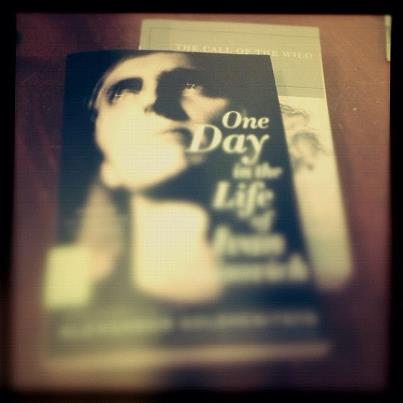
One Day in the Life of Ivan Denisovich and The Call of the Wild
“Do you prefer Summer or Winter in books and writing?” asks blogger Lea At Sea. What do you think? I had to think about that for a while.
I finished a few books recently by authors Ian McEwan and Barbara Kingsolver. Saturday, On Chesil Beach and The Bean Trees all have specific seasons and locations central to each novel. As I thought of how the seasons permeate a novel, two novels come to mind:
by Aleksandr Solzhenitsyn and The Call of the Wild by Jack London. [1] It never occurred to me to read One Day in the Life of Ivan Denisovich because it begins on a cold winter morning. The character and narrative interested me. The gulag in winter is a prominent element of the story, but that isn’t the reason I read the book. It was the story.
By nature I’m a fall/winter sort of person. Maybe that’s why I recalled those two books:One Day in the Life of Ivan Denisovich and The Call of the Wild. But my reading choice is not directly influenced by that predisposition otherwise I would not have picked up a book set in spring/summer of the American southwest. However, I am curious to learn if your reading selections are influenced by that perimeter. Do you choose a book because it is seasonally based? Further, if you are a poet and/or writer, do you specifically write for a specific season?
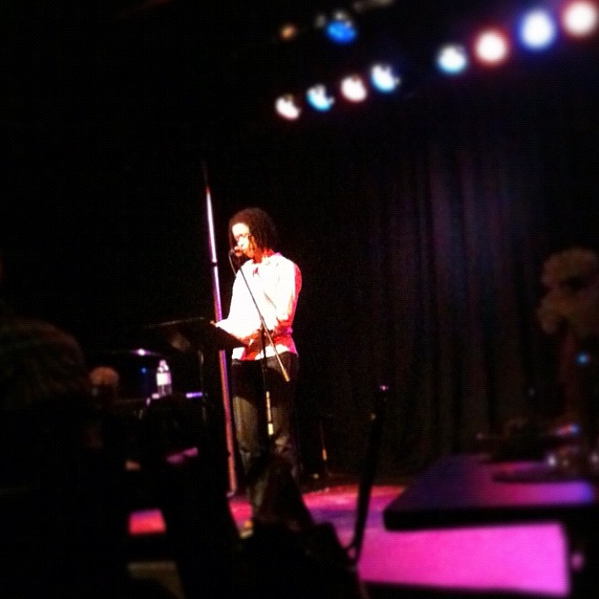
Evie Shockley reading at The Altamont Theater, Asheville, NC
If it is possible to be drunk on poetry, than I am still sobering up from last night’s event Poetry at the Altamont featuring Evie Shockley. It was quite a special night as Evie Shockley read selections from the new black and a half-red sea as well as some new poems in progress.
Other highlights include poems read by notable poets including Lee Ann Brown, Jeff Davis (who also hosted the event), Eric Steineger, Caleb Beissert and many others whom I have forgotten there names, but not their words. There were verses read about five drinks at a bar with reflections of a homeless man in a cardboard box home and another poem about bees and honey and lazy hippies squatting in someone’s home all summer.
I also read some poems last night. Earlier in that day I had mailed off a manuscript to a publisher and had intended to read selections from that manuscript, but I changed up what I read. I can’t tell you what I read. You’ll have to ask someone who was there last night at The Altamont.
It was such a pleasure to join this gathering of poets and share works in progress in sort of literary laboratory. Looking forward to the next gathering.
Sometimes a few notes of music follow you for days are weeks or years. Sometimes a line of poetry haunts you like a memory you can’t quite recall. It’s like rain, it permeates the air, wets the ground, even makes tea taste more pronounced.
Here’s part of a story I can share with you. After I was at university studying art and design, I found an audio CD in a music store titled Jazz for a Rainy Afternoon. What attracted me to the album, a compilation, was the fact that the cover art reminded me of a sexier version of Gustave Caillebotte’s famous painting. I purchased the audio CD. It was background music initially. Something to edge off lonely days as a poor graduate beginning a career in graphic design. About the same time I discovered, and purchased, a copy of William Kistler’s poetry book America February.
I have always enjoyed poetry and music, but reading Kistler’s work was rigorous for me. Light verse and traditional poems, the variety that fill American and English school book anthologies, were what I was familiar with. But Kistler’s poetry was a new dish for my inexperienced palate. Equally, understanding the musical selections of Jazz for a Rainy Afternoon as more than a background soundtrack was challenging.
A line from one of Susan L Daniels’s poems has captured my attention this past week—the way jazz and poetry sometimes do. The speaker in the poem answers a question, so you like jazz, by saying: “…the answer is no/I live it sometimes…” That’s what I have come to enjoy about the complicated progression in a song or a poem that avoids a clean resolution.
Jazz and poetry work into you. It takes you down that familiar path of a rainy day afternoon, a common enough subject, but it is a variation of that theme. Never the same way twice. Like reading a poem as a school boy and reading it later as a graduate and later as a professional. Same poem printed on the page, but different. Always different. But familiar, because you “live it.” There’s more to this story. Maybe I’ll share it with you on another rainy day afternoon.
A book is more than a collection of letters and pages.
The week before Fathers Day I completed a book design project that is a “legacy of letters from a decorated World War II hero…” Or so the back copy states.
Reading a manuscript like that, at times, seems voyeuristic. The compelling part of the book is the context of knowing that the author was three when his father passed away suddenly. He grew up hearing friends and family tell him “You sure look like your Daddy” or “I knew your Dad, he was one of the best.” The letters that the author collected for the book shares who is father was and what kind of man he was. But most importantly, for the author, it was the only way to hear the voice of a father he never knew.
At times, during the process of designing the cover and page layout, I glimpsed that boyish tenderness of the author (now in his sixties) as he ached for the presence his father. I cherished Fathers Day all the more as I thought of the author.
A couple of things come to mind as I wrap up this project and send it to press. First, the art of letter writing seems non-existent. The last letter I received was from my oldest child who placed it in my boot for me to find one morning. It was a simple note written in colored pencil. It is placed in my journal. I glance at it periodically.
Last time I received a hand-written letter was years ago. There are the seasonal holiday letters that begin filling my mail box every year between Thanksgiving and New Year’s Day. They usually arrive as letters printed out on decorative stationary purchased at Kinkos or Office Depot. But hand-written letters? Do people still do that in our culture?
Secondly, the legacy left behind of those letters written prior to, during and after a major historical event impresses me. What kind of legacy might we leave our children and grandchildren with a mountain of un-memorable text messages. What will our tweets and status updates mean a half century from now? Will Twitter be obsolete by then? Or Facebook? Can you imagine your grandchildren asking you, “What’s Twitter?” After you explain the whole social media birth of micro blogging they giggle and say, “Twitter is so 2012. I can’t believe how primitive that seems.”
Emails may convey some of the gravitas as a written (or typed) letter. However, as Luddite as this sounds, I still have hand-written letters from family and friends placed in an old shoe box. Letters and notes from a woman who became my wife are stored in a similar fashion. A typed note from my grandfather, when age had crippled his hand-writing, is placed in a book of his poems as a reminder and memento. As a child, my grandmother wrote a brief letter to me each birthday and placed a stick of gum in between the folds. I looked forward to that letter each year. You can’t attach a stick of gum to an email.
Besides, I doubt anyone in our culture would wait, anticipate and enjoy a letter that arrives annually. Everything is so urgent… almost panicked. Why isn’t someone responding to my emails, texts, tweets? It’s been 30 seconds! (Place emoticons here.) In my own life, I notice how differently I process social media and online content. There lacks a linear stretch of the intellect when processing clusters of data points from Twitter, Facebook, HuffPo, etc. My attention span fatigues when I have to wade through a barrage of emails, updates and tweets.
Yet I enjoy the long articles in the Atlantic Monthly, London Review of Books, The New York Review of Books or the like. It stimulates my mind. 700-word news articles for the most part bore me. There’s nothing there but a nut graph. No context. No history. No personality or narrative trajectory. Just a Google-like, or Wikipedia-like, democratized collection of information. There’s nothing there to engage my mind. Nothing that challenges my mind, beliefs or values. A book on the Battle of Agincourt offers nuances that blog posts, tweets and texts don’t offer.
Reading through a legacy of letters, like the book I am ready to send to press, captures the exchange of ideas in a sustained, generational conversation between a father and a son. The more our culture engages in the scatterbrained conflagration of data items, I suspect civil, engaging conversation (like letter writing) may become obsolete.
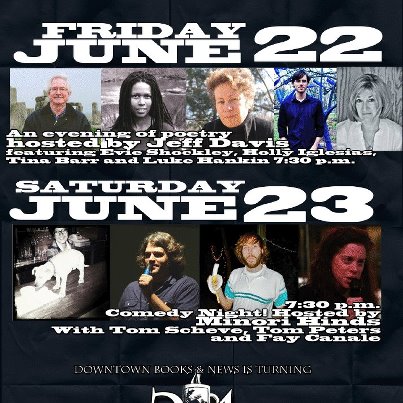
Tonight, 7:30 p.m., Downtown Books & News presents an evening of poetry hosted by Jeff Davis and features Evie Shockley (recently selected for Holmes National Poetry Prize), Holly Iglesias, Luke Hankins and Tina Barr.
Or not. Here’s what professional copywriters will tell you. There are two steps to writing your business bio:
provide an overview of your skills and experience.
include related or interesting facts to punctuate your credentials.
Pretty simple, right. Wrong. Why is it so difficult to write in third-person? About yourself? (And I need send this to the publicist later today.) So, I wrote a first draft. It works. It’s short. Simple. To the point. But something is missing. So, I searched a couple web sites for help. Here’s a few basic principles I gleaned from Terje Johansen: [1]
write in third person
list facts, not wishes
cite relevant experiences
belong somewhere
write tight
add a hook
Here’s a few things to add to that list:
audience
storytelling
social media
The business bio I’m writing is to be placed on a publishing house’s web site. So that audience will be authors and readers. A dash of storytelling to the bio helps readers remember who you are because of the narrative you share. And be sure to include your LinkedIn info. Here’s what I plan to send to the publicist:
Matthew Mulder began his career in a quiet Wisconsin studio of a calligrapher where he learned a hands-on approach to color, design, typography and the ancient art of Celtic knots. As creative director, he brings more than sixteen years of experience to the art department and provides creative, strategic solutions to the publishing business. After-hours, Matthew is a culture-maker in the literary community of Asheville, North Carolina where he is invited to present his work to audiences at bookstores, cafés, and fine art centers. His published work appears in such literary journals as Crab Creek Review, H_NGM_N, Small Press Review and others. Follow Matthew on Twitter @mxmulder or LinkedIn.
Sunday afternoon, June 3rd at 3 p.m., the Poetrio monthly reading series continues with Donna Lisle Burton, Alice Osborn, and Erica Wright. Details here [link].
From Malaprop’s community outreach director, Virginia McKinley:
Poet and visual artist Donna Lisle Burton. . . . has two previous collections of poems; is also an accomplished painter, portraitist, and photographer; and has four decades of experience as a special education teacher. Of Donna Lisle Burton’s third collection of poems, LETTING GO, award-winning Asheville poet Pat Riviere-Seel has written, “Do not be misled by the title: once you start reading, there will be no Letting Go [sic].” North Carolina Poet Laureate Cathy Smith Bowers has offered this additional appreciation: “Reading the poems of Donna Lisle Burton is like happening upon a cache of tender and beautifully crafted love letters. Among the objects of her most intimate affections are lovers both old and new — parents and siblings and children; students and friends; flowers and bridges and mills. And, finally, her luckiest of lovers, whoever might open the pages of this exquisite book.” The variations on letting go that are gathered in this collection are not entirely beautiful or easy, and not always for the reasons one might anticipate. . . .
Alice Osborn is another transplant to North Carolina. . . . AFTER THE STEAMING STOPS is her most recent collection of poetry; previous collections are Right Lane Ends, and Unfinished Projects. The latter prompted these remarks from writer Homer Hickam: “I love Alice’s poetry. She gives me thoughts I’ve never thought, and dreams I’ve never dreamed. She uses words like a master potter — molding the clay of the mind into vessels that hold not things, but life, place, and time.” AFTER THE STEAMING STOPS seems a book more of broken dreams than of new or unexpected ones. There is no sentimentality in the face of death, departures, endings. . . Before the fierceness of nature and life, love becomes fierce — but after the fact, and nearly as helpless as the child who declared, “I’ll find my own way!” — and bicycled off as a tornado approached, “no clue dueling cyclones ate children / near the road he and Daddy drive on every day to school.”
Erica Wright. . . . serves as poetry editor for Guernica, a magazine of art and politics, and teaches creative writing at Marymount Manhattan College. . . . Of her 2011 book, INSTRUCTIONS FOR KILLING THE JACKAL, Christopher Crawford observed in a recent review for the literary magazine Neon, “Wright is not afraid to use the darkest of imagery combined with a violence of language. A great number of the poems here are in tercets and couplets and Wright makes good use of these forms[,] which allows her to move her short, sharp-edged anecdotes with disquieting ease from beginning to end. Wright’s poems often follow the tracks of her thoughts through various twists, turns and enjambments. The darkness that informs these images is always just below the surface, the music in the lines is subtle and tense . . . The poems give a sense of someone trying to find something while at the same time avoiding it, leaving the scene while simultaneously confronting it. . . .” Erica Wright’s imagery, settings, and situations often recall the elements of tall tales — but tales whose paths soon wind toward mythical landscapes, the unsettling territory and characters of fables, a realm of constant metamorphosis and of faith mingled with superstition. . .
Hope to see you at this month’s Poetrio reading series.
Just received this email from Malaprop’s regarding tonight’s, June 1st, reading at 7 p.m.
Triple reading event, featuring new poems by Sebastian Matthews, and selected poems from his most recent collection: MIRACLE DAY: MID-LIFE SONGS; a reading by Sybil Baker from her novel INTO THIS WORLD; and a reading by novelist Chris Hale from her just-completed memoir, LINE OF SIGHT.
I’m very excited to learn of Sebastian Matthews’s new collection of poems.
The window is open on a warm late May day and a cool mountain breeze moves the curtains like papery fingers. Occasionally, I glance at the Japanese maple outside or the grape vine wildly clinging to a handmade, crude trellis of found pine limbs….
[read more]
UPDATE: This blog post is available as part of an audio podcast.
Asheville Wordfest – Reading at The Altamont Theatre, May 4, 2012
It was truly an honor to be invited to read a few poems at this year’s Asheville Wordfest. When I received the invitation I thought it was a mistake. So, I direct messaged the director using Twitter saying: “my twitter acct is wonky today. i received something from you re: wordfest… how can i help?” Previously, I had helped with audio during a previous Wordfest featuring the poet Li-young Lee. She direct messaged me on Twitter with a note of confirmation. So, I began selecting poems for the event.
Since I haven’t read my poetry publicly in more than a year, I was a bit anxious about the invitation to read at this year’s Wordfest. Last year was a busy year of readings at bookstores, [1] a literary salon, [2] and a featured guest at the Mountain Xpress poetry show. [3] Then employment for me became tricky and I endured the challenges of a transition to a new job, lay off, unemployment, and another job transition with a three-hour round trip commute. I kept writing new poems, but the new out-of-state job prevented me from participating in the active literary scene here in Asheville.
There were more than a hundred new poems I wrote last year to consider for the Asheville Wordfest poetry reading. I selected four or five new poems, but I didn’t feel confident enough in their craftsmanship to read publicly. One manuscript I have been developing for awhile had the strongest work that best fit this year’s Wordfest theme, “HOME: Place and Planet.” I started it when I took a writing workshop taught by Ashveille Wordfest Director, Laura Hope-Gill, a few years ago.
Two practices help me decide what poems to read. First, it is my practice to put a poetry manuscript in a presentation book with sheet protectors. That way pages don’t fall to the floor during a reading. You can usually purchase presentation books of that nature at office supply stores. I select a variety of poems on various subjects or themes. Further, it is my practice at an actual poetry reading featuring multiple poets to listen closely to the other poets. While the reading takes place, I select poems that speak to other poets’ work as a way to have a literary conversation. So, I brought four working manuscripts hoping that I might find a poem that might play off a poem read by Ronald Reginald King, DeWayne Barton, and Katherine Soniat.
As I walked to the podium after a very generous introduction by Laura Hope-Gill, I still hadn’t decided what poem would complete my reading. I knew the poem I would lead off with and I knew the one to follow, but the third and final poems I hadn’t quite decided. Improvisation is something I am developing in public readings, because each night the audience is different, with individual needs, interests and mood. A bar room poem might work in one setting and audience, but not work another night with a different audience. So, after I clumsily introduced myself, I knew by the time I finished reading the second poem where the narrative of the poem selection would lead. For better or worse, the reading was videocast and a recording is available. Here’s a link to the video [link here].
When I sat down next to my wife after completing my reading, I noticed a couple mentions on Twitter regarding the live videocast. One person [4] tweeted, “Goosebumps: poem dedicated to Jenny.”
The afterglow of Asheville Wordfest 2012 has barely faded. In truth, I’m still recovering from the rich, full weekend, but excited to announce tomorrow night’s literary reading.
Friday, May 11th at 7:00 p.m. the Downtown Books and News (67 North Lexington Ave., Asheville, NC) hosts the Juniper Bends Literary Reading featuring poets and prose writers: Abigail DeWitt, Anne Maren-Hogan, M. Owens and Mesha Maren. More details on the Juniper Bends Literary Reading Facebook events page: link.
Next week I’ve been invited to read some of my poems at one of the Asheville Wordfest 2012 events. The schedule is still fluid. So, you’ll have to check the official Wordfest website for the schedule details. Suffice it to say, I am extremely humbled and honored to read with great local and global poets.
How do you explain a poem without revealing its mystery? I thought about that question this weekend after a private poetry reading session. A few poets gathered under a full moon to read new work….
[read more]
UPDATE: This blog post is available as part of an audio podcast.
During the summer of 2010, I took up the challenge to write 30 poems in 30 days with two goals in mind:
generate new material and
unclutter my mind.
Yesterday I began a new cycle of poems with the goal of writing 30 poems and 30 days during National Poetry Month (if your following National Poetry Month on twitter, the hashtag is #NPM12).
“Only idiots and the self-deluded think that being able to self-publish qualifies them to write,” concludes one person commenting on Two reasons why not to self-publish your book. It’s true. Not every self-published author writes well. For that matter, not every best-selling author writes well. I do agree in part with that comment–the logical part, not the jaded part. Like I said before, I am an advocate of self-publishing, but my views are changing.
Regarding self-publishing, I wrote a multi-part series titled The Economics of Writing. The basic premise of the series is this question: Why should a poet/writer spend his/her money on literary contests when they might self-publish his/her own work? You can read the whole series by following the links. What prompted the series was:
I’ve been in publishing for a while and know how much it costs to produce and distribute print products and
I read a story about a writer that spent more than $14,000 in a seven-year period on contest entry/reading fees, related postage, sample journals, literary memberships and writing conferences/workshops and won a $500 cash prize during that period.
I’ll avoid the analysis of literary contests [read about them in the second part of the series], and move to notable poets and writers who have self-published their work: Margaret Atwood, T.S. Eliot, Robert Service, Nikki Giovanni and Viggo Mortensen [read more details in the third part of the series].
When you consider the amount of time and energy–not to mention money–it takes to publish a book, self-publishing is an option to consider if you don’t want to wait for a publishing house to release your product. A poet and/or writer may spend years working with an agent to secure a book deal with a traditional publishing house. Whereas, self-publishing a book can make its way to the market in a matter of days or weeks.
Most self-published authors fail with their book releases in the following three areas:
Cover design. And in general, book design. Just because you cleverly wrote your major literary work in MS Word does not mean you can print it in MS Word. Let a professional graphic designer package your literary endeavor. Further, just because you have Adobe products loaded on your fancy schmancy MAC machine, doesn’t qualify you as a designer either. Book design is not the same as designing a web site (that you really borrowed from WordPress or some other blog platform and told your client you designed their web site *sigh*). A book cover is the movie poster for the book. It must invite, entice, and coax readers to pull the book from the retail shelf (or etail shelf), read the back blurbs and first chapter, and ultimately buy the book.
Editing. First draft, best draft is not the best practice in selling books. Having your ever-loving mother to review your manuscript is not that same as getting your manuscript edited. Even a good writing group is not enough–but it is a very good start. Hire a good editor to work on your literary masterpiece. A good editor will make a huge difference in the final product. So much of self-published books are deficient in quality work. There are gruesome typos, grammatical crime scenes, and abominable stylistic failures. A good editor is like a good film producer–a poet/writer may have the vision, but the editor knows best how to articulate it to readers. A good editor is one of your best friends. The last thing you want to do is release a book product that you immediately have to print a second revised edition because you used “their” instead of “there.”
Production efficiency and quality. The financial bar has been lowered in matters of producing a book. Print-on-demand options are more affordable now than ever before. But more affordable doesn’t always equate to quality book product. A lot of do-it-yourselfers enjoy the look of the Etsy-ish, handcrafted book products that clutters the indie poetry and zine scene. And that’s fine. Those products are souvenir. People who purchase those items understand that they are a souvenir, book art object. But that option is more expensive than one might suspect. Consider a book’s cover price of $12 per copy for a 64-page literary chapbook. Most traditional publishers have a production markup of no less that 12 times. If, for example, the cover price is $12, than the book’s production cost–printing cost, cover art, book design, etc.–on a 1000 copies print run is $1 per copy. Most self-publishers don’t consider this fact and usually spend $6 per copy on a print run at Kinkos for a run of 100 copies. At that rate, it’s a hobby not a business.
I’ve been on both sides of the argument. I’ve self-published books that failed and succeeded. I launched two book imprints within a media organization that sold over 30,000 books in a couple of years. And here’s where I’m changing my position on self-publishing versus traditional publishing: idealism versus reality. Poet and blogger extraordinaire, Ron Silliman, offers these thoughts on idealism versus reality when he suggests that it would be ideal:
…if all bookstores carried every book of poetry that is in print… and if all poets had equal access to book publication.… But until then, it’s the real world I’m going to engage with…
So, where does that leave authors who don’t have a literary agent and don’t want to wait years and years to get their work published? Co-publishing. There are several reputable publishing houses that offer co-publishing services. A poet/writer still pays for the production of the book product, but the publishing house offers editors, publishers with decades of experience, a professional art department, a public relation staff, a warehouse facility, events coordination, distribution and other services. Consider the question that sparked the multi-part series I wrote. As a writer, would you rather spend seven years and $14,000 trying to win a literary contest and/or land a book deal? Or spend $14,000 and seven years selling your book, earning new readers and working on your upcoming books?
Tonight from 7:00 p.m. until 8:30 p.m., Poetry at the Altamont continues with this month’s featured poet, Laura Hope-Gill.
It’s been awhile since I visited the The Altamont Theatre. I believe it was during last year’s Wordfest. It’s a gorgeous setting to hear poets read their work. I’m looking forward to tonight’s event.
Here’s more details about the event Poetry at the Altamont from their Facebook invite page:
Poetry at the Altamont is a reading series for poets and poetry lovers commencing on the third Monday of each month at seven o’clock in the evening at The Altamont Theatre in downtown Asheville. The event consists of a reading by the feature poet followed by an open microphone, for which readers may sign up and recite one or two short pieces. During the open portion of the event, we encourage new voices and accomplished poets alike to share what they have been working on, a space where writers have the opportunity to try out new works in front of an audience on a regular basis. Please join us for consistent, fine poetry in a setting that is equally fine.
Hosted by Jeff Davis and Laura Hope-Gill
Produced by Caleb Beissert and Aaron Price
Confession: I am an advocate of self-publishing. I have been for years. But my views are changing on the matter due to the glut of poorly written self-published books being released each year. Serendipitously, I found this article in the London Evening Standard that offers two reasons why not to self-publish: 1) publishers and 2) editors.
Authors need publishers more than ever when there are so many voices out there competing for our attention. As Horowitz rightly says, the main raison d’être of a publisher is to provide the author with a skilful editor who can turn a sow’s ear into a silk purse.
Editors are the midwives of great literature. T S Eliot’s The Wasteland wouldn’t have been the masterpiece it is if it hadn’t been edited by Ezra Pound and his wife, Vivien.
The death of publishing is greatly exaggerated. We will still need publishers as long as we read books, just as we still need critics to review those books. It is part of the great filtering process of literature and culture. (link: Self-publishing makes us think we can write)