What is your book cover trying to tell us
Month: March 2008
Wikipedia is not the beginning and end of research
…students don’t consult enough sources. Wikipedia is so easy and accessible that it stands out from all other reference works. Thirty years ago, students might check several encyclopedias…. Now, it’s Wikipedia first and, too often, last.
Mark Bauerlein, via The Chronicle of Higher Education. Link.
The ubiquitous Wikipedia
…the Wikipedia site was listed among the top three Google hits 100 percent of the time.
Michael Petrilli. Link.
Coffee snobs unite!
There’s coffee and then there’s coffee. Ditto what David Burn says:
“I have enough compromise in my life, I don’t need it in my coffee.”
“The surface of graphic design”
1) “the equal footing on which everything lends itself to art”
2) “the surface of conversion where words, forms, and things exchange roles”
3) “the surface of equivalence” between “the purity of art” and “forms of life.”
“Better content from trusted sources”
Just because a cell phone can shoot video doesn’t mean the person operating the device has the faintest clue about building an audience.
David Burn of AdPulp on Link
Love ’em/hate ’em — poetry book cover designs
Gary Sullivan on poetry book cover designs:
“Stephen Paul Miller’s Skinny Eighth Avenue… has enough design problems to send me quickly in the other direction…. screams not just DESKTOP PUBLISHING but PRINT ON DEMAND.
“In the 60s and 70s, amateurish often meant a simple type on a white cover with a hand-drawn black & white image. These items often have a kind of funky charm, and sometimes even elegance, to them…. With the rise of desktop publishing in the 80s, things began heading south. Link
Avoid scaring off potential readers with “desktop publishing/print on demand” covers and hire me a professional graphic designer.
Lost in translation
Considering that I just read a few books of French prose (translations), I find this vaguely interesting.
“Did you know that in America we publish less literature in translation by far than any other industrialized democracy (in America 1% while in France 60%)?” Link
Based on my reading habits, I am a minority among most American.
Weekend review
Another reason not to visit Disney: Fingertip biometrics at Disney turnstiles
Open society: largest data breaches
If it looks like a moleskine: “stylish little pocket notebook”
And finally, from Seth Godin:
“So, there’s plenty of bad economic news floating around. From the price of oil to Wall Street to bailouts to the death of traditional advertising.
Which is great news for anyone hoping to grow or to make an impact.”
Quote: Persistence is having the same goal over and over
Persistence isn’t using the same tactics over and over. That’s just annoying.
Persistence is having the same goal over and over.
Seth Godin. Link.
Next week, I start another 30-day Poetry Marathon… I’ll write one poem per day.
Deborah Ager. Link.
New info opiate
research shows that a brain rewards itself with a squirt of natural opiates when it comes across new information that requires interpretation
Mark Frauenfelder (via Boing Boing) Link
People buy bookcovers, not books
From Brand Autopsy:
“Borders recently tested a front-facing display strategy where more books were stocked with their covers, not spines, facing customers. Sales increased by 9.0%. The strategy was so successful, all Borders bookstores will be switching to the front-facing strategy in the next couple of weeks.” Link
From Rands in Repose:
“Anyone who has ever been in a bookstore knows that you’re not browsing books; you’re browsing covers.” (via Brocatus Link) Link
Silly me. I thought people bought books because of the words contained inside the covers.
Quote: Modern art is a disaster area…
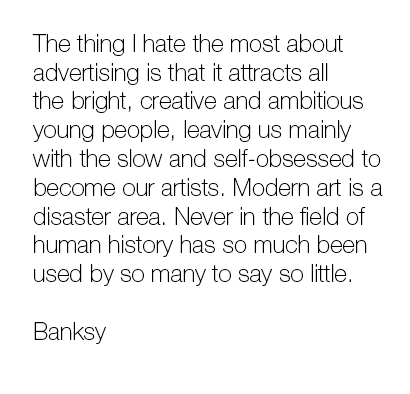
(via Room 116) Link
Pornographers don’t sell pornography
AdPulp provides this:
“42.7% of consumer time online is spent with content sites, 28.6% is with communication sites, 16.1% with commerce sites and 5% on search sites.” Link
(For more detailed analysis visit OPA Link)
While a lot of content provider sites (i.e. news and entertainment sites) feel pressure to offer their content for free (and some have already removed their firewalls—i.e. TNYT and WSJ) the question remains—how does an organization provide “free” content without going bankrupt?
Jake McKee’s post—You’re selling the wrong thing—sited the McGuire HuffingtonPost Porn Knows What It’s For—Do You? as an answer to that question. To excerpt some notable quote from McGuire’s article:
“Pornographers… don’t seem to care much about how they do it—they’ll just find ways to give people the orgasms however people want them given… magazines… online photos, online videos… why are newspapers… having such a hard time?… they have a fundamental misunderstanding of what they do.
“The value of a newspaper is not that it gives me information; the value of a newspaper is how it selects information…”
And here’s a necessary mainstream-media-sucks, blogs-rule rant from McGuire:
“Blogs are excellent selectors of information, while newspapers are pretty clunky at it—because for the past 300 years they existed in an ecosystem where information was scarce. Now information (and access to it) is abundant.”
McGuire misses the point in the steam of his own blog-rant.
Blogs survive as scavengers of info. Blogs select and repackage recycled information. Blogs—with the exception of maybe 50 techno-intelligentsia sites—rarely provide original content. The mainstream media behemoths still provide the bulk of online content. Here’s were McGuire is correct: pornographers don’t care about how or by what vehicle they deliver the content—online or offline. Pornographers bank on three basic actions: consumption, evangelism, purchase (and repeat).
Or to put it another way: “delivering anticipated, personal and relevant [content] to people who actually want” it. (Source). Do people still consume news? Yes. Do the majority of people want to pay for it? No. How does a news/entertainment organization earn revenue online? IMHO, online advertising + products = revenue. Translation: offer ad rates (dictated by web traffic) plus and an online store with shopping cart for souvenirs related to the content the consumers want.
Targeting your book’s demographic? Or manufacturing your book’s audience?
Positioning one’s book in an already cluttered publishing arena is essential. Niching-down is another way of targeting a reader audience. Consider horror novels with all the sub genres: macabre, goth, post-apocalyptic, mystery, Victorian, etc. Authors and agents understand that before a manuscript is finished it needs to fit a market. Genre-defying books tend to be a challenge to position and are often avoided by major publishers. Is it a mystery or romance or high literature?
Cory Doctorow appears to either be a happy capitalist or a guerrilla marketeer by taking advantage of his online prominence (secure, soft market) and publishing leverage (200-copy give-aways are not cheap if one considers obscene postal rates) to penetrate a teen reader market.
“Since this book is intended for high-school-age kids, my publisher has agreed to send 200 advance review copies of the book to school newspaper reviewers, along with the same press-kit… (actually, the school kit has even more stuff — it also includes a signed personal letter explaining why I wrote this book and why I hope kids will read it).” (via Boing Boing) Link
Strategically this is a smart move—even for smaller, independent publishers. The best marketing device is the actual product. However, I wonder if offering a free downloadable preview—or entire book—would be more effective. Why bother with book reviewers? The actually end-user, the reader, is the one who will purchase the product—not the high school book reviewer.
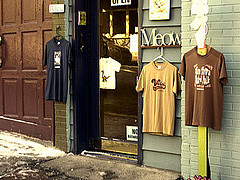
Asehville’s Lexington Avenue street threads. (photo by Coffeehouse Junkie)
Biltmore Village Under Construction

(photo by Coffeehouse Junkie)
Is design transitive?
Hugh Graham writes that “design is too often about the transitive and the temporary.” (Transitive—the word comes from the Latin and means “passing over”) Consider how quickly designers have to change and adapt to generational demographics.
Brand Noise offers this:
“According to Princeton sociologist Robert Wuthnow in a new book titled After the Baby Boomers the key differences between Gen Y and Baby Boomers include that the younger generation is ‘spending more time in school, remaining financially independent… and changing jobs more often.’” Link
Now consider the Baby Boomers (again from Brand Noise):
“They comprise nearly 24% of the population, have a buying power of $3 trillion, and include many of the country’s current business and political leaders. But marketers misunderstand—and inefficiently target—this country’s 78 million baby boomers.” Link
Designers, by the nature of their craft, are communication experts and should be able to articulate ideas, brands, and identity to various changing demographics successfully providing they are supplied with reliable research. Hugh Graham agrees that change is the new norm, but pushes beyond that and proposes that “there’s a new form of change on the horizon; we’re heading into a constrained environment where the designer’s artistry and craft will have to encourage what lasts, what matters, what sustains.” Link
Can design be both transitive and sustainable? Only time will tell.
How to keep your job in journalism
According to Ashvegas:
1) Create killer content
2) Pimp your work
3) Brand yourself
Source: https://ashvegas.com/how-to-keep-your-job-in-journalism
 Coffeehouse Junkie