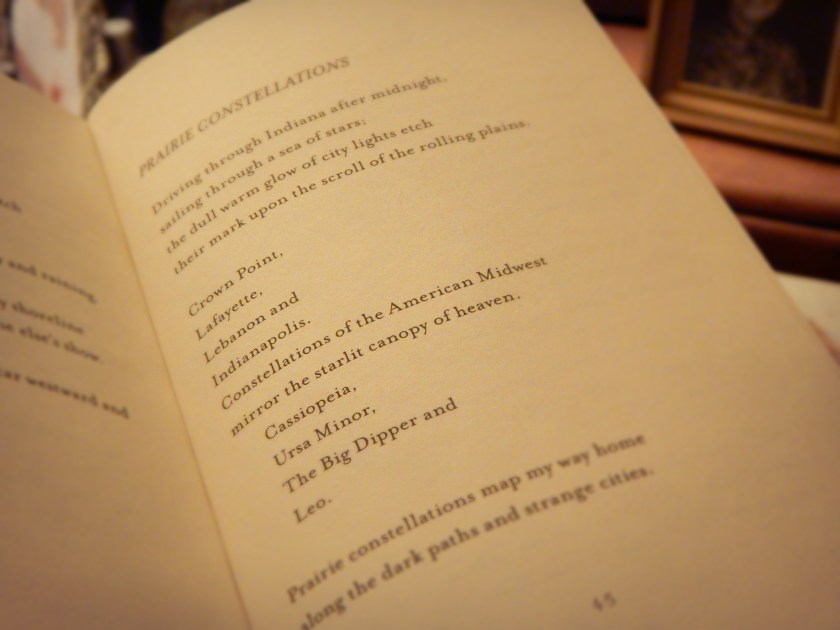
Poem Six: Prairie Constellations
![DSCN5432[sqr-bsc-lomo-dusk-tilt]](https://coffeehousejunkie.net/wp-content/uploads/2016/04/dscn5432sqr-bsc-lomo-dusk-tilt.jpg?w=840&h=840)
Last night at the New French Bar, was published in Crab Creek Review.
As stated previously, the poetry reading list for National Poetry Month is designed to encourage you to seek out the influence of living poets — where they live and and where they read. Allow me to introduce you to a few of the living poets I met at the open mics and coffee dens of Asheville, North Carolina.
One of those souls is an editor, poet, journalist and friend, Pasckie Pascua.[1] He has published several chapbooks and collections of poetry and prose. We first met at a coffeeshop in West Asheville and later haunted Beanstreets and other places from North Carolina to New York City. He left the back door to the poetry scene open for me and allowed me to grow and mature as a poet and writer. He also published many of my early writings. Lines from his poems still echo in my mind, like this one:
“The color of my poem
is also the color of my brother’s soul,
the color of my friend’s heart.”[2]
Another poet I wrote with and read alongside is Jessica Newton.[3] She facilitated a writers group when I first moved to Asheville. We gathered at the UNCA library or other spots around Asheville to write and read our compositions. Sometimes she brought writing prompts or other sources of inspiration. We shared prompts and poems. One night Mara Leigh Koslen[4] brought examples of haibun.[5] She introduced the poetic form and then we wrote. It was that night that I composed the first draft of a poem that would later be published.[6] Several other poets and writers visited the writers group.
My poetry reading list is really an introduction to friends and poets who I have met face-to-face. We read and wrote poetry together. We drank coffee at sidewalk cafés until dark-thirty. We shared wine after a moonlit poetry reading. Met in cafés and coffeehouse, taverns and art galleries, bookstores and basements and rooftop ballrooms. We did life together.
When I introduce you to poetry, I introduce you to friends.
I’ll continue the reading list, introductions throughout this month. [7]
NOTES:
Poems well composed haunt readers. Like an old injury, they return with an ache during inclimate weather. It is April. Yet snow covered the ground earlier this week. Along edges of many fields near Whitewater, small mounds of unmelted snow still remained.
It is National Poetry Month. Like the season, it is time to celebrate in spite of the frosty conditions.
An open mic I visited this week featured one young poet amid a variety of singer songwriters. The poem shared was morose, hurried and full of mixed metaphors. Nothing wrong with that. I dare say a lot of my early work resided in that landscape. I hope to hear more of her work.
A prominent poetry publication arrived in the mail a couple weeks ago. I read nearly midway through the publication searching for a memorable line or image. Nothing. A lot of doleful activism and academic rubric. Maybe it was the reader’s fault. Maybe after more rest I will pick up the publication, reread the poems and find something notable.
This weekend, while rearranging a bookshelf I noticed a stack of books, newspapers and magazines. Included were old issues of The New York Times, books of poetry translations, a couple American poetry books and a copy of the May 2011 edition of Poetry magazine.
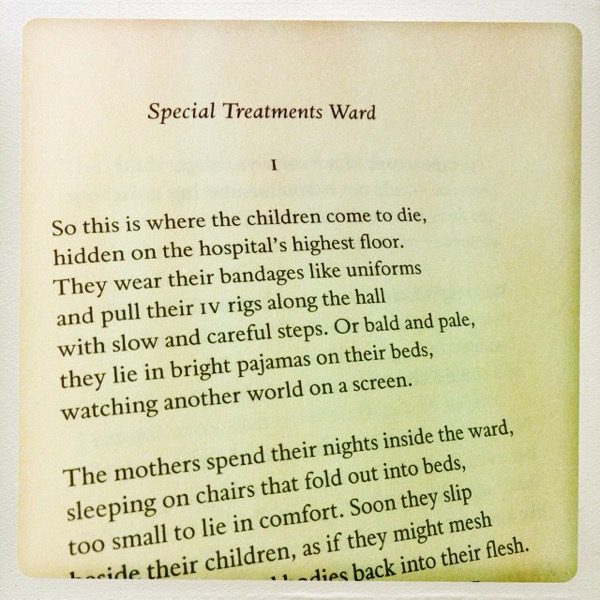
The publication featured a Dana Gioia poem with a haunting opening line “So this is where the children come to die, . . .” How can you not keep reading this poem? It is so good. In the second part of the poem, the speaker reflected, “I’d lost one child/and couldn’t bear to watch another die” and ended that part of the poem with “But there are poems we do not choose to write.” From the first line of the first part of the poem to the last line of the third part, the poem “Special Treatments Ward” was exceptional.
A poem that possesses a reader like Dana Gioia’s poem “Special Treatments Ward” will survive long after the April snow has melted.
NOTES:
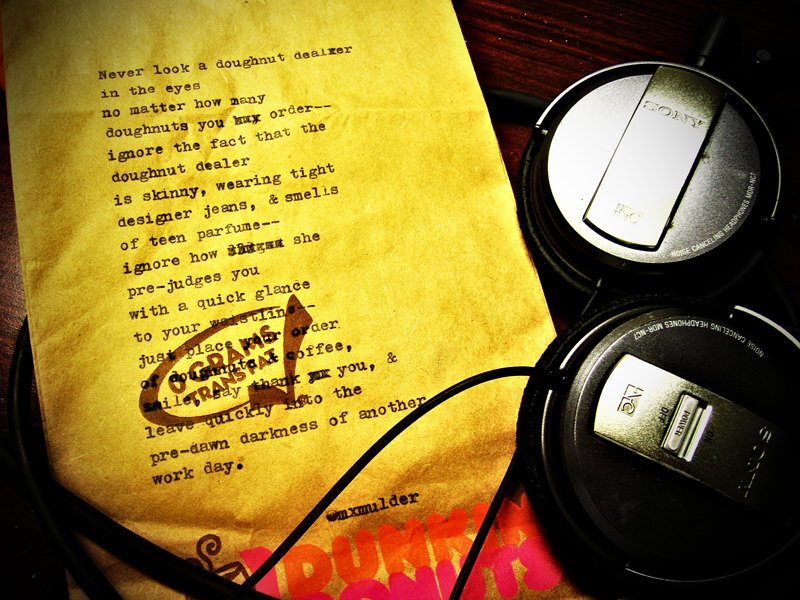
1) Originally published April 5, 2011, https://coffeehousejunkie.net/2011/04/05/poem-never-look-a-doughnut-dealer-in-the-eyes/
2) This is a rough draft and includes typos, erroneous grammar and other literary warts. In this case, perfume is intentionally misspelled to represent a unique American accent.
![DSCN5435[basic-lomo-sangria]](https://coffeehousejunkie.net/wp-content/uploads/2016/04/dscn5435basic-lomo-sangria.jpg?w=768&h=1024)
Loneliness visits, was published in ISM Quarterly.
![DSCN5421[bsc-lomo-dusk]](https://coffeehousejunkie.net/wp-content/uploads/2016/04/dscn5421bsc-lomo-dusk.jpg?w=840&h=630)
Reading “My American Body” by W. K. Buckley
by Matthew Mulder
Fireflies sparkle
outside. I see them through the
living room window.
It’s the time between
times as I
examine a new hole in
my jeans and consider
“Picking up their shreds
to the tangled light.”
Condensation rolls down
St. Pauli Girl who
makes me sparkle
inside.
NOTES:
(c) Matthew Mulder. All rights reserved.
Originally published in Rapid River Arts & Culture Magazine, October 2005
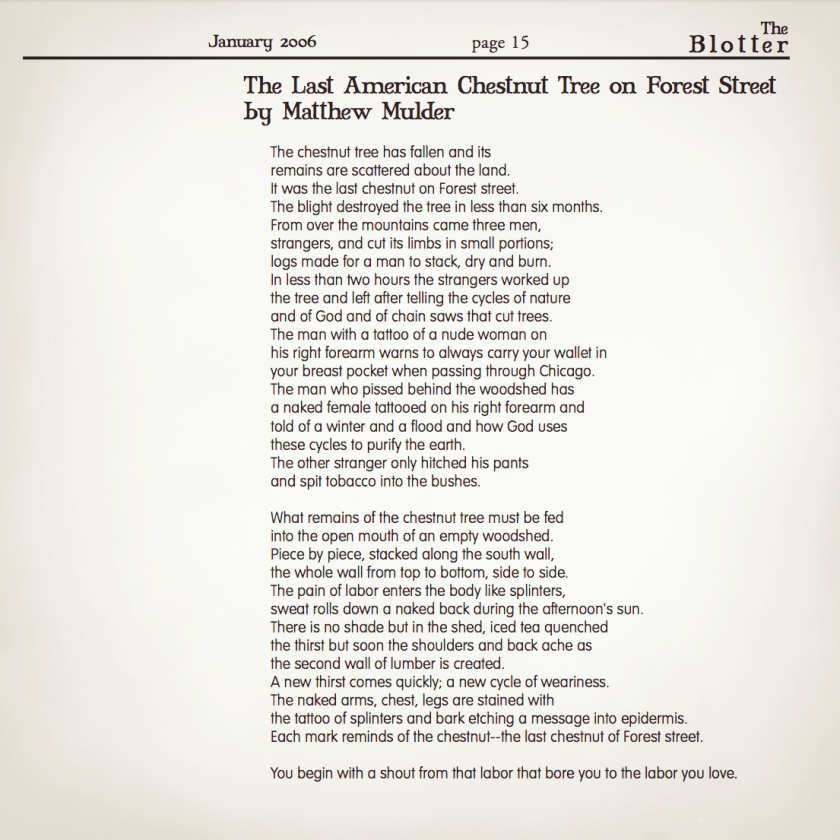
The Last American Chestnut Tree on Forest Street, was published in The Blotter.
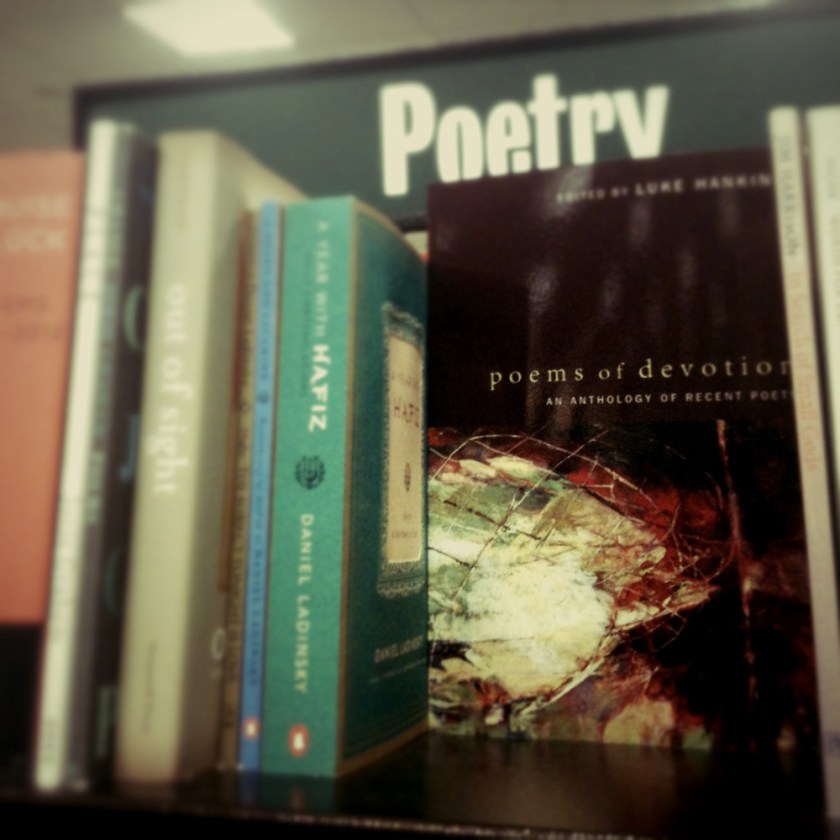
The best way to share poetry with people — who do not know that they may like poetry — is to start by reading the works of living poets. That is the basic idea of my poetry reading list for National Poetry Month.
Most books lists of are just lists. Promotional bullet points. Usually there is an image of the book or photo of the poet, a brief description or summary, sometimes even a list of credentials and awards, and a hyperlink to the poetic work or an online retail store. That is an approach I will try to avoid.
I read recently that the ancient Greeks and Romans enjoyed literature in a very different way than our modern culture — where we silently read books. The ancient poets read and/or recited their work out loud to a public audience.
So, my poetry reading list for National Poetry Month is designed to encourage you to seek out the influence of living poets — where they live and and where they read.[1]
NOTES:
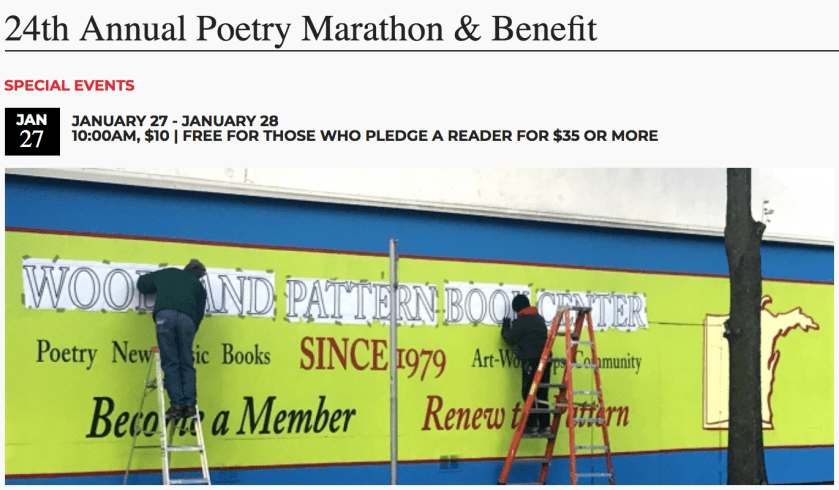
The 24th Annual Poetry Marathon Benefit Reading for Milwaukee’s Woodland Pattern Book Center is next weekend, Saturday, January 27, 2018.
The time slot between 9 PM – 10 PM is when I’ll be reading some poetry. Others reading during that segment include: Patrick Branum, Andrew Cantrell, Nick Demske, Dan Godston, Sara Goodman, Marcy Rae Henry, Jennifer Karmin, Kimberly Lyons and Blake Nemec.
Please consider supporting the effort. Contact me for details. Or visit the links provided. Much gratitude!
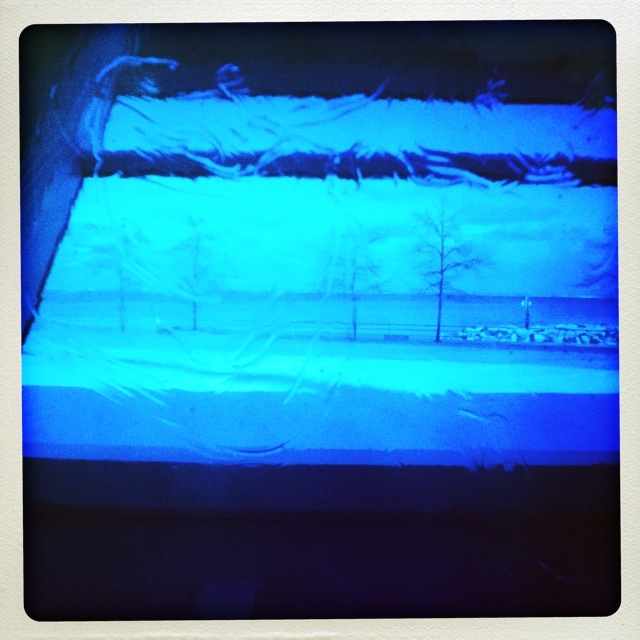
Lake Michigan. Last week. As viewed from the the Milwaukee Art Museum’s Baumgartner Galleria. Glass sculpture.

The 24th Annual Poetry Marathon Benefit Reading for Milwaukee’s Woodland Pattern Book Center is this Saturday, January 27, 2018.
Five reasons to support the poetry marathon:
If those five reasons are not enough, I will be reading during the Annual Poetry Marathon. Please consider supporting the effort. Contact me for details. Or visit the links provided. Much gratitude!
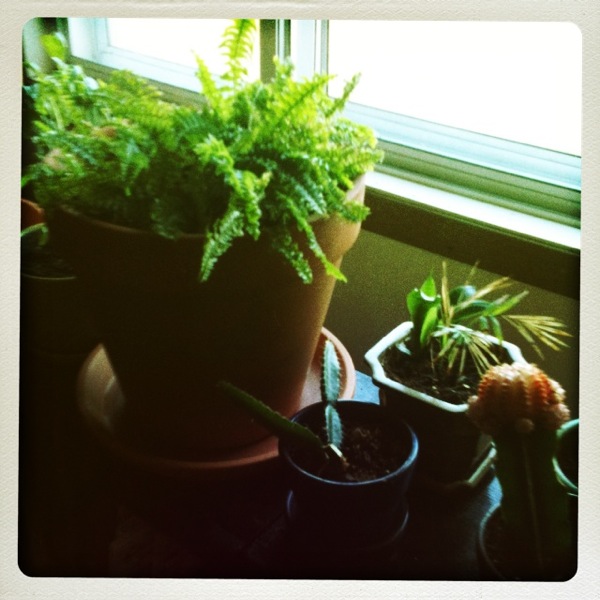
Enduring below freezing and sub-zero weather is a challenge. Green plants in the window are a delightful remedy if not evidence of common grace.
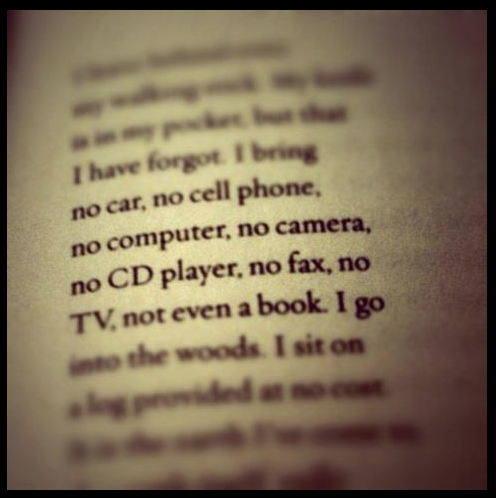
Excerpt from a poem read months ago.
Since it’s 6°F outside, thought I’d share this wonderful painting.

Christmas Eve by John Everett Millais, 1887:
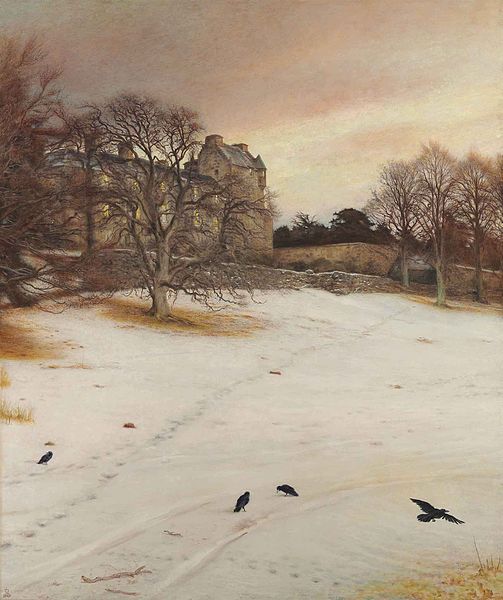 Christmas Eve by John Everett Millais, 1887
Since the tradition curating advent poems[1] was started a few years ago, I found this story[2] particularly interesting.
NOTES:
[1] Advent Poems (or the 12 days of Christmas poetry), December 13, 2012, https://coffeehousejunkie.net/2012/12/13/2013-advent-poems-or-the-12-days-of-christmas-poetry/.
[2] Justin Taylor, “THE TRUE STORY OF PAIN AND HOPE BEHIND “I HEARD THE BELLS ON CHRISTMAS DAY”,” http://www.thegospelcoalition.org, December 21, 2014, accessed December 11, 2016 https://blogs.thegospelcoalition.org/justintaylor/2014/12/21/the-story-of-pain-and-hope-behind-i-heard-the-bells-on-christmas-day/.
The winter is cold, is cold.
All’s spent in keeping warm.
Has joy been frozen, too?
I blow upon my hands
Stiff from the biting wind.
My heart beats slow, beats slow.
What has become of joy?
If joy’s gone from my heart
Then it is closed to You
Who made it, gave it life.
If I protect myself
I’m hiding, Lord, from you.
How we defend ourselves
In ancient suits of mail!
Protected from the sword,
Shrinking from the wound,
We look for happiness,
Small, safety-seeking, dulled,
Selfish, exclusive, in-turned.
Elusive, evasive, peace comes
Only when it’s not sought.
Help me forget the cold
That grips the grasping world.
Let me stretch out my hands
To purifying fire,
Clutching fingers uncurled.
Look! Here is the melting joy.
My heart beats once again.[1]
This audio podcast features the poem “The Winter Is Cold, Is Cold” by Madeleine L’Engle and concludes with a selection from the Book of Common Prayer that is often read on Christmas Day.
NOTES:
[1] Source: The Winter Is Cold, Is Cold by Madeleine L’Engle
[2] Advent Poems (or the 12 days of Christmas poetry)
Enter “how to tame the email dragon” in the Google search engine and about 2,300,000 results are available (in 0.50 seconds).
Fact.
The average length of an email is 50-100 words. Most emails are longer.[1]
Fact.
You spend at least 13 hours a week at the office[2] reading and replying to emails.
That is 650 hours a year![3]
Perspective.
It takes 12 to 13 hours to read John Updike’s Rabbit, Run.
Or (for non-readers) that is equivalent to a ten-episode Game of Thrones binge watching marathon.
Fact.
Most full-time employees work 1700 hours per year.[4] That means nearly 40 percent of your work life is engaged in reading and replying to emails.
NOTES:
[1] The Muse, Are Your Emails Too Long? (Hint: Probably), Forbes, March 11, 2014, accessed December 18, 2017. https://www.forbes.com/sites/dailymuse/2014/03/11/are-your-emails-too-long-hint-probably/#7e9f22965400
[2] Jordan Weissmann, Re:Re:Fw:Re: Workers Spend 650 Hours a Year on Email, The Atlantic, JUL 28, 2012, accessed December 18, 2017. https://www.theatlantic.com/business/archive/2012/07/re-re-fw-re-workers-spend-650-hours-a-year-on-email/260447/
[3] Megan Garber, You Probably Write a Novel’s Worth of Email Every Year, The Atlantic, JAN 8, 2013, accessed December 18, 2017. https://www.theatlantic.com/technology/archive/2013/01/you-probably-write-a-novels-worth-of-email-every-year/266942/
[4] Joe Weisenthal, Check Out How Much The Average American Works Each Year Compared To The French, The Germans, And The Koreans, Business Insider, Aug. 17, 2013, accessed December 18, 2017. http://www.businessinsider.com/average-annual-hours-worked-for-americans-vs-the-rest-of-the-world-2013-8
No one can celebrate
a genuine Christmas
without being truly poor.
The self-sufficient, the proud,
those who, because they have
everything, look down on others,
those who have no need
even of God- for them there
will be no Christmas.
Only the poor, the hungry,
those who need someone
to come on their behalf,
will have that someone.
That someone is God.
Emmanuel. God-with-us.
Without poverty of spirit
there can be no abundance of God.[1]
This audio podcast features “The House of Christmas” by GK Chesterton, “The God We Hardly Knew” by Óscar Romero and a selection from the Book of Common Prayer.
 Also, special thanks to Folk Angel for permission to use “O Little Town Of Bethlehem” from their album Glad Tidings – Christmas Songs, Vol. 4. If you are looking for some great Christmas records, check out their website, FolkAngel.com.
NOTES:
[1] Source: The God We Hardly Knew by Óscar Romero
[2] Advent Poems (or the 12 days of Christmas poetry)
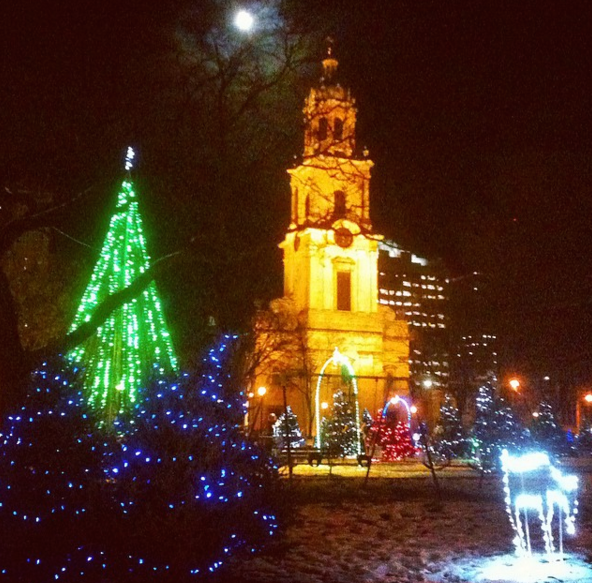
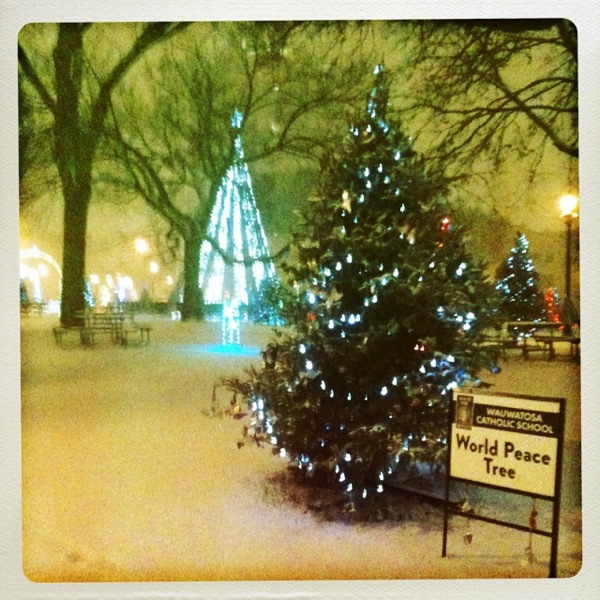
When I saw Christmas decorations and trees begin to populate Milwaukee’s Cathedral Square Park as early as November 1st, I thought, Is it that time of year already? Unbelievable. With this weekend’s snowfall, the Cathedral Square Park’s decorated Christmas trees looks particularly Decemberish.

Earlier this month I searched online for some Christmas card ideas. Imagine my surprise when the search displayed a block print I created five years ago.
It seems so long ago and so far away. So much has happened in those few short years that it is difficult to catalog. Curiously, I clicked in the Pinterest link. Then I read the original blog post. It is the most visited post on the blog.
For the last few years, I have received modest feedback on a post I published titled “Advent Poems (or the 12 days of Christmas poetry).”[1] The most intriguing comment regarded a poem by W. S. Beattie. I could not locate the poem online. And the mystery of it excited me. Are there really poems people read that are not on the internet? I thought to myself. A lovely thought.
This year, a digital trail lead me to a PDF file posted by the Brentwood United Reformed Church.[2] Here is the poem recommended by a reader with the preface that the poem’s topic regards the misuse of Advent.
Advent Longing
by W.S. Beattie
These are the greedy days.
It used to be
That Advent was a longing fast,
A time to feel our need
in faith and tingling hope
And keen-eyed looking forward.
Now we cannot wait
But day by day and week by week
We celebrate obsessively
Clutching at Christmas.
When at last it comes,
The day itself,
Our glass is empty.
We have held the feast
Already, and the news is stale
Before it ever reaches us.
We cheat ourselves.
Yet – somehow – still we hope
In these spoiled days
That there may be a child.
It is a humble poem with a good reminder.
Another reader suggested the inclusion of T. S. Eliot’s “Journey of the Magi.”[3]
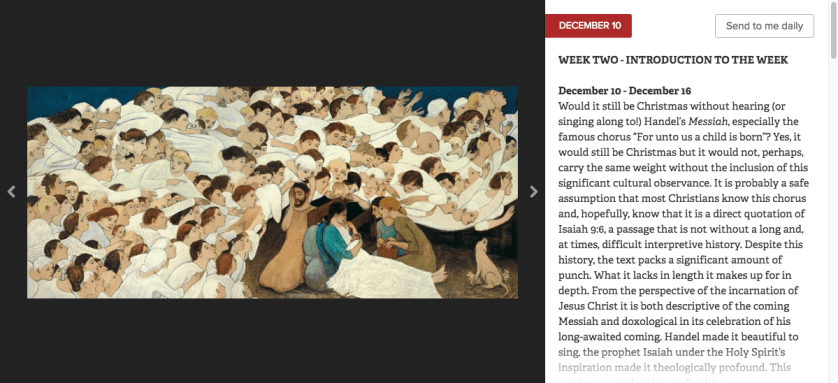
And yet another reader pointed me in the direction of Biola University’s Center for Christianity, Culture, and the Arts (CCCA) The Advent Project.[4] I truly enjoy CCCA’s Advent project as it includes art, literature, music and video.
I need to revisit my “12 days of Advent” poetry list. Maybe next year it will expand to a “24 Days of Advent” poetry list. For now, please enjoy reading 12 days of Advent poems.
NOTES:
[1] Advent Poems (or 12 days of poetry) https://coffeehousejunkie.net/2012/12/13/2013-advent-poems-or-the-12-days-of-christmas-poetry/
[2] Brentwood United Reformed Church, The Courier, December 2014/January 2015. Accessed December 11, 2017. http://www.brentwood-urc.org.uk/The%20COURIER%20-%20Dec%20January%202015.pdf
[3] The Poetry Archive, T. S. Eliot, “Journey of the Magi,” accessed December 11, 2017. https://www.poetryarchive.org/poem/journey-magi
[4] Biola University, Center for Christianity, Culture, and the Arts (CCCA), The Advent Project, accessed December 11, 2017. http://ccca.biola.edu/advent/2017/#day-dec-7
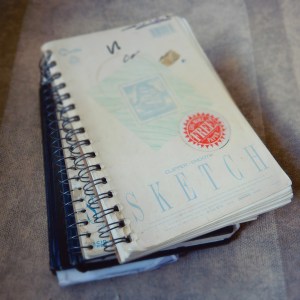
Personal archeology.
Discovered these old sketch books in September. Looked at them. Placed them on a shelf. Lost them again.

Rediscovered the sketch books again this weekend. Marveled at how much time was invested. Considered how these books were populated with sketches of classmates, drawings of roommates and other ephemera in a place and time were smart phones, tablets and laptops were not ubiquitous.
Question:
What would you be able to create if you were not glued to your smart phone for more than four hours[1] a day?
NOTES:
Immensity cloistered in thy dear womb,
Now leaves His well-belov’d imprisonment,
There He hath made Himself to His intent
Weak enough, now into the world to come;
But O, for thee, for Him, hath the inn no room?
Yet lay Him in this stall, and from the Orient,
Stars and wise men will travel to prevent
The effect of Herod’s jealous general doom.
Seest thou, my soul, with thy faith’s eyes, how He
Which fills all place, yet none holds Him, doth lie?
Was not His pity towards thee wondrous high,
That would have need to be pitied by thee?
Kiss Him, and with Him into Egypt go,
With His kind mother, who partakes thy woe.[1]
This audio podcast features “Mosaic of the Nativity (Serbia, Winter 1993)” by Jane Kenyon, “Nativity” by John Donne, “A Christmas Carol” by Christina Georgina Rossetti and a selection from the Book of Common Prayer.
 Special thanks to Folk Angel for permission to use “God Rest Ye Merry Gentlemen” from their album Comfort & Joy – Christmas Songs, Vol. 3. If you are looking for some great Christmas records, check out their website, FolkAngel.com.
NOTES:
[1] Source: “Nativity” by John Donne
[2] Advent Poems (or the 12 days of Christmas poetry)
When I see the cradle rocking
What is it that I see?
I see a rood on the hilltop
Of Calvary.
When I hear the cattle lowing
What is it that they say?
They say that shadows feasted
At Tenebrae.
When I know that the grave is empty,
Absence eviscerates me,
And I dwell in a cavernous, constant
Horror vacui.[1]
This audio podcast features “Annunciation” by Denise Levertov, “Advent” by Donald Hall, “Into The Darkest Hour” by Madeleine L’Engle[2] and a selection from the Book of Common Prayer.
NOTES:
[1] Source: Poetry Foundation
[2] Advent Poems (or the 12 days of Christmas poetry)

