- What a deal. A monthly bus pass is only $15. Except it takes three times as long to get anywhere around town.
- Wow, it’s cheaper to by a six-pack of beer than a gallon of milk.
- Did I really see “buy 2 for $10” next to the organic milk section at the grocery?
- $20 for petrol used to last the entire month. The fuel gauge reads that the auto is almost empty. I won’t get paid until next week. Hope there are no household emergencies on Sunday that force me to use the auto, because the buses don’t run on Sunday.
- If I skip lunch, I can afford to but an extra gallon of petrol in the tank.
Author: coffeehousejunkie
Writing book reviews
The nice thing about writing reviews of poetry books is the ongoing education I am receiving by reading contemporary poetry.
Often I am mistaken as a student on the bus. Last week an older woman asked me if I was a student at UNCA. I told her no and that I was reading a book to write a review of it. Later that week, a man on the bus asked me if I was in college. Again, I told him no and that I was reading a book (a different book of poems (I read two books last week)) to wrote a review about it. He then began to tell me about a book he read that absolutely amazed him. It was a narrative nonfiction book about Ernest Shackleton’s Antarctic expedition. The conversation was amiable.
I came away thinking that must I look like a student. I suppose there are worse things to look like.
Why do I do it?
Write Anything (formerly Write Stuff) asks a good question: Why do you do it?
I’ve been asking myself that question a lot recently: Why do I have the desire to compose poems and write prose? A few weeks ago I applied for a writing class–which begins next week–and thought I must be insane. Why should I spend money on an advanced poetry writing class when most readers in America don’t even read poetry. I mean, really, why do I torture myself? Why can’t I have a hobby like a normal American? Something like model trains or comic book collecting or kayaking. But no… I’ve got to do the hard things and hone my craft in the dark art of poetry. I might was well learn to speak Latin or something equally useful. I couldn’t even bring myself to attend the poetry event at Malaprop’s today.
This week at Malaprop’s
Time: Friday, September 5, 2008 7:00 p.m.
Location: Malaprop’s Bookstore/Cafe
Title of Event: Jonathon Flaum-A Fable of Leadership
Local author and CEO of WriteMind Communications,Inc., Flaum will read from his new book, How the Red Wolf Found Its Howl: The Internal Journey to Leadership
Time: Sunday, September 7, 2008 3:00 p.m.
Location: Malaprop’s Bookstore/Cafe
Title of Event: Poetrio- 3 Readings by 3 Poets
Join us every first Sunday for Poetrio, poetry readings by three poets. This month’s featured poets are Scott Owens, author of The Fractured World, Beverly Jackson, author of Every Burning Thing, and Pat Riviere-Seel, author of No Turning Back Now (New Women’s Voices Series, No. 30)
The other day
Poetry Class: What’s your all time favorite poems
The teacher of the poetry class I am enrolled in asked the class what are our all time favorite poems. I was surprised my my selections.
As I child I remember listening to my grandfather reciting an excerpt from Henry Wadsworth Longfellow’s “Hiawatha” (Part I, Chapter 3). So, I chose that as an all time favorite.
In school, I memorized several poems that have become my favorites as well. They include:
- Walt Whitman’s “O Captain! My Captain!”
- Rudyard Kipling’s “If”
- Edward Rowland Sill’s “Opportunity”
- Thomas Hood’s “I Remember, I Remember”
Other poems I’ve found along the way include:
- Carl Sandburg’s “Grass”
- Sergeant Joyce Kilmer’s “Trees”
- W.B. Yeats’ “The Lake Isle Of Innisfree”
- Robert Pinksy’s “Samurai Song”
The list I sent to the class instructor is not final nor reflective of poets who have influenced me. I tend to enjoy a complete work rather than an individual poem. If I was asked what three books of poetry have influenced my own work, it would be more representative of the direction my poetic work is moving. Still, it is interesting to learn which individual poems became the foundation of my journey into poetry.
Presidential Campaign Typeface
Optima vs. Gotham
The Obama camp chose Gotham. Conceptually this chose could be a bad move (i.e. think of a future dystopian America or simply think of the south side of Chicago). Gotham is a fairly new typeface designed my Tobias Frere-Jones who was inspired by mid 20th-century architectural signage. This could swing two ways; 1) Obama could be considered as too trendy, new, inexperienced and 2) Obama could be considered as recycled material from the 1950s rather than a truly progressive. Gotham is classified as a geometric due to its lineal monoline circles and rectangles providing a modern feel. This could be a challenge for Obama if he’s trying to secure the parties base which started voting in the 1950’s.
The McCain camp chose Optima. Conceptually this chose could be a good move (i.e. think optimistic or Optimus Prime). Interestingly, Optima was designed by Hermann Zapf as one of the first digital typefaces for desktop publishing in the 1950s. This could date McCain as a dinosaur or cast him as a futurist. Further, Optima is classified as a humanist typeface due to its calligraphic elements. This could be a bad thing for McCain if he’s trying to secure the Christian vote.
(Other font thoughts from Steven Heller here).
What magazines do you receive?
Deborah of 32 poems magazine wants to know:
I’m getting Cimarron Review, Bloomsbury Review, Ninth Letter, Virginia Quarterly Review, The New Yorker and some others. The New Yorker hardly needs my support, but there you go. I am morally opposed to The Atlantic, because they do not publish enough poetry. The amount of poetry they publish withered to nearly nothing the last time I checked. That’s about the time I decided to subscribe only to magazines that offered a large poetry presence. You could easily tell me how few poems The New Yorker publishes. Well, The New Yorker is The New Yorker. The prose is also good.
Some other magazines that invite my interest include Southwest Review, Barn Owl Review, and Pebble Lake Review to name a few. I’m only including magazines one can subscribe to, so that leaves out many excellent online magazines.
What magazines do you like?
American Poetry Review, Poetry, Poets & Writers and Small Press Review.
Magazines I used to subscriber to, but had to cancel due to lack of funds: Entrepreneur, Fast Company, Main Street Rag, New York Review of Books, Paste, Salamander and Slipstream.
Unwritten Poetry Rules
Problematic literary contests?
From Poetry Hut Blog:
One of the editors of Cider Press — Robert Wynne — has responded to (what appears to be) unethical behavior regarding their Cider Press Review Book Award. And Stacey Lynn Brown’s rebuttal. (I’ve read that Pavement Saw Press’ contest has been problematic. And did you know that there was no winner chosen this year for the Cave Canem Poetry Prize?)
Poet Billy Collins sells out
“[Billy] Collins, the former U.S. poet laureate, is the keynote speaker for the Decatur Book Festival Friday night at Agnes Scott College. Word from the festival organizers is that all of the free tickets have been given out…” Link
Poets & Writers magazine explains why in the recent issue:
“What makes Billy Collins one of America’s best-known (and best-selling) poets? Perhaps it’s his attention to what matters most — his audience.”
A 90-second GTD primer:
From 43 Folders:
- Project. Any desirable outcome that requires more than one physical action in order to be considered complete.
- “Present a persuasive pitch to Henderson’s group on 2008-10-03” is a Project.
- Next Action. The next physical activity I could perform that moves a Project nearer to the outcome I want.
- “Call Henderson to schedule time and location for 10/3 presentation” is the next action for my Project.
- Context. Any limitation, opportunity, tool, or resource that lets me do one of the physical actions in my Project.
- “@calls” is the Context for my Next Action
- in this case, “@calls” serves as a list of all items I could do on any Project, so long as I have access to a phone.
- (See? Different angle.)
- The Four Criteria Model. The notion that Priority is only one of four criteria in deciding what to do at a given moment.
- The other three are “Time Available,” “Energy Available,” and (you guessed it) “Context.
These impassable streets
Ditto, Ashvegas:
The other thing that is annoying the hell out of me in Asheville is all the road construction. Every street and sidewalk in downtown Asheville is currently impassable. Link
Last night, I waited at the Transit Center 20 minutes to catch the bus home. Earlier this week, I waited 20 minutes for the bus heading to the Transit Center. Thinking I was late and had missed the bus, I walked back home to at least plug into my digital nomad life. Two minutes later I see the bus pass by. So I totally missed that bus and arrived at work two hours late.
Whoever had the bright idea at ATS, to throw spaghetti on the a map of Asheville and decide that’s how to re-route buses should be forced to drive those routes for an entire day. Since the schedules are fubar, I don’t even plan to show up at the bus stop on time. This morning I found it saved time to simply walk—almost two miles—from the Transit Center to the office.
Overheard @ Pritchard Park
“I lost my rune stone…”
A concert isn’t about the music
A concert isn’t about the music, is it? And a restaurant isn’t about the food.
Seth Godin1
NOTES:
1) Seth Godin, “Sing it (please S I N G I T),” August 2, 2008, Seth Godin’s Blog, accessed August 2, 2008, http://sethgodin.typepad.com/seths_blog/2008/08/sing-it-please.html (page no longer available, web site deactivated)
The Cloud
You hear a lot of talk about “The Cloud” nowadays…. But nobody seems to be talking about Power Laws.
Hugh MacLeod1
NOTES:
1) Hugh MacLeod, “the cloud’s best-kept secret,” August 1, 2008, Gaping Void, accessed August 2, 2008, http://www.gapingvoid.com/Moveable_Type/archives/004638.html (page not available)
I don’t watch TV
I don’t watch TV and I don’t go to meetings. You’d be amazed at the difference it makes…. I would imagine we’re going to see a rapid acceleration in the quality and meaning of things we manage to create with our new-found time. At least I hope so.
Seth Godin1
NOTES:
1) Seth Godin, “The TV dividend,” July 30, 2008, Seth Godin’s Blog, accessed August 2, 2008, http://sethgodin.typepad.com/seths_blog/2008/07/the-tv-dividend.html (page no longer available, web site deactivated)
A stack of books arrived

The magazine editor asked me to write reviews. Can’t wait to start reading… and then writing.
Technology changes, people don’t
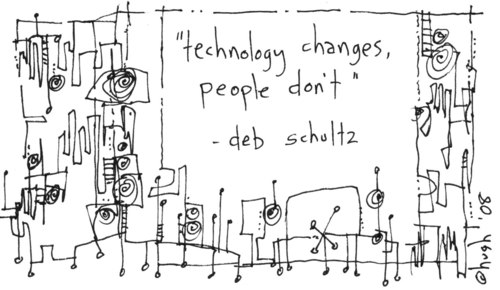
(via Gaping Void)1
NOTES:
1) Hugh MacLeod, August 1, 2008, Gaping Void, accessed August 2, 2008, http://www.gapingvoid.com/ (page not available)
Naked conversations
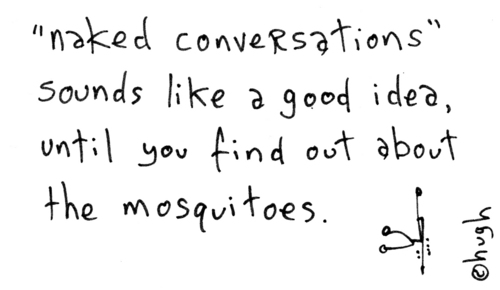
The big story is not about blogging. It’s not about Twitter, YouTube, Facebook, Friendfeed or whatever.
It is about..
Cheap. Easy. Global. Media.
CheapEasyGlobal is the big story.
(via Gaping Void)1
NOTES:
1) Hugh MacLeod, “cheapeasyglobal,” July 13, 2008, Gaping Void, accessed July 31, 2008, http://www.gapingvoid.com/Moveable_Type/archives/004603.html (page not available)
From the Editor’s Desk

“May the wind take your troubles away…”
—Son Volt, “Windfall” from the Trance album
A hiatus from blogging was needed and taken. Many reasons exist for disconnection from the matrix—the blogosphere—which I may detail later. The primary reason is that I could not maintain the luxury of blogging and accomplish work-related tasks.
After Christmas, and during the following six months, I released seven projects to the market: this book


A respite was needed. So I took off three and a half weeks. I pointed the auto to parts unknown and hit the road in search of coffee houses and lost threads. Three thousand miles were traveled. For five nights during the journey, I slept in a different bed each night. For four nights, I spent in a cabin miles from the nearest phone and six miles from the closest town which is not marked on most maps. Three times I got lost. Twice it was my fault. Once it was not, but that once was a beautiful distraction.
I don’t know if the wind really “takes your troubles away.” I don’t know if I found those lost threads. I did find a couple excellent coffee houses (remind me to tell you where to find a Boris Latte). I’m back in Asheville now. I guess it is time to reconnect and get back to work.
Of course, if you’re reading this on tumblr, you are probably already perverting the language.
U.S. Gas Prices
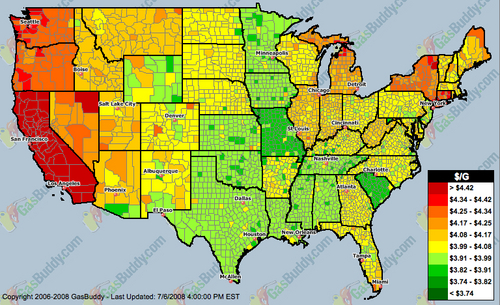
U.S. Gas Prices
A heat map visualization via Gas Buddy

