A stack of books arrived


The magazine editor asked me to write reviews. Can’t wait to start reading… and then writing.

Technology changes, people don’t

(via Gaping Void)1

NOTES:
1) Hugh MacLeod, August 1, 2008, Gaping Void, accessed August 2, 2008, http://www.gapingvoid.com/ (page not available)

Naked conversations

The big story is not about blogging. It’s not about Twitter, YouTube, Facebook, Friendfeed or whatever.

It is about..

Cheap. Easy. Global. Media.

CheapEasyGlobal is the big story.

(via Gaping Void)1

NOTES:
1) Hugh MacLeod, “cheapeasyglobal,” July 13, 2008, Gaping Void, accessed July 31, 2008, http://www.gapingvoid.com/Moveable_Type/archives/004603.html (page not available)

From the Editor’s Desk


Editor’s desk
Originally uploaded by coffeehouse junkie
“May the wind take your troubles away…”
—Son Volt, “Windfall” from the Trance album

A hiatus from blogging was needed and taken. Many reasons exist for disconnection from the matrix—the blogosphere—which I may detail later. The primary reason is that I could not maintain the luxury of blogging and accomplish work-related tasks.

After Christmas, and during the following six months, I released seven projects to the market: this book and this book (both with new forewords) as paperbacks, another book for this organization, a new book and accompanying audio book (which I produced), a childrens book and an academic teachers planner for the coming school year. That may not mean a lot to most of you. But consider that each project requires a minimum of 480 to 960 hours to complete, there are more than 1000 hours (using a standard workweek of Monday to Friday for measurement) from January 1 to June 30, and I am only one designer/editor/marketing director/manager/publisher. Needless to say, work hours for me did not fit into a standard 40-hour work week. In fact, it was more often than not that I was working as early as 8 a.m. and finished around midnight or later. This took a toll on me physically, mentally and spiritually.

A respite was needed. So I took off three and a half weeks. I pointed the auto to parts unknown and hit the road in search of coffee houses and lost threads. Three thousand miles were traveled. For five nights during the journey, I slept in a different bed each night. For four nights, I spent in a cabin miles from the nearest phone and six miles from the closest town which is not marked on most maps. Three times I got lost. Twice it was my fault. Once it was not, but that once was a beautiful distraction.

I don’t know if the wind really “takes your troubles away.” I don’t know if I found those lost threads. I did find a couple excellent coffee houses (remind me to tell you where to find a Boris Latte). I’m back in Asheville now. I guess it is time to reconnect and get back to work.

Of course, if you’re reading this on tumblr, you are probably already perverting the language.

How texting is wrecking our language

U.S. Gas Prices

joelaz:

U.S. Gas Prices

A heat map visualization via Gas Buddy

Poetry Is Dead

Society… did not favor the reading of poetry…. By the ’90s, it was all over…. consider that poetry is the only art form where the number of people creating it is far greater than the number of people appreciating it…. People don’t possess the patience to read a poem 20 times before the sound and sense of it takes hold….

I am part of a world that apotheosizes the trendy, and poetry is just about as untrendy as it gets. I want to read books with buzz… and I can’t remember the last book of poetry that created even a dying mosquito’s worth of hum. I am also lazy, and poetry takes work.

–Bruce Wexler1

NOTES:
1) Bruce Wexler, “Poetry Is Dead. Does Anybody Really Care?” May 5, 2003, Newsweek, accessed July 7, 2008, http://www.newsweek.com/id/59182/page/1 (page no longer available)


B.I. – a poem sketch with photo

before the internet
i often read
books or magazines
during breaks and lunches
at the office —
then i ate
at my desk and surfed
web pages or placed
orders on amazon.com
for books i didn’t read
and remain in storage.

now i read
books and magazines
during work breaks and lunches —
while someone else
in some other office
sells his/her x-men comic
collection and some other
digital fetus in another office
far far away
buys a x-men comic collection
during lunch hour
and later sells it
because he/her
didn’t make time
to read it.

Sunset at the Arboretum

The North Carolina Arboretum (http://www.ncarboretum.org/)

Caffeinated poem

Caffeinated poem: A few weeks ago I had compiled a set of poems to submit to various poetry contests including Boston Review. But I was reading Robert Pinsky’s book Gulf Music and never sent them. It’s not that I forgot to send them. It is just that compared to Robert Pinsky, my poems appear un-submittable. So instead I wrote a poem on a paper cup after drinking a latte from The Dripolator.

Tumblr. – The Documentary.

boringloser:

Tumblr. – The Documentary.

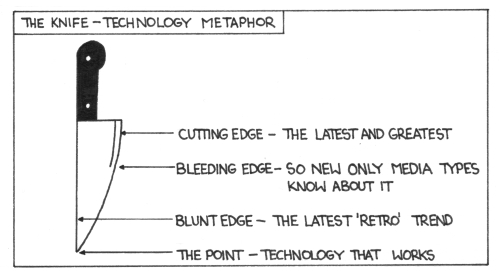
The Knife metaphor

aja:

The Flowfield Unity

“Blogs shouldn’t be work”

As newspapers, including mine, have begun to take a nosedive, the powers that be have decided that blogs must pay. The numbers (hits) are watched incessantly, and increasing them has become the criterion for survival, not just of the blog itself, but of the writer behind it. In a real sense, the blog has become an albatross, or a target painted on my chest. If I didn’t have one, no one would be looking at those blog numbers – they’d be looking at other numbers, true, but there’d be no pressure on the blog. There’s the rub: a blog with pressure becomes work, and blogs shouldn’t be work.

Timothy Mangan1

NOTES:
1) Richard Chang, Paul Hodgins and Timothy Mangan, “To Blog or Not to Blog,” May 25, 2008, ARTSJOURNAL weblog, accessed June 5, 2008, https://www.artsjournal.com/npac/2008/05/to-blog-or-not-to-blog.html

The therapeutic value of blogging

writing activates a cluster of neurological pathways…. people coping with cancer diagnoses and other serious conditions are increasingly seeking—and finding—solace in the blogosphere. “Blogging undoubtedly affords similar benefits” to expressive writing, says Morgan, who wants to incorporate writing programs into supportive care for cancer patients.

Jessica Wapner, Scientific American1

NOTES:
1) Jessica Wapner, “Blogging–It’s Good for You,” June 1, 2008, Scientific American, accessed June 5, 2008, http://www.sciam.com/article.cfm?id=the-healthy-type

Poet charts online reaction to chapbook release

Jilly Dybka released her self-pub book recently and has this to share about the books early impact (link):

Book release announced May 16, 2008

Stats provided May 25, 2008

400 daily readers of Poetry Hut

83 downloads of Trouble and Honey

5 individuals donated via PayPal

13 copies ordered via Lulu.com

Jilly provides her own interpretation of these numbers, but the numbers seem a bit off.

To make an accurate assesment of the data she would need to track daily page views, daily individual items sold (and/or downloaded), and daily revenue. Or at least track it weekly. From the collection of data she could discover and project sales trends, adjust marketing and promotional compaigns, and (in general) provide herself a statiscal analysis of the publishing effort of Trouble and Honey.

IMHO, I think it is too early to determine anything regarding this chapbook release.  

Day in the Life of Asheville

I’m surprised that one of the photos I submitted to the DITLO project was chosen as the jugde’s pick. The Day in the Life of Asheville photo project took place between 12:00 noon April 18 through midnight April 19 in Asheville, NC city limits.

asheville transit center

outside books and news

Izzy’s

ash and steven

Can a computer write books?

From Jeff Gomez, author of Print Is Dead: Books in our Digital Age:

Philip Parker, a science professor who has “written” more than 200,000 books…. But Parker doesn’t really write the books; instead he has invented a series of “computer algorithms that collect publicly available information on a subject… and… turns the results into books in a range of genres….”

…just because the rats in Ratatouille are computer generated, the idea and the story and the dialogue weren’t computer generated. Computers are increasingly helping us be more creative but, in the end, that’s all they’re doing: helping.

Link

There’s already services available that convert blog content to book format. Like Gomez stated, it still requires the human touch to generate the content. Technology made it easier to collect the information into an enjoyable package.

I’m confused

Micheal Smith (head of the International Digital Publishing Forum) says”

E-books are a growing niche for now… but I certainly don’t see a time when everybody will be reading them. People just love what the traditional book represents to them. Link

Yet…

Public sightings of e-books remain rare compared to iPods or iPhones… Link

And…

Publishing house Penguin said today that it…. is… working on turning its 5,000 title Penguin backlist into ebooks for publication this year and next. Link

Yet…

The publisher is digitising its entire worldwide backlist so that it can make the most of the emerging ebook trend. It also hopes the print-on-demand opportunities – whereby customers can have one-off copies of out-of-print titles printed, bound and shipped to them – will give older books a new lease of life. Link

Does that last part make sense to you? Penguin plans to publish ebooks and POD out-of-print titles? Why? Why, I ask, if the ebook is available would you want a POD of that title?

Here’s an idea; why not offer limited edition printings of out-of-print titles to collectors and bibliophiles. Due to limited supply, Penguin could charge more for these special lifestyle objects. Ebooks are geared for a completely different audience—an audience who just wants the content and not the packaging. Don’t waste time on POD. POD books are for university creative writing students and vagrant poets.

The Web never sleeps

Our always-on wired world doesn’t leave room for contemplation… Charles Bukowski once lamented that writing poems that were published soon after felt like throw-away journalism. But…. the Web never sleeps.

Jeff Gomez, Print is Dead1

NOTES:
1) Jeff Gomez, “24 Hour Posting People: Bloggers feel the pressure,” April 7, 2008, Print is Dead, accessed April 12, 2008, http://printisdeadblog.com/2008/04/07/24-hour-posting-people-bloggers-feel-the-pressure/ (page no longer available, web site deactivated)

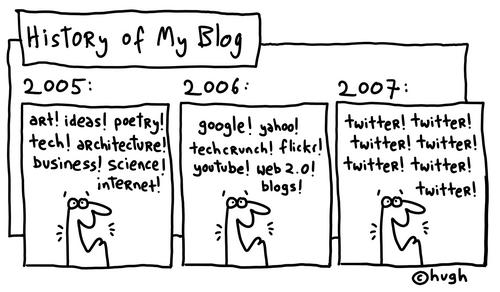
History of My Blog

Link

Been blogging since 2004. Retrospective maybe in order.