Calling antiquarian book collectors

For those how love a well-crafted book, AbeBooks.com has a special featured titled “The Wonder of Woodcuts” by Scott Laming. The selections posted here, The Wonder of Woodcuts, are high quality (and high priced) books for antiquarian collectors.

Best reads of 2013

The best books I read in 2013 (that may or may not have been published during the calendar) follow an eclectic path―from fiction to poetry, non-fiction to graphic novels. Instead of providing a review of each book or why I consider it a “best read,” I will provide a quote from each book if possible.

1. A Wrinkle in Time by Madeleine Lengle

“A straight line is not the shortest distance between two points.”
― Madeleine L’Engle, A Wrinkle in Time

“Life, with its rules, its obligations, and its freedoms, is like a sonnet: You’re given the form, but you have to write the sonnet yourself. – Mrs. Whatsit”
― Madeleine L’Engle, A Wrinkle in Time

2. American Primitive by Mary Oliver

3. Blankets by Craig Thompson

“I wanted a heaven. And I grew up striving for that world– an eternal world- that would wash away my temporary misery.”
― Craig Thompson, Blankets

“How satisfying it is to leave a mark on a blank surface. To make a map of my movement – no matter how temporary.”
― Craig Thompson, Blankets

4. Bonhoeffer: Pastor, Martyr, Prophet, Spy by Eric Metaxas

“The worlds of folklore and religion were so mingled in early twentieth venture German culture that even families who didn’t go to church were often deeply Christian.”
― Eric Metaxas, Bonhoeffer: Pastor, Martyr, Prophet, Spy

“Bonhoeffer thought of death as the last station on the road to freedom.”
― Eric Metaxas, Bonhoeffer: Pastor, Martyr, Prophet, Spy

5. Channel Zero by Brian Wood

“…and all of a sudden, world cultures become the Monoculture, the same conversation, the same clothes, the same show.”
― Brian Wood, Channel Zero

“And, all over the world, one by one, we quit fighting it.”
― Brian Wood, Channel Zero

“It’s about learning how to give a shit again, about finding ways to make things better. It’s about anger as a positive force of creation. It’s about your right to not have to live in the world they’ve built for you.”
― Brian Wood, Channel Zero

6. The Cost of Discipleship by Dietrich Bonhoeffer

“Judging others makes us blind, whereas love is illuminating. By judging others we blind ourselves to our own evil and to the grace which others are just as entitled to as we are.”
― Dietrich Bonhoeffer, The Cost of Discipleship

“Cheap grace is the grace we bestow on ourselves. Cheap grace is the preaching of forgiveness without requiring repentance, baptism without church discipline, Communion without confession…. Cheap grace is grace without discipleship, grace without the cross, grace without Jesus Christ, living and incarnate.”
― Dietrich Bonhoeffer, The Cost Of Discipleship

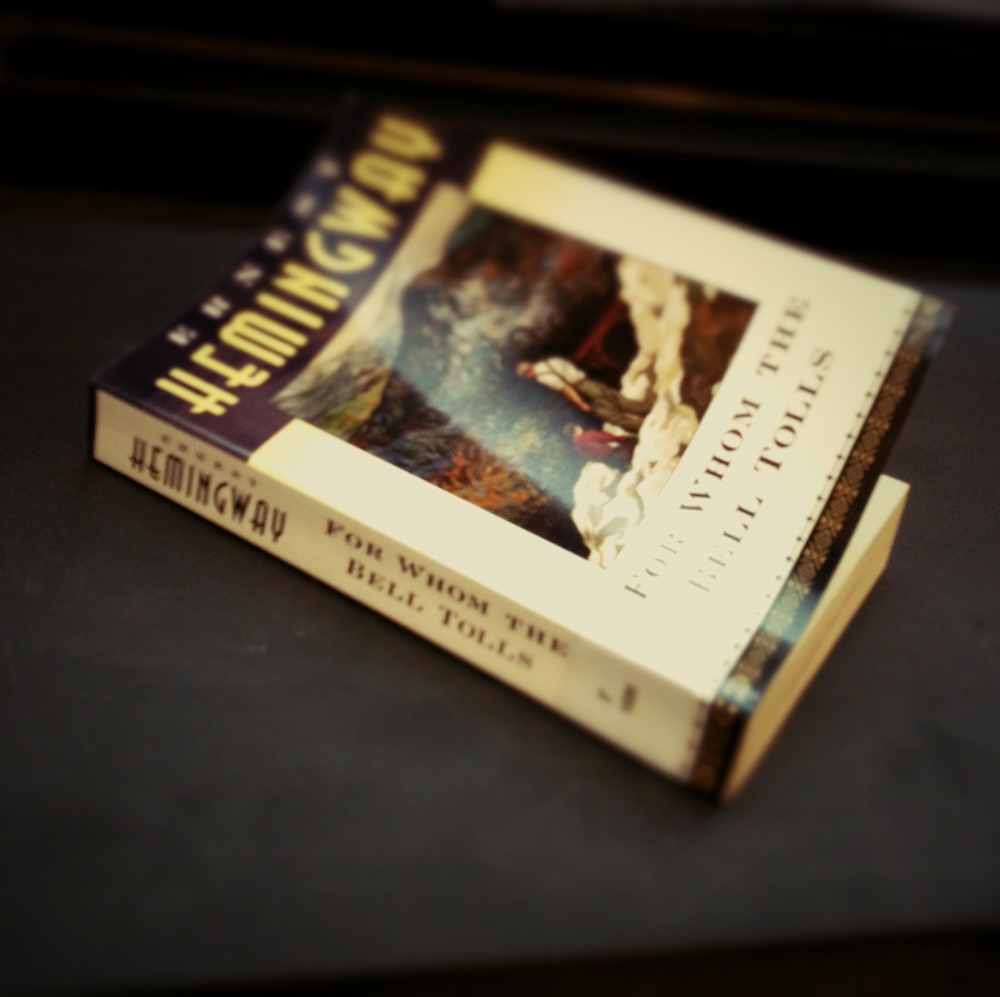
7. For Whom the Bell Tolls by Ernest Hemingway

“For what are we born if not to aid one another?”
― Ernest Hemingway, For Whom the Bell Tolls

“The world is a fine place and worth fighting for and I hate very much to leave it.”
― Ernest Hemingway, For Whom the Bell Tolls

8. Jayber Crow by Wendell Berry

“What can’t be helped must be endured.”
― Wendell Berry, Jayber Crow

“This religion that scorned the beauty and goodness of this world was a puzzle to me.”
― Wendell Berry, Jayber Crow

9. The Old Man and the Sea by Ernest Hemingway

“But man is not made for defeat,” he said. “A man can be destroyed but not defeated. ”
― Ernest Hemingway, The Old Man and the Sea

“Perhaps I should not have been a fisherman, he thought. But that was the thing that I was born for.”
― Ernest Hemingway, The Old Man and the Sea

10. The Prodigal God  by Timothy Keller

“Jesus’s teaching consistently attracted the irreligious while offending the Bible-believing, religious people of his day. However, in the main, our churches today do not have this effect. The kind of outsiders Jesus attracted are not attracted to contemporary churches, even our most avant-garde ones. We tend to draw conservative, buttoned-down, moralistic people. The licentious and liberated or the broken and marginal avoid church. That can only mean one thing. If the preaching of our ministers and the practice of our parishioners do not have the same effect on people that Jesus had, then we must not be declaring the same message that Jesus did.”
― Timothy Keller, The Prodigal God

11. The Red Tent by Anita Diamant

“If you want to understand any woman you must first ask about her mother and then listen carefully. Stories about food show a strong connection. Wistful silences demonstrate unfinished business. The more a daughter knows about the details of her mother’s life – without flinching or whining – the stronger the daughter.”
― Anita Diamant, The Red Tent

“The painful things seemed like knots on a beautiful necklace, necessary for keeping the beads in place.”
― Anita Diamant, The Red Tent

12. River Inside the River: Three Lyric Sequences by Gregory Orr

13. Sailing Alone Around the Room: New and Selected Poems by Billy Collins

14. The Shallows: What the Internet Is Doing to Our Brains by Nicholas Carr

“What the Net seems to be doing is chipping away my capacity for concentration and contemplation. Whether I’m online or not, my mind now expects to take in information the way the Net distributes it: in a swiftly moving stream of particles. Once I was a scuba diver in the sea of words. Now I zip along the surface like a guy on a Jet Ski.”
― Nicholas G. Carr, The Shallows

“Culture is sustained in our synapses…It’s more than what can be reduced to binary code and uploaded onto the Net. To remain vital, culture must be renewed in the minds of the members of every generation. Outsource memory, and culture withers.”
― Nicholas G. Carr, The Shallows

15. Who Killed Homer?: The Demise of Classical Education and the Recovery of Greek Wisdom by Victor Davis Hanson, John Heath

“[We owe the Greeks] our present Western notions of constitutional government, free speech, individual rights, civilian control over the military, separation between religious and political authority, middle-class egalitarianism, private property, and free scientific inquiry.”
― Victor Davis Hanson, John Heath, Who Killed Homer?

The best books I should have read before 2013

Hemingway - book

The 2013 lists are in. From The Seattle Times[1] to The Economist,[2] from NPR[3] to Publisher’s Weekly[4] to The Paris Review[5] and even Bianca Stone’s Poetry Picks[6], everyone seems to be sharing the best books to read of the year.

In some unknown manner, I feel obligated as a reader, and a dabbler in spilled ink and exploded pens, that I should offer a list of best reads of 2013. However, when I look back at the last twelve months of reading material only a few of them were published in the last calendar year.

It is true that as a practice my family congregates at the public library at least once a week, sometimes more. And, since I am an agnostic[7] as far booksellers go, at least a couple nights a week myself and some family members can be observed wandering through the aisles of a Barnes & Noble or a used bookstore. Often I am disappointed in bookstores and libraries because they tend to focus on the bestsellers and popular trends rather than the well-written and perennial books.

So, maybe I should title the list, “the best books I should have read before 2013”. Next week I will share some of the best books I read in 2013 (that may or may not have been published during the calendar).

UPDATE: Here is my list best reads of 2013.

NOTES:
[1] The Seattle Times, 31 of the best titles of 2013
[2] The Economist, A bountiful offering
[3] Our Guide To 2013’s Great Reads
[4] Publisher’s Weekly, Best 20 Books of 2013
[5] The Paris Review, Best of the “Best”
[6] My Poetry Picks for 2013
[7] By agnostic, I refer to the lesser used denotation of the word meaning unwilling to commit to an opinion. This is my quiet response to local matters. Bumper stickers and posters decorate the downtown area declaring “Local is the new black” or “Choose Independents, Buy Local”. This is all well and good, but I am not dogmatic on the point. To demonize corporate retail outlets is a moral pretense that I disagree with on the grounds that the people of Asheville need work. In these economic hard times, any work is good work. Why should I shame one hard worker who is employed at Barnes & Noble and not also shame one hard worker who is employed at a local independent bookseller? Seems like undeserved discrimination to me. My preference is to visit corporate and independent bookstores alike and maintain a bookseller agnosticism in the hopes that neither employees of Barnes and Noble or Malaprop’s loss their jobs as they try to support their families and communities. And no, I am not running for city council.

How many copies do you need?

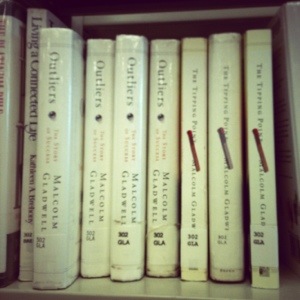
20130530-102758.jpg That’s the question I asked myself when I saw four copies of Outliers and three copies of The Tipping Point at the downtown public library. Does the library need that much Malcolm Gladwell? Yet, I can hardly find seven books written by Vonnegut. I was able to locate at least seven books by Hemingway but not all that much on Steinbeck. The experience got me thinking.

Gladwell’s book The Tipping Point is an interesting book, but how will it stand up over the years? It’s a bestseller now, but in 50 years, or 100 years, will it still be impacting readers?

Along a parallel track, will your favorite blogs have the same readership in 50 years? Some of the blogs I used to enjoy reading eight years ago have disappeared from the webosphere a few short years ago and the writer’s voice I looked forward to hearing is no longer there.

But books remain. Whatever their legacy, they have a space, or more, on the bookshelves of a library. At least for now.

Thanks for your support

Now available as an ebook

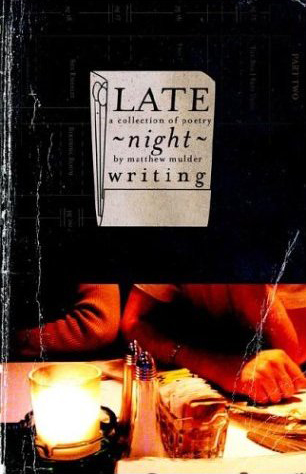
Just wanted to say thanks to all who have purchased an ebook version of Late Night Writing. Your support means a lot to me.

Since the book’s re-release as an ebook, it has sold more copies as an ebook in less than two months than it did in the first year of its release as a print book.

Hope you enjoyed reading Late Night Writing. If you like this title, you may also like some of the forthcoming ebooks that are scheduled for release. More details are forthcoming.

Again, thanks so much for your support of Late Night Writing!

The Last of the Great Chained Libraries

Normally, I don’t reblog material from other blogs, but this is such an interesting piece about chained libraries. Hope you enjoy the read as much as I did.

medievalfragments's avatarmedievalfragments

By Jenny Weston

On a beautiful sunny day last week, the Turning Over a New Leaf project team decided to take a day off from the office to visit a spectacular chained library in the small town of Zutphen (located in the eastern part of the Netherlands). Built in 1564 as part of the church of St Walburga, it is one of only five chained libraries in the world that survive ‘intact’—that is, complete with the original books, chains, rods, and furniture.

Needless to say, it was a rather surreal moment for all of us to step into the little room to see the dark-wood lecterns, upon which were placed (in neat rows, side-by-side) beautiful 15th- and 16th-century books, secured in place by metal chains.

Looking closer, it is possible to see just how the chained-library system works. Each book is fitted with a metal clasp, usually on the back cover…

View original post 522 more words

So many books, so little time

First quarter books
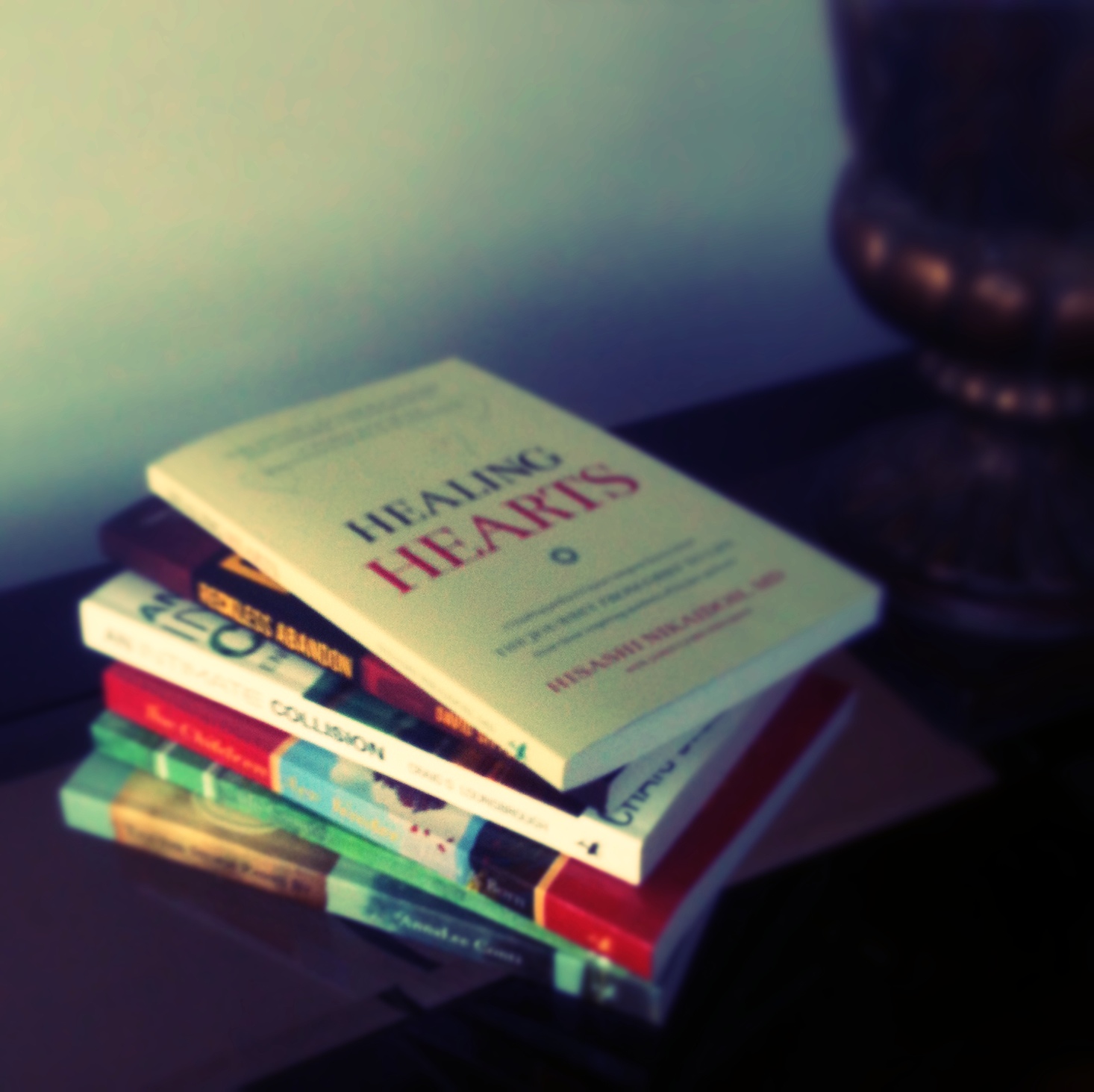
What do you think of when you look at a stack of books?

Maybe, so many books, so little time. Or, can’t wait to get home and read this novel/memoir/biography tonight after supper….

[read more]

UPDATE: This blog post is available as part of an audio podcast.

Listen here:

Or listen on:
PodOmatic: coffeehousejunkie.podomatic.com
SoundCloud: soundcloud.com/coffeehousejunkie

E-book: How long does it take to write a haiku?: and other stories

Purchase the e-book Kindle Edition for $0.99!

What do you think about when you see a stack of books? In this short collection of stories you will also learn what a creative director thinks of when he sees a stack of books. Who is the audience for your poems? Is possible to write in your sleep, or not?

Late Night Writing ebook – now available

Late Night Writing – ebook

After nearly a decade since it was published, Late Night Writing is now available as an ebook for $1.99 at Amazon.com. The ebook features some new material — a Foreword by journeyman journalist/editor, poet, and founder of The Indie, Pasckie Pascua, an Introduction and an epigraph (of sorts).

Late Night Writing is available as a Kindle ebook, and that means you should be able to read it on all Kindle devices as well as iPhone and iPad devices. For those who do not have an ereader or tablet, Amazon has an app you can download that will allow you to read ebooks from your desktop or laptop computer.

Last month I re-read Late Night Writing and found, in retrospect, that reminds me of something Thomas Merton once wrote. I am interested to learn what you think of the collection of poems. Please leave your comments below or feel free to leave a starred review on the ebook’s Amazon page. Thanks for your support!

Do children’s books sell as e-books?

DoKidsEbooksSell_zhivago_lomo
Photo courtesy of @mxmulder

Let’s face it, e-books are no longer a novelty. With the Kindle, Kobo, Nook and other e-reader devices, the transition to a digital reading experience is no longer a discussion. They are here to stay. But is the e-book market just for adults? How well do children’s books sell on this new platform?

Last year, I worked on a half dozen or so children’s books. Not books I’ve written, mind you, but I did design covers, inside layout and typesetting. All of the titles are available on various e-reader devices. Each book features fully illustrated pages (the industry trade refers to them as picture books) and they print at various formats. The most common — and standard to the trade — is a 32-page, 8.5″x11″, colored ends hardcover book.

This is where the question gets interesting: Do children’s books sell as e-books? According to one report,

“children’s and young adult digital book revenues exploded nearly 300 percent…”[1]

Those sales numbers are quite convincing. Authors request e-books of their picture books in addition to their traditionally printed picture books. At least, the authors I work with are convinced by the published industry sales reports. Best I can tell is that young adult books perform much better than picture books even though children’s and young adult books are lumped together in a single category.

My experience is that the iPad provides the best possible interface as an e-reader with brighter colors and fluid user experience. The more popular e-readers (i.e. Kindle and Nook) seem clumsy by comparison leading some to believe that the e-reader device is a transitional technology that is soon to be replaced by the tablet.[2] Both Kindle and Nook scale down a large format picture book to the default viewing area specific to the individual device. Though the iPad has the better picture book experience, I’ve noticed that children are more interested in apps than e-books.

So, what is an author of children’s picture books to do? Here are some things to keep in mind as a children’s book author:

  • A picture book that is interactive (using apps to feature audio, video, etc.) sells better than a static digital e-book.
  • Young adult fiction titles sell better as an e-book than picture books.
  • Publishers typically provide both print and digital products, and it is wise to have the book in as many formats as financially viable.
  • Scholastic published a report on the reading habits of children stating that: “Eighty percent of kids who read ebooks still read books for fun primarily in print.”[3]
  • The same report shares that: “Fifty-eight percent of kids… want to read books printed on paper even though there are ebooks available”[4]

The tactile interaction with a physical book is an important part of the reading experience for children. In her book The Writing Life, Annie Dillard writes,

“The written word is weak. Many people prefer life to it.”

As e-books gain market share, the written word — whether print or digital — will always compete with life. Readers still seek to retreat into books that don’t offer the distraction of emails, hyperlinks, social media updates, Youtube videos and the like. It’s a choice the reader and the author must make.

NOTES: What prompted this post is a discussion posted on the LinkedIn group Ebooks, Ebook Readers, Digital Books and Digital Content… The specific discussion thread is here http://www.linkedin.com/groups/Do-childrens-books-sell-as-1515307.S.212309551
[1] Jason Boog, “Children’s & Young Adult eBooks Saw Nearly 300% Growth,” Galleycat, September 7, 2012 accessed February 19, 2013 http://www.mediabistro.com/galleycat/category/sales-stats
[2] Dan Eldridge, “The Disappearing Market Share of the E-Reader: Is it now a transitioning technology?,” Teleread.com, November 1, 2012 accessed February 19, 2013 http://www.teleread.com/e-ink/the-disappearing-market-share-of-the-e-reader-is-it-now-a-transitioning-technology/
[3] Kids & Family Reading Report, Scholastic, accessed February 19, 2013 http://mediaroom.scholastic.com/kfrr
[4] Kids & Family Reading Report, Scholastic, accessed February 19, 2013 http://mediaroom.scholastic.com/kfrr

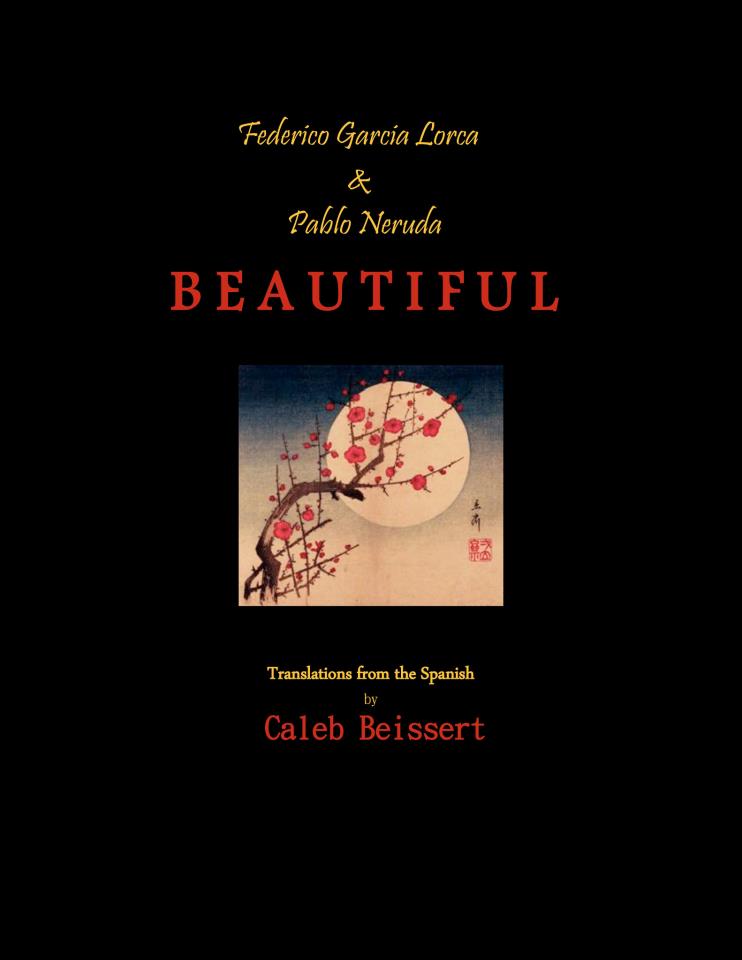
Interview: Caleb Beissert on Beautiful translations of Federico García Lorca and Pablo Neruda

Beautiful by Caleb Beissert Caleb Beissert is a poet, translator and musician. His published work appears in International Poetry Review, Tar River Poetry, Asheville Poetry Review and Beatitude: Golden Anniversary, 1959-2009.

This week, Poetry at the Altamont celebrates the release of Caleb Beissert’s first book, Beautiful, a selection of poems by Pablo Neruda and Federico García Lorca translated into English. During the last few weeks, Beautiful was well received by enthusiastic audiences at Montford Books & More and Malaprop’s Books & Cafe and is a Small Press Distribution best-seller.

The Altamont theater doors open at 7:00 P.M. for Poetry at the Altamont. Admission is $5 at the door. Beer and wine sold at the bar and lounge will remain open for drinks after the reading. Event link.

UPDATE: Caleb Beissert is the featured guest of the Coffee with the Poet Series, Thursday, February 21st at 10:30 a.m. at City Lights Bookstore. Event link

Caleb graciously agreed to an interview to discuss poetry, translation work and Beautiful.

Coffeehouse Junkie Blog

First, for those who don’t know you, Caleb, please share a little about yourself and how you came to poetry.

Caleb Beissert

I arrived naturally at poetry. I had a strong interest in writing as a child, which stemmed from my mother’s and father’s both being journalists. They read to me constantly, even while I was in utero. I still love being read to, hence the poetry readings I attend. During my fugitive teenage years, I wrote notebooks full of song lyrics—songwriters such as Bob Dylan, Tom Petty, Robert Hunter, Kurt Cobain, Roger Waters, and The Beatles among my influences. When I went to college and took a poetry writing class, I discovered I’d been writing poetry for years. Of course songwriting is a different beast, but one does inform the other.

Throughout my time at Western Carolina University, I studied writing, foreign languages, philosophy, music, art—I wasn’t satisfied with the notion of going to college to get a job, rather I wanted to learn everything I could for the sake of knowing. I began publishing my poetry, traveling abroad, corresponding with accomplished writers, and I participated in the Gilbert-Chappell Distinguished Poet Series.

My literary heritage largely came from the American Beats, especially Allen Ginsberg and Richard Brautigan; the British poets, namely Blake and Coleridge; and mystics, like Hafiz, Rumi, Kabir, Mirabai; as well as Walt Whitman, E.E. Cummings, W.S. Merwin, early on Shel Silverstein, and then later the great Hispanic poets, particularly Federico García Lorca and Pablo Neruda. Now I’m living in Asheville, writing, producing poetry events, and also working as a musician.

Coffeehouse Junkie Blog

How did the translation work of these two poets, Federico García Lorca and Pablo Neruda, come about?

Caleb Beissert

As I glossed over previously, I was at WCU studying poetry and foreign language when I began translating these two poets. It must have been my attraction to Surrealism that led me to García Lorca. I had read a few translations in Bly’s Leaping Poetry, eaten up Lorca’s lecture Theory and Play of the Duende, and fallen into Poema del cante jondo. I was fascinated by this idea of the duende and also with the marriage of poetry with music, seen in the influence of Andalusian flamenco music on his work.

An interest in Neruda also came through my gravitating toward Surrealism, though I must acknowledge that neither of these poets wrote exclusively or even primarily in this style. One day my Spanish professor assigned the students to attempt a translation of Neruda’s famous “Poema 20” from Veinte poemas de amor y una canción desesperada. I thoroughly enjoyed the assignment—probably the only one who did—and it was then I realized I could translate. From there, of course, the complexities of poetry translation began to unravel. I studied essays by Gregory Rabassa, John Felstiner, Margaret Sayers Penden, Eliot Weinberger, and read many bilingual or “bisexual” editions, as a good friend likes to call them.

Eventually, I timidly showed my translations to a few trusted poet friends/mentors, among them Dr. Mary Adams and Thomas Rain Crowe, who encouraged me to continue the work. It has been a process of frustration, learning and accomplishment. Many late nights of pulling out my hair. I’ve dabbled in other Spanish-writing poets, such as César Vallejo, Rafael Alberti, Pedro Salinas, Vicente Aleixandre, Nicanor Parra, and Manuel González Prada; however, it was García Lorca and Neruda I spent the most time with, grew to know them through their words, heard their voices, conversed in dreams, and eventually compiled enough English-language adaptations for two books.

Coffeehouse Junkie Blog

How the translation work inform the craft of your own poetry?

Caleb Beissert

I find myself writing odes to people and places I’ve never known. I’ve written poems to or after these poets, places and ideas from their poetry, even employed mimicry for effect sometimes, but going deeper, I’m sure it has changed the way I think about language, construct lines, choose words, though the translation process itself does that as well. I have developed my own poetry while spending a great amount of time with these poets, therefore their impact on my work is tremendous. It is hard for me to see, because often one must step away from his or her work to get an accurate picture of it, but I know the influence is there.
Rarely do I reblog someone’s blog post, but this is extremely useful for authors and graphic designers who are working on a children’s book.

Tara Lazar's avatarWriting for Kids (While Raising Them)

Editorial Anonymous provided a great explanation of basic picture book construction a few months ago.

At that time, I skimmed the info. Today, I’m studying it.

Why? An editor asked me to make page breaks on my current manuscript. And know what? I had more page breaks than a 32-page picture book would allow! Whoops. I knew that my manuscript had to fall within the 500- to 800-word length, but I had neglected to pay attention to logical page breaks.

The editor said, “Page turns can make or break a book, and it can be helpful to an editor to see how you envision the text.”

In a 32-page picture book, you don’t actually have 32 pages for your story. You only have 24 pages since 8 are used for the book ends, copyright and title. And 24 pages translates to 12 spreads (an illustration that spans the two opened pages…

View original post 410 more words

Interview: Barbie Angell on Roasting Questions

Roasting Questions Flyer

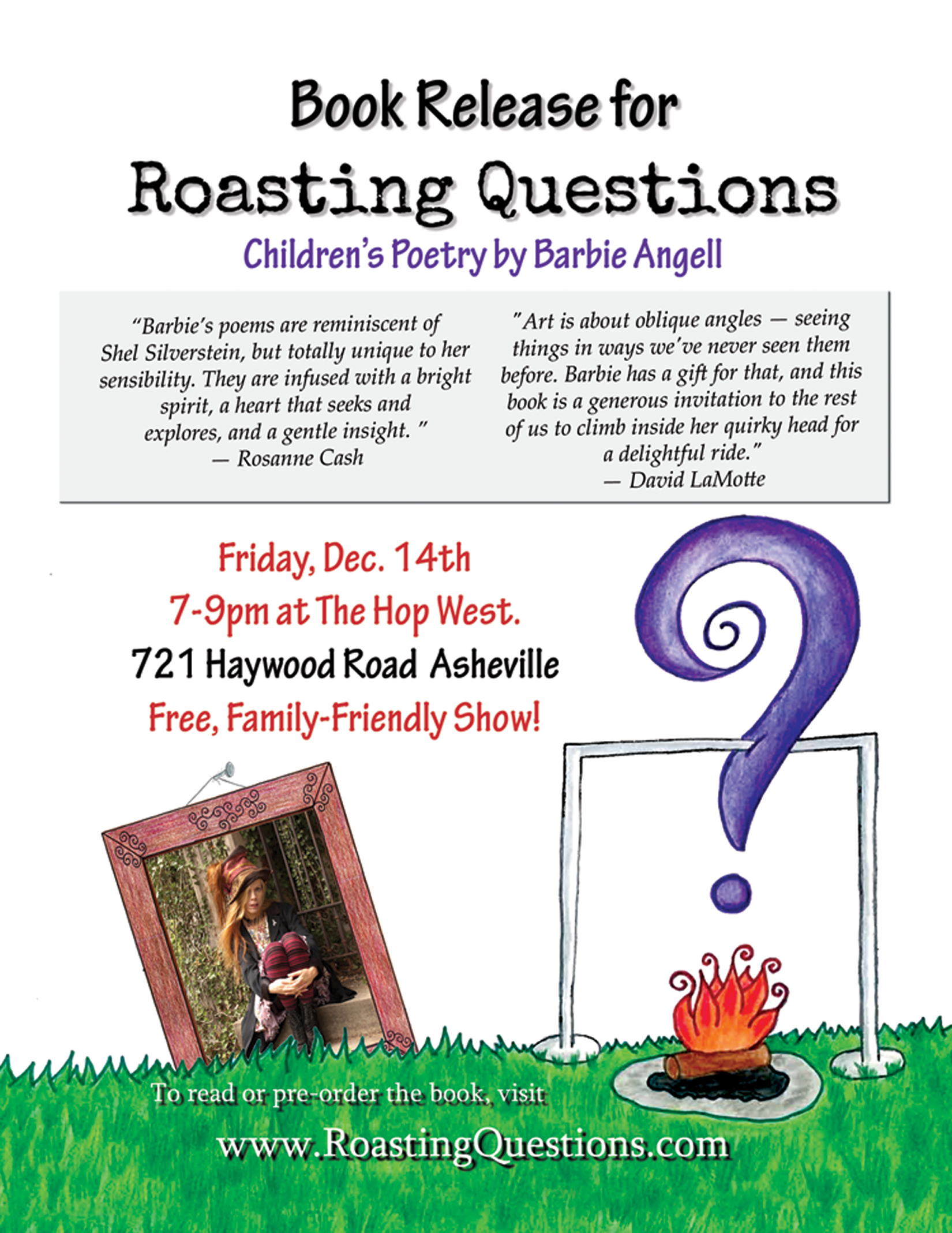
Barbie Angell is Asheville’s “poetess extraordinaire.” She has performed her poetry before audiences at bars, coffee shops and this Friday she’ll be at The Hop West promoting her new book Roasting Questions, a collection of children’s poems. The Hop West book release event is free and runs from 7 – 9 p.m. Visit Barbie’s web site for more details or visit The Hop West for directions.

Her previous self-published volumes of poetry have sold over 500 copies, according to her publisher, and she has earned a loyal audience from people who don’t know they like poetry to celebrated artists like Rosanne Cash and David LaMotte. Barbie kindly agreed to an interview to discuss the release of her first book Roasting Questions.

Coffeehouse Junkie Blog

For those who don’t know a thing about you, tell a little about yourself and how you came to poetry.

Barbie Angell

As a child, I loved reading Shel Silverstein. I was sick a lot & often alone and Shel’s poetry really grabs hold of loneliness and pushes the reader into a new world with quite tilted perspectives. My first Christmas in Mooseheart, a sort of orphanage, I was given a diary. Knowing I didn’t have the privacy required to keep an actual diary, I chose to hide my thoughts in poems. When I was in college I realized that, while poets didn’t appreciate my rhyming style, people who didn’t normally go to poetry events really loved my work. I was able to tap into an entirely new audience who had previously been ignored. In 1997 I was offered a children’s poetry gig which paid $75 for a half hour of performing. I didn’t write children’s poetry, but I needed the money, so I chose some of my rhyming pieces that were G-rated and the event was so successful that they gave me the job the next 2 years.

Coffeehouse Junkie Blog

Roasting Questions has been in the works for a little more than a year. Tell how the Roasting Questions developed as a collection of poems for children of all ages.

Barbie Angell

The book has changed a great deal since its inception. Originally it was going to have poems with blank sections for the children to draw a picture and also pictures with blank sections to write a poem. I still plan to do that book, most likely as a black and white supplemental to Roasting Questions. The pieces that ended up in this book were all given final approval by my seven year-old son. About half of them are also ones which I perform when I do bar shows and get the same incredible response from adults as they do at my children’s performances.

I’m unbelievably proud of Roasting Questions. Laura Hope-Gill assisted in the editing of the pieces and Michele Scheve and I brainstormed about the layout. With each “problem” that arose, I ended up finding a solution that made the book even more rich and quirky. Those two ladies from Grateful Steps Publishing House taught me a great deal and because of them the book is everything I could have hoped for.

Coffeehouse Junkie Blog

This is your first published book. Years from now, and hopefully many published books down the road, when you look back at Roasting Questions what do you hope readers will remember as the enduring idea of the book?

Barbie Angell

I absolutely hope you’re right and that this is the first of many books. The main philosophies behind Roasting Questions are fairly simple. I try to speak to the reader the way that Shel did, not over their heads or talking down to them, but speaking directly to them. Letting them know that we are all confused at times, all struggling with who we are and who we want to be. In the end, even though we’re all different, we want to connect with each other and be the best “us” we can be.

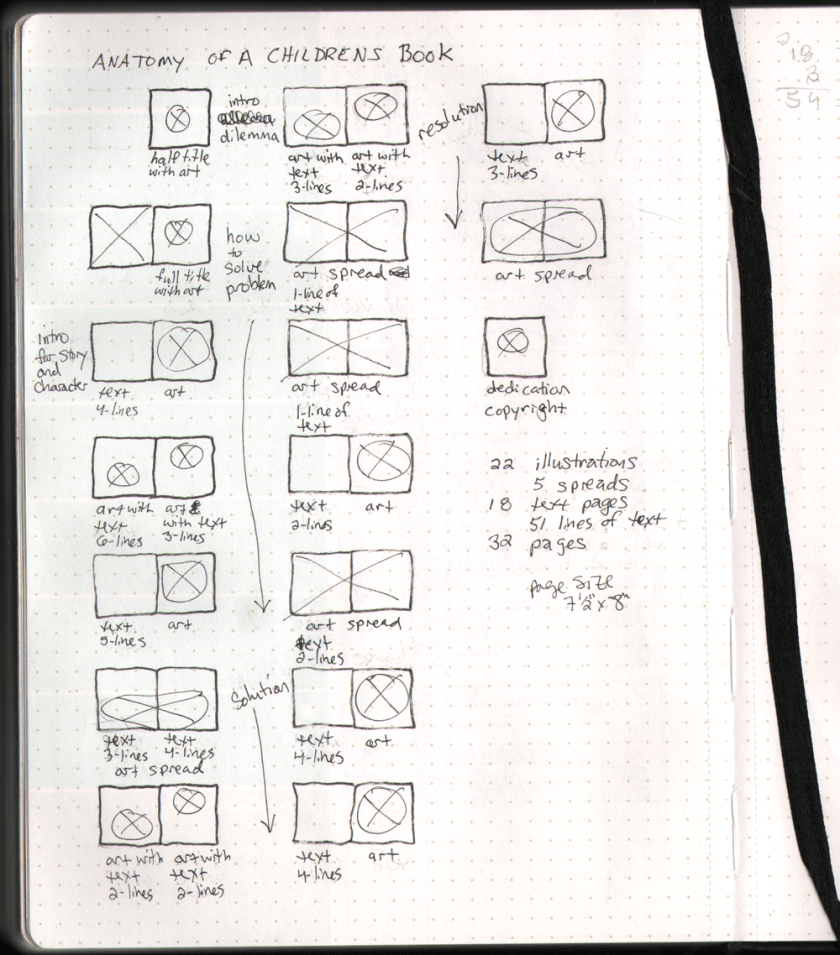
Anatomy of a children’s book

Updated - Anatomy of a Children's Book
Updated – Anatomy of a Children’s Book

UPDATE: A new image of the anatomy of a children’s book replaced the smartphone photo.

This crude sketch was quite popular at a recent meet-up of illustrators and comic book artists. Basically, the topic of children’s books came up and I got the impression that the idea of creating a children’s book was intimidating to artists. As well it should be. But it is not a path of labyrinthian impossibility. The big question is how to do it.

So, to encourage these artists, I showed them this dissection of a children’s book: 22 illustrations (five spreads), 18 pages of text (51 lines to be specific) an 32 pages (including title pages, front matter and back matter), intro story and character on page four, intro dilemma on page 14, how to solve problem (pages 15 to 23), problem solved on page 24 and resolution on page 28. It didn’t take long before a several artists were asking to take a photo of this anatomy of a children’s book with their smart phones.

Like all recipes, what you do with the ingredients (i.e. text, words and pages) is up to the artist and writer. And, like any good disclaimer, results do very.

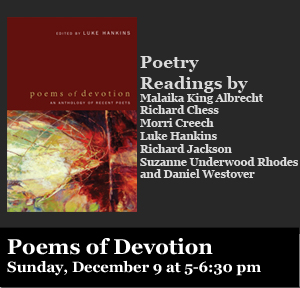
Interview: Luke Hankins on Poems of Devotion

Poems of Devotion

Luke Hankins is Senior Editor at Asheville Poetry Review and the author of a collection of poems, Weak Devotions, a chapbook of translations of French poems by Stella Vinitchi Radulescu, I Was Afraid of Vowels…Their Paleness and editor of Poems of Devotion: An Anthology of Recent Poets. This Sunday, December 9 at 5 p.m., at Malaprop’s Bookstore/Cafe, Luke will read selections from Poems of Devotion: An Anthology of Recent Poets along with other featured contributors: Malaika King Albrecht, Richard Chess, Morri Creech, Richard Jackson, Suzanne Underwood Rhodes, and Daniel Westover. Luke agreed to a quick interview to discuss the recently published Poems of Devotion.

Coffeehouse Junkie Blog

Tell me how the anthology, Poems of Devotion, developed from concept to final printed book.

Luke Hankins

In my final year of graduate school, I took an independent study course with the superb poet and teacher Maurice Manning, which essentially meant that I chose an academic/creative project and he offered input on and evaluation of it. I have had a strong interest in spiritual poetry for many years, so it was natural that I would choose a topic that reflected this passion. The essay I wrote for that class was an examination of a particular set of qualities that characterized many of my favorite spiritual poems, qualities which, in my mind, constituted a distinct mode of composition. The essay was an early form of what is now the introductory essay of the anthology, examining what I call the devotional mode in poetry. When I first wrote it, the idea of editing an anthology hadn’t occurred to me, but as I continued to revisit and revise the essay after graduate school, I felt increasingly that the compiling “poems of devotion” would make for a superb collection of poems. As an experiment, I began gathering poems that I would include in a theoretical anthology, and that’s when I began to feel a real impulse — a “call,” if you will — to bring these poems together in an anthology. I sent out a proposal to several publishers, and I eventually signed a contract with Wipf & Stock Publishers.

What followed was — well, let’s just say a year of very hard work! Gathering the poems I wanted to include was one aspect: reading widely, taking recommendations, spending long days in the library or in coffee shops with large stacks of books. But all of that, though difficult, was full of pleasure and felt deeply rewarding. The other aspect was obtaining — and paying for! — permission from copyright holders to reprint the poems. That process was often labyrinthine, frustrating, and, not least of all, expensive. But it was worth it. I’m very excited about the finished anthology, and am moved and challenged anew each time I read it. Truly.

Coffeehouse Junkie Blog

Maurice Manning is becoming one of my favorite living poets. At the public library, I discovered his book Bucolics and then had an opportunity to attend one of his lectures at Warren Wilson. But I digress. You beat me to the second question which is what did you learn most? Seems like the whole publishing side of the anthology was quite a classroom of experience. If you will, highlight one moment during that year long process that “felt deeply rewarding” for you.

Luke Hankins

I think approaching the copyright aspect of the anthology with a certain level of naivety in many instances worked to my advantage. People were more inclined to take mercy on me and my minuscule budget! But there were a few publishing houses who were absolutely unmovable, and I had to pay out my teeth, so to speak, to include poems I felt were necessary to the anthology. So I learned to rejoice in small mercies where they came, and to practice stoicism about what I saw as exorbitant pricing from some of the major publishing houses.

Regarding your second question, I wouldn’t want to try to single out one moment that felt rewarding. I’ll just say that the process of discovering poets I came to love, whose work I had never read or had only read cursorily, was one of the most rewarding aspects. Re-reading poets whose work has been very impactful for me was another aspect. Also, there was an overall sense of being blessed to be able to dedicate myself to an undertaking that felt like an important fulfillment of who I am. I felt that I was working with real purpose. I felt that I was doing what I was meant to do.

Coffeehouse Junkie Blog

One final question, what’s the biggest thing you hope readers take away from Poems of Devotion?

Luke Hankins

I hope that readers — whether religious or non-religious, theistic or non-theistic — come away with a conviction that the devotional mode is a powerful, ongoing, vital mode in literature. I believe in these poems and their ability to do just that.

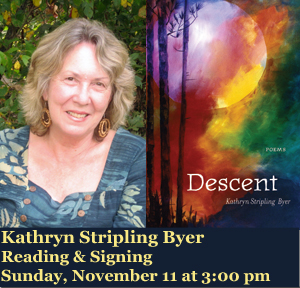
Kathryn Stripling Byer Poetry Reading & Booksigning

Sunday, November 11, 2012, 3:00 p.m., Malaprop’s presents a poetry reading and book signing for Kathryn Stripling Byer.

From Malaprop’s news release:

Poetry reading and booksigning event with Kathryn Stripling Byer, former North Carolina Poet Laureate and another favorite here at Malaprop’s.  On November 11 she will read from and sign DESCENT, a collection of poems described as “navigating the dangerous currents of family and race,” in which Byer “confronts the legacy of southern memory, where too often ‘it’s safer to stay blind.'”

David Hopes, Holly Iglesias & Richard Krawiec

Malaprop’s presents Poetrio, November 4, 2012, 3 P.M., featuring David Hopes, Holly Iglesias and Richard Krawiec.

From Malaprop’s:

Richard Krawiec is an extraordinarily versatile writer who has published novels and short fiction as well as nonfiction (including textbooks on teaching writing), plays, and two books of poetry, Breakdown, and She Hands Me the Razor.  …AND LOVE… is the fifth anthology for which he has served in an editorial role, and this anthology includes his own poem “She Hands Me the Razor.”  The editors’ introduction to …AND LOVE… offers an enormous (and still not exhaustive) list of varieties and aspects of love, summarized, at least for the moment, in this way: “Whatever it brings, love is the only thing that makes everything else ring true.  And that’s what this collection is all about.  This burgeoning landscape of love, collected here, in the words of 125 poets.”

Holly Iglesias is well known to those who attend Malaprop’s poetry events regularly.  She last read at Malaprop’s for the October 2012 all-poetry Writers at Home event, and she has previously read on more than one occasion at Poetrio.  She has published several collections of poetry, the latest of which is Fruta Bomba (February 2012), and is the author of the critical study Boxing Inside the Box: Women’s Prose Poetry. Among her many honors is a 2011 fellowship in creative writing from the National Endowment for the Arts.  She teaches in the Master of Liberal Arts program at UNC-Asheville and contributed the poem “American Impressionists” (from her book Souvenirs of a Shrunken World) to the anthology …AND LOVE….

Poet David Brendan Hopes is also a prize-winning playwright, memoirist, and actor who lives in Asheville and is Professor of Literature and Language at UNC-Asheville.  His poetry has earned him the Juniper and Saxifrage prizes in poetry, and he continues his work as a playwright with a Lincoln trilogy for theater (the first two parts are completed), while working as well on a novel about Asheville.  He has published a number of poetry collections, and he read from his book Dream of Adonis at the Malaprop’s Poetrio event in 2008.  We are very happy to welcome him back for the presentation of …AND LOVE.., to which he contributed the poem “Before Supper.”

A bookless American library

Empty shelves at the downtown city library

Why can’t I find a copy of Kurt Vonnegut’s Slaughterhouse-Five at a local public library? I’m wandering through the aisles of bookshelves thinking, It’s not an obscure title. Is it? Earlier, I visited a couple library branches and couldn’t find a single copy. How is that possible? Later I would find a copy at a bookstore (actually, I would find copies at three of the local bookstores, but I would be out of cash and wouldn’t be able to afford to buy a copy… more on that later… like, wait-for-my-memoir later…).

Is it possible? Are American libraries moving toward booklessness? At the main, downtown city library I stare at a whole wall of bookshelves emptied of books (see photo). Glancing around the place it appears that the only thing people do at that library is use the toilet, enjoy the air conditioned space on hot summer days, and rent CDs and DVDs. The magazine racks are full and there is an man, probably in his 60s, reading the latest copy of the New Yorker. Beyond the reference desk, I see that every computer terminal is occupied. My mood is turning away from searching for a copy of Slaughterhouse-Five, to mischievous. I want to walk over to the reference desk librarian and ask, “Where might I find a book about Tralfamadore?” From experience, I know what the reference desk librarian will do. The scene will go something like this:

“Excuse me, but where might I find a book about Tralfamadore?”

“Tralfamadore? Let me see,” he says as he opens a web browser on the computer and sounds out the word tral-fam-a-dore under his breath. “Oh, Tralfamadore. From Kurt Vonnegut’s novel Slaughterhouse-Five.”

“Did you just google that?” I ask.

He looks at me and doesn’t say anything.

“Shouldn’t that be unholy sacrilege to use Google in a library?” I ask. “I mean, this is supposed to be a house of intellect.”

He folds his hands in front of the keyboard and says, “I used Wikipedia.”

“Wikipedia?” I snort.

The reference desk librarian catches the eyes of the library’s security guard who walks toward us.

The scene concludes with me mumbling something about the democratization of content leaves an intellectual void that is too quickly filled with bits of data rather than depth of knowledge and wisdom.

But I don’t walk to the reference desk. I get lost somewhere in the fiction aisles–somewhere in the section where books by authors with last names beginning with “k” are placed. The whole thing–the search for a single copy of a book and the failure to locate it at a public library–is loathsome to me. I have this uneasy feeling ‪that Ray Bradbury’s‬ ‪Fahrenheit 451‬ may be prophetic. And I want to start memorizing large volumes of literature for the mere preservation of it to share with the next generation. Isn’t that why books are written? To share not just with this present age, but to extend beyond the life of the writer? My eye’s find a book about bean trees–or rather, a novel. It’s not a very thick novel, but it seems to have found me and I can’t just leave it on the bookshelf and I don’t want to leave the library empty-handed.

After the book is processed silently by a librarian, I walk to catch a bus home. Reading the first few pages at the transit center I know I have found a new friend in this book. It’s a feeling I can’t say I have regarding Google or Wikipedia. To me, they are repositories of data–vapid of personality in the same fashion as the  Borg–to be mined or to be assimilated.

On summer or winter in books and writing

One Day in the Life of Ivan Denisovich‬ and The Call of the Wild

“Do you prefer Summer or Winter in books and writing?” asks blogger Lea At Sea. What do you think? I had to think about that for a while.

I finished a few books recently by authors Ian McEwan and Barbara Kingsolver. Saturday, On Chesil Beach and The Bean Trees all have specific seasons and locations central to each novel. As I thought of how the seasons permeate a novel, two novels come to mind: ‪

by ‪Aleksandr Solzhenitsyn‬ and ‪The Call of the Wild‬ by Jack London. [1] It never occurred to me to read One Day in the Life of Ivan Denisovich‬ because it begins on a cold winter morning. The character and narrative interested me. The gulag in winter is a prominent element of the story, but that isn’t the reason I read the book. It was the story.

By nature I’m a fall/winter sort of person. Maybe that’s why I recalled those two books:One Day in the Life of Ivan Denisovich‬ and ‪The Call of the Wild‬. But my reading choice is not directly influenced by that predisposition otherwise I would not have picked up a book set in spring/summer of the American southwest. However, I am curious to learn if your reading selections are influenced by that perimeter. Do you choose a book because it is seasonally based? Further, if you are a poet and/or writer, do you specifically write for a specific season?

NOTES: [1] Technically, ‪The Call of the Wild‬ and On Chesil Beach are novellas. Maybe I should refer to the works as books rather than their literary distinctions. Writing Forums offers distinctions between short story, novella and novel lengths. Basically, word count. Short Short Stories & Flash Fiction; usually under 1,000 words; Short Stories, 7,499 words to 15,000 words; Novelette, 7,500 to 17,499 words; Novella, 17,500 words to 39,999 words; Novel, minimum word count of 40,000 words. It is my understanding that a proper novel runs an average of 80,000 words. Since we’re on the topic of word count, Fiction Factor offers How Long Should Your Story Be? by Lee Masterson and Writer’s Relief presents Short Story Or Novella? What’s The Difference And Where To Publish Shorter Fiction.

The English novel versus the American novel

Which do you prefer, the English novel or the American novel? I’ve been thinking about that after reading some of Ian McEwan’s and Barbara Kingsolver’s books. Maybe it is the difference in the writers and not so much the country from which they live. There is a tone or manner that seems a marked distinction between the two styles. What do you think?

Letter writing, a vanishing art

A book is more than a collection of letters and pages.

The week before Fathers Day I completed a book design project that is a “legacy of letters from a decorated World War II hero…” Or so the back copy states.

Reading a manuscript like that, at times, seems voyeuristic. The compelling part of the book is the context of knowing that the author was three when his father passed away suddenly. He grew up hearing friends and family tell him “You sure look like your Daddy” or “I knew your Dad, he was one of the best.” The letters that the author collected for the book shares who is father was and what kind of man he was. But most importantly, for the author, it was the only way to hear the voice of a father he never knew.

At times, during the process of designing the cover and page layout, I glimpsed that boyish tenderness of the author (now in his sixties) as he ached for the presence his father. I cherished Fathers Day all the more as I thought of the author.

A couple of things come to mind as I wrap up this project and send it to press. First, the art of letter writing seems non-existent. The last letter I received was from my oldest child who placed it in my boot for me to find one morning. It was a simple note written in colored pencil. It is placed in my journal. I glance at it periodically.

Last time I received a hand-written letter was years ago. There are the seasonal holiday letters that begin filling my mail box every year between Thanksgiving and New Year’s Day. They usually arrive as letters printed out on decorative stationary purchased at Kinkos or Office Depot. But hand-written letters? Do people still do that in our culture?

Secondly, the legacy left behind of those letters written prior to, during and after a major historical event impresses me. What kind of legacy might we leave our children and grandchildren with a mountain of un-memorable text messages. What will our tweets and status updates mean a half century from now? Will Twitter be obsolete by then? Or Facebook? Can you imagine your grandchildren asking you, “What’s Twitter?” After you explain the whole social media birth of micro blogging they giggle and say, “Twitter is so 2012. I can’t believe how primitive that seems.”

Emails may convey some of the gravitas as a written (or typed) letter. However, as Luddite as this sounds, I still have hand-written letters from family and friends placed in an old shoe box. Letters and notes from a woman who became my wife are stored in a similar fashion. A typed note from my grandfather, when age had crippled his hand-writing, is placed in a book of his poems as a reminder and memento. As a child, my grandmother wrote a brief letter to me each birthday and placed a stick of gum in between the folds. I looked forward to that letter each year. You can’t attach a stick of gum to an email.

Besides, I doubt anyone in our culture would wait, anticipate and enjoy a letter that arrives annually. Everything is so urgent… almost panicked. Why isn’t someone responding to my emails, texts, tweets? It’s been 30 seconds! (Place emoticons here.) In my own life, I notice how differently I process social media and online content. There lacks a linear stretch of the intellect when processing clusters of data points from Twitter, Facebook, HuffPo, etc. My attention span fatigues when I have to wade through a barrage of emails, updates and tweets.

Yet I enjoy the long articles in the Atlantic Monthly, London Review of Books, The New York Review of Books or the like. It stimulates my mind. 700-word news articles for the most part bore me. There’s nothing there but a nut graph. No context. No history. No personality or narrative trajectory. Just a Google-like, or Wikipedia-like, democratized collection of information. There’s nothing there to engage my mind. Nothing that challenges my mind, beliefs or values. A book on the Battle of Agincourt offers nuances that blog posts, tweets and texts don’t offer.

Reading through a legacy of letters, like the book I am ready to send to press, captures the exchange of ideas in a sustained, generational conversation between a father and a son. The more our culture engages in the scatterbrained conflagration of data items, I suspect civil, engaging conversation (like letter writing) may become obsolete.

There are days when I wonder what kind of novel Sal Paradise and Billy Pilgrim might make if they hit the road together.

Three ways for authors to promote their new book

This is obvious, but essential. Connecting with a local bookseller is vital to promoting your book. Most booksellers see your book title listed in their wholesale catalogs. All you need to do is remind them it’s there and then see if they’ll host an event. Be sure to contact the bookstore’s event coordinator, not the store’s book buyer. The PR  & Events Coordinator schedules store events like readings and book signings and is the best point of contact for a newly published author.

Consider non-bookstore venues. Schools, public libraries, or other venues may have suitable audiences for your book title. Don’t just assume that your audience only buys books at Barnes & Noble. Libraries are great places to read. I’ve read in various locations including a tavern, café, ballroom, art studio, church and several other places. One author I know had a reading at a chocolate shop. Be creative with your events.

Social media sites like Twitter, Facebook, etc. are great tools to promote your book. If you don’t have an account, you’re already behind. Be authentic and approachable on these sites. If you sound like you’re a pushy salesperson, you’ll lose your audience. Share with your social media audience the same way you approach your book reading audience. Make converts from social media followers to book buyers.

How to capturing abstract ideas in a book cover design

How do you capture an abstract thought for a book cover design? That’s the question one person left in the comments section to Judging a book by its cover.

That is a challenge. A lot of abstract ideas — like love, grief, joy, freedom, etc. — have emotional and psychological weight. Photography is an easy tool to use in conveying physical responses to abstract thoughts. Photos illustrating love or grief become cliché. For example: how many books can you find at a local book seller on the topic of grief of a loved one that includes sun bursting through voluminous clouds? There are reasons for a majority of the bereavement books have similar titles — primarily marketing. Readers looking for books on how to cope with grief in a book store find themselves staring at a shelves of cloud cover books. So how does a graphic designer create a cover that competes with all the cloud-covered-grief-books?

Here are two other tools to consider: color and shape.

Color

Color psychology informs me what colors might work best to address a book on the topic of grief, freedom or spirituality. The challenge arises frequently — due to an enormous amount of books published every year — that most books on the topic of grief utilize the same color scheme or photographs of a path leading through a forest with a bright patch of light at the end or the ever-present sun breaking through the clouds. So I turn to color psychology as a tool to design a book cover dealing with the abstract concepts of grief, joy, love, etc. There has been a lot of research in this field to learn from. For example, blue (depending on the shade or tint) offers a feeling of peace, tranquility, confident, and as reliable as the sky and ocean. But blue can also be cold and corporate (again, depending on the shade or tint). Interestingly, brown can express reliable and authenticity.

Shapes

Recently, I’ve turned to the psychology of shapes and patterns as a way to define abstract ideas like endurance, peace or joy. According to research, there are three main categories of shapes: geometric, organic and abstract. Other distinctions remind me of primary school including: circles, squares, triangles, spirals, and more. Also, the orientation of the shape is essential — horizontal and vertical. Squares and rectangles are common but express peace, stability, conformity or other abstract concepts. For example, a horizontal rectangle expresses confidence in much the same manner as the color blue. Whereas a spiral shape my best represent grief as it expresses the idea of death, life and transformation.

As I share the psychology of color and shape with authors with whom I am designing their book covers, they often need to be educated on the visual vocabulary of these ideas. Most of the authors understand the premise of how color, shapes and patterns express the content of their book. Additionally, most of the authors prefer a photographic cover design. This is a bit off in my mind, because what is a photograph but a composition of colors and shapes? Is there a lack of visual literacy in our culture? Or is the graphic design community a cloistered cult of artists that do not share secrets with the outside world?

As I design book covers, these are the tools I fall back on consistently: color and shapes.

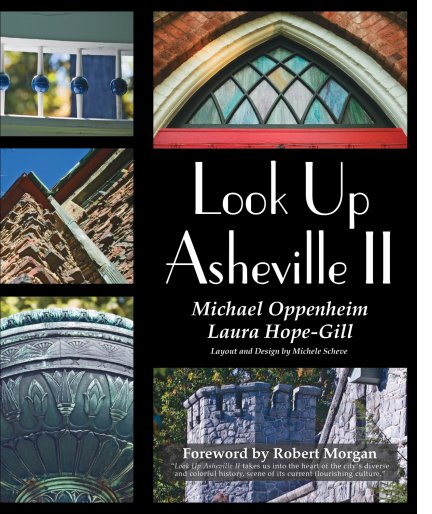
Book Launch for Look Up Asheville Collection II

Look Up Asheville II by Michael Oppenheim and Laura Hope-Gill

Tonight at 6:30 p.m. the Look Up Asheville II book launch begins at the Battery Park Champagne Bar/Book Exchange. Join the festivities for the launch of Look Up Asheville II featuring photography by Michael Oppenheim and essays by Laura Hope-Gill. Poet Robert Morgan writes: “Look Up Asheville II takes us into the heart of the city’s diverse and colorful history, scene of its current flourishing culture.”

From the event invitation: “Look Up Asheville II features more architectural details captured by local photographer, Michael Oppenheim, accompanied by historical essays by Laura Hope-Gill, with a Foreword by premier author and poet Robert Morgan (Gap Creek, Lions of the West, Terroir). Designed by Michele Scheve, Look Up Asheville II does more than inform readers and viewers of the architectural, social and creative history of Asheville; it celebrates all these with stories and luminous images. The new book contains Asheville’s grand Bed and Breakfasts and more of the exquisitely built churches, inns, museums and downtown treasures.”