![DSCN5435[basic-lomo-sangria]](https://coffeehousejunkie.net/wp-content/uploads/2016/04/dscn5435basic-lomo-sangria.jpg?w=768&h=1024)
Poem 04: Loneliness visits
![DSCN5421[bsc-lomo-dusk]](https://coffeehousejunkie.net/wp-content/uploads/2016/04/dscn5421bsc-lomo-dusk.jpg?w=840&h=630)
Reading “My American Body” by W. K. Buckley
by Matthew Mulder
Fireflies sparkle
outside. I see them through the
living room window.
It’s the time between
times as I
examine a new hole in
my jeans and consider
“Picking up their shreds
to the tangled light.”
Condensation rolls down
St. Pauli Girl who
makes me sparkle
inside.
NOTES:
(c) Matthew Mulder. All rights reserved.
Originally published in Rapid River Arts & Culture Magazine, October 2005
![DSCN5416[sqr-basic-lomo-dusk-tilt]](https://coffeehousejunkie.net/wp-content/uploads/2016/03/dscn5416sqr-basic-lomo-dusk-tilt.jpg?w=840&h=840)
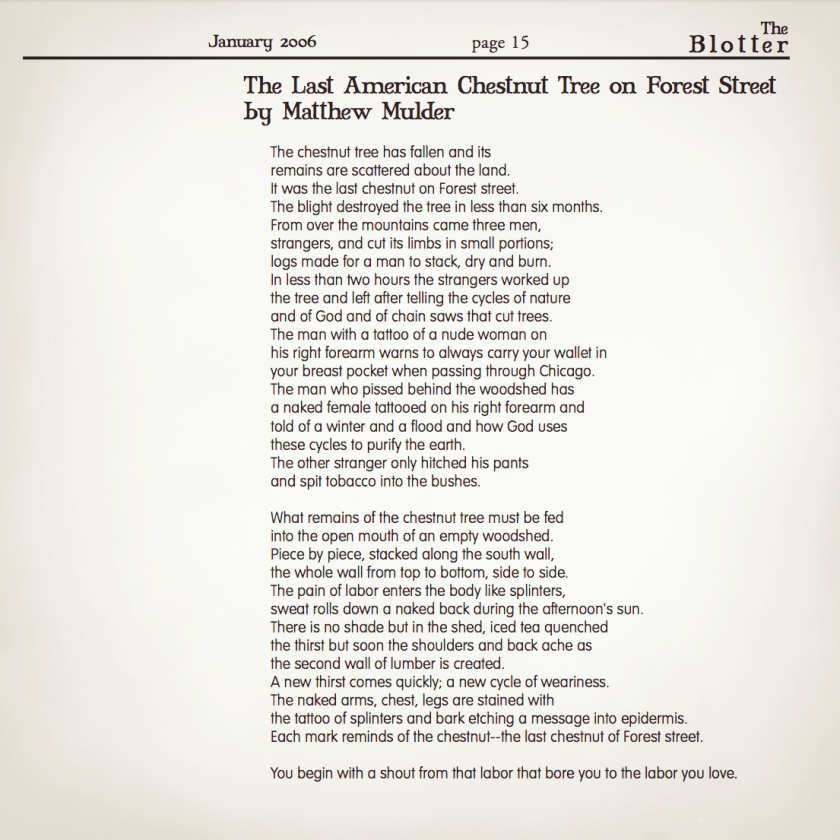
NOTES: Originally published in Rapid River Arts & Culture Magazine, April 2004. Unable to locate the printed artifact nor find a digital version on the publisher’s website, I photographed this draft of “Saturday Night, Coffeehouse.”
![DSCN5411[sqr-basic-lomo-lofi]](https://coffeehousejunkie.net/wp-content/uploads/2016/04/dscn5411sqr-basic-lomo-lofi.jpg?w=840&h=840)
It is no joke. It is April. And it is the beginning of National Poetry Month.
For poets and poetry fans, April is a special month-long celebration of poems and poets. For most of America, it is the beginning of baseball season.
One question that is asked of me when an individual learns that I compose lines poetry is this: “Are you published?”
The answer is yes.
Throughout the month of April I will post selections of my published work for your reading pleasure.
April is a good month to test your poetry writing skills. A few years ago I took up the challenge[1] to write 30 poems in 30 days.[2] You are invited to the challenge as well.
NOTES:
[1] 30 poems in 30 days challenge
[2] Write 30 poems in 30 days: a challenge
![DSCN5358[sqr-basic-helsinki]](https://coffeehousejunkie.net/wp-content/uploads/2016/03/dscn5358sqr-basic-helsinki.jpg?w=840&h=840)
01. Monday: the yogurt was a wee bit past its edible state. I ate it anyway.
02. Tuesday: the milk was a starting to go sour. I drank it anyway.
03. Stomach produced loud gurgling disapproval for two days.
04. I threw out the milk and yogurt, and drank ginger tea all day.
05. Last week: wore mismatched socks all week. To the office.
06. No one noticed.
07. Or did not tell me.
08. I aced this silly test [link]. It felt good to earn the “A+” badge. But it also made me feel stupid that even took the quiz at all.
09. Most lunch breaks I walk through the city.
10. Or walk along River Walk.
11. Or walk to the lakefront.
12. Or sometimes find a coffeeshop and read ghazals.
Previous confessions: [1] [2] [3] [4] [5] [6] [7] [8] [9] [10] [11]
![DSCN5385[sqr-basic-lomo-lofi]](https://coffeehousejunkie.net/wp-content/uploads/2016/03/dscn5385sqr-basic-lomo-lofi.jpg?w=840&h=840)
Ever have one of those days (or weeks) when you know you should have spent a few dollars to fix a small problem to avoid larger difficulty? And you did not.
Okay, maybe it is more like this.
Ever have a month so crazy busy that all the small tasks that should get done are not completed? And then the phone does not recharge overnight. Which means the alarm clock app does not wake you up. You are late for work. With a smart phone is about as dumb as a rock. And panic sets in when you realize you have to drive more than 70 miles to work without a mobile device? How are you going to make it through the day? The week?
When will the blessed power cable arrive from the magical land of Amazon?
That is when you realize, you will survive. It is just like the 90s. Completely unplugged. (Just like Nirvana’s 1993 MTV Unplugged session in New York City.)
![DSCN5377[sqr-basic-lomo-lofi]](https://coffeehousejunkie.net/wp-content/uploads/2016/03/dscn5377sqr-basic-lomo-lofi.jpg?w=840&h=840)
Yes. It is snowing. In Milwaukee. On Maundy Thursday.
![DSCN5321[sqr-basic-lofi]](https://coffeehousejunkie.net/wp-content/uploads/2016/03/dscn5321sqr-basic-lofi.jpg?w=840&h=840)
It is not on the menu, but if you ask a barista for a London fog tea latte, in most cases, he or she will know how to make it.
And since Milwaukee is cloaked in dense fog, I asked the barista for London fog tea latte. He looked at me twice, smiled and said, “Yeah, I can do that.”
Reposting this interview. Enjoy!
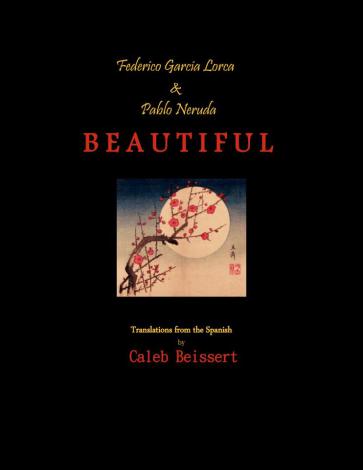 Caleb Beissert is a poet, translator and musician. His published work appears in International Poetry Review, Tar River Poetry, Asheville Poetry Review and Beatitude: Golden Anniversary, 1959-2009.
This week, Poetry at the Altamont celebrates the release of Caleb Beissert’s first book, Beautiful, a selection of poems by Pablo Neruda and Federico García Lorca translated into English. During the last few weeks, Beautiful was well received by enthusiastic audiences at Montford Books & More and Malaprop’s Books & Cafe and is a Small Press Distribution best-seller.
The Altamont theater doors open at 7:00 P.M. for Poetry at the Altamont. Admission is $5 at the door. Beer and wine sold at the bar and lounge will remain open for drinks after the reading. Event link.
UPDATE: Caleb Beissert is the featured guest of the Coffee with the Poet Series, Thursday, February 21st at 10:30 a.m. at City Lights Bookstore. Event…
View original post 741 more words
 For me, every book cover I design begins with pencil sketches that eventually lead to ink drawings. Actually, I suppose it begins prior to that. The author receives a pre-publication questionnaire from me prior to the design process. The questionnaire asks the author what is his/her elevator pitch, what are the pillars of the book (i.e. what are three main concepts/ideas in the book?), and what is the book’s key audience? There are more questions that help me prepare for the design process, but reading through that document helps me form an idea of who the author is, what the book is about and how best to represent the book’s content with an attractive cover.
Then I receive the manuscript a few weeks later and begin reading the author’s work. This helps try to envision in my mind an iconic poster image. For me, a book cover is the equivalence of a film poster. At…
View original post 324 more words
This is the most read blog post this week. Thought I would share it with those who may be interested in reading about graphic design tips.
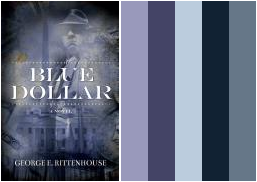 Color palette based on book cover design for the novel Blue Dollar
Wear the blue neck tie to suggest boldness and confidence. Wear the red tie for passion. Or so the conventional wisdom offers those business persons who are presenting themselves for a job interview. Color is important when designing books, posters, web sites, etc. Building an effective color palette takes years of experience in knowing the right color combinations that present contrast or harmony or various other arrangements.
Thanks to some online resources, creating a color palette takes only a few minutes. Here are four online tools to use in creating a customized color palette.
There is also a way to create a color matrix using Adobe Illustrator, but that’s a bit more involved and takes longer to explain. Here’s an example of what a color matrix looks like (see below).
View original post 17 more words
 An ice circle, or ice disc, forms in slow moving water in cold climates.
Imagine my surprise when I spotted several ice circles slowly spinning in the waters north of the art museum on an afternoon walk. Beautiful. Like gears grinding away rough edges into glistening discs in the afternoon sun. The delicate slushy, glassy sound reminds me of wind chimes. But there is no wind today. Flags like wilted flowers hang on the poles around the war memorial building. A hawk is perched on a lamp post.
The noisy hurly burly of East Town’s traffic and many construction projects is a dim echo to the mesmerizing music of ice circles.
I could sit here beside those circling ice discs the rest of the day. Or at least until the sun sets.
But only a few minutes remain of my break. And there is work to be done — projects to complete. Matters of consequence.
With hesitation, I leave the spinning ice circles to perform their tranquil charms to the neighboring ducks, gulls and the lone hawk.
![DSCN5167[sqr-basic]](https://coffeehousejunkie.net/wp-content/uploads/2016/02/dscn5167sqr-basic.jpg?w=840&h=840)
When night winds leaves subzero signatures on the Saturday morning window, it is time for coffee and jazz and few lines of poetry… [1]
Try to count the colors
In a frosted window at sunrise
try to imagine the hues and shades
Of a Wisconsin winter morning…
NOTES
[1] With apologies to Three Crosses, inspired by song “Michelangelo”
So, it is Fat Tuesday.[1] Meaning it is almost Lent.[2] In Milwaukee. Meaning it is Pączki Day.[3] And the office fun committee made sure those special Polish pastries are available for staff in the lunch room.
Not from Milwaukee? Not Polish? A member of the fun committee smiled and said, “Everyone is Polish on Pączki Day.”
NOTES
[1] Fat Tuesday, also named Mardi Gras
[2] On Lent, fasting and feasting
[3] For a primer, OnMilwaukee provides a word on pączki and seven Milwaukee locations to enjoy the treat.

Since the publisher posted the following on Facebook last night, I guess it is alright to unveil a new book I designed:
Jordan Rice’s debut poetry collection, CONSTELLARIUM, a finalist for the 2015 Orison Poetry Prize, is now available for pre-order at a discounted price! Order now and be among the first to receive the book when it’s released in April.
“Constellarium is a bold announcement of a new poetic voice to be reckoned with. These poems make us stare down shame and celebrate transition, celebrate the body inside. Jordan Rice does not flinch from what society would have us try to look away from, instead she carefully constructs a book in which we are forced to reckon, layer by layer, with her being. Let us be thankful that such a voice exists, that it is brilliant and shattering, and here to take us all on her journey.” –Fatimah Asghar
The process of cover design is exciting. Especially when the title of the project is constellarium.
There are so many stories behind the cover design that would be fun to share. Like, for example, how the kidlingers enjoyed the image of cetus — how cetus does not look like any image of a whale they have ever seen in a picture book. And how the eldest kidlinger is writing a report about rhinos.
And how a species of rhino has been reported extinct. And we wonder if these old drawings are accurate. And that maybe the cetus represented in the book cover art is correct. But maybe that species of ceti (is that the correct nominative plural of cetus, Latin students?) is now extinct.
Maybe these behind-the-scenes stories are more interesting to me than you.
See if you can find cetus in the cover art by pre-ordering Jordan Rice’s Constellarium!
“Amazing readings, beautiful community,” tweeted one of the poetry marathon attendees Saturday night. Indeed it was a good night to visit Woodland Pattern Book Center to hear poets share their work. To be exact, 150 area poets shared their work.
I participated in the 9 o’clock hour. Featured poets included: Matt Cook, Tom Erickson, Peter Burzynski, Franklin K.R. Cline, Carmen Murguia, Peter Whalen, Bob Koss, Jane Lukic, Michael Wendt. One of the highlights of that hour was to hear a Czesław Miłosz poem read in Polish.
Each poet is afforded five minutes to read. The poems I selected earlier in the day loosely fit the motif of something old, something new, something borrowed and something blue. They were all short poems. One of the poems was a spare two lines. So, I read it slowly. In truth, I try to read all poetry at a slow pace. It is a technique I picked up from some of my favorite poets in Western North Carolina.
After the 9 o’clock hour readings concluded, one of the event coordinators commented that she likes this part of the marathon. She said that the poets are warmed up at this point and the poetry really engages the audience. While milling around after the reading, a board member of Woodland Pattern asked me if I was a visiting professor. I smiled. It is a question I get asked a lot after a public reading.

How does a poet select poems to read at a poetry marathon? I have been asking myself and my wife that question all week. Tomorrow is the annual poetry marathon at Woodland Pattern Book Center in Milwaukee. Something like 150 poets will be at the all-day event.
As I peruse a collection of publications I am a little startled to realize that there is a decade or more of work published in various journals and reviews.[1] Some of the publications are regional to North Carolina while others are national.
My work does not have a lot of Milwaukee-area credentials and I am not well-known to this region (forthcoming work is to be published by a Milwaukee publisher). Even so, I feel like an outsider at the Woodland Pattern poetry community. This is familiar territory.[2]
During a conversation with my wife this week an idea formed. Selecting poems based on the wedding adage was the plan: something old, something new, something borrowed, something blue. This developed into an engaging exercise of finding poems to fit that motif. Looking forward to sharing the results tomorrow night — between 9 and 10 p.m. — at Woodland Pattern Book Center.
NOTES
[1] A SHORT LIST OF SEVEN PUBLISHED POEMS:”Saturday Night, Coffee House,” Rapid River, 2004; “Reading ‘My American Body’ by W. K. Buckley,” Rapid River, 2005; “Narrative Kernel,” Rapid River, 2005; “Last Bus,” H_NGM_N, 2005; “The Last American Chestnut Tree,” The Blotter, 2006; “Loneliness Visits,” .ISM Quarterly, 2006; “Last Night at the New French Bar,” Crab Creek Review, 2010
[2] A good friend and poet, Barbie Angell, once told me that I am on the cusp as far as a poet and writer is concerned. Meaning, that I am on the border or threshold of the academic (published) poetry scene and the street (unpublished) poetry scene. So, being a stranger to the Milwaukee poetry scene is familiar place for me.
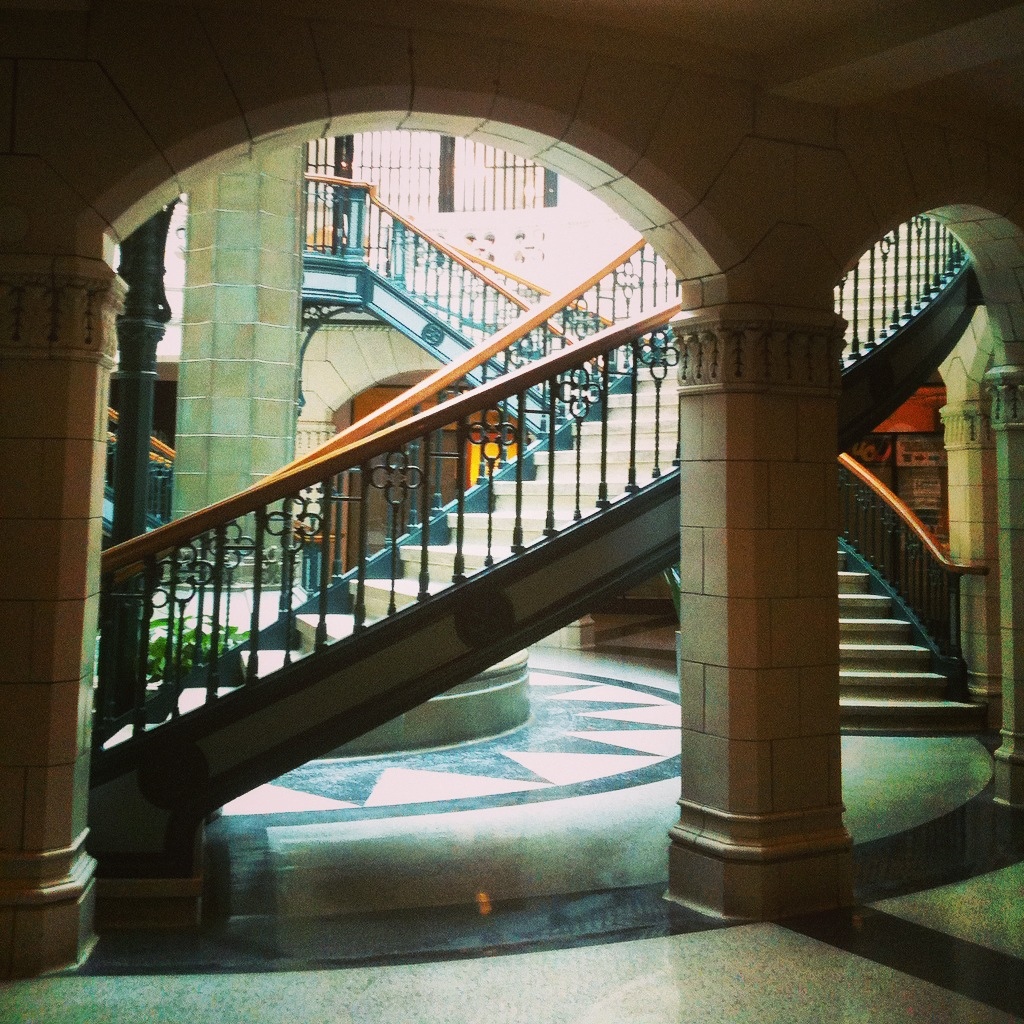 Some days, I walk to Grand Avenue — or rather, The Shops of Grand Avenue — in the afternoon. It breaks up the work day. Offers exercise. Occasionally lunch. Or coffee.

Woodland Pattern Book Center’s 22nd Annual Poetry Marathon & Benefit is almost here and I have done a horrible job promoting the event.
This is the second time I will be reading poetry at the Woodland Pattern Book Center. If you are so inclined, you may sponsor me as I read poetry during the 9 -10 PM portion of the marathon. Details on sponsorship is here.
Or join the event and hear some of the poets in the area and beyond. Last year, if I recall correctly, some of the poets drove from as far as Madison to read at the marathon. Hope to see you there.
Several expressions are used in open mic circles when a poet or a singer songwriter is introduced to the audience. One of those expressions is, “Welcome, So-and-so to the stage. She going to bless the mic with her poetry.” Another expression often heard is, “Ya’ll give it up for What’s-his-name who is here to spit some poetry at you tonight.”
Last night I had the opportunity to read some recent, unpublished poems at the Grassroots open mic in Racine. That was the first time I have read at the Racine Arts Council ArtSpace Gallery (last summer I read some old poems at a Grassroots open mic at George’s Tavern). The poems seemed well received by at least a few people who talked to me at the end of the evening.
There was a time in my life when I used to read my work at open mics and other gigs at least once or twice a week. But those were different times and in a place far from here. Yet, the exercise of public speaking/reading returned quickly. There was fear in my mind that those skills had atrophied.
I will be reading at Woodland Pattern Book Center’s 22nd Annual Poetry Marathon & Benefit. It is a fundraising event. Your support is appreciated. It will be my second time reading at Woodland Pattern. For those interested attending and supporting the event, I will be reading on January 30th at 9 p.m. with a group of other poets — more details on that coming soon. If you would like to sponsor my reading, feel free to leave a note in the comments section or email me.
![DSCN5088[sqr-basic-vintage-HKfilm]](https://coffeehousejunkie.net/wp-content/uploads/2016/01/dscn5088sqr-basic-vintage-hkfilm.jpg?w=560) Yesterday’s afternoon walk was a bit chilly. Air temperature was around 10°F with wind chill of -7°F. Especially at the corner of Broadway and East Wisconsin. It was practically a wind tunnel. Crossing Water Street was not much better. But I finally made it across the bridge and to the River Walk.
Yesterday’s afternoon walk was a bit chilly. Air temperature was around 10°F with wind chill of -7°F. Especially at the corner of Broadway and East Wisconsin. It was practically a wind tunnel. Crossing Water Street was not much better. But I finally made it across the bridge and to the River Walk.
The river was not quite frozen. And for the most part, very few people are out for a wintery stroll. One woman pulled her faux fur lined hood over her head and quickly shuffled out of the Wells Fargo building to a waiting SUV. A couple guys, both dressed in thick dark coats, waited for a bus. There was a man waiting at the street corner smoking a cigarette. He wore a red flannel jacket and no gloves.
Funny how cigarette smoke is so distinct in the frigid air. The subtle distinctions between Camel Turkish Gold 100’s, Marlboro Red, Newport Menthol Blue and Chesterfield Bronze is almost as unmistakable as the scent of a fajita or a falafel. Wondered why he had no gloves.
There was a Tranströmer poem I tried to recall as I walked along the River Walk. My breath, thick clouds, attempted to signal a line of the poem. What was it about? A train? A couple in a hotel? Something about night? Or was it a horizon? The frozen river surface does not help. And forty minutes in the cold temperature sent me back to the warm harbor of the office building.
![DSCN5084[edit]](https://coffeehousejunkie.net/wp-content/uploads/2016/01/dscn5084edit.jpg)
So, the highways and roads were a bit slippery with tonight’s snowfall. Traffic was slow due to multiple auto accidents and road conditions.
But it is Wisconsin. And it is January. And it warmed up to 13°F — which is better than this morning at -8°F.
Glad to be off the roads. Time to warm up with a hot toddy. Awhile back I read this article from The Guardian on how to make the best hot toddy. My tonic is pretty simple: 2 ounces of boiled water, 1 ounce Knob Creek, 1 teaspoon honey, 1 teaspoon lemon juice, a pinch of nutmeg and 3 cloves.
But what if I am out of cloves?
Here is the big question for tonight, do I substitute nutmeg and cloves with a stick of cinnamon? What is your recipe for the perfect winter night hot toddy?
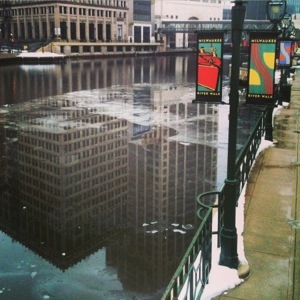 It is difficult to believe that it is winter in Wisconsin. The weather reports offer that snowfall is in the forecast for this weekend and sub zero temperatures. But for now, a lunch time walk along Milwaukee’s River Walk is a damp pleasure.

 Coffeehouse Junkie